ANUGYA JAISWAL (17BSBIOTH009)
BIOFERTIFIZER
 INTRODUCTION
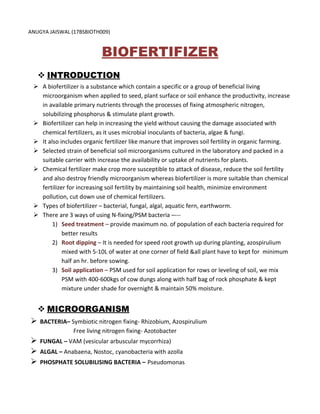
 A biofertilizer is a substance which contain a specific or a group of beneficial living
microorganism when applied to seed, plant surface or soil enhance the productivity, increase
in available primary nutrients through the processes of fixing atmospheric nitrogen,
solubilizing phosphorus & stimulate plant growth.
 Biofertilizer can help in increasing the yield without causing the damage associated with
chemical fertilizers, as it uses microbial inoculants of bacteria, algae & fungi.
 It also includes organic fertilizer like manure that improves soil fertility in organic farming.
 Selected strain of beneficial soil microorganisms cultured in the laboratory and packed in a
suitable carrier with increase the availability or uptake of nutrients for plants.
 Chemical fertilizer make crop more susceptible to attack of disease, reduce the soil fertility
and also destroy friendly microorganism whereas biofertilizer is more suitable than chemical
fertilizer for increasing soil fertility by maintaining soil health, minimize environment
pollution, cut down use of chemical fertilizers.
 Types of biofertilizer – bacterial, fungal, algal, aquatic fern, earthworm.
 There are 3 ways of using N-fixing/PSM bacteria –---
1) Seed treatment – provide maximum no. of population of each bacteria required for
better results
2) Root dipping – It is needed for speed root growth up during planting, azospirulium
mixed with 5-10L of water at one corner of field &all plant have to kept for minimum
half an hr. before sowing.
3) Soil application – PSM used for soil application for rows or leveling of soil, we mix
PSM with 400-600kgs of cow dungs along with half bag of rock phosphate & kept
mixture under shade for overnight & maintain 50% moisture.
 MICROORGANISM
 BACTERIA– Symbiotic nitrogen fixing- Rhizobium, Azospirulium
Free living nitrogen fixing- Azotobacter
 FUNGAL – VAM (vesicular arbuscular mycorrhiza)
 ALGAL – Anabaena, Nostoc, cyanobacteria with azolla
 PHOSPHATE SOLUBILISING BACTERIA – Pseudomonas
 PRODUCTION PROCESS
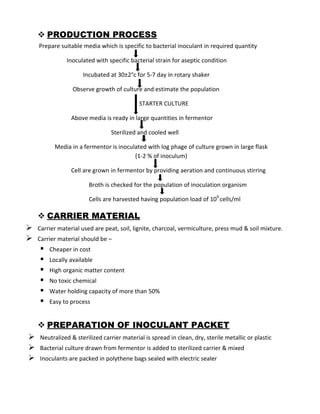
Prepare suitable media which is specific to bacterial inoculant in required quantity
Inoculated with specific bacterial strain for aseptic condition
Incubated at 30±2°c for 5-7 day in rotary shaker
Observe growth of culture and estimate the population
STARTER CULTURE
Above media is ready in large quantities in fermentor
Sterilized and cooled well
Media in a fermentor is inoculated with log phage of culture grown in large flask
(1-2 % of inoculum)
Cell are grown in fermentor by providing aeration and continuous stirring
Broth is checked for the population of inoculation organism
Cells are harvested having population load of 109
cells/ml
 CARRIER MATERIAL
 Carrier material used are peat, soil, lignite, charcoal, vermiculture, press mud & soil mixture.
 Carrier material should be –
 Cheaper in cost
 Locally available
 High organic matter content
 No toxic chemical
 Water holding capacity of more than 50%
 Easy to process
 PREPARATION OF INOCULANT PACKET
 Neutralized & sterilized carrier material is spread in clean, dry, sterile metallic or plastic
 Bacterial culture drawn from fermentor is added to sterilized carrier & mixed
 Inoculants are packed in polythene bags sealed with electric sealer
 POLYTHENE BAGS SPECIFICATION
 Low density grade
 Thickness – 50-75 micron
 Packet marked with –
Name of manufacture Batch no.
Name of product Date of expiry
Strain no. Price
Crops to which recommended Full address
Method of inoculation Storage instruction
Date of manufacture
 APPLICATION
 No adverse effect on plant growth & soil fertility
 Sustain soil health
 Improve texture, structure & water holding capacity of soil
 Increase grain yield by 10-40%
 Renewable source of nutrient
 Ecofriendly, non-pollutants & cost effective method
 Stimulates plant growth by secreting growth hormones
 Secrete fungi static & antibiotic like substance

BIOFERTILIZER - PRODUCTION AND APPLICATIONS

  • 1.
    ANUGYA JAISWAL (17BSBIOTH009) BIOFERTIFIZER INTRODUCTION  A biofertilizer is a substance which contain a specific or a group of beneficial living microorganism when applied to seed, plant surface or soil enhance the productivity, increase in available primary nutrients through the processes of fixing atmospheric nitrogen, solubilizing phosphorus & stimulate plant growth.  Biofertilizer can help in increasing the yield without causing the damage associated with chemical fertilizers, as it uses microbial inoculants of bacteria, algae & fungi.  It also includes organic fertilizer like manure that improves soil fertility in organic farming.  Selected strain of beneficial soil microorganisms cultured in the laboratory and packed in a suitable carrier with increase the availability or uptake of nutrients for plants.  Chemical fertilizer make crop more susceptible to attack of disease, reduce the soil fertility and also destroy friendly microorganism whereas biofertilizer is more suitable than chemical fertilizer for increasing soil fertility by maintaining soil health, minimize environment pollution, cut down use of chemical fertilizers.  Types of biofertilizer – bacterial, fungal, algal, aquatic fern, earthworm.  There are 3 ways of using N-fixing/PSM bacteria –--- 1) Seed treatment – provide maximum no. of population of each bacteria required for better results 2) Root dipping – It is needed for speed root growth up during planting, azospirulium mixed with 5-10L of water at one corner of field &all plant have to kept for minimum half an hr. before sowing. 3) Soil application – PSM used for soil application for rows or leveling of soil, we mix PSM with 400-600kgs of cow dungs along with half bag of rock phosphate & kept mixture under shade for overnight & maintain 50% moisture.  MICROORGANISM  BACTERIA– Symbiotic nitrogen fixing- Rhizobium, Azospirulium Free living nitrogen fixing- Azotobacter  FUNGAL – VAM (vesicular arbuscular mycorrhiza)  ALGAL – Anabaena, Nostoc, cyanobacteria with azolla  PHOSPHATE SOLUBILISING BACTERIA – Pseudomonas
  • 2.
     PRODUCTION PROCESS Preparesuitable media which is specific to bacterial inoculant in required quantity Inoculated with specific bacterial strain for aseptic condition Incubated at 30±2°c for 5-7 day in rotary shaker Observe growth of culture and estimate the population STARTER CULTURE Above media is ready in large quantities in fermentor Sterilized and cooled well Media in a fermentor is inoculated with log phage of culture grown in large flask (1-2 % of inoculum) Cell are grown in fermentor by providing aeration and continuous stirring Broth is checked for the population of inoculation organism Cells are harvested having population load of 109 cells/ml  CARRIER MATERIAL  Carrier material used are peat, soil, lignite, charcoal, vermiculture, press mud & soil mixture.  Carrier material should be –  Cheaper in cost  Locally available  High organic matter content  No toxic chemical  Water holding capacity of more than 50%  Easy to process  PREPARATION OF INOCULANT PACKET  Neutralized & sterilized carrier material is spread in clean, dry, sterile metallic or plastic  Bacterial culture drawn from fermentor is added to sterilized carrier & mixed  Inoculants are packed in polythene bags sealed with electric sealer
  • 3.
     POLYTHENE BAGSSPECIFICATION  Low density grade  Thickness – 50-75 micron  Packet marked with – Name of manufacture Batch no. Name of product Date of expiry Strain no. Price Crops to which recommended Full address Method of inoculation Storage instruction Date of manufacture  APPLICATION  No adverse effect on plant growth & soil fertility  Sustain soil health  Improve texture, structure & water holding capacity of soil  Increase grain yield by 10-40%  Renewable source of nutrient  Ecofriendly, non-pollutants & cost effective method  Stimulates plant growth by secreting growth hormones  Secrete fungi static & antibiotic like substance