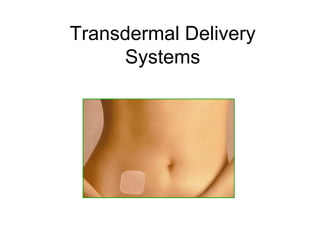
Transdermal Delivery
Systems
Advantages of Transdermal
Delivery Systems
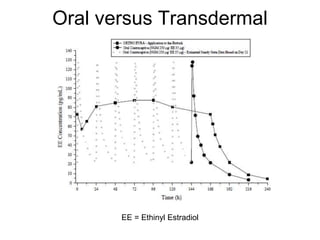
• Reasonably constant dosage can be maintained
(as opposed to peaks and valleys associated
with oral dosage)
• First pass metabolism in the liver and GI tract is
avoided
• Reduced need for active administration (some
patches can last 7 days)
• The patch is noninvasive and dosage can be
stopped by removal
• Easy to apply and to monitor
Oral versus Transdermal
EE = Ethinyl Estradiol
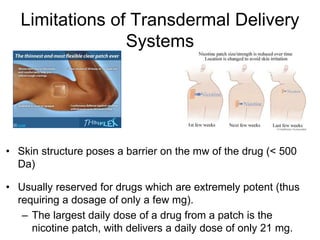
Limitations of Transdermal Delivery
Systems
• Skin structure poses a barrier on the mw of the drug (< 500
Da)
• Usually reserved for drugs which are extremely potent (thus
requiring a dosage of only a few mg).
– The largest daily dose of a drug from a patch is the
nicotine patch, with delivers a daily dose of only 21 mg.
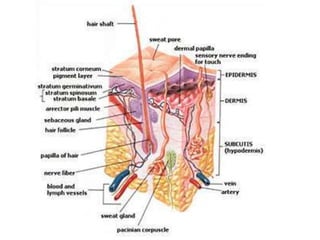
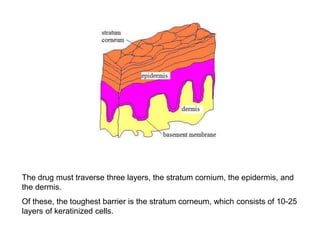
The drug must traverse three layers, the stratum cornium, the epidermis, and
the dermis.
Of these, the toughest barrier is the stratum corneum, which consists of 10-25
layers of keratinized cells.
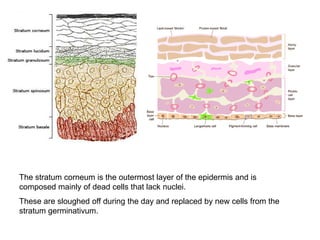
The stratum corneum is the outermost layer of the epidermis and is
composed mainly of dead cells that lack nuclei.
These are sloughed off during the day and replaced by new cells from the
stratum germinativum.
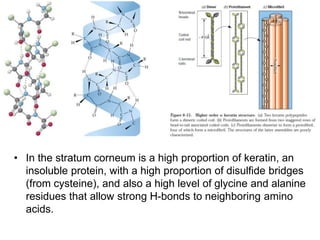
• In the stratum corneum is a high proportion of keratin, an
insoluble protein, with a high proportion of disulfide bridges
(from cysteine), and also a high level of glycine and alanine
residues that allow strong H-bonds to neighboring amino
acids.
Types of patches: definitions
• Liner: Protects the drug during storage and is
removed prior to use
• Drug
• Adhesive: Serves to bind the components of the
patch to the skin
• Membrane: Controls the release of the drug
from the reservoir in certain types of patches
• Backing: Protects the patch from the outer
environment.
Drug in Adhesive
Patches
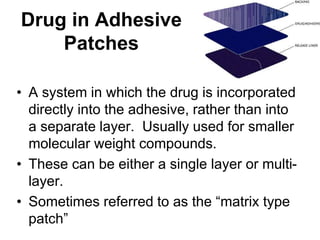
• A system in which the drug is incorporated
directly into the adhesive, rather than into
a separate layer. Usually used for smaller
molecular weight compounds.
• These can be either a single layer or multi-
layer.
• Sometimes referred to as the “matrix type
patch”
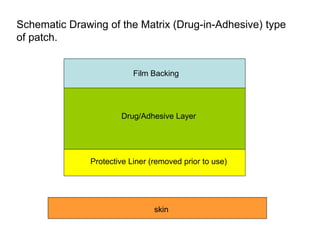
Film Backing
Drug/Adhesive Layer
Protective Liner (removed prior to use)
skin
Schematic Drawing of the Matrix (Drug-in-Adhesive) type
of patch.
Drug in Adhesive Patches Can Also Have
Additional Layers to Regulate Rate of Drug
Delivery
• Link
Reservoir Patches
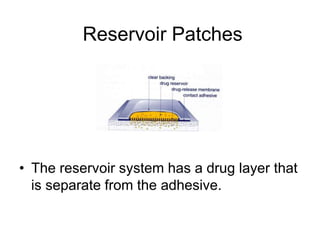
• The reservoir system has a drug layer that
is separate from the adhesive.
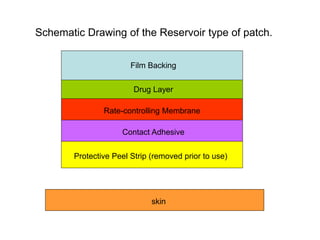
Film Backing
Drug Layer
Protective Peel Strip (removed prior to use)
skin
Schematic Drawing of the Reservoir type of patch.
Rate-controlling Membrane
Contact Adhesive
• http://molinterv.aspetjournals.org/cgi/reprin
t/4/6/308
Article illustrating two types of patches can be found at:
What kind of drugs can be
incorporated into a patch?
• Compounds with low logP will not diffuse
into skin lipids
• However, compounds with high logP also
have difficulties, this time associated with
their diffusion out of the stratum corneum.
• The accepted range of logP values is
between 1 and 3.
Products on the market, or in development include:
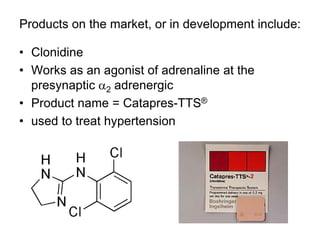
• Clonidine
• Works as an agonist of adrenaline at the
presynaptic a2 adrenergic
• Product name = Catapres-TTS®
• used to treat hypertension
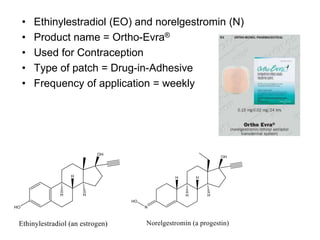
• Ethinylestradiol (EO) and norelgestromin (N)
• Product name = Ortho-Evra®
• Used for Contraception
• Type of patch = Drug-in-Adhesive
• Frequency of application = weekly
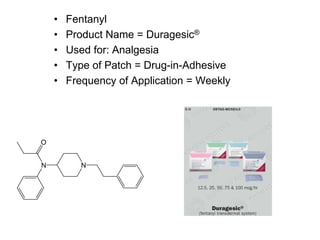
• Fentanyl
• Product Name = Duragesic®
• Used for: Analgesia
• Type of Patch = Drug-in-Adhesive
• Frequency of Application = Weekly
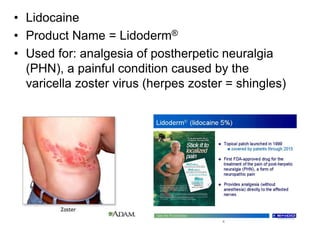
• Lidocaine
• Product Name = Lidoderm®
• Used for: analgesia of postherpetic neuralgia
(PHN), a painful condition caused by the
varicella zoster virus (herpes zoster = shingles)
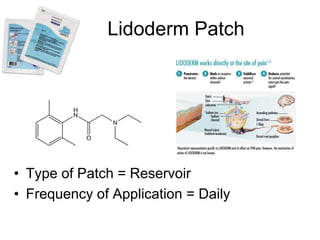
Lidoderm Patch
• Type of Patch = Reservoir
• Frequency of Application = Daily
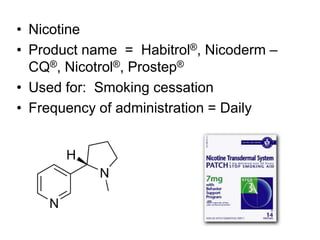
• Nicotine
• Product name = Habitrol®, Nicoderm –
CQ®, Nicotrol®, Prostep®
• Used for: Smoking cessation
• Frequency of administration = Daily
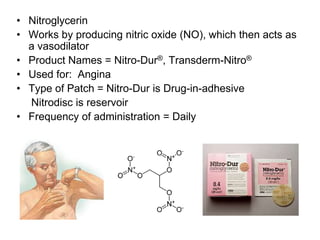
• Nitroglycerin
• Works by producing nitric oxide (NO), which then acts as
a vasodilator
• Product Names = Nitro-Dur®, Transderm-Nitro®
• Used for: Angina
• Type of Patch = Nitro-Dur is Drug-in-adhesive
Nitrodisc is reservoir
• Frequency of administration = Daily
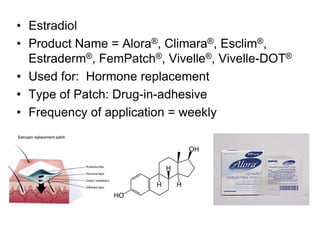
• Estradiol
• Product Name = Alora®, Climara®, Esclim®,
Estraderm®, FemPatch®, Vivelle®, Vivelle-DOT®
• Used for: Hormone replacement
• Type of Patch: Drug-in-adhesive
• Frequency of application = weekly
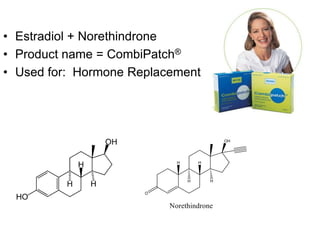
• Estradiol + Norethindrone
• Product name = CombiPatch®
• Used for: Hormone Replacement
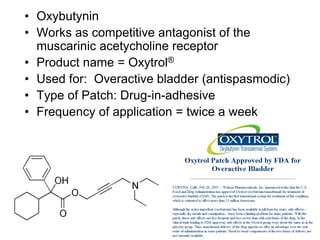
• Oxybutynin
• Works as competitive antagonist of the
muscarinic acetycholine receptor
• Product name = Oxytrol®
• Used for: Overactive bladder (antispasmodic)
• Type of Patch: Drug-in-adhesive
• Frequency of application = twice a week
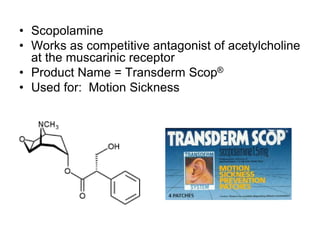
• Scopolamine
• Works as competitive antagonist of acetylcholine
at the muscarinic receptor
• Product Name = Transderm Scop®
• Used for: Motion Sickness
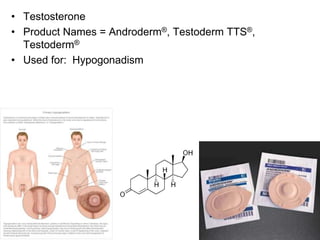
• Testosterone
• Product Names = Androderm®, Testoderm TTS®,
Testoderm®
• Used for: Hypogonadism
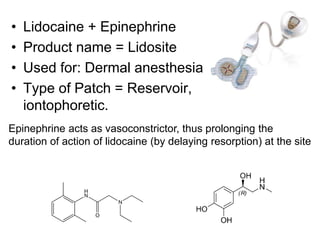
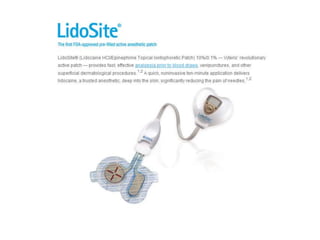
• Lidocaine + Epinephrine
• Product name = Lidosite
• Used for: Dermal anesthesia
• Type of Patch = Reservoir,
iontophoretic.
Epinephrine acts as vasoconstrictor, thus prolonging the
duration of action of lidocaine (by delaying resorption) at the site
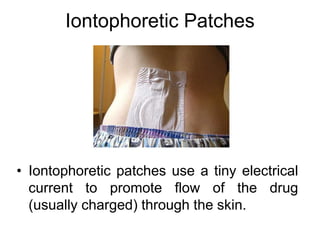
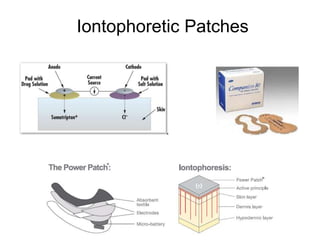
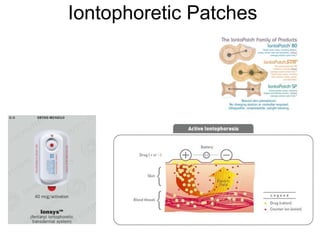
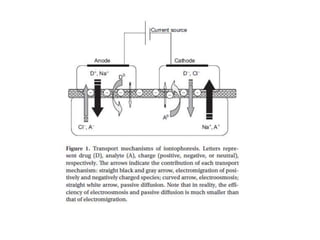
Iontophoretic Patches
• Iontophoretic patches use a tiny electrical
current to promote flow of the drug
(usually charged) through the skin.
Iontophoretic Patches
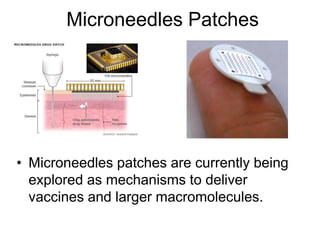
Microneedles Patches
• Microneedles patches are currently being
explored as mechanisms to deliver
vaccines and larger macromolecules.
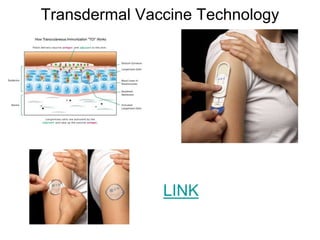
Transdermal Vaccine Technology
LINK
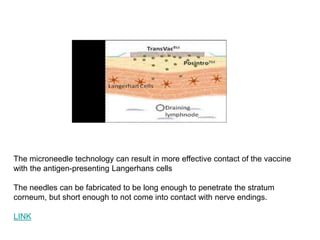
The microneedle technology can result in more effective contact of the vaccine
with the antigen-presenting Langerhans cells
The needles can be fabricated to be long enough to penetrate the stratum
corneum, but short enough to not come into contact with nerve endings.
LINK
Assigned Reading
• Scheindlin Stanley Transdermal drug delivery: PAST,
PRESENT, FUTURE. Molecular interventions (2004),
4(6), 308-12 (see link in presentation).
• Prausnitz, Mark R.; Langer, Robert. Transdermal drug
delivery. Nature Biotechnology (2008), 26(11), 1261-
1268 Link
• Sieg, A.; Wascotte, V. Diagnostic and therapeutic
applications of iontophoresis. Journal of Drug Targeting,
(2009); 17(9): 690-700.
• Graduate Students Only: Subedi, R. K. et al. Recent
Advances in Transdermal Drug Delivery. Archives of
Pharmal Research (2010), 33(3): 339-351.
Homework Questions
1. List the advantages of administering drugs via trandermal drug
delivery systems, over administering medications orally.
2. Use diagrams to illustrate the differences between a drug-in-adhesive
patch and a reservoir patch
3. List the limitations on the types of drugs which can be administered by
first-generation transdermal delivery systems. Explain why much of
the drug is wasted, and how this is commercially feasible.
4. Draw the structures of the following drugs and circle the functionalities
capable of ionization at biological pH. Redraw each structure,
showing the predominant charge state at pH = 7.4 (blood pH):
Fentanyl, Lidocaine.
5. Explain how second and third generation transdermal devices differ
from first generation and provide examples of each that are in clinical
trials.
6. Explain how transdermal delivery of vaccines might elucidate a
greater immune response than conventional methods.

transdermal drug delivery systems.ppt

  • 1.
  • 2.
    Advantages of Transdermal DeliverySystems • Reasonably constant dosage can be maintained (as opposed to peaks and valleys associated with oral dosage) • First pass metabolism in the liver and GI tract is avoided • Reduced need for active administration (some patches can last 7 days) • The patch is noninvasive and dosage can be stopped by removal • Easy to apply and to monitor
  • 3.
    Oral versus Transdermal EE= Ethinyl Estradiol
  • 4.
    Limitations of TransdermalDelivery Systems • Skin structure poses a barrier on the mw of the drug (< 500 Da) • Usually reserved for drugs which are extremely potent (thus requiring a dosage of only a few mg). – The largest daily dose of a drug from a patch is the nicotine patch, with delivers a daily dose of only 21 mg.
  • 6.
    The drug musttraverse three layers, the stratum cornium, the epidermis, and the dermis. Of these, the toughest barrier is the stratum corneum, which consists of 10-25 layers of keratinized cells.
  • 7.
    The stratum corneumis the outermost layer of the epidermis and is composed mainly of dead cells that lack nuclei. These are sloughed off during the day and replaced by new cells from the stratum germinativum.
  • 8.
    • In thestratum corneum is a high proportion of keratin, an insoluble protein, with a high proportion of disulfide bridges (from cysteine), and also a high level of glycine and alanine residues that allow strong H-bonds to neighboring amino acids.
  • 9.
    Types of patches:definitions • Liner: Protects the drug during storage and is removed prior to use • Drug • Adhesive: Serves to bind the components of the patch to the skin • Membrane: Controls the release of the drug from the reservoir in certain types of patches • Backing: Protects the patch from the outer environment.
  • 10.
    Drug in Adhesive Patches •A system in which the drug is incorporated directly into the adhesive, rather than into a separate layer. Usually used for smaller molecular weight compounds. • These can be either a single layer or multi- layer. • Sometimes referred to as the “matrix type patch”
  • 11.
    Film Backing Drug/Adhesive Layer ProtectiveLiner (removed prior to use) skin Schematic Drawing of the Matrix (Drug-in-Adhesive) type of patch.
  • 12.
    Drug in AdhesivePatches Can Also Have Additional Layers to Regulate Rate of Drug Delivery • Link
  • 13.
    Reservoir Patches • Thereservoir system has a drug layer that is separate from the adhesive.
  • 14.
    Film Backing Drug Layer ProtectivePeel Strip (removed prior to use) skin Schematic Drawing of the Reservoir type of patch. Rate-controlling Membrane Contact Adhesive
  • 15.
  • 16.
    What kind ofdrugs can be incorporated into a patch? • Compounds with low logP will not diffuse into skin lipids • However, compounds with high logP also have difficulties, this time associated with their diffusion out of the stratum corneum. • The accepted range of logP values is between 1 and 3.
  • 17.
    Products on themarket, or in development include: • Clonidine • Works as an agonist of adrenaline at the presynaptic a2 adrenergic • Product name = Catapres-TTS® • used to treat hypertension
  • 18.
    • Ethinylestradiol (EO)and norelgestromin (N) • Product name = Ortho-Evra® • Used for Contraception • Type of patch = Drug-in-Adhesive • Frequency of application = weekly
  • 19.
    • Fentanyl • ProductName = Duragesic® • Used for: Analgesia • Type of Patch = Drug-in-Adhesive • Frequency of Application = Weekly
  • 20.
    • Lidocaine • ProductName = Lidoderm® • Used for: analgesia of postherpetic neuralgia (PHN), a painful condition caused by the varicella zoster virus (herpes zoster = shingles)
  • 21.
    Lidoderm Patch • Typeof Patch = Reservoir • Frequency of Application = Daily
  • 22.
    • Nicotine • Productname = Habitrol®, Nicoderm – CQ®, Nicotrol®, Prostep® • Used for: Smoking cessation • Frequency of administration = Daily
  • 23.
    • Nitroglycerin • Worksby producing nitric oxide (NO), which then acts as a vasodilator • Product Names = Nitro-Dur®, Transderm-Nitro® • Used for: Angina • Type of Patch = Nitro-Dur is Drug-in-adhesive Nitrodisc is reservoir • Frequency of administration = Daily
  • 24.
    • Estradiol • ProductName = Alora®, Climara®, Esclim®, Estraderm®, FemPatch®, Vivelle®, Vivelle-DOT® • Used for: Hormone replacement • Type of Patch: Drug-in-adhesive • Frequency of application = weekly
  • 25.
    • Estradiol +Norethindrone • Product name = CombiPatch® • Used for: Hormone Replacement
  • 26.
    • Oxybutynin • Worksas competitive antagonist of the muscarinic acetycholine receptor • Product name = Oxytrol® • Used for: Overactive bladder (antispasmodic) • Type of Patch: Drug-in-adhesive • Frequency of application = twice a week
  • 27.
    • Scopolamine • Worksas competitive antagonist of acetylcholine at the muscarinic receptor • Product Name = Transderm Scop® • Used for: Motion Sickness
  • 28.
    • Testosterone • ProductNames = Androderm®, Testoderm TTS®, Testoderm® • Used for: Hypogonadism
  • 29.
    • Lidocaine +Epinephrine • Product name = Lidosite • Used for: Dermal anesthesia • Type of Patch = Reservoir, iontophoretic. Epinephrine acts as vasoconstrictor, thus prolonging the duration of action of lidocaine (by delaying resorption) at the site
  • 30.
    Iontophoretic Patches • Iontophoreticpatches use a tiny electrical current to promote flow of the drug (usually charged) through the skin.
  • 31.
  • 32.
  • 35.
    Microneedles Patches • Microneedlespatches are currently being explored as mechanisms to deliver vaccines and larger macromolecules.
  • 36.
  • 37.
    The microneedle technologycan result in more effective contact of the vaccine with the antigen-presenting Langerhans cells The needles can be fabricated to be long enough to penetrate the stratum corneum, but short enough to not come into contact with nerve endings. LINK
  • 38.
    Assigned Reading • ScheindlinStanley Transdermal drug delivery: PAST, PRESENT, FUTURE. Molecular interventions (2004), 4(6), 308-12 (see link in presentation). • Prausnitz, Mark R.; Langer, Robert. Transdermal drug delivery. Nature Biotechnology (2008), 26(11), 1261- 1268 Link • Sieg, A.; Wascotte, V. Diagnostic and therapeutic applications of iontophoresis. Journal of Drug Targeting, (2009); 17(9): 690-700. • Graduate Students Only: Subedi, R. K. et al. Recent Advances in Transdermal Drug Delivery. Archives of Pharmal Research (2010), 33(3): 339-351.
  • 39.
    Homework Questions 1. Listthe advantages of administering drugs via trandermal drug delivery systems, over administering medications orally. 2. Use diagrams to illustrate the differences between a drug-in-adhesive patch and a reservoir patch 3. List the limitations on the types of drugs which can be administered by first-generation transdermal delivery systems. Explain why much of the drug is wasted, and how this is commercially feasible. 4. Draw the structures of the following drugs and circle the functionalities capable of ionization at biological pH. Redraw each structure, showing the predominant charge state at pH = 7.4 (blood pH): Fentanyl, Lidocaine. 5. Explain how second and third generation transdermal devices differ from first generation and provide examples of each that are in clinical trials. 6. Explain how transdermal delivery of vaccines might elucidate a greater immune response than conventional methods.