LEARNING COMPETENCIES
1. Explainingestion, absorption, assimilation,
and excretion.
2. Explain how diseases of the digestive
system are prevented, detected, and
treated.
3. Identify healthful practices that affect the
digestive system.
3.
TABLE OF CONTENTS
1.Functions of Digestive System.
2. Forms of Digestion.
3. Parts of the Digestive System.
4. The Accessory Organs.
5. Diseases Associated with the Digestive
System.
6. Healthy Practices Promoting Wellness of
the Digestive System.
4.
TEST YOUR MIND!
WHYDOES THE HUMAN BODY IS
IN NEED OF CONSTANT SUPPLY
OF NUTRIENTS AND ENERGY?
Functions of Digestive
System
Thefood contains necessary nutrients
needed by the body for its growth, repair of
damaged tissues and other physical activities.
Digestive system is composed of organs
and glands working together to break down
or digest the food to its building blocks or
units.
Forms of Digestion
1.Mechanical Digestion
- Includes processes like chewing and cutting of
food to break down into smaller pieces.
2. Chemical Digestion
- Involves enzymes which chemically break down the
food into simpler form.
Parts of theDigestive
System
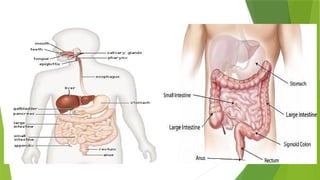
The main part of the digestive system is
the alimentary canal/digestive tract. The
alimentary canal is about 30feet long from
mouth to anus.
12.
MOUTH
Digestion process beginsin the mouth. It
is the site of ingestion food.
Food enters the body through the
mouth, with the teeth, tongue, and salivary
glands.
Both mechanical and chemical digestion
occur.
13.
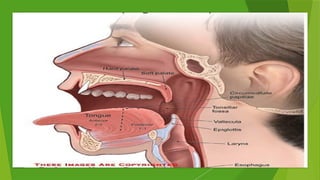
TONGUE & EPIGLOTTIS
Thetongue helps in mixing the food with the
saliva, and it pushes a ball of food called bolus.
A flap of tissue called epiglottis automatically
closes the trachea or the “air tube” when
swallowing the bolus.
After swallowing, the epiglottis will go back to
its original position allowing air to pass through the
trachea.
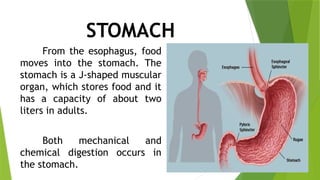
STOMACH
From the esophagus,food
moves into the stomach. The
stomach is a J-shaped muscular
organ, which stores food and it
has a capacity of about two
liters in adults.
Both mechanical and
chemical digestion occurs in
the stomach.
18.
CHYME
Muscular contraction inthe stomach
causes the mixing of the food with gastric
juices, forming a chyme.
Chyme will pass through the pyloric
sphincter to the small intestine.
20.
SMALL INTESTINE
The smallintestine is the
longest part of the alimentary
canal, which is about 23 feet long.
It is divided into three
sections: duodenum, jejunum, and
ileum.
The food (chyme) will
undergo complete digestion in the
small intestine.
21.
SMALL INTESTINE
In thesmall intestine, intestinal glands
secrete enzymes for complete digestion of
carbohydrates, protein and fats.
The mixture of enzymes in the intestine
is called intestinal juice.
It is also the site of absorption, where
nutrients are absorbed into the blood vessels
of the circulatory system.
22.
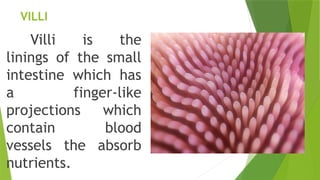
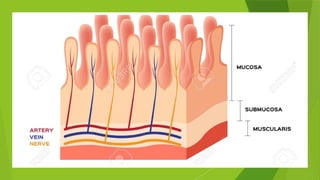
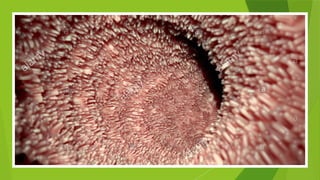
VILLI
Villi is the
liningsof the small
intestine which has
a finger-like
projections which
contain blood
vessels the absorb
nutrients.
25.
LARGE INTESTINE
After absorptionof
nutrients, it becomes
mostly undigested food and
water. It passes then
through the large intestine.
It is divided into three
regions: caecum, colon and
rectum.
26.
LARGE INTESTINE
The largeintestine temporarily stores
feces in the rectum and egested out or
excreted (excretion) through the opening
called anus.
The Accessory Organs
Theaccessory organs of the digestive
system include salivary glands, the liver, the
pancreas and the gallbladder.
These glands/organs have ducts or
opening that allow them pour their secretions
into the organs of digestion to help in
chemical digestion.
29.
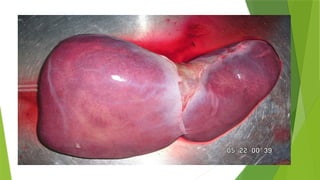
LIVER
Liver is thelargest organ in the body
located to the right of the stomach.
The liver produces a bile, a salt-solution
that emulsifies fat, bile breaks down fat into
smaller fat droplets so that the small
intestine can digest the fat easily.
31.
LIVER
The liver playsan important role in the
assimilation of absorbed food.
Assimilation is a process where food
nutrients become part of the body tissues. It
happens after absorption.
33.
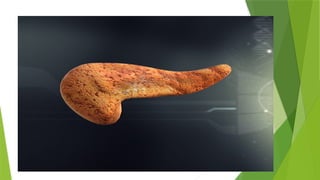
PANCREAS
The pancreas islocated between the
stomach and small intestine. It produces
substance called pancreatic juice.
This juice contains enzymes to digest
carbohydrates, protein and fats.
Healthy Practices Promoting
Wellnessof the Digestive
System
Human body needs nutrients to be
healthy. Most of the nutrients come from the
food that are taken every day. These are
called essential nutrients.
The six classes of essential nutrients
are:
Carbohydrates, Proteins, Lipids/Fats,
37.
CARBOHYDRATES
Carbohydrates are
the mainsource of
energy. Food sources
include rice, cereals,
bread, and some fruits
and nuts.
Carbohydrates is
very important in
keeping the large
intestine clean and
promote easy
38.
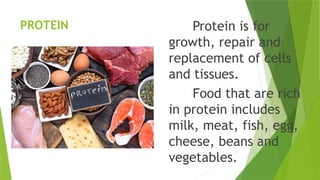
PROTEIN Protein isfor
growth, repair and
replacement of cells
and tissues.
Food that are rich
in protein includes
milk, meat, fish, egg,
cheese, beans and
vegetables.
39.
FATS
Fats provide much
energythan
carbohydrates, but
they are needed only
in small amount.
Food sources
include animal fat,
vegetable oil, butter
and margarine.
40.
VITAMINS AND MINERALS
Vitaminsand minerals are also
important, they contain no energy but they
help in maintaining a healthy body
specifically for growth and repair.
Fresh fruits and vegetables are
good sources of vitamins and minerals.
41.
WATER
Water also containno energy and
nutrients, but is very vital to life.
Water carries nutrients and wastes
throughout the body in the bloodstream.
It is important that our body takes in
enough amount of water every day, at least 8
to 10 glasses of water or 2.5 liters.
Diseases Associated withthe
Digestive System
Due to our modern lifestyle of
consuming high calorie fast food, alcohol,
and limited intake of green leafy vegetables,
diseases of the digestive system known as
gastrointestinal diseases are becoming
common today.
44.
ULCER
Characterized by painfulsores in the
lining of the stomach or the first segment of
the small intestine, the duodenum.
Research shows that the presence of a
certain bacteria known as Helicobacter pylori
or H. Pylori in the stomach is the cause of
almost all stomach ulcers.
45.
ULCER
Patients with ulcermay experience
upper abdominal pain.
The presence of ulcer is detected using
an x-ray of the gastro intestinal tract.
Treatment of ulcers require taking
antibiotics and stomach acid suppressants to
eliminate the H. pylori.
46.
DIARRHEA
This digestive disorderoccurs when the
lining of the large intestine cannot maintain
the usual level of water absorption thus
secretes more than the normal quantities of
water.
47.
DIARRHEA
Food poisoning fromexposure to
bacteria from the Salmonella group, certain
virus causing intestinal flu and infections
caused by protozoans such as amoeba.
Proper handwashing technique using
soap and water can prevent most bacteria
from entering the body.
48.
CONSTIPATION
The condition inwhich a person has less
than three bowel movements a week or with
bowel movement with hard stool that is
painful to eliminate.
It can be relieved by drinking water at
least 8 glasses a day.
49.
APPENDICITIS
The inflammation ofthe appendix which is
caused by an obstruction such as hard mass of
feces and foreign body.
Due to the obstruction, secretions from the
appendix cannot pass through which later on
accumulates. This cause the appendix to enlarge
and bacteria to build up to cause infection.
50.
COLON CANCER
A cancerfrom the uncontrolled cell
growth in the colon or rectum, originating
from the inner lining of the colon.
51.
OBESITY
The condition inwhich the body mass
index (BMI) of a person is 30 kg/m2 or higher,
characterized by high accumulation of body
fats that might have negative effect on his
health.
Editor's Notes
#17 Contraction of the stomach is mechanical digestion causes the mixing of the food with gastric juices.
Secretions of gastric juice carry out chemical digestion.
#25 Caecum- a pouch connected to the appendix.
Colon- the longest in the organ and divided into ascending, transverse and descending
Rectum- short segment that stores feces.
#44 Stomach – gastric ulcer
Small intestine- duodenal ulcer
#46 Excessive loss of water makes the person dehydrated.
#49 If the appendix bursts, the bacterial infection can spread and may kill the person if not given proper treatment.