Forest Conservation Act
B121635
Md Nazeemoddin
Objectives
● Introduction
● Historical background
● Forest consevervation act
● Resposibilities of an individual
● Conclusion
Introduction
● Forestry in india is a major environmental
resource.
● India is one of the ten most forest-rich countries.
● Contributed 22% in country's area and
contributed 1.7% to GDP.
● Forest conservation is a practice of planning and
maintaining forested areas for the benefit and
sustainibility for the generations.
Why...why..why...?
Contd..
--> Loss of biodiversity
Contd..
Historical background
● Indian forest act of 1927.
– Reserved forests
– Protected forests
– Village forests
● Indian first forest policy in 1951.
– Focused on revenue
● Preservation of its biological diversity and genetic resources
●
In 1992,73rd 74th
ammendments gives States the ability to
provide power to the local panchayats.
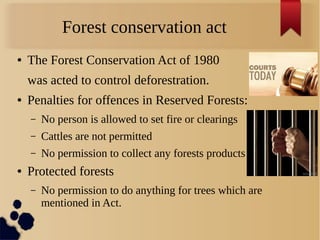
Forest conservation act
● The Forest Conservation Act of 1980
was acted to control deforestration.
● Penalties for offences in Reserved Forests:
– No person is allowed to set fire or clearings
– Cattles are not permitted
– No permission to collect any forests products
● Protected forests
– No permission to do anything for trees which are
mentioned in Act.
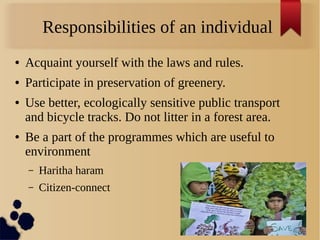
Responsibilities of an individual
● Acquaint yourself with the laws and rules.
● Participate in preservation of greenery.
● Use better, ecologically sensitive public transport
and bicycle tracks. Do not litter in a forest area.
● Be a part of the programmes which are useful to
environment
– Haritha haram
– Citizen-connect
Conclusion
Please act to the Act
Thank you
very much

Forest conservation act_Save the forest

  • 1.
  • 2.
    Objectives ● Introduction ● Historicalbackground ● Forest consevervation act ● Resposibilities of an individual ● Conclusion
  • 3.
    Introduction ● Forestry inindia is a major environmental resource. ● India is one of the ten most forest-rich countries. ● Contributed 22% in country's area and contributed 1.7% to GDP. ● Forest conservation is a practice of planning and maintaining forested areas for the benefit and sustainibility for the generations.
  • 4.
  • 5.
    Contd.. --> Loss ofbiodiversity
  • 6.
  • 7.
    Historical background ● Indianforest act of 1927. – Reserved forests – Protected forests – Village forests ● Indian first forest policy in 1951. – Focused on revenue ● Preservation of its biological diversity and genetic resources ● In 1992,73rd 74th ammendments gives States the ability to provide power to the local panchayats.
  • 8.
    Forest conservation act ●The Forest Conservation Act of 1980 was acted to control deforestration. ● Penalties for offences in Reserved Forests: – No person is allowed to set fire or clearings – Cattles are not permitted – No permission to collect any forests products ● Protected forests – No permission to do anything for trees which are mentioned in Act.
  • 9.
    Responsibilities of anindividual ● Acquaint yourself with the laws and rules. ● Participate in preservation of greenery. ● Use better, ecologically sensitive public transport and bicycle tracks. Do not litter in a forest area. ● Be a part of the programmes which are useful to environment – Haritha haram – Citizen-connect
  • 10.
  • 11.