USES OF BIODIVERSITY, THREATS TO
BIODIVERSITY , HABITAT LOSS , POACHING OF
WILDLIFE , MAN WILDLIFE CONFLICTS -HOTSPOTS
OF BIODIVERSITY .
Submitted
by:
T.Rishitha
WV/2022-43
Submitted to:
Dr.Beesam
Srinu
Dept. of VPHE
2.
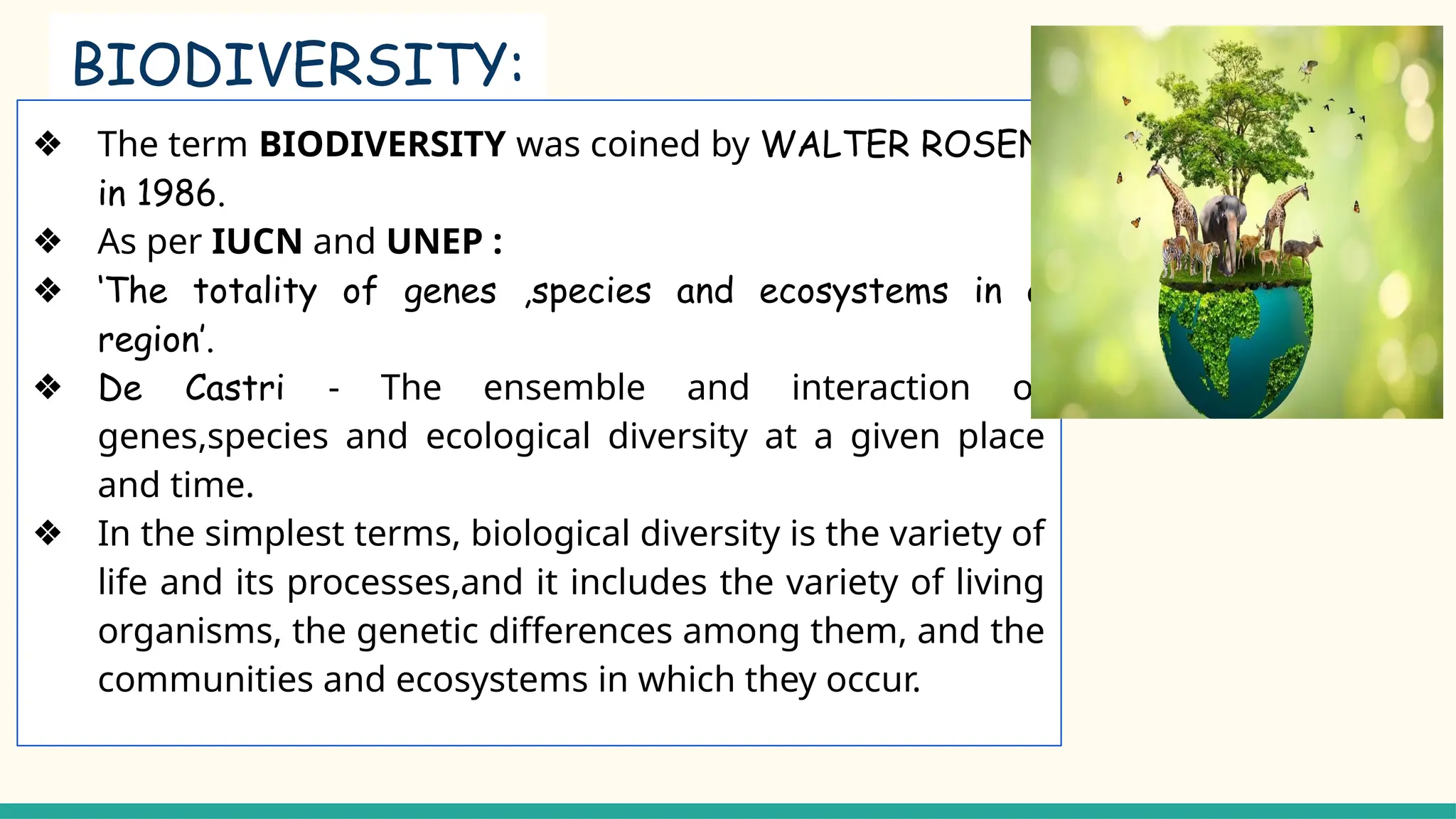
BIODIVERSITY:
❖ The termBIODIVERSITY was coined by WALTER ROSEN
in 1986.
❖ As per IUCN and UNEP :
❖ ‘The totality of genes ,species and ecosystems in a
region’.
❖ De Castri - The ensemble and interaction of
genes,species and ecological diversity at a given place
and time.
❖ In the simplest terms, biological diversity is the variety of
life and its processes,and it includes the variety of living
organisms, the genetic differences among them, and the
communities and ecosystems in which they occur.
4.
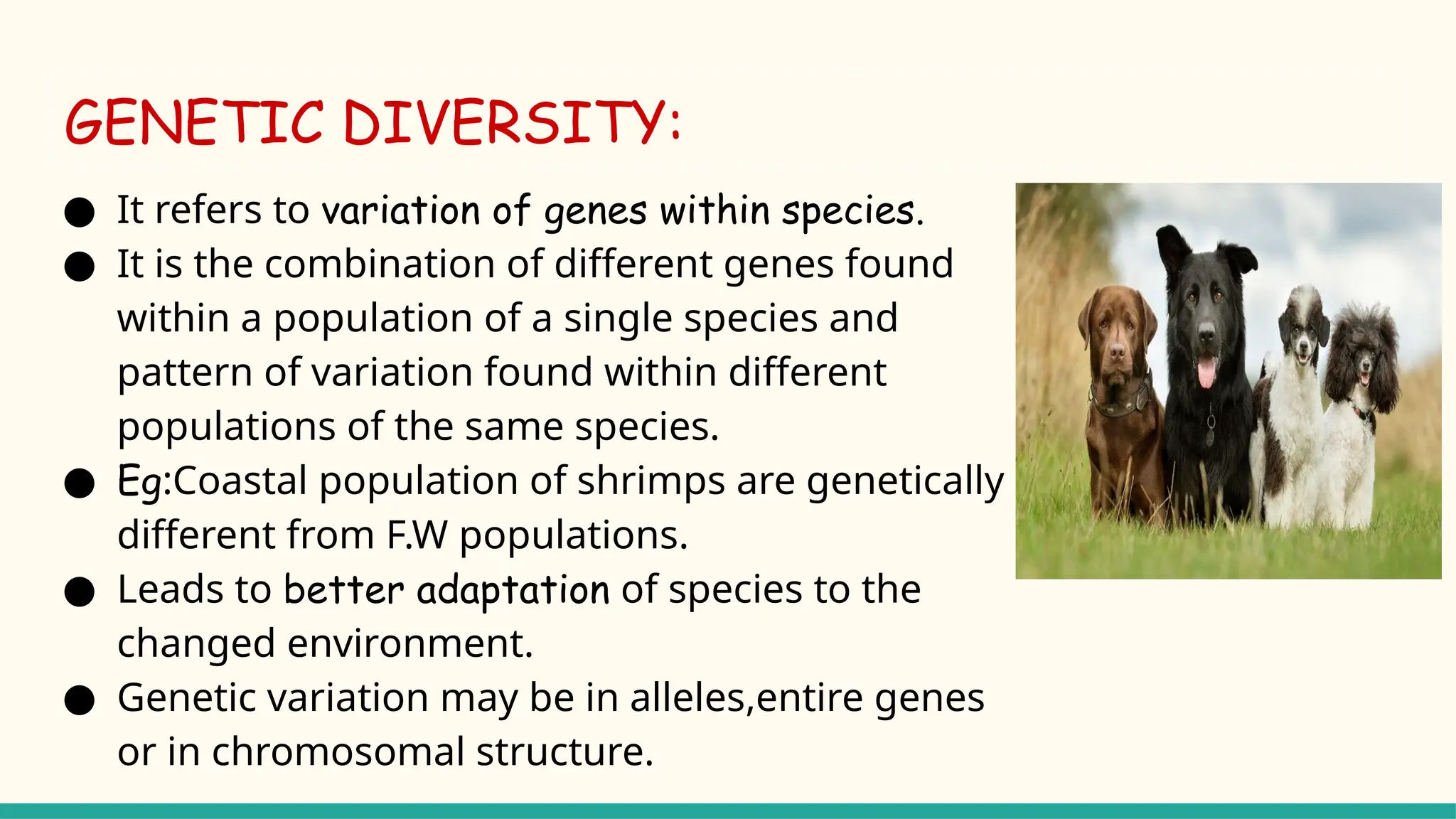
GENETIC DIVERSITY:
● Itrefers to variation of genes within species.
● It is the combination of different genes found
within a population of a single species and
pattern of variation found within different
populations of the same species.
● Eg:Coastal population of shrimps are genetically
different from F.W populations.
● Leads to better adaptation of species to the
changed environment.
● Genetic variation may be in alleles,entire genes
or in chromosomal structure.
5.
SPECIES DIVERSITY:
➢ ‘Thenumber of different species present in an
ecosystem and relative abundance of each of those
species .
➢ Diversity is the greatest when all the species are
present equally abundant in the area.
➢ The simplest measures of species diversity are
(SR+SE) are :
❏ Species richness (the no. of species per unit area)
❏ Species evenness(the evenness in no.of individuals
of each species in the area)
★ Greater the Species richness greater is the
species diversity.
6.
ECOSYSTEM DIVERSITY
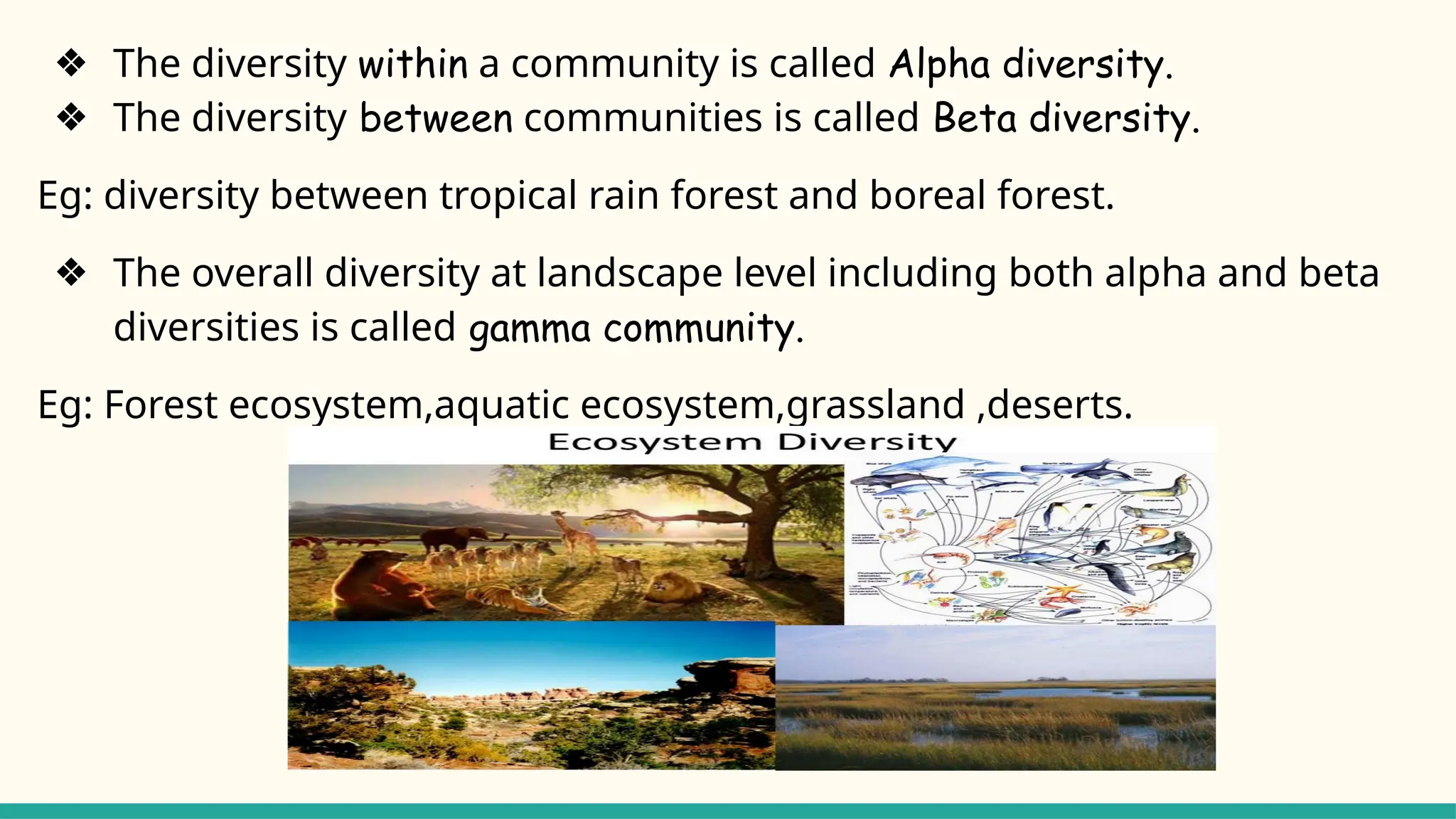
● “Thevariety of habitats that occur within a region,or the mosaic of
patches found within a landscape’’.
● Eg: Variety of habitats and environmental parameters that
constitute the Bay of Bengal-Godavari Delta
ecosystem:grasslands ,wetlands ,rivers, estuaries,fresh and salt
water and mangrove ecosystems.
● Ecosystem diversity is tougher to measure than species or genetic
diversity because the boundaries of communities-associations of
species-and ecosystems show ecotones identification of which
needs detailed field analysis.
7.
❖ The diversitywithin a community is called Alpha diversity.
❖ The diversity between communities is called Beta diversity.
Eg: diversity between tropical rain forest and boreal forest.
❖ The overall diversity at landscape level including both alpha and beta
diversities is called gamma community.
Eg: Forest ecosystem,aquatic ecosystem,grassland ,deserts.
9.
USES OF BIODIVERSITY:
❖Biodiversity is very essential for health of biosphere and it provides the
raw materials for man in order to make him adapt to changing
environment.
❖ Man derives many direct and indirect benefits from the living
things.Biodiversity provides ecological services also.
➢ The uses of biodiversity are as follows :
● Consumptive use value :
● It includes food,medicine,fuel,fibre,timber,clothing,etc. 80,000 species are
edible wild plant species.90% of the crops have been domesticated from
wild tropical plants.75% of the world population depends upon plants for
medicines.
● For instance, penicillin from a fungus name Penicillium,Quinine from a
plant namely Cinchona,tetracycline from a bacterium and cancer -curing
drugs like Vinblastine obtained from Catharanthus roseus(Nithyakalyani)
10.
● Productive usevalue :
● The products are commercially usable.
● The wild gene resources are traded to introduce desirable traits in the crops
and domesticated animals.
● Productive uses of biological resources are fuel ,timber ,musk ,tusk,
ivory,honey ,fibre ,gums ,resins ,medicines ,silk ,wool etc.
● Social value:
● Biodiversity in India is related to our religious ,cultural ,and spiritual
uses.
● Many plants like Tulsi ,Pipal ,Hibiscus and Datura are considered to be
sacred.
● Peacock,cow,snake,bull and owl have a place in our spiritual arena.
● Ethical value:
● We must protect every life.It is based on concept that ‘Live and Let Live’.
● We must enjoy watching all animals although some animals are not
useful to us directly like giraffe,kangaroo etc.
11.
We should notcage birds for our pleasure and passing of time.
➢ Aesthetic value:
● Biodiversity provides us a good deal for fun and recreation. This
type of tourism is called Ecotourism which generates 12 billion$
as income per year. But if we kill the Lion we get only
Rs.50,000/-
● A teak fetches Rs.50,000/- if cut down;but it lives,its value is
priceless by way of its ecological role.
➢ Option value or unknown benefits:
● We must try to explore the potentials of biodiversity for future
benefit of mankind. We must protect the biodiversity in order to
find out drugs to fight diseases like Cancer and AIDS.
13.
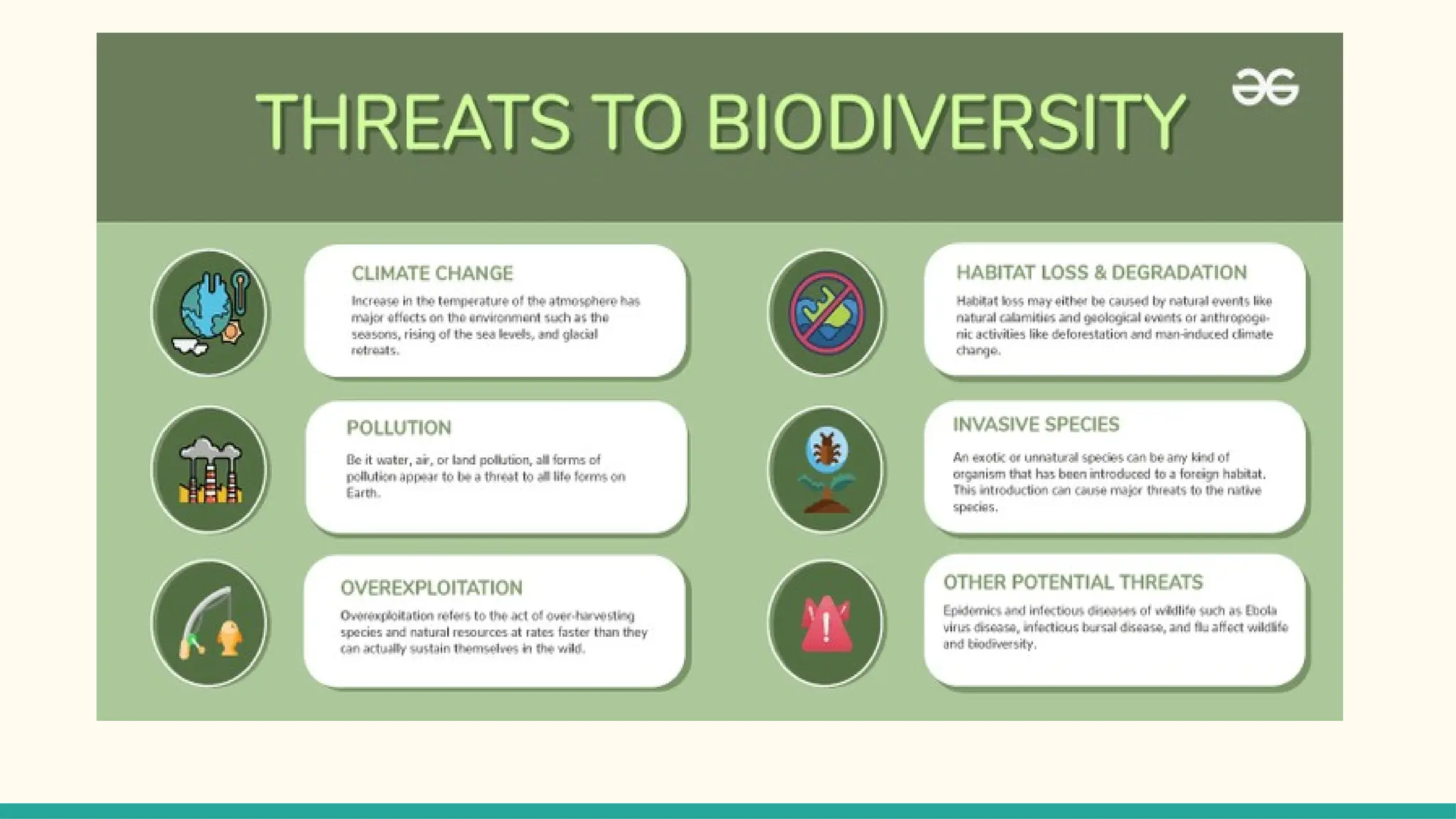
THREATS TO BIODIVERSITY:
❏Though the rate of loss of species has been a slow process in the past ,the
process of extinction has become fast in recent years .It has been
reported that approximately 10,000 species become extinct every year .
This raises an alarm regarding the threat to biodiversity . If this trend
continues ⅓ or ⅔ of our current biodiversity would become extinct by the
middle of the 21st century.
FACTORS CAUSING LOSS OF BIODIVERSITY:
❏ Habitat loss:
Destruction of habitats due to clearing of forests and grasslands for
agricultural lands,pastures,settlement areas or project development lead
to loss of habitat . These factors are responsible for the disappearance of
thousands of species.
17.
● Acc. tothe WHO estimates, about 80% of the population of
developing countries relies on traditional medicines, mostly
drugs from plants . In order to meet the demand, about 86% of
plant collection involves destructive harvesting .
● Many plants become endangered .
● The wetlands,mangroves and estuaries with rich biodiversity
are under threat .
● They are destroyed ,as if they have no value.
● POACHING OF WILDLIFE :
● Poaching of Wildlife refers to the illegal hunting,capturing,or
killing of wild animals . It’s a serious global issue that threatens
biodiversity and pushes many species towards extinction.
18.
Causes of poaching:
● High demand for animal products
(ivory,fur,traditional medicine).
● Weak enforcement of wildlife protection laws.
● Poverty and lack of livelihoods.
● Corruption and organized crime networks.
Consequences:
● Species extinction ,Ecosystem imbalance due to
loss of key species,Economic
loss(e.g.,tourism),Spread of diseases through
illegal wildlife trade .
19.
Solutions:
A. Strengthening anti-poachinglaws and
enforcement.
B. Supporting local communities with sustainable
livelihoods.
C. Global cooperation to dismantle trafficking
networks.
D. Raising awareness and reducing demand for
illegal wildlife products.
20.
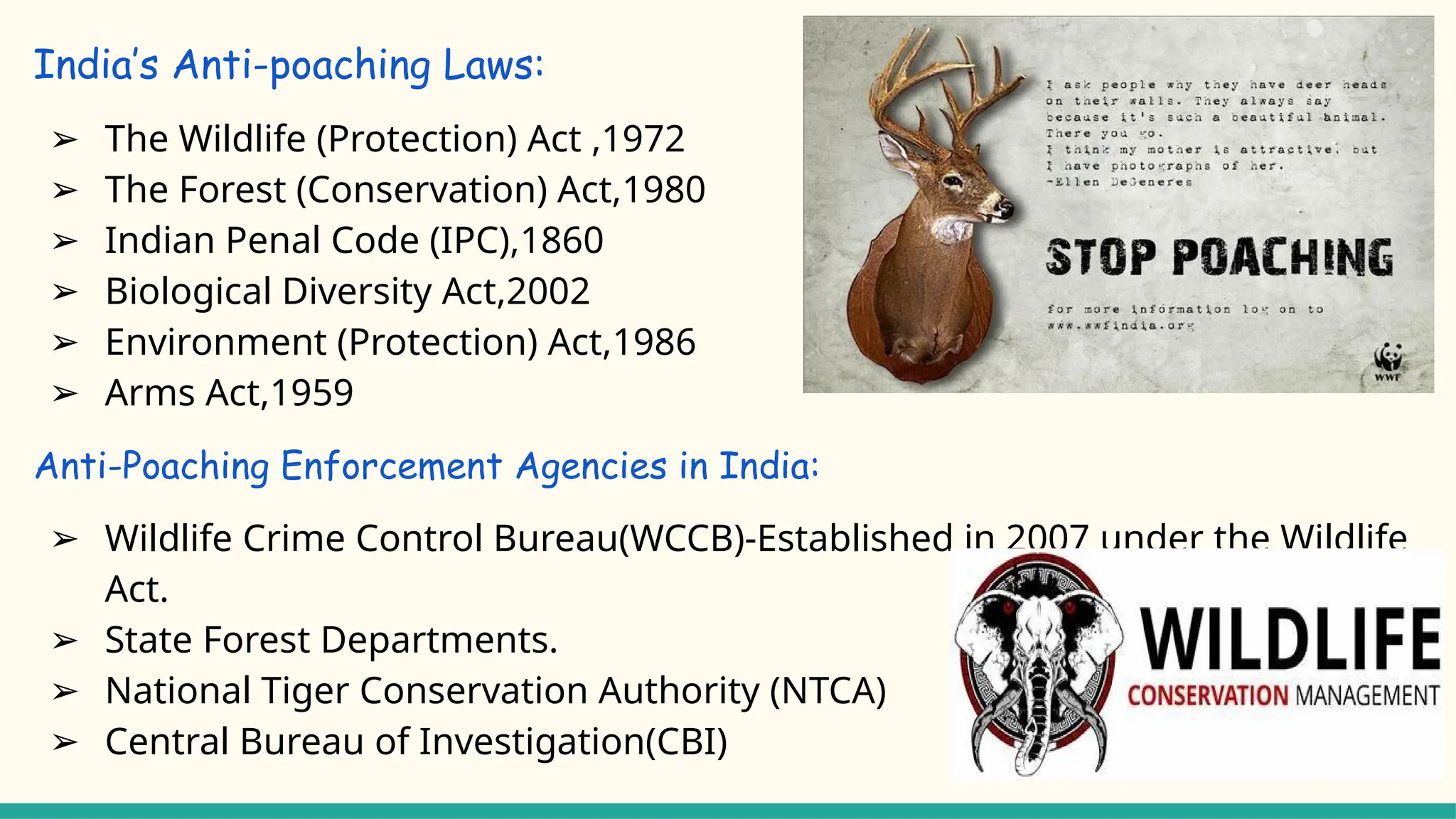
India’s Anti-poaching Laws:
➢The Wildlife (Protection) Act ,1972
➢ The Forest (Conservation) Act,1980
➢ Indian Penal Code (IPC),1860
➢ Biological Diversity Act,2002
➢ Environment (Protection) Act,1986
➢ Arms Act,1959
Anti-Poaching Enforcement Agencies in India:
➢ Wildlife Crime Control Bureau(WCCB)-Established in 2007 under the Wildlife
Act.
➢ State Forest Departments.
➢ National Tiger Conservation Authority (NTCA)
➢ Central Bureau of Investigation(CBI)
21.
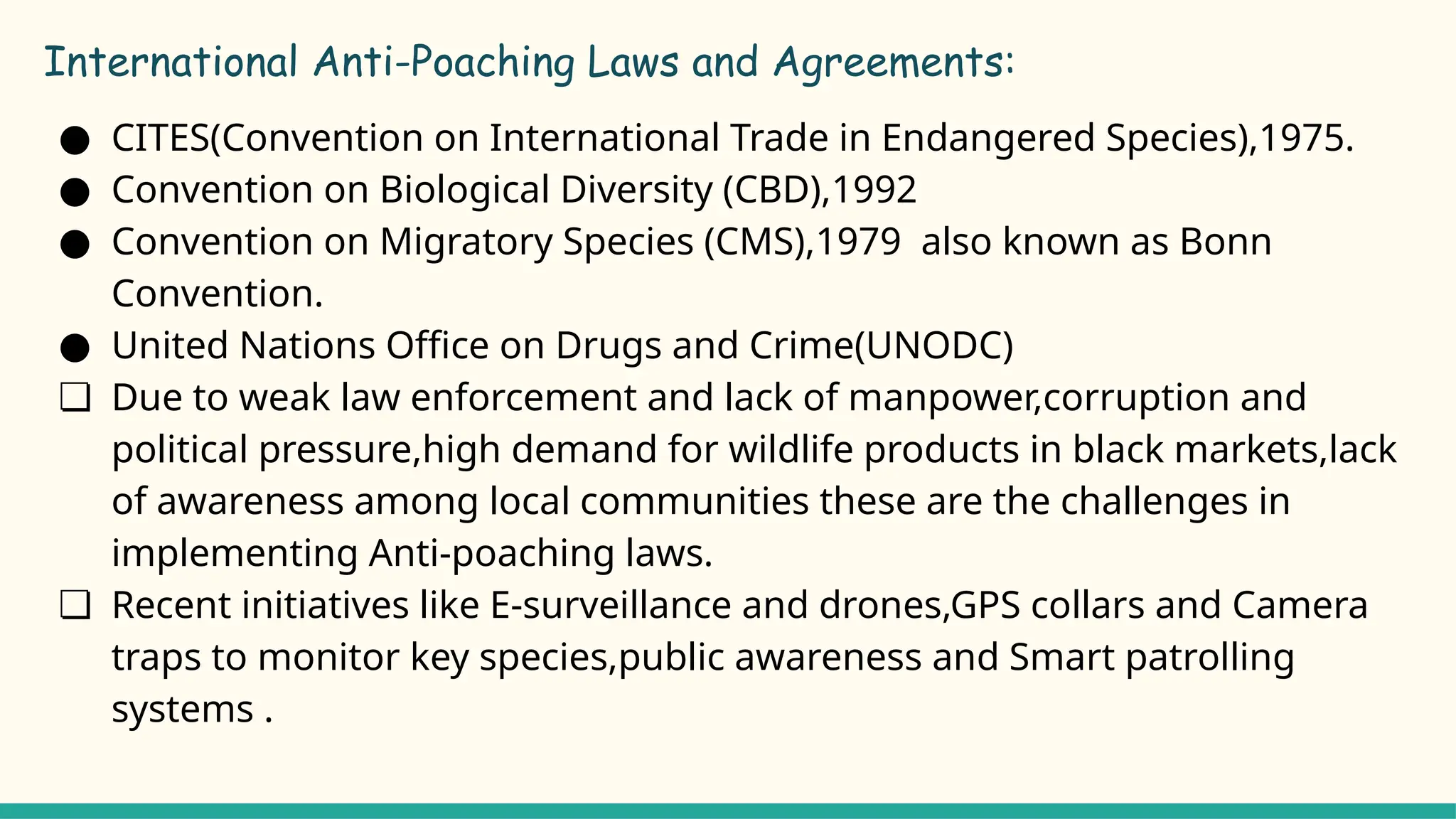
International Anti-Poaching Lawsand Agreements:
● CITES(Convention on International Trade in Endangered Species),1975.
● Convention on Biological Diversity (CBD),1992
● Convention on Migratory Species (CMS),1979 also known as Bonn
Convention.
● United Nations Office on Drugs and Crime(UNODC)
❏ Due to weak law enforcement and lack of manpower,corruption and
political pressure,high demand for wildlife products in black markets,lack
of awareness among local communities these are the challenges in
implementing Anti-poaching laws.
❏ Recent initiatives like E-surveillance and drones,GPS collars and Camera
traps to monitor key species,public awareness and Smart patrolling
systems .
22.
Man-Wildlife Conflicts :
●Its refers to the negative interactions between humans and wild animals.
● Common types of Man-Wildlife conflicts in India:
● Crop Raiding ,Livestock Predation ,Human casualties , Property damage.
Causes:
⧫ Habitat Loss and Fragmentation
⧫ Encroachment into forest areas
⧫ Scarcity of food and water
⧫ Increase in wildlife population
⧫ Climate change
⧫ Illegal wildlife trade and poaching
● One adult Elephant needs 2q of green fodder and 150 L of water daily .If
this is not available , wild animals move out.
23.
Mitigation Strategies :
❖Habitat Restoration and Corridor Development.
❖ Use of technology.
❖ Community Participation.
❖ Compensation schemes.
❖ Alternative Livelihoods.
❖ Translocation and Rescue Operations.
❖ Awareness and Education.
❖ Policy and Legal Measures.
Some of the govt. initiatives India like :
❏ Project Tiger and Project Elephant .
❏ Human-Wildlife Conflict Mitigation Programs by MoEFCC.
❏ National Wildlife Action Plan (2017-2031).
❏ State-level schemes for crop and cattle loss compensation.
24.
● For Eg:Elephant in Sambalpur ,Orissa killed 195 humans in 5 yrs. The
villagers killed 98 elephants in retaliation and injured 30 elephants.
● For Eg: Estuarine ecosystem in Adyar,Chennai has disappeared posing a
major threat to nearly 170 species of birds,many of which nest and breed
there . Tropical forests disappear at the rate of 0.6% per year in our
country. Marine biodiversity is also threatened by human intervention .
● The wetlands in India are distributed in different geographical
regions.Most of the wetlands in India are linked with major river
systems.India has 27403 wetlands covering 4.1 million.
● Of these ,2175 are natural and the rest are man made. Wetlands occupy
18.4 of the area of our country of which 70% are under rice cultivation.
● In India, out of estimated 4.1 million ha of wetlands , 1.5 mha are natural
and 2.6mha are man made . Wetlands provide food and shelter for
mammals and birds.
25.
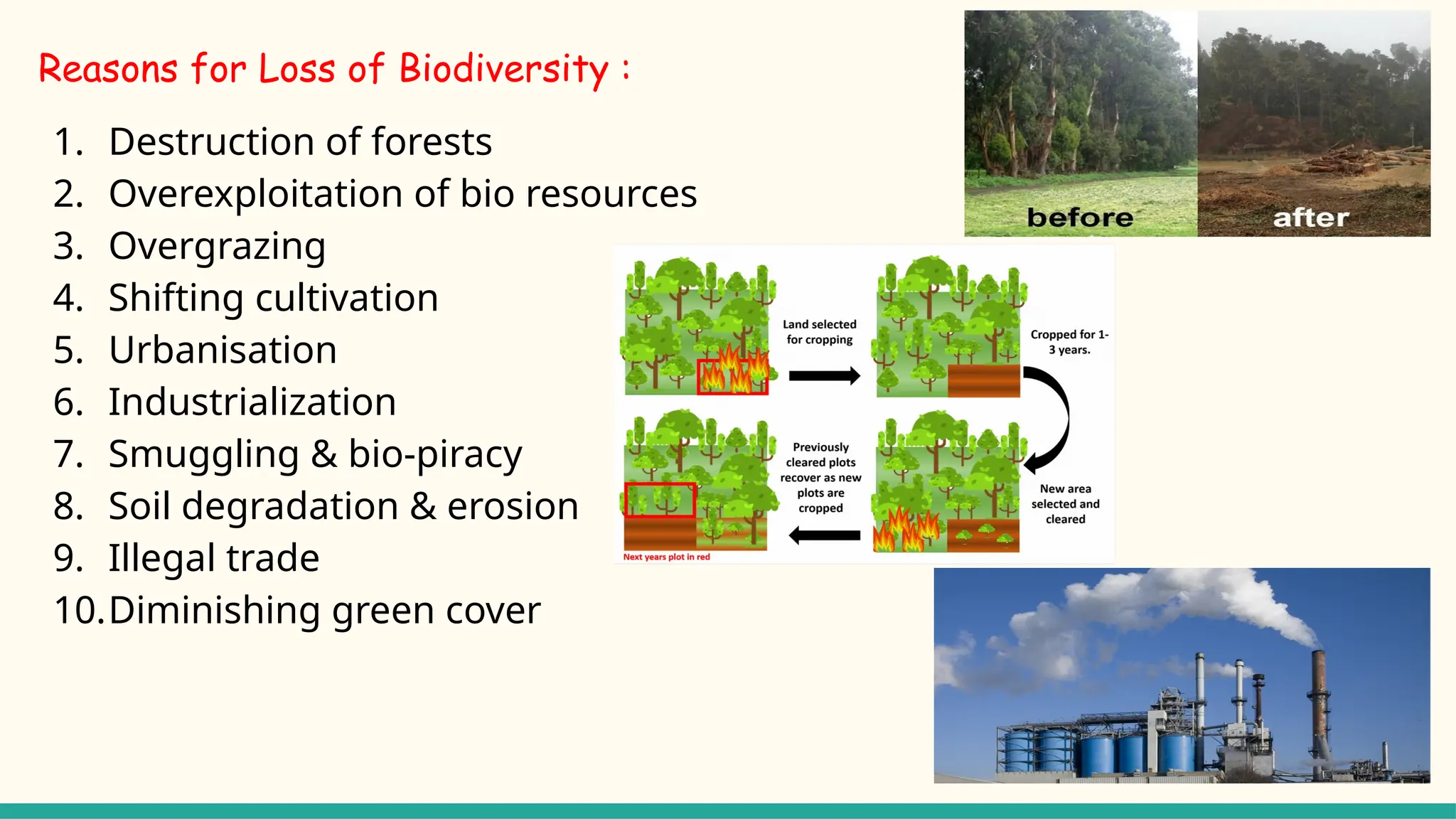
Reasons for Lossof Biodiversity :
1. Destruction of forests
2. Overexploitation of bio resources
3. Overgrazing
4. Shifting cultivation
5. Urbanisation
6. Industrialization
7. Smuggling & bio-piracy
8. Soil degradation & erosion
9. Illegal trade
10.Diminishing green cover
26.
11. Mining forores ,roads ,river valley projects.
12. Exploitation of timber resources
13. Exploitation of NTFP(Non Timber Forest Produce)
14. Loss of land fertility
15. De-vegetation
16. Drought and famine
17. Desertification
18. Tourism business
19. Unequal globalization
20. Greed rather than need
27.
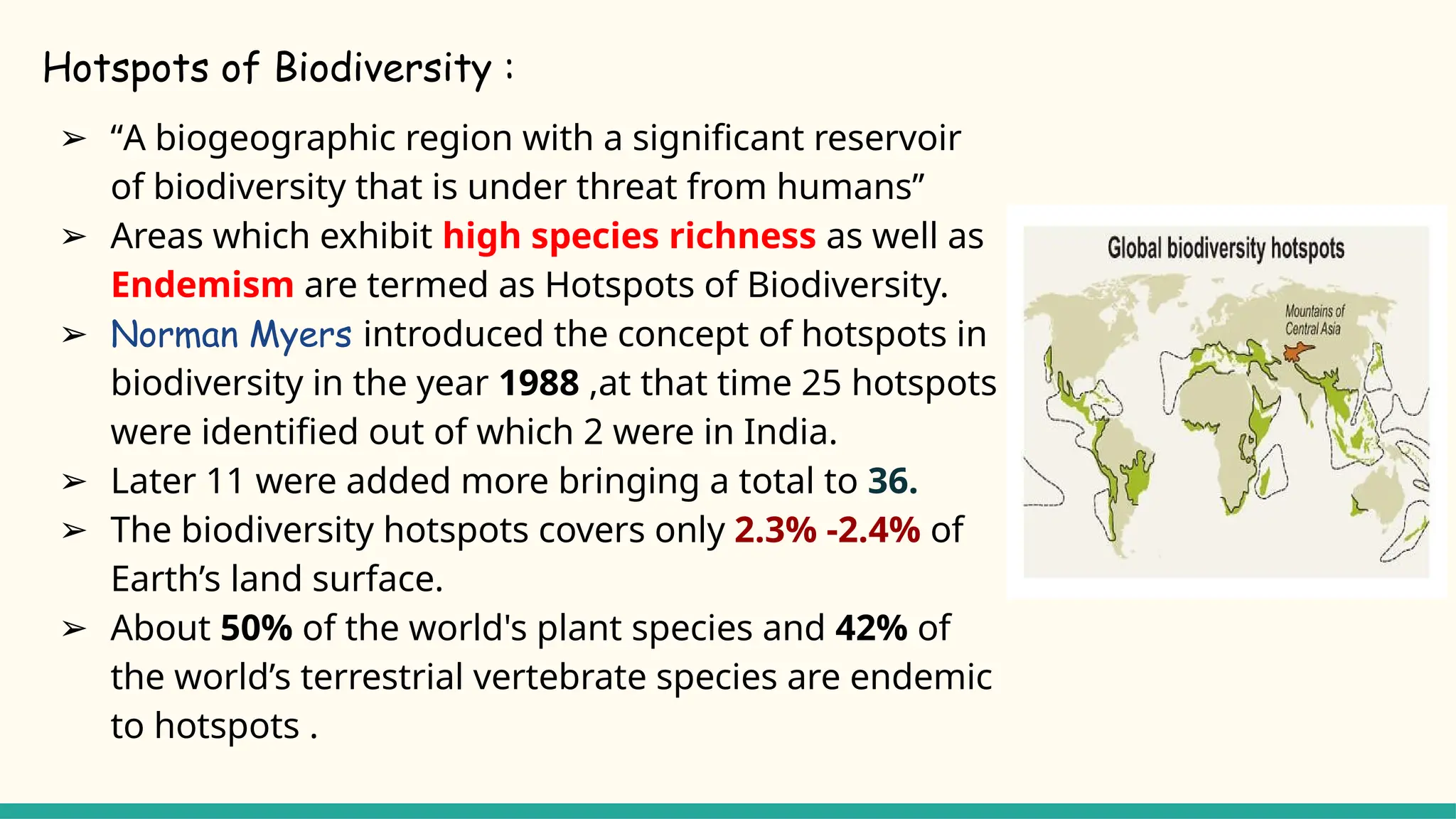
Hotspots of Biodiversity:
➢ “A biogeographic region with a significant reservoir
of biodiversity that is under threat from humans’’
➢ Areas which exhibit high species richness as well as
Endemism are termed as Hotspots of Biodiversity.
➢ Norman Myers introduced the concept of hotspots in
biodiversity in the year 1988 ,at that time 25 hotspots
were identified out of which 2 were in India.
➢ Later 11 were added more bringing a total to 36.
➢ The biodiversity hotspots covers only 2.3% -2.4% of
Earth’s land surface.
➢ About 50% of the world's plant species and 42% of
the world’s terrestrial vertebrate species are endemic
to hotspots .
30.
❖ At presentINDIA has 4 out of 36 biodiversity hotspots in
the world.
❖ This concept was developed on the basis of two important
considerations :
1. The species which are not found elsewhere and
2. Difference of loss of habitat .
❖ India is the world’s 12th most biodiverse region with a 0.46
BioD score on diversity index , which is calculated by its
percentage of species in each group relative to the total
global number of species in each group which includes more
than 45000 flora and 91000 fauna species.
❖ Western Ghat is the biodiversity rich place in India.
31.
➢ Acc. toConservation International criteria to qualify as a hotspot:
1. Must have at least 1,500 species of vascular plants as endemics .
2. Must have lostat at least 70% of its original natural vegetation.
➢ Importance of Biodiversity Hotspots :
● They support a huge variety of life forms, many of which are
found nowhere else.
● Critical for ecosystem services like clean air,water,carbon
sequestration, and soil fertility.
● Essential for medicinal resources and agriculture.
● Vital for climate regulation and sustainability.
● Conserving hotspots can maximize global conservation
outcomes efficiently.
32.
Hotspot Region SpecialHighlights
Amazon Rainforest South America World’s largest rainforest , incredible
species diversity.
Sundaland Southeast Asia High endemism,includes Borneo and
Sumatra
Indo-Burma South Asia and Southeast
Asia
Critical for freshwater biodiversity
Madagascar and Indian
Ocean Islands
Africa Over 90% species are endemic
Himalaya Asia High-altitude biodiversity,unique flora and
fauna
Western Ghats and Sri
Lanka
India and Sri Lanka “Hottest hotspot” with high plant plant
diversity.
Caribbean Islands North America Rich coral reefs, endemic reptiles and birds
Mediterranean Basin Europe,North Africa ,Middle
East
Unique vegetation (e.g.,olives),major
historic human interaction
34.
❖ India isone the world’s 17 megadiverse countries.
❖ It hosts about 7-8% of the world’s recorded species.
❖ India has 4 biodiversity hotspots, these hotspots are rich
in endemic flora and fauna but are also under severe
threat from human activities.
❏ HIMALAYA Hotspot:
● Location: Entire Indian Himalayan region (from J&K to
Arunachal Pradesh),and parts of Nepal,Bhutan, and
Myanmar.
❏ Special features:
● Home to alpine forests,temperate forests, and glaciers.
● Rich in endemic plants (like Blue Poppy and
Rhododendrons)
● Animals like Snow Leopard,Red Panda,Musk Deer, and
Himalayan Monal are found here.
Special Features:
➢ Extremelyhigh freshwater biodiversity.
➢ Rich diversity of Orchids and Bamboo
➢ Species like the Hoolock Gibbon(India’s only ape) and Burmese
Python.
Threats:
➢ Shifting agriculture(Jhum cultivation)
➢ Hunting and poaching
➢ Habitat fragmentation.
37.
3.Western Ghats &Sri Lanka Hotspot:
➢ Location:Stretching along the western coast
of India(Maharashtra ,Goa ,Karnataka ,Kerala
, Tamil Nadu) and parts of Sri Lanka
Special Features:
➢ Called the “Hottest Hotspot” of biodiversity.
➢ Over 7,400 plant species , with nearly 1,500
endemic to the region.
➢ Imp. animals: Lion-tailed Macaque ,Nilgiri
Tahr,Malabar Civet,Purple Frog.
4.Sundaland Biodiversity Hotspot:(NicobarIslands)
Location:
➢ Nicobar islands of India (part of Sundaland)
➢ Other parts include Malaysia ,Singapore ,Indonesia ,Brunei.
Key Features:
➢ Tropical evergreen rainforests.
➢ High levels of marine and terrestrial endemism.
Important Endemic species:
➢ Nicobar Megapode,Nicobar Long-tailed Macaque,Saltwater
Crocodile,Endemic palms and mangroves.
40.
Threats:
● Rising sealevels due to climate change.
● Habitat destruction due to tsunami.
● Invasive species like rats,cats.
Conservative Initiatives in India:
1. Project Tiger(1973) -Protect tigers and their habitats.
2. Project Elephant(1992) -Conserve elephants and their corridors.
3. Biosphere Reserves -Conservation of ecosystems and sustainable
development.
4. Wildlife Protection Act (1972) -Legal framework for protecting
wildlife.
41.
5. National BiodiversityAuthority(2003) -Regulate access to
biological resources.
❖ Sacred Groves:Community protected forests based on
religious beliefs,mostly found in biodiversity hotspots like
Western Ghats and Northeast India.