Biodiesel
Preparation
Biodiesel
• Biodiesel is a liquid biofuel obtained by chemical processes from vegetable
oils or animal fats and an alcohol that can be used in diesel engines,
alone or blended with diesel oil.
• ASTM (American Society for Testing and Materials) defines biodiesel as a
mixture of long-chain monoalkylic esters from fatty acids obtained from
renewable resources, to be used in diesel engines.
• Blends with diesel fuel are indicated as ‘‘Bx’’, where ‘‘x’’ is the percentage
of biodiesel in the blend.
• For instance, ‘‘B5’’ indicates a blend with 5% biodiesel and 95% diesel fuel;
in consequence, B100 indicates pure biodiesel.
• Biodiesel is an alternative energy source and could be a substitute for
petroleum-based diesel fuel.
• One of the most prominent alternative energy resources, attracting more
and more interest in recent years with the price for crude oil reaching
record heights, is biodiesel, which is a possible substitute for petroleum-
based diesel fuel.
• Many studies have shown that the properties of biodiesel are very close to
diesel fuel.
• Therefore, biodiesel fuel can be used in diesel engines with little or no
modification.
• Biodiesel has a higher cetane number than diesel fuel, no aromatics, no
sulfur, and contains 10-11% oxygen by weight.
• These characteristics of biodiesel are responsible for a reduction in the
emissions of carbon monoxide (CO), hydrocarbon (HC) and particulate
matter (PM) in the exhaust gas compared to diesel fuel.
• However, to be a viable alternative, a biodiesel should provide a net energy
gain, be economically competitive, and be producible in large quantities
without reducing food supplies.
The biodiesel cycle
Raw Materials for Biodiesel Production
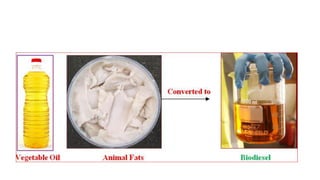
• The raw materials for biodiesel production are vegetable oils, animal
fats and short chain alcohols.
• The oils most used for worldwide biodiesel production are rapeseed, soybean, palm,
sunflower, peanut, linseed, vegetable
• oils, and also animal fats.
• Methanol is the most frequently used alcohol although ethanol can also be used.
• Since cost is the main concern in biodiesel production and trading (mainly due to oil
prices), the use of non-edible vegetable oils is recommended.
• Besides its lower cost, another undeniable advantage of non-edible oils for biodiesel
production lies in the fact that no foodstuffs are spent to produce fuel.
• These and other reasons have led to medium- and large-scale biodiesel production trials
in several countries, using non-edible oils such as castor oil, cotton, jojoba and jatropha.
• Animal fats are also an interesting option, especially in countries with plenty of livestock
resources, although it is necessary to carry out preliminary treatment since they are
solid; furthermore, highly acidic grease from cattle, pork, poultry, and fish can be used.
• Microalgae appear to be a very important alternative for future biodiesel production due
to their very high oil yield; however, it must be taken into account that only some species
are useful for biofuel production.
• Although the properties of oils and fats used as raw materials may differ, the properties
of biodiesel must be the same, complying with the requirements set by international
standards.
Characteristics of Oils and Fats Used in Biodiesel Production
• Oils and fats, known as lipids, are hydrophobic substances insoluble in
water and are of animal or vegetal origin.
• They differ in their physical states at room temperature.
• From a chemical viewpoint, lipids are fatty glycerol esters known as
triglycerides.
• The three hydrocarbon chains may be of equal or different lengths,
depending on the type of oil; they may also differ on the number of
double-covalent bonds in each chain.
• R', R'' and R''' represent hydrocarbon chains of fatty acids, which in most cases vary in
• length from 12 to 18 carbon atoms.
• Fatty acids may be saturated fatty acids (SFA) or non-saturated fatty acids (NSFA).
• In the former, there are only single covalent bonds in the molecules.
Important Fatty Acids in Oil
The most frequent fatty acids in oils are lauric, palmitic, estearic, linoleic and linolenic, although others may also be
present.
It is important to note that vegetable oils differ in their content of fatty acids.
For instance, ricinoleic acid is the main component of castor oil, whereas in olive oil it is oleic acid, in soybean oil it is
linoleic acid, and in linseed oil it is linolenic acid.
Fatty Acids Composition (approximate) of some Vegitable
Oils
Characteristics of Alcohols used in Biodiesel Production
• Alcohols that can be used in biodiesel production are those with short
chains, including methanol, ethanol, butanol, and amylic alcohol.
• The most widely used alcohols are methanol (CH3OH) and ethanol
(C2H5OH) because of their low cost and properties.
• Methanol is often preferred to ethanol in spite of its high toxicity
because its use in biodiesel production requires simpler technology;
excess alcohol may be recovered at a low cost and higher reaction
speeds are reached.
Most Important Alcohols used in Biodiesel Production
 Methanol: Most widely used, in spite of its toxicity. It is a substance of
petrochemical origin.
 Ethanol: Less used, requires more complex production technology and the
reaction speeds are lower. It can be produced from biomass
• Biodiesel Production Process
• Biodiesel is produced from vegetable oils or animal fats and an alcohol,
through a transesterification reaction.
• This chemical reaction converts an ester (vegetable oil or animal fat) into a
mixture of esters of the fatty acids that makes up the oil (or fat).
• Biodiesel is obtained from the purification of the mixture of fatty acid
methyl esters (FAME).
• A catalyst is used to accelerate the reaction.
• In order to understand the chemical process, we must know the chemistry
of esterification and transesterification.
• It is the general name for a chemical reaction in which two
reactants (typically an alcohol and an acid) form an ester as the
reaction product.
• Esters are common in organic chemistry and biological materials,
and often have a pleasant characteristic, fruity odor.
• Chemistry of Transesterification
• In organic chemistry, transesterification is the process of exchanging
the organic group R″ of an ester with the organic group R′ of an
alcohol.
• These reactions are often catalyzed by the addition of an acid or base
catalyst.
• The reaction can also be accomplished with the help of enzymes
(biocatalysts) particularly lipases.
Biodiesel production and preparation techniques

Biodiesel production and preparation techniques

  • 1.
  • 2.
    Biodiesel • Biodiesel isa liquid biofuel obtained by chemical processes from vegetable oils or animal fats and an alcohol that can be used in diesel engines, alone or blended with diesel oil. • ASTM (American Society for Testing and Materials) defines biodiesel as a mixture of long-chain monoalkylic esters from fatty acids obtained from renewable resources, to be used in diesel engines. • Blends with diesel fuel are indicated as ‘‘Bx’’, where ‘‘x’’ is the percentage of biodiesel in the blend. • For instance, ‘‘B5’’ indicates a blend with 5% biodiesel and 95% diesel fuel; in consequence, B100 indicates pure biodiesel. • Biodiesel is an alternative energy source and could be a substitute for petroleum-based diesel fuel.
  • 3.
    • One ofthe most prominent alternative energy resources, attracting more and more interest in recent years with the price for crude oil reaching record heights, is biodiesel, which is a possible substitute for petroleum- based diesel fuel. • Many studies have shown that the properties of biodiesel are very close to diesel fuel. • Therefore, biodiesel fuel can be used in diesel engines with little or no modification. • Biodiesel has a higher cetane number than diesel fuel, no aromatics, no sulfur, and contains 10-11% oxygen by weight. • These characteristics of biodiesel are responsible for a reduction in the emissions of carbon monoxide (CO), hydrocarbon (HC) and particulate matter (PM) in the exhaust gas compared to diesel fuel. • However, to be a viable alternative, a biodiesel should provide a net energy gain, be economically competitive, and be producible in large quantities without reducing food supplies.
  • 5.
  • 6.
    Raw Materials forBiodiesel Production • The raw materials for biodiesel production are vegetable oils, animal fats and short chain alcohols.
  • 7.
    • The oilsmost used for worldwide biodiesel production are rapeseed, soybean, palm, sunflower, peanut, linseed, vegetable • oils, and also animal fats. • Methanol is the most frequently used alcohol although ethanol can also be used. • Since cost is the main concern in biodiesel production and trading (mainly due to oil prices), the use of non-edible vegetable oils is recommended. • Besides its lower cost, another undeniable advantage of non-edible oils for biodiesel production lies in the fact that no foodstuffs are spent to produce fuel. • These and other reasons have led to medium- and large-scale biodiesel production trials in several countries, using non-edible oils such as castor oil, cotton, jojoba and jatropha. • Animal fats are also an interesting option, especially in countries with plenty of livestock resources, although it is necessary to carry out preliminary treatment since they are solid; furthermore, highly acidic grease from cattle, pork, poultry, and fish can be used. • Microalgae appear to be a very important alternative for future biodiesel production due to their very high oil yield; however, it must be taken into account that only some species are useful for biofuel production. • Although the properties of oils and fats used as raw materials may differ, the properties of biodiesel must be the same, complying with the requirements set by international standards.
  • 10.
    Characteristics of Oilsand Fats Used in Biodiesel Production • Oils and fats, known as lipids, are hydrophobic substances insoluble in water and are of animal or vegetal origin. • They differ in their physical states at room temperature. • From a chemical viewpoint, lipids are fatty glycerol esters known as triglycerides. • The three hydrocarbon chains may be of equal or different lengths, depending on the type of oil; they may also differ on the number of double-covalent bonds in each chain.
  • 11.
    • R', R''and R''' represent hydrocarbon chains of fatty acids, which in most cases vary in • length from 12 to 18 carbon atoms. • Fatty acids may be saturated fatty acids (SFA) or non-saturated fatty acids (NSFA). • In the former, there are only single covalent bonds in the molecules.
  • 12.
    Important Fatty Acidsin Oil The most frequent fatty acids in oils are lauric, palmitic, estearic, linoleic and linolenic, although others may also be present. It is important to note that vegetable oils differ in their content of fatty acids. For instance, ricinoleic acid is the main component of castor oil, whereas in olive oil it is oleic acid, in soybean oil it is linoleic acid, and in linseed oil it is linolenic acid.
  • 13.
    Fatty Acids Composition(approximate) of some Vegitable Oils
  • 14.
    Characteristics of Alcoholsused in Biodiesel Production • Alcohols that can be used in biodiesel production are those with short chains, including methanol, ethanol, butanol, and amylic alcohol. • The most widely used alcohols are methanol (CH3OH) and ethanol (C2H5OH) because of their low cost and properties. • Methanol is often preferred to ethanol in spite of its high toxicity because its use in biodiesel production requires simpler technology; excess alcohol may be recovered at a low cost and higher reaction speeds are reached. Most Important Alcohols used in Biodiesel Production  Methanol: Most widely used, in spite of its toxicity. It is a substance of petrochemical origin.  Ethanol: Less used, requires more complex production technology and the reaction speeds are lower. It can be produced from biomass
  • 15.
    • Biodiesel ProductionProcess • Biodiesel is produced from vegetable oils or animal fats and an alcohol, through a transesterification reaction. • This chemical reaction converts an ester (vegetable oil or animal fat) into a mixture of esters of the fatty acids that makes up the oil (or fat). • Biodiesel is obtained from the purification of the mixture of fatty acid methyl esters (FAME). • A catalyst is used to accelerate the reaction. • In order to understand the chemical process, we must know the chemistry of esterification and transesterification.
  • 16.
    • It isthe general name for a chemical reaction in which two reactants (typically an alcohol and an acid) form an ester as the reaction product. • Esters are common in organic chemistry and biological materials, and often have a pleasant characteristic, fruity odor.
  • 18.
    • Chemistry ofTransesterification • In organic chemistry, transesterification is the process of exchanging the organic group R″ of an ester with the organic group R′ of an alcohol. • These reactions are often catalyzed by the addition of an acid or base catalyst. • The reaction can also be accomplished with the help of enzymes (biocatalysts) particularly lipases.