1. Polymers and Classification
2. Exigency of it
3. Degradation and Biodegradation
4. Mechanisms of Biodegradation
5. Important biodegradable polymers
6. Applications and Advantages
7. Scopes
8. The Ending Note (must watch)
 A polymer is a large molecule that is made up of repeating subunits connected to each other
by chemical bonds.
 Repeating subunits: Monomers
 Common examples
 Plastic
 Proteins
 Cellulose in paper
 DNA
 Rubber…. Fig 1: Origin of word POLYMER
Biodegradable polymers are the degradable polymeric
substances in which degradation may result from either
naturally occurring microorganisms(or microbes) such
such as bacteria, fungi, and algae or by synthetic
biodegradation catalyzed by transition metals.
”
“
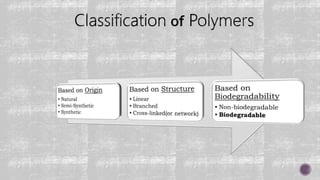
Classification
Natural
Biopolymers
Ex: Albumin, Collagen,
Dextran,Cellulose
Synthetic
Biopolymers
Ex: PLA, PCL,
PEA
 Degradation by microbes or living
organisms
 Conversion into naturally
acceptable entities
 Occurs by UV radiation, heat and
light from Sun, etc.
 Normal plastics: strong bonds
between carbon atom; so cannot
biodegrade
Enzymatic Hydrolytic
Common
 Transformation and deterioration of polymers solely by living
organisms including the micro organisms excreted by them.
 Active enzymatic reaction over the molecular structure of the polymer.
 Biological process during composting to yield CO2 , water, inorganic
compound and biomass.
 Rate of degradation is consistent with water compostable materials
such as; cellulose wood or paper.
 Process leaves no visible; distinguishable or toxic residue.
 Microbes responsible Burkholderia xenovorans LB400
and Rhodococcus sp. strain RHA1
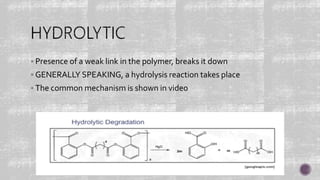
 Presence of a weak link in the polymer, breaks it down
 GENERALLY SPEAKING, a hydrolysis reaction takes place
 The common mechanism is shown in video
 Can be processed with a large number of techniques and is commercially
available (large-scale production) in a wide range of grades.
 It is relatively cheap and has some remarkable properties, which make it
suitable for different applications.
 Different syntheses to produce this biopolymer, its diverse properties and
various applications.
 Its biodegradability is adapted to short-term packaging, and its
biocompatibility in contact with living tissues is exploited for biomedical
applications (implants, sutures, drug encapsulation … ).
 Biodegradable polyester
 Especially used for drug delivery
 Slower degradation rate than PLA
 High miscibility with a large range of other polymers
 Two main pathways to produce polycaprolactone are known :
 the polycondensation of a hydroxycarboxylic acid: 6-hydroxyhexanoic acid,
 the ring-opening polymerisation (ROP) of a lactone: epsilon-caprolactone (epsilon-CL), or
 General method of catalysation by transition elements
Class
PLA
1. Orthopedic devices
2. Medical implants
PCL
1. Use as an Implantable biomaterial
2. Normal drug delivery device
3. Root canal filling
4. Targeted drug delivery
MEDICAL
 Localized drug delivery
 Reduce side effects
 Improved patient compliance
 Decrease in dosing frequency
GENERAL
 Decrease in land pollution
 Improved aquatic ecosystem
 Lesser landfill occupation
 Waste reduction
1. Pouncer is the brain child of
engineer and ex-British Army
veteran Nigel Gifford
2. Made of biodegradable starch
based thermoplastic polymer
3. Fuel used: Compressed air/
fuel
Will either be dropped from a plane or shot from a
catapult on the ground
The disposed off components be made of such
polymers which degrade by themselves
It can contain certain bacteria, which starts eating
off the components once it has fulfilled its task
Will solve problem of floating space debris
THIS IS THE FUTURE
BELIEVE ME
MODIT ADARSH
Biodegradable polymers

Biodegradable polymers

  • 3.
    1. Polymers andClassification 2. Exigency of it 3. Degradation and Biodegradation 4. Mechanisms of Biodegradation 5. Important biodegradable polymers 6. Applications and Advantages 7. Scopes 8. The Ending Note (must watch)
  • 4.
     A polymeris a large molecule that is made up of repeating subunits connected to each other by chemical bonds.  Repeating subunits: Monomers  Common examples  Plastic  Proteins  Cellulose in paper  DNA  Rubber…. Fig 1: Origin of word POLYMER
  • 12.
    Biodegradable polymers arethe degradable polymeric substances in which degradation may result from either naturally occurring microorganisms(or microbes) such such as bacteria, fungi, and algae or by synthetic biodegradation catalyzed by transition metals. ” “
  • 13.
  • 15.
     Degradation bymicrobes or living organisms  Conversion into naturally acceptable entities  Occurs by UV radiation, heat and light from Sun, etc.  Normal plastics: strong bonds between carbon atom; so cannot biodegrade
  • 16.
  • 17.
     Transformation anddeterioration of polymers solely by living organisms including the micro organisms excreted by them.  Active enzymatic reaction over the molecular structure of the polymer.  Biological process during composting to yield CO2 , water, inorganic compound and biomass.  Rate of degradation is consistent with water compostable materials such as; cellulose wood or paper.  Process leaves no visible; distinguishable or toxic residue.  Microbes responsible Burkholderia xenovorans LB400 and Rhodococcus sp. strain RHA1
  • 19.
     Presence ofa weak link in the polymer, breaks it down  GENERALLY SPEAKING, a hydrolysis reaction takes place  The common mechanism is shown in video
  • 21.
     Can beprocessed with a large number of techniques and is commercially available (large-scale production) in a wide range of grades.  It is relatively cheap and has some remarkable properties, which make it suitable for different applications.  Different syntheses to produce this biopolymer, its diverse properties and various applications.  Its biodegradability is adapted to short-term packaging, and its biocompatibility in contact with living tissues is exploited for biomedical applications (implants, sutures, drug encapsulation … ).
  • 22.
     Biodegradable polyester Especially used for drug delivery  Slower degradation rate than PLA  High miscibility with a large range of other polymers  Two main pathways to produce polycaprolactone are known :  the polycondensation of a hydroxycarboxylic acid: 6-hydroxyhexanoic acid,  the ring-opening polymerisation (ROP) of a lactone: epsilon-caprolactone (epsilon-CL), or  General method of catalysation by transition elements
  • 23.
    Class PLA 1. Orthopedic devices 2.Medical implants PCL 1. Use as an Implantable biomaterial 2. Normal drug delivery device 3. Root canal filling 4. Targeted drug delivery
  • 24.
    MEDICAL  Localized drugdelivery  Reduce side effects  Improved patient compliance  Decrease in dosing frequency GENERAL  Decrease in land pollution  Improved aquatic ecosystem  Lesser landfill occupation  Waste reduction
  • 25.
    1. Pouncer isthe brain child of engineer and ex-British Army veteran Nigel Gifford 2. Made of biodegradable starch based thermoplastic polymer 3. Fuel used: Compressed air/ fuel Will either be dropped from a plane or shot from a catapult on the ground
  • 26.
    The disposed offcomponents be made of such polymers which degrade by themselves It can contain certain bacteria, which starts eating off the components once it has fulfilled its task Will solve problem of floating space debris
  • 28.
    THIS IS THEFUTURE BELIEVE ME MODIT ADARSH

Editor's Notes

  • #6 Non biodegradable examples: poly vinyl chloride, polyethylene Biodegradable: collagen, polyglycolic acid
  • #13 These polymers comprise of monomers linked to one another through functional groups and have unstable links in the backbone of the structure of the whole compound, ref video Later broken down into biologically acceptable molecules that are metabolized in such a way that it does remain like a foreign body anymore.
  • #14 PLA: Polylactic acid PCL: polycaprolactum PEA:Polyesteramide
  • #16 Degradation of normal plastics takes time. That too it takes place only when sufficient sunlight is falling on them. But then also they are converted to smaller and smaller particles which may ultimately go into the ocean and harm the aquatic life
  • #18 Disadvantage is that if they do not get sufficient oxygen, they may produce methane gas which again becomes a cause of pollution
  • #22 Polylactic acid (PLA) is at present one of the most promising biodegradable polymers (biopolymers) and has been the subject of abundant literature over the last decade. PLA can be processed with a large number of techniques and is commercially available (large-scale production) in a wide range of grades. It is relatively cheap and has some remarkable properties, which make it suitable for different applications. This chapter deals with the different syntheses to produce this biopolymer, its diverse properties and various applications. Its biodegradability is adapted to short-term packaging, and its biocompatibility in contact with living tissues is exploited for biomedical applications (implants, sutures, drug encapsulation … ). Thermoplastic aliphatic polyester derived from renewable sources like corn starch, or sugarcane Highly crystalline and high melting point Used in preparation of sutures and orthopedic devices
  • #24 PLA medical implants in the form of anchors, screws, plates, pins, rods, and as a mesh.[21]  Depending on the exact type used, it breaks down inside the body within 6 months to 2 years. This gradual degradation is desirable for a support structure, because it gradually transfers the load to the body (e.g. the bone) as that area heals. The strength characteristics of PLA and PLLA implants are well documented.[22] PCL It performs like gutta-percha, has similar handling properties, and for retreatment purposes may be softened with heat, or dissolved with solvents like chloroform. Similar to gutta-percha, there are master cones in all ISO sizes and accessory cones in different sizes and taper available.
  • #26 . Pouncer is designed with an airframe skin made from biodegradable starch-based thermoplastic, which will be filled with vacuum-packed food packages.  Wood will be used for the rest of the parts, which can be used for cooking and heating. Pouncer will used either compressed air or solid fuel for power. And the plan is to launch it from a tailgate aircraft at 10,000 feet in the air or a catapult on the ground, then it will drop within a 25 mile radius of its target. Will either be dropped from a plane or shot from a catapult on the ground Drone will drop within 25 miles of target to keep a safe distance from wars Production will begin in 12 months and a global roll-out will follow
  • #30 DISADVANTAGES DO EXIST