BIOCHEMICAL TEST IN
MICROBIOLOGY
By:
Suganesawaran.S
1st Msc Food Science Technology And Nutrition
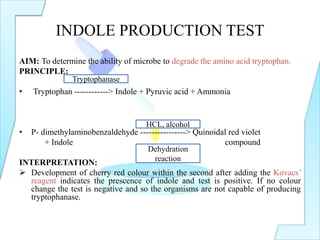
AIM: To determine the ability of microbe to degrade the amino acid tryptophan.
PRINCIPLE:
• Tryptophan ------------> Indole + Pyruvic acid + Ammonia
• P- dimethylaminobenzaldehyde ----------------> Quinoidal red violet
+ Indole compound
INTERPRETATION:
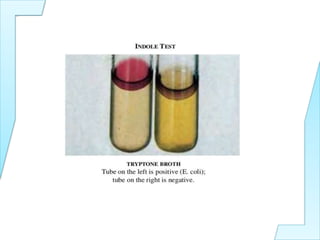
 Development of cherry red colour within the second after adding the Kovacs’
reagent indicates the prescence of indole and test is positive. If no colour
change the test is negative and so the organisms are not capable of producing
tryptophanase.
INDOLE PRODUCTION TEST
Tryptophanase
HCL, alcohol
Dehydration
reaction
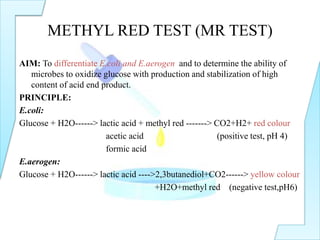
AIM: To differentiate E.coli and E.aerogen and to determine the ability of
microbes to oxidize glucose with production and stabilization of high
content of acid end product.
PRINCIPLE:
E.coli:
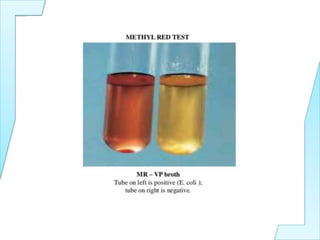
Glucose + H2O------> lactic acid + methyl red -------> CO2+H2+ red colour
acetic acid (positive test, pH 4)
formic acid
E.aerogen:
Glucose + H2O------> lactic acid ---->2,3butanediol+CO2------> yellow colour
+H2O+methyl red (negative test,pH6)
METHYL RED TEST (MR TEST)
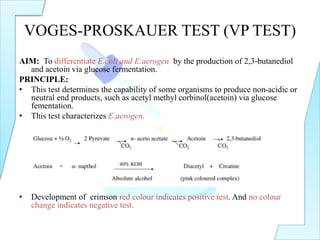
AIM: To differentiate E.coli and E.aerogen by the production of 2,3-butanediol
and acetoin via glucose fermentation.
PRINCIPLE:
• This test determines the capability of some organisms to produce non-acidic or
neutral end products, such as acetyl methyl corbinol(acetoin) via glucose
fementation.
• This test characterizes E.aerogen.
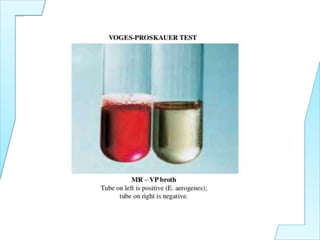
• Development of crimson red colour indicates positive test. And no colour
change indicates negative test.
VOGES-PROSKAUER TEST (VP TEST)
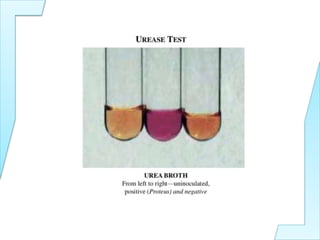
AIM: To determine the ability of microbes to degrade urea by urease.
PRINCIPLE:
• Urea is diamide carbonic acid .
• The hydrolysis of urea is catalysed by specific enzyme urease to yield 2
moles of ammonia.
• Urease attacks N and C bonds in urea and forms ammonia.
• The presence of urease is detected, when the organisms are grown in urea
broth.
• pH indicator phenol red turns deep pink in colour when urea is broken-
down.
• Helps in identification of Proteus spp.
UREASE TEST
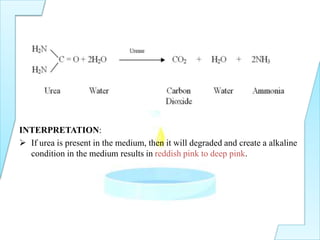
INTERPRETATION:
 If urea is present in the medium, then it will degraded and create a alkaline
condition in the medium results in reddish pink to deep pink.
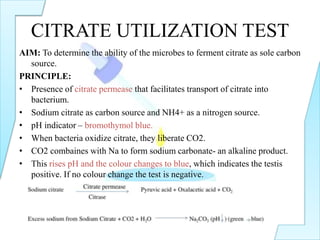
AIM: To determine the ability of the microbes to ferment citrate as sole carbon
source.
PRINCIPLE:
• Presence of citrate permease that facilitates transport of citrate into
bacterium.
• Sodium citrate as carbon source and NH4+ as a nitrogen source.
• pH indicator – bromothymol blue.
• When bacteria oxidize citrate, they liberate CO2.
• CO2 combaines with Na to form sodium carbonate- an alkaline product.
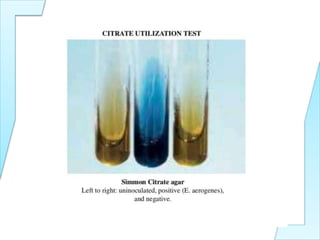
• This rises pH and the colour changes to blue, which indicates the testis
positive. If no colour change the test is negative.
CITRATE UTILIZATION TEST
REFERENCES
• Isenberg, h. D., & Sundheim, L. H. (1958). Indole reactions in bacteria. Journal
of bacteriology, 75(6), 682–690. https://doi.org/10.1128/jb.75.6.682-690.1958
• Barry, A. L., Bernsohn, K. L., Adams, A. P., & Thrupp, L. D. (1970). Improved 18-
hour methyl red test. Applied microbiology, 20(6), 866–870.
https://doi.org/10.1128/am.20.6.866-870.1970
• Barry, A. L., & Feeney, K. L. (1967). Two quick methods for Voges-Proskauer
test. Applied microbiology, 15(5), 1138–1141.
https://doi.org/10.1128/am.15.5.1138-1141.1967
• Dahlén, G., Hassan, H., Blomqvist, S., & Carlén, A. (2018). Rapid urease test
(RUT) for evaluation of urease activity in oral bacteria in vitro and in
supragingival dental plaque ex vivo. BMC oral health, 18(1), 89.
https://doi.org/10.1186/s12903-018-0541-3
• Van Hofwegen, D. J., Hovde, C. J., & Minnich, S. A. (2016). Rapid Evolution of
Citrate Utilization by Escherichia coli by Direct Selection Requires citT and
dctA. Journal of bacteriology, 198(7), 1022–1034.
https://doi.org/10.1128/JB.00831-15
THANK YOU

BIOCHEMICAL TEST IN MICROBIOLOGY

  • 1.
    BIOCHEMICAL TEST IN MICROBIOLOGY By: Suganesawaran.S 1stMsc Food Science Technology And Nutrition
  • 2.
    AIM: To determinethe ability of microbe to degrade the amino acid tryptophan. PRINCIPLE: • Tryptophan ------------> Indole + Pyruvic acid + Ammonia • P- dimethylaminobenzaldehyde ----------------> Quinoidal red violet + Indole compound INTERPRETATION:  Development of cherry red colour within the second after adding the Kovacs’ reagent indicates the prescence of indole and test is positive. If no colour change the test is negative and so the organisms are not capable of producing tryptophanase. INDOLE PRODUCTION TEST Tryptophanase HCL, alcohol Dehydration reaction
  • 4.
    AIM: To differentiateE.coli and E.aerogen and to determine the ability of microbes to oxidize glucose with production and stabilization of high content of acid end product. PRINCIPLE: E.coli: Glucose + H2O------> lactic acid + methyl red -------> CO2+H2+ red colour acetic acid (positive test, pH 4) formic acid E.aerogen: Glucose + H2O------> lactic acid ---->2,3butanediol+CO2------> yellow colour +H2O+methyl red (negative test,pH6) METHYL RED TEST (MR TEST)
  • 6.
    AIM: To differentiateE.coli and E.aerogen by the production of 2,3-butanediol and acetoin via glucose fermentation. PRINCIPLE: • This test determines the capability of some organisms to produce non-acidic or neutral end products, such as acetyl methyl corbinol(acetoin) via glucose fementation. • This test characterizes E.aerogen. • Development of crimson red colour indicates positive test. And no colour change indicates negative test. VOGES-PROSKAUER TEST (VP TEST)
  • 8.
    AIM: To determinethe ability of microbes to degrade urea by urease. PRINCIPLE: • Urea is diamide carbonic acid . • The hydrolysis of urea is catalysed by specific enzyme urease to yield 2 moles of ammonia. • Urease attacks N and C bonds in urea and forms ammonia. • The presence of urease is detected, when the organisms are grown in urea broth. • pH indicator phenol red turns deep pink in colour when urea is broken- down. • Helps in identification of Proteus spp. UREASE TEST
  • 9.
    INTERPRETATION:  If ureais present in the medium, then it will degraded and create a alkaline condition in the medium results in reddish pink to deep pink.
  • 11.
    AIM: To determinethe ability of the microbes to ferment citrate as sole carbon source. PRINCIPLE: • Presence of citrate permease that facilitates transport of citrate into bacterium. • Sodium citrate as carbon source and NH4+ as a nitrogen source. • pH indicator – bromothymol blue. • When bacteria oxidize citrate, they liberate CO2. • CO2 combaines with Na to form sodium carbonate- an alkaline product. • This rises pH and the colour changes to blue, which indicates the testis positive. If no colour change the test is negative. CITRATE UTILIZATION TEST
  • 13.
    REFERENCES • Isenberg, h.D., & Sundheim, L. H. (1958). Indole reactions in bacteria. Journal of bacteriology, 75(6), 682–690. https://doi.org/10.1128/jb.75.6.682-690.1958 • Barry, A. L., Bernsohn, K. L., Adams, A. P., & Thrupp, L. D. (1970). Improved 18- hour methyl red test. Applied microbiology, 20(6), 866–870. https://doi.org/10.1128/am.20.6.866-870.1970 • Barry, A. L., & Feeney, K. L. (1967). Two quick methods for Voges-Proskauer test. Applied microbiology, 15(5), 1138–1141. https://doi.org/10.1128/am.15.5.1138-1141.1967 • Dahlén, G., Hassan, H., Blomqvist, S., & Carlén, A. (2018). Rapid urease test (RUT) for evaluation of urease activity in oral bacteria in vitro and in supragingival dental plaque ex vivo. BMC oral health, 18(1), 89. https://doi.org/10.1186/s12903-018-0541-3 • Van Hofwegen, D. J., Hovde, C. J., & Minnich, S. A. (2016). Rapid Evolution of Citrate Utilization by Escherichia coli by Direct Selection Requires citT and dctA. Journal of bacteriology, 198(7), 1022–1034. https://doi.org/10.1128/JB.00831-15
  • 14.