A.SATHIYARAJI Dr,P.Saranraj,MSc,PhD,NET.
BP221518 Department of Microbiology
MSc Applied Microbiology Sacred Heart College(Autonomous)
Sacred Heart College-TPT. Thirupathur-635601
IMVIC TEST
INDOLE TEST
 AIM: To detect the ability of the microorganisms to degrade the
amino acidTryptophan and produce Indole.
 CULTURE MEDIUM USED:Tryptophan Broth
 INDICATOR: Kovac’s Reagent or Ehrlich Reagent (Anaerobic
bacteria)
 PRINCIPLE: The amino acid Tryptophan present in the Tryptophan
Broth is acted upon by the enzyme Tryptophanase produced by
bacteria and converted into Indole, Pyruvic acid and Ammonia.
 Indole reacts with the Indicator Kovac’s reagent or Ehrlich’s reagent
and produce Red colour ring at the top.
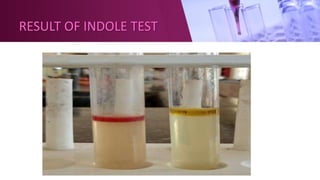
RESULT OF INDOLE TEST
 Positive Indole Test – Formation of Pink to Cherry red
ring.
 Negative Indole Test – No Cherry red ring.
 Indole Positive Bacteria – Escherichia coli, Proteus vulgaris,
Enterococcus faecalis, Klebsiella oxytoca, Flavobacterium sp.,
Haemophillus influenzae, Pasteurella multocida, Pasteurella
pneumotropica, Edwardsiella sp., Bacillus alveli, Aeromonas
hydrophila, Aeromonas punctata, Pleisomonas shigelloides and
Vibrio cholerae.
 Indole Negative Bacteria – Bacillus sp., Lactobacillus sp., Klebsiella
pneumoniae, Proteus mirabilis, Salmonella sp., Shigella sonnei,
Pseudomonas sp., Serratia sp., Yersinia sp., Pasteurella haemolytica,
Pasteurella ureae, Haemophillus sp., Enterobacter sp., Aeromonas
salmonicidia and Alcaligenes sp.
METHYL RED TEST(MR) TEST
METHYL RED (MR)TEST
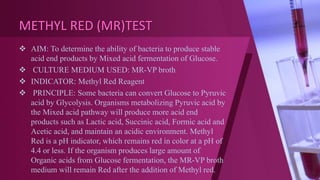
 AIM: To determine the ability of bacteria to produce stable
acid end products by Mixed acid fermentation of Glucose.
 CULTURE MEDIUM USED: MR-VP broth
 INDICATOR: Methyl Red Reagent
 PRINCIPLE: Some bacteria can convert Glucose to Pyruvic
acid by Glycolysis. Organisms metabolizing Pyruvic acid by
the Mixed acid pathway will produce more acid end
products such as Lactic acid, Succinic acid, Formic acid and
Acetic acid, and maintain an acidic environment. Methyl
Red is a pH indicator, which remains red in color at a pH of
4.4 or less. If the organism produces large amount of
Organic acids from Glucose fermentation, the MR-VP broth
medium will remain Red after the addition of Methyl red.
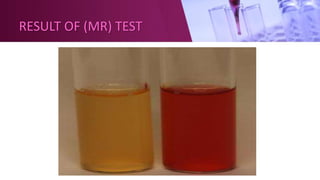
RESULT OF (MR) TEST
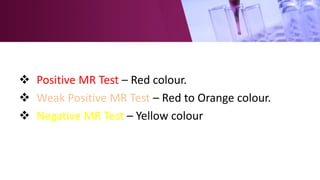
 Positive MR Test – Red colour.
 Weak Positive MR Test – Red to Orange colour.
 Negative MR Test – Yellow colour
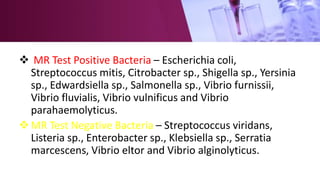
 MR Test Positive Bacteria – Escherichia coli,
Streptococcus mitis, Citrobacter sp., Shigella sp., Yersinia
sp., Edwardsiella sp., Salmonella sp., Vibrio furnissii,
Vibrio fluvialis, Vibrio vulnificus and Vibrio
parahaemolyticus.
MR Test Negative Bacteria – Streptococcus viridans,
Listeria sp., Enterobacter sp., Klebsiella sp., Serratia
marcescens, Vibrio eltor and Vibrio alginolyticus.
VOGES PROSKAUER
(VP) TEST
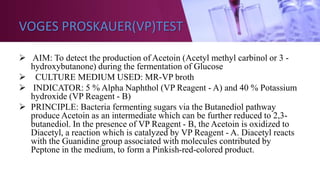
VOGES PROSKAUER(VP)TEST
 AIM: To detect the production of Acetoin (Acetyl methyl carbinol or 3 -
hydroxybutanone) during the fermentation of Glucose
 CULTURE MEDIUM USED: MR-VP broth
 INDICATOR: 5 % Alpha Naphthol (VP Reagent - A) and 40 % Potassium
hydroxide (VP Reagent - B)
 PRINCIPLE: Bacteria fermenting sugars via the Butanediol pathway
produce Acetoin as an intermediate which can be further reduced to 2,3-
butanediol. In the presence of VP Reagent - B, the Acetoin is oxidized to
Diacetyl, a reaction which is catalyzed by VP Reagent - A. Diacetyl reacts
with the Guanidine group associated with molecules contributed by
Peptone in the medium, to form a Pinkish-red-colored product.
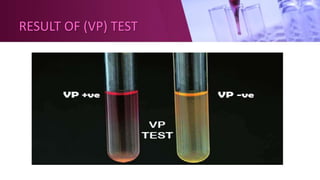
RESULT OF (VP) TEST
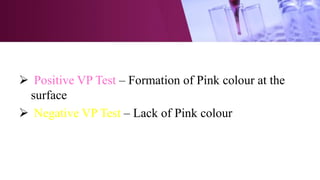
 Positive VP Test – Formation of Pink colour at the
surface
 Negative VP Test – Lack of Pink colour
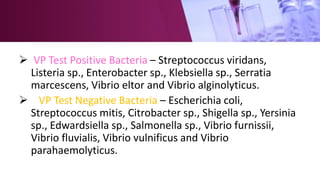
 VP Test Positive Bacteria – Streptococcus viridans,
Listeria sp., Enterobacter sp., Klebsiella sp., Serratia
marcescens, Vibrio eltor and Vibrio alginolyticus.
 VP Test Negative Bacteria – Escherichia coli,
Streptococcus mitis, Citrobacter sp., Shigella sp., Yersinia
sp., Edwardsiella sp., Salmonella sp., Vibrio furnissii,
Vibrio fluvialis, Vibrio vulnificus and Vibrio
parahaemolyticus.
CITRATE UTILIZATION TEST
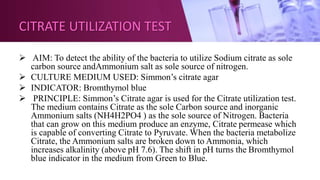
 AIM: To detect the ability of the bacteria to utilize Sodium citrate as sole
carbon source andAmmonium salt as sole source of nitrogen.
 CULTURE MEDIUM USED: Simmon’s citrate agar
 INDICATOR: Bromthymol blue
 PRINCIPLE: Simmon’s Citrate agar is used for the Citrate utilization test.
The medium contains Citrate as the sole Carbon source and inorganic
Ammonium salts (NH4H2PO4 ) as the sole source of Nitrogen. Bacteria
that can grow on this medium produce an enzyme, Citrate permease which
is capable of converting Citrate to Pyruvate. When the bacteria metabolize
Citrate, the Ammonium salts are broken down to Ammonia, which
increases alkalinity (above pH 7.6). The shift in pH turns the Bromthymol
blue indicator in the medium from Green to Blue.
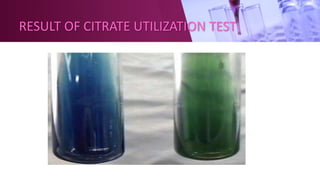
RESULT OF CITRATE UTILIZATION TEST
 Positive Citrate Utilization Test – Colour change of
slant from Green to Blue
 Negative Citrate utilization Test – No colour change
of slant. Slant remain Green colour.
 Citrate Utilization Positive Bacteria – Salmonella sp.,
Edwardsiella sp., Citrobacter sp., Klebsiella sp.,
Enterobacter sp., Serratia sp., Providencia sp. and
Vibrio vulnificus.
 Citrate Utilization Negative Bacteria – Escherichia
coli, Shigella sp.,Morganella sp. &Yersinia sp.
IMVIC lecture video ppt.pptx

IMVIC lecture video ppt.pptx

  • 1.
    A.SATHIYARAJI Dr,P.Saranraj,MSc,PhD,NET. BP221518 Departmentof Microbiology MSc Applied Microbiology Sacred Heart College(Autonomous) Sacred Heart College-TPT. Thirupathur-635601 IMVIC TEST
  • 2.
    INDOLE TEST  AIM:To detect the ability of the microorganisms to degrade the amino acidTryptophan and produce Indole.  CULTURE MEDIUM USED:Tryptophan Broth  INDICATOR: Kovac’s Reagent or Ehrlich Reagent (Anaerobic bacteria)  PRINCIPLE: The amino acid Tryptophan present in the Tryptophan Broth is acted upon by the enzyme Tryptophanase produced by bacteria and converted into Indole, Pyruvic acid and Ammonia.  Indole reacts with the Indicator Kovac’s reagent or Ehrlich’s reagent and produce Red colour ring at the top.
  • 3.
  • 4.
     Positive IndoleTest – Formation of Pink to Cherry red ring.  Negative Indole Test – No Cherry red ring.
  • 5.
     Indole PositiveBacteria – Escherichia coli, Proteus vulgaris, Enterococcus faecalis, Klebsiella oxytoca, Flavobacterium sp., Haemophillus influenzae, Pasteurella multocida, Pasteurella pneumotropica, Edwardsiella sp., Bacillus alveli, Aeromonas hydrophila, Aeromonas punctata, Pleisomonas shigelloides and Vibrio cholerae.  Indole Negative Bacteria – Bacillus sp., Lactobacillus sp., Klebsiella pneumoniae, Proteus mirabilis, Salmonella sp., Shigella sonnei, Pseudomonas sp., Serratia sp., Yersinia sp., Pasteurella haemolytica, Pasteurella ureae, Haemophillus sp., Enterobacter sp., Aeromonas salmonicidia and Alcaligenes sp.
  • 6.
  • 7.
    METHYL RED (MR)TEST AIM: To determine the ability of bacteria to produce stable acid end products by Mixed acid fermentation of Glucose.  CULTURE MEDIUM USED: MR-VP broth  INDICATOR: Methyl Red Reagent  PRINCIPLE: Some bacteria can convert Glucose to Pyruvic acid by Glycolysis. Organisms metabolizing Pyruvic acid by the Mixed acid pathway will produce more acid end products such as Lactic acid, Succinic acid, Formic acid and Acetic acid, and maintain an acidic environment. Methyl Red is a pH indicator, which remains red in color at a pH of 4.4 or less. If the organism produces large amount of Organic acids from Glucose fermentation, the MR-VP broth medium will remain Red after the addition of Methyl red.
  • 8.
  • 9.
     Positive MRTest – Red colour.  Weak Positive MR Test – Red to Orange colour.  Negative MR Test – Yellow colour
  • 10.
     MR TestPositive Bacteria – Escherichia coli, Streptococcus mitis, Citrobacter sp., Shigella sp., Yersinia sp., Edwardsiella sp., Salmonella sp., Vibrio furnissii, Vibrio fluvialis, Vibrio vulnificus and Vibrio parahaemolyticus. MR Test Negative Bacteria – Streptococcus viridans, Listeria sp., Enterobacter sp., Klebsiella sp., Serratia marcescens, Vibrio eltor and Vibrio alginolyticus.
  • 11.
  • 12.
    VOGES PROSKAUER(VP)TEST  AIM:To detect the production of Acetoin (Acetyl methyl carbinol or 3 - hydroxybutanone) during the fermentation of Glucose  CULTURE MEDIUM USED: MR-VP broth  INDICATOR: 5 % Alpha Naphthol (VP Reagent - A) and 40 % Potassium hydroxide (VP Reagent - B)  PRINCIPLE: Bacteria fermenting sugars via the Butanediol pathway produce Acetoin as an intermediate which can be further reduced to 2,3- butanediol. In the presence of VP Reagent - B, the Acetoin is oxidized to Diacetyl, a reaction which is catalyzed by VP Reagent - A. Diacetyl reacts with the Guanidine group associated with molecules contributed by Peptone in the medium, to form a Pinkish-red-colored product.
  • 13.
  • 14.
     Positive VPTest – Formation of Pink colour at the surface  Negative VP Test – Lack of Pink colour
  • 15.
     VP TestPositive Bacteria – Streptococcus viridans, Listeria sp., Enterobacter sp., Klebsiella sp., Serratia marcescens, Vibrio eltor and Vibrio alginolyticus.  VP Test Negative Bacteria – Escherichia coli, Streptococcus mitis, Citrobacter sp., Shigella sp., Yersinia sp., Edwardsiella sp., Salmonella sp., Vibrio furnissii, Vibrio fluvialis, Vibrio vulnificus and Vibrio parahaemolyticus.
  • 16.
  • 17.
    CITRATE UTILIZATION TEST AIM: To detect the ability of the bacteria to utilize Sodium citrate as sole carbon source andAmmonium salt as sole source of nitrogen.  CULTURE MEDIUM USED: Simmon’s citrate agar  INDICATOR: Bromthymol blue  PRINCIPLE: Simmon’s Citrate agar is used for the Citrate utilization test. The medium contains Citrate as the sole Carbon source and inorganic Ammonium salts (NH4H2PO4 ) as the sole source of Nitrogen. Bacteria that can grow on this medium produce an enzyme, Citrate permease which is capable of converting Citrate to Pyruvate. When the bacteria metabolize Citrate, the Ammonium salts are broken down to Ammonia, which increases alkalinity (above pH 7.6). The shift in pH turns the Bromthymol blue indicator in the medium from Green to Blue.
  • 18.
    RESULT OF CITRATEUTILIZATION TEST
  • 19.
     Positive CitrateUtilization Test – Colour change of slant from Green to Blue  Negative Citrate utilization Test – No colour change of slant. Slant remain Green colour.
  • 20.
     Citrate UtilizationPositive Bacteria – Salmonella sp., Edwardsiella sp., Citrobacter sp., Klebsiella sp., Enterobacter sp., Serratia sp., Providencia sp. and Vibrio vulnificus.  Citrate Utilization Negative Bacteria – Escherichia coli, Shigella sp.,Morganella sp. &Yersinia sp.