1. Introduction
2. Concept of Biodiversity and its types
3. Benefits of Biodiversity
4. Threats to Biodiversity
5. Conservation of Biodiversity
6. Importance of biodiversity
7. Conclusion
8. Reference
Contents
The term Biodiversity was first coined by Walter G. Rosen in
1986.
 The biosphere comprises of a complex collections of
innumerable organisms, known as the Biodiversity, which
constitute the vital life support for survival of human race.
Biological diversity, abbreviated as biodiversity, represent
the sum total of various life forms such as unicellular fungi,
protozoa, bacteria, and multi cellular organisms such as plants,
fishes, and mammals at various biological levels including
gens, habitats, and ecosystem .
Bio =
Biodiversity
What does “Bio” means?
Biodiversity
Diversity = Variety
What does “Diversity” means?
1. Diversity of genes
Each member of any animal or plants
species differs widely from other individual
in its genetic makeup.
for ex- Chihuahuas, beagles, and rottweilers are all the
same species —but they're not the same because there is
variety in their genes.
Chihuahua Beagle
Rottweilers
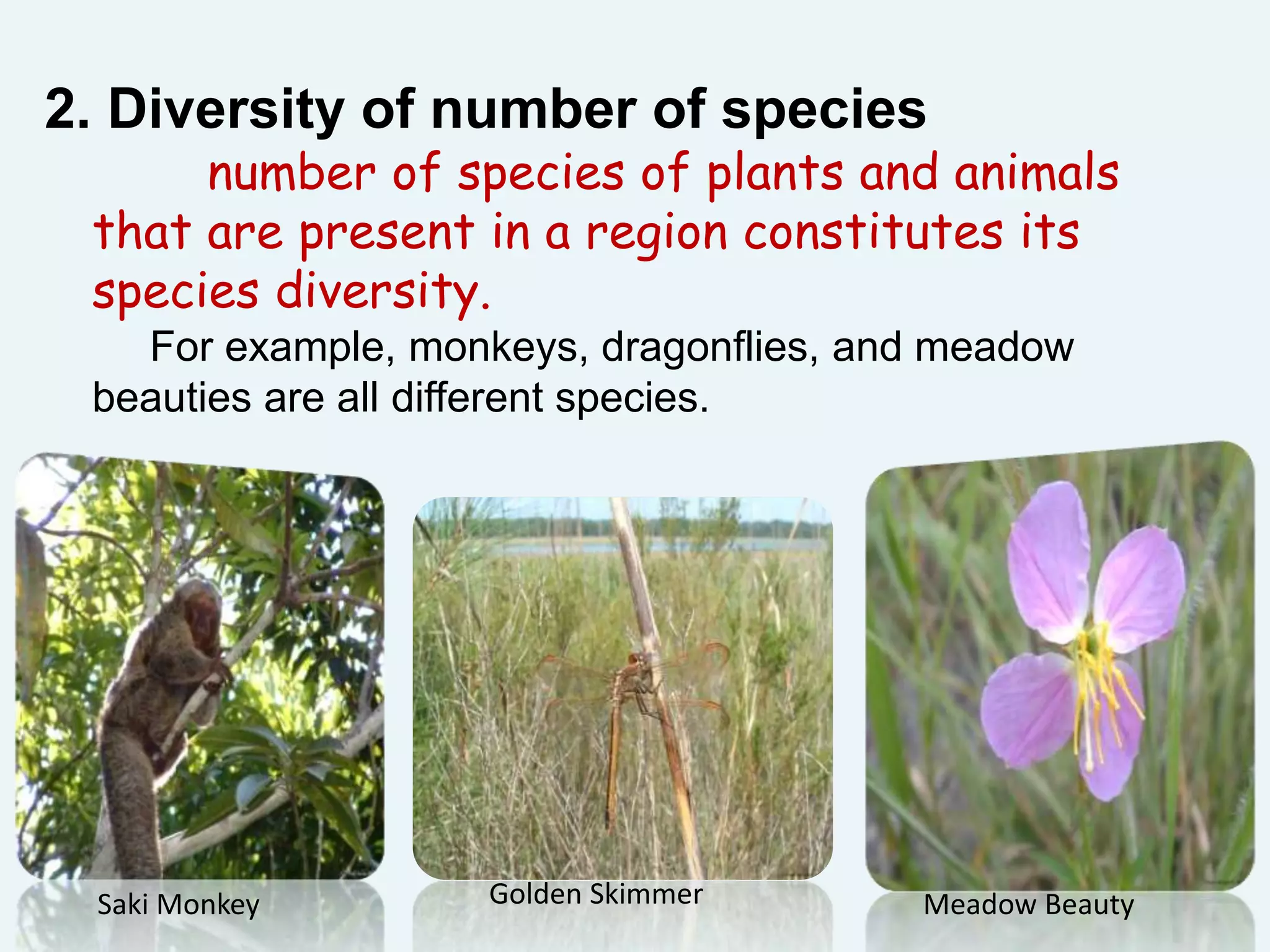
2. Diversity of number of species
number of species of plants and animals
that are present in a region constitutes its
species diversity.
For example, monkeys, dragonflies, and meadow
beauties are all different species.
Saki Monkey Golden Skimmer Meadow Beauty
There are large variety of different
ecosystems on earth. Each having their
own complement of distinctive interlinked
species based on the differences in the
habitat
3. Variety of ecosystems
Lakes, Ponds, and Rivers are all Freshwater
Ecosystems.
 Rocky coast, Sand Dune, Estuary, Salt Marsh , Coral
Reef are all Marine Ecosystems.
Consumptive value:
 Food/Drink
 Fuel
 Medicine
 Batter crop varieties
 Industrial Material
Non-Consumptive Value:
 Recreation
 Education and Research
 Traditional value
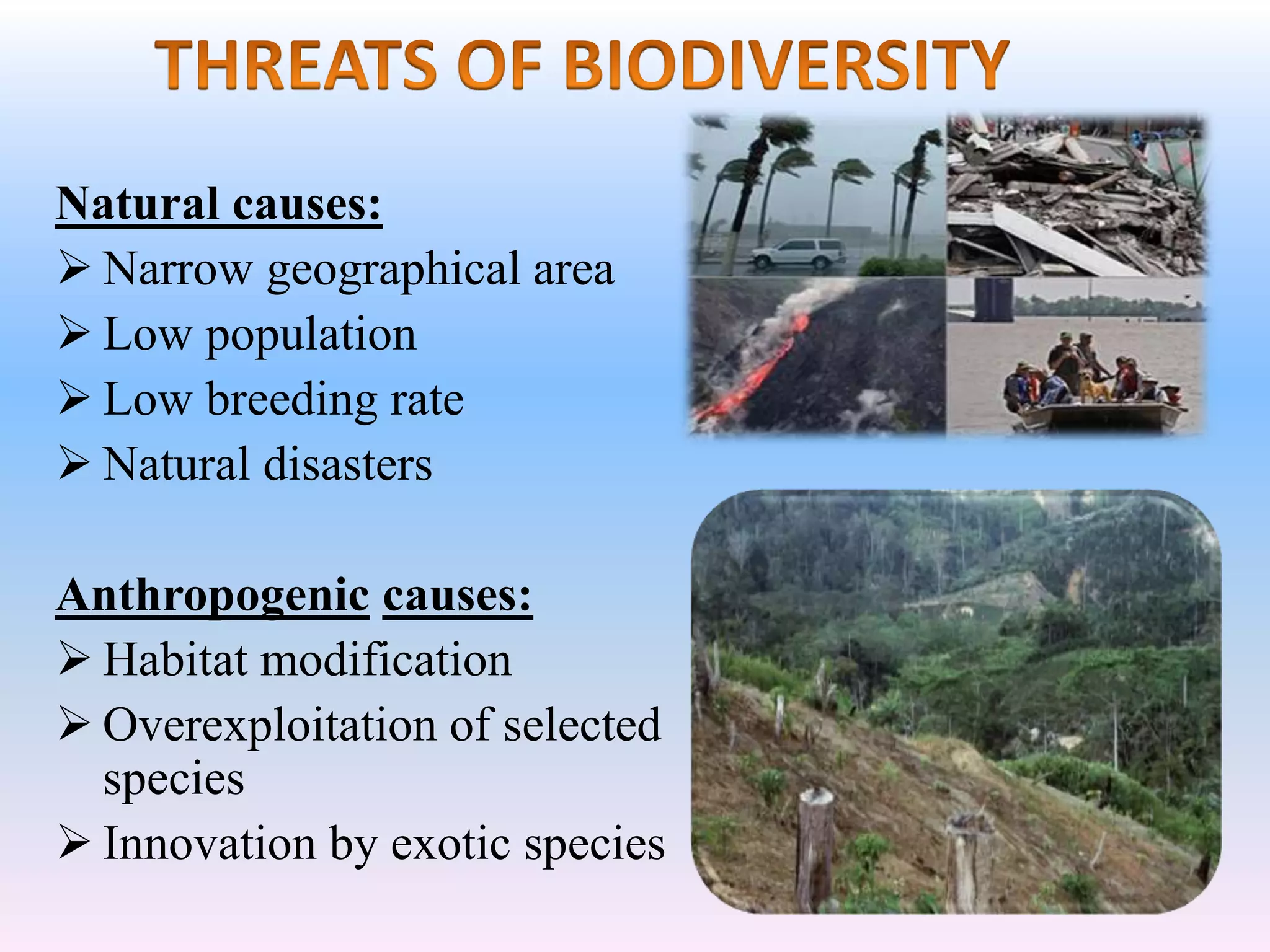
Natural causes:
 Narrow geographical area
 Low population
 Low breeding rate
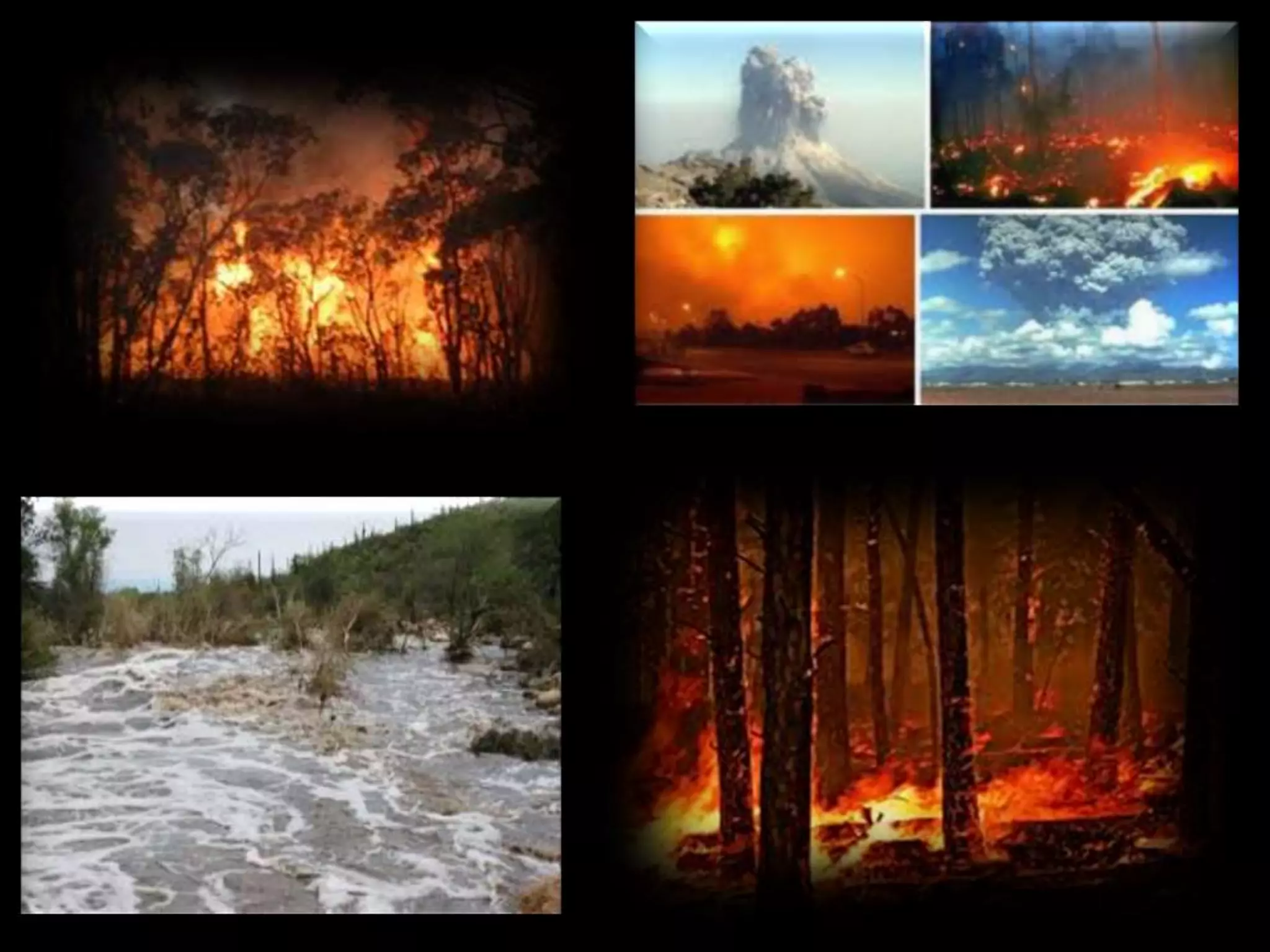
 Natural disasters
Anthropogenic causes:
 Habitat modification
 Overexploitation of selected
species
 Innovation by exotic species
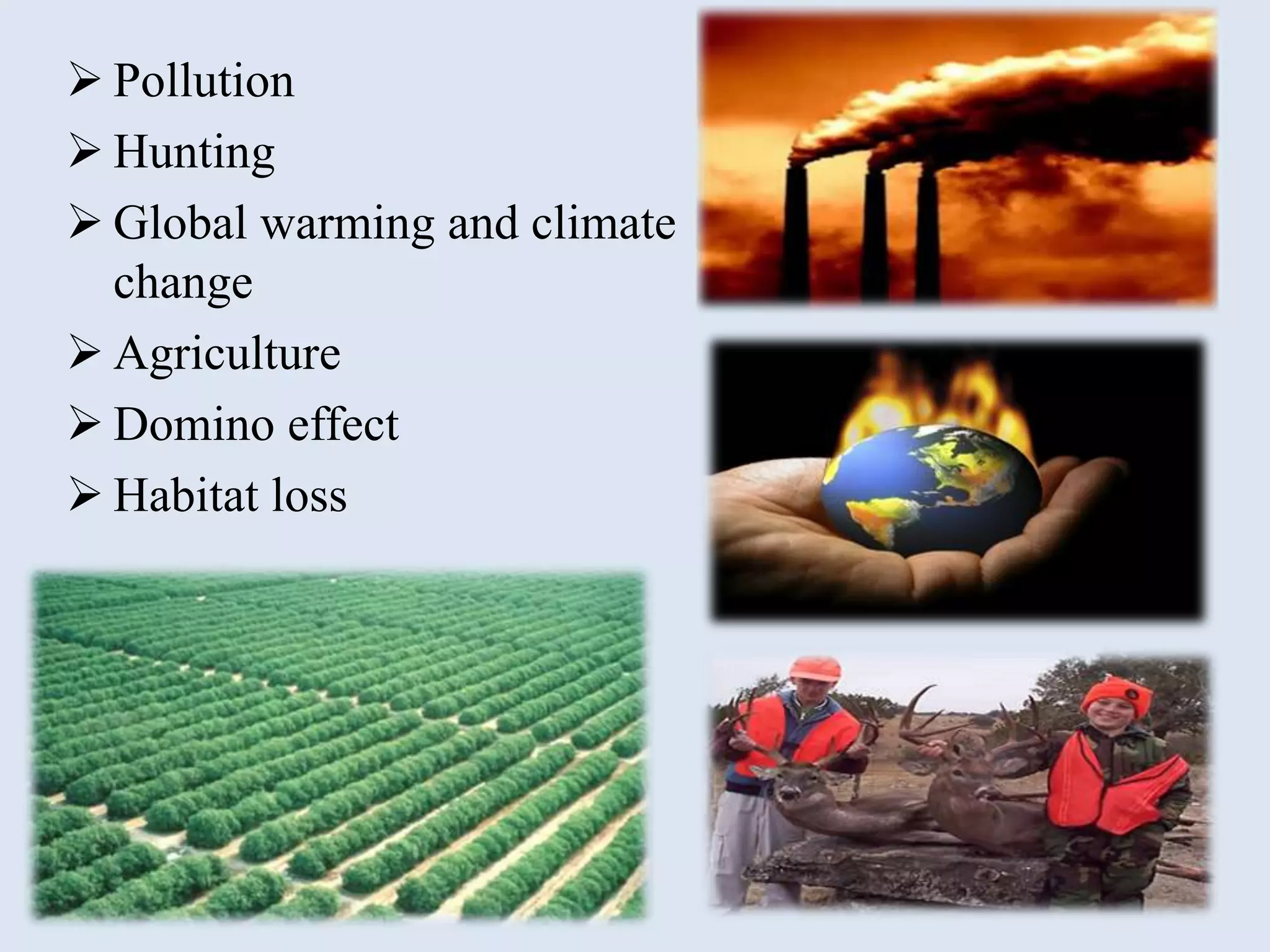
 Pollution
 Hunting
 Global warming and climate
change
 Agriculture
 Domino effect
 Habitat loss
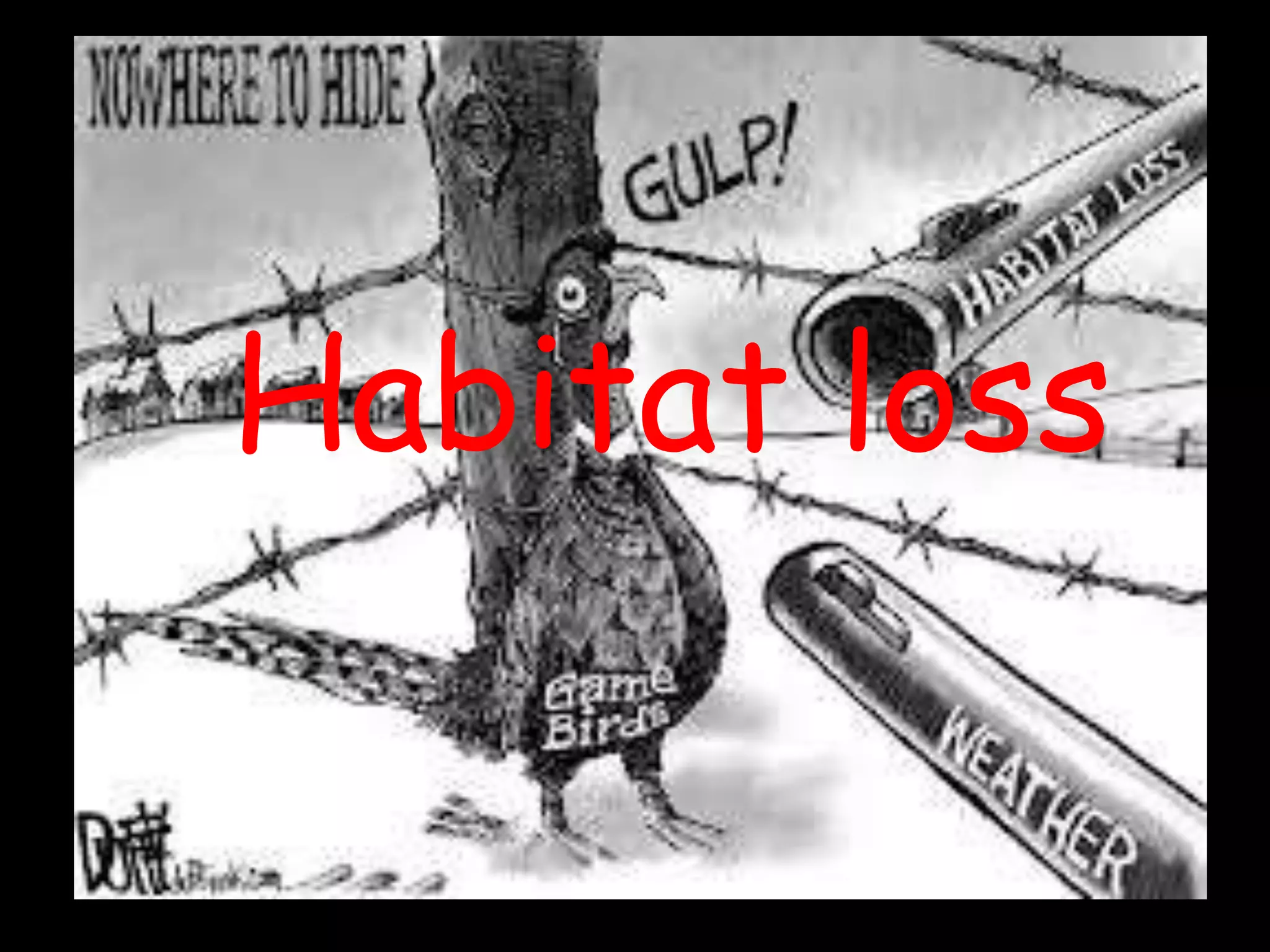
Habitat loss
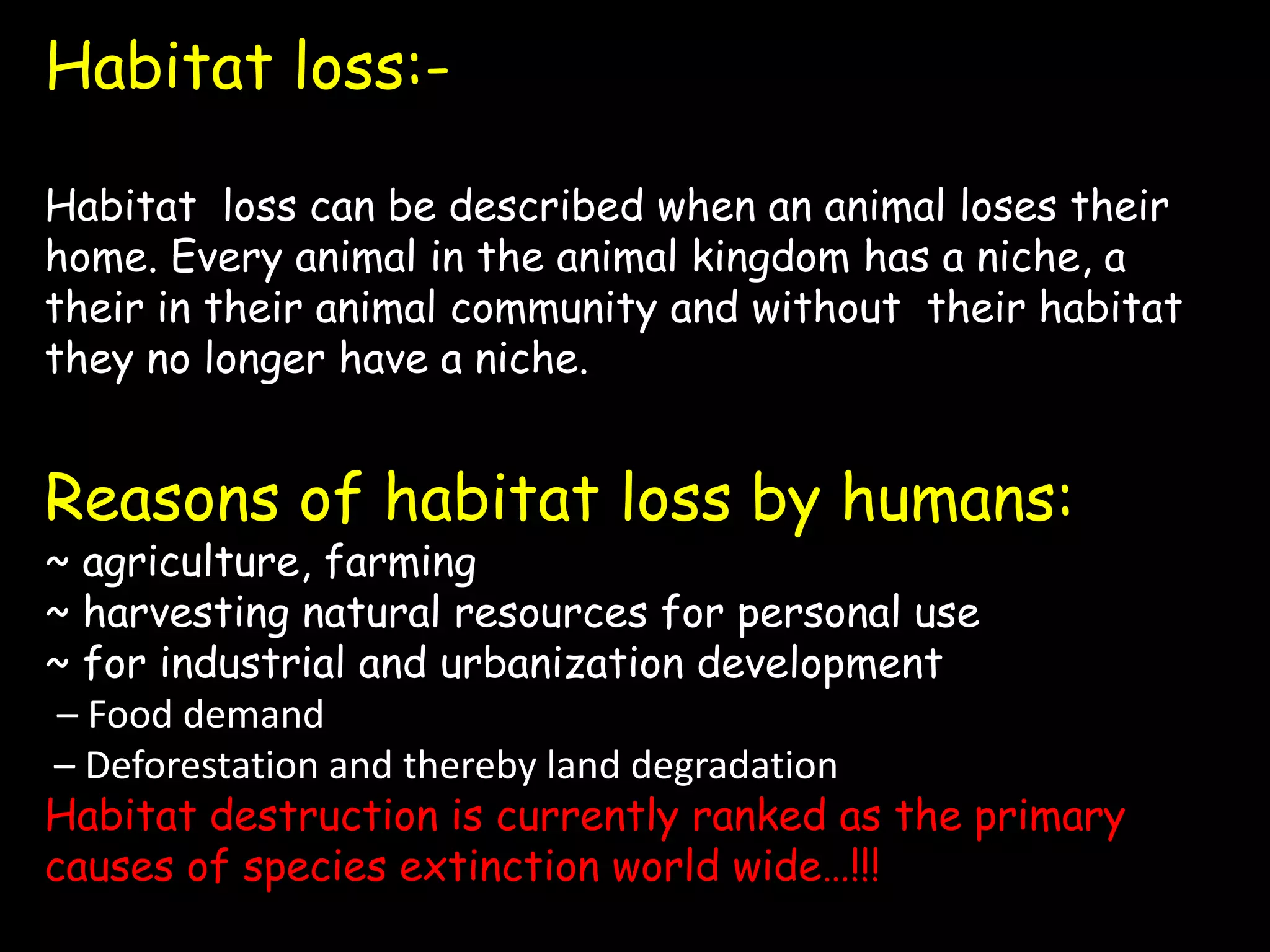
Habitat loss:-
Habitat loss can be described when an animal loses their
home. Every animal in the animal kingdom has a niche, a
their in their animal community and without their habitat
they no longer have a niche.
Reasons of habitat loss by humans:
~ agriculture, farming
~ harvesting natural resources for personal use
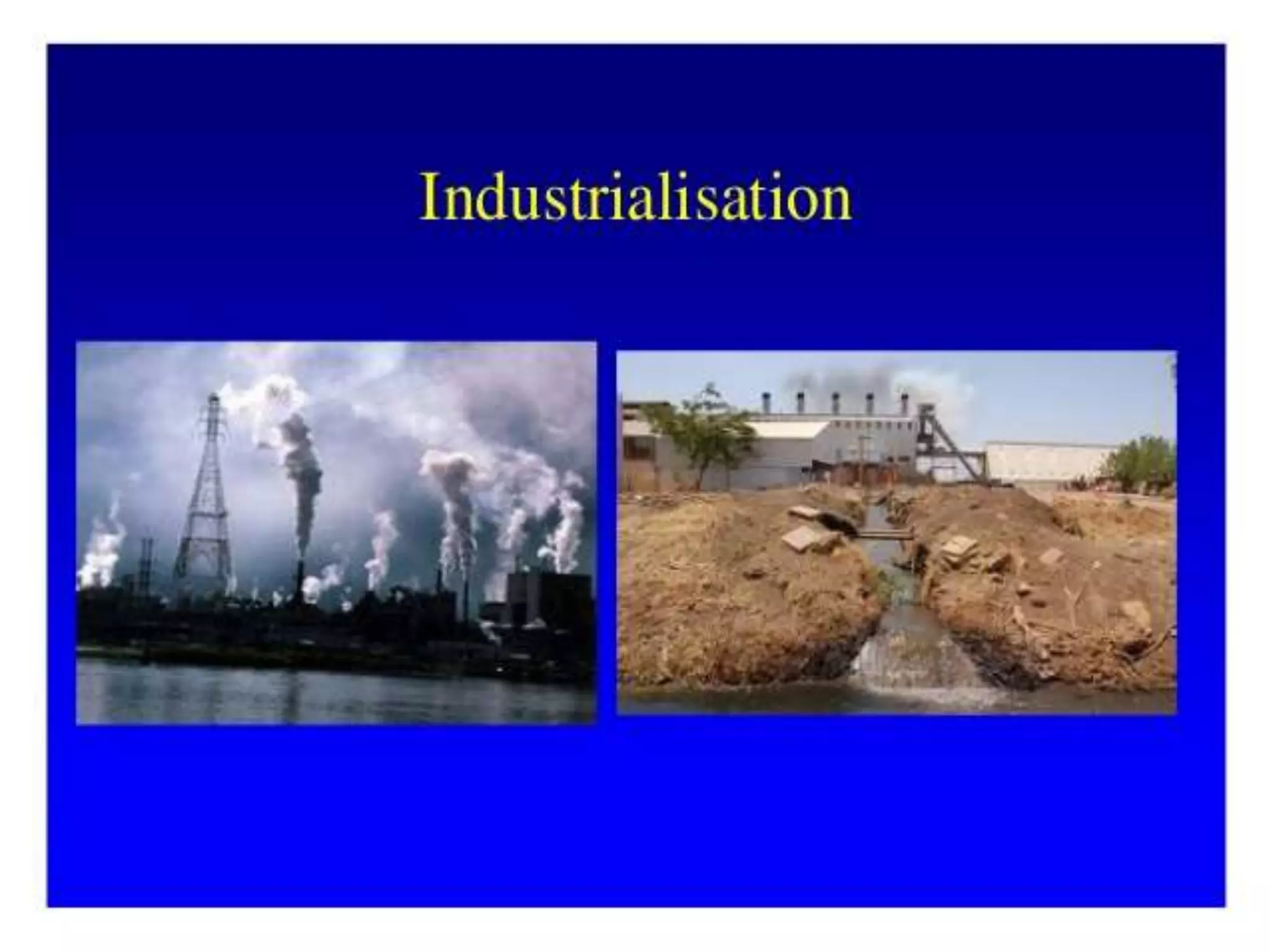
~ for industrial and urbanization development
– Food demand
– Deforestation and thereby land degradation
Habitat destruction is currently ranked as the primary
causes of species extinction world wide…!!!
Solutions on for this..
~ Protecting remaining intact section of natural
habitat.
~ Reduce human population and expansion of
urbanisation and industries.
~ Educating the public about the importance of
natural habitat and bio diversity.
~Solutions to habitat loss can include planting trees,
planting home gardens so as to reduce need for man to
need large lands for agricultural farms which lead to
habitat loss.
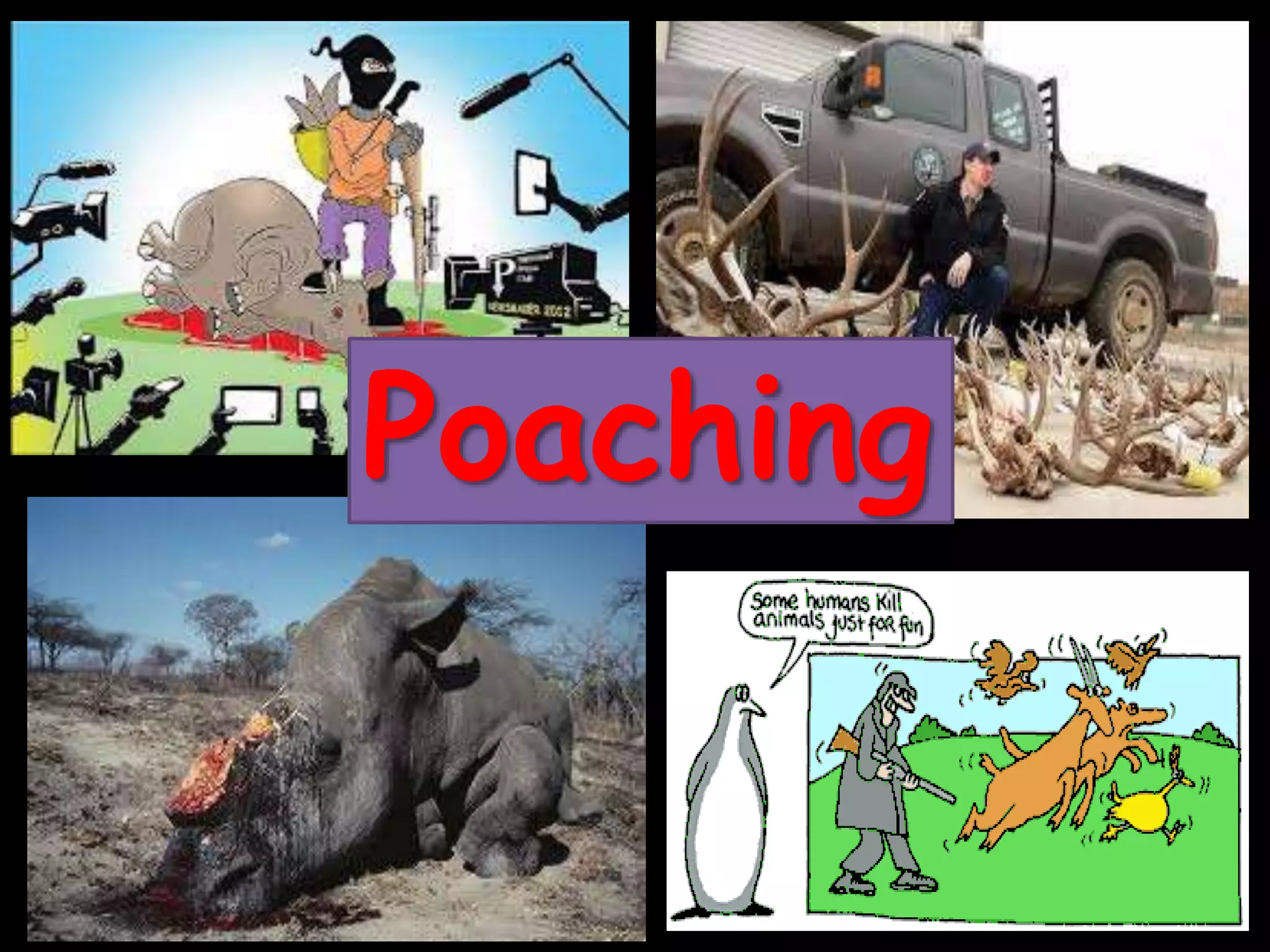
Poaching
Poaching:-
Poaching is the hunting and harvesting taking of wild
plants or animals, such as
through hunting, harvesting, fishing, or trapping.
History of poaching
~ Millions of years ago, in the Stone Age
~Followed through the ages, to even the
tribal natives
~but it was during the Late Middle Ages that
poaching became a punishable offense
Why Poaching is done???
~ Poaching is done for large profits gained
by the illegal sale or trade of animal parts,
meat and pelts.
~ Exists because there is a demand for these
products, caused by a lack of education or
disregard for the law amongst the
buyers
~ Many cultures believe that certain animal
parts have medicinal value.
Poaching is not limited to animals
its also for plants too…………!
Three of the most often poached species in the park
are galax, black cohosh, and ginseng.
GALAX BLACK COHOSH GINSENG
How does poaching affect the
environment?
~Poaching or illegal hunting causes animals endangered
of being extinct. If more animals becomes extinct
there's a disruption in the food chain, and that will
cause major problems in our ecosystem, resulting
eventually in new adaptations of animals, and or
species beyond human control.
~Poaching results in animals being hunted too soon for
them to have time to reproduce and repopulate.
 Biodiversity inventories
 Conserving Biodiversity in protected Habitats-
• In situ conservation
• Ex situ conservation
 Seed Bank, Gene Bank, Pollen Bank, DNA
Bank
Gene Bank
zoo
Bandhavgarh National Park
 The term insitu conservation denotes
conservation of species in its natural habitat ,that is
where the species is normally found.
 The insitu conservation strategies stress on
protection of total ecosystems through a network
of protected areas
 This is a conservation of species outside their
habitat.
1. Seed bank, gene bank, germplasm bank
2. Translocation area
3. Botanical parks
4. Zoological parks
Biodiversity
Conservation
In situ
Sacred
groves and
lakes
Biosphere
Reserves
Terrestrial
Marine
National
parks, wildlife
sanctuaries
Ex situ
Sacred plant home
garden
Seed Bank, Gene
bank,
Cryopreservation
Botanical garden,
Zoological garden,
Aquaria
BIODIVERSITY IN INDIA
Source- Based on Kumar et.al 2000
Categories No. of Indian
Species
% of Indian species
Evaluated
Species Threatened
In India
Mammals 386 59 41%
Birds 1219 _ 7%
Reptiles 495 73 46%
Amphibians 207 79 57%
Freshwater Fish 700 46 70%
 Generation of soils and maintenance of soil
quality
 Maintenance of air quality
 Maintenance of water quality
 Pest control
 Detoxification and decomposition of wastes
 Pollination and crop production
 Climate stabilization
 Prevention and mitigation of natural disasters
 Provision of food security
So…..please conserve the
Nature….
CONCLUSION
Biodiversity is our life. If the Biodiversity got lost at
this rate then in near future, the survival of human
being will be threatened. So, it is our moral duty to
conserve Biodiversity as well our Environment. Long-
term maintenance of species and their management
requires co-operative efforts across entire landscapes.
Biodiversity should be dealt with at scale of habitats or
ecosystems rather than at species level.
REFERENCES
 Roy Sovan, Environmental Science, Publishing Syndicate , 2003,
Kolkata.
 Dara.S.S., Environmental chemistry and Pollution Control, S.chand
& company Ltd., New Delhi
 Schulze Ernst- Detlef, Mooney Harold, Biodiversity and Ecosystem
Function, Springer- Verlag, London
 Mohapatra Pradipta Kumar, Textbook of Environmental
Biotechnology, I.K. International pub. House pvt.
Ltd.,2006, New Delhi
 Khan. T. I. Global Biodiversity and Environmental Conservation,
Pointer Publishers, 2001, Jaipur
 www.eolss.net
 www.ibc2010.com
MYSORE

Bio diversity by shreedhar beese

  • 3.
    1. Introduction 2. Conceptof Biodiversity and its types 3. Benefits of Biodiversity 4. Threats to Biodiversity 5. Conservation of Biodiversity 6. Importance of biodiversity 7. Conclusion 8. Reference Contents
  • 4.
    The term Biodiversitywas first coined by Walter G. Rosen in 1986.  The biosphere comprises of a complex collections of innumerable organisms, known as the Biodiversity, which constitute the vital life support for survival of human race. Biological diversity, abbreviated as biodiversity, represent the sum total of various life forms such as unicellular fungi, protozoa, bacteria, and multi cellular organisms such as plants, fishes, and mammals at various biological levels including gens, habitats, and ecosystem .
  • 5.
  • 6.
    Biodiversity Diversity = Variety Whatdoes “Diversity” means?
  • 8.
    1. Diversity ofgenes Each member of any animal or plants species differs widely from other individual in its genetic makeup. for ex- Chihuahuas, beagles, and rottweilers are all the same species —but they're not the same because there is variety in their genes. Chihuahua Beagle Rottweilers
  • 9.
    2. Diversity ofnumber of species number of species of plants and animals that are present in a region constitutes its species diversity. For example, monkeys, dragonflies, and meadow beauties are all different species. Saki Monkey Golden Skimmer Meadow Beauty
  • 10.
    There are largevariety of different ecosystems on earth. Each having their own complement of distinctive interlinked species based on the differences in the habitat 3. Variety of ecosystems Lakes, Ponds, and Rivers are all Freshwater Ecosystems.  Rocky coast, Sand Dune, Estuary, Salt Marsh , Coral Reef are all Marine Ecosystems.
  • 12.
    Consumptive value:  Food/Drink Fuel  Medicine  Batter crop varieties  Industrial Material Non-Consumptive Value:  Recreation  Education and Research  Traditional value
  • 13.
    Natural causes:  Narrowgeographical area  Low population  Low breeding rate  Natural disasters Anthropogenic causes:  Habitat modification  Overexploitation of selected species  Innovation by exotic species
  • 14.
     Pollution  Hunting Global warming and climate change  Agriculture  Domino effect  Habitat loss
  • 15.
  • 17.
    Habitat loss:- Habitat losscan be described when an animal loses their home. Every animal in the animal kingdom has a niche, a their in their animal community and without their habitat they no longer have a niche. Reasons of habitat loss by humans: ~ agriculture, farming ~ harvesting natural resources for personal use ~ for industrial and urbanization development – Food demand – Deforestation and thereby land degradation Habitat destruction is currently ranked as the primary causes of species extinction world wide…!!!
  • 19.
    Solutions on forthis.. ~ Protecting remaining intact section of natural habitat. ~ Reduce human population and expansion of urbanisation and industries. ~ Educating the public about the importance of natural habitat and bio diversity. ~Solutions to habitat loss can include planting trees, planting home gardens so as to reduce need for man to need large lands for agricultural farms which lead to habitat loss.
  • 22.
  • 23.
    Poaching:- Poaching is thehunting and harvesting taking of wild plants or animals, such as through hunting, harvesting, fishing, or trapping. History of poaching ~ Millions of years ago, in the Stone Age ~Followed through the ages, to even the tribal natives ~but it was during the Late Middle Ages that poaching became a punishable offense
  • 25.
    Why Poaching isdone??? ~ Poaching is done for large profits gained by the illegal sale or trade of animal parts, meat and pelts. ~ Exists because there is a demand for these products, caused by a lack of education or disregard for the law amongst the buyers ~ Many cultures believe that certain animal parts have medicinal value.
  • 27.
    Poaching is notlimited to animals its also for plants too…………! Three of the most often poached species in the park are galax, black cohosh, and ginseng. GALAX BLACK COHOSH GINSENG
  • 28.
    How does poachingaffect the environment? ~Poaching or illegal hunting causes animals endangered of being extinct. If more animals becomes extinct there's a disruption in the food chain, and that will cause major problems in our ecosystem, resulting eventually in new adaptations of animals, and or species beyond human control. ~Poaching results in animals being hunted too soon for them to have time to reproduce and repopulate.
  • 29.
     Biodiversity inventories Conserving Biodiversity in protected Habitats- • In situ conservation • Ex situ conservation  Seed Bank, Gene Bank, Pollen Bank, DNA Bank Gene Bank zoo Bandhavgarh National Park
  • 30.
     The terminsitu conservation denotes conservation of species in its natural habitat ,that is where the species is normally found.  The insitu conservation strategies stress on protection of total ecosystems through a network of protected areas
  • 31.
     This isa conservation of species outside their habitat. 1. Seed bank, gene bank, germplasm bank 2. Translocation area 3. Botanical parks 4. Zoological parks
  • 32.
    Biodiversity Conservation In situ Sacred groves and lakes Biosphere Reserves Terrestrial Marine National parks,wildlife sanctuaries Ex situ Sacred plant home garden Seed Bank, Gene bank, Cryopreservation Botanical garden, Zoological garden, Aquaria
  • 33.
    BIODIVERSITY IN INDIA Source-Based on Kumar et.al 2000 Categories No. of Indian Species % of Indian species Evaluated Species Threatened In India Mammals 386 59 41% Birds 1219 _ 7% Reptiles 495 73 46% Amphibians 207 79 57% Freshwater Fish 700 46 70%
  • 35.
     Generation ofsoils and maintenance of soil quality  Maintenance of air quality  Maintenance of water quality  Pest control  Detoxification and decomposition of wastes  Pollination and crop production  Climate stabilization  Prevention and mitigation of natural disasters  Provision of food security
  • 36.
  • 37.
    CONCLUSION Biodiversity is ourlife. If the Biodiversity got lost at this rate then in near future, the survival of human being will be threatened. So, it is our moral duty to conserve Biodiversity as well our Environment. Long- term maintenance of species and their management requires co-operative efforts across entire landscapes. Biodiversity should be dealt with at scale of habitats or ecosystems rather than at species level.
  • 38.
    REFERENCES  Roy Sovan,Environmental Science, Publishing Syndicate , 2003, Kolkata.  Dara.S.S., Environmental chemistry and Pollution Control, S.chand & company Ltd., New Delhi  Schulze Ernst- Detlef, Mooney Harold, Biodiversity and Ecosystem Function, Springer- Verlag, London  Mohapatra Pradipta Kumar, Textbook of Environmental Biotechnology, I.K. International pub. House pvt. Ltd.,2006, New Delhi  Khan. T. I. Global Biodiversity and Environmental Conservation, Pointer Publishers, 2001, Jaipur  www.eolss.net  www.ibc2010.com
  • 40.