DepartmentofMechanicalEngineering Humility Entrepreneurship Teamwork
Learning Social Responsibility Respect for IndividualDeliver The Promise
GMRInstituteofTechnology,Rajam
Name of the student
J.Komal
15341A0121
Under the Guidance of
Mr.K.S.B PRASAD
Assistant Professor
Dept. of CIVIL ENGINEERING
BIO CONCRETE
DepartmentofMechanicalEngineering Humility Entrepreneurship Teamwork
Learning Social Responsibility Respect for IndividualDeliver The Promise
GMRInstituteofTechnology,Rajam
TABLE OF CONTENTS
 ABSTRACT
 INTRODUCTION
 LITERATURE REVIEW
 METHODOLOGY
 PREPARATION
 COMPOSITION AND TESTS
 APPLICATIONS
 ADVANTAGES AND DISADVANTAGES
 CONCLUSION
 REFERENCE
28 November 2017
DepartmentofMechanicalEngineering Humility Entrepreneurship Teamwork
Learning Social Responsibility Respect for IndividualDeliver The Promise
GMRInstituteofTechnology,Rajam
ABSTRACT
This paper gives a brief description of the various properties of concrete
which vary with the addition of bacteria.
Due to improper design, temperature effects like freezing and shrinkage
which causes deformation and produce cracks in the structures. Cracks
are one of the major weaknesses of concrete which leads to the
structural failure.
As regular manual maintenance and repair of concrete constructions is
costly and in some cases not at all possible, inclusion of an autonomous
self healing repair mechanism would be highly beneficial as it could
both reduce maintenance and increase material durability.
DepartmentofMechanicalEngineering Humility Entrepreneurship Teamwork
Learning Social Responsibility Respect for IndividualDeliver The Promise
GMRInstituteofTechnology,Rajam
INTRODUCTION
 Concrete is a vital building material that is an absolutely essential component
of construction practice. It is also a very brittle material with low tolerance for
strain, so it is commonly expected to crack with time . In order to rectify these
cracks, bio concrete is used.
 Bio concrete is the special type of concrete which invented by Microbiologist
Hendrik Jonkers .
 Bio concrete is also called as Bacterial concrete and self healing concrete.
 It is mainly made to improve the strength and durability of concrete.The
development of self-healing concrete technology has become one of the most
important researcher's objectives in the field of civil engineering sciences and
biotechnology in recent years.
48 November 2017
DepartmentofMechanicalEngineering Humility Entrepreneurship Teamwork
Learning Social Responsibility Respect for IndividualDeliver The Promise
GMRInstituteofTechnology,Rajam
LITERATURE REVIEW
 Z.P.Bhathena and NamrataGadkar have published a paper about on
Bacterial concrete, a novel approach for increasing its durability. In this paper a
total of six samples were collected from different sites such as mangrove area.
From these samples the calcite precipitating organisms which precipitate
calcium carbonate by means of ureolysis were screened.
 Hendrik Jonkers and Erik Schlangen have published a paper on
Development of a bacteria-based self healing concrete. In this paper Bacillus
cohnii, Bacillus halodurans and Bacillus pseudofirmus species were obtained
from the German Collection of Microorganisms and Cell cultures. The bacteria
cultures were cleaned from medium residues by centrifugation, washing and
resuspension of the cell pellet in tap water. The cement samples were made
incorporating the suspension and are tested.
58 November 2017
DepartmentofMechanicalEngineering Humility Entrepreneurship Teamwork
Learning Social Responsibility Respect for IndividualDeliver The Promise
GMRInstituteofTechnology,Rajam
METHODOLOGY
68 November 2017
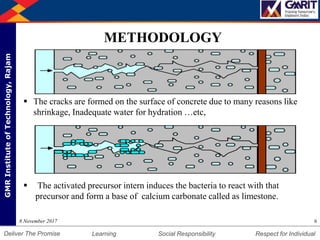
 The cracks are formed on the surface of concrete due to many reasons like
shrinkage, Inadequate water for hydration …etc,
 The activated precursor intern induces the bacteria to react with that
precursor and form a base of calcium carbonate called as limestone.
DepartmentofMechanicalEngineering Humility Entrepreneurship Teamwork
Learning Social Responsibility Respect for IndividualDeliver The Promise
GMRInstituteofTechnology,Rajam
CONT…
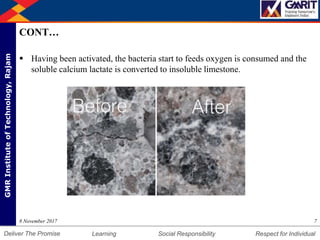
 Having been activated, the bacteria start to feeds oxygen is consumed and the
soluble calcium lactate is converted to insoluble limestone.
78 November 2017
DepartmentofMechanicalEngineering Humility Entrepreneurship Teamwork
Learning Social Responsibility Respect for IndividualDeliver The Promise
GMRInstituteofTechnology,Rajam
PREPARATION
PREPARATION OF BACTERIAL SOLUTION :-
 Primarily 12.5g of Nutrient broth (media) is added to a 500ml conical flask
containing distilled water.
 It is then covered with a thick cotton plug and is made air tight with paper
and rubber band.
 It is then sterilized using a cooker for about 10-20 minutes. Now the
solution is free from any contaminants and the solution is clear orange in
colour before the addition of the bacteria.
 Later the flasks are opened up and kept in a shaker at a speed of 150- 200
rpm overnight.
88 November 2017
DepartmentofMechanicalEngineering Humility Entrepreneurship Teamwork
Learning Social Responsibility Respect for IndividualDeliver The Promise
GMRInstituteofTechnology,Rajam
CONT…
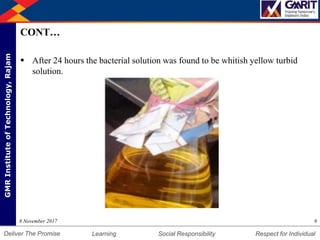
 After 24 hours the bacterial solution was found to be whitish yellow turbid
solution.
98 November 2017
DepartmentofMechanicalEngineering Humility Entrepreneurship Teamwork
Learning Social Responsibility Respect for IndividualDeliver The Promise
GMRInstituteofTechnology,Rajam
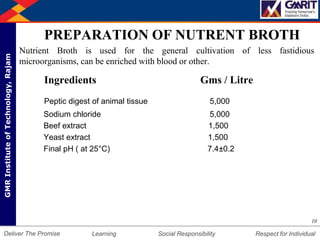
PREPARATION OF NUTRENT BROTH
Nutrient Broth is used for the general cultivation of less fastidious
microorganisms, can be enriched with blood or other.
Ingredients Gms / Litre
Peptic digest of animal tissue 5,000
Sodium chloride 5,000
Beef extract 1,500
Yeast extract 1,500
Final pH ( at 25°C) 7.4±0.2
10
DepartmentofMechanicalEngineering Humility Entrepreneurship Teamwork
Learning Social Responsibility Respect for IndividualDeliver The Promise
GMRInstituteofTechnology,Rajam
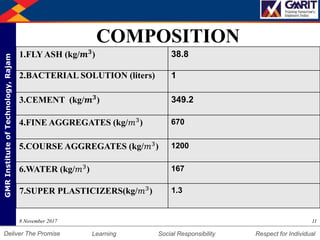
COMPOSITION
2.BACTERIAL SOLUTION (liters) 1
118 November 2017
3.CEMENT (kg/𝒎 𝟑
) 349.2
4.FINE AGGREGATES (kg/𝑚3) 670
5.COURSE AGGREGATES (kg/𝑚3) 1200
6.WATER (kg/𝑚3
) 167
1.FLY ASH (kg/𝒎 𝟑) 38.8
7.SUPER PLASTICIZERS(kg/𝑚3) 1.3
DepartmentofMechanicalEngineering Humility Entrepreneurship Teamwork
Learning Social Responsibility Respect for IndividualDeliver The Promise
GMRInstituteofTechnology,Rajam
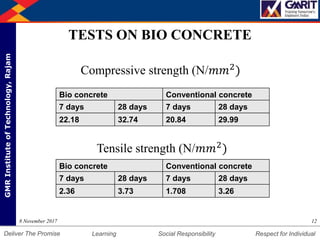
TESTS ON BIO CONCRETE
128 November 2017
Bio concrete Conventional concrete
7 days 28 days 7 days 28 days
22.18 32.74 20.84 29.99
Compressive strength (N/𝑚𝑚2)
Tensile strength (N/𝑚𝑚2)
Bio concrete Conventional concrete
7 days 28 days 7 days 28 days
2.36 3.73 1.708 3.26
DepartmentofMechanicalEngineering Humility Entrepreneurship Teamwork
Learning Social Responsibility Respect for IndividualDeliver The Promise
GMRInstituteofTechnology,Rajam
138 November 2017
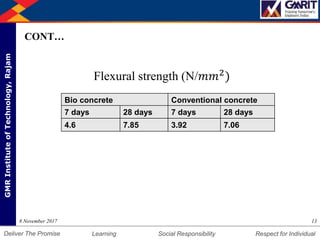
Flexural strength (N/𝑚𝑚2)
Bio concrete Conventional concrete
7 days 28 days 7 days 28 days
4.6 7.85 3.92 7.06
CONT…
DepartmentofMechanicalEngineering Humility Entrepreneurship Teamwork
Learning Social Responsibility Respect for IndividualDeliver The Promise
GMRInstituteofTechnology,Rajam
APPLICATION
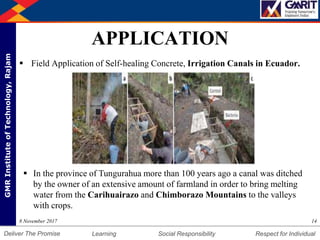
 Field Application of Self-healing Concrete, Irrigation Canals in Ecuador.
148 November 2017
 In the province of Tungurahua more than 100 years ago a canal was ditched
by the owner of an extensive amount of farmland in order to bring melting
water from the Carihuairazo and Chimborazo Mountains to the valleys
with crops.
DepartmentofMechanicalEngineering Humility Entrepreneurship Teamwork
Learning Social Responsibility Respect for IndividualDeliver The Promise
GMRInstituteofTechnology,Rajam
 In this region the air temperature varies between 5ºC and 20°C with sometimes
temperatures below zero. The canal runs from an altitude of 3200 to 2700
meters above sea level.
 The length of this canal is of approximately 24 kilometres. During the 60’s the
land was distributed among the farmers who worked it and the canal remain as
property of this community.
 For decades the efficiency of the canal was low since about 70% of the water
was loss due to evaporation or infiltration into the soil.
 To improve the efficiency the farmers together with local authorities casted
concrete linings in the canal without any steel reinforcement. Within a year the
concrete linings started cracking. The cracks lead to decrease the yield of the
canal again.
 Delft University of Technology, together with Foundation Imagine (NL) and
the Catholic University of Santiago de Guayaquil (Ecuador) proposed the use of
self-healing concrete reinforced with natural fibres as a viable solution to
improve the sustainability and performance of this irrigation system.
158 November 2017
DepartmentofMechanicalEngineering Humility Entrepreneurship Teamwork
Learning Social Responsibility Respect for IndividualDeliver The Promise
GMRInstituteofTechnology,Rajam
CONT…
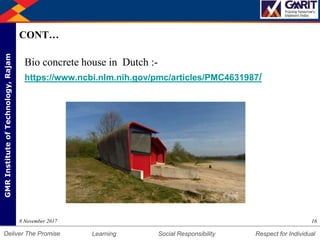
Bio concrete house in Dutch :-
https://www.ncbi.nlm.nih.gov/pmc/articles/PMC4631987/
168 November 2017
DepartmentofMechanicalEngineering Humility Entrepreneurship Teamwork
Learning Social Responsibility Respect for IndividualDeliver The Promise
GMRInstituteofTechnology,Rajam
 Three years ago, we learned that a Dutch team had developed a biological
concrete that could repair its own cracks. They said it might be two or three
years before it found its way into the larger world—and now, we’re getting
a look at its real-world applications.
 The concrete is a collaboration between two scientists named Eric
Schlangen and Henk Jonkers, who are profiled today in an update on their
research from CNN. The duo first made news in 2012, when they
introduced their “biocement,” which uses bacteria to patch up the cracks in
concrete that lead to structural degradation.
 Here’s how it works: Traditional concrete aggregate is mixed with bacteria
and capsules of calcium lactate. When a crack in the concrete forms, water
seeps in and “activates” the bacteria, which is hard-wired to eat calcium
lactate. When it does, it produces calcite—an ingredient of limestone—that
accumulates to fill the space between the crack.
178 November 2017
DepartmentofMechanicalEngineering Humility Entrepreneurship Teamwork
Learning Social Responsibility Respect for IndividualDeliver The Promise
GMRInstituteofTechnology,Rajam
188 November 2017
ADVANTAGES
 The use of bio concrete significantly influences the strength of concrete.
 It has lower permeability than conventional concrete.
 It offers great resistance to freeze-thaw attacks.
 The chances of corrosion in reinforcement are reduced.
 Remedying of cracks can be done efficiently.
 Maintenance cost of this concrete is low.
 The durability of concrete is 200 years.
DepartmentofMechanicalEngineering Humility Entrepreneurship Teamwork
Learning Social Responsibility Respect for IndividualDeliver The Promise
GMRInstituteofTechnology,Rajam
DISADVANTAGES
 Design of bacterial concrete is not mentioned in IS codes or any other
codes.
 Cost of this concrete is comparatively higher than conventional concrete
i.e. about 7-28% more than conventional concrete.
 The investigations involved in calcite precipitation are costly.
198 November 2017
DepartmentofMechanicalEngineering Humility Entrepreneurship Teamwork
Learning Social Responsibility Respect for IndividualDeliver The Promise
GMRInstituteofTechnology,Rajam
CONCLUSION
 Hence, self healing concrete is crack resistant.
 Which protects the concrete and reinforcement from cracks and from
corrosion.
 By doing this, it prevents water to percolate into reinforced steel concrete
and hence it does not comes in contact with reinforcements.
208 November 2017
DepartmentofMechanicalEngineering Humility Entrepreneurship Teamwork
Learning Social Responsibility Respect for IndividualDeliver The Promise
GMRInstituteofTechnology,Rajam
REFERENCE
 Antonopoulou, S. Self healing in ECC materials with high content of different
microfibers and micro particles, MSc Thesis, Delft University of Technology, 2009
 De Muynck, W., Debrouwer, D., De Belie, N., Verstraete, W., 2008. Bacterial
carbonate precipitation improves the durability of cementations materials. Cement
& Concrete Res. 38, 1005–1014.
 De Muynck, W., Debrouwer, D., De Belie, N., Verstraete, W., 2008. Bacterial
carbonate precipitation improves the durability of cementations materials. Cement
& Concrete Res. 38, 1005–1014.
 Jonkers, HM & Schlangen, E. (2009a). Bacteria-based self healing concrete.
International journal of restoration of buildings and monuments, 15(4), 255- 265.
 Jonkers, HM, Thijssen, A, Muijzer, G, Copuroglu, O & Schlangen, E. (2009b).
Application of bacteria as selfhealing agent for the development of sustainable
concrete. Ecological engineering, 1-6.
 M.Biswasa, S.Majumdar, T.Chowdhury, B. Chattopadhyay, S.Mandal, U.
Halder, S. Yamasaki, “Bioremediase a unique protein from a novel
bacterium.
218 November 2017
DepartmentofMechanicalEngineering Humility Entrepreneurship Teamwork
Learning Social Responsibility Respect for IndividualDeliver The Promise
GMRInstituteofTechnology,Rajam
CONT…
 D. A.Stevens, J. R.Hamilton, N.Johnson, K. K. Kim, J. S. Lee,“Halomonas, a newly
recognized human pathogen causing infections and contamination in a dialysis center:
three new species,” Medicine (Baltimore), 88(4), 244-249, 2009.
 A. Buu-Hoi, C. Branger, F. J. Acar,“Vancomycinresistant Streptococci or
Leuconostoc sp.,” Antimicrob Agents Chemother., 28:458–60, 1985.
 R. Facklam , J. A. Elliott , “Identification, classification, and clinical relevance of
catalase-negative, gram-positive cocci, excluding Streptococci and
Enterococci,” ClinMicrobiol Rev., 8, 479–95, 1995.
 J.Wang, K. V.Tittelboom, N.De Belie, W.Verstraete,“Use of silica gel or
polyurethane immobilized bacteria for selfhealing concrete,” Construction and
Building Materials. 26, 532–540, 2012.
 Healthcare-associated Infections (HAIs), Acinetobacter in Healthcare Settings,
last accessed on 12/31/2014,
http://www.cdc.gov/HAI/organisms/acinetobacter.html,20 14.
 Min, W., Björn, J. & Mette , G., 2012. A review: Self-healing in cementitious
materials and engineered cementitious composite as a self-healing material.
Construction and Building Materials, Volume 28, pp. 571-583. Blaiszik, B. J. et
al., 2010. Self-Healing Polymers and Composites, Illinois: University of Illinois.
228 November 2017
DepartmentofMechanicalEngineering Humility Entrepreneurship Teamwork
Learning Social Responsibility Respect for IndividualDeliver The Promise
GMRInstituteofTechnology,Rajam
• Gundersen JK, Jorgensen BB. Microstructure of diffusive boundary-layers and the
oxygen-uptake of the sea-floor. Nature 1990;345:604–7
• Gerard B, Marchand J. Influence of cracking on the diffusion properties of cement-
based materials – part I: influence of continuous cracks on the steadystate regime.
Cem Concr Res 2000;30:37–43.
• Schlangen E, Joseph C. Self-healing processes in concrete. In: Gosh SK, editor.
Self-healing materials: fundamentals, design strategies, and applications.
Weinheim: Wiley-VCH verlag GmbH and Co KGaA; 2009. p. 141–82.
• Edvardsen C. Water permeability and autogenous healing of cracks in concrete.
ACI Mater J 1999;96:448–54.
238 November 2017
DepartmentofMechanicalEngineering Humility Entrepreneurship Teamwork
Learning Social Responsibility Respect for IndividualDeliver The Promise
GMRInstituteofTechnology,Rajam
248 November 2017
Thank You

BIO CONCRETE

  • 1.
    DepartmentofMechanicalEngineering Humility EntrepreneurshipTeamwork Learning Social Responsibility Respect for IndividualDeliver The Promise GMRInstituteofTechnology,Rajam Name of the student J.Komal 15341A0121 Under the Guidance of Mr.K.S.B PRASAD Assistant Professor Dept. of CIVIL ENGINEERING BIO CONCRETE
  • 2.
    DepartmentofMechanicalEngineering Humility EntrepreneurshipTeamwork Learning Social Responsibility Respect for IndividualDeliver The Promise GMRInstituteofTechnology,Rajam TABLE OF CONTENTS  ABSTRACT  INTRODUCTION  LITERATURE REVIEW  METHODOLOGY  PREPARATION  COMPOSITION AND TESTS  APPLICATIONS  ADVANTAGES AND DISADVANTAGES  CONCLUSION  REFERENCE 28 November 2017
  • 3.
    DepartmentofMechanicalEngineering Humility EntrepreneurshipTeamwork Learning Social Responsibility Respect for IndividualDeliver The Promise GMRInstituteofTechnology,Rajam ABSTRACT This paper gives a brief description of the various properties of concrete which vary with the addition of bacteria. Due to improper design, temperature effects like freezing and shrinkage which causes deformation and produce cracks in the structures. Cracks are one of the major weaknesses of concrete which leads to the structural failure. As regular manual maintenance and repair of concrete constructions is costly and in some cases not at all possible, inclusion of an autonomous self healing repair mechanism would be highly beneficial as it could both reduce maintenance and increase material durability.
  • 4.
    DepartmentofMechanicalEngineering Humility EntrepreneurshipTeamwork Learning Social Responsibility Respect for IndividualDeliver The Promise GMRInstituteofTechnology,Rajam INTRODUCTION  Concrete is a vital building material that is an absolutely essential component of construction practice. It is also a very brittle material with low tolerance for strain, so it is commonly expected to crack with time . In order to rectify these cracks, bio concrete is used.  Bio concrete is the special type of concrete which invented by Microbiologist Hendrik Jonkers .  Bio concrete is also called as Bacterial concrete and self healing concrete.  It is mainly made to improve the strength and durability of concrete.The development of self-healing concrete technology has become one of the most important researcher's objectives in the field of civil engineering sciences and biotechnology in recent years. 48 November 2017
  • 5.
    DepartmentofMechanicalEngineering Humility EntrepreneurshipTeamwork Learning Social Responsibility Respect for IndividualDeliver The Promise GMRInstituteofTechnology,Rajam LITERATURE REVIEW  Z.P.Bhathena and NamrataGadkar have published a paper about on Bacterial concrete, a novel approach for increasing its durability. In this paper a total of six samples were collected from different sites such as mangrove area. From these samples the calcite precipitating organisms which precipitate calcium carbonate by means of ureolysis were screened.  Hendrik Jonkers and Erik Schlangen have published a paper on Development of a bacteria-based self healing concrete. In this paper Bacillus cohnii, Bacillus halodurans and Bacillus pseudofirmus species were obtained from the German Collection of Microorganisms and Cell cultures. The bacteria cultures were cleaned from medium residues by centrifugation, washing and resuspension of the cell pellet in tap water. The cement samples were made incorporating the suspension and are tested. 58 November 2017
  • 6.
    DepartmentofMechanicalEngineering Humility EntrepreneurshipTeamwork Learning Social Responsibility Respect for IndividualDeliver The Promise GMRInstituteofTechnology,Rajam METHODOLOGY 68 November 2017  The cracks are formed on the surface of concrete due to many reasons like shrinkage, Inadequate water for hydration …etc,  The activated precursor intern induces the bacteria to react with that precursor and form a base of calcium carbonate called as limestone.
  • 7.
    DepartmentofMechanicalEngineering Humility EntrepreneurshipTeamwork Learning Social Responsibility Respect for IndividualDeliver The Promise GMRInstituteofTechnology,Rajam CONT…  Having been activated, the bacteria start to feeds oxygen is consumed and the soluble calcium lactate is converted to insoluble limestone. 78 November 2017
  • 8.
    DepartmentofMechanicalEngineering Humility EntrepreneurshipTeamwork Learning Social Responsibility Respect for IndividualDeliver The Promise GMRInstituteofTechnology,Rajam PREPARATION PREPARATION OF BACTERIAL SOLUTION :-  Primarily 12.5g of Nutrient broth (media) is added to a 500ml conical flask containing distilled water.  It is then covered with a thick cotton plug and is made air tight with paper and rubber band.  It is then sterilized using a cooker for about 10-20 minutes. Now the solution is free from any contaminants and the solution is clear orange in colour before the addition of the bacteria.  Later the flasks are opened up and kept in a shaker at a speed of 150- 200 rpm overnight. 88 November 2017
  • 9.
    DepartmentofMechanicalEngineering Humility EntrepreneurshipTeamwork Learning Social Responsibility Respect for IndividualDeliver The Promise GMRInstituteofTechnology,Rajam CONT…  After 24 hours the bacterial solution was found to be whitish yellow turbid solution. 98 November 2017
  • 10.
    DepartmentofMechanicalEngineering Humility EntrepreneurshipTeamwork Learning Social Responsibility Respect for IndividualDeliver The Promise GMRInstituteofTechnology,Rajam PREPARATION OF NUTRENT BROTH Nutrient Broth is used for the general cultivation of less fastidious microorganisms, can be enriched with blood or other. Ingredients Gms / Litre Peptic digest of animal tissue 5,000 Sodium chloride 5,000 Beef extract 1,500 Yeast extract 1,500 Final pH ( at 25°C) 7.4±0.2 10
  • 11.
    DepartmentofMechanicalEngineering Humility EntrepreneurshipTeamwork Learning Social Responsibility Respect for IndividualDeliver The Promise GMRInstituteofTechnology,Rajam COMPOSITION 2.BACTERIAL SOLUTION (liters) 1 118 November 2017 3.CEMENT (kg/𝒎 𝟑 ) 349.2 4.FINE AGGREGATES (kg/𝑚3) 670 5.COURSE AGGREGATES (kg/𝑚3) 1200 6.WATER (kg/𝑚3 ) 167 1.FLY ASH (kg/𝒎 𝟑) 38.8 7.SUPER PLASTICIZERS(kg/𝑚3) 1.3
  • 12.
    DepartmentofMechanicalEngineering Humility EntrepreneurshipTeamwork Learning Social Responsibility Respect for IndividualDeliver The Promise GMRInstituteofTechnology,Rajam TESTS ON BIO CONCRETE 128 November 2017 Bio concrete Conventional concrete 7 days 28 days 7 days 28 days 22.18 32.74 20.84 29.99 Compressive strength (N/𝑚𝑚2) Tensile strength (N/𝑚𝑚2) Bio concrete Conventional concrete 7 days 28 days 7 days 28 days 2.36 3.73 1.708 3.26
  • 13.
    DepartmentofMechanicalEngineering Humility EntrepreneurshipTeamwork Learning Social Responsibility Respect for IndividualDeliver The Promise GMRInstituteofTechnology,Rajam 138 November 2017 Flexural strength (N/𝑚𝑚2) Bio concrete Conventional concrete 7 days 28 days 7 days 28 days 4.6 7.85 3.92 7.06 CONT…
  • 14.
    DepartmentofMechanicalEngineering Humility EntrepreneurshipTeamwork Learning Social Responsibility Respect for IndividualDeliver The Promise GMRInstituteofTechnology,Rajam APPLICATION  Field Application of Self-healing Concrete, Irrigation Canals in Ecuador. 148 November 2017  In the province of Tungurahua more than 100 years ago a canal was ditched by the owner of an extensive amount of farmland in order to bring melting water from the Carihuairazo and Chimborazo Mountains to the valleys with crops.
  • 15.
    DepartmentofMechanicalEngineering Humility EntrepreneurshipTeamwork Learning Social Responsibility Respect for IndividualDeliver The Promise GMRInstituteofTechnology,Rajam  In this region the air temperature varies between 5ºC and 20°C with sometimes temperatures below zero. The canal runs from an altitude of 3200 to 2700 meters above sea level.  The length of this canal is of approximately 24 kilometres. During the 60’s the land was distributed among the farmers who worked it and the canal remain as property of this community.  For decades the efficiency of the canal was low since about 70% of the water was loss due to evaporation or infiltration into the soil.  To improve the efficiency the farmers together with local authorities casted concrete linings in the canal without any steel reinforcement. Within a year the concrete linings started cracking. The cracks lead to decrease the yield of the canal again.  Delft University of Technology, together with Foundation Imagine (NL) and the Catholic University of Santiago de Guayaquil (Ecuador) proposed the use of self-healing concrete reinforced with natural fibres as a viable solution to improve the sustainability and performance of this irrigation system. 158 November 2017
  • 16.
    DepartmentofMechanicalEngineering Humility EntrepreneurshipTeamwork Learning Social Responsibility Respect for IndividualDeliver The Promise GMRInstituteofTechnology,Rajam CONT… Bio concrete house in Dutch :- https://www.ncbi.nlm.nih.gov/pmc/articles/PMC4631987/ 168 November 2017
  • 17.
    DepartmentofMechanicalEngineering Humility EntrepreneurshipTeamwork Learning Social Responsibility Respect for IndividualDeliver The Promise GMRInstituteofTechnology,Rajam  Three years ago, we learned that a Dutch team had developed a biological concrete that could repair its own cracks. They said it might be two or three years before it found its way into the larger world—and now, we’re getting a look at its real-world applications.  The concrete is a collaboration between two scientists named Eric Schlangen and Henk Jonkers, who are profiled today in an update on their research from CNN. The duo first made news in 2012, when they introduced their “biocement,” which uses bacteria to patch up the cracks in concrete that lead to structural degradation.  Here’s how it works: Traditional concrete aggregate is mixed with bacteria and capsules of calcium lactate. When a crack in the concrete forms, water seeps in and “activates” the bacteria, which is hard-wired to eat calcium lactate. When it does, it produces calcite—an ingredient of limestone—that accumulates to fill the space between the crack. 178 November 2017
  • 18.
    DepartmentofMechanicalEngineering Humility EntrepreneurshipTeamwork Learning Social Responsibility Respect for IndividualDeliver The Promise GMRInstituteofTechnology,Rajam 188 November 2017 ADVANTAGES  The use of bio concrete significantly influences the strength of concrete.  It has lower permeability than conventional concrete.  It offers great resistance to freeze-thaw attacks.  The chances of corrosion in reinforcement are reduced.  Remedying of cracks can be done efficiently.  Maintenance cost of this concrete is low.  The durability of concrete is 200 years.
  • 19.
    DepartmentofMechanicalEngineering Humility EntrepreneurshipTeamwork Learning Social Responsibility Respect for IndividualDeliver The Promise GMRInstituteofTechnology,Rajam DISADVANTAGES  Design of bacterial concrete is not mentioned in IS codes or any other codes.  Cost of this concrete is comparatively higher than conventional concrete i.e. about 7-28% more than conventional concrete.  The investigations involved in calcite precipitation are costly. 198 November 2017
  • 20.
    DepartmentofMechanicalEngineering Humility EntrepreneurshipTeamwork Learning Social Responsibility Respect for IndividualDeliver The Promise GMRInstituteofTechnology,Rajam CONCLUSION  Hence, self healing concrete is crack resistant.  Which protects the concrete and reinforcement from cracks and from corrosion.  By doing this, it prevents water to percolate into reinforced steel concrete and hence it does not comes in contact with reinforcements. 208 November 2017
  • 21.
    DepartmentofMechanicalEngineering Humility EntrepreneurshipTeamwork Learning Social Responsibility Respect for IndividualDeliver The Promise GMRInstituteofTechnology,Rajam REFERENCE  Antonopoulou, S. Self healing in ECC materials with high content of different microfibers and micro particles, MSc Thesis, Delft University of Technology, 2009  De Muynck, W., Debrouwer, D., De Belie, N., Verstraete, W., 2008. Bacterial carbonate precipitation improves the durability of cementations materials. Cement & Concrete Res. 38, 1005–1014.  De Muynck, W., Debrouwer, D., De Belie, N., Verstraete, W., 2008. Bacterial carbonate precipitation improves the durability of cementations materials. Cement & Concrete Res. 38, 1005–1014.  Jonkers, HM & Schlangen, E. (2009a). Bacteria-based self healing concrete. International journal of restoration of buildings and monuments, 15(4), 255- 265.  Jonkers, HM, Thijssen, A, Muijzer, G, Copuroglu, O & Schlangen, E. (2009b). Application of bacteria as selfhealing agent for the development of sustainable concrete. Ecological engineering, 1-6.  M.Biswasa, S.Majumdar, T.Chowdhury, B. Chattopadhyay, S.Mandal, U. Halder, S. Yamasaki, “Bioremediase a unique protein from a novel bacterium. 218 November 2017
  • 22.
    DepartmentofMechanicalEngineering Humility EntrepreneurshipTeamwork Learning Social Responsibility Respect for IndividualDeliver The Promise GMRInstituteofTechnology,Rajam CONT…  D. A.Stevens, J. R.Hamilton, N.Johnson, K. K. Kim, J. S. Lee,“Halomonas, a newly recognized human pathogen causing infections and contamination in a dialysis center: three new species,” Medicine (Baltimore), 88(4), 244-249, 2009.  A. Buu-Hoi, C. Branger, F. J. Acar,“Vancomycinresistant Streptococci or Leuconostoc sp.,” Antimicrob Agents Chemother., 28:458–60, 1985.  R. Facklam , J. A. Elliott , “Identification, classification, and clinical relevance of catalase-negative, gram-positive cocci, excluding Streptococci and Enterococci,” ClinMicrobiol Rev., 8, 479–95, 1995.  J.Wang, K. V.Tittelboom, N.De Belie, W.Verstraete,“Use of silica gel or polyurethane immobilized bacteria for selfhealing concrete,” Construction and Building Materials. 26, 532–540, 2012.  Healthcare-associated Infections (HAIs), Acinetobacter in Healthcare Settings, last accessed on 12/31/2014, http://www.cdc.gov/HAI/organisms/acinetobacter.html,20 14.  Min, W., Björn, J. & Mette , G., 2012. A review: Self-healing in cementitious materials and engineered cementitious composite as a self-healing material. Construction and Building Materials, Volume 28, pp. 571-583. Blaiszik, B. J. et al., 2010. Self-Healing Polymers and Composites, Illinois: University of Illinois. 228 November 2017
  • 23.
    DepartmentofMechanicalEngineering Humility EntrepreneurshipTeamwork Learning Social Responsibility Respect for IndividualDeliver The Promise GMRInstituteofTechnology,Rajam • Gundersen JK, Jorgensen BB. Microstructure of diffusive boundary-layers and the oxygen-uptake of the sea-floor. Nature 1990;345:604–7 • Gerard B, Marchand J. Influence of cracking on the diffusion properties of cement- based materials – part I: influence of continuous cracks on the steadystate regime. Cem Concr Res 2000;30:37–43. • Schlangen E, Joseph C. Self-healing processes in concrete. In: Gosh SK, editor. Self-healing materials: fundamentals, design strategies, and applications. Weinheim: Wiley-VCH verlag GmbH and Co KGaA; 2009. p. 141–82. • Edvardsen C. Water permeability and autogenous healing of cracks in concrete. ACI Mater J 1999;96:448–54. 238 November 2017
  • 24.
    DepartmentofMechanicalEngineering Humility EntrepreneurshipTeamwork Learning Social Responsibility Respect for IndividualDeliver The Promise GMRInstituteofTechnology,Rajam 248 November 2017 Thank You