“BACTERIA BASED SELF HEALING CONCRETE”
SUHAAS M - 1SI20CV038
SIDDAGANGA INSTITUTE OF TECHNOLOGY, TUMAKURU
DEPARTMENT OF CIVIL ENGINEERING
TECHNICAL SEMINAR
on
PRESENTATION BY :
DATE : 9th December 2024
1
GUIDE : Dr. SREEDHARA B. M
Assistant Professor,
Dept. of Civil Engineering
CONTENTS
2
1. Introduction
2. Literature survey
3. Literature summary
4. Objectives
5. Methodology
6. Effects of Bacteria on concrete
7. References
• Microcracks are one of the miserable factors in concrete structures which we must need to look into.
• Due to external loading and chemical reactions, microcracks spreads, causing harmful species to enter the
concrete(corrosion, carbonation etc.) causing durability of the concrete to deteriorate.
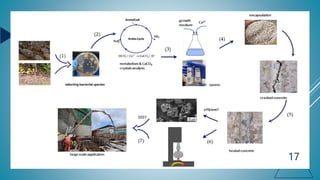
• Using Bacillus megaterium colony(popularly known for MICP-Microbial Induced Calcite Precipitation)
followed by suitable culturing process and with specified encapsulation technique.
INTRODUCTION
3
INTRODUCTION
• Self-healing efficiency is the regain in the functionality and desired quality criterion of a cement base
material relative to its original form, after healing from crack.
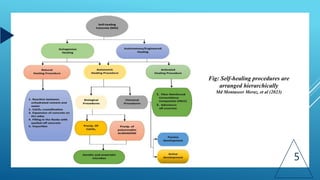
• Self-healing in concrete can be classified into two following groups.
• Autogenous healing : Caused naturally by binding materials, i.e., further hydration of un-hydrated
Portland cement. (Addition of fly ash and bacterial spores into the cementitious composition).
• Autonomous healing : Facilitate the production of self-healing concrete, encapsulated healing agents
are preferably added to the concrete mix during preparation
4
5
Fig: Self-healing procedures are
arranged hierarchically
Md Montaseer Meraz, et al (2023)
6
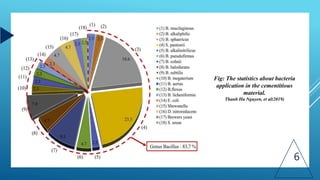
Fig: The statistics about bacteria
application in the cementitious
material.
Thanh Ha Nguyen, et al(2019)
LITERATURE REVIEWS
7
LITERATURE-1) Self-healing concrete by use of microencapsulated bacterial spores
• AUTHORS AND JOURNALS J.Y. Wang, et al.
Cement and Concrete Research
• YEAR OF PUBLISHING 27 November 2013
• OBJECTIVE To asses the self healing efficiency, influence of microcapsules,
Influence of incubation conditions, and effect of water
permeability.
• CONCLUSIONS The maximum crack width healed in the specimens of the
bacteria series was 970 μm, about 4 times that of the non-
bacteria series (max 250 μm).
The overall water permeability in the bacteria series was about
10 times lower than that in non-bacteria series. No self-healing
was observed in all specimens stored at 95%RH, indicating that
the presence of liquid water is an essential component
for self-healing.
8
LITERATURE-2) Bacteria-based repair and self-healing of concrete
• AUTHORS AND JOURNALS N. De Belie & J. Wang
Journal of sustainable cement based materials
• YEAR OF PUBLISHING 16 Oct 2015
• OBJECTIVE To assess different metabolic pathways of bacterial calcium
carbonate precipitation.
• CONCLUSIONS • Using MICP from urea hydrolysis for soil improvement has
been applied successfully on a scale of 1 m3 and the first
field test on large scale (100 m3has also been performed and
very promising efficiency was obtained.
9
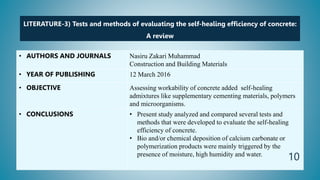
LITERATURE-3) Tests and methods of evaluating the self-healing efficiency of concrete:
A review
• AUTHORS AND JOURNALS Nasiru Zakari Muhammad
Construction and Building Materials
• YEAR OF PUBLISHING 12 March 2016
• OBJECTIVE Assessing workability of concrete added self-healing
admixtures like supplementary cementing materials, polymers
and microorganisms.
• CONCLUSIONS • Present study analyzed and compared several tests and
methods that were developed to evaluate the self-healing
efficiency of concrete.
• Bio and/or chemical deposition of calcium carbonate or
polymerization products were mainly triggered by the
presence of moisture, high humidity and water.
10
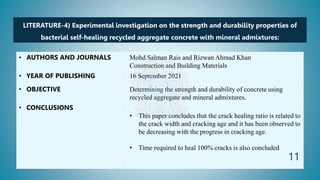
LITERATURE-4) Experimental investigation on the strength and durability properties of
bacterial self-healing recycled aggregate concrete with mineral admixtures:
• AUTHORS AND JOURNALS Mohd Salman Rais and Rizwan Ahmad Khan
Construction and Building Materials
• YEAR OF PUBLISHING 16 September 2021
• OBJECTIVE Determining the strength and durability of concrete using
recycled aggregate and mineral admixtures.
• CONCLUSIONS
• This paper concludes that the crack healing ratio is related to
the crack width and cracking age and it has been observed to
be decreasing with the progress in cracking age.
• Time required to heal 100% cracks is also concluded
11
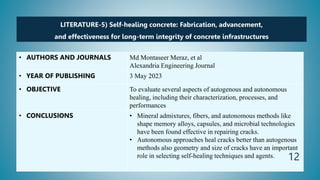
LITERATURE-5) Self-healing concrete: Fabrication, advancement,
and effectiveness for long-term integrity of concrete infrastructures
• AUTHORS AND JOURNALS Md Montaseer Meraz, et al
Alexandria Engineering Journal
• YEAR OF PUBLISHING 3 May 2023
• OBJECTIVE To evaluate several aspects of autogenous and autonomous
healing, including their characterization, processes, and
performances
• CONCLUSIONS • Mineral admixtures, fibers, and autonomous methods like
shape memory alloys, capsules, and microbial technologies
have been found effective in repairing cracks.
• Autonomous approaches heal cracks better than autogenous
methods also geometry and size of cracks have an important
role in selecting self-healing techniques and agents. 12
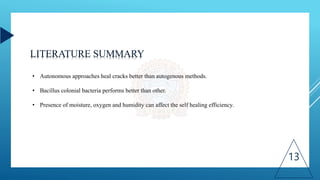
LITERATURE SUMMARY
13
• Autonomous approaches heal cracks better than autogenous methods.
• Bacillus colonial bacteria performs better than other.
• Presence of moisture, oxygen and humidity can affect the self healing efficiency.
OBJECTIVES
14
1) To investigate properties and self healing efficiency of Bacterial Self-healing concrete.
METHODOLOGY
15
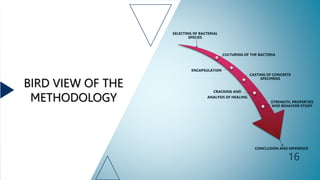
BIRD VIEW OF THE
METHODOLOGY
SELECTING OF BACTERIAL
SPECIES
CULTURING OF THE BACTERIA
ENCAPSULATION
CASTING OF CONCRETE
SPECIMENS
CRACKING AND
ANALYSIS OF HEALING
STRENGTH, PROPERTIES
AND BEHAVIOR STUDY
CONCLUSION AND INFERENCE
16
17
18
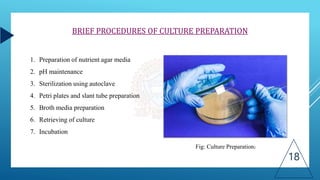
1. Preparation of nutrient agar media
2. pH maintenance
3. Sterilization using autoclave
4. Petri plates and slant tube preparation
5. Broth media preparation
6. Retrieving of culture
7. Incubation
BRIEF PROCEDURES OF CULTURE PREPARATION
Fig: Culture Preparation)
19
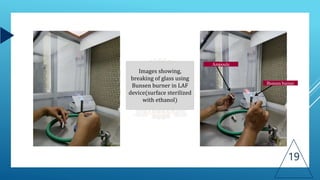
Images showing,
breaking of glass using
Bunsen burner in LAF
device(surface sterilized
with ethanol)
Ampoule
Bunsen burner
20
EFFECT OF BACTERIA ON PROPERTIES OF CONCRETE
1. Hydration kinetics
The addition of bacteria spore powder in concrete either accelerate or retard the setting time of concrete
depending on the calcium source supplied. The addition of calcium lactate can retard the setting time,
calciumformate and calcium nitrate can accelerate the setting time of concrete.
2. Compressive strength
Precipitation of calcite was higher in higher grade concrete as compared to the lower grade concrete. So,
higher grade concrete imparts more strength as compared to the lower grade concrete. The maximum
development rate of strength for the highest grade of 50 MPa concrete is as high 24% in strength.
3. Water permeability
Water permeability depends on the features of pore network of cementitious materials quantified by
porosity, tortuosity, specific surface, size distribution, connectivity, and micro cracks.
CaCO3 deposition in concrete resulted in a decrease of water absorption and permeability of concrete
specimens.
21
EFFECT OF BACTERIA ON PROPERTIES OF CONCRETE
4. Chloride ion permeability
The rate of chloride ion ingress into concrete is primarily dependent on the internal pore structure of concrete.
The pore structure, in turn, depends on other factors such as the mix design, curing conditions, the degree of
hydration, utilization of supplementary cementitious materials, and construction practices.
5. Microstructure
Calcite precipitation in mortar and concrete was visualized by SEM analysis. Rod-shaped bacteria associated
with calcite crystals were found. Due to this deposition, the impermeability of the concrete is improved as this
deposition acts as a barrier to harmful substances as that enter the sample. The addition of bacteria into the concrete
can improve the microstructure of concrete by mineral precipitation. This has been verified by SEM, EDS and
XRD analysis.
• Zakari, N., Shafaghat, A., Keyvanfar, A., Zaimi, M., Majid, A., Ghoshal, S. K., ... & Adekunle, A. (2016). Tests and methods of evaluating the self-
healing efficiency of concrete: A review. Constr. Build. Mater, 112, 1123-1132.
• Rais, M. S., & Khan, R. A. (2021). Experimental investigation on the strength and durability properties of bacterial self-healing recycled aggregate
concrete with mineral admixtures. Construction and Building Materials, 306, 124901.
• Althoey, F., Zaid, O., Arbili, M. M., Martínez-García, R., Alhamami, A., Shah, H. A., & Yosri, A. M. (2023). Physical, strength, durability and
microstructural analysis of self-healing concrete: A systematic review. Case Studies in Construction Materials, 18, e01730.
• Qian, C., Zheng, T., Zhang, X., & Su, Y. (2021). Application of microbial self-healing concrete: Case study. Construction and Building
Materials, 290, 123226.
• Shaheen, N., Khushnood, R. A., Memon, S. A., & Adnan, F. (2023). Feasibility assessment of newly isolated calcifying bacterial strains in self-
healing concrete. Construction and Building Materials, 362, 129662.
• Jakubovskis, R., Jankutė, A., Urbonavičius, J., & Gribniak, V. (2020). Analysis of mechanical performance and durability of self-healing biological
concrete. Construction and Building Materials, 260, 119822.
• Bagga, M., Hamley-Bennett, C., Alex, A., Freeman, B. L., Justo-Reinoso, I., Mihai, I. C., ... & Ofiţeru, I. D. (2022). Advancements in bacteria based
self-healing concrete and the promise of modelling. Construction and Building Materials, 358, 129412.
22
THANK YOU
23

Technical seminar presentation on bacterial self healing concrete

  • 1.
    “BACTERIA BASED SELFHEALING CONCRETE” SUHAAS M - 1SI20CV038 SIDDAGANGA INSTITUTE OF TECHNOLOGY, TUMAKURU DEPARTMENT OF CIVIL ENGINEERING TECHNICAL SEMINAR on PRESENTATION BY : DATE : 9th December 2024 1 GUIDE : Dr. SREEDHARA B. M Assistant Professor, Dept. of Civil Engineering
  • 2.
    CONTENTS 2 1. Introduction 2. Literaturesurvey 3. Literature summary 4. Objectives 5. Methodology 6. Effects of Bacteria on concrete 7. References
  • 3.
    • Microcracks areone of the miserable factors in concrete structures which we must need to look into. • Due to external loading and chemical reactions, microcracks spreads, causing harmful species to enter the concrete(corrosion, carbonation etc.) causing durability of the concrete to deteriorate. • Using Bacillus megaterium colony(popularly known for MICP-Microbial Induced Calcite Precipitation) followed by suitable culturing process and with specified encapsulation technique. INTRODUCTION 3
  • 4.
    INTRODUCTION • Self-healing efficiencyis the regain in the functionality and desired quality criterion of a cement base material relative to its original form, after healing from crack. • Self-healing in concrete can be classified into two following groups. • Autogenous healing : Caused naturally by binding materials, i.e., further hydration of un-hydrated Portland cement. (Addition of fly ash and bacterial spores into the cementitious composition). • Autonomous healing : Facilitate the production of self-healing concrete, encapsulated healing agents are preferably added to the concrete mix during preparation 4
  • 5.
    5 Fig: Self-healing proceduresare arranged hierarchically Md Montaseer Meraz, et al (2023)
  • 6.
    6 Fig: The statisticsabout bacteria application in the cementitious material. Thanh Ha Nguyen, et al(2019)
  • 7.
  • 8.
    LITERATURE-1) Self-healing concreteby use of microencapsulated bacterial spores • AUTHORS AND JOURNALS J.Y. Wang, et al. Cement and Concrete Research • YEAR OF PUBLISHING 27 November 2013 • OBJECTIVE To asses the self healing efficiency, influence of microcapsules, Influence of incubation conditions, and effect of water permeability. • CONCLUSIONS The maximum crack width healed in the specimens of the bacteria series was 970 μm, about 4 times that of the non- bacteria series (max 250 μm). The overall water permeability in the bacteria series was about 10 times lower than that in non-bacteria series. No self-healing was observed in all specimens stored at 95%RH, indicating that the presence of liquid water is an essential component for self-healing. 8
  • 9.
    LITERATURE-2) Bacteria-based repairand self-healing of concrete • AUTHORS AND JOURNALS N. De Belie & J. Wang Journal of sustainable cement based materials • YEAR OF PUBLISHING 16 Oct 2015 • OBJECTIVE To assess different metabolic pathways of bacterial calcium carbonate precipitation. • CONCLUSIONS • Using MICP from urea hydrolysis for soil improvement has been applied successfully on a scale of 1 m3 and the first field test on large scale (100 m3has also been performed and very promising efficiency was obtained. 9
  • 10.
    LITERATURE-3) Tests andmethods of evaluating the self-healing efficiency of concrete: A review • AUTHORS AND JOURNALS Nasiru Zakari Muhammad Construction and Building Materials • YEAR OF PUBLISHING 12 March 2016 • OBJECTIVE Assessing workability of concrete added self-healing admixtures like supplementary cementing materials, polymers and microorganisms. • CONCLUSIONS • Present study analyzed and compared several tests and methods that were developed to evaluate the self-healing efficiency of concrete. • Bio and/or chemical deposition of calcium carbonate or polymerization products were mainly triggered by the presence of moisture, high humidity and water. 10
  • 11.
    LITERATURE-4) Experimental investigationon the strength and durability properties of bacterial self-healing recycled aggregate concrete with mineral admixtures: • AUTHORS AND JOURNALS Mohd Salman Rais and Rizwan Ahmad Khan Construction and Building Materials • YEAR OF PUBLISHING 16 September 2021 • OBJECTIVE Determining the strength and durability of concrete using recycled aggregate and mineral admixtures. • CONCLUSIONS • This paper concludes that the crack healing ratio is related to the crack width and cracking age and it has been observed to be decreasing with the progress in cracking age. • Time required to heal 100% cracks is also concluded 11
  • 12.
    LITERATURE-5) Self-healing concrete:Fabrication, advancement, and effectiveness for long-term integrity of concrete infrastructures • AUTHORS AND JOURNALS Md Montaseer Meraz, et al Alexandria Engineering Journal • YEAR OF PUBLISHING 3 May 2023 • OBJECTIVE To evaluate several aspects of autogenous and autonomous healing, including their characterization, processes, and performances • CONCLUSIONS • Mineral admixtures, fibers, and autonomous methods like shape memory alloys, capsules, and microbial technologies have been found effective in repairing cracks. • Autonomous approaches heal cracks better than autogenous methods also geometry and size of cracks have an important role in selecting self-healing techniques and agents. 12
  • 13.
    LITERATURE SUMMARY 13 • Autonomousapproaches heal cracks better than autogenous methods. • Bacillus colonial bacteria performs better than other. • Presence of moisture, oxygen and humidity can affect the self healing efficiency.
  • 14.
    OBJECTIVES 14 1) To investigateproperties and self healing efficiency of Bacterial Self-healing concrete.
  • 15.
  • 16.
    BIRD VIEW OFTHE METHODOLOGY SELECTING OF BACTERIAL SPECIES CULTURING OF THE BACTERIA ENCAPSULATION CASTING OF CONCRETE SPECIMENS CRACKING AND ANALYSIS OF HEALING STRENGTH, PROPERTIES AND BEHAVIOR STUDY CONCLUSION AND INFERENCE 16
  • 17.
  • 18.
    18 1. Preparation ofnutrient agar media 2. pH maintenance 3. Sterilization using autoclave 4. Petri plates and slant tube preparation 5. Broth media preparation 6. Retrieving of culture 7. Incubation BRIEF PROCEDURES OF CULTURE PREPARATION Fig: Culture Preparation)
  • 19.
    19 Images showing, breaking ofglass using Bunsen burner in LAF device(surface sterilized with ethanol) Ampoule Bunsen burner
  • 20.
    20 EFFECT OF BACTERIAON PROPERTIES OF CONCRETE 1. Hydration kinetics The addition of bacteria spore powder in concrete either accelerate or retard the setting time of concrete depending on the calcium source supplied. The addition of calcium lactate can retard the setting time, calciumformate and calcium nitrate can accelerate the setting time of concrete. 2. Compressive strength Precipitation of calcite was higher in higher grade concrete as compared to the lower grade concrete. So, higher grade concrete imparts more strength as compared to the lower grade concrete. The maximum development rate of strength for the highest grade of 50 MPa concrete is as high 24% in strength. 3. Water permeability Water permeability depends on the features of pore network of cementitious materials quantified by porosity, tortuosity, specific surface, size distribution, connectivity, and micro cracks. CaCO3 deposition in concrete resulted in a decrease of water absorption and permeability of concrete specimens.
  • 21.
    21 EFFECT OF BACTERIAON PROPERTIES OF CONCRETE 4. Chloride ion permeability The rate of chloride ion ingress into concrete is primarily dependent on the internal pore structure of concrete. The pore structure, in turn, depends on other factors such as the mix design, curing conditions, the degree of hydration, utilization of supplementary cementitious materials, and construction practices. 5. Microstructure Calcite precipitation in mortar and concrete was visualized by SEM analysis. Rod-shaped bacteria associated with calcite crystals were found. Due to this deposition, the impermeability of the concrete is improved as this deposition acts as a barrier to harmful substances as that enter the sample. The addition of bacteria into the concrete can improve the microstructure of concrete by mineral precipitation. This has been verified by SEM, EDS and XRD analysis.
  • 22.
    • Zakari, N.,Shafaghat, A., Keyvanfar, A., Zaimi, M., Majid, A., Ghoshal, S. K., ... & Adekunle, A. (2016). Tests and methods of evaluating the self- healing efficiency of concrete: A review. Constr. Build. Mater, 112, 1123-1132. • Rais, M. S., & Khan, R. A. (2021). Experimental investigation on the strength and durability properties of bacterial self-healing recycled aggregate concrete with mineral admixtures. Construction and Building Materials, 306, 124901. • Althoey, F., Zaid, O., Arbili, M. M., Martínez-García, R., Alhamami, A., Shah, H. A., & Yosri, A. M. (2023). Physical, strength, durability and microstructural analysis of self-healing concrete: A systematic review. Case Studies in Construction Materials, 18, e01730. • Qian, C., Zheng, T., Zhang, X., & Su, Y. (2021). Application of microbial self-healing concrete: Case study. Construction and Building Materials, 290, 123226. • Shaheen, N., Khushnood, R. A., Memon, S. A., & Adnan, F. (2023). Feasibility assessment of newly isolated calcifying bacterial strains in self- healing concrete. Construction and Building Materials, 362, 129662. • Jakubovskis, R., Jankutė, A., Urbonavičius, J., & Gribniak, V. (2020). Analysis of mechanical performance and durability of self-healing biological concrete. Construction and Building Materials, 260, 119822. • Bagga, M., Hamley-Bennett, C., Alex, A., Freeman, B. L., Justo-Reinoso, I., Mihai, I. C., ... & Ofiţeru, I. D. (2022). Advancements in bacteria based self-healing concrete and the promise of modelling. Construction and Building Materials, 358, 129412. 22
  • 23.