International Research Journal of Engineering and Technology (IRJET) e-ISSN: 2395-0056
Volume: 06 Issue: 09 | Sep 2019 www.irjet.net p-ISSN: 2395-0072
© 2019, IRJET | Impact Factor value: 7.34 | ISO 9001:2008 Certified Journal | Page 2068
A Review Paper on Application of Bacillus Subtilis Bacteria for
Improving Properties and Healing of Cracks in Concrete
Shrikant Rajendra Muramkar1, Prof. Manish Bhatkar2
1Dept. of Civil Engineering, JCOET Yavatmal, India
2Assistant Professor, Dept. of Civil Engineering, JCOET Yavatmal, India
---------------------------------------------------------------------***----------------------------------------------------------------------
Abstract - Self healing concrete is a bacterial concrete which
heals itself automatically without any maintenance. Whenthe
cracks formed in concrete it comes in contact with air, water
and moisture, bacteria gets activated and forms lime as a
result cracks heals itself. Buildingrequireslessmaintenanceas
well as more durability, corrosive resistance and it is fulfill by
the bacterial concrete. Now a days, Bacterial concrete has
been accepted in the construction industry as a challenging
composition for self repairing and incrementing the
compressive strength of the concrete.
Key Words: Bacterial concrete, Bacillus subtilis,
Calcium lactate
1.INTRODUCTION:
Cracks in concrete is a phenomenon that can hardly
be complete avoided due to shrinkage reactions of setting
concrete and tensile stresses occurring in set structures.
Durability of concrete is impaired by these cracks since they
provide an easy path for the transportation of liquids and
gasses that potentially contain harmful substances.Ifmicro-
cracks grow and reach the reinforcement, not only the
concrete itself may be attacked, but also the reinforcement
will be corroded.
Adopting bacteria induced carbonate precipitationto fill
the cracks is very innovative. The microbial precipitation
depends on several factors including the concentration of
dissolved inorganic carbon, the PH, and the concentration of
calcium ions and the presence of nucleationsites.Also,when
Bacteria are used to work for the healing of cracks in
concrete, the major hindering factor is the high alkaline
environment of concrete, restricting the growth of the
bacteria. Therefore, necessary measures need to be taken to
protect bacteria in concrete.
When the cracks formed in concrete it comes in contact
with air, water and moisture. Duetheinteractionofmoisture
or water with bacteria, the bacteria gets activated andforms
lime as a result cracks heals itself. Similarly, Bacterial
concrete provides more compressive strength. Bacillus
Subtilis has the great potential to heal the cracks in concrete
surface and thereby enhancing th durability of a concrete
structure or an element.
By the use of Bacterial concrete buildings requires less
maintenance as well as more durability,corrosiveresistance
and it is fulfill by the bacterial concrete. Now a days,
Bacterial concrete has been accepted in the construction
industry as a challenging composition for self repairing and
incrementing the compressive strength of the concrete.
Bacterial concrete also plays the helping role in a seismic
zone at a primary stage.
2. THE BACTERIA-BACILLUS SUBTILIS:
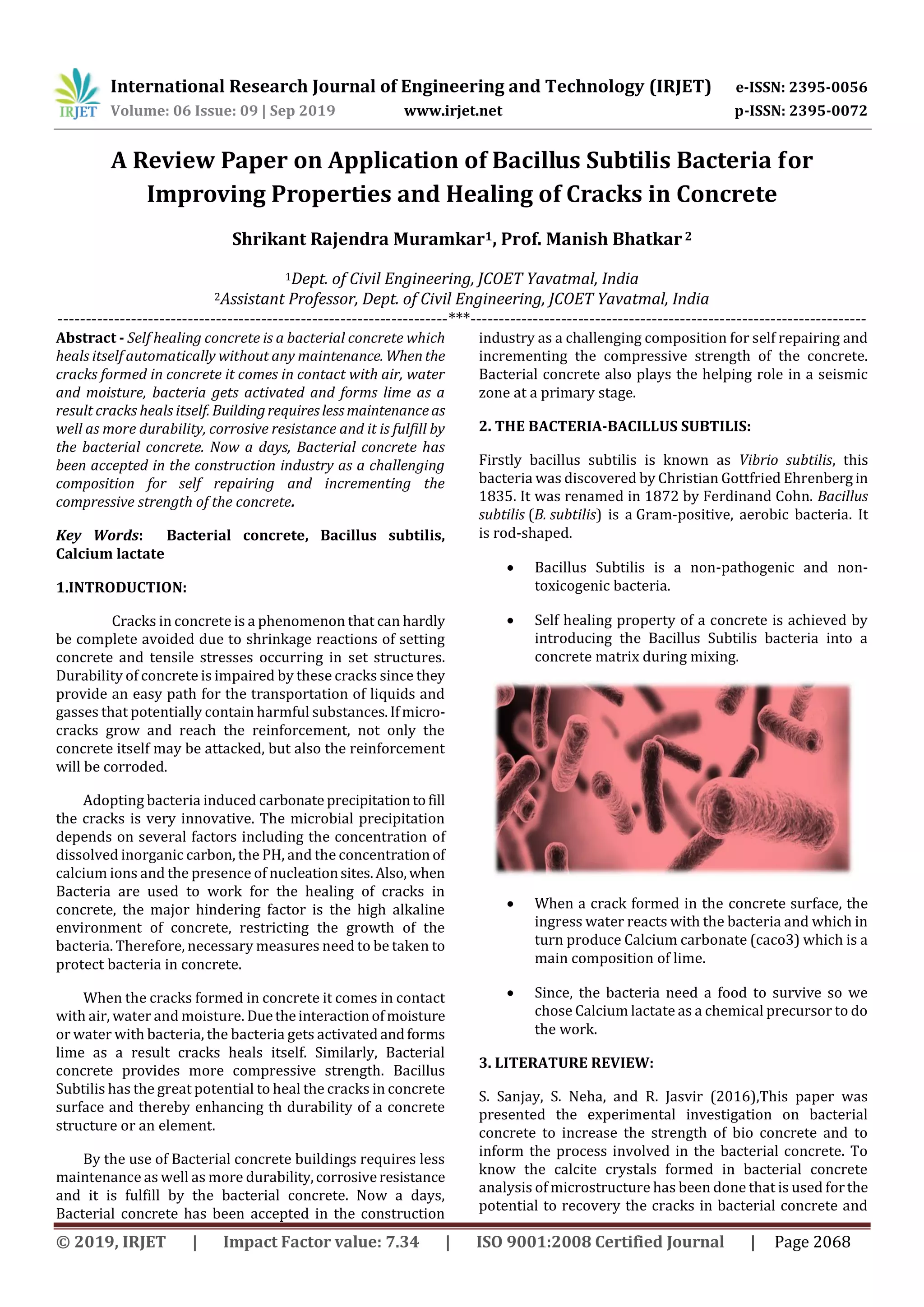
Firstly bacillus subtilis is known as Vibrio subtilis, this
bacteria was discovered by Christian Gottfried Ehrenberg in
1835. It was renamed in 1872 by Ferdinand Cohn. Bacillus
subtilis (B. subtilis) is a Gram-positive, aerobic bacteria. It
is rod-shaped.
 Bacillus Subtilis is a non-pathogenic and non-
toxicogenic bacteria.
 Self healing property of a concrete is achieved by
introducing the Bacillus Subtilis bacteria into a
concrete matrix during mixing.
 When a crack formed in the concrete surface, the
ingress water reacts with the bacteria and which in
turn produce Calcium carbonate (caco3) which is a
main composition of lime.
 Since, the bacteria need a food to survive so we
chose Calcium lactate as a chemical precursor to do
the work.
3. LITERATURE REVIEW:
S. Sanjay, S. Neha, and R. Jasvir (2016),This paper was
presented the experimental investigation on bacterial
concrete to increase the strength of bio concrete and to
inform the process involved in the bacterial concrete. To
know the calcite crystals formed in bacterial concrete
analysis of microstructure has been done that is used forthe
potential to recovery the cracks in bacterial concrete and
International Research Journal of Engineering and Technology (IRJET) e-ISSN: 2395-0056
Volume: 06 Issue: 09 | Sep 2019 www.irjet.net p-ISSN: 2395-0072
© 2019, IRJET | Impact Factor value: 7.34 | ISO 9001:2008 Certified Journal | Page 2069
also to inform the biological reaction in concrete. As a result,
has been got because of good adaptability of nutrient broth
medium of bio concrete at 28 days attained better strength
when compared to urea medium [1].
A. Thakur, A. Phogat, K. Singh (2016), This paper has
presented the overview of several paper inthecurrentyears
on the use of bio concrete for improving in the mechanical
properties, durability and permeation features of normal
concrete. They have been studies the analysis on bio
concrete by XRD and SEM tests and also several types of
bacteria’s, their isolation process, several methods used in
the adding of bacterial species in concrete and their
belongings on water absorption and compressive strength.
Finally, they concluded the bacterial type such as B. cereus
and S. pasteurii extremerise inthecompressivestrength and
the maximum reduce in water absorption for 28 days curing
period of specimen respectively. The bacterial like bacillus
sphaericus, B. pasteurii, and Bacillus flexus are not harm the
human body and also, they have the potential to precipitate
calcite but some other bacterial species is dangerous for
human health [2].
N. Amudhavalli, K. Keerthana and A. Ranjani (2015), this
paper has presented the overview of bacterial concrete,
bacteria the state of art results in all projects show that
material designed as self-healing agents. Some of the
bacteria is drawbacks not directly functional inconstruction
structure like houses and offices because of health concerns
this bacteria like B. Pasteuri, B. megaterium, B. subtilis.
Lastly, they achieve that bacterium that have used in
concrete in better way because of their advantages than
other bacteria that are B. Sphaericus and Eschericheria Coli
[3].
N. Chahal and R.Siddique (2008) this study has been
presented that with use of Sporosarcina pasteurii which
would make it, self-healing. They observed that newly
formed cracks healed by the presence of bacteria. In the
concrete mix 10%, 20% and 30% and also 5% and 10%
dosage of fly ash and silica fume respectively replacing
cement in the bacterial solution of 103, 105 and 107
cells/ml. They did tests on the water absorption and
porosity, chloride permeabilityandcompressivestrength by
using up to age 91 days. They concludedthatbythepresence
of S. pasteruii increase compressive strength, cut downs the
permeability and porosity of silica fume and fly ash concrete
[4].
V Srinivasa Reddy, M V SeshagiriRaoand S Sushma8, have
published a paper on Feasibility Study on Bacterial Concrete
as an innovative self crack healing system. This paper
describes about the effect of bacterial cell concentration of
Bacillus subtilis JC3, on the strength, by determining the
compressive strength of standard cement mortar cubes of
different grades, incorporated with various bacterial cell
concentrations. This shows that the Improvement in
compressive strength reaches a maximum at about 105/ml
cell concentration. The cost of using microbial concrete
compared to conventional concrete which is critical in
determining the economic feasibility of the technology, is
also studied. The cost analysis showed an increase in cost of
2.3 to 3.9 times between microbial concrete and
conventional concrete with decrease of grade.And nutrients
such as inexpensive, high protein- containing industrial
wastes such as corn steep liquor (CSL) or lactose mother
liquor (LML) effluent from starch industry can also be used,
so that overall process cost reduces dramatically.
Precipitation of these crystals inside the gel matrix also
enhances the durability of concrete significantly.
Furthermore, this analysis has shown an increase in thecost
of production and a significant decrease in carbon footprint
compared to conventional concrete[5].
Ramakrishnan et al, (2001) proposed a novel technique in
remediating cracks and fissures in concrete by
microbiologically inducing calcite precipitation.
Microbiologically induced calciteprecipitationisa technique
that comes under a broader category of science called
biomineralization. Bacillus pasteurii, a common soil
bacterium can induce the precipitates of calcite. As a
microbial sealant, Calcite exhibited its positive potential in
selectively consolidating simulated fractures and surface
fissures in granites and in the consolidation of sand. MICP is
highly desirable chemical reaction because the calcite
precipitation induced is a result of microbial activities. The
technique can be used to improve the compressive strength
and stiffness of cracked concrete specimens. A durability
study on concrete beams treated with bacteria, exposed to
alkaline, sulfate and freeze-thaw environments was studied
by him. The effect of different concentrations of bacteria on
the durability of concrete was also studied by him. It was
found that all the beams with bacteria performed betterthan
the control beams (without bacteria). The durability
performance increased with increase in theconcentration of
bacteria. Microbial calcite precipitation was quantifiedby X-
ray diffraction (XRD) analysis and visualized by SEM. The
unique imaging and microanalysis capabilities of SEM
established the presence of calcite precipitation inside
cracks, rod shaped bacterial impressions and a new calcite
layer on the surface of concrete. This calcite layer improves
the impermeability of the specimen, thus increasing its
resistance to alkaline, sulfate and freeze-thaw attack [6].
4. SCOPE AND OBJECTIVES OF WORK:
FROM DETAILED LITERATURE REVIEW THE FOLLOWING
POINTS ARE EVIDENCE:
 Develop bacterial concrete by introducing the bacteria’s of
bacillus family.
To find optimum dosage of bacteria required for bacterial
concrete.
 To increase compressive strength of concrete.
 To remediate the cracks developed in concrete.
International Research Journal of Engineering and Technology (IRJET) e-ISSN: 2395-0056
Volume: 06 Issue: 09 | Sep 2019 www.irjet.net p-ISSN: 2395-0072
© 2019, IRJET | Impact Factor value: 7.34 | ISO 9001:2008 Certified Journal | Page 2070
 To study the durability of concrete under various
weathering conditions. To check the performanceofbacillus
subtilis by durability test.
 To verify the performance of bacillus subtilis with 1mm
and 2mm crack width and 15mm, 20mm, 25mm, and 30mm
crack depth.
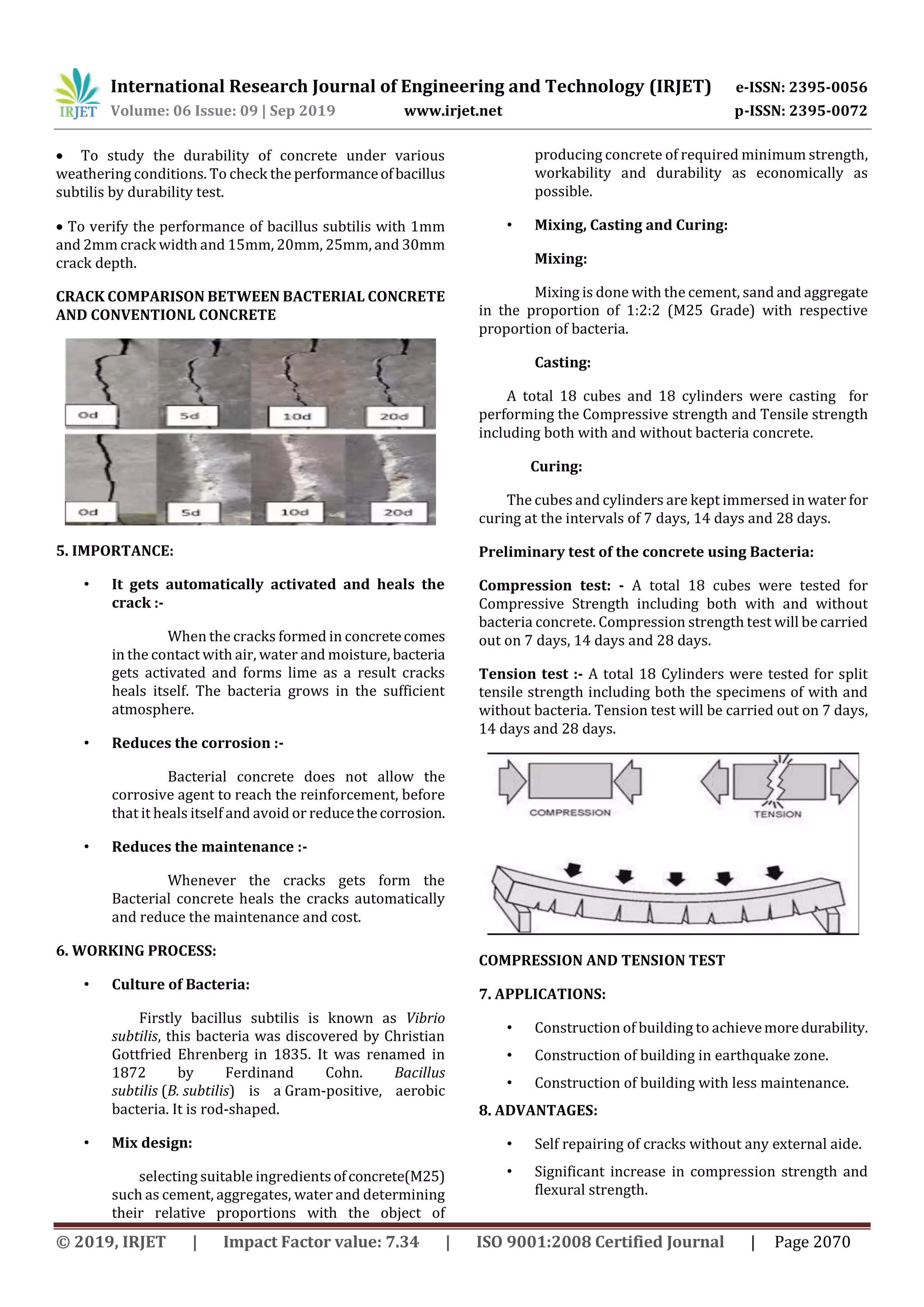
CRACK COMPARISON BETWEEN BACTERIAL CONCRETE
AND CONVENTIONL CONCRETE
5. IMPORTANCE:
• It gets automatically activated and heals the
crack :-
When the cracks formed in concretecomes
in the contact with air, water and moisture, bacteria
gets activated and forms lime as a result cracks
heals itself. The bacteria grows in the sufficient
atmosphere.
• Reduces the corrosion :-
Bacterial concrete does not allow the
corrosive agent to reach the reinforcement, before
that it heals itself and avoid or reducethecorrosion.
• Reduces the maintenance :-
Whenever the cracks gets form the
Bacterial concrete heals the cracks automatically
and reduce the maintenance and cost.
6. WORKING PROCESS:
• Culture of Bacteria:
Firstly bacillus subtilis is known as Vibrio
subtilis, this bacteria was discovered by Christian
Gottfried Ehrenberg in 1835. It was renamed in
1872 by Ferdinand Cohn. Bacillus
subtilis (B. subtilis) is a Gram-positive, aerobic
bacteria. It is rod-shaped.
• Mix design:
selecting suitable ingredientsofconcrete(M25)
such as cement, aggregates, water and determining
their relative proportions with the object of
producing concrete of required minimum strength,
workability and durability as economically as
possible.
• Mixing, Casting and Curing:
Mixing:
Mixing is done with the cement, sand and aggregate
in the proportion of 1:2:2 (M25 Grade) with respective
proportion of bacteria.
Casting:
A total 18 cubes and 18 cylinders were casting for
performing the Compressive strength and Tensile strength
including both with and without bacteria concrete.
Curing:
The cubes and cylinders are kept immersed in water for
curing at the intervals of 7 days, 14 days and 28 days.
Preliminary test of the concrete using Bacteria:
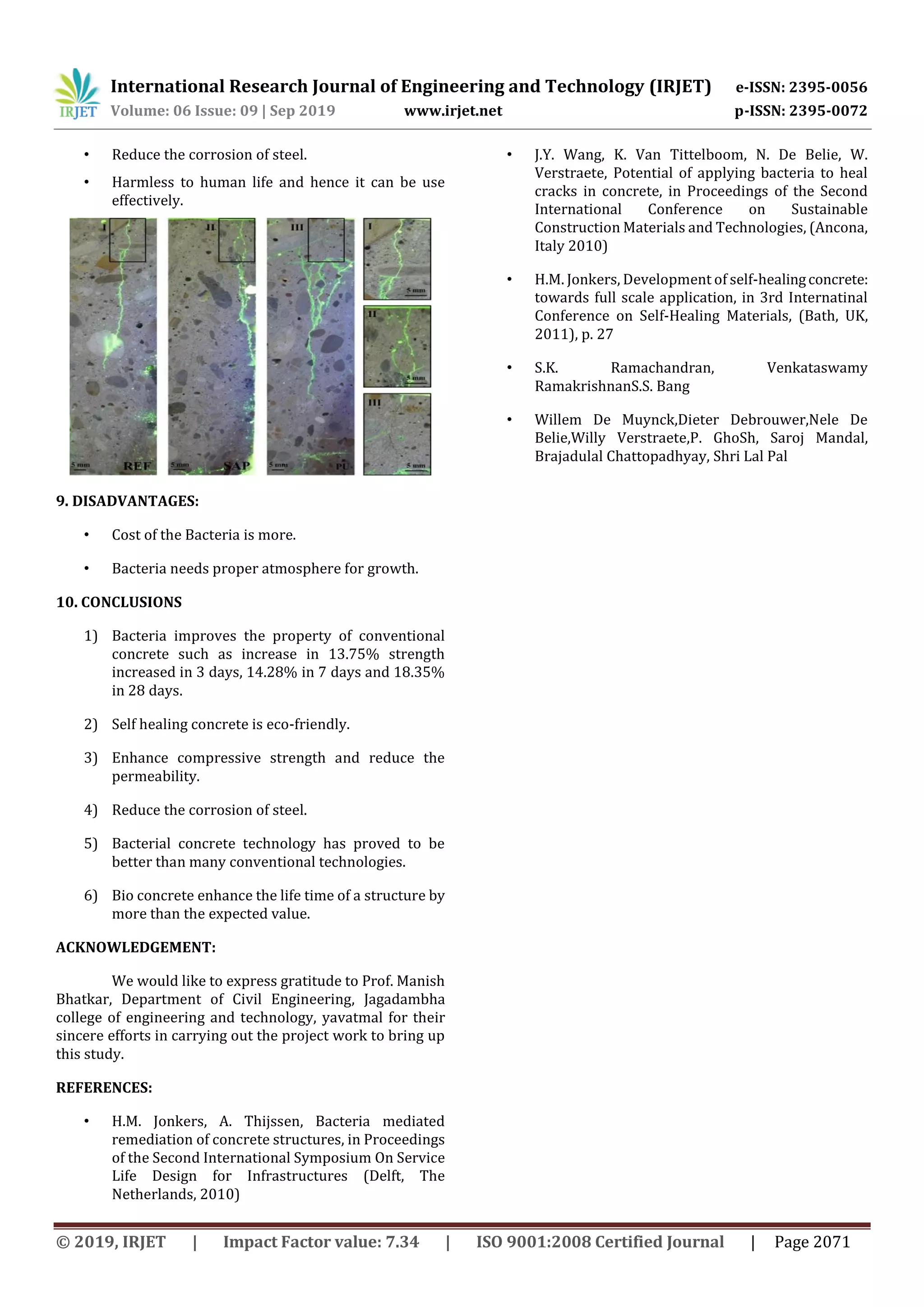
Compression test: - A total 18 cubes were tested for
Compressive Strength including both with and without
bacteria concrete. Compression strength test will be carried
out on 7 days, 14 days and 28 days.
Tension test :- A total 18 Cylinders were tested for split
tensile strength including both the specimens of with and
without bacteria. Tension test will be carried out on 7 days,
14 days and 28 days.
COMPRESSION AND TENSION TEST
7. APPLICATIONS:
• Construction of building to achievemoredurability.
• Construction of building in earthquake zone.
• Construction of building with less maintenance.
8. ADVANTAGES:
• Self repairing of cracks without any external aide.
• Significant increase in compression strength and
flexural strength.
International Research Journal of Engineering and Technology (IRJET) e-ISSN: 2395-0056
Volume: 06 Issue: 09 | Sep 2019 www.irjet.net p-ISSN: 2395-0072
© 2019, IRJET | Impact Factor value: 7.34 | ISO 9001:2008 Certified Journal | Page 2071
• Reduce the corrosion of steel.
• Harmless to human life and hence it can be use
effectively.
9. DISADVANTAGES:
• Cost of the Bacteria is more.
• Bacteria needs proper atmosphere for growth.
10. CONCLUSIONS
1) Bacteria improves the property of conventional
concrete such as increase in 13.75% strength
increased in 3 days, 14.28% in 7 days and 18.35%
in 28 days.
2) Self healing concrete is eco-friendly.
3) Enhance compressive strength and reduce the
permeability.
4) Reduce the corrosion of steel.
5) Bacterial concrete technology has proved to be
better than many conventional technologies.
6) Bio concrete enhance the life time of a structure by
more than the expected value.
ACKNOWLEDGEMENT:
We would like to express gratitude to Prof. Manish
Bhatkar, Department of Civil Engineering, Jagadambha
college of engineering and technology, yavatmal for their
sincere efforts in carrying out the project work to bring up
this study.
REFERENCES:
• H.M. Jonkers, A. Thijssen, Bacteria mediated
remediation of concrete structures, in Proceedings
of the Second International Symposium On Service
Life Design for Infrastructures (Delft, The
Netherlands, 2010)
• J.Y. Wang, K. Van Tittelboom, N. De Belie, W.
Verstraete, Potential of applying bacteria to heal
cracks in concrete, in Proceedings of the Second
International Conference on Sustainable
Construction Materials and Technologies, (Ancona,
Italy 2010)
• H.M. Jonkers, Development of self-healingconcrete:
towards full scale application, in 3rd Internatinal
Conference on Self-Healing Materials, (Bath, UK,
2011), p. 27
• S.K. Ramachandran, Venkataswamy
RamakrishnanS.S. Bang
• Willem De Muynck,Dieter Debrouwer,Nele De
Belie,Willy Verstraete,P. GhoSh, Saroj Mandal,
Brajadulal Chattopadhyay, Shri Lal Pal

IRJET- A Review Paper on Application of Bacillus Subtilis Bacteria for Improving Properties and Healing of Cracks in Concrete

  • 1.
    International Research Journalof Engineering and Technology (IRJET) e-ISSN: 2395-0056 Volume: 06 Issue: 09 | Sep 2019 www.irjet.net p-ISSN: 2395-0072 © 2019, IRJET | Impact Factor value: 7.34 | ISO 9001:2008 Certified Journal | Page 2068 A Review Paper on Application of Bacillus Subtilis Bacteria for Improving Properties and Healing of Cracks in Concrete Shrikant Rajendra Muramkar1, Prof. Manish Bhatkar2 1Dept. of Civil Engineering, JCOET Yavatmal, India 2Assistant Professor, Dept. of Civil Engineering, JCOET Yavatmal, India ---------------------------------------------------------------------***---------------------------------------------------------------------- Abstract - Self healing concrete is a bacterial concrete which heals itself automatically without any maintenance. Whenthe cracks formed in concrete it comes in contact with air, water and moisture, bacteria gets activated and forms lime as a result cracks heals itself. Buildingrequireslessmaintenanceas well as more durability, corrosive resistance and it is fulfill by the bacterial concrete. Now a days, Bacterial concrete has been accepted in the construction industry as a challenging composition for self repairing and incrementing the compressive strength of the concrete. Key Words: Bacterial concrete, Bacillus subtilis, Calcium lactate 1.INTRODUCTION: Cracks in concrete is a phenomenon that can hardly be complete avoided due to shrinkage reactions of setting concrete and tensile stresses occurring in set structures. Durability of concrete is impaired by these cracks since they provide an easy path for the transportation of liquids and gasses that potentially contain harmful substances.Ifmicro- cracks grow and reach the reinforcement, not only the concrete itself may be attacked, but also the reinforcement will be corroded. Adopting bacteria induced carbonate precipitationto fill the cracks is very innovative. The microbial precipitation depends on several factors including the concentration of dissolved inorganic carbon, the PH, and the concentration of calcium ions and the presence of nucleationsites.Also,when Bacteria are used to work for the healing of cracks in concrete, the major hindering factor is the high alkaline environment of concrete, restricting the growth of the bacteria. Therefore, necessary measures need to be taken to protect bacteria in concrete. When the cracks formed in concrete it comes in contact with air, water and moisture. Duetheinteractionofmoisture or water with bacteria, the bacteria gets activated andforms lime as a result cracks heals itself. Similarly, Bacterial concrete provides more compressive strength. Bacillus Subtilis has the great potential to heal the cracks in concrete surface and thereby enhancing th durability of a concrete structure or an element. By the use of Bacterial concrete buildings requires less maintenance as well as more durability,corrosiveresistance and it is fulfill by the bacterial concrete. Now a days, Bacterial concrete has been accepted in the construction industry as a challenging composition for self repairing and incrementing the compressive strength of the concrete. Bacterial concrete also plays the helping role in a seismic zone at a primary stage. 2. THE BACTERIA-BACILLUS SUBTILIS: Firstly bacillus subtilis is known as Vibrio subtilis, this bacteria was discovered by Christian Gottfried Ehrenberg in 1835. It was renamed in 1872 by Ferdinand Cohn. Bacillus subtilis (B. subtilis) is a Gram-positive, aerobic bacteria. It is rod-shaped.  Bacillus Subtilis is a non-pathogenic and non- toxicogenic bacteria.  Self healing property of a concrete is achieved by introducing the Bacillus Subtilis bacteria into a concrete matrix during mixing.  When a crack formed in the concrete surface, the ingress water reacts with the bacteria and which in turn produce Calcium carbonate (caco3) which is a main composition of lime.  Since, the bacteria need a food to survive so we chose Calcium lactate as a chemical precursor to do the work. 3. LITERATURE REVIEW: S. Sanjay, S. Neha, and R. Jasvir (2016),This paper was presented the experimental investigation on bacterial concrete to increase the strength of bio concrete and to inform the process involved in the bacterial concrete. To know the calcite crystals formed in bacterial concrete analysis of microstructure has been done that is used forthe potential to recovery the cracks in bacterial concrete and
  • 2.
    International Research Journalof Engineering and Technology (IRJET) e-ISSN: 2395-0056 Volume: 06 Issue: 09 | Sep 2019 www.irjet.net p-ISSN: 2395-0072 © 2019, IRJET | Impact Factor value: 7.34 | ISO 9001:2008 Certified Journal | Page 2069 also to inform the biological reaction in concrete. As a result, has been got because of good adaptability of nutrient broth medium of bio concrete at 28 days attained better strength when compared to urea medium [1]. A. Thakur, A. Phogat, K. Singh (2016), This paper has presented the overview of several paper inthecurrentyears on the use of bio concrete for improving in the mechanical properties, durability and permeation features of normal concrete. They have been studies the analysis on bio concrete by XRD and SEM tests and also several types of bacteria’s, their isolation process, several methods used in the adding of bacterial species in concrete and their belongings on water absorption and compressive strength. Finally, they concluded the bacterial type such as B. cereus and S. pasteurii extremerise inthecompressivestrength and the maximum reduce in water absorption for 28 days curing period of specimen respectively. The bacterial like bacillus sphaericus, B. pasteurii, and Bacillus flexus are not harm the human body and also, they have the potential to precipitate calcite but some other bacterial species is dangerous for human health [2]. N. Amudhavalli, K. Keerthana and A. Ranjani (2015), this paper has presented the overview of bacterial concrete, bacteria the state of art results in all projects show that material designed as self-healing agents. Some of the bacteria is drawbacks not directly functional inconstruction structure like houses and offices because of health concerns this bacteria like B. Pasteuri, B. megaterium, B. subtilis. Lastly, they achieve that bacterium that have used in concrete in better way because of their advantages than other bacteria that are B. Sphaericus and Eschericheria Coli [3]. N. Chahal and R.Siddique (2008) this study has been presented that with use of Sporosarcina pasteurii which would make it, self-healing. They observed that newly formed cracks healed by the presence of bacteria. In the concrete mix 10%, 20% and 30% and also 5% and 10% dosage of fly ash and silica fume respectively replacing cement in the bacterial solution of 103, 105 and 107 cells/ml. They did tests on the water absorption and porosity, chloride permeabilityandcompressivestrength by using up to age 91 days. They concludedthatbythepresence of S. pasteruii increase compressive strength, cut downs the permeability and porosity of silica fume and fly ash concrete [4]. V Srinivasa Reddy, M V SeshagiriRaoand S Sushma8, have published a paper on Feasibility Study on Bacterial Concrete as an innovative self crack healing system. This paper describes about the effect of bacterial cell concentration of Bacillus subtilis JC3, on the strength, by determining the compressive strength of standard cement mortar cubes of different grades, incorporated with various bacterial cell concentrations. This shows that the Improvement in compressive strength reaches a maximum at about 105/ml cell concentration. The cost of using microbial concrete compared to conventional concrete which is critical in determining the economic feasibility of the technology, is also studied. The cost analysis showed an increase in cost of 2.3 to 3.9 times between microbial concrete and conventional concrete with decrease of grade.And nutrients such as inexpensive, high protein- containing industrial wastes such as corn steep liquor (CSL) or lactose mother liquor (LML) effluent from starch industry can also be used, so that overall process cost reduces dramatically. Precipitation of these crystals inside the gel matrix also enhances the durability of concrete significantly. Furthermore, this analysis has shown an increase in thecost of production and a significant decrease in carbon footprint compared to conventional concrete[5]. Ramakrishnan et al, (2001) proposed a novel technique in remediating cracks and fissures in concrete by microbiologically inducing calcite precipitation. Microbiologically induced calciteprecipitationisa technique that comes under a broader category of science called biomineralization. Bacillus pasteurii, a common soil bacterium can induce the precipitates of calcite. As a microbial sealant, Calcite exhibited its positive potential in selectively consolidating simulated fractures and surface fissures in granites and in the consolidation of sand. MICP is highly desirable chemical reaction because the calcite precipitation induced is a result of microbial activities. The technique can be used to improve the compressive strength and stiffness of cracked concrete specimens. A durability study on concrete beams treated with bacteria, exposed to alkaline, sulfate and freeze-thaw environments was studied by him. The effect of different concentrations of bacteria on the durability of concrete was also studied by him. It was found that all the beams with bacteria performed betterthan the control beams (without bacteria). The durability performance increased with increase in theconcentration of bacteria. Microbial calcite precipitation was quantifiedby X- ray diffraction (XRD) analysis and visualized by SEM. The unique imaging and microanalysis capabilities of SEM established the presence of calcite precipitation inside cracks, rod shaped bacterial impressions and a new calcite layer on the surface of concrete. This calcite layer improves the impermeability of the specimen, thus increasing its resistance to alkaline, sulfate and freeze-thaw attack [6]. 4. SCOPE AND OBJECTIVES OF WORK: FROM DETAILED LITERATURE REVIEW THE FOLLOWING POINTS ARE EVIDENCE:  Develop bacterial concrete by introducing the bacteria’s of bacillus family. To find optimum dosage of bacteria required for bacterial concrete.  To increase compressive strength of concrete.  To remediate the cracks developed in concrete.
  • 3.
    International Research Journalof Engineering and Technology (IRJET) e-ISSN: 2395-0056 Volume: 06 Issue: 09 | Sep 2019 www.irjet.net p-ISSN: 2395-0072 © 2019, IRJET | Impact Factor value: 7.34 | ISO 9001:2008 Certified Journal | Page 2070  To study the durability of concrete under various weathering conditions. To check the performanceofbacillus subtilis by durability test.  To verify the performance of bacillus subtilis with 1mm and 2mm crack width and 15mm, 20mm, 25mm, and 30mm crack depth. CRACK COMPARISON BETWEEN BACTERIAL CONCRETE AND CONVENTIONL CONCRETE 5. IMPORTANCE: • It gets automatically activated and heals the crack :- When the cracks formed in concretecomes in the contact with air, water and moisture, bacteria gets activated and forms lime as a result cracks heals itself. The bacteria grows in the sufficient atmosphere. • Reduces the corrosion :- Bacterial concrete does not allow the corrosive agent to reach the reinforcement, before that it heals itself and avoid or reducethecorrosion. • Reduces the maintenance :- Whenever the cracks gets form the Bacterial concrete heals the cracks automatically and reduce the maintenance and cost. 6. WORKING PROCESS: • Culture of Bacteria: Firstly bacillus subtilis is known as Vibrio subtilis, this bacteria was discovered by Christian Gottfried Ehrenberg in 1835. It was renamed in 1872 by Ferdinand Cohn. Bacillus subtilis (B. subtilis) is a Gram-positive, aerobic bacteria. It is rod-shaped. • Mix design: selecting suitable ingredientsofconcrete(M25) such as cement, aggregates, water and determining their relative proportions with the object of producing concrete of required minimum strength, workability and durability as economically as possible. • Mixing, Casting and Curing: Mixing: Mixing is done with the cement, sand and aggregate in the proportion of 1:2:2 (M25 Grade) with respective proportion of bacteria. Casting: A total 18 cubes and 18 cylinders were casting for performing the Compressive strength and Tensile strength including both with and without bacteria concrete. Curing: The cubes and cylinders are kept immersed in water for curing at the intervals of 7 days, 14 days and 28 days. Preliminary test of the concrete using Bacteria: Compression test: - A total 18 cubes were tested for Compressive Strength including both with and without bacteria concrete. Compression strength test will be carried out on 7 days, 14 days and 28 days. Tension test :- A total 18 Cylinders were tested for split tensile strength including both the specimens of with and without bacteria. Tension test will be carried out on 7 days, 14 days and 28 days. COMPRESSION AND TENSION TEST 7. APPLICATIONS: • Construction of building to achievemoredurability. • Construction of building in earthquake zone. • Construction of building with less maintenance. 8. ADVANTAGES: • Self repairing of cracks without any external aide. • Significant increase in compression strength and flexural strength.
  • 4.
    International Research Journalof Engineering and Technology (IRJET) e-ISSN: 2395-0056 Volume: 06 Issue: 09 | Sep 2019 www.irjet.net p-ISSN: 2395-0072 © 2019, IRJET | Impact Factor value: 7.34 | ISO 9001:2008 Certified Journal | Page 2071 • Reduce the corrosion of steel. • Harmless to human life and hence it can be use effectively. 9. DISADVANTAGES: • Cost of the Bacteria is more. • Bacteria needs proper atmosphere for growth. 10. CONCLUSIONS 1) Bacteria improves the property of conventional concrete such as increase in 13.75% strength increased in 3 days, 14.28% in 7 days and 18.35% in 28 days. 2) Self healing concrete is eco-friendly. 3) Enhance compressive strength and reduce the permeability. 4) Reduce the corrosion of steel. 5) Bacterial concrete technology has proved to be better than many conventional technologies. 6) Bio concrete enhance the life time of a structure by more than the expected value. ACKNOWLEDGEMENT: We would like to express gratitude to Prof. Manish Bhatkar, Department of Civil Engineering, Jagadambha college of engineering and technology, yavatmal for their sincere efforts in carrying out the project work to bring up this study. REFERENCES: • H.M. Jonkers, A. Thijssen, Bacteria mediated remediation of concrete structures, in Proceedings of the Second International Symposium On Service Life Design for Infrastructures (Delft, The Netherlands, 2010) • J.Y. Wang, K. Van Tittelboom, N. De Belie, W. Verstraete, Potential of applying bacteria to heal cracks in concrete, in Proceedings of the Second International Conference on Sustainable Construction Materials and Technologies, (Ancona, Italy 2010) • H.M. Jonkers, Development of self-healingconcrete: towards full scale application, in 3rd Internatinal Conference on Self-Healing Materials, (Bath, UK, 2011), p. 27 • S.K. Ramachandran, Venkataswamy RamakrishnanS.S. Bang • Willem De Muynck,Dieter Debrouwer,Nele De Belie,Willy Verstraete,P. GhoSh, Saroj Mandal, Brajadulal Chattopadhyay, Shri Lal Pal