Benchmarking for Big Data
Applications with the
DataBench Framework
Dr. Arne J. Berre, SINTEF
Supported by
Gabriella Cattaneo, IDC,
Barbara Pernici,Politecnico di Milano
Tomas Pariente Lobo, ATOS
Todor Ivanov, Univ. Frankfurt,
Roberto Zicari, Univ. Frankfurt
IEEE Big Data Conference
The Second IEEE International Workshop on
Benchmarking, Performance Tuning and
Optimization for Big Data Applications (BPOD)
December 10, 2018
09/04/2019 DataBench Project - GA Nr 780966 1www.databench.eu
January 1st, 2018-December 31st, 2020
250 pm
Outline
• DataBench
• Business Benchmarking
• Technical Benchmarking
• BDVA Reference Model – Digital Platforms
• Overview of Benchmarks
09/04/2019 DataBench Project - GA Nr 780966 2
4/9/2019 DataBench Project - GA Nr 780966 3
What is Benchmarking?
https://www.shopify.com/encyclopedia/benchmarking
• Benchmarking is a process of measuring the performance of a company’s products,
services, or processes against those of another business considered to be the best
in the industry, aka “best in class.”
• The point of benchmarking is to identify internal opportunities for improvement. By
studying companies with superior performance, breaking down what makes such
superior performance possible, and then comparing those processes to how your
business operates, you can implement changes that will yield significant
improvements.
 Business Benchmarking
4/9/2019 DataBench Project - GA Nr 780966 3
4/9/2019 DataBench Project - GA Nr 780966 4
Technical Benchmarks
• In short, we define that a software benchmark is a program used for
comparison of software products/tools executing on a pre-
configured hardware environment.
• Jim Gray (Gray 1992) describes the benchmarking as follows:
”This quantitative comparison starts with the definition of a benchmark
or workload. The benchmark is run on several different systems, and
the performance and price of each system is measured and recorded.
Performance is typically a throughput metric (work/second) and price is
typically a five-year cost-of-ownership metric. Together, they give a
price/performance ratio.”
4/9/2019 DataBench Project - GA Nr 780966 4
09/04/2019 DataBench Project - GA Nr 780966 5
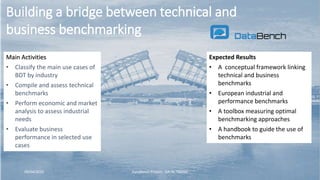
Main Activities
• Classify the main use cases of
BDT by industry
• Compile and assess technical
benchmarks
• Perform economic and market
analysis to assess industrial
needs
• Evaluate business
performance in selected use
cases
Expected Results
• A conceptual framework linking
technical and business
benchmarks
• European industrial and
performance benchmarks
• A toolbox measuring optimal
benchmarking approaches
• A handbook to guide the use of
benchmarks
Building a bridge between technical and
business benchmarking
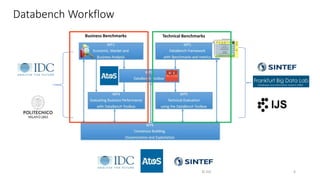
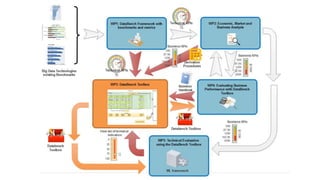
Databench Workflow
6© IDC
6© IDC
Technical BenchmarksBusiness Benchmarks
DataBench Project - GA Nr 780966 8
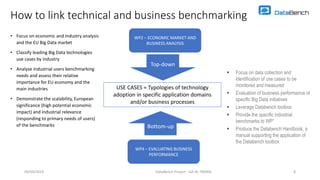
How to link technical and business benchmarking
WP2 – ECONOMIC MARKET AND
BUSINESS ANALYSIS
WP4 – EVALUATING BUSINESS
PERFORMANCE
Top-down
Bottom-up
• Focus on economic and industry analysis
and the EU Big Data market
• Classify leading Big Data technologies
use cases by industry
• Analyse industrial users benchmarking
needs and assess their relative
importance for EU economy and the
main industries
• Demonstrate the scalability, European
significance (high potential economic
impact) and industrial relevance
(responding to primary needs of users)
of the benchmarks
USE CASES = Typologies of technology
adoption in specific application domains
and/or business processes
 Focus on data collection and
identification of use cases to be
monitored and measured
 Evaluation of business performance of
specific Big Data initiatives
 Leverage Databench toolbox
 Provide the specific industrial
benchmarks to WP”
 Produce the Databench Handbook, a
manual supporting the application of
the Databench toolbox
09/04/2019
Early Results from the
Databench Business users
Survey
09/04/2019 DataBench Project - GA Nr 780966 9
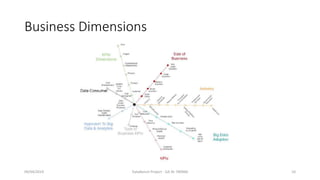
Business Dimensions
09/04/2019 DataBench Project - GA Nr 780966 10
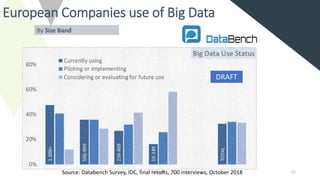
European Companies use of Big Data
© IDC 11
By Size Band
DRAFT
Source: Databench Survey, IDC, final results, 700 interviews, October 2018
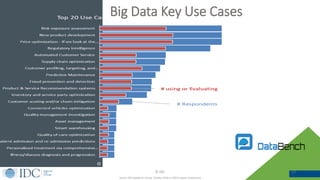
Big Data Key Use Cases
© IDC 12
Source: IDC DataBench Survey, October 2018 (n=700 European Companies)
© IDC 13
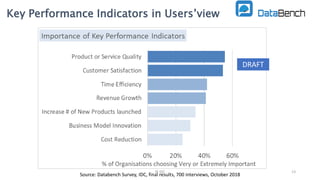
Key Performance Indicators in Users’view
Quality and Customers are the
two most important KPI’s
DRAFT
Source: Databench Survey, IDC, final results, 700 interviews, October 2018
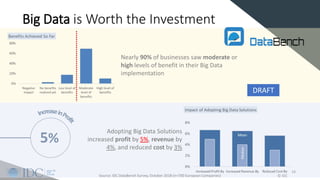
Big Data is Worth the Investment
© IDC
14
Nearly 90% of businesses saw moderate or
high levels of benefit in their Big Data
implementation
Source: IDC DataBench Survey, October 2018 (n=700 European Companies)
Adopting Big Data Solutions
increased profit by 5%, revenue by
4%, and reduced cost by 3%
5%
DRAFT
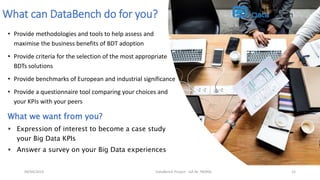
• Provide methodologies and tools to help assess and
maximise the business benefits of BDT adoption
• Provide criteria for the selection of the most appropriate
BDTs solutions
• Provide benchmarks of European and industrial significance
• Provide a questionnaire tool comparing your choices and
your KPIs with your peers
DataBench Project - GA Nr 780966 15
What can DataBench do for you?
What we want from you?
 Expression of interest to become a case study
your Big Data KPIs
 Answer a survey on your Big Data experiences
09/04/2019
Big Data
Technical Benchmarking
09/04/2019 DataBench Project - GA Nr 780966 16
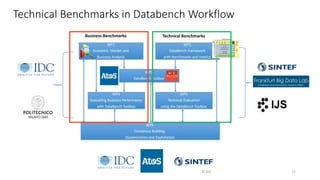
Technical Benchmarks in Databench Workflow
17© IDC
17© IDC
Technical BenchmarksBusiness Benchmarks
Goals&Objectives
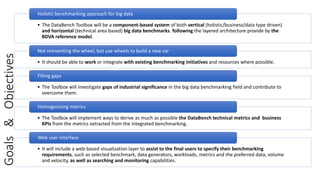
• The DataBench Toolbox will be a component-based system of both vertical (holistic/business/data type driven)
and horizontal (technical area based) big data benchmarks. following the layered architecture provide by the
BDVA reference model.
Holistic benchmarking approach for big data
• It should be able to work or integrate with existing benchmarking initiatives and resources where possible.
Not reinventing the wheel, but use wheels to build a new car
• The Toolbox will investigate gaps of industrial significance in the big data benchmarking field and contribute to
overcome them.
Filling gaps
• The Toolbox will implement ways to derive as much as possible the DataBench technical metrics and business
KPIs from the metrics extracted from the integrated benchmarking.
Homogenising metrics
• It will include a web-based visualization layer to assist to the final users to specify their benchmarking
requirements, such as selected benchmark, data generators, workloads, metrics and the preferred data, volume
and velocity, as well as searching and monitoring capabilities.
Web user interface
9-4-2019 19www.bdva.eu
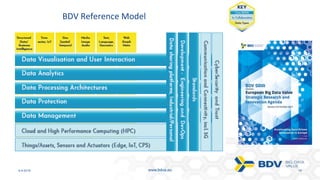
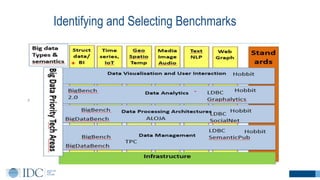
BDV Reference Model
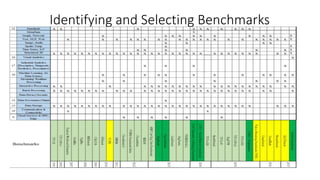
Identifying and Selecting Benchmarks
21
23
Domain/Sector/Busi
ness solutions KPIs
(Manufact,
Transport, Energy,..
Business
Transport
Manufacturing
Energy
.. Domain X …
22 Standards x x x x x x x x x x
MetaData x
Graph, Network x x x x x x x x x x x
Text, NLP, Web x x x x x x x x x x x x x x x x x x x x x x
Image, Audio x x x x
Spatio Temp x x
Time Series, IoT x x x x x x x
Structured, BI x x x x x x x x x x x x x x x x x x x x x x x x x x x x x x x x
18 Visual Analytics x
17
Industrial Analytics
(Descriptive,
Diagnostic,
Predictive,
Prescriptive)
x x x x
16
Machine Learning,
AI, Data Science
x x x x x x x x x x x x
Streaming/ Realtime
Processing x x x x x x x
Interactive
Processing
x x x x x x x x x x x x x x x x x x x x x x x
Batch Processing x x x x x x x x x x x x x x x x x x x x x x x x x x x x x x
Data
Privacy/Security
15
Data
Governance/Mgmt
x
14 Data Storage x x x x x x x x x x x x x x x x x x x x x x x x x x x x x x x x
19
Communication &
Connectivity
x x
9
Cloud Services &
HPC, Edge x x x x x x
TPC-H
TPC-DSv1
LinearRoad
HadoopWorkloadExamples
GridMix
PigMix
MRBench
CALDA
HiBench
YCSB
SWIM
CloudRank-D
PUMABenchmarkSuite
CloudeSuite
MRBS
AMPLabBigDataBenchmark
BigBench
BigDataBench
LinkBench
BigFrame
PRIMEBALL
SemanticPublishingBenchmark(SPB)
SocialNetworkBenchmark
StreamBench
TPCx-HS
SparkBench
TPCx-V
BigFUN
TPC-DSv2
TPCx-BB
Graphalytics
YahooStreamingBenchmark(YSB)
DeepBench
DeepMark
TensorFlowBenchmarks
Fathom
AdBench
RIoTBench
HobbitBenchmark
TPCx-HSv2
BigBenchV2
Sanzu
Pennmachinelearningbenchmark(PMLB)
OpenMLbenchmarksuites
Senska
DAWNBench/MLPerf
IDEBench
ABench
1999
2002
2004
2009
2011
2018
BDVA Reference Model
2016
2017
2014
Verticals,incl.DatatypesAnalytics,Processing,DataManagement,Infra
Benchmarks
2015
2013
2012
2010
2008
2007
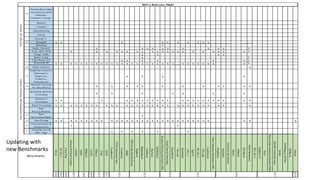
Updating with
new Benchmarks
Identifying and Selecting Benchmarks
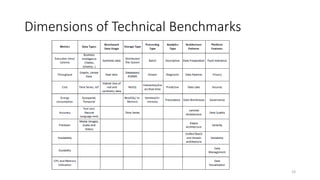
Dimensions of Technical Benchmarks
23
Evidence Based Big Data Benchmarking to Improve
Business Performance
Benchmark Organizations
25
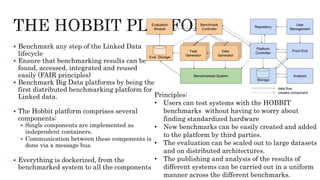
 Benchmark any step of the Linked Data
lifecycle
 Ensure that benchmarking results can be
found, accessed, integrated and reused
easily (FAIR principles)
 Benchmark Big Data platforms by being the
first distributed benchmarking platform for
Linked data.
 The Hobbit platform comprises several
components:
 Single components are implemented as
independent containers.
 Communication between these components is
done via a message bus.
 Everything is dockerized, from the
benchmarked system to all the components
Principles:
• Users can test systems with the HOBBIT
benchmarks without having to worry about
finding standardized hardware
• New benchmarks can be easily created and added
to the platform by third parties.
• The evaluation can be scaled out to large datasets
and on distributed architectures.
• The publishing and analysis of the results of
different systems can be carried out in a uniform
manner across the different benchmarks.
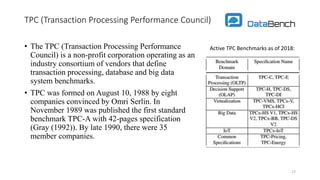
TPC (Transaction Processing Performance Council)
• The TPC (Transaction Processing Performance
Council) is a non-profit corporation operating as an
industry consortium of vendors that define
transaction processing, database and big data
system benchmarks.
• TPC was formed on August 10, 1988 by eight
companies convinced by Omri Serlin. In
November 1989 was published the first standard
benchmark TPC-A with 42-pages specification
(Gray (1992)). By late 1990, there were 35
member companies.
27
Active TPC Benchmarks as of 2018:
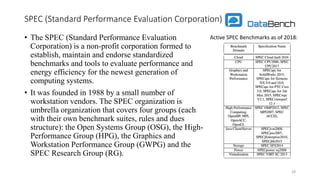
SPEC (Standard Performance Evaluation Corporation)
• The SPEC (Standard Performance Evaluation
Corporation) is a non-profit corporation formed to
establish, maintain and endorse standardized
benchmarks and tools to evaluate performance and
energy efficiency for the newest generation of
computing systems.
• It was founded in 1988 by a small number of
workstation vendors. The SPEC organization is
umbrella organization that covers four groups (each
with their own benchmark suites, rules and dues
structure): the Open Systems Group (OSG), the High-
Performance Group (HPG), the Graphics and
Workstation Performance Group (GWPG) and the
SPEC Research Group (RG).
28
Active SPEC Benchmarks as of 2018:
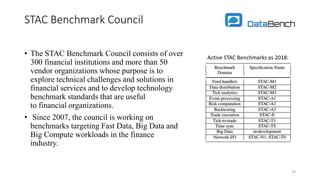
STAC Benchmark Council
• The STAC Benchmark Council consists of over
300 financial institutions and more than 50
vendor organizations whose purpose is to
explore technical challenges and solutions in
financial services and to develop technology
benchmark standards that are useful
to financial organizations.
• Since 2007, the council is working on
benchmarks targeting Fast Data, Big Data and
Big Compute workloads in the finance
industry.
29
Active STAC Benchmarks as 2018:
Relevant Benchmark Platforms & Tools
• Hobbit - https://project-hobbit.eu/
• ALOJA - https://aloja.bsc.es/
• OLTPBench - https://github.com/oltpbenchmark/oltpbench
• PEEL - http://peel-framework.org/
• PAT - https://github.com/intel-hadoop/PAT
30
Evidence Based Big Data Benchmarking to Improve
Business Performance
The DataBench ToolBox
Benchmarks
Stress-testing the Big Data Technology Ecosystem
Todor Ivanov (Frankfurt Big Data Lab)
31
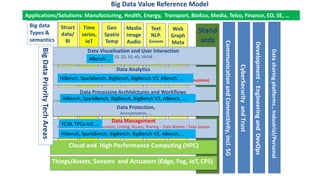
Big Data Value Reference Model
Time
series,
IoT
Geo
Spatio
Temp
Media
Image
Audio
Text
NLP.
Genom
Web
Graph
Meta
Struct
data/
BI
Stand
ards
Data Processing Architectures and Workflows
Batch, Interactive, Streaming/Real-time
Data Visualisation and User Interaction
1D, 2D, 3D, 4D, VR/AR
Data Analytics
Descriptive, Diagnostic, Predictive, Prescriptive
Machine Learning and AI, Deep Learning, Statistics, HYBRID ANALYTICS (Optim/Simulation)
j
Data Management
Collection, Preparation, Curation, Linking, Access, Sharing – Data Market / Data Spaces
DB types: SQL, NoSQL (Document, Key-Value, Coloum, Array,Graph, …)
Cloud and High Performance Computing (HPC)
BigDataPriorityTechAreas
Applications/Solutions: Manufacturing, Health, Energy, Transport, BioEco, Media, Telco, Finance, EO, SE, …
Data Protection,
Anonymisation, …
Big data
Types &
semantics
Things/Assets, Sensors and Actuators (Edge, Fog, IoT, CPS)
CommunicationandConnectivity,incl.5G
CyberSecurityandTrust
Development-EngineeringandDevOps
Datasharingplatforms.,Industrial/Personal
HiBench, SparkBench, BigBench, BigBench V2, ABench, …
YCSB, TPCx-IoT, …
HiBench, SparkBench, BigBench, BigBench V2, ABench, …
ABench …
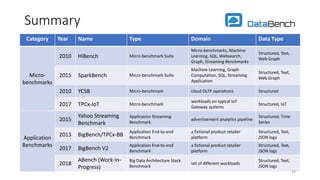
Summary
Category Year Name Type Domain Data Type
Micro-
benchmarks
2010 HiBench Micro-benchmark Suite
Micro-benchmarks, Machine
Learning, SQL, Websearch,
Graph, Streaming Benchmarks
Structured, Text,
Web Graph
2015 SparkBench Micro-benchmark Suite
Machine Learning, Graph
Computation, SQL, Streaming
Application
Structured, Text,
Web Graph
2010 YCSB Micro-benchmark cloud OLTP operations Structured
2017 TPCx-IoT Micro-benchmark
workloads on typical IoT
Gateway systems
Structured, IoT
Application
Benchmarks
2015
Yahoo Streaming
Benchmark
Application Streaming
Benchmark
advertisement analytics pipeline
Structured, Time
Series
2013 BigBench/TPCx-BB
Application End-to-end
Benchmark
a fictional product retailer
platform
Structured, Text,
JSON logs
2017 BigBench V2
Application End-to-end
Benchmark
a fictional product retailer
platform
Structured, Text,
JSON logs
2018
ABench (Work-in-
Progress)
Big Data Architecture Stack
Benchmark
set of different workloads
Structured, Text,
JSON logs
33
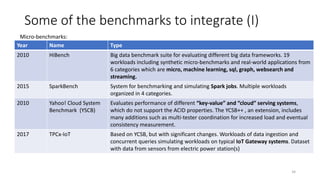
Some of the benchmarks to integrate (I)
Year Name Type
2010 HiBench Big data benchmark suite for evaluating different big data frameworks. 19
workloads including synthetic micro-benchmarks and real-world applications from
6 categories which are micro, machine learning, sql, graph, websearch and
streaming.
2015 SparkBench System for benchmarking and simulating Spark jobs. Multiple workloads
organized in 4 categories.
2010 Yahoo! Cloud System
Benchmark (YSCB)
Evaluates performance of different “key-value” and “cloud” serving systems,
which do not support the ACID properties. The YCSB++ , an extension, includes
many additions such as multi-tester coordination for increased load and eventual
consistency measurement.
2017 TPCx-IoT Based on YCSB, but with significant changes. Workloads of data ingestion and
concurrent queries simulating workloads on typical IoT Gateway systems. Dataset
with data from sensors from electric power station(s)
34
Micro-benchmarks:
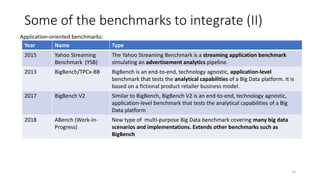
Some of the benchmarks to integrate (II)
Year Name Type
2015 Yahoo Streaming
Benchmark (YSB)
The Yahoo Streaming Benchmark is a streaming application benchmark
simulating an advertisement analytics pipeline.
2013 BigBench/TPCx-BB BigBench is an end-to-end, technology agnostic, application-level
benchmark that tests the analytical capabilities of a Big Data platform. It is
based on a fictional product retailer business model.
2017 BigBench V2 Similar to BigBench, BigBench V2 is an end-to-end, technology agnostic,
application-level benchmark that tests the analytical capabilities of a Big
Data platform
2018 ABench (Work-in-
Progress)
New type of multi-purpose Big Data benchmark covering many big data
scenarios and implementations. Extends other benchmarks such as
BigBench
35
Application-oriented benchmarks:
gcattaneo@idc.com
rstevens@idc.com
Evidence Based Big Data Benchmarking to
Improve Business Performance
Micro-benchmarks
37
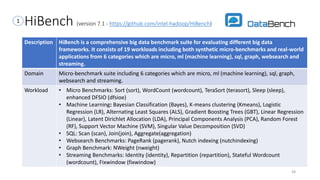
HiBench (version 7.1 - https://github.com/intel-hadoop/HiBench)
Description HiBench is a comprehensive big data benchmark suite for evaluating different big data
frameworks. It consists of 19 workloads including both synthetic micro-benchmarks and real-world
applications from 6 categories which are micro, ml (machine learning), sql, graph, websearch and
streaming.
Domain Micro-benchmark suite including 6 categories which are micro, ml (machine learning), sql, graph,
websearch and streaming.
Workload • Micro Benchmarks: Sort (sort), WordCount (wordcount), TeraSort (terasort), Sleep (sleep),
enhanced DFSIO (dfsioe)
• Machine Learning: Bayesian Classification (Bayes), K-means clustering (Kmeans), Logistic
Regression (LR), Alternating Least Squares (ALS), Gradient Boosting Trees (GBT), Linear Regression
(Linear), Latent Dirichlet Allocation (LDA), Principal Components Analysis (PCA), Random Forest
(RF), Support Vector Machine (SVM), Singular Value Decomposition (SVD)
• SQL: Scan (scan), Join(join), Aggregate(aggregation)
• Websearch Benchmarks: PageRank (pagerank), Nutch indexing (nutchindexing)
• Graph Benchmark: NWeight (nweight)
• Streaming Benchmarks: Identity (identity), Repartition (repartition), Stateful Wordcount
(wordcount), Fixwindow (fixwindow)
38
1
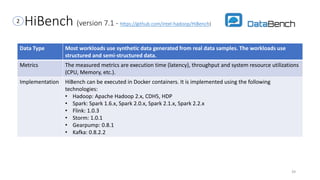
HiBench (version 7.1 - https://github.com/intel-hadoop/HiBench)
39
Data Type Most workloads use synthetic data generated from real data samples. The workloads use
structured and semi-structured data.
Metrics The measured metrics are execution time (latency), throughput and system resource utilizations
(CPU, Memory, etc.).
Implementation HiBench can be executed in Docker containers. It is implemented using the following
technologies:
• Hadoop: Apache Hadoop 2.x, CDH5, HDP
• Spark: Spark 1.6.x, Spark 2.0.x, Spark 2.1.x, Spark 2.2.x
• Flink: 1.0.3
• Storm: 1.0.1
• Gearpump: 0.8.1
• Kafka: 0.8.2.2
2
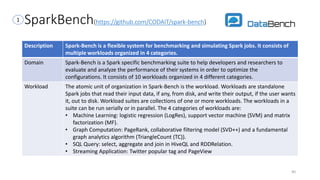
SparkBench(https://github.com/CODAIT/spark-bench)
Description Spark-Bench is a flexible system for benchmarking and simulating Spark jobs. It consists of
multiple workloads organized in 4 categories.
Domain Spark-Bench is a Spark specific benchmarking suite to help developers and researchers to
evaluate and analyze the performance of their systems in order to optimize the
configurations. It consists of 10 workloads organized in 4 different categories.
Workload The atomic unit of organization in Spark-Bench is the workload. Workloads are standalone
Spark jobs that read their input data, if any, from disk, and write their output, if the user wants
it, out to disk. Workload suites are collections of one or more workloads. The workloads in a
suite can be run serially or in parallel. The 4 categories of workloads are:
• Machine Learning: logistic regression (LogRes), support vector machine (SVM) and matrix
factorization (MF).
• Graph Computation: PageRank, collaborative filtering model (SVD++) and a fundamental
graph analytics algorithm (TriangleCount (TC)).
• SQL Query: select, aggregate and join in HiveQL and RDDRelation.
• Streaming Application: Twitter popular tag and PageView
40
1
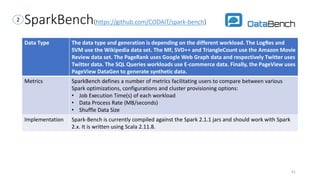
SparkBench(https://github.com/CODAIT/spark-bench)
Data Type The data type and generation is depending on the different workload. The LogRes and
SVM use the Wikipedia data set. The MF, SVD++ and TriangleCount use the Amazon Movie
Review data set. The PageRank uses Google Web Graph data and respectively Twitter uses
Twitter data. The SQL Queries workloads use E-commerce data. Finally, the PageView uses
PageView DataGen to generate synthetic data.
Metrics SparkBench defines a number of metrics facilitating users to compare between various
Spark optimizations, configurations and cluster provisioning options:
• Job Execution Time(s) of each workload
• Data Process Rate (MB/seconds)
• Shuffle Data Size
Implementation Spark-Bench is currently compiled against the Spark 2.1.1 jars and should work with Spark
2.x. It is written using Scala 2.11.8.
41
2
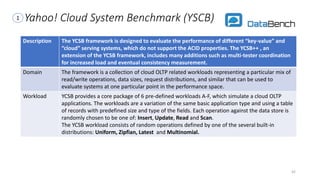
Yahoo! Cloud System Benchmark (YSCB)
Description The YCSB framework is designed to evaluate the performance of different “key-value” and
“cloud” serving systems, which do not support the ACID properties. The YCSB++ , an
extension of the YCSB framework, includes many additions such as multi-tester coordination
for increased load and eventual consistency measurement.
Domain The framework is a collection of cloud OLTP related workloads representing a particular mix of
read/write operations, data sizes, request distributions, and similar that can be used to
evaluate systems at one particular point in the performance space.
Workload YCSB provides a core package of 6 pre-defined workloads A-F, which simulate a cloud OLTP
applications. The workloads are a variation of the same basic application type and using a table
of records with predefined size and type of the fields. Each operation against the data store is
randomly chosen to be one of: Insert, Update, Read and Scan.
The YCSB workload consists of random operations defined by one of the several built-in
distributions: Uniform, Zipfian, Latest and Multinomial.
42
1
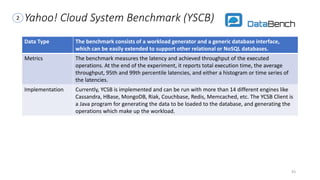
Yahoo! Cloud System Benchmark (YSCB)
Data Type The benchmark consists of a workload generator and a generic database interface,
which can be easily extended to support other relational or NoSQL databases.
Metrics The benchmark measures the latency and achieved throughput of the executed
operations. At the end of the experiment, it reports total execution time, the average
throughput, 95th and 99th percentile latencies, and either a histogram or time series of
the latencies.
Implementation Currently, YCSB is implemented and can be run with more than 14 different engines like
Cassandra, HBase, MongoDB, Riak, Couchbase, Redis, Memcached, etc. The YCSB Client is
a Java program for generating the data to be loaded to the database, and generating the
operations which make up the workload.
43
2
TPCx-IoT
Description The TPC Benchmark IoT (TPCx-IoT) benchmark workload is designed based on Yahoo
Cloud Serving Benchmark (YCSB). It is not comparable to YCSB due to significant changes.
The TPCx-IoT workloads consists of data ingestion and concurrent queries simulating
workloads on typical IoT Gateway systems. The dataset represents data from sensors from
electric power station(s).
Domain TPCx-IoT was developed to provide the industry with an objective measure of the hardware,
operating system, data storage and data management systems for IoT Gateway systems. The
TPCx-IoT benchmark models a continuous system availability of 24 hours a day, 7 days a
week.
Workload The System Under Test (SUT) must run a data management platform that is commercially
available and data must be persisted in a non-volatile durable media with a minimum of
two-way replication. The workload represents data inject into the SUT with analytics
queries in the background. The analytic queries retrieve the readings of a randomly
selected sensor for two 30 second time intervals, TI1 and TI2. The first time interval TI1 is
defined between the timestamp the query was started Ts and the timestamp 5 seconds
prior to TS , i.e. TI1 =[TS -5,TS]. The second time interval is a randomly selected 5 seconds
time interval TI2 within the 1800 seconds time interval prior to the start of the first query, TS
-5. If TS <=1810, prior to the start of the first query, TS -5.
44
1
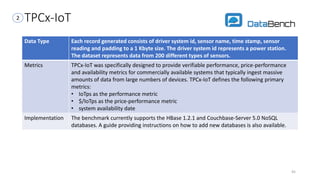
TPCx-IoT
Data Type Each record generated consists of driver system id, sensor name, time stamp, sensor
reading and padding to a 1 Kbyte size. The driver system id represents a power station.
The dataset represents data from 200 different types of sensors.
Metrics TPCx-IoT was specifically designed to provide verifiable performance, price-performance
and availability metrics for commercially available systems that typically ingest massive
amounts of data from large numbers of devices. TPCx-IoT defines the following primary
metrics:
• IoTps as the performance metric
• $/IoTps as the price-performance metric
• system availability date
Implementation The benchmark currently supports the HBase 1.2.1 and Couchbase-Server 5.0 NoSQL
databases. A guide providing instructions on how to add new databases is also available.
45
2
Application Benchmarks
46
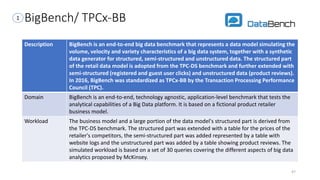
BigBench/ TPCx-BB
Description BigBench is an end-to-end big data benchmark that represents a data model simulating the
volume, velocity and variety characteristics of a big data system, together with a synthetic
data generator for structured, semi-structured and unstructured data. The structured part
of the retail data model is adopted from the TPC-DS benchmark and further extended with
semi-structured (registered and guest user clicks) and unstructured data (product reviews).
In 2016, BigBench was standardized as TPCx-BB by the Transaction Processing Performance
Council (TPC).
Domain BigBench is an end-to-end, technology agnostic, application-level benchmark that tests the
analytical capabilities of a Big Data platform. It is based on a fictional product retailer
business model.
Workload The business model and a large portion of the data model's structured part is derived from
the TPC-DS benchmark. The structured part was extended with a table for the prices of the
retailer's competitors, the semi-structured part was added represented by a table with
website logs and the unstructured part was added by a table showing product reviews. The
simulated workload is based on a set of 30 queries covering the different aspects of big data
analytics proposed by McKinsey.
47
1
BigBench/ TPCx-BB
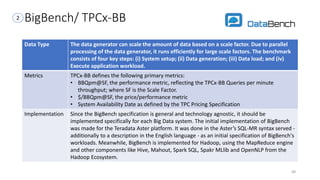
Data Type The data generator can scale the amount of data based on a scale factor. Due to parallel
processing of the data generator, it runs efficiently for large scale factors. The benchmark
consists of four key steps: (i) System setup; (ii) Data generation; (iii) Data load; and (iv)
Execute application workload.
Metrics TPCx-BB defines the following primary metrics:
• BBQpm@SF, the performance metric, reflecting the TPCx-BB Queries per minute
throughput; where SF is the Scale Factor.
• $/BBQpm@SF, the price/performance metric
• System Availability Date as defined by the TPC Pricing Specification
Implementation Since the BigBench specification is general and technology agnostic, it should be
implemented specifically for each Big Data system. The initial implementation of BigBench
was made for the Teradata Aster platform. It was done in the Aster’s SQL-MR syntax served -
additionally to a description in the English language - as an initial specification of BigBench's
workloads. Meanwhile, BigBench is implemented for Hadoop, using the MapReduce engine
and other components like Hive, Mahout, Spark SQL, Spakr MLlib and OpenNLP from the
Hadoop Ecosystem.
48
2
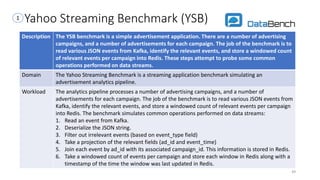
Yahoo Streaming Benchmark (YSB)
Description The YSB benchmark is a simple advertisement application. There are a number of advertising
campaigns, and a number of advertisements for each campaign. The job of the benchmark is to
read various JSON events from Kafka, identify the relevant events, and store a windowed count
of relevant events per campaign into Redis. These steps attempt to probe some common
operations performed on data streams.
Domain The Yahoo Streaming Benchmark is a streaming application benchmark simulating an
advertisement analytics pipeline.
Workload The analytics pipeline processes a number of advertising campaigns, and a number of
advertisements for each campaign. The job of the benchmark is to read various JSON events from
Kafka, identify the relevant events, and store a windowed count of relevant events per campaign
into Redis. The benchmark simulates common operations performed on data streams:
1. Read an event from Kafka.
2. Deserialize the JSON string.
3. Filter out irrelevant events (based on event_type field)
4. Take a projection of the relevant fields (ad_id and event_time)
5. Join each event by ad_id with its associated campaign_id. This information is stored in Redis.
6. Take a windowed count of events per campaign and store each window in Redis along with a
timestamp of the time the window was last updated in Redis.
49
1
Yahoo Streaming Benchmark (YSB)
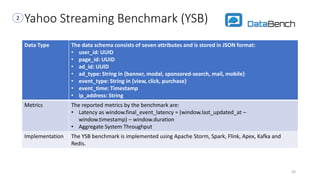
Data Type The data schema consists of seven attributes and is stored in JSON format:
• user_id: UUID
• page_id: UUID
• ad_id: UUID
• ad_type: String in {banner, modal, sponsored-search, mail, mobile}
• event_type: String in {view, click, purchase}
• event_time: Timestamp
• ip_address: String
Metrics The reported metrics by the benchmark are:
• Latency as window.final_event_latency = (window.last_updated_at –
window.timestamp) – window.duration
• Aggregate System Throughput
Implementation The YSB benchmark is implemented using Apache Storm, Spark, Flink, Apex, Kafka and
Redis.
50
2
BigBench V2
Description The BigBench V2 benchmark addresses some of the limitation of the BigBench (TPCx-BB)
benchmark. BigBench V2 separates from TPC-DS with a simple data model. The new data
model still has the variety of structured, semi-structured, and unstructured data as the original
BigBench data model. The difference is that the structured part has only six tables that capture
necessary information about users (customers), products, web pages, stores, online sales and
store sales. BigBench V2 mandates late binding by requiring query processing to be done
directly on key-value web-logs rather than a pre-parsed form of it.
Domain Similar to BigBench, BigBench V2 is an end-to-end, technology agnostic, application-level
benchmark that tests the analytical capabilities of a Big Data platform.
Workload All 11 TPC-DS queries on the complex structured part are removed and replaced by simpler
queries mostly against the key-value web-logs. The new BigBench V2 queries have only 5 queries
on the structured part versus 18 in BigBench. This change has no impact on the coverage of the
different business categories done in BigBench. In addition to the removal of TPC-DS queries,
BigBench V2 mandates late binding, but it does not impose a specific implementation of it. This
requirement means that a system using BigBench V2 can extract the keys and their
corresponding values per query at run-time.
51
1
BigBench V2
Data Type A new scale factor-based data generator for the new data model was developed. The web-
logs are produced as key-value pairs with two sets of keys. The first set is a small set of
keys that represent fields from the structured tables like IDs of users, products, and web
pages. The other set of keys is larger and is produced randomly. This set is used to simulate
the real life cases of large keys in web-logs that may not be used in actual queries. Product
reviews are produced and linked to users and products as in BigBench but the review text
is produced synthetically contrary to the Markov chain model used in BigBench. We
decided to generate product reviews in this way because the Markov chain model requires
real data sets which limits our options for products and makes the generator hard to scale.
Metrics BigBench V2 uses the same metric definition and computation as BigBench.
Implementation Similar to BigBench, BigBench V2 is technology agnostic and can be implemented for any
system. Query implementations on Hive, Mahout, Spark SQL, Spark MLlib and OpenNLP
from the Hadoop Ecosystem were reported in the paper.
52
2
ABench: Big Data Architecture Stack Benchmark
(Work-in-Progress)
• New type of multi-purpose Big Data benchmark covering many big data scenarios and implementations.
• Benchmark Framework
 Data generators or plugins for custom data generators
 Include data generator or public data sets to simulate workload that stresses the architecture
• Reuse of existing benchmarks
 Case study using BigBench (in the next slides, Streaming and Machine Learning)
• Open source implementation and extendable design
• Easy to setup and extend
• Supporting and combining all four types of benchmarks in ABench
53
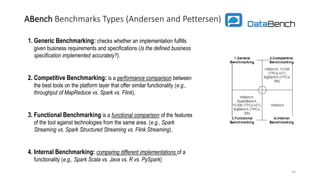
ABench Benchmarks Types (Andersen and Pettersen)
54
1. Generic Benchmarking: checks whether an implementation fulfills
given business requirements and specifications (Is the defined business
specification implemented accurately?).
2. Competitive Benchmarking: is a performance comparison between
the best tools on the platform layer that offer similar functionality (e.g.,
throughput of MapReduce vs. Spark vs. Flink).
3. Functional Benchmarking is a functional comparison of the features
of the tool against technologies from the same area. (e.g., Spark
Streaming vs. Spark Structured Streaming vs. Flink Streaming).
4. Internal Benchmarking: comparing different implementations of a
functionality (e.g., Spark Scala vs. Java vs. R vs. PySpark)
Stream Processing Benchmark – Use Case
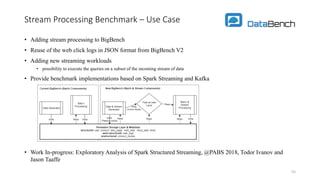
• Adding stream processing to BigBench
• Reuse of the web click logs in JSON format from BigBench V2
• Adding new streaming workloads
• possibility to execute the queries on a subset of the incoming stream of data
• Provide benchmark implementations based on Spark Streaming and Kafka
• Work In-progress: Exploratory Analysis of Spark Structured Streaming, @PABS 2018, Todor Ivanov and
Jason Taaffe
55
Machine Learning Benchmark – Use Case
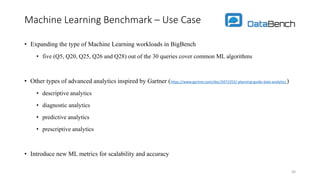
• Expanding the type of Machine Learning workloads in BigBench
• five (Q5, Q20, Q25, Q26 and Q28) out of the 30 queries cover common ML algorithms
• Other types of advanced analytics inspired by Gartner (https://www.gartner.com/doc/3471553/-planning-guide-data-analytics )
• descriptive analytics
• diagnostic analytics
• predictive analytics
• prescriptive analytics
• Introduce new ML metrics for scalability and accuracy
56
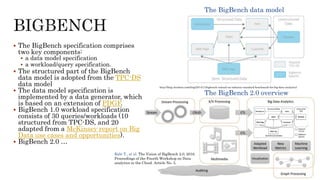
 The BigBench specification comprises
two key components:
 a data model specification
 a workload/query specification.
 The structured part of the BigBench
data model is adopted from the TPC-DS
data model
 The data model specification is
implemented by a data generator, which
is based on an extension of PDGF.
 BigBench 1.0 workload specification
consists of 30 queries/workloads (10
structured from TPC-DS, and 20
adapted from a McKinsey report on Big
Data use cases and opportunities).
 BigBench 2.0 …
The BigBench data model
The BigBench 2.0 overview
Rabi T., et al. The Vision of BigBench 2.0, 2016.
Proceedings of the Fourth Workshop on Data
analytics in the Cloud. Article No. 3,
http://blog.cloudera.com/blog/2014/11/bigbench-toward-an-industry-standard-benchmark-for-big-data-analytics/
Summary
• DataBench:
• A framework for big data benchmarking for PPP projects and big data practitioners
• We will provide methodology and tools
• Added value:
• An umbrella to access to multiple benchmarks
• Homogenized technical metrics
• Derived business KPIs,
• A community around
• PPP projects, industrial partners (BDVA and beyond) and benchmarking initiatives are
welcomed to work with us, either to use our framework or to add new benchmarks
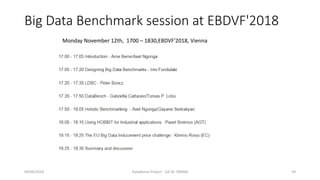
Big Data Benchmark session at EBDVF'2018
09/04/2019 DataBench Project - GA Nr 780966 59
Monday November 12th, 1700 – 1830,EBDVF'2018, Vienna
Arne.J.Berre@sintef.no
todor@dbis.cs.uni-frankfurt.de
tomas.parientelobo@atos.net
Evidence Based Big Data Benchmarking to
Improve Business Performance

Benchmarking for Big Data Applications with the DataBench Framework, Arne Berre, BPOD 2018, 10/12/2018

  • 1.
    Benchmarking for BigData Applications with the DataBench Framework Dr. Arne J. Berre, SINTEF Supported by Gabriella Cattaneo, IDC, Barbara Pernici,Politecnico di Milano Tomas Pariente Lobo, ATOS Todor Ivanov, Univ. Frankfurt, Roberto Zicari, Univ. Frankfurt IEEE Big Data Conference The Second IEEE International Workshop on Benchmarking, Performance Tuning and Optimization for Big Data Applications (BPOD) December 10, 2018 09/04/2019 DataBench Project - GA Nr 780966 1www.databench.eu January 1st, 2018-December 31st, 2020 250 pm
  • 2.
    Outline • DataBench • BusinessBenchmarking • Technical Benchmarking • BDVA Reference Model – Digital Platforms • Overview of Benchmarks 09/04/2019 DataBench Project - GA Nr 780966 2
  • 3.
    4/9/2019 DataBench Project- GA Nr 780966 3 What is Benchmarking? https://www.shopify.com/encyclopedia/benchmarking • Benchmarking is a process of measuring the performance of a company’s products, services, or processes against those of another business considered to be the best in the industry, aka “best in class.” • The point of benchmarking is to identify internal opportunities for improvement. By studying companies with superior performance, breaking down what makes such superior performance possible, and then comparing those processes to how your business operates, you can implement changes that will yield significant improvements.  Business Benchmarking 4/9/2019 DataBench Project - GA Nr 780966 3
  • 4.
    4/9/2019 DataBench Project- GA Nr 780966 4 Technical Benchmarks • In short, we define that a software benchmark is a program used for comparison of software products/tools executing on a pre- configured hardware environment. • Jim Gray (Gray 1992) describes the benchmarking as follows: ”This quantitative comparison starts with the definition of a benchmark or workload. The benchmark is run on several different systems, and the performance and price of each system is measured and recorded. Performance is typically a throughput metric (work/second) and price is typically a five-year cost-of-ownership metric. Together, they give a price/performance ratio.” 4/9/2019 DataBench Project - GA Nr 780966 4
  • 5.
    09/04/2019 DataBench Project- GA Nr 780966 5 Main Activities • Classify the main use cases of BDT by industry • Compile and assess technical benchmarks • Perform economic and market analysis to assess industrial needs • Evaluate business performance in selected use cases Expected Results • A conceptual framework linking technical and business benchmarks • European industrial and performance benchmarks • A toolbox measuring optimal benchmarking approaches • A handbook to guide the use of benchmarks Building a bridge between technical and business benchmarking
  • 6.
    Databench Workflow 6© IDC 6©IDC Technical BenchmarksBusiness Benchmarks
  • 7.
    DataBench Project -GA Nr 780966 8 How to link technical and business benchmarking WP2 – ECONOMIC MARKET AND BUSINESS ANALYSIS WP4 – EVALUATING BUSINESS PERFORMANCE Top-down Bottom-up • Focus on economic and industry analysis and the EU Big Data market • Classify leading Big Data technologies use cases by industry • Analyse industrial users benchmarking needs and assess their relative importance for EU economy and the main industries • Demonstrate the scalability, European significance (high potential economic impact) and industrial relevance (responding to primary needs of users) of the benchmarks USE CASES = Typologies of technology adoption in specific application domains and/or business processes  Focus on data collection and identification of use cases to be monitored and measured  Evaluation of business performance of specific Big Data initiatives  Leverage Databench toolbox  Provide the specific industrial benchmarks to WP”  Produce the Databench Handbook, a manual supporting the application of the Databench toolbox 09/04/2019
  • 8.
    Early Results fromthe Databench Business users Survey 09/04/2019 DataBench Project - GA Nr 780966 9
  • 9.
  • 10.
    European Companies useof Big Data © IDC 11 By Size Band DRAFT Source: Databench Survey, IDC, final results, 700 interviews, October 2018
  • 11.
    Big Data KeyUse Cases © IDC 12 Source: IDC DataBench Survey, October 2018 (n=700 European Companies)
  • 12.
    © IDC 13 KeyPerformance Indicators in Users’view Quality and Customers are the two most important KPI’s DRAFT Source: Databench Survey, IDC, final results, 700 interviews, October 2018
  • 13.
    Big Data isWorth the Investment © IDC 14 Nearly 90% of businesses saw moderate or high levels of benefit in their Big Data implementation Source: IDC DataBench Survey, October 2018 (n=700 European Companies) Adopting Big Data Solutions increased profit by 5%, revenue by 4%, and reduced cost by 3% 5% DRAFT
  • 14.
    • Provide methodologiesand tools to help assess and maximise the business benefits of BDT adoption • Provide criteria for the selection of the most appropriate BDTs solutions • Provide benchmarks of European and industrial significance • Provide a questionnaire tool comparing your choices and your KPIs with your peers DataBench Project - GA Nr 780966 15 What can DataBench do for you? What we want from you?  Expression of interest to become a case study your Big Data KPIs  Answer a survey on your Big Data experiences 09/04/2019
  • 15.
    Big Data Technical Benchmarking 09/04/2019DataBench Project - GA Nr 780966 16
  • 16.
    Technical Benchmarks inDatabench Workflow 17© IDC 17© IDC Technical BenchmarksBusiness Benchmarks
  • 17.
    Goals&Objectives • The DataBenchToolbox will be a component-based system of both vertical (holistic/business/data type driven) and horizontal (technical area based) big data benchmarks. following the layered architecture provide by the BDVA reference model. Holistic benchmarking approach for big data • It should be able to work or integrate with existing benchmarking initiatives and resources where possible. Not reinventing the wheel, but use wheels to build a new car • The Toolbox will investigate gaps of industrial significance in the big data benchmarking field and contribute to overcome them. Filling gaps • The Toolbox will implement ways to derive as much as possible the DataBench technical metrics and business KPIs from the metrics extracted from the integrated benchmarking. Homogenising metrics • It will include a web-based visualization layer to assist to the final users to specify their benchmarking requirements, such as selected benchmark, data generators, workloads, metrics and the preferred data, volume and velocity, as well as searching and monitoring capabilities. Web user interface
  • 18.
  • 19.
  • 20.
    21 23 Domain/Sector/Busi ness solutions KPIs (Manufact, Transport,Energy,.. Business Transport Manufacturing Energy .. Domain X … 22 Standards x x x x x x x x x x MetaData x Graph, Network x x x x x x x x x x x Text, NLP, Web x x x x x x x x x x x x x x x x x x x x x x Image, Audio x x x x Spatio Temp x x Time Series, IoT x x x x x x x Structured, BI x x x x x x x x x x x x x x x x x x x x x x x x x x x x x x x x 18 Visual Analytics x 17 Industrial Analytics (Descriptive, Diagnostic, Predictive, Prescriptive) x x x x 16 Machine Learning, AI, Data Science x x x x x x x x x x x x Streaming/ Realtime Processing x x x x x x x Interactive Processing x x x x x x x x x x x x x x x x x x x x x x x Batch Processing x x x x x x x x x x x x x x x x x x x x x x x x x x x x x x Data Privacy/Security 15 Data Governance/Mgmt x 14 Data Storage x x x x x x x x x x x x x x x x x x x x x x x x x x x x x x x x 19 Communication & Connectivity x x 9 Cloud Services & HPC, Edge x x x x x x TPC-H TPC-DSv1 LinearRoad HadoopWorkloadExamples GridMix PigMix MRBench CALDA HiBench YCSB SWIM CloudRank-D PUMABenchmarkSuite CloudeSuite MRBS AMPLabBigDataBenchmark BigBench BigDataBench LinkBench BigFrame PRIMEBALL SemanticPublishingBenchmark(SPB) SocialNetworkBenchmark StreamBench TPCx-HS SparkBench TPCx-V BigFUN TPC-DSv2 TPCx-BB Graphalytics YahooStreamingBenchmark(YSB) DeepBench DeepMark TensorFlowBenchmarks Fathom AdBench RIoTBench HobbitBenchmark TPCx-HSv2 BigBenchV2 Sanzu Pennmachinelearningbenchmark(PMLB) OpenMLbenchmarksuites Senska DAWNBench/MLPerf IDEBench ABench 1999 2002 2004 2009 2011 2018 BDVA Reference Model 2016 2017 2014 Verticals,incl.DatatypesAnalytics,Processing,DataManagement,Infra Benchmarks 2015 2013 2012 2010 2008 2007 Updating with new Benchmarks
  • 21.
  • 22.
  • 24.
    Evidence Based BigData Benchmarking to Improve Business Performance Benchmark Organizations 25
  • 25.
     Benchmark anystep of the Linked Data lifecycle  Ensure that benchmarking results can be found, accessed, integrated and reused easily (FAIR principles)  Benchmark Big Data platforms by being the first distributed benchmarking platform for Linked data.  The Hobbit platform comprises several components:  Single components are implemented as independent containers.  Communication between these components is done via a message bus.  Everything is dockerized, from the benchmarked system to all the components Principles: • Users can test systems with the HOBBIT benchmarks without having to worry about finding standardized hardware • New benchmarks can be easily created and added to the platform by third parties. • The evaluation can be scaled out to large datasets and on distributed architectures. • The publishing and analysis of the results of different systems can be carried out in a uniform manner across the different benchmarks.
  • 26.
    TPC (Transaction ProcessingPerformance Council) • The TPC (Transaction Processing Performance Council) is a non-profit corporation operating as an industry consortium of vendors that define transaction processing, database and big data system benchmarks. • TPC was formed on August 10, 1988 by eight companies convinced by Omri Serlin. In November 1989 was published the first standard benchmark TPC-A with 42-pages specification (Gray (1992)). By late 1990, there were 35 member companies. 27 Active TPC Benchmarks as of 2018:
  • 27.
    SPEC (Standard PerformanceEvaluation Corporation) • The SPEC (Standard Performance Evaluation Corporation) is a non-profit corporation formed to establish, maintain and endorse standardized benchmarks and tools to evaluate performance and energy efficiency for the newest generation of computing systems. • It was founded in 1988 by a small number of workstation vendors. The SPEC organization is umbrella organization that covers four groups (each with their own benchmark suites, rules and dues structure): the Open Systems Group (OSG), the High- Performance Group (HPG), the Graphics and Workstation Performance Group (GWPG) and the SPEC Research Group (RG). 28 Active SPEC Benchmarks as of 2018:
  • 28.
    STAC Benchmark Council •The STAC Benchmark Council consists of over 300 financial institutions and more than 50 vendor organizations whose purpose is to explore technical challenges and solutions in financial services and to develop technology benchmark standards that are useful to financial organizations. • Since 2007, the council is working on benchmarks targeting Fast Data, Big Data and Big Compute workloads in the finance industry. 29 Active STAC Benchmarks as 2018:
  • 29.
    Relevant Benchmark Platforms& Tools • Hobbit - https://project-hobbit.eu/ • ALOJA - https://aloja.bsc.es/ • OLTPBench - https://github.com/oltpbenchmark/oltpbench • PEEL - http://peel-framework.org/ • PAT - https://github.com/intel-hadoop/PAT 30
  • 30.
    Evidence Based BigData Benchmarking to Improve Business Performance The DataBench ToolBox Benchmarks Stress-testing the Big Data Technology Ecosystem Todor Ivanov (Frankfurt Big Data Lab) 31
  • 31.
    Big Data ValueReference Model Time series, IoT Geo Spatio Temp Media Image Audio Text NLP. Genom Web Graph Meta Struct data/ BI Stand ards Data Processing Architectures and Workflows Batch, Interactive, Streaming/Real-time Data Visualisation and User Interaction 1D, 2D, 3D, 4D, VR/AR Data Analytics Descriptive, Diagnostic, Predictive, Prescriptive Machine Learning and AI, Deep Learning, Statistics, HYBRID ANALYTICS (Optim/Simulation) j Data Management Collection, Preparation, Curation, Linking, Access, Sharing – Data Market / Data Spaces DB types: SQL, NoSQL (Document, Key-Value, Coloum, Array,Graph, …) Cloud and High Performance Computing (HPC) BigDataPriorityTechAreas Applications/Solutions: Manufacturing, Health, Energy, Transport, BioEco, Media, Telco, Finance, EO, SE, … Data Protection, Anonymisation, … Big data Types & semantics Things/Assets, Sensors and Actuators (Edge, Fog, IoT, CPS) CommunicationandConnectivity,incl.5G CyberSecurityandTrust Development-EngineeringandDevOps Datasharingplatforms.,Industrial/Personal HiBench, SparkBench, BigBench, BigBench V2, ABench, … YCSB, TPCx-IoT, … HiBench, SparkBench, BigBench, BigBench V2, ABench, … HiBench, SparkBench, BigBench, BigBench V2, ABench, … ABench …
  • 32.
    Summary Category Year NameType Domain Data Type Micro- benchmarks 2010 HiBench Micro-benchmark Suite Micro-benchmarks, Machine Learning, SQL, Websearch, Graph, Streaming Benchmarks Structured, Text, Web Graph 2015 SparkBench Micro-benchmark Suite Machine Learning, Graph Computation, SQL, Streaming Application Structured, Text, Web Graph 2010 YCSB Micro-benchmark cloud OLTP operations Structured 2017 TPCx-IoT Micro-benchmark workloads on typical IoT Gateway systems Structured, IoT Application Benchmarks 2015 Yahoo Streaming Benchmark Application Streaming Benchmark advertisement analytics pipeline Structured, Time Series 2013 BigBench/TPCx-BB Application End-to-end Benchmark a fictional product retailer platform Structured, Text, JSON logs 2017 BigBench V2 Application End-to-end Benchmark a fictional product retailer platform Structured, Text, JSON logs 2018 ABench (Work-in- Progress) Big Data Architecture Stack Benchmark set of different workloads Structured, Text, JSON logs 33
  • 33.
    Some of thebenchmarks to integrate (I) Year Name Type 2010 HiBench Big data benchmark suite for evaluating different big data frameworks. 19 workloads including synthetic micro-benchmarks and real-world applications from 6 categories which are micro, machine learning, sql, graph, websearch and streaming. 2015 SparkBench System for benchmarking and simulating Spark jobs. Multiple workloads organized in 4 categories. 2010 Yahoo! Cloud System Benchmark (YSCB) Evaluates performance of different “key-value” and “cloud” serving systems, which do not support the ACID properties. The YCSB++ , an extension, includes many additions such as multi-tester coordination for increased load and eventual consistency measurement. 2017 TPCx-IoT Based on YCSB, but with significant changes. Workloads of data ingestion and concurrent queries simulating workloads on typical IoT Gateway systems. Dataset with data from sensors from electric power station(s) 34 Micro-benchmarks:
  • 34.
    Some of thebenchmarks to integrate (II) Year Name Type 2015 Yahoo Streaming Benchmark (YSB) The Yahoo Streaming Benchmark is a streaming application benchmark simulating an advertisement analytics pipeline. 2013 BigBench/TPCx-BB BigBench is an end-to-end, technology agnostic, application-level benchmark that tests the analytical capabilities of a Big Data platform. It is based on a fictional product retailer business model. 2017 BigBench V2 Similar to BigBench, BigBench V2 is an end-to-end, technology agnostic, application-level benchmark that tests the analytical capabilities of a Big Data platform 2018 ABench (Work-in- Progress) New type of multi-purpose Big Data benchmark covering many big data scenarios and implementations. Extends other benchmarks such as BigBench 35 Application-oriented benchmarks:
  • 35.
    gcattaneo@idc.com rstevens@idc.com Evidence Based BigData Benchmarking to Improve Business Performance
  • 36.
  • 37.
    HiBench (version 7.1- https://github.com/intel-hadoop/HiBench) Description HiBench is a comprehensive big data benchmark suite for evaluating different big data frameworks. It consists of 19 workloads including both synthetic micro-benchmarks and real-world applications from 6 categories which are micro, ml (machine learning), sql, graph, websearch and streaming. Domain Micro-benchmark suite including 6 categories which are micro, ml (machine learning), sql, graph, websearch and streaming. Workload • Micro Benchmarks: Sort (sort), WordCount (wordcount), TeraSort (terasort), Sleep (sleep), enhanced DFSIO (dfsioe) • Machine Learning: Bayesian Classification (Bayes), K-means clustering (Kmeans), Logistic Regression (LR), Alternating Least Squares (ALS), Gradient Boosting Trees (GBT), Linear Regression (Linear), Latent Dirichlet Allocation (LDA), Principal Components Analysis (PCA), Random Forest (RF), Support Vector Machine (SVM), Singular Value Decomposition (SVD) • SQL: Scan (scan), Join(join), Aggregate(aggregation) • Websearch Benchmarks: PageRank (pagerank), Nutch indexing (nutchindexing) • Graph Benchmark: NWeight (nweight) • Streaming Benchmarks: Identity (identity), Repartition (repartition), Stateful Wordcount (wordcount), Fixwindow (fixwindow) 38 1
  • 38.
    HiBench (version 7.1- https://github.com/intel-hadoop/HiBench) 39 Data Type Most workloads use synthetic data generated from real data samples. The workloads use structured and semi-structured data. Metrics The measured metrics are execution time (latency), throughput and system resource utilizations (CPU, Memory, etc.). Implementation HiBench can be executed in Docker containers. It is implemented using the following technologies: • Hadoop: Apache Hadoop 2.x, CDH5, HDP • Spark: Spark 1.6.x, Spark 2.0.x, Spark 2.1.x, Spark 2.2.x • Flink: 1.0.3 • Storm: 1.0.1 • Gearpump: 0.8.1 • Kafka: 0.8.2.2 2
  • 39.
    SparkBench(https://github.com/CODAIT/spark-bench) Description Spark-Bench isa flexible system for benchmarking and simulating Spark jobs. It consists of multiple workloads organized in 4 categories. Domain Spark-Bench is a Spark specific benchmarking suite to help developers and researchers to evaluate and analyze the performance of their systems in order to optimize the configurations. It consists of 10 workloads organized in 4 different categories. Workload The atomic unit of organization in Spark-Bench is the workload. Workloads are standalone Spark jobs that read their input data, if any, from disk, and write their output, if the user wants it, out to disk. Workload suites are collections of one or more workloads. The workloads in a suite can be run serially or in parallel. The 4 categories of workloads are: • Machine Learning: logistic regression (LogRes), support vector machine (SVM) and matrix factorization (MF). • Graph Computation: PageRank, collaborative filtering model (SVD++) and a fundamental graph analytics algorithm (TriangleCount (TC)). • SQL Query: select, aggregate and join in HiveQL and RDDRelation. • Streaming Application: Twitter popular tag and PageView 40 1
  • 40.
    SparkBench(https://github.com/CODAIT/spark-bench) Data Type Thedata type and generation is depending on the different workload. The LogRes and SVM use the Wikipedia data set. The MF, SVD++ and TriangleCount use the Amazon Movie Review data set. The PageRank uses Google Web Graph data and respectively Twitter uses Twitter data. The SQL Queries workloads use E-commerce data. Finally, the PageView uses PageView DataGen to generate synthetic data. Metrics SparkBench defines a number of metrics facilitating users to compare between various Spark optimizations, configurations and cluster provisioning options: • Job Execution Time(s) of each workload • Data Process Rate (MB/seconds) • Shuffle Data Size Implementation Spark-Bench is currently compiled against the Spark 2.1.1 jars and should work with Spark 2.x. It is written using Scala 2.11.8. 41 2
  • 41.
    Yahoo! Cloud SystemBenchmark (YSCB) Description The YCSB framework is designed to evaluate the performance of different “key-value” and “cloud” serving systems, which do not support the ACID properties. The YCSB++ , an extension of the YCSB framework, includes many additions such as multi-tester coordination for increased load and eventual consistency measurement. Domain The framework is a collection of cloud OLTP related workloads representing a particular mix of read/write operations, data sizes, request distributions, and similar that can be used to evaluate systems at one particular point in the performance space. Workload YCSB provides a core package of 6 pre-defined workloads A-F, which simulate a cloud OLTP applications. The workloads are a variation of the same basic application type and using a table of records with predefined size and type of the fields. Each operation against the data store is randomly chosen to be one of: Insert, Update, Read and Scan. The YCSB workload consists of random operations defined by one of the several built-in distributions: Uniform, Zipfian, Latest and Multinomial. 42 1
  • 42.
    Yahoo! Cloud SystemBenchmark (YSCB) Data Type The benchmark consists of a workload generator and a generic database interface, which can be easily extended to support other relational or NoSQL databases. Metrics The benchmark measures the latency and achieved throughput of the executed operations. At the end of the experiment, it reports total execution time, the average throughput, 95th and 99th percentile latencies, and either a histogram or time series of the latencies. Implementation Currently, YCSB is implemented and can be run with more than 14 different engines like Cassandra, HBase, MongoDB, Riak, Couchbase, Redis, Memcached, etc. The YCSB Client is a Java program for generating the data to be loaded to the database, and generating the operations which make up the workload. 43 2
  • 43.
    TPCx-IoT Description The TPCBenchmark IoT (TPCx-IoT) benchmark workload is designed based on Yahoo Cloud Serving Benchmark (YCSB). It is not comparable to YCSB due to significant changes. The TPCx-IoT workloads consists of data ingestion and concurrent queries simulating workloads on typical IoT Gateway systems. The dataset represents data from sensors from electric power station(s). Domain TPCx-IoT was developed to provide the industry with an objective measure of the hardware, operating system, data storage and data management systems for IoT Gateway systems. The TPCx-IoT benchmark models a continuous system availability of 24 hours a day, 7 days a week. Workload The System Under Test (SUT) must run a data management platform that is commercially available and data must be persisted in a non-volatile durable media with a minimum of two-way replication. The workload represents data inject into the SUT with analytics queries in the background. The analytic queries retrieve the readings of a randomly selected sensor for two 30 second time intervals, TI1 and TI2. The first time interval TI1 is defined between the timestamp the query was started Ts and the timestamp 5 seconds prior to TS , i.e. TI1 =[TS -5,TS]. The second time interval is a randomly selected 5 seconds time interval TI2 within the 1800 seconds time interval prior to the start of the first query, TS -5. If TS <=1810, prior to the start of the first query, TS -5. 44 1
  • 44.
    TPCx-IoT Data Type Eachrecord generated consists of driver system id, sensor name, time stamp, sensor reading and padding to a 1 Kbyte size. The driver system id represents a power station. The dataset represents data from 200 different types of sensors. Metrics TPCx-IoT was specifically designed to provide verifiable performance, price-performance and availability metrics for commercially available systems that typically ingest massive amounts of data from large numbers of devices. TPCx-IoT defines the following primary metrics: • IoTps as the performance metric • $/IoTps as the price-performance metric • system availability date Implementation The benchmark currently supports the HBase 1.2.1 and Couchbase-Server 5.0 NoSQL databases. A guide providing instructions on how to add new databases is also available. 45 2
  • 45.
  • 46.
    BigBench/ TPCx-BB Description BigBenchis an end-to-end big data benchmark that represents a data model simulating the volume, velocity and variety characteristics of a big data system, together with a synthetic data generator for structured, semi-structured and unstructured data. The structured part of the retail data model is adopted from the TPC-DS benchmark and further extended with semi-structured (registered and guest user clicks) and unstructured data (product reviews). In 2016, BigBench was standardized as TPCx-BB by the Transaction Processing Performance Council (TPC). Domain BigBench is an end-to-end, technology agnostic, application-level benchmark that tests the analytical capabilities of a Big Data platform. It is based on a fictional product retailer business model. Workload The business model and a large portion of the data model's structured part is derived from the TPC-DS benchmark. The structured part was extended with a table for the prices of the retailer's competitors, the semi-structured part was added represented by a table with website logs and the unstructured part was added by a table showing product reviews. The simulated workload is based on a set of 30 queries covering the different aspects of big data analytics proposed by McKinsey. 47 1
  • 47.
    BigBench/ TPCx-BB Data TypeThe data generator can scale the amount of data based on a scale factor. Due to parallel processing of the data generator, it runs efficiently for large scale factors. The benchmark consists of four key steps: (i) System setup; (ii) Data generation; (iii) Data load; and (iv) Execute application workload. Metrics TPCx-BB defines the following primary metrics: • BBQpm@SF, the performance metric, reflecting the TPCx-BB Queries per minute throughput; where SF is the Scale Factor. • $/BBQpm@SF, the price/performance metric • System Availability Date as defined by the TPC Pricing Specification Implementation Since the BigBench specification is general and technology agnostic, it should be implemented specifically for each Big Data system. The initial implementation of BigBench was made for the Teradata Aster platform. It was done in the Aster’s SQL-MR syntax served - additionally to a description in the English language - as an initial specification of BigBench's workloads. Meanwhile, BigBench is implemented for Hadoop, using the MapReduce engine and other components like Hive, Mahout, Spark SQL, Spakr MLlib and OpenNLP from the Hadoop Ecosystem. 48 2
  • 48.
    Yahoo Streaming Benchmark(YSB) Description The YSB benchmark is a simple advertisement application. There are a number of advertising campaigns, and a number of advertisements for each campaign. The job of the benchmark is to read various JSON events from Kafka, identify the relevant events, and store a windowed count of relevant events per campaign into Redis. These steps attempt to probe some common operations performed on data streams. Domain The Yahoo Streaming Benchmark is a streaming application benchmark simulating an advertisement analytics pipeline. Workload The analytics pipeline processes a number of advertising campaigns, and a number of advertisements for each campaign. The job of the benchmark is to read various JSON events from Kafka, identify the relevant events, and store a windowed count of relevant events per campaign into Redis. The benchmark simulates common operations performed on data streams: 1. Read an event from Kafka. 2. Deserialize the JSON string. 3. Filter out irrelevant events (based on event_type field) 4. Take a projection of the relevant fields (ad_id and event_time) 5. Join each event by ad_id with its associated campaign_id. This information is stored in Redis. 6. Take a windowed count of events per campaign and store each window in Redis along with a timestamp of the time the window was last updated in Redis. 49 1
  • 49.
    Yahoo Streaming Benchmark(YSB) Data Type The data schema consists of seven attributes and is stored in JSON format: • user_id: UUID • page_id: UUID • ad_id: UUID • ad_type: String in {banner, modal, sponsored-search, mail, mobile} • event_type: String in {view, click, purchase} • event_time: Timestamp • ip_address: String Metrics The reported metrics by the benchmark are: • Latency as window.final_event_latency = (window.last_updated_at – window.timestamp) – window.duration • Aggregate System Throughput Implementation The YSB benchmark is implemented using Apache Storm, Spark, Flink, Apex, Kafka and Redis. 50 2
  • 50.
    BigBench V2 Description TheBigBench V2 benchmark addresses some of the limitation of the BigBench (TPCx-BB) benchmark. BigBench V2 separates from TPC-DS with a simple data model. The new data model still has the variety of structured, semi-structured, and unstructured data as the original BigBench data model. The difference is that the structured part has only six tables that capture necessary information about users (customers), products, web pages, stores, online sales and store sales. BigBench V2 mandates late binding by requiring query processing to be done directly on key-value web-logs rather than a pre-parsed form of it. Domain Similar to BigBench, BigBench V2 is an end-to-end, technology agnostic, application-level benchmark that tests the analytical capabilities of a Big Data platform. Workload All 11 TPC-DS queries on the complex structured part are removed and replaced by simpler queries mostly against the key-value web-logs. The new BigBench V2 queries have only 5 queries on the structured part versus 18 in BigBench. This change has no impact on the coverage of the different business categories done in BigBench. In addition to the removal of TPC-DS queries, BigBench V2 mandates late binding, but it does not impose a specific implementation of it. This requirement means that a system using BigBench V2 can extract the keys and their corresponding values per query at run-time. 51 1
  • 51.
    BigBench V2 Data TypeA new scale factor-based data generator for the new data model was developed. The web- logs are produced as key-value pairs with two sets of keys. The first set is a small set of keys that represent fields from the structured tables like IDs of users, products, and web pages. The other set of keys is larger and is produced randomly. This set is used to simulate the real life cases of large keys in web-logs that may not be used in actual queries. Product reviews are produced and linked to users and products as in BigBench but the review text is produced synthetically contrary to the Markov chain model used in BigBench. We decided to generate product reviews in this way because the Markov chain model requires real data sets which limits our options for products and makes the generator hard to scale. Metrics BigBench V2 uses the same metric definition and computation as BigBench. Implementation Similar to BigBench, BigBench V2 is technology agnostic and can be implemented for any system. Query implementations on Hive, Mahout, Spark SQL, Spark MLlib and OpenNLP from the Hadoop Ecosystem were reported in the paper. 52 2
  • 52.
    ABench: Big DataArchitecture Stack Benchmark (Work-in-Progress) • New type of multi-purpose Big Data benchmark covering many big data scenarios and implementations. • Benchmark Framework  Data generators or plugins for custom data generators  Include data generator or public data sets to simulate workload that stresses the architecture • Reuse of existing benchmarks  Case study using BigBench (in the next slides, Streaming and Machine Learning) • Open source implementation and extendable design • Easy to setup and extend • Supporting and combining all four types of benchmarks in ABench 53
  • 53.
    ABench Benchmarks Types(Andersen and Pettersen) 54 1. Generic Benchmarking: checks whether an implementation fulfills given business requirements and specifications (Is the defined business specification implemented accurately?). 2. Competitive Benchmarking: is a performance comparison between the best tools on the platform layer that offer similar functionality (e.g., throughput of MapReduce vs. Spark vs. Flink). 3. Functional Benchmarking is a functional comparison of the features of the tool against technologies from the same area. (e.g., Spark Streaming vs. Spark Structured Streaming vs. Flink Streaming). 4. Internal Benchmarking: comparing different implementations of a functionality (e.g., Spark Scala vs. Java vs. R vs. PySpark)
  • 54.
    Stream Processing Benchmark– Use Case • Adding stream processing to BigBench • Reuse of the web click logs in JSON format from BigBench V2 • Adding new streaming workloads • possibility to execute the queries on a subset of the incoming stream of data • Provide benchmark implementations based on Spark Streaming and Kafka • Work In-progress: Exploratory Analysis of Spark Structured Streaming, @PABS 2018, Todor Ivanov and Jason Taaffe 55
  • 55.
    Machine Learning Benchmark– Use Case • Expanding the type of Machine Learning workloads in BigBench • five (Q5, Q20, Q25, Q26 and Q28) out of the 30 queries cover common ML algorithms • Other types of advanced analytics inspired by Gartner (https://www.gartner.com/doc/3471553/-planning-guide-data-analytics ) • descriptive analytics • diagnostic analytics • predictive analytics • prescriptive analytics • Introduce new ML metrics for scalability and accuracy 56
  • 56.
     The BigBenchspecification comprises two key components:  a data model specification  a workload/query specification.  The structured part of the BigBench data model is adopted from the TPC-DS data model  The data model specification is implemented by a data generator, which is based on an extension of PDGF.  BigBench 1.0 workload specification consists of 30 queries/workloads (10 structured from TPC-DS, and 20 adapted from a McKinsey report on Big Data use cases and opportunities).  BigBench 2.0 … The BigBench data model The BigBench 2.0 overview Rabi T., et al. The Vision of BigBench 2.0, 2016. Proceedings of the Fourth Workshop on Data analytics in the Cloud. Article No. 3, http://blog.cloudera.com/blog/2014/11/bigbench-toward-an-industry-standard-benchmark-for-big-data-analytics/
  • 57.
    Summary • DataBench: • Aframework for big data benchmarking for PPP projects and big data practitioners • We will provide methodology and tools • Added value: • An umbrella to access to multiple benchmarks • Homogenized technical metrics • Derived business KPIs, • A community around • PPP projects, industrial partners (BDVA and beyond) and benchmarking initiatives are welcomed to work with us, either to use our framework or to add new benchmarks
  • 58.
    Big Data Benchmarksession at EBDVF'2018 09/04/2019 DataBench Project - GA Nr 780966 59 Monday November 12th, 1700 – 1830,EBDVF'2018, Vienna
  • 59.

Editor's Notes

  • #2 Gabriella Cattaneo (IDC) will provide ideas on how big data benchmarking could help organizations to get better business insights and take informed decision
  • #8 The approach is as follows: The DataBench Toolbox allows to reuse exisiting and new benchmarks in a uniform way, collects and calculate coherent metrics that make them comparable This Toolbox will be used by different stakeholders (BDV PPP projects, industries, etc.) to benchmark and compare with others The metrics will be them derived and transformed into a set of coherent business KPIs of industrial significance
  • #10 Gabriella Cattaneo (IDC) will provide ideas on how big data benchmarking could help organizations to get better business insights and take informed decision
  • #17 Gabriella Cattaneo (IDC) will provide ideas on how big data benchmarking could help organizations to get better business insights and take informed decision
  • #25 I miss the Business KPÎs formulas from WP2 to WP3. WP3 will implement the transformation, but the design should come form WP2. I miss also a functional overview of the whole process independent from the WP view (more conceptual)