،‫مفاهیم‬ ‫داده؛‬ ‫کالن‬
‫ها‬‫حل‬ ‫راه‬ ‫و‬ ‫ها‬‫چالش‬
VAHID AMIRI
VAHIDAMIRY.IR
VAHID.AMIRY@GMAIL.COM
@DATASTACK
‫های‬ ‫داده‬ ‫پردازش‬ ‫و‬ ‫توزیعی‬ ‫محاسبات‬ ‫ملی‬ ‫کنفرانس‬ ‫سومین‬‫بزرگ‬
‫تبریز‬
‫اردیبهشت‬96
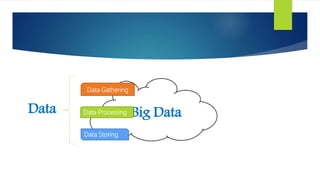
Big DataData Data Processing
Data Gathering
Data Storing
Big Data Definition
 No single standard definition…
“Big Data” is data whose scale, diversity, and complexity
require new architecture, techniques, algorithms, and
analytics to manage it and extract value and hidden
knowledge from it…
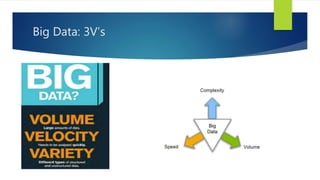
Big Data: 3V’s
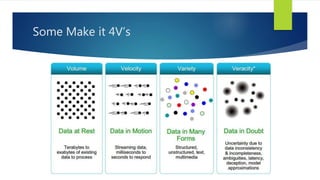
Some Make it 4V’s
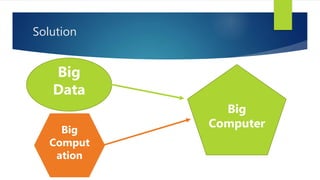
Solution
Big
Data
Big
Comput
ation
Big
Computer
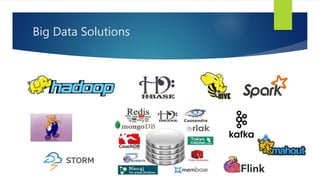
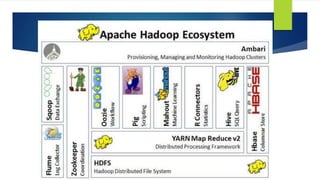
Big Data Solutions
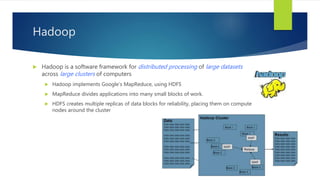
 Hadoop is a software framework for distributed processing of large datasets
across large clusters of computers
 Hadoop implements Google’s MapReduce, using HDFS
 MapReduce divides applications into many small blocks of work.
 HDFS creates multiple replicas of data blocks for reliability, placing them on compute
nodes around the cluster
Hadoop
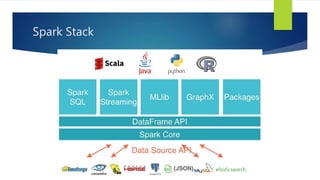
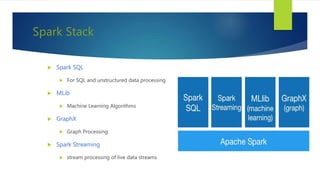
Spark Stack
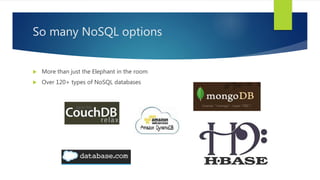
 More than just the Elephant in the room
 Over 120+ types of NoSQL databases
So many NoSQL options
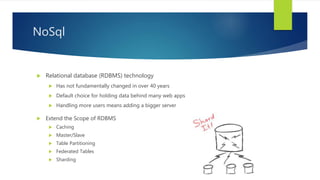
 Extend the Scope of RDBMS
 Caching
 Master/Slave
 Table Partitioning
 Federated Tables
 Sharding
NoSql
 Relational database (RDBMS) technology
 Has not fundamentally changed in over 40 years
 Default choice for holding data behind many web apps
 Handling more users means adding a bigger server
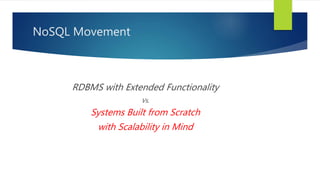
RDBMS with Extended Functionality
Vs.
Systems Built from Scratch
with Scalability in Mind
NoSQL Movement
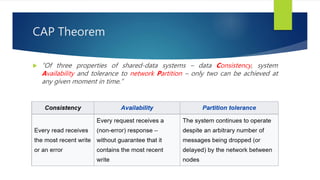
CAP Theorem
 “Of three properties of shared-data systems – data Consistency, system
Availability and tolerance to network Partition – only two can be achieved at
any given moment in time.”
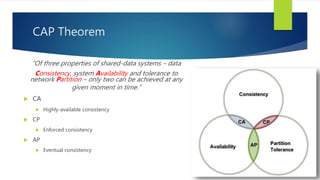
“Of three properties of shared-data systems – data
Consistency, system Availability and tolerance to
network Partition – only two can be achieved at any
given moment in time.”
 CA
 Highly-available consistency
 CP
 Enforced consistency
 AP
 Eventual consistency
CAP Theorem
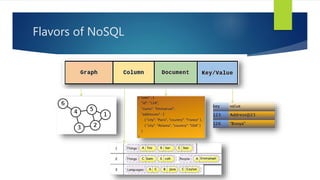
Flavors of NoSQL
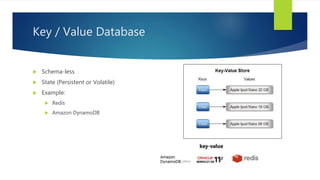
 Schema-less
 State (Persistent or Volatile)
 Example:
 Redis
 Amazon DynamoDB
Key / Value Database
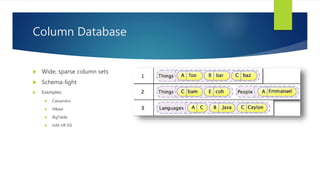
 Wide, sparse column sets
 Schema-light
 Examples:
 Cassandra
 HBase
 BigTable
 GAE HR DS
Column Database
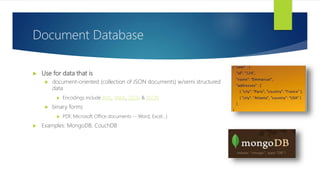
 Use for data that is
 document-oriented (collection of JSON documents) w/semi structured
data
 Encodings include XML, YAML, JSON & BSON
 binary forms
 PDF, Microsoft Office documents -- Word, Excel…)
 Examples: MongoDB, CouchDB
Document Database
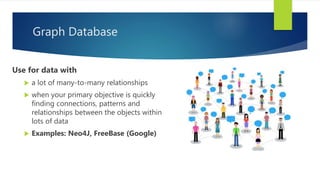
Graph Database
Use for data with
 a lot of many-to-many relationships
 when your primary objective is quickly
finding connections, patterns and
relationships between the objects within
lots of data
 Examples: Neo4J, FreeBase (Google)
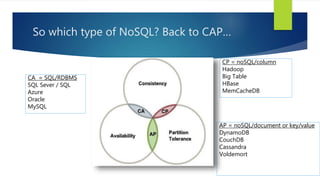
So which type of NoSQL? Back to CAP…
CP = noSQL/column
Hadoop
Big Table
HBase
MemCacheDB
AP = noSQL/document or key/value
DynamoDB
CouchDB
Cassandra
Voldemort
CA = SQL/RDBMS
SQL Sever / SQL
Azure
Oracle
MySQL
About Apache Spark
 Fast and general purpose cluster computing system
 10x (on disk) - 100x (In-Memory) faster
 Most popular for running Iterative Machine Learning Algorithms.
 Provides high level APIs in
 Java
 Scala
 Python
 R
 http://spark.apache.org/
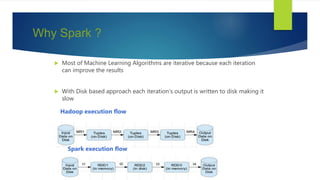
Why Spark ?
 Most of Machine Learning Algorithms are iterative because each iteration
can improve the results
 With Disk based approach each iteration’s output is written to disk making it
slow
Hadoop execution flow
Spark execution flow
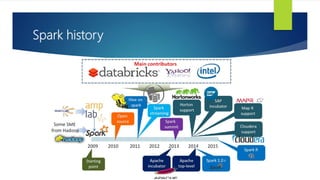
Spark history
A Brief History: MapReduce
 MapReduce use cases showed two major limitations:
 difficultly of programming directly in MR
 performance bottlenecks, or batch not fitting the use cases
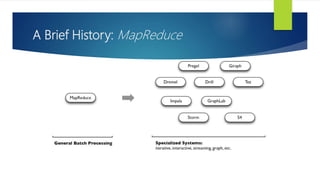
A Brief History: MapReduce
A Brief History: Spark
 Some key points about Spark:
 handles batch, interactive, and real-time within a single framework
 native integration with Java, Python, Scala
 programming at a higher level of abstraction
 more general: map/reduce is just one set of supported constructs
Spark Stack
 Spark SQL
 For SQL and unstructured data processing
 MLib
 Machine Learning Algorithms
 GraphX
 Graph Processing
 Spark Streaming
 stream processing of live data streams
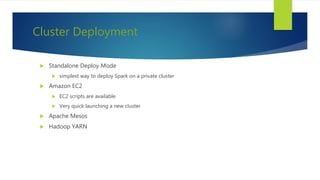
Cluster Deployment
 Standalone Deploy Mode
 simplest way to deploy Spark on a private cluster
 Amazon EC2
 EC2 scripts are available
 Very quick launching a new cluster
 Apache Mesos
 Hadoop YARN
Which Language Should I Use?
 Standalone programs can be written in any, but console is only Python & Scala
 Python developers: can stay with Python for both
 Java developers: consider using Scala for console (to learn the API)
 Performance: Java / Scala will be faster (statically typed), but Python can do well
for numerical work with NumPy
RDD
 Resilient Distributed Datasets (RDD) are the primary abstraction in Spark – a
fault-tolerant collection of elements that can be operated on in parallel
RDD
 two types of operations on RDDs:
 transformations and actions
 transformations are lazy
 (not computed immediately)
 the transformed RDD gets recomputed
 when an action is run on it (default)
 however, an RDD can be persisted into
 storage in memory or disk
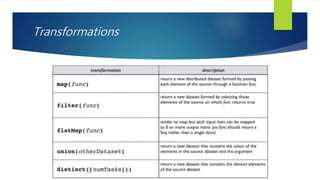
Transformations
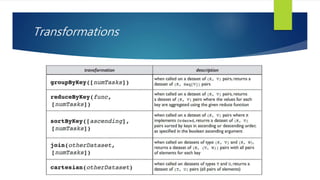
 Transformations create a new dataset from an existing one
 All transformations in Spark are lazy: they do not compute their results right away
– instead they remember the transformations applied to some base dataset
 optimize the required calculations
 recover from lost data partitions
Transformations
Transformations
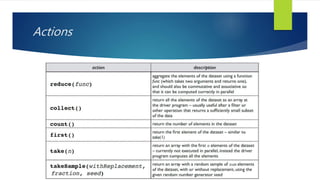
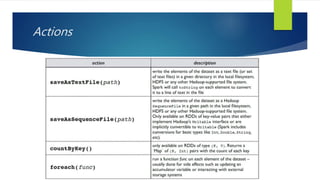
Actions
Actions
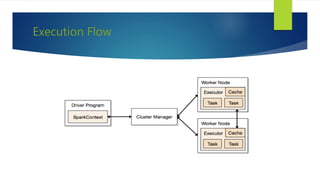
Execution Flow
Standalone (Scala)
/* SimpleApp.scala */
import org.apache.spark.SparkContext
import org.apache.spark.SparkContext._
import org.apache.spark.SparkConf
object SimpleApp {
def main(args: Array[String]) {
val logFile = "YOUR_SPARK_HOME/README.md" // Should be some file on your
system
val conf = new SparkConf().setAppName("Simple Application")
.setMaster(“local")
val sc = new SparkContext(conf)
val logData = sc.textFile(logFile, 2).cache()
val numAs = logData.filter(line => line.contains("a")).count()
val numBs = logData.filter(line => line.contains("b")).count()
println("Lines with a: %s, Lines with b: %s".format(numAs, numBs))
}
}
Standalone (Java)
public class SimpleApp {
public static void main(String[] args) {
String logFile = “LOGFILES_ADDRESS";
SparkConf conf = new SparkConf().setAppName("Simple Application").setMaster("local");
JavaSparkContext sc = new JavaSparkContext(conf);
JavaRDD<String> logData = sc.textFile(logFile);
long numAs = logData.filter(new Function<String, Boolean>() {
public Boolean call(String s) { return s.contains("a"); }
}).count();
long numBs = logData.filter(new Function<String, Boolean>() {
public Boolean call(String s) { return s.contains("b"); }
}).count();
System.out.println("Lines with a: " + numAs + ", lines with b: " + numBs);
}
}
Big data vahidamiri-tabriz-13960226-datastack.ir

Big data vahidamiri-tabriz-13960226-datastack.ir

  • 1.
    ،‫مفاهیم‬ ‫داده؛‬ ‫کالن‬ ‫ها‬‫حل‬‫راه‬ ‫و‬ ‫ها‬‫چالش‬ VAHID AMIRI VAHIDAMIRY.IR VAHID.AMIRY@GMAIL.COM @DATASTACK ‫های‬ ‫داده‬ ‫پردازش‬ ‫و‬ ‫توزیعی‬ ‫محاسبات‬ ‫ملی‬ ‫کنفرانس‬ ‫سومین‬‫بزرگ‬ ‫تبریز‬ ‫اردیبهشت‬96
  • 2.
    Big DataData DataProcessing Data Gathering Data Storing
  • 4.
    Big Data Definition No single standard definition… “Big Data” is data whose scale, diversity, and complexity require new architecture, techniques, algorithms, and analytics to manage it and extract value and hidden knowledge from it…
  • 5.
  • 6.
  • 7.
  • 8.
  • 9.
     Hadoop isa software framework for distributed processing of large datasets across large clusters of computers  Hadoop implements Google’s MapReduce, using HDFS  MapReduce divides applications into many small blocks of work.  HDFS creates multiple replicas of data blocks for reliability, placing them on compute nodes around the cluster Hadoop
  • 11.
  • 12.
     More thanjust the Elephant in the room  Over 120+ types of NoSQL databases So many NoSQL options
  • 13.
     Extend theScope of RDBMS  Caching  Master/Slave  Table Partitioning  Federated Tables  Sharding NoSql  Relational database (RDBMS) technology  Has not fundamentally changed in over 40 years  Default choice for holding data behind many web apps  Handling more users means adding a bigger server
  • 14.
    RDBMS with ExtendedFunctionality Vs. Systems Built from Scratch with Scalability in Mind NoSQL Movement
  • 15.
    CAP Theorem  “Ofthree properties of shared-data systems – data Consistency, system Availability and tolerance to network Partition – only two can be achieved at any given moment in time.”
  • 16.
    “Of three propertiesof shared-data systems – data Consistency, system Availability and tolerance to network Partition – only two can be achieved at any given moment in time.”  CA  Highly-available consistency  CP  Enforced consistency  AP  Eventual consistency CAP Theorem
  • 17.
  • 18.
     Schema-less  State(Persistent or Volatile)  Example:  Redis  Amazon DynamoDB Key / Value Database
  • 19.
     Wide, sparsecolumn sets  Schema-light  Examples:  Cassandra  HBase  BigTable  GAE HR DS Column Database
  • 20.
     Use fordata that is  document-oriented (collection of JSON documents) w/semi structured data  Encodings include XML, YAML, JSON & BSON  binary forms  PDF, Microsoft Office documents -- Word, Excel…)  Examples: MongoDB, CouchDB Document Database
  • 21.
    Graph Database Use fordata with  a lot of many-to-many relationships  when your primary objective is quickly finding connections, patterns and relationships between the objects within lots of data  Examples: Neo4J, FreeBase (Google)
  • 22.
    So which typeof NoSQL? Back to CAP… CP = noSQL/column Hadoop Big Table HBase MemCacheDB AP = noSQL/document or key/value DynamoDB CouchDB Cassandra Voldemort CA = SQL/RDBMS SQL Sever / SQL Azure Oracle MySQL
  • 25.
    About Apache Spark Fast and general purpose cluster computing system  10x (on disk) - 100x (In-Memory) faster  Most popular for running Iterative Machine Learning Algorithms.  Provides high level APIs in  Java  Scala  Python  R  http://spark.apache.org/
  • 26.
    Why Spark ? Most of Machine Learning Algorithms are iterative because each iteration can improve the results  With Disk based approach each iteration’s output is written to disk making it slow Hadoop execution flow Spark execution flow
  • 27.
  • 28.
    A Brief History:MapReduce  MapReduce use cases showed two major limitations:  difficultly of programming directly in MR  performance bottlenecks, or batch not fitting the use cases
  • 29.
  • 30.
    A Brief History:Spark  Some key points about Spark:  handles batch, interactive, and real-time within a single framework  native integration with Java, Python, Scala  programming at a higher level of abstraction  more general: map/reduce is just one set of supported constructs
  • 31.
    Spark Stack  SparkSQL  For SQL and unstructured data processing  MLib  Machine Learning Algorithms  GraphX  Graph Processing  Spark Streaming  stream processing of live data streams
  • 32.
    Cluster Deployment  StandaloneDeploy Mode  simplest way to deploy Spark on a private cluster  Amazon EC2  EC2 scripts are available  Very quick launching a new cluster  Apache Mesos  Hadoop YARN
  • 33.
    Which Language ShouldI Use?  Standalone programs can be written in any, but console is only Python & Scala  Python developers: can stay with Python for both  Java developers: consider using Scala for console (to learn the API)  Performance: Java / Scala will be faster (statically typed), but Python can do well for numerical work with NumPy
  • 34.
    RDD  Resilient DistributedDatasets (RDD) are the primary abstraction in Spark – a fault-tolerant collection of elements that can be operated on in parallel
  • 35.
    RDD  two typesof operations on RDDs:  transformations and actions  transformations are lazy  (not computed immediately)  the transformed RDD gets recomputed  when an action is run on it (default)  however, an RDD can be persisted into  storage in memory or disk
  • 36.
    Transformations  Transformations createa new dataset from an existing one  All transformations in Spark are lazy: they do not compute their results right away – instead they remember the transformations applied to some base dataset  optimize the required calculations  recover from lost data partitions
  • 37.
  • 38.
  • 39.
  • 40.
  • 41.
  • 42.
    Standalone (Scala) /* SimpleApp.scala*/ import org.apache.spark.SparkContext import org.apache.spark.SparkContext._ import org.apache.spark.SparkConf object SimpleApp { def main(args: Array[String]) { val logFile = "YOUR_SPARK_HOME/README.md" // Should be some file on your system val conf = new SparkConf().setAppName("Simple Application") .setMaster(“local") val sc = new SparkContext(conf) val logData = sc.textFile(logFile, 2).cache() val numAs = logData.filter(line => line.contains("a")).count() val numBs = logData.filter(line => line.contains("b")).count() println("Lines with a: %s, Lines with b: %s".format(numAs, numBs)) } }
  • 43.
    Standalone (Java) public classSimpleApp { public static void main(String[] args) { String logFile = “LOGFILES_ADDRESS"; SparkConf conf = new SparkConf().setAppName("Simple Application").setMaster("local"); JavaSparkContext sc = new JavaSparkContext(conf); JavaRDD<String> logData = sc.textFile(logFile); long numAs = logData.filter(new Function<String, Boolean>() { public Boolean call(String s) { return s.contains("a"); } }).count(); long numBs = logData.filter(new Function<String, Boolean>() { public Boolean call(String s) { return s.contains("b"); } }).count(); System.out.println("Lines with a: " + numAs + ", lines with b: " + numBs); } }