




Biblical Ethics 2
     - Love for God
Lesson Overview
In this lesson we are going to study the first four
commandments two headings:
  1. Biblical Values regarding Worship
  2. Biblical Values regarding Work
Biblical Values regarding Worship
The first three command-    Overview
ments focus on our duties
                              • Commandment 1:
towards God, specifically
                                Internal Worship
how we are to worship
and honour him as God.        • Commandment 2:
                                External Worship
                              • Commandment 3:
                                Verbal Worship
The First Commandment

INTERNAL WORSHIP
The Internal Worship of God

1) The first commandment deals with the heart
   of worship: our inner loyalty to God.
The Internal Worship of God

1) The first commandment deals with the heart
   of worship: our inner loyalty to God.
2) Since the Lord is the only true God, he
   deserves the full allegiance of all people.
The Internal Worship of God

1) The first commandment deals with the heart
   of worship: our inner loyalty to God.
2) Since the Lord is the only true God, he
   deserves the full allegiance of all people.
3) God demands first place in our hearts. We
   may not substitute anything for him.
The Internal Worship of God

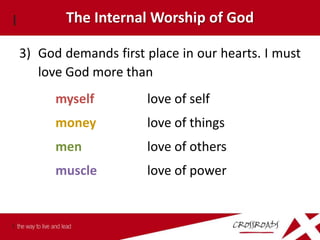
3) God demands first place in our hearts. I must
   love God more than
      myself         love of self
      money          love of things
      men            love of others
      muscle         love of power
The Second Commandment

EXTERNAL WORSHIP
The External Worship of God

1) We must not form idols to represent
   God, because he is invisible.
The External Worship of God

1) We must not form idols to represent God,
   because he is invisible.
2) There are two kinds of idols:
     a) Those intended to represent the Lord
     b) Those intended to represent other gods
The External Worship of God

1) We must not form idols to represent God,
   because he is invisible.
2) There are two kinds of idols:
     a) Those intended to represent the Lord
     b) Those intended to represent other gods

3) We must not use idols or images as aids to
   our worship.
The Third Commandment

VERBAL WORSHIP
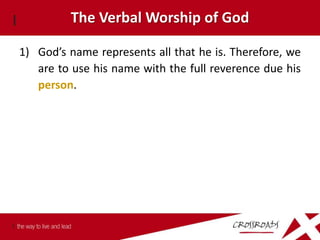
The Verbal Worship of God

1) God’s name represents all that he is. Therefore, we
   are to use his name with the full reverence due his
   person.
The Verbal Worship of God

1) God’s name represents all that he is. Therefore, we
   are to use his name with the full reverence due his
   person.
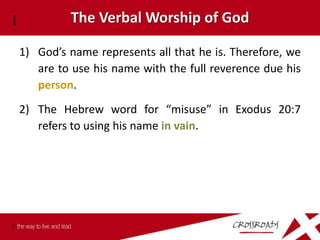
2) The Hebrew word for “misuse” in Exodus 20:7
   refers to using his name in vain.
The Verbal Worship of God

1) God’s name represents all that he is. Therefore, we
   are to use his name with the full reverence due his
   person.
2) The Hebrew word for “misuse” in Exodus 20:7
   refers to using his name in vain.
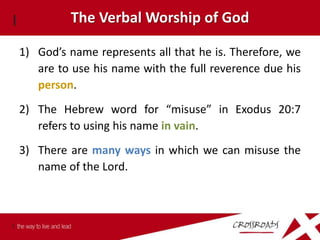
3) There are many ways in which we can misuse the
   name of the Lord.
The Verbal Worship of God
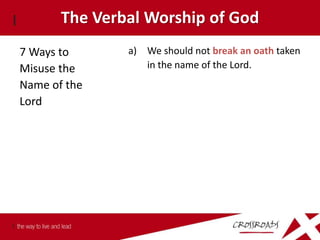
7 Ways to      a) We should not break an oath taken
Misuse the        in the name of the Lord.
Name of the
Lord
The Verbal Worship of God
7 Ways to      a) We should not break an oath taken
Misuse the        in the name of the Lord.
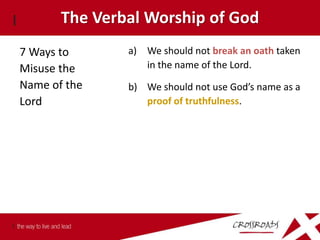
Name of the    b) We should not use God’s name as a
Lord              proof of truthfulness.
The Verbal Worship of God
7 Ways to      a) We should not break an oath taken
Misuse the        in the name of the Lord.
Name of the    b) We should not use God’s name as a
Lord              proof of truthfulness.

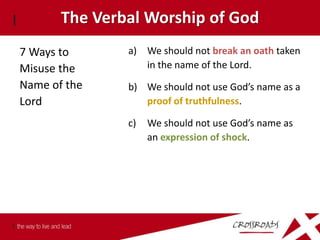
               c)   We should not use God’s name as
                    an expression of shock.
The Verbal Worship of God
7 Ways to      a) We should not break an oath taken
Misuse the        in the name of the Lord.
Name of the    b) We should not use God’s name as a
Lord              proof of truthfulness.

               c)   We should not use God’s name as
                    an expression of shock.

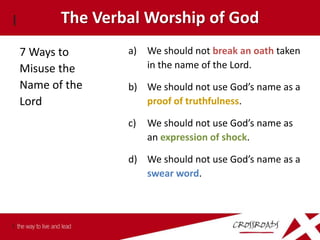
               d) We should not use God’s name as a
                  swear word.
The Verbal Worship of God
7 Ways to      e) We should not use God’s name as a
Misuse the        filler in prayer.
Name of the
Lord
The Verbal Worship of God
7 Ways to      e) We should not use God’s name as a
Misuse the        filler in prayer.
Name of the    f)   We should not perform spiritual
Lord                services without reverence.
The Verbal Worship of God
7 Ways to      e) We should not use God’s name as a
Misuse the        filler in prayer.
Name of the    f)   We should not perform spiritual
Lord                services without reverence.

               g) We should be extremely cautious
                  about speaking in God’s name.
Biblical Values regarding Work
The Value of

WORK
Work
The Bible treats work
as God’s gift and man’s
duty.
Work
The Bible treats work   1) God ordained
as God’s gift and man’s    work.
duty.
Work
The Bible treats work   1) God ordained
as God’s gift and man’s    work.
duty.                   2) Sin made work
                           drudgery.
Work
The Bible treats work   1) God ordained
as God’s gift and man’s    work.
duty.                   2) Sin made work
                           drudgery.
                        3) Work brings
                           satisfaction.
Work
The Bible treats work   1) God ordained
as God’s gift and man’s    work.
duty.                   2) Sin made work
                           drudgery.
                        3) Work brings
                           satisfaction.
                        4) Diligence pleases
                           God.
The Value of

REST
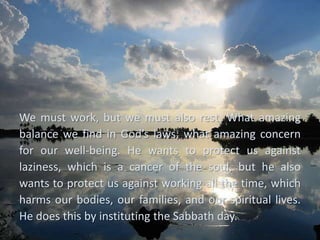
We must work, but we must also rest. What amazing
balance we find in God’s laws; what amazing concern
for our well-being. He wants to protect us against
laziness, which is a cancer of the soul, but he also
wants to protect us against working all the time, which
harms our bodies, our families, and our spiritual lives.
He does this by instituting the Sabbath day.
The Sabbath
1) The Sabbath was a day
   of rest.
The Sabbath
1) The Sabbath was a day   God designed the Sabbath to
   of rest.                protect us against the tyranny
                           of overwork. The Lord Jesus
                           Christ declared the purpose
                           and point of the Sabbath. And
                           he said to them, ‘The Sabbath
                           was made for man, and not
                           man for the Sabbath’ (Mark
                           2:27).
The Sabbath
1) The Sabbath was a day
   of rest.
2) The Sabbath was a day
   of remembrance.
The Sabbath
1) The Sabbath was a day   God also designed the Sabbath
   of rest.                as a day of remembrance, that
                           is, a time for the Israelites to
2) The Sabbath was a day   take a break from their frantic
   of remembrance.         lives and reflect on the
                           greatness and goodness of
                           God when he redeemed them
                           from Egypt (Deut. 5:12-15). So
                           it is a day to replace work with
                           worship, to focus on spiritual
                           values and needs.
The Sabbath
• The fourth commandment expresses God’s
  heart for both work and worship.
• It affirms that work is God-ordained and
  God-honouring.
• The provision of the Sabbath was to facilitate
  rest and remembrance.
Conclusion
Conclusion
1) The first four commandments are God-focused,
   teaching about our duties toward God himself.
2) The first commandment deals with the internal
   worship of God; he deserves and demands first
   place in our lives, and we should have no allegiance
   before or above him.
3) The second commandment deals with the external
   worship of God. We are not to make any idols to
   represent him.
Conclusion
4) The third commandment deals with the verbal
   worship of God. God’s name represents his person;
   therefore, we are to use it reverently, not lightly (in
   vain).
5) The fourth commandment deals work and rest. God
   ordained work, but he also provided time for rest
   and remembrance (worship).
Biblical Ethics 2: Love for God

Biblical Ethics 2: Love for God

  • 2.
    Biblical Ethics 2 - Love for God
  • 3.
    Lesson Overview In thislesson we are going to study the first four commandments two headings: 1. Biblical Values regarding Worship 2. Biblical Values regarding Work
  • 4.
  • 5.
    Biblical Values regardingWorship The first three command- Overview ments focus on our duties • Commandment 1: towards God, specifically Internal Worship how we are to worship and honour him as God. • Commandment 2: External Worship • Commandment 3: Verbal Worship
  • 6.
  • 7.
    The Internal Worshipof God 1) The first commandment deals with the heart of worship: our inner loyalty to God.
  • 8.
    The Internal Worshipof God 1) The first commandment deals with the heart of worship: our inner loyalty to God. 2) Since the Lord is the only true God, he deserves the full allegiance of all people.
  • 9.
    The Internal Worshipof God 1) The first commandment deals with the heart of worship: our inner loyalty to God. 2) Since the Lord is the only true God, he deserves the full allegiance of all people. 3) God demands first place in our hearts. We may not substitute anything for him.
  • 10.
    The Internal Worshipof God 3) God demands first place in our hearts. I must love God more than myself love of self money love of things men love of others muscle love of power
  • 11.
  • 12.
    The External Worshipof God 1) We must not form idols to represent God, because he is invisible.
  • 13.
    The External Worshipof God 1) We must not form idols to represent God, because he is invisible. 2) There are two kinds of idols: a) Those intended to represent the Lord b) Those intended to represent other gods
  • 14.
    The External Worshipof God 1) We must not form idols to represent God, because he is invisible. 2) There are two kinds of idols: a) Those intended to represent the Lord b) Those intended to represent other gods 3) We must not use idols or images as aids to our worship.
  • 15.
  • 16.
    The Verbal Worshipof God 1) God’s name represents all that he is. Therefore, we are to use his name with the full reverence due his person.
  • 17.
    The Verbal Worshipof God 1) God’s name represents all that he is. Therefore, we are to use his name with the full reverence due his person. 2) The Hebrew word for “misuse” in Exodus 20:7 refers to using his name in vain.
  • 18.
    The Verbal Worshipof God 1) God’s name represents all that he is. Therefore, we are to use his name with the full reverence due his person. 2) The Hebrew word for “misuse” in Exodus 20:7 refers to using his name in vain. 3) There are many ways in which we can misuse the name of the Lord.
  • 19.
    The Verbal Worshipof God 7 Ways to a) We should not break an oath taken Misuse the in the name of the Lord. Name of the Lord
  • 20.
    The Verbal Worshipof God 7 Ways to a) We should not break an oath taken Misuse the in the name of the Lord. Name of the b) We should not use God’s name as a Lord proof of truthfulness.
  • 21.
    The Verbal Worshipof God 7 Ways to a) We should not break an oath taken Misuse the in the name of the Lord. Name of the b) We should not use God’s name as a Lord proof of truthfulness. c) We should not use God’s name as an expression of shock.
  • 22.
    The Verbal Worshipof God 7 Ways to a) We should not break an oath taken Misuse the in the name of the Lord. Name of the b) We should not use God’s name as a Lord proof of truthfulness. c) We should not use God’s name as an expression of shock. d) We should not use God’s name as a swear word.
  • 23.
    The Verbal Worshipof God 7 Ways to e) We should not use God’s name as a Misuse the filler in prayer. Name of the Lord
  • 24.
    The Verbal Worshipof God 7 Ways to e) We should not use God’s name as a Misuse the filler in prayer. Name of the f) We should not perform spiritual Lord services without reverence.
  • 25.
    The Verbal Worshipof God 7 Ways to e) We should not use God’s name as a Misuse the filler in prayer. Name of the f) We should not perform spiritual Lord services without reverence. g) We should be extremely cautious about speaking in God’s name.
  • 26.
  • 27.
  • 28.
    Work The Bible treatswork as God’s gift and man’s duty.
  • 29.
    Work The Bible treatswork 1) God ordained as God’s gift and man’s work. duty.
  • 30.
    Work The Bible treatswork 1) God ordained as God’s gift and man’s work. duty. 2) Sin made work drudgery.
  • 31.
    Work The Bible treatswork 1) God ordained as God’s gift and man’s work. duty. 2) Sin made work drudgery. 3) Work brings satisfaction.
  • 32.
    Work The Bible treatswork 1) God ordained as God’s gift and man’s work. duty. 2) Sin made work drudgery. 3) Work brings satisfaction. 4) Diligence pleases God.
  • 33.
  • 34.
    We must work,but we must also rest. What amazing balance we find in God’s laws; what amazing concern for our well-being. He wants to protect us against laziness, which is a cancer of the soul, but he also wants to protect us against working all the time, which harms our bodies, our families, and our spiritual lives. He does this by instituting the Sabbath day.
  • 35.
    The Sabbath 1) TheSabbath was a day of rest.
  • 36.
    The Sabbath 1) TheSabbath was a day God designed the Sabbath to of rest. protect us against the tyranny of overwork. The Lord Jesus Christ declared the purpose and point of the Sabbath. And he said to them, ‘The Sabbath was made for man, and not man for the Sabbath’ (Mark 2:27).
  • 37.
    The Sabbath 1) TheSabbath was a day of rest. 2) The Sabbath was a day of remembrance.
  • 38.
    The Sabbath 1) TheSabbath was a day God also designed the Sabbath of rest. as a day of remembrance, that is, a time for the Israelites to 2) The Sabbath was a day take a break from their frantic of remembrance. lives and reflect on the greatness and goodness of God when he redeemed them from Egypt (Deut. 5:12-15). So it is a day to replace work with worship, to focus on spiritual values and needs.
  • 39.
    The Sabbath • Thefourth commandment expresses God’s heart for both work and worship. • It affirms that work is God-ordained and God-honouring. • The provision of the Sabbath was to facilitate rest and remembrance.
  • 40.
  • 41.
    Conclusion 1) The firstfour commandments are God-focused, teaching about our duties toward God himself. 2) The first commandment deals with the internal worship of God; he deserves and demands first place in our lives, and we should have no allegiance before or above him. 3) The second commandment deals with the external worship of God. We are not to make any idols to represent him.
  • 42.
    Conclusion 4) The thirdcommandment deals with the verbal worship of God. God’s name represents his person; therefore, we are to use it reverently, not lightly (in vain). 5) The fourth commandment deals work and rest. God ordained work, but he also provided time for rest and remembrance (worship).