
2nd commandment:You shall not take the name of the Lord your God in vain. (Ex. 20:7, Dt. 5:11)
Context:Q. What is the first thing you must know about a person?
A. The first thing we must know about a person is his/her name.
It is that which makes him or her different from other persons.
Names of persons represent their uniqueness, they are slighted when their names are misspelled or mispronounced
Knowing the name of a person is the initial way of knowing the person, for there is usually a history or story behind the name.
The manner with which a name is spoken usually manifest the attitude of a person towards another.Part 1-Biblical meaning of the “Name”NAMING is as old as when God commanded to name the  animals He had created.
By so doing Adam not only took responsibility over those he named but also assumed power over them.
The Hebrews never gave a name to their God, unlike the pagan nations that gave names to their gods. They believed that the all-powerful God could never be named.
God introduced Himself to Moses with a name : “ I  AM WHO AM”.
God making known his name is God making known his person.
Through this name, God made known His dominion & power over history- past , present & future.Part II- Biblical meaning of the “Name”In the New Testament, God fully revealed Himself as Father, Son and Holy Spirit.
Jesus revealed God as Father – a name that most profoundly express the very essence of God whom Jesus experienced as “Abba”.
In the Gospels Jesus healed the sick, cast out demons & worked all kinds of miracles. Jesus thus acted according to the essence of his name, which means “ One who saves”Reverence for God’s NameThe Second Commandment: Honor God’s NameBy the second commandment, we are obliged to speak with reverence of God, of the saints and of all holy things, and to keep our lawful oaths and vows.
Reverence for God’s name:God’s purpose in revealing His name for His people to adore Him under His true name.
Invocation of God’s name must therefore be made in the spirit of reverence & worship.
Jesus’ name must also be held in similar reverence & esteem. – In raising Jesus from the dead & in making him sit at His right hand, God has given him the name above every other name, which is not distinct from that of God.
To speak God’s name prayerfully is to honor Him. To say His name reverently is to Love Him.Church Teaching: CFC,# 2143, 2145The name of God should only be used to bless, praise & glorify God.
The faithful should bear witness to the Lord’s name by confessing the faith without giving way to fear.- Preaching & catechizing should be permeated with adoration & respect for the name of our Lord Jesus Christ.
In reverence for God, oaths, vows and promises are made on solemn occasions like baptism, marriage, priestly ordinations and religious vows.- Persons who enter into any of these should undergo proper preparations & understanding of what they are entering.By taking God’s name in vain is meant that the name of God or the holy name of Jesus Christ is used without reverence or respect. It is a sin to take God’s name in vain; oftentimes it is a venial sin4 due to lack of reflection. (CCC # 2146)
Oath – the calling on God to witness the truth of what we say.Three (3) things necessary to make an oath lawful:1.We must have good reason for taking an oath.2.We must be convinced that what we say under oath is true.3. We must not swear or take an oath to do what is wrong.
Vow – a deliberate promise made to God by which a person binds himself under pain of sin to do something that is especially pleasing to God. 
Sin against the second commandment:1.Perjury– a person sins by perjury when he deliberately calls on God to bear witness to a lie. In courts adults swear in God’s name to tell “the truth & nothing but the truth.” But how many cases are still not solved due to false swearing.2.False, rash unjust and unnecessary oaths 3.Blasphemy– insulting language which expresses contempt for God, either directly or indirectly or through his saints and holy things.
Offenses against 2nd CommandmentBlasphemy- e.g, i.) when someone  would outrightly accuse God of being unjust & lacking in mercy.
ii). Some Filipino Catholics easily question God’s mercy & kindness when calamities strike them. This may not be blashemy, but may weaken one’s faith & trust in God if left to predominate in one’s attitude towards difficulties in life.4.Cursing – the calling down of some evil on a person, place or thing. In the Filipino homes cursing has become almost natural part of family quarrel,- wishing someone evil or death is against Christian charityProfane words (Profanity)- is a disrespectful use of God’s name, using the name of God or Jesus to express anger, fear, or surprise.
Profanity:i.) Some Filipino are fond of using the term like “ Dios ko!” to express anger or “ Susmayosep” ( a contraction of “ Hesus, Maria y Jose”) to express surprise.ii.) These similar expressions & the imprudent use of the name of Jesus in ordinary conversations may seem unimportant & small. But if we really want to revere God, we cannot afford to utter it carelessly & thoughtlessly.Summary / ConclusionTo use the name of God in vain is to act against the very person of God, for his name, he is made present.
Using religion for purposes other than worshipping God and loving and serving others is an abuse and desecration of religion
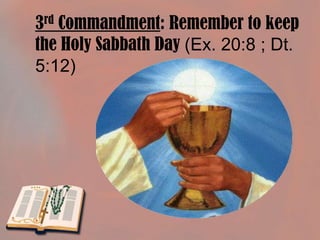
Beyond using the name of God in coarse, vulgar, & foul language, the worst sins against the 2ndcomm are sins that directly attack His very person & majesty of his authority like cursing, blasphemy, false oaths3rd Commandment: Remember to keep the Holy Sabbath Day (Ex. 20:8 ; Dt. 5:12)
WHAT IS SABBATH?God works & He wants man to work ( Gen.1:28)
Work distinguishes man from the rest of other creatures. – We work for a living, for our survival, but more importantly for the development & progress of mankind.
God created the Sabbath so that our mind &body can rest from our daily routine. What is Sabbath?In order to function well, we need relaxation & recreation. Our body & mind need to be 	“re-created”. Rest will “ create again” our body & mind by replenishing the energy dissipated so that we can carry on with the human tasks. Man has the right to periodic rest… ( Mater et Magistra or MM, 249)What is the profound purpose of bodily & mental rest?It is meant to lift the spirit up to god the Creator & worship Him with our whole heart & whole mind & whole body.
St. Augustine said: “ Our hearts are restless until they rest in God.”
The real rest that we ought to seek is resting in the holy presence of God since that is what we are created for. ( CFC, 918)What is the profound purpose of bodily & mental rest? The Sabbath or Rest is for all God’s people together with all His creation to worship Him.
All our efforts to better the world will be nothing if we separate ourselves from God, the Source of all these efforts.- There we go back to Him to be “re-created.”
We cannot worship God while neglecting our loved ones & our neighbors who are in need.What is the profound purpose of bodily & mental rest? The Sabbath celebration has a social dimension:i). It is a day when families come together  to enjoy each other’s company & strengthen relationships.	ii.) It is also a day to focus our attention on the poor, the sick, the victims of calamities, the ignorant, etc. We can spend this day helping these less privileged members of the community
To summarize the reasons for the Sabbath are:1. To worship God the creator2. Human physical rest3. Social obligation of caring for the less privileged
The Third Commandment: Sunday is the Lord’s Day By the third commandment, we are obliged to worship God in a special on Sunday, the Lord’s Day.
The Church commands us to keep Sunday instead of the Sabbath as the Lord’s Day because the Sabbath which represented the completion of the first creation (Genesis account), has been replaced by Sunday which recalls the new creation by the Resurrection of Christ (CCC # 2174, 2190-2191).
The Church commands us to worship God on Sunday by attending the Holy Sacrifice of the Mass.  This commandment corresponds as well to the first Law or Precept of the Catholic Church: You shall attend Mass on Sundays and on holy days of obligation and rest from servile labor.
Holy Days of Obligation are special days that should be kept holy even if they do not fall on a Sunday, and which are dedicated to the Lord and his saints to commemorate some outstanding mystery of the faith.
Holy Days of Obligation (in the Philippines only)1.Solemnity of Mary, Mother of God  Octave Day of Christmas (January 1)Mary is the Mother of Jesus Christ, who is true God and true man.  Being the Mother of God, Mary is endowed by God with special privileges: she is free from all sins, and she was assumed into heaven body and soul.
The redemption began with Mary’s fiat (yes) to the word of God, when she accepted her roles as the Mother of the Son of God.  Jesus came through Mary’s faith, who received the divine plan as the “handmaid of the Lord, “(Ancilla Domini) fully devoted to fulfilling his will.
2.Solemnity of the Immaculate Conception of the Blessed Virgin Mary (December 8)Originating in the 7th century feast of “Conception of Mary by St. Anne,”: Pope Clement XI, in his Bull, CommissiNobis, established this solemnity for the entire Church in 1708.
For Filipinos, this special title of the Blessed Virgin Mary is given importance by virtue of being the Principal Patroness of the Philippines, as declared by Pope Pius XII in 1942. As such, on this day in all Cathedrals and parish Churches, the consecration of the Philippines to Mary Immaculate is to be prayed according to the approved formula
3. Christmas, Solemnity of the Lord’s Birth (December 25)Proper Feasts for the Philippines:1.Feasts of the Santo Niño (third Sunday of January)2.Feasts of St. Lorenzo Ruiz and Companions, Martyrs (September 28) 
San Lorenzowas a devoted husband and father of three children in the Philippines during the seventeenth century.  After he was unjustly accused of murder, he fled with Christian missionaries to Japan where he was tortured for faith and died professing: “I shall die for God, and for him I would give many thousands of lives if I had them.”
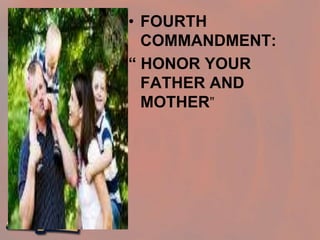
FOURTH COMMANDMENT:“ HONOR YOUR FATHER AND MOTHER”
Fourth Commandment: Honor your father and your mother. (Ex. 20:12, Dt. 5:16)The Fourth Commandment: Obedience, Love and Respect for ParentsBy the fourth commandment, we are obliged to respect and love our parents, to obey them in all that is not sinful, and to help them when they are in need. 
THE FILIPINO FAMILY TODAY:The Philippine situation today reveals that, while family-orientation is still held as a Filipino value, there are quite a number of Filipino families that are disintegrating.
Many children are born practically without parents.
Children growing up with single parents due to job opportunities abroad.
Some are victims of broken families.
Others have both parents, but irresponsible & neglectful
Others are victims of child abuse in different formsObstacles / hindrances in honoring parents:[ CFC, 1006-1008]1. Irresponsible parents – Not all fathers & mothers are really loving2. Parent’s inability or refusal to understand the different stages of growth of their children – A lot of Filipino parents do not know the characteristics of the different stages of human growth & dev’t. Hence they often fail to guide their children and “allow” them to grow & become mature individuals.
Obstacles / Hindrances:3. Generation Gap- With the “high-tech” and “colonial” mentality come so many cultural changes that plague the Filipino homes.- The young who are more expose & open are highly adaptable, while elders who prefer to be traditional cling to the old attitudes & practices
Hindrances / Obstacles:4. Parental Absence- McCann Erickson Philippines Survey shows the growing phenomenon of break-ups in Filipino homes & families.McCann report finds that a substantial minority of the young live in a fatherless or motherless home.In addition to single parent & marital split-ups, the study cites overseas migrant worker may have the highest impact on this phenomenonSignificant percentage of working mothers may contribute to the growing absence of nurturing & bonding in Filipino homes.
The Nature of the Family [ CFC, 1012-1016;1019]Covenant Relationshipthe founded is founded on love, the  same love that bound God with Israel in their covenantal relationship
the family is the place where we truly belong, where we find our deepest relationships, & where we discover who we are
it a covenant love because it creates & sustains the basic community we need to become & survive as persons
Without our families, who are we? What is the use of anything we do or think or strive for, if we cannot share it with our loved ones?
Apart from the family we lose our “roots” as personsNature of the Family2. The family as Domestic ChurchThe family is the school of discipleship, where we first learn how to give, love, & forgive
It is a domestic Church, where we first hear the name of Jesus, learn our first prayers, and know what is right & wrong.
It is where we experience the Church as a people of God, a people who are both graced and sinfulNature of the Family3. The family is the First & Vital Cell of SocietyThe family is the first school where we learn to say our first words & live the values of sharing, fairness, & justice
It is the formation ground of the future citizens of a nation and of the whole world.
The family is an irreplaceable place where traditions and value systems of a people and a culture are passed on from generation to generationWhat the Fourth Commandment Demands?1. Assistance for parentsYoung children are obliged to help their parents in the home chores
Adult children are obliged to take care of their sick, aged, unproductive parents2. Filial respect for parentsBoth parents must receive equal respect from all the children

Fcl 402 (2nd commandment)

  • 1.
    2nd commandment:You shallnot take the name of the Lord your God in vain. (Ex. 20:7, Dt. 5:11)
  • 2.
    Context:Q. What isthe first thing you must know about a person?
  • 3.
    A. The firstthing we must know about a person is his/her name.
  • 4.
    It is thatwhich makes him or her different from other persons.
  • 5.
    Names of personsrepresent their uniqueness, they are slighted when their names are misspelled or mispronounced
  • 6.
    Knowing the nameof a person is the initial way of knowing the person, for there is usually a history or story behind the name.
  • 7.
    The manner withwhich a name is spoken usually manifest the attitude of a person towards another.Part 1-Biblical meaning of the “Name”NAMING is as old as when God commanded to name the animals He had created.
  • 8.
    By so doingAdam not only took responsibility over those he named but also assumed power over them.
  • 9.
    The Hebrews nevergave a name to their God, unlike the pagan nations that gave names to their gods. They believed that the all-powerful God could never be named.
  • 10.
    God introduced Himselfto Moses with a name : “ I AM WHO AM”.
  • 11.
    God making knownhis name is God making known his person.
  • 12.
    Through this name,God made known His dominion & power over history- past , present & future.Part II- Biblical meaning of the “Name”In the New Testament, God fully revealed Himself as Father, Son and Holy Spirit.
  • 13.
    Jesus revealed Godas Father – a name that most profoundly express the very essence of God whom Jesus experienced as “Abba”.
  • 14.
    In the GospelsJesus healed the sick, cast out demons & worked all kinds of miracles. Jesus thus acted according to the essence of his name, which means “ One who saves”Reverence for God’s NameThe Second Commandment: Honor God’s NameBy the second commandment, we are obliged to speak with reverence of God, of the saints and of all holy things, and to keep our lawful oaths and vows.
  • 15.
    Reverence for God’sname:God’s purpose in revealing His name for His people to adore Him under His true name.
  • 16.
    Invocation of God’sname must therefore be made in the spirit of reverence & worship.
  • 17.
    Jesus’ name mustalso be held in similar reverence & esteem. – In raising Jesus from the dead & in making him sit at His right hand, God has given him the name above every other name, which is not distinct from that of God.
  • 18.
    To speak God’sname prayerfully is to honor Him. To say His name reverently is to Love Him.Church Teaching: CFC,# 2143, 2145The name of God should only be used to bless, praise & glorify God.
  • 19.
    The faithful shouldbear witness to the Lord’s name by confessing the faith without giving way to fear.- Preaching & catechizing should be permeated with adoration & respect for the name of our Lord Jesus Christ.
  • 20.
    In reverence forGod, oaths, vows and promises are made on solemn occasions like baptism, marriage, priestly ordinations and religious vows.- Persons who enter into any of these should undergo proper preparations & understanding of what they are entering.By taking God’s name in vain is meant that the name of God or the holy name of Jesus Christ is used without reverence or respect. It is a sin to take God’s name in vain; oftentimes it is a venial sin4 due to lack of reflection. (CCC # 2146)
  • 21.
    Oath – thecalling on God to witness the truth of what we say.Three (3) things necessary to make an oath lawful:1.We must have good reason for taking an oath.2.We must be convinced that what we say under oath is true.3. We must not swear or take an oath to do what is wrong.
  • 22.
    Vow – adeliberate promise made to God by which a person binds himself under pain of sin to do something that is especially pleasing to God. 
  • 23.
    Sin against thesecond commandment:1.Perjury– a person sins by perjury when he deliberately calls on God to bear witness to a lie. In courts adults swear in God’s name to tell “the truth & nothing but the truth.” But how many cases are still not solved due to false swearing.2.False, rash unjust and unnecessary oaths 3.Blasphemy– insulting language which expresses contempt for God, either directly or indirectly or through his saints and holy things.
  • 24.
    Offenses against 2ndCommandmentBlasphemy- e.g, i.) when someone would outrightly accuse God of being unjust & lacking in mercy.
  • 25.
    ii). Some FilipinoCatholics easily question God’s mercy & kindness when calamities strike them. This may not be blashemy, but may weaken one’s faith & trust in God if left to predominate in one’s attitude towards difficulties in life.4.Cursing – the calling down of some evil on a person, place or thing. In the Filipino homes cursing has become almost natural part of family quarrel,- wishing someone evil or death is against Christian charityProfane words (Profanity)- is a disrespectful use of God’s name, using the name of God or Jesus to express anger, fear, or surprise.
  • 26.
    Profanity:i.) Some Filipinoare fond of using the term like “ Dios ko!” to express anger or “ Susmayosep” ( a contraction of “ Hesus, Maria y Jose”) to express surprise.ii.) These similar expressions & the imprudent use of the name of Jesus in ordinary conversations may seem unimportant & small. But if we really want to revere God, we cannot afford to utter it carelessly & thoughtlessly.Summary / ConclusionTo use the name of God in vain is to act against the very person of God, for his name, he is made present.
  • 27.
    Using religion forpurposes other than worshipping God and loving and serving others is an abuse and desecration of religion
  • 28.
    Beyond using thename of God in coarse, vulgar, & foul language, the worst sins against the 2ndcomm are sins that directly attack His very person & majesty of his authority like cursing, blasphemy, false oaths3rd Commandment: Remember to keep the Holy Sabbath Day (Ex. 20:8 ; Dt. 5:12)
  • 29.
    WHAT IS SABBATH?Godworks & He wants man to work ( Gen.1:28)
  • 30.
    Work distinguishes manfrom the rest of other creatures. – We work for a living, for our survival, but more importantly for the development & progress of mankind.
  • 31.
    God created theSabbath so that our mind &body can rest from our daily routine. What is Sabbath?In order to function well, we need relaxation & recreation. Our body & mind need to be “re-created”. Rest will “ create again” our body & mind by replenishing the energy dissipated so that we can carry on with the human tasks. Man has the right to periodic rest… ( Mater et Magistra or MM, 249)What is the profound purpose of bodily & mental rest?It is meant to lift the spirit up to god the Creator & worship Him with our whole heart & whole mind & whole body.
  • 32.
    St. Augustine said:“ Our hearts are restless until they rest in God.”
  • 33.
    The real restthat we ought to seek is resting in the holy presence of God since that is what we are created for. ( CFC, 918)What is the profound purpose of bodily & mental rest? The Sabbath or Rest is for all God’s people together with all His creation to worship Him.
  • 34.
    All our effortsto better the world will be nothing if we separate ourselves from God, the Source of all these efforts.- There we go back to Him to be “re-created.”
  • 35.
    We cannot worshipGod while neglecting our loved ones & our neighbors who are in need.What is the profound purpose of bodily & mental rest? The Sabbath celebration has a social dimension:i). It is a day when families come together to enjoy each other’s company & strengthen relationships. ii.) It is also a day to focus our attention on the poor, the sick, the victims of calamities, the ignorant, etc. We can spend this day helping these less privileged members of the community
  • 36.
    To summarize thereasons for the Sabbath are:1. To worship God the creator2. Human physical rest3. Social obligation of caring for the less privileged
  • 37.
    The Third Commandment:Sunday is the Lord’s Day By the third commandment, we are obliged to worship God in a special on Sunday, the Lord’s Day.
  • 38.
    The Church commandsus to keep Sunday instead of the Sabbath as the Lord’s Day because the Sabbath which represented the completion of the first creation (Genesis account), has been replaced by Sunday which recalls the new creation by the Resurrection of Christ (CCC # 2174, 2190-2191).
  • 39.
    The Church commandsus to worship God on Sunday by attending the Holy Sacrifice of the Mass. This commandment corresponds as well to the first Law or Precept of the Catholic Church: You shall attend Mass on Sundays and on holy days of obligation and rest from servile labor.
  • 40.
    Holy Days ofObligation are special days that should be kept holy even if they do not fall on a Sunday, and which are dedicated to the Lord and his saints to commemorate some outstanding mystery of the faith.
  • 41.
    Holy Days ofObligation (in the Philippines only)1.Solemnity of Mary, Mother of God Octave Day of Christmas (January 1)Mary is the Mother of Jesus Christ, who is true God and true man. Being the Mother of God, Mary is endowed by God with special privileges: she is free from all sins, and she was assumed into heaven body and soul.
  • 42.
    The redemption beganwith Mary’s fiat (yes) to the word of God, when she accepted her roles as the Mother of the Son of God. Jesus came through Mary’s faith, who received the divine plan as the “handmaid of the Lord, “(Ancilla Domini) fully devoted to fulfilling his will.
  • 43.
    2.Solemnity of theImmaculate Conception of the Blessed Virgin Mary (December 8)Originating in the 7th century feast of “Conception of Mary by St. Anne,”: Pope Clement XI, in his Bull, CommissiNobis, established this solemnity for the entire Church in 1708.
  • 44.
    For Filipinos, thisspecial title of the Blessed Virgin Mary is given importance by virtue of being the Principal Patroness of the Philippines, as declared by Pope Pius XII in 1942. As such, on this day in all Cathedrals and parish Churches, the consecration of the Philippines to Mary Immaculate is to be prayed according to the approved formula
  • 45.
    3. Christmas, Solemnityof the Lord’s Birth (December 25)Proper Feasts for the Philippines:1.Feasts of the Santo Niño (third Sunday of January)2.Feasts of St. Lorenzo Ruiz and Companions, Martyrs (September 28) 
  • 46.
    San Lorenzowas adevoted husband and father of three children in the Philippines during the seventeenth century. After he was unjustly accused of murder, he fled with Christian missionaries to Japan where he was tortured for faith and died professing: “I shall die for God, and for him I would give many thousands of lives if I had them.”
  • 47.
    FOURTH COMMANDMENT:“ HONORYOUR FATHER AND MOTHER”
  • 48.
    Fourth Commandment: Honoryour father and your mother. (Ex. 20:12, Dt. 5:16)The Fourth Commandment: Obedience, Love and Respect for ParentsBy the fourth commandment, we are obliged to respect and love our parents, to obey them in all that is not sinful, and to help them when they are in need. 
  • 49.
    THE FILIPINO FAMILYTODAY:The Philippine situation today reveals that, while family-orientation is still held as a Filipino value, there are quite a number of Filipino families that are disintegrating.
  • 50.
    Many children areborn practically without parents.
  • 51.
    Children growing upwith single parents due to job opportunities abroad.
  • 52.
    Some are victimsof broken families.
  • 53.
    Others have bothparents, but irresponsible & neglectful
  • 54.
    Others are victimsof child abuse in different formsObstacles / hindrances in honoring parents:[ CFC, 1006-1008]1. Irresponsible parents – Not all fathers & mothers are really loving2. Parent’s inability or refusal to understand the different stages of growth of their children – A lot of Filipino parents do not know the characteristics of the different stages of human growth & dev’t. Hence they often fail to guide their children and “allow” them to grow & become mature individuals.
  • 55.
    Obstacles / Hindrances:3.Generation Gap- With the “high-tech” and “colonial” mentality come so many cultural changes that plague the Filipino homes.- The young who are more expose & open are highly adaptable, while elders who prefer to be traditional cling to the old attitudes & practices
  • 56.
    Hindrances / Obstacles:4.Parental Absence- McCann Erickson Philippines Survey shows the growing phenomenon of break-ups in Filipino homes & families.McCann report finds that a substantial minority of the young live in a fatherless or motherless home.In addition to single parent & marital split-ups, the study cites overseas migrant worker may have the highest impact on this phenomenonSignificant percentage of working mothers may contribute to the growing absence of nurturing & bonding in Filipino homes.
  • 57.
    The Nature ofthe Family [ CFC, 1012-1016;1019]Covenant Relationshipthe founded is founded on love, the same love that bound God with Israel in their covenantal relationship
  • 58.
    the family isthe place where we truly belong, where we find our deepest relationships, & where we discover who we are
  • 59.
    it a covenantlove because it creates & sustains the basic community we need to become & survive as persons
  • 60.
    Without our families,who are we? What is the use of anything we do or think or strive for, if we cannot share it with our loved ones?
  • 61.
    Apart from thefamily we lose our “roots” as personsNature of the Family2. The family as Domestic ChurchThe family is the school of discipleship, where we first learn how to give, love, & forgive
  • 62.
    It is adomestic Church, where we first hear the name of Jesus, learn our first prayers, and know what is right & wrong.
  • 63.
    It is wherewe experience the Church as a people of God, a people who are both graced and sinfulNature of the Family3. The family is the First & Vital Cell of SocietyThe family is the first school where we learn to say our first words & live the values of sharing, fairness, & justice
  • 64.
    It is theformation ground of the future citizens of a nation and of the whole world.
  • 65.
    The family isan irreplaceable place where traditions and value systems of a people and a culture are passed on from generation to generationWhat the Fourth Commandment Demands?1. Assistance for parentsYoung children are obliged to help their parents in the home chores
  • 66.
    Adult children areobliged to take care of their sick, aged, unproductive parents2. Filial respect for parentsBoth parents must receive equal respect from all the children