Lesson Plan in Religion
I – Objectives:
o Doctrine: Understand and learn about Sacrament and its importance in our daily lives.
o Morals: May they live and share what they have learned.
o Worship: Give thanks to God for His love endures forever.
II - Subject Matter
Topic: Sacrament
Reference : CCC, CFC, PCP II, Vatican II, The Word Made Flesh and Pastoral Notes
Materials : Visual aids
III – Procedures:
Teacher’s Activity Pupils Activity
 Preliminary Activities
 Prayer
As we begin our class today. Let us have
a prayer first. Let us ask the presence of
the Holy Spirit that He may intercede
upon us for the whole duration of our
class this morning.
Together we pray our school prayer.
 Greetings
Good morning class!
You may take your sit now!
 Checking of Attendance
How many are absent today?
Who are they?
 Review/Checking of
Assignment
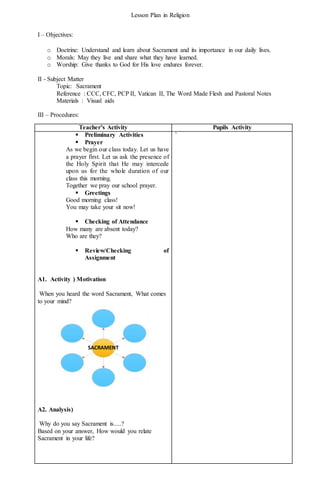
A1. Activity ) Motivation
When you heard the word Sacrament, What comes
to your mind?
A2. Analysis)
Why do you say Sacrament is.....?
Based on your answer, How would you relate
Sacrament in your life?
`
SACRAMENT
A3.) Abstraction
According to CFC,
Sacrament is outward sign, instituted by Christ,
to give grace.
A Sacrament is a sign.
 Sacrament is a special visible sign that
points us into contact with our Lord.
 The seven ritual sacraments further are
particular signs that represent particular
actions and values of Jesus. ( symbols like
water, candle, bread and wine, chrism oil,
ring, arrahae ,veil etc)
 St. Augustine define sacrament was a sign
of symbol- a sacred reality and holy in
which the believer can both perceive and
receive an invisible grace.
 Ex. Water in Baptism point the rebirth of a
Christian.
A Sacrament instituted by Christ.
 Today Christ is seen as the Primordial
Sacrament. Jesus is much more than simply
the originator of the Sacraments. He is at
once the Source, the Primary Agent, and
the Goal of all sacramental activity.
o Source – Christ is the one whom all the
sacraments are rooted.
o Primary Agent – He is the one, who
through the actions and words of the
minister celebrating the various sacraments
(Baptism, Confession, Confirmation,
Eucharist…)
o Goal – of all sacraments, Christ is the
perfection toward which our life on earth
tender not only does he challenge to a
response of love, but effectively empowers
us through the Holy Spirit to grow into His
fullness.
A Sacrament to give grace.
o The Church has always that the sacraments
give grace EX OPERA OPERATO, this
means that any lack of holiness on the part
of the minister does not prevent grace from
being offered.
o Christ himself acts through Spirit when the
sacraments are celebrated properly.
o Christ is active in all sacraments most
especially in Eucharist for His blood and
body are made present under the
appearances of bread and wine.
The effect of the Sacraments in two fold.
1. To draw us into a closer relationship to the
Church and thereby,
2. To relationship to Christ himself in the spirit
and to the Father.
According to PCP II, depicts the sacraments as the
center of the Catholic life. Just as without Christ,
Christian faith is impossible, so without the
sacrament there could be no Catholic Church.
Sacraments are signs which not only point to an
invisible reality (God's love and grace) but also
make that reality present.
Vatican II stressed faith while explaining the
purpose of the sacrament.
o To sanctify men and women.
o To build up the Body of Christ and,
o To give worship to God.
CCC, in the Catholic Church the sacraments are
divided into three categories;
Sacrament of Initiation
 Baptsim
 Eucharist
 Confirmation
Sacrament of Healing
 Penance
 Anointing of the sick
Sacrament of Service/Vocation
 Matrimony
 Holy Orders
Generalization
A descriptive definition of sacrament according
to the liturgical renewal would be "a saving
symbolic act or a visible sign, arising from the
ministry of Christ and continued in, by and for
the Church which when we received in faith,
fashions us into likeness to Christ in His Paschal
Mystery through the power of the Holy Spirit."
A4.) Application
Write in a 1 whole sheet of paper.
1.) Draw a symbol that represents sacraments.
2.) Relate the symbol into your life. Explain it.
IV - Evaluation
Write in a ½ crosswise.
Essay
1. Why sacrament is imperative for us?
2. How would you apply the sacrament as the center of Christian faith?
V. Assignment
Write in a 1 whole sheet of paper.
What are the 7 sacraments? Define each of it.
Prepared by:
Frederick John C. Gilbero
Demo Teacher

Lesson plan in Religion

  • 1.
    Lesson Plan inReligion I – Objectives: o Doctrine: Understand and learn about Sacrament and its importance in our daily lives. o Morals: May they live and share what they have learned. o Worship: Give thanks to God for His love endures forever. II - Subject Matter Topic: Sacrament Reference : CCC, CFC, PCP II, Vatican II, The Word Made Flesh and Pastoral Notes Materials : Visual aids III – Procedures: Teacher’s Activity Pupils Activity  Preliminary Activities  Prayer As we begin our class today. Let us have a prayer first. Let us ask the presence of the Holy Spirit that He may intercede upon us for the whole duration of our class this morning. Together we pray our school prayer.  Greetings Good morning class! You may take your sit now!  Checking of Attendance How many are absent today? Who are they?  Review/Checking of Assignment A1. Activity ) Motivation When you heard the word Sacrament, What comes to your mind? A2. Analysis) Why do you say Sacrament is.....? Based on your answer, How would you relate Sacrament in your life? ` SACRAMENT
  • 2.
    A3.) Abstraction According toCFC, Sacrament is outward sign, instituted by Christ, to give grace. A Sacrament is a sign.  Sacrament is a special visible sign that points us into contact with our Lord.  The seven ritual sacraments further are particular signs that represent particular actions and values of Jesus. ( symbols like water, candle, bread and wine, chrism oil, ring, arrahae ,veil etc)  St. Augustine define sacrament was a sign of symbol- a sacred reality and holy in which the believer can both perceive and receive an invisible grace.  Ex. Water in Baptism point the rebirth of a Christian. A Sacrament instituted by Christ.  Today Christ is seen as the Primordial Sacrament. Jesus is much more than simply the originator of the Sacraments. He is at once the Source, the Primary Agent, and the Goal of all sacramental activity. o Source – Christ is the one whom all the sacraments are rooted. o Primary Agent – He is the one, who through the actions and words of the minister celebrating the various sacraments (Baptism, Confession, Confirmation, Eucharist…) o Goal – of all sacraments, Christ is the perfection toward which our life on earth tender not only does he challenge to a response of love, but effectively empowers us through the Holy Spirit to grow into His fullness. A Sacrament to give grace. o The Church has always that the sacraments give grace EX OPERA OPERATO, this means that any lack of holiness on the part of the minister does not prevent grace from being offered. o Christ himself acts through Spirit when the sacraments are celebrated properly. o Christ is active in all sacraments most especially in Eucharist for His blood and body are made present under the appearances of bread and wine.
  • 3.
    The effect ofthe Sacraments in two fold. 1. To draw us into a closer relationship to the Church and thereby, 2. To relationship to Christ himself in the spirit and to the Father. According to PCP II, depicts the sacraments as the center of the Catholic life. Just as without Christ, Christian faith is impossible, so without the sacrament there could be no Catholic Church. Sacraments are signs which not only point to an invisible reality (God's love and grace) but also make that reality present. Vatican II stressed faith while explaining the purpose of the sacrament. o To sanctify men and women. o To build up the Body of Christ and, o To give worship to God. CCC, in the Catholic Church the sacraments are divided into three categories; Sacrament of Initiation  Baptsim  Eucharist  Confirmation Sacrament of Healing  Penance  Anointing of the sick Sacrament of Service/Vocation  Matrimony  Holy Orders Generalization A descriptive definition of sacrament according to the liturgical renewal would be "a saving symbolic act or a visible sign, arising from the ministry of Christ and continued in, by and for the Church which when we received in faith, fashions us into likeness to Christ in His Paschal Mystery through the power of the Holy Spirit." A4.) Application Write in a 1 whole sheet of paper. 1.) Draw a symbol that represents sacraments. 2.) Relate the symbol into your life. Explain it.
  • 4.
    IV - Evaluation Writein a ½ crosswise. Essay 1. Why sacrament is imperative for us? 2. How would you apply the sacrament as the center of Christian faith? V. Assignment Write in a 1 whole sheet of paper. What are the 7 sacraments? Define each of it. Prepared by: Frederick John C. Gilbero Demo Teacher