An exposi*onal study taught by
Harry Morgan
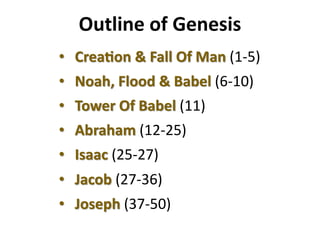
• Crea%on & Fall Of Man (1-5)
• Noah, Flood & Babel (6-10)
• Tower Of Babel (11)
• Abraham (12-25)
• Isaac (25-27)
• Jacob (27-36)
• Joseph (37-50)
Outline of Genesis
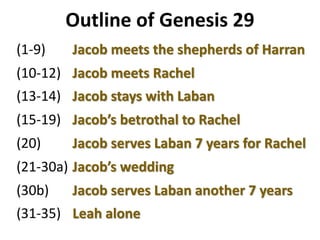
(1-9) Jacob meets the shepherds of Harran
(10-12) Jacob meets Rachel
(13-14) Jacob stays with Laban
(15-19) Jacob’s betrothal to Rachel
(20) Jacob serves Laban 7 years for Rachel
(21-30a) Jacob’s wedding
(30b) Jacob serves Laban another 7 years
(31-35) Leah alone
Outline of Genesis 29
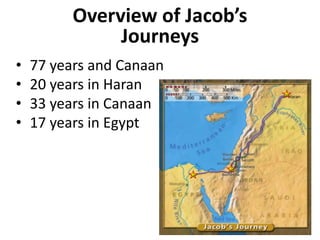
Overview of Jacob’s
Journeys
• 77 years and Canaan
• 20 years in Haran
• 33 years in Canaan
• 17 years in Egypt
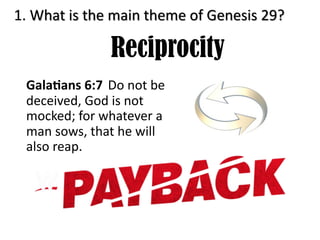
1. What is the main theme of Genesis 29?
Reciprocity
Gala$ans 6:7 Do not be
deceived, God is not
mocked; for whatever a
man sows, that he will
also reap.
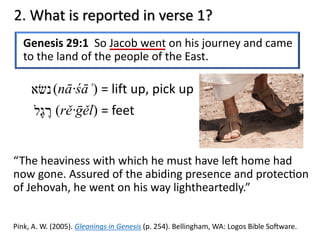
2. What is reported in verse 1?
Genesis 29:1 So Jacob went on his journey and came
to the land of the people of the East.
“The heaviness with which he must have le= home had
now gone. Assured of the abiding presence and protec@on
of Jehovah, he went on his way lightheartedly.”
Pink, A. W. (2005). Gleanings in Genesis (p. 254). Bellingham, WA: Logos Bible So>ware.
‫נ‬‫שׂ‬‫א‬ (nā·śāʾ) = lift up, pick up
‫ר‬ֶ‫ג‬ֶ‫ל‬ (rě·ḡěl) = feet
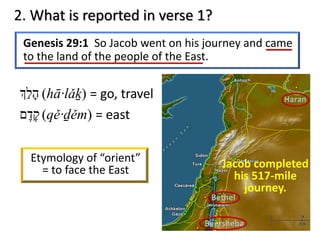
Genesis 29:1 So Jacob went on his journey and came
to the land of the people of the East.
2. What is reported in verse 1?
‫ה‬ָ‫ל‬ַ. (hā·lǎḵ) = go, travel
‫ק‬ֶ‫ד‬ֶ‫ם‬ (qě·ḏěm) = east
Jacob completed
his 517-mile
journey.
Etymology of “orient”
= to face the East
• Abraham’s servant met Rebekah at a well (24:10–15)
• Jacob encounters Rachel at a well (29:10)
• For Abraham’s servant “it happened” (24:15)
• For Jacob “was still speaking” (29:9)
• Rebekah was tending of her family’s flock (24:16–21)
• Rachel’s was tending of her father’s flock (v. 6)
Genesis 24 & 29 parallels
John Calvin: “Whenever we may wander in uncertainty
through intricate windings, we must contemplate with
eyes of faith, the secret providence of God which
governs us and our affairs and leads us to unexpected
results.”
Our heavenly Father
is ordering our lives
to glorify Him even
if we cannot always
see it.
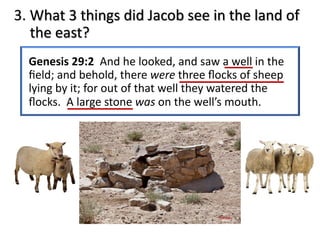
3. What 3 things did Jacob see in the land of
the east?
Genesis 29:2 And he looked, and saw a well in the
field; and behold, there were three flocks of sheep
lying by it; for out of that well they watered the
flocks. A large stone was on the well’s mouth.
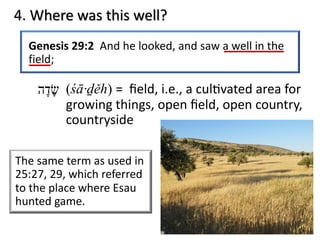
4. Where was this well?
Genesis 29:2 And he looked, and saw a well in the
field;
‫שׂ‬ָ‫ד‬ֶ‫ה‬ (śā·ḏěh) = field, i.e., a cul>vated area for
growing things, open field, open country,
countryside
The same term as used in
25:27, 29, which referred
to the place where Esau
hunted game.
5. How did Jacob locate this parJcular well?
Coincidence is God’s way of remaining anonymous.
Albert Einstein
Genesis 29:2 And he looked, and saw a well in the
field;
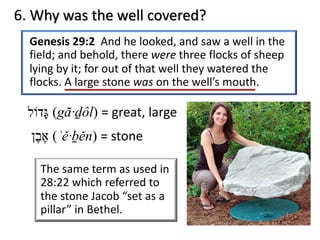
6. Why was the well covered?
Genesis 29:2 And he looked, and saw a well in the
field; and behold, there were three flocks of sheep
lying by it; for out of that well they watered the
flocks. A large stone was on the well’s mouth.
‫א‬ֶ‫ב‬ֶ‫ן‬ (ʾě·ḇěn) = stone
‫גּ‬ָ‫ד‬‫וֹ‬‫ל‬ (gā·ḏôl) = great, large
The same term as used in
28:22 which referred to
the stone Jacob “set as a
pillar” in Bethel.
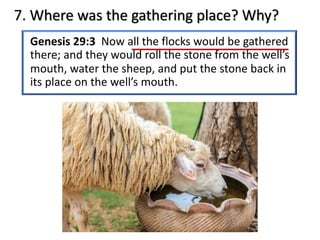
7. Where was the gathering place? Why?
Genesis 29:3 Now all the flocks would be gathered
there; and they would roll the stone from the well’s
mouth, water the sheep, and put the stone back in
its place on the well’s mouth.
8. What did Jacob call these strangers?
Genesis 29:4 And Jacob said to them, “My brethren,
where are you from?”
Ma#hew 12:50 whoever
does the will of My Father
in heaven is My brother…”
1
Jacob
becomes
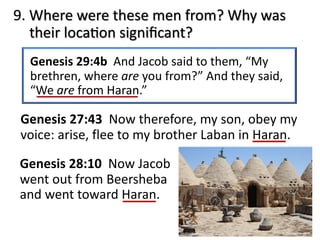
9. Where were these men from? Why was
their locaJon significant?
Genesis 29:4b And Jacob said to them, “My
brethren, where are you from?” And they said,
“We are from Haran.”
Genesis 27:43 Now therefore, my son, obey my
voice: arise, flee to my brother Laban in Haran.
Genesis 28:10 Now Jacob
went out from Beersheba
and went toward Haran.
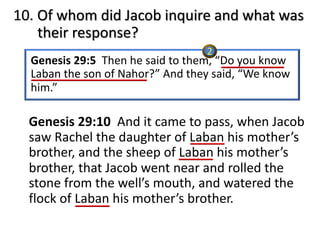
10. Of whom did Jacob inquire and what was
their response?
Genesis 29:5 Then he said to them, “Do you know
Laban the son of Nahor?” And they said, “We know
him.”
2
Genesis 29:10 And it came to pass, when Jacob
saw Rachel the daughter of Laban his mother’s
brother, and the sheep of Laban his mother’s
brother, that Jacob went near and rolled the
stone from the well’s mouth, and watered the
flock of Laban his mother’s brother.
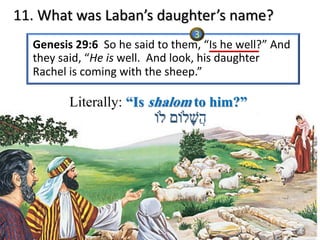
11. What was Laban’s daughter’s name?
Genesis 29:6 So he said to them, “Is he well?” And
they said, “He is well. And look, his daughter
Rachel is coming with the sheep.”
3
Literally: “Is shalom to him?”
‫ה‬ֲ‫שׁ‬ָ%‫ו‬‫ם‬%‫ו‬
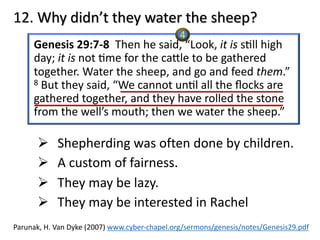
12. Why didn’t they water the sheep?
Genesis 29:7-8 Then he said, “Look, it is s@ll high
day; it is not @me for the caXle to be gathered
together. Water the sheep, and go and feed them.”
8 But they said, “We cannot un@l all the flocks are
gathered together, and they have rolled the stone
from the well’s mouth; then we water the sheep.”
Ø Shepherding was often done by children.
Ø A custom of fairness.
Ø They may be lazy.
Ø They may be interested in Rachel
Parunak, H. Van Dyke (2007) www.cyber-chapel.org/sermons/genesis/notes/Genesis29.pdf
4
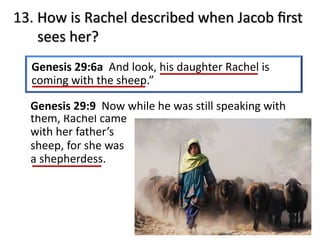
them, Rachel came
with her father’s
sheep, for she was
a shepherdess.
13. How is Rachel described when Jacob first
sees her?
Genesis 29:6a And look, his daughter Rachel is
coming with the sheep.”
Genesis 29:9 Now while he was still speaking with
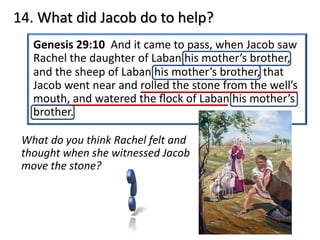
Genesis 29:10 And it came to pass, when Jacob saw
Rachel the daughter of Laban his mother’s brother,
and the sheep of Laban his mother’s brother, that
Jacob went near and rolled the stone from the well’s
mouth, and watered the flock of Laban his mother’s
brother.
14. What did Jacob do to help?
What do you think Rachel felt and
thought when she witnessed Jacob
move the stone?
15. How did he greet Rachel?
Genesis 29:11 Then Jacob kissed Rachel, and lifted
up his voice and wept.
‫נ‬ָ‫שׁ‬ַ‫ק‬ (nā·šǎq) = kiss, i.e., to touch with the lips, as
a gesture of affec6on & mutual rela6onship
(cp. Gen. 27:26-27; 33:4; 45:15)
‫נ‬ָ‫שׂ‬ָ‫א‬ (nā·śāʾ) = be liHed up
‫בּ‬ָ‫כ‬ָ‫ה‬ (bā·ḵāh) = weep, wail, cry, sob, mourn, i.e.,
to well-up tears in the eyes and have mild
convulsions or spasms of the diaphragm,
and oHen make vocal sounds of soH
groaning or loud wailing
16. What did Rachel do when Jacob told her
who he was?
Genesis 29:12 And Jacob told Rachel that he was
her father’s relative and that he was Rebekah’s son.
So she ran and told her father.
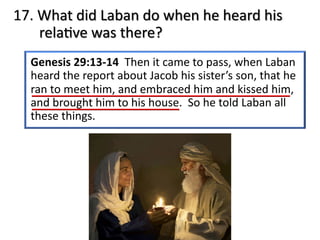
17. What did Laban do when he heard his
relaJve was there?
Genesis 29:13-14 Then it came to pass, when Laban
heard the report about Jacob his sister’s son, that he
ran to meet him, and embraced him and kissed him,
and brought him to his house. So he told Laban all
these things.
18. What did Laban learn from Jacob?
Genesis 29:13b So he told Laban all these things.
1. Jacob’s mother wants him to stay away for a
while. Jacob has time on his hands.
2. Jacob’s father instructed him to take one of
Laban’s daughters to wife.
3. Jacob is penniless, unable to bring the
required bride price.
4. The moving of the stone single-handed shows
his strength. This is someone whose services
could be useful to Laban.
Parunak, H. Van Dyke (2007) www.cyber-chapel.org/sermons/genesis/notes/Genesis29.pdf
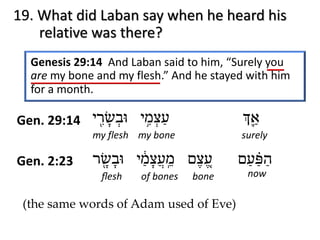
19. What did Laban say when he heard his
relative was there?
Genesis 29:14 And Laban said to him, “Surely you
are my bone and my flesh.” And he stayed with him
for a month.
(the same words of Adam used of Eve)
flesh of bones bone
‫ﬠ‬ֶ֚‫צ‬ֶ‫ם‬‫מ‬ֵֽ‫ﬠ‬ֲ‫צ‬ָ‫מ‬ַ֔‫י‬‫וּ‬‫ב‬ָ‫שׂ‬ָ֖‫ר‬ ‫ה‬ַ‫פּ‬ַ֗‫ﬠ‬ַ‫ם‬
now
‫א‬ַ֛‫ְך‬‫ﬠ‬ַ‫צ‬ְ‫מ‬ִ֥‫י‬‫וּ‬‫ב‬ְ‫שׂ‬ָ‫ִ֖ר‬‫י‬
my flesh my bone
Gen. 2:23
surely
Gen. 29:14
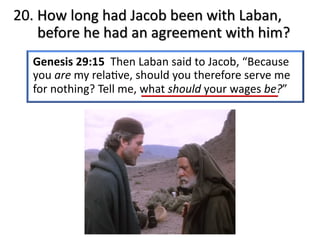
20. How long had Jacob been with Laban,
before he had an agreement with him?
Genesis 29:15 Then Laban said to Jacob, “Because
you are my rela@ve, should you therefore serve me
for nothing? Tell me, what should your wages be?”
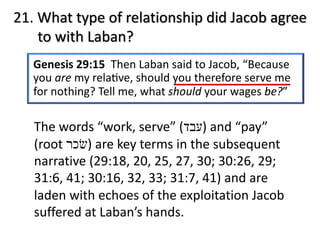
21. What type of relationship did Jacob agree
to with Laban?
Genesis 29:15 Then Laban said to Jacob, “Because
you are my rela@ve, should you therefore serve me
for nothing? Tell me, what should your wages be?”
The words “work, serve” ( ‫ע‬‫ב‬‫ד‬ ) and “pay”
(root ‫שׂ‬‫כ‬‫ר‬ ) are key terms in the subsequent
narrative (29:18, 20, 25, 27, 30; 30:26, 29;
31:6, 41; 30:16, 32, 33; 31:7, 41) and are
laden with echoes of the exploitation Jacob
suffered at Laban’s hands.
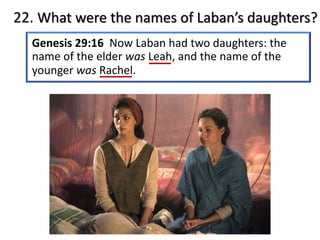
22. What were the names of Laban’s daughters?
Genesis 29:16 Now Laban had two daughters: the
name of the elder was Leah, and the name of the
younger was Rachel.
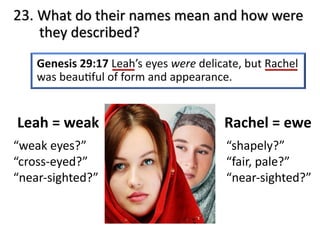
23. What do their names mean and how were
they described?
Leah = weak
“weak eyes?”
“cross-eyed?”
“near-sighted?”
Rachel = ewe
“shapely?”
“fair, pale?”
“near-sighted?”
24. What kind of arrangement was agreed
upon between Jacob and Laban?
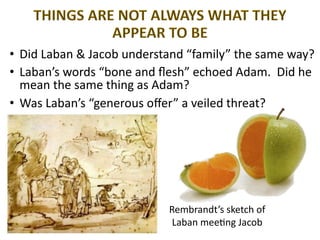
Rembrandt’s sketch of
Laban mee;ng Jacob
• Did Laban & Jacob understand “family” the same way?
• Laban’s words “bone and flesh” echoed Adam. Did he
mean the same thing as Adam?
• Was Laban’s “generous offer” a veiled threat?
25. What do these events tell us about Jacob’s
character?
26. What happened after Jacob fulfilled his
end of the bargain?
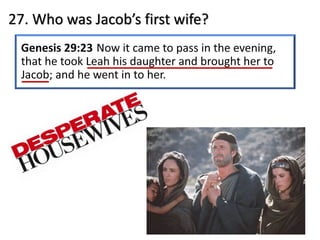
27. Who was Jacob’s first wife?
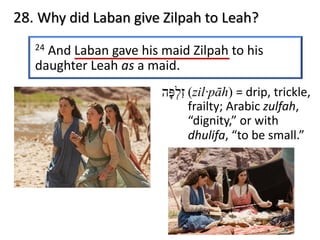
28. Why did Laban give Zilpah to Leah?
24 And Laban gave his maid Zilpah to his
daughter Leah as a maid.
‫ז‬ִ‫ל‬ְ‫פּ‬ָ‫ה‬ (zil·pāh) = drip, trickle,
frailty; Arabic zulfah,
“dignity,” or with
dhulifa, “to be small.”
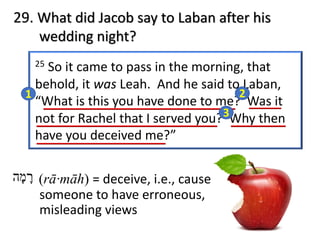
29. What did Jacob say to Laban after his
wedding night?
25 So it came to pass in the morning, that
behold, it was Leah. And he said to Laban,
“What is this you have done to me? Was it
not for Rachel that I served you? Why then
have you deceived me?”
1 2
3
‫ר‬ָ‫מ‬ָ‫ה‬ (rā·māh) = deceive, i.e., cause
someone to have erroneous,
misleading views
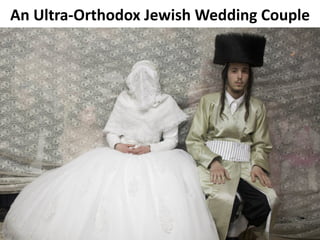
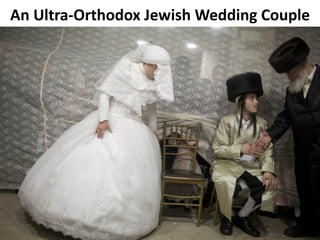
An Ultra-Orthodox Jewish Wedding Couple
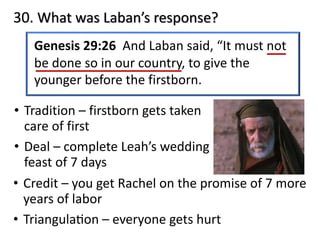
30. What was Laban’s response?
Genesis 29:26 And Laban said, “It must not
be done so in our country, to give the
younger before the firstborn.
• Tradition – firstborn gets taken
care of first
• Deal – complete Leah’s wedding
feast of 7 days
• Credit – you get Rachel on the promise of 7 more
years of labor
• Triangula>on – everyone gets hurt
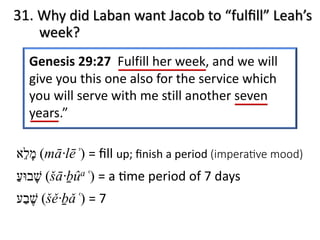
31. Why did Laban want Jacob to “fulfill” Leah’s
week?
Genesis 29:27 Fulfill her week, and we will
give you this one also for the service which
you will serve with me still another seven
years.”
‫מ‬ָ‫ל‬ֵ‫א‬ (mā·lēʾ) = fill up; finish a period (impera(ve mood)
‫שׁ‬ָ‫ב‬‫וּ‬‫ﬠ‬ַ (šā·ḇûaʿ) = a >me period of 7 days
‫שׁ‬ֶ‫ב‬ַ‫ע‬ (šě·ḇǎʿ) = 7
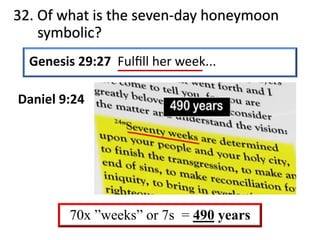
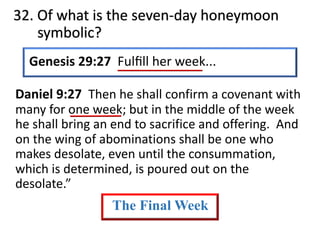
32. Of what is the seven-day honeymoon
symbolic?
Genesis 29:27 Fulfill her week...
Daniel 9:24
70x ”weeks” or 7s = 490 years
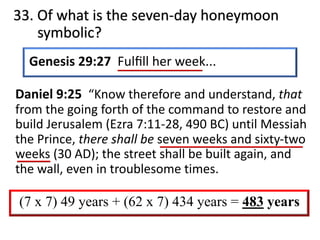
33. Of what is the seven-day honeymoon
symbolic?
Genesis 29:27 Fulfill her week...
Daniel 9:25 “Know therefore and understand, that
from the going forth of the command to restore and
build Jerusalem (Ezra 7:11-28, 490 BC) until Messiah
the Prince, there shall be seven weeks and sixty-two
weeks (30 AD); the street shall be built again, and
the wall, even in troublesome times.
(7 x 7) 49 years + (62 x 7) 434 years = 483 years
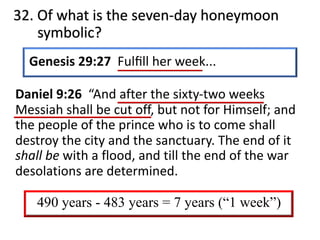
32. Of what is the seven-day honeymoon
symbolic?
Genesis 29:27 Fulfill her week...
Daniel 9:26 “And after the sixty-two weeks
Messiah shall be cut off, but not for Himself; and
the people of the prince who is to come shall
destroy the city and the sanctuary. The end of it
shall be with a flood, and till the end of the war
desolations are determined.
490 years - 483 years = 7 years (“1 week”)
32. Of what is the seven-day honeymoon
symbolic?
Genesis 29:27 Fulfill her week...
Daniel 9:27 Then he shall confirm a covenant with
many for one week; but in the middle of the week
he shall bring an end to sacrifice and offering. And
on the wing of abominations shall be one who
makes desolate, even until the consummation,
which is determined, is poured out on the
desolate.”
The Final Week
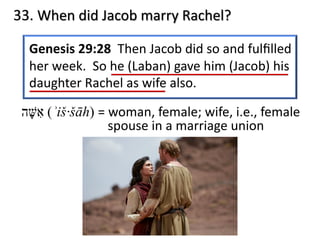
33. When did Jacob marry Rachel?
Genesis 29:28 Then Jacob did so and fulfilled
her week. So he (Laban) gave him (Jacob) his
daughter Rachel as wife also.
‫א‬ִ‫שּׁ‬ָ‫ה‬ (ʾiš·šāh) = woman, female; wife, i.e., female
spouse in a marriage union
34. Who is Bilhah?
‫בּ‬ִ‫ל‬ְ‫ה‬ָ‫ה‬ (bil·hāh) = simplicity, modesty, timid, or faltering
• A wedding gi) given to Rachel by her father Laban
(29:28-29)
• A concubine given to Jacob by Rachel (30:3)
• The mother of 2 of Jacob’s 12 sons: Dan & Naphtali
(30:4-8; 35:25).
• Reuben, commiPed incest with Bilhah (35:22; 49:3-4)
35. What was Jacob’s heart toward Rachel?
‫א‬ָ‫ה‬ַ‫ב‬ (ʾā·hǎḇ) = love, i.e., have an affection based on
a close relationship, sometimes in comparison
to other persons with a lesser relationship
36. What was Jacob’s family life like?
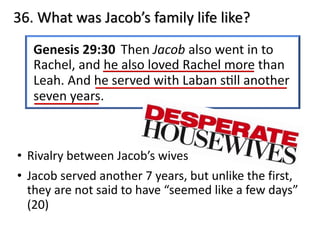
• Rivalry between Jacob’s wives
• Jacob served another 7 years, but unlike the first,
they are not said to have “seemed like a few days”
(20)
37. How did the strife between Jacob’s wives
mirror his relaJonship with Esau?
• Their strife is rooted in favoritism and partiality.
• Their strife is of the elder against the younger.
• Their strife is rooted in deception (cp. the theft of
the blessing in Genesis 27 with the switched brides
at the wedding).
• Their strife is the object of barter (cp. the sale of
the birthright in Genesis 25 with the mandrakes in
30:14-16).
38. If God is omniscient then what does “when
the LORD saw” mean?
God or the LORD “saw” in Genesis
1:4, 10, 12, 18, 21, 25, 31; 2:19 – creation
6:5, 12; 7:1; 11:5 – awareness of sin
9:16; 16:13; 22:8, 14 – attention to compassion & mercy
29:31, 32; 31:42 – awareness of affliction
‫ר‬ָ‫א‬ָ‫ה‬ (rā·ʾāh) = see, look, view, i.e., use the percep@on of
sight to view objects and make judgments based on
the percep@ons
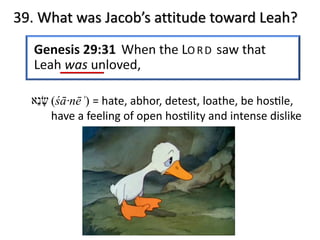
39. What was Jacob’s attitude toward Leah?
‫שׂ‬ָ‫נ‬ֵ‫א‬ (śā·nēʾ) = hate, abhor, detest, loathe, be hos@le,
have a feeling of open hos@lity and intense dislike
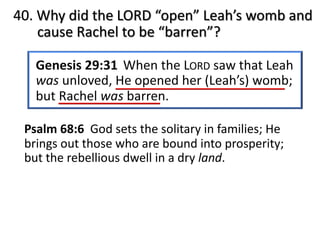
40. Why did the LORD “open” Leah’s womb and
cause Rachel to be “barren”?
Psalm 68:6 God sets the solitary in families; He
brings out those who are bound into prosperity;
but the rebellious dwell in a dry land.
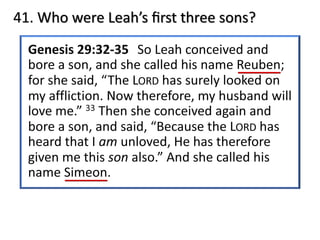
41. Who were Leah’s first three sons?
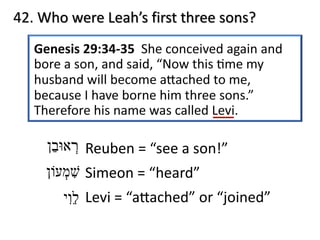
42. Who were Leah’s first three sons?
Reuben = “see a son!”
Simeon = “heard”
Levi = “a[ached” or “joined”
‫ְר‬‫א‬‫וּ‬‫ב‬ֵ‫ן‬
‫שׁ‬ִ‫מ‬ְ‫ע‬‫וֹ‬‫ן‬
‫ל‬ֵ‫ִו‬‫י‬
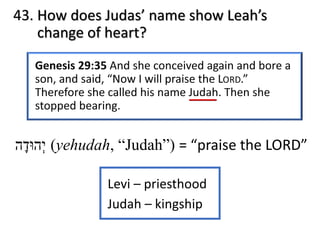
43. How does Judas’ name show Leah’s
change of heart?
‫ְי‬‫ה‬‫וּ‬‫ד‬ָ‫ה‬ (yehudah, “Judah”) = “praise the LORD”
Levi – priesthood
Judah – kingship

Jacob Marries Twice - Genesis 29

  • 1.
    An exposi*onal studytaught by Harry Morgan
  • 2.
    • Crea%on &Fall Of Man (1-5) • Noah, Flood & Babel (6-10) • Tower Of Babel (11) • Abraham (12-25) • Isaac (25-27) • Jacob (27-36) • Joseph (37-50) Outline of Genesis
  • 3.
    (1-9) Jacob meetsthe shepherds of Harran (10-12) Jacob meets Rachel (13-14) Jacob stays with Laban (15-19) Jacob’s betrothal to Rachel (20) Jacob serves Laban 7 years for Rachel (21-30a) Jacob’s wedding (30b) Jacob serves Laban another 7 years (31-35) Leah alone Outline of Genesis 29
  • 4.
    Overview of Jacob’s Journeys •77 years and Canaan • 20 years in Haran • 33 years in Canaan • 17 years in Egypt
  • 5.
    1. What isthe main theme of Genesis 29? Reciprocity Gala$ans 6:7 Do not be deceived, God is not mocked; for whatever a man sows, that he will also reap.
  • 6.
    2. What isreported in verse 1? Genesis 29:1 So Jacob went on his journey and came to the land of the people of the East. “The heaviness with which he must have le= home had now gone. Assured of the abiding presence and protec@on of Jehovah, he went on his way lightheartedly.” Pink, A. W. (2005). Gleanings in Genesis (p. 254). Bellingham, WA: Logos Bible So>ware. ‫נ‬‫שׂ‬‫א‬ (nā·śāʾ) = lift up, pick up ‫ר‬ֶ‫ג‬ֶ‫ל‬ (rě·ḡěl) = feet
  • 7.
    Genesis 29:1 SoJacob went on his journey and came to the land of the people of the East. 2. What is reported in verse 1? ‫ה‬ָ‫ל‬ַ. (hā·lǎḵ) = go, travel ‫ק‬ֶ‫ד‬ֶ‫ם‬ (qě·ḏěm) = east Jacob completed his 517-mile journey. Etymology of “orient” = to face the East
  • 8.
    • Abraham’s servantmet Rebekah at a well (24:10–15) • Jacob encounters Rachel at a well (29:10) • For Abraham’s servant “it happened” (24:15) • For Jacob “was still speaking” (29:9) • Rebekah was tending of her family’s flock (24:16–21) • Rachel’s was tending of her father’s flock (v. 6) Genesis 24 & 29 parallels
  • 9.
    John Calvin: “Wheneverwe may wander in uncertainty through intricate windings, we must contemplate with eyes of faith, the secret providence of God which governs us and our affairs and leads us to unexpected results.” Our heavenly Father is ordering our lives to glorify Him even if we cannot always see it.
  • 10.
    3. What 3things did Jacob see in the land of the east? Genesis 29:2 And he looked, and saw a well in the field; and behold, there were three flocks of sheep lying by it; for out of that well they watered the flocks. A large stone was on the well’s mouth.
  • 11.
    4. Where wasthis well? Genesis 29:2 And he looked, and saw a well in the field; ‫שׂ‬ָ‫ד‬ֶ‫ה‬ (śā·ḏěh) = field, i.e., a cul>vated area for growing things, open field, open country, countryside The same term as used in 25:27, 29, which referred to the place where Esau hunted game.
  • 12.
    5. How didJacob locate this parJcular well? Coincidence is God’s way of remaining anonymous. Albert Einstein Genesis 29:2 And he looked, and saw a well in the field;
  • 13.
    6. Why wasthe well covered? Genesis 29:2 And he looked, and saw a well in the field; and behold, there were three flocks of sheep lying by it; for out of that well they watered the flocks. A large stone was on the well’s mouth. ‫א‬ֶ‫ב‬ֶ‫ן‬ (ʾě·ḇěn) = stone ‫גּ‬ָ‫ד‬‫וֹ‬‫ל‬ (gā·ḏôl) = great, large The same term as used in 28:22 which referred to the stone Jacob “set as a pillar” in Bethel.
  • 14.
    7. Where wasthe gathering place? Why? Genesis 29:3 Now all the flocks would be gathered there; and they would roll the stone from the well’s mouth, water the sheep, and put the stone back in its place on the well’s mouth.
  • 15.
    8. What didJacob call these strangers? Genesis 29:4 And Jacob said to them, “My brethren, where are you from?” Ma#hew 12:50 whoever does the will of My Father in heaven is My brother…” 1 Jacob becomes
  • 16.
    9. Where werethese men from? Why was their locaJon significant? Genesis 29:4b And Jacob said to them, “My brethren, where are you from?” And they said, “We are from Haran.” Genesis 27:43 Now therefore, my son, obey my voice: arise, flee to my brother Laban in Haran. Genesis 28:10 Now Jacob went out from Beersheba and went toward Haran.
  • 17.
    10. Of whomdid Jacob inquire and what was their response? Genesis 29:5 Then he said to them, “Do you know Laban the son of Nahor?” And they said, “We know him.” 2 Genesis 29:10 And it came to pass, when Jacob saw Rachel the daughter of Laban his mother’s brother, and the sheep of Laban his mother’s brother, that Jacob went near and rolled the stone from the well’s mouth, and watered the flock of Laban his mother’s brother.
  • 18.
    11. What wasLaban’s daughter’s name? Genesis 29:6 So he said to them, “Is he well?” And they said, “He is well. And look, his daughter Rachel is coming with the sheep.” 3 Literally: “Is shalom to him?” ‫ה‬ֲ‫שׁ‬ָ%‫ו‬‫ם‬%‫ו‬
  • 19.
    12. Why didn’tthey water the sheep? Genesis 29:7-8 Then he said, “Look, it is s@ll high day; it is not @me for the caXle to be gathered together. Water the sheep, and go and feed them.” 8 But they said, “We cannot un@l all the flocks are gathered together, and they have rolled the stone from the well’s mouth; then we water the sheep.” Ø Shepherding was often done by children. Ø A custom of fairness. Ø They may be lazy. Ø They may be interested in Rachel Parunak, H. Van Dyke (2007) www.cyber-chapel.org/sermons/genesis/notes/Genesis29.pdf 4
  • 20.
    them, Rachel came withher father’s sheep, for she was a shepherdess. 13. How is Rachel described when Jacob first sees her? Genesis 29:6a And look, his daughter Rachel is coming with the sheep.” Genesis 29:9 Now while he was still speaking with
  • 21.
    Genesis 29:10 Andit came to pass, when Jacob saw Rachel the daughter of Laban his mother’s brother, and the sheep of Laban his mother’s brother, that Jacob went near and rolled the stone from the well’s mouth, and watered the flock of Laban his mother’s brother. 14. What did Jacob do to help? What do you think Rachel felt and thought when she witnessed Jacob move the stone?
  • 22.
    15. How didhe greet Rachel? Genesis 29:11 Then Jacob kissed Rachel, and lifted up his voice and wept. ‫נ‬ָ‫שׁ‬ַ‫ק‬ (nā·šǎq) = kiss, i.e., to touch with the lips, as a gesture of affec6on & mutual rela6onship (cp. Gen. 27:26-27; 33:4; 45:15) ‫נ‬ָ‫שׂ‬ָ‫א‬ (nā·śāʾ) = be liHed up ‫בּ‬ָ‫כ‬ָ‫ה‬ (bā·ḵāh) = weep, wail, cry, sob, mourn, i.e., to well-up tears in the eyes and have mild convulsions or spasms of the diaphragm, and oHen make vocal sounds of soH groaning or loud wailing
  • 23.
    16. What didRachel do when Jacob told her who he was? Genesis 29:12 And Jacob told Rachel that he was her father’s relative and that he was Rebekah’s son. So she ran and told her father.
  • 24.
    17. What didLaban do when he heard his relaJve was there? Genesis 29:13-14 Then it came to pass, when Laban heard the report about Jacob his sister’s son, that he ran to meet him, and embraced him and kissed him, and brought him to his house. So he told Laban all these things.
  • 25.
    18. What didLaban learn from Jacob? Genesis 29:13b So he told Laban all these things. 1. Jacob’s mother wants him to stay away for a while. Jacob has time on his hands. 2. Jacob’s father instructed him to take one of Laban’s daughters to wife. 3. Jacob is penniless, unable to bring the required bride price. 4. The moving of the stone single-handed shows his strength. This is someone whose services could be useful to Laban. Parunak, H. Van Dyke (2007) www.cyber-chapel.org/sermons/genesis/notes/Genesis29.pdf
  • 26.
    19. What didLaban say when he heard his relative was there? Genesis 29:14 And Laban said to him, “Surely you are my bone and my flesh.” And he stayed with him for a month. (the same words of Adam used of Eve) flesh of bones bone ‫ﬠ‬ֶ֚‫צ‬ֶ‫ם‬‫מ‬ֵֽ‫ﬠ‬ֲ‫צ‬ָ‫מ‬ַ֔‫י‬‫וּ‬‫ב‬ָ‫שׂ‬ָ֖‫ר‬ ‫ה‬ַ‫פּ‬ַ֗‫ﬠ‬ַ‫ם‬ now ‫א‬ַ֛‫ְך‬‫ﬠ‬ַ‫צ‬ְ‫מ‬ִ֥‫י‬‫וּ‬‫ב‬ְ‫שׂ‬ָ‫ִ֖ר‬‫י‬ my flesh my bone Gen. 2:23 surely Gen. 29:14
  • 27.
    20. How longhad Jacob been with Laban, before he had an agreement with him? Genesis 29:15 Then Laban said to Jacob, “Because you are my rela@ve, should you therefore serve me for nothing? Tell me, what should your wages be?”
  • 28.
    21. What typeof relationship did Jacob agree to with Laban? Genesis 29:15 Then Laban said to Jacob, “Because you are my rela@ve, should you therefore serve me for nothing? Tell me, what should your wages be?” The words “work, serve” ( ‫ע‬‫ב‬‫ד‬ ) and “pay” (root ‫שׂ‬‫כ‬‫ר‬ ) are key terms in the subsequent narrative (29:18, 20, 25, 27, 30; 30:26, 29; 31:6, 41; 30:16, 32, 33; 31:7, 41) and are laden with echoes of the exploitation Jacob suffered at Laban’s hands.
  • 29.
    22. What werethe names of Laban’s daughters? Genesis 29:16 Now Laban had two daughters: the name of the elder was Leah, and the name of the younger was Rachel.
  • 30.
    23. What dotheir names mean and how were they described? Leah = weak “weak eyes?” “cross-eyed?” “near-sighted?” Rachel = ewe “shapely?” “fair, pale?” “near-sighted?”
  • 31.
    24. What kindof arrangement was agreed upon between Jacob and Laban?
  • 32.
    Rembrandt’s sketch of Labanmee;ng Jacob • Did Laban & Jacob understand “family” the same way? • Laban’s words “bone and flesh” echoed Adam. Did he mean the same thing as Adam? • Was Laban’s “generous offer” a veiled threat?
  • 33.
    25. What dothese events tell us about Jacob’s character?
  • 34.
    26. What happenedafter Jacob fulfilled his end of the bargain?
  • 35.
    27. Who wasJacob’s first wife?
  • 36.
    28. Why didLaban give Zilpah to Leah? 24 And Laban gave his maid Zilpah to his daughter Leah as a maid. ‫ז‬ִ‫ל‬ְ‫פּ‬ָ‫ה‬ (zil·pāh) = drip, trickle, frailty; Arabic zulfah, “dignity,” or with dhulifa, “to be small.”
  • 37.
    29. What didJacob say to Laban after his wedding night? 25 So it came to pass in the morning, that behold, it was Leah. And he said to Laban, “What is this you have done to me? Was it not for Rachel that I served you? Why then have you deceived me?” 1 2 3 ‫ר‬ָ‫מ‬ָ‫ה‬ (rā·māh) = deceive, i.e., cause someone to have erroneous, misleading views
  • 38.
  • 39.
  • 40.
    30. What wasLaban’s response? Genesis 29:26 And Laban said, “It must not be done so in our country, to give the younger before the firstborn. • Tradition – firstborn gets taken care of first • Deal – complete Leah’s wedding feast of 7 days • Credit – you get Rachel on the promise of 7 more years of labor • Triangula>on – everyone gets hurt
  • 41.
    31. Why didLaban want Jacob to “fulfill” Leah’s week? Genesis 29:27 Fulfill her week, and we will give you this one also for the service which you will serve with me still another seven years.” ‫מ‬ָ‫ל‬ֵ‫א‬ (mā·lēʾ) = fill up; finish a period (impera(ve mood) ‫שׁ‬ָ‫ב‬‫וּ‬‫ﬠ‬ַ (šā·ḇûaʿ) = a >me period of 7 days ‫שׁ‬ֶ‫ב‬ַ‫ע‬ (šě·ḇǎʿ) = 7
  • 42.
    32. Of whatis the seven-day honeymoon symbolic? Genesis 29:27 Fulfill her week... Daniel 9:24 70x ”weeks” or 7s = 490 years
  • 43.
    33. Of whatis the seven-day honeymoon symbolic? Genesis 29:27 Fulfill her week... Daniel 9:25 “Know therefore and understand, that from the going forth of the command to restore and build Jerusalem (Ezra 7:11-28, 490 BC) until Messiah the Prince, there shall be seven weeks and sixty-two weeks (30 AD); the street shall be built again, and the wall, even in troublesome times. (7 x 7) 49 years + (62 x 7) 434 years = 483 years
  • 44.
    32. Of whatis the seven-day honeymoon symbolic? Genesis 29:27 Fulfill her week... Daniel 9:26 “And after the sixty-two weeks Messiah shall be cut off, but not for Himself; and the people of the prince who is to come shall destroy the city and the sanctuary. The end of it shall be with a flood, and till the end of the war desolations are determined. 490 years - 483 years = 7 years (“1 week”)
  • 45.
    32. Of whatis the seven-day honeymoon symbolic? Genesis 29:27 Fulfill her week... Daniel 9:27 Then he shall confirm a covenant with many for one week; but in the middle of the week he shall bring an end to sacrifice and offering. And on the wing of abominations shall be one who makes desolate, even until the consummation, which is determined, is poured out on the desolate.” The Final Week
  • 46.
    33. When didJacob marry Rachel? Genesis 29:28 Then Jacob did so and fulfilled her week. So he (Laban) gave him (Jacob) his daughter Rachel as wife also. ‫א‬ִ‫שּׁ‬ָ‫ה‬ (ʾiš·šāh) = woman, female; wife, i.e., female spouse in a marriage union
  • 47.
    34. Who isBilhah? ‫בּ‬ִ‫ל‬ְ‫ה‬ָ‫ה‬ (bil·hāh) = simplicity, modesty, timid, or faltering • A wedding gi) given to Rachel by her father Laban (29:28-29) • A concubine given to Jacob by Rachel (30:3) • The mother of 2 of Jacob’s 12 sons: Dan & Naphtali (30:4-8; 35:25). • Reuben, commiPed incest with Bilhah (35:22; 49:3-4)
  • 48.
    35. What wasJacob’s heart toward Rachel? ‫א‬ָ‫ה‬ַ‫ב‬ (ʾā·hǎḇ) = love, i.e., have an affection based on a close relationship, sometimes in comparison to other persons with a lesser relationship
  • 49.
    36. What wasJacob’s family life like? • Rivalry between Jacob’s wives • Jacob served another 7 years, but unlike the first, they are not said to have “seemed like a few days” (20)
  • 50.
    37. How didthe strife between Jacob’s wives mirror his relaJonship with Esau? • Their strife is rooted in favoritism and partiality. • Their strife is of the elder against the younger. • Their strife is rooted in deception (cp. the theft of the blessing in Genesis 27 with the switched brides at the wedding). • Their strife is the object of barter (cp. the sale of the birthright in Genesis 25 with the mandrakes in 30:14-16).
  • 51.
    38. If Godis omniscient then what does “when the LORD saw” mean? God or the LORD “saw” in Genesis 1:4, 10, 12, 18, 21, 25, 31; 2:19 – creation 6:5, 12; 7:1; 11:5 – awareness of sin 9:16; 16:13; 22:8, 14 – attention to compassion & mercy 29:31, 32; 31:42 – awareness of affliction ‫ר‬ָ‫א‬ָ‫ה‬ (rā·ʾāh) = see, look, view, i.e., use the percep@on of sight to view objects and make judgments based on the percep@ons
  • 52.
    39. What wasJacob’s attitude toward Leah? ‫שׂ‬ָ‫נ‬ֵ‫א‬ (śā·nēʾ) = hate, abhor, detest, loathe, be hos@le, have a feeling of open hos@lity and intense dislike
  • 53.
    40. Why didthe LORD “open” Leah’s womb and cause Rachel to be “barren”? Psalm 68:6 God sets the solitary in families; He brings out those who are bound into prosperity; but the rebellious dwell in a dry land.
  • 54.
    41. Who wereLeah’s first three sons?
  • 55.
    42. Who wereLeah’s first three sons? Reuben = “see a son!” Simeon = “heard” Levi = “a[ached” or “joined” ‫ְר‬‫א‬‫וּ‬‫ב‬ֵ‫ן‬ ‫שׁ‬ִ‫מ‬ְ‫ע‬‫וֹ‬‫ן‬ ‫ל‬ֵ‫ִו‬‫י‬
  • 56.
    43. How doesJudas’ name show Leah’s change of heart? ‫ְי‬‫ה‬‫וּ‬‫ד‬ָ‫ה‬ (yehudah, “Judah”) = “praise the LORD” Levi – priesthood Judah – kingship