- What The Faff!!
Contents
Organizational Structure, Chart .................................................................................................................... 2
Structure of Org ............................................................................................................................................ 2
   Division of Labor: Kaam Baato...Dard khud mit jayega............................................................................. 2
   Centralization versus Decentralization: .................................................................................................... 2
   Line Maaro, Authority Paao....Staff Research deke jaao .......................................................................... 2
   Unity of Command .................................................................................................................................... 3
   Formalization- Code Red or No Code? ...................................................................................................... 3
Types of Organization ................................................................................................................................... 3
   Mechanistic Organizations:....................................................................................................................... 3
   Organic Organizations:.............................................................................................................................. 3
   Simple Structure ....................................................................................................................................... 4
MATRIX Organization .................................................................................................................................... 4
   Types of Matrix (no..not Reloaded And Revolutions) ............................................................................... 4
Virtual/Network Organizations ..................................................................................................................... 5
   Virtual Organizations ................................................................................................................................ 5
   Network Organizations ............................................................................................................................. 5
Comparison of Structures- ONE SLIDE SLAP ................................................................................................. 6
Critical Success Factors ................................................................................................................................. 7
Appex Case Study .......................................................................................................................................... 7
   APPEX EVOLUTION .................................................................................................................................... 8
NOVARTIS CASE............................................................................................................................................. 8
Organizational Structure, Chart


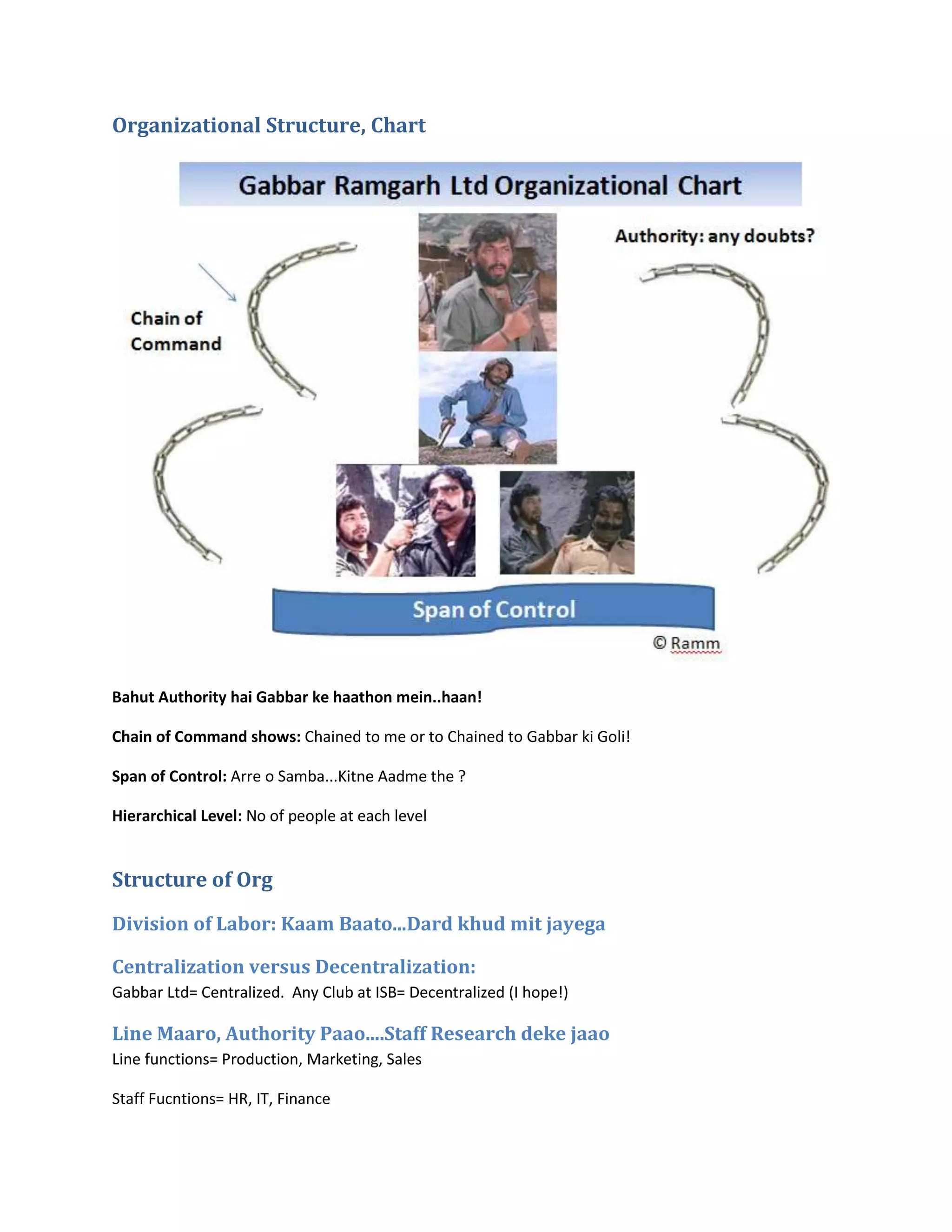
Bahut Authority hai Gabbar ke haathon mein..haan!

Chain of Command shows: Chained to me or to Chained to Gabbar ki Goli!

Span of Control: Arre o Samba...Kitne Aadme the ?

Hierarchical Level: No of people at each level


Structure of Org

Division of Labor: Kaam Baato...Dard khud mit jayega

Centralization versus Decentralization:
Gabbar Ltd= Centralized. Any Club at ISB= Decentralized (I hope!)

Line Maaro, Authority Paao....Staff Research deke jaao
Line functions= Production, Marketing, Sales

Staff Fucntions= HR, IT, Finance
Unity of Command
Of course, you don't want your employees to run around sayin "mere do do boss! mere do do boss!"

Formalization- Code Red or No Code?


If you are a code red organization, you CEO must really be of the kind "we follow orders or people die!"
A No Code Organization= SAS? I


Types of Organization


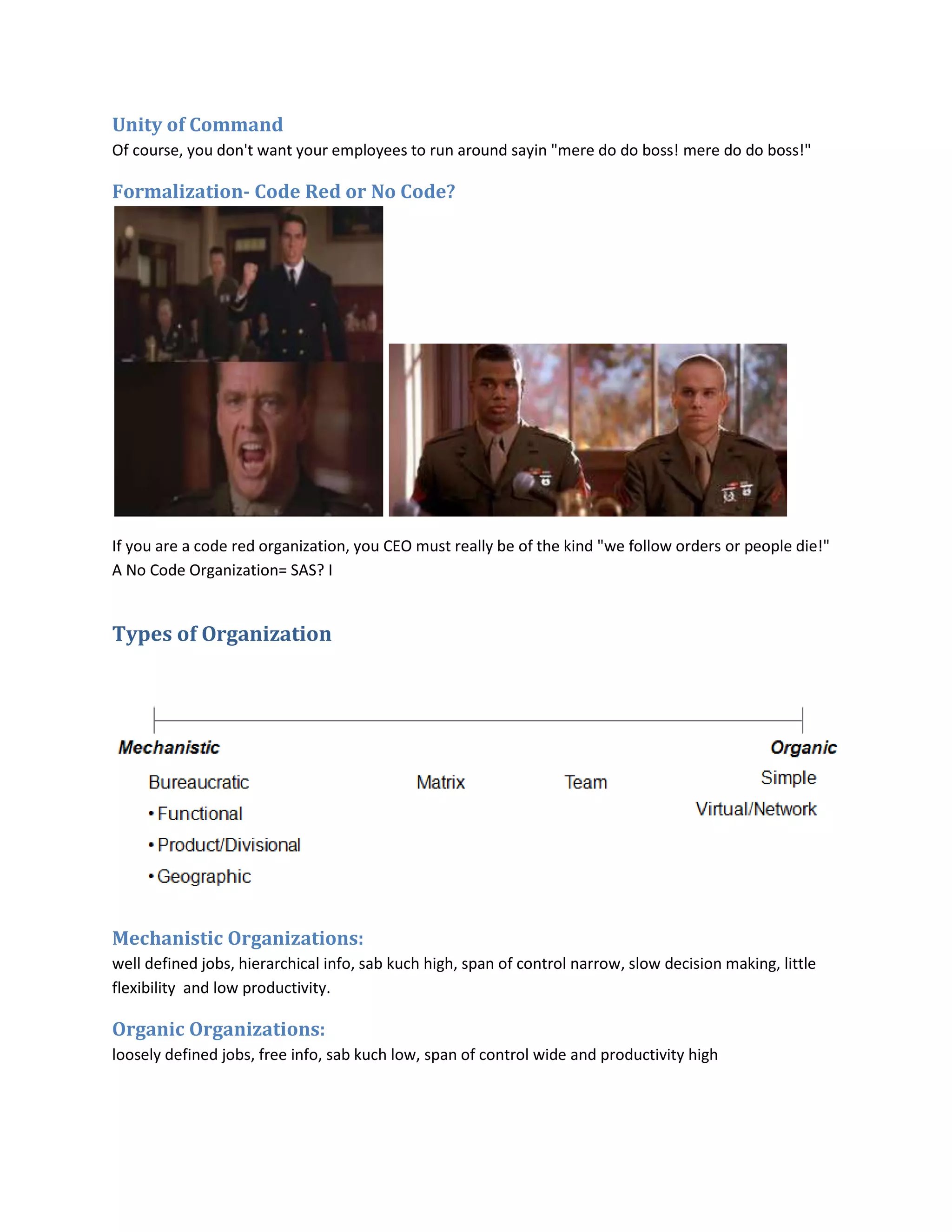
Mechanistic Organizations:
well defined jobs, hierarchical info, sab kuch high, span of control narrow, slow decision making, little
flexibility and low productivity.

Organic Organizations:
loosely defined jobs, free info, sab kuch low, span of control wide and productivity high
Main disadvantage of Divisional Structure is duplication and lack of synergy. Similar prob with gegraphic.
Team structure -Remember CHAK DE... team can become bigger than Organization. Kabir Khan won't
like it.

Simple Structure
Who says what's in a name? Here everything is clear!- less Formalization, less departments, more
control, more authority concentration, easier decisions making and suitable for small orgs.

And Now for the ONE..


MATRIX Organization
Wake up Neo!

        The matrix structure groups employees by both function and product.
        A matrix organization frequently uses teams of employees to accomplish work
        Helps take advantage of the strengths, as well as make up for the weaknesses, of functional and
        decentralized forms.

 An example would be a company that produces two products, "product a" and "product b". Using the
matrix structure, this company would organize functions within the company as follows: "product a"
sales department, "product a" customer service department, "product a" accounting, "product b" sales
department, "product b" customer service department, "product b" accounting department. !


You: Wow! This is like almost best of both worlds! This Matrix Orgs...Do they exist for real?
Morpheus: What is real? How do you define real?
You: Aargh... Not again!!

Types of Matrix (no..not Reloaded And Revolutions)
Weak/Functional Matrix: A project manager with only limited authority is assigned to oversee the cross-
functional aspects of the project. The functional managers maintain control over their resources and
project areas.
Balanced/Functional Matrix: A project manager is assigned to oversee the project. Power is shared
equally between the project manager and the functional managers. It brings the best aspects of
functional and project-wala organizations. However, this is the most difficult system to maintain as the
sharing power is delicate proposition.

Strong/Project Matrix: A project manager is primarily responsible for the project. Functional managers
provide technical expertise and assign resources as needed.


Virtual/Network Organizations

Virtual Organizations
        A firm that contracts out almost all functions
        A virtual organization might not have even have a permanent office
        Best Example would be your fashion industry ABC. There may be a brand ABC with no
        company/office, but one designer XYZ outsourcing tailoring work to one guy, buying material
        from Thailand & China to another and marketing to another.

Network Organizations
        It is a collection of autonomous firms or units that behave as a single larger entity
        Uses social mechanisms for coordination and control
        Entities are subsidiaries or different legal entities

Egg Sample: ITC and its different divisions. Like Spices division will supply to not just ITC foods, but also
other companies. (now does this info count in my ELP? Anyone hear me??)
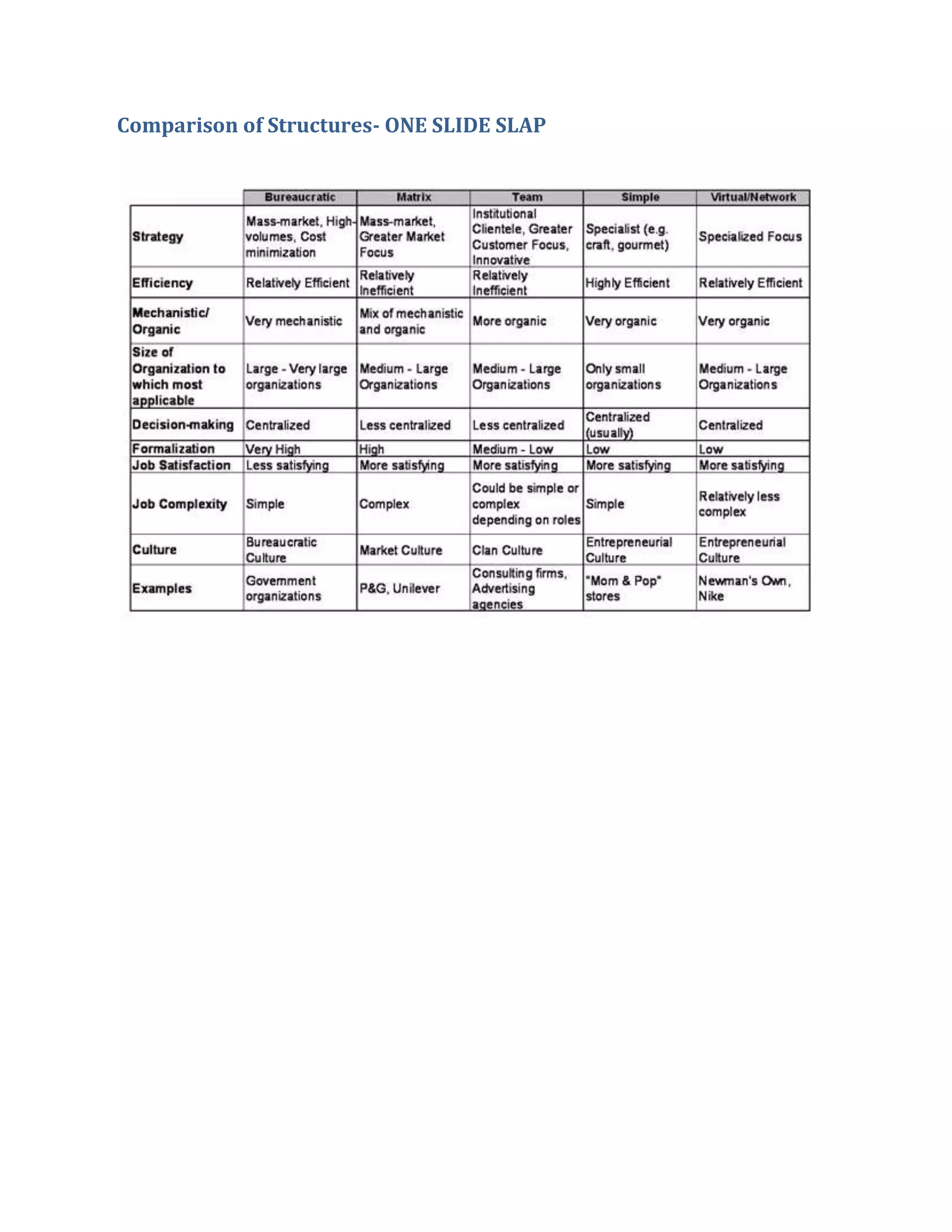
Comparison of Structures- ONE SLIDE SLAP
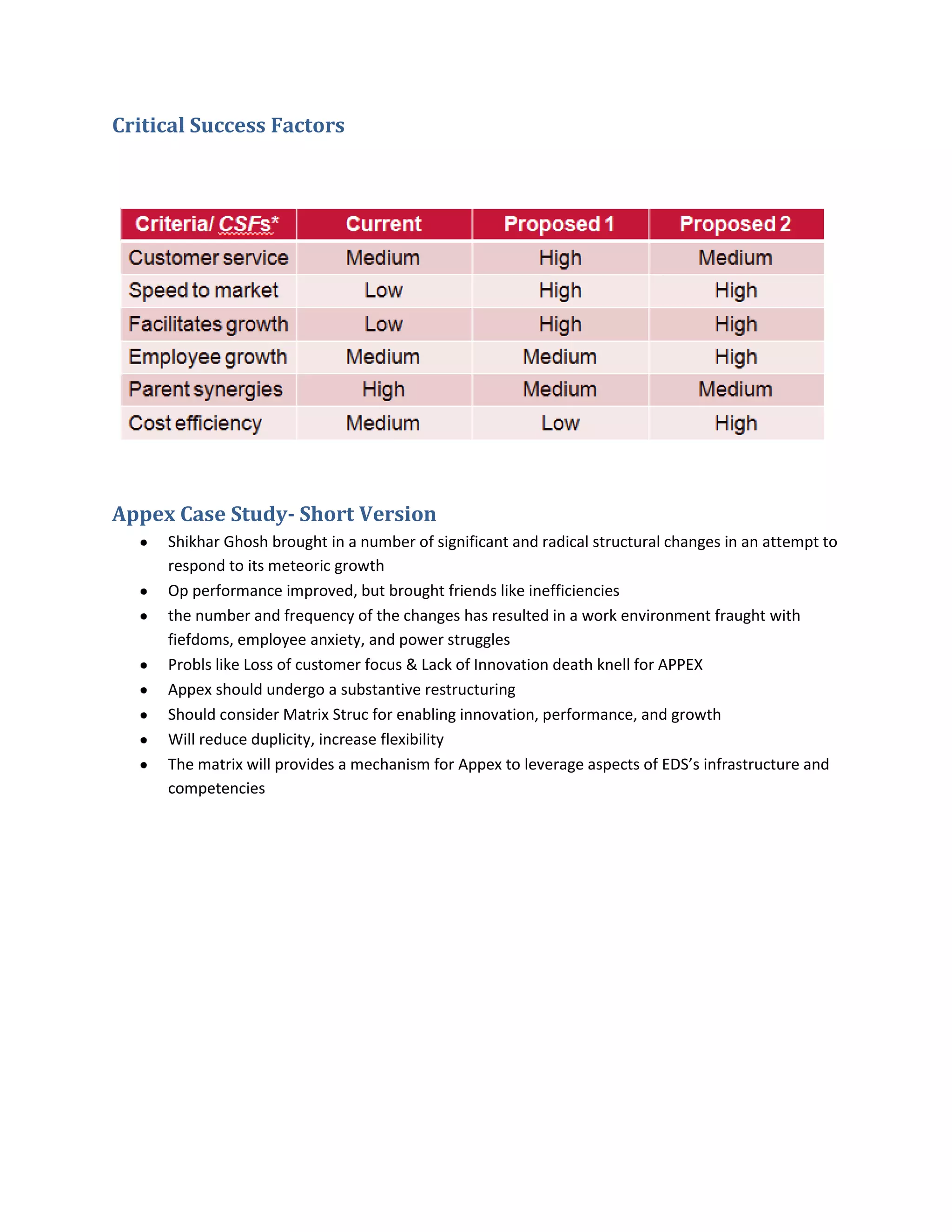
Critical Success Factors


Appex Case Study- Short Version
     Shikhar Ghosh brought in a number of significant and radical structural changes in an attempt to
     respond to its meteoric growth
     Op performance improved, but brought friends like inefficiencies
     the number and frequency of the changes has resulted in a work environment fraught with
     fiefdoms, employee anxiety, and power struggles
     Probls like Loss of customer focus & Lack of Innovation death knell for APPEX
     Appex should undergo a substantive restructuring
     Should consider Matrix Struc for enabling innovation, performance, and growth
     Will reduce duplicity, increase flexibility
     The matrix will provides a mechanism for Appex to leverage aspects of EDS’s infrastructure and
     competencies
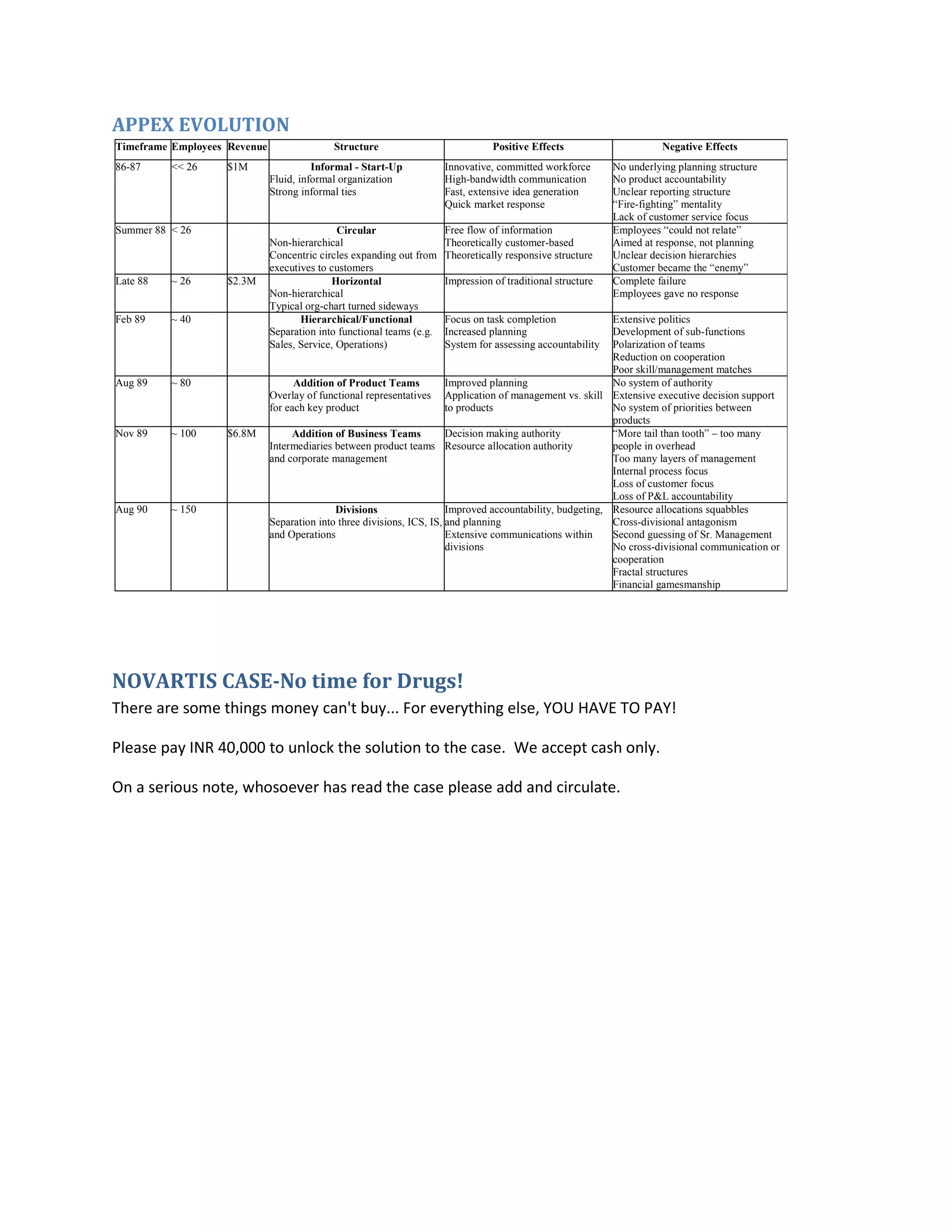
APPEX EVOLUTION
Timeframe Employees Revenue                 Structure                             Positive Effects                     Negative Effects
86-87     << 26    $1M                  Informal - Start-Up            Innovative, committed workforce       No underlying planning structure
                              Fluid, informal organization             High-bandwidth communication          No product accountability
                              Strong informal ties                     Fast, extensive idea generation       Unclear reporting structure
                                                                       Quick market response                 “Fire-fighting” mentality
                                                                                                             Lack of customer service focus
Summer 88 < 26                                Circular                 Free flow of information              Employees “could not relate”
                              Non-hierarchical                         Theoretically customer-based          Aimed at response, not planning
                              Concentric circles expanding out from    Theoretically responsive structure    Unclear decision hierarchies
                              executives to customers                                                        Customer became the “enemy”
Late 88   ~ 26     $2.3M                    Horizontal                 Impression of traditional structure   Complete failure
                              Non-hierarchical                                                               Employees gave no response
                              Typical org-chart turned sideways
Feb 89    ~ 40                       Hierarchical/Functional           Focus on task completion             Extensive politics
                              Separation into functional teams (e.g.   Increased planning                   Development of sub-functions
                              Sales, Service, Operations)              System for assessing accountability  Polarization of teams
                                                                                                            Reduction on cooperation
                                                                                                            Poor skill/management matches
Aug 89    ~ 80                      Addition of Product Teams           Improved planning                   No system of authority
                              Overlay of functional representatives Application of management vs. skill Extensive executive decision support
                              for each key product                      to products                         No system of priorities between
                                                                                                            products
Nov 89    ~ 100    $6.8M           Addition of Business Teams           Decision making authority           “More tail than tooth” – too many
                              Intermediaries between product teams Resource allocation authority            people in overhead
                              and corporate management                                                      Too many layers of management
                                                                                                            Internal process focus
                                                                                                            Loss of customer focus
                                                                                                            Loss of P&L accountability
Aug 90    ~ 150                              Divisions                  Improved accountability, budgeting, Resource allocations squabbles
                              Separation into three divisions, ICS, IS, and planning                        Cross-divisional antagonism
                              and Operations                            Extensive communications within     Second guessing of Sr. Management
                                                                        divisions                           No cross-divisional communication or
                                                                                                            cooperation
                                                                                                            Fractal structures
                                                                                                            Financial gamesmanship


NOVARTIS CASE-No time for Drugs!
There are some things money can't buy... For everything else, YOU HAVE TO PAY!

Please pay INR 40,000 to unlock the solution to the case. We accept cash only.

On a serious note, whosoever has read the case please add and circulate.

Management of Organization-Part 7

  • 1.
    - What TheFaff!! Contents Organizational Structure, Chart .................................................................................................................... 2 Structure of Org ............................................................................................................................................ 2 Division of Labor: Kaam Baato...Dard khud mit jayega............................................................................. 2 Centralization versus Decentralization: .................................................................................................... 2 Line Maaro, Authority Paao....Staff Research deke jaao .......................................................................... 2 Unity of Command .................................................................................................................................... 3 Formalization- Code Red or No Code? ...................................................................................................... 3 Types of Organization ................................................................................................................................... 3 Mechanistic Organizations:....................................................................................................................... 3 Organic Organizations:.............................................................................................................................. 3 Simple Structure ....................................................................................................................................... 4 MATRIX Organization .................................................................................................................................... 4 Types of Matrix (no..not Reloaded And Revolutions) ............................................................................... 4 Virtual/Network Organizations ..................................................................................................................... 5 Virtual Organizations ................................................................................................................................ 5 Network Organizations ............................................................................................................................. 5 Comparison of Structures- ONE SLIDE SLAP ................................................................................................. 6 Critical Success Factors ................................................................................................................................. 7 Appex Case Study .......................................................................................................................................... 7 APPEX EVOLUTION .................................................................................................................................... 8 NOVARTIS CASE............................................................................................................................................. 8
  • 2.
    Organizational Structure, Chart BahutAuthority hai Gabbar ke haathon mein..haan! Chain of Command shows: Chained to me or to Chained to Gabbar ki Goli! Span of Control: Arre o Samba...Kitne Aadme the ? Hierarchical Level: No of people at each level Structure of Org Division of Labor: Kaam Baato...Dard khud mit jayega Centralization versus Decentralization: Gabbar Ltd= Centralized. Any Club at ISB= Decentralized (I hope!) Line Maaro, Authority Paao....Staff Research deke jaao Line functions= Production, Marketing, Sales Staff Fucntions= HR, IT, Finance
  • 3.
    Unity of Command Ofcourse, you don't want your employees to run around sayin "mere do do boss! mere do do boss!" Formalization- Code Red or No Code? If you are a code red organization, you CEO must really be of the kind "we follow orders or people die!" A No Code Organization= SAS? I Types of Organization Mechanistic Organizations: well defined jobs, hierarchical info, sab kuch high, span of control narrow, slow decision making, little flexibility and low productivity. Organic Organizations: loosely defined jobs, free info, sab kuch low, span of control wide and productivity high
  • 4.
    Main disadvantage ofDivisional Structure is duplication and lack of synergy. Similar prob with gegraphic. Team structure -Remember CHAK DE... team can become bigger than Organization. Kabir Khan won't like it. Simple Structure Who says what's in a name? Here everything is clear!- less Formalization, less departments, more control, more authority concentration, easier decisions making and suitable for small orgs. And Now for the ONE.. MATRIX Organization Wake up Neo! The matrix structure groups employees by both function and product. A matrix organization frequently uses teams of employees to accomplish work Helps take advantage of the strengths, as well as make up for the weaknesses, of functional and decentralized forms. An example would be a company that produces two products, "product a" and "product b". Using the matrix structure, this company would organize functions within the company as follows: "product a" sales department, "product a" customer service department, "product a" accounting, "product b" sales department, "product b" customer service department, "product b" accounting department. ! You: Wow! This is like almost best of both worlds! This Matrix Orgs...Do they exist for real? Morpheus: What is real? How do you define real? You: Aargh... Not again!! Types of Matrix (no..not Reloaded And Revolutions) Weak/Functional Matrix: A project manager with only limited authority is assigned to oversee the cross- functional aspects of the project. The functional managers maintain control over their resources and project areas.
  • 5.
    Balanced/Functional Matrix: Aproject manager is assigned to oversee the project. Power is shared equally between the project manager and the functional managers. It brings the best aspects of functional and project-wala organizations. However, this is the most difficult system to maintain as the sharing power is delicate proposition. Strong/Project Matrix: A project manager is primarily responsible for the project. Functional managers provide technical expertise and assign resources as needed. Virtual/Network Organizations Virtual Organizations A firm that contracts out almost all functions A virtual organization might not have even have a permanent office Best Example would be your fashion industry ABC. There may be a brand ABC with no company/office, but one designer XYZ outsourcing tailoring work to one guy, buying material from Thailand & China to another and marketing to another. Network Organizations It is a collection of autonomous firms or units that behave as a single larger entity Uses social mechanisms for coordination and control Entities are subsidiaries or different legal entities Egg Sample: ITC and its different divisions. Like Spices division will supply to not just ITC foods, but also other companies. (now does this info count in my ELP? Anyone hear me??)
  • 6.
  • 7.
    Critical Success Factors AppexCase Study- Short Version Shikhar Ghosh brought in a number of significant and radical structural changes in an attempt to respond to its meteoric growth Op performance improved, but brought friends like inefficiencies the number and frequency of the changes has resulted in a work environment fraught with fiefdoms, employee anxiety, and power struggles Probls like Loss of customer focus & Lack of Innovation death knell for APPEX Appex should undergo a substantive restructuring Should consider Matrix Struc for enabling innovation, performance, and growth Will reduce duplicity, increase flexibility The matrix will provides a mechanism for Appex to leverage aspects of EDS’s infrastructure and competencies
  • 8.
    APPEX EVOLUTION Timeframe EmployeesRevenue Structure Positive Effects Negative Effects 86-87 << 26 $1M Informal - Start-Up Innovative, committed workforce No underlying planning structure Fluid, informal organization High-bandwidth communication No product accountability Strong informal ties Fast, extensive idea generation Unclear reporting structure Quick market response “Fire-fighting” mentality Lack of customer service focus Summer 88 < 26 Circular Free flow of information Employees “could not relate” Non-hierarchical Theoretically customer-based Aimed at response, not planning Concentric circles expanding out from Theoretically responsive structure Unclear decision hierarchies executives to customers Customer became the “enemy” Late 88 ~ 26 $2.3M Horizontal Impression of traditional structure Complete failure Non-hierarchical Employees gave no response Typical org-chart turned sideways Feb 89 ~ 40 Hierarchical/Functional Focus on task completion Extensive politics Separation into functional teams (e.g. Increased planning Development of sub-functions Sales, Service, Operations) System for assessing accountability Polarization of teams Reduction on cooperation Poor skill/management matches Aug 89 ~ 80 Addition of Product Teams Improved planning No system of authority Overlay of functional representatives Application of management vs. skill Extensive executive decision support for each key product to products No system of priorities between products Nov 89 ~ 100 $6.8M Addition of Business Teams Decision making authority “More tail than tooth” – too many Intermediaries between product teams Resource allocation authority people in overhead and corporate management Too many layers of management Internal process focus Loss of customer focus Loss of P&L accountability Aug 90 ~ 150 Divisions Improved accountability, budgeting, Resource allocations squabbles Separation into three divisions, ICS, IS, and planning Cross-divisional antagonism and Operations Extensive communications within Second guessing of Sr. Management divisions No cross-divisional communication or cooperation Fractal structures Financial gamesmanship NOVARTIS CASE-No time for Drugs! There are some things money can't buy... For everything else, YOU HAVE TO PAY! Please pay INR 40,000 to unlock the solution to the case. We accept cash only. On a serious note, whosoever has read the case please add and circulate.