Best Practices for  Rating and Policy Administration System Replacement   June 18th 2009
Martin Higgins Director,  Edgewater Technology, Inc.   Todd Meyer Senior Sales Consultant,  ISO Susan Daly Sales Consultant,  AQS   Today’s Speakers
About Edgewater The Nature of the Beast Best Practices Summary How AQS can help How ISO Rating Service can help Final Thoughts Q&A Agenda
Technology Management Consulting Firm  Provide a unique blend of specialty IT services  Leverage proven industry expertise in strategy, technology and enterprise performance management Focus on middle and Global 2000 market Stable and Proven Founded in 1992 Headquartered in Wakefield, MA 300 Employees, 240 Consultants 600 Clients Large North American footprint +2,000 projects completed to date Publicly traded (NASDAQ: EDGW) Insurance Practice Over 50 clients Expertise in policy administration, rating, system selection About Edgewater
The Nature of the Beast (Why best practices are important) Best Practices
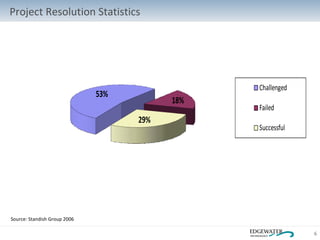
Project Resolution Statistics Source: Standish Group 2006
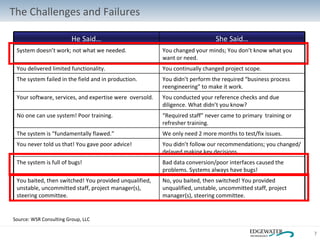
The Challenges and Failures Source: WSR Consulting Group, LLC He Said… She Said… System doesn’t work; not what we needed. You changed your minds; You don’t know what you want or need. You delivered limited functionality. You continually changed project scope. The system failed in the field and in production. You didn’t perform the required “business process reengineering” to make it work. Your software, services, and expertise were  oversold. You conducted your reference checks and due diligence. What didn’t you know? No one can use system! Poor training. “ Required staff” never came to primary  training or refresher training. The system is “fundamentally flawed.” We only need 2 more months to test/fix issues. You never told us that! You gave poor advice! You didn’t follow our recommendations; you changed/delayed making key decisions. The system is full of bugs! Bad data conversion/poor interfaces caused the problems. Systems always have bugs!  You baited, then switched! You provided unqualified, unstable, uncommitted staff, project manager(s), steering committee. No, you baited, then switched! You provided unqualified, unstable, uncommitted staff, project manager(s), steering committee.
Excerpt from Edgewater Whitepaper Best Practices Summary
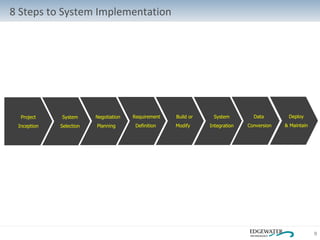
8 Steps to System Implementation Project Inception System Selection Requirement Definition Negotiation  Planning System Integration Data Conversion Build or Modify Deploy & Maintain
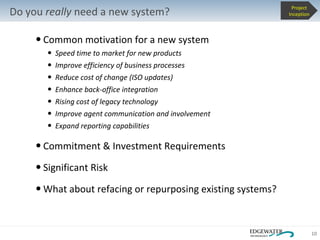
Common motivation for a new system Speed time to market for new products Improve efficiency of business processes Reduce cost of change (ISO updates) Enhance back-office integration Rising cost of legacy technology Improve agent communication and involvement Expand reporting capabilities Commitment & Investment Requirements Significant Risk What about refacing or repurposing existing systems? Do you  really  need a new system? Project Inception
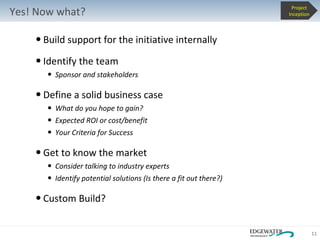
Build support for the initiative internally Identify the team Sponsor and stakeholders Define a solid business case  What do you hope to gain? Expected ROI or cost/benefit Your Criteria for Success Get to know the market Consider talking to industry experts  Identify potential solutions (Is there a fit out there?) Custom Build? Yes! Now what? Project Inception
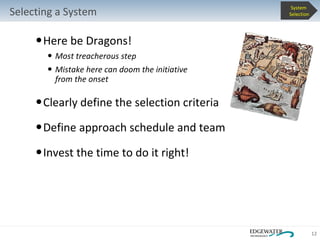
Selecting a System Here be Dragons! Most treacherous step Mistake here can doom the initiative from the onset Clearly define the selection criteria Define approach schedule and team Invest the time to do it right! System  Selection
Vendor Market 101 Over 50 rating and administration vendors Product Types Code vs. tool based Support for out of the box product definitions Best of breed vs. 1-stop-shop Delivery Models Ongoing Updates System  Selection
Is the technology sustainable? Is the vendor sustainable? Can the system be customized and still get maintenance releases from the vendor? Can I customize the system in house? What do really get out of the box? ISO content? Big part of the TCO How will it integrate with my back-end systems? Favor standard formats like XML What do your customers think of you? Questions to Ask System  Selection
Selecting a System: Requirements Business requirements Consider current and future Level of detail is very important For example, “The system must support OOS endorsements” Most vendors will meet this requirement What does that really mean? Do you expect automatic rollback and  roll-forward? How will your back-end systems respond? What will the DEC look like? System  Selection
Selecting a System: Evaluation RFI and/or RFP?  Limited short list Based on well-defined requirements Scripted demonstrations Script the demos! Proof of concept Really needed? What risk is being addressed? Make meaningful and reusable Perform the due diligence System  Selection
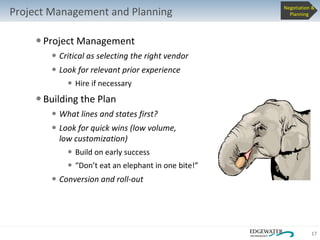
Project Management and Planning Project Management Critical as selecting the right vendor Look for relevant prior experience Hire if necessary Building the Plan What lines and states first? Look for quick wins (low volume,  low customization) Build on early success “ Don’t eat an elephant in one bite!” Conversion and roll-out Negotiation & Planning
Requirements approach depends on product High functionality OOB  -> Gap analysis Low or no functionality OOB -> Detailed requirements Gap analysis is lowest risk Involve the  right  combination of business users High Business Knowledge  Progressive Thinkers Consider business process reengineering  Consider cost of modifications Varies depending on vendor Code-based or limited content = $$$$ Configuration-based or high content = $ Requirements or Gap Analysis Requirement Definition
Strongly consider a blended approach If vendor allows it Institutionalizes knowledge about system early Insist on frequent releases Only reliable way to track progress Testing Early and often Clearly defined test plans Plan for broken builds Include smoke, system, and user Development/Customization Build or Modify
With integration, one size does  not  fit all Pick the right product to start with Consider the following interfaces Agency upload and download (use a tool) Real-time interfaces Batch interfaces Reporting and business intelligence For all but the simplest cases, use a product! BizTalk, WebSphere Integrator, ESB Consider using experts to get you started System Integration System  Integration
Is automation required? Number of policies True cost of automation (specs, development, testing, environments, cleanup, etc.) How cl3an is y0ur d@ta? Exception cases Consider manual entry if practical  Use the vendor’s API if possible Data integration (ETL) is last resort What about historical data? Consider a historical repository Consider BI up front Data Conversion Data  Conversion
Externally facing or internal only Internal is better to start with Most common strategies Renewal (lower risk, higher cost) Big Bang (higher risk, lower cost) Consider limited agency rollout Automate regulatory updates Minimize interpretation Maintenance of ISO content  3,100 ISO filings in 2006 for commercial/lines Over 2,200 affect the 9 primary lines Deployment and Maintenance Deploy &  Maintain
Select the right product Out-of-the-box functionality Ability to customize  without forking Integration Friendly Build the right Team Project Management, Partners Don’t bite off more than you can chew Minimize Risk in all areas Requirements, Development, Conversion and Rollout Consider life after implementation Best Practices Summary
How AQS Can Help Best Practices
AQS has 40 customers Average tenure 16 years Stability and experience Founded in 1979 More than 200 dedicated employees Average employee tenure – 7 +  years Average insurance experience – 12 years Why AQS? Experts in both insurance and technology Decision support tools Streamlined maintenance of ISO updates Experience delivering and implementing rating & policy system implementations for small, medium & large Carriers Multiple implementation options Vendor Support (full service) Self Service Hybrid (shared) AQS Overview
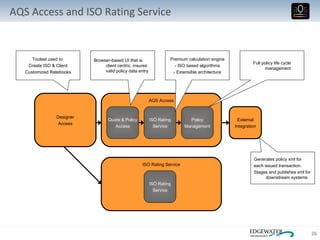
AQS Access and ISO Rating Service AQS Access Quote & Policy Access ISO Rating Service Designer Access Policy Management External Integration Browser-based UI that is client centric, insures valid policy data entry Premium calculation engine - ISO based algorithms - Extensible architecture Full policy life cycle management Toolset used to  Create ISO & Client Customized Ratebooks ISO Rating Service ISO Rating Service Generates policy xml for  each issued transaction. Stages and publishes xml for downstream systems.
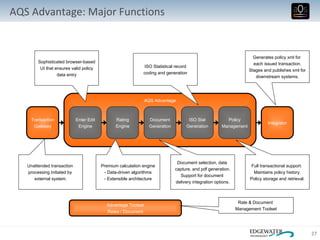
AQS Advantage: Major Functions AQS Advantage Enter Edit Engine Rating Engine Transaction Gateway Document Generation ISO Stat Generation Policy Management Integrator Sophisticated browser-based UI that ensures valid policy data entry Premium calculation engine - Data-driven algorithms - Extensible architecture Document selection, data  capture, and pdf generation. Support for document  delivery integration options. ISO Statistical record coding and generation Full transactional support.  Maintains policy history. Policy storage and retrieval. Generates policy xml for  each issued transaction. Stages and publishes xml for  downstream systems. Unattended transaction  processing initiated by  external system. Advantage Toolset Rates / Document Rate & Document  Management Toolset
XML based integration ‘ Call-Out’ capability Modern .NET architecture for all application components Highly configurable Preloaded ISO content Integrates with ISO Passport data sources Performance and Scalability Reports – impact analysis, functional specification Automated testing tools AQS Highlights
AQS Approach Best of breed Partnerships with functional components for enterprise solutions Claims Billing Etc.
No duplicate data entry Support for all policy types/lines of business Full policy life cycle transaction types Real-time data validation/error checking Real-time rate calculations Easy to use/intuitive navigation Automatic forms selection/assignment Automated workflow and referrals Rating worksheets Workflow/diary/notes Customer-centric view (vs. policy-centric) Benefits for Primary End Users
Faster speed to market for new products Reduced premium leakage Reduced “adverse selection” Improved retention of profitable customers Easier to stay current with ISO Less costly to maintain content Web-based for ease of doing business Automatic “Stat Code” assignment Best-of-breed product component option Benefits for Management
Single system supports all P/C lines of business Tools based Decision-support tools Configurable page design (user interface) All changes are automatically documented Designer tools  Ratebook inheritance leverages ISO base content Import/export capability (speed, accuracy) Ratebook modeling, comparison, and analysis tools Functional specification documents Benefits for Product Specialists
Current technologies (.NET, SQL Server, XML) Highly configurable security model Proven performance/scalability Content updates distributed via ISOnet XML input/output Integration with downstream systems Version control (date-driven Ratebooks) Self-documenting system Benefits for IT/Systems Personnel
The ISO Rating Service Best Practices
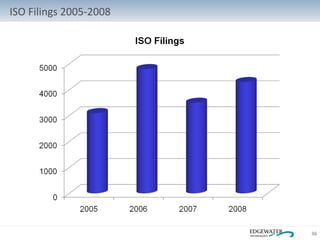
Maintenance of ISO content  Over 4000 ISO filings last year alone Analysis and data entry can be costly Expert content from the source Legacy system maintenance can cost carriers millions of dollars per year! The Magnitude of the Challenge
ISO Filings 2005-2008
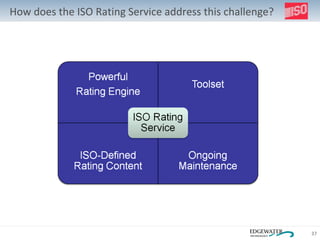
How does the ISO Rating Service address this challenge?
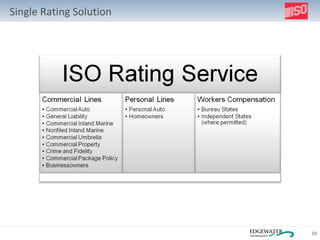
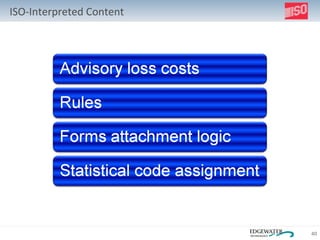
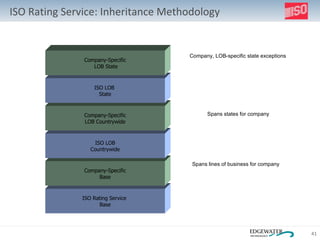
ISO Rating Service A single rating solution for multiple ISO programs Incorporates ISO-interpreted content Content inheritance model allows company-customized rating deviations and state exceptions Streamlined delivery of ISO content updates via ISOnet
Single Rating Solution
ISO-Interpreted Content
ISO Rating Service: Inheritance Methodology ISO Rating Service  Base Company-Specific Base ISO LOB Countrywide Company-Specific LOB Countrywide ISO LOB  State Company-Specific  LOB State Spans lines of business for company Spans states for company Company, LOB-specific state exceptions
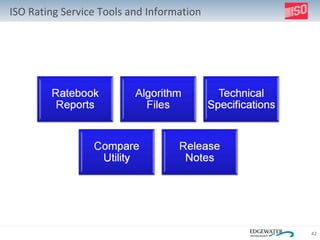
ISO Rating Service Tools and Information
Key Benefits What does all of this mean for you? Quick access to ISO-defined content, leveraged to enable faster speed to market for bringing up new lines, states, and rate plans Ability to determine how close your company is with respect to following ISO for loss costs, rules, forms and stat code assignment, allowing your company to remain in compliance and thus reduce exposure to fines Use of development tools with a patented inheritance methodology that provide you the ISO-defined content to customize to your needs, resulting in greater accuracy, less redundancy, and reduced costs Use of analytical tools to assist with the analysis effort for maintenance going forward, resulting in less time spent preparing for the next release Powerful Tools Designed with Growth, Quality and Efficiency in Mind!
Final Thoughts Best Practices
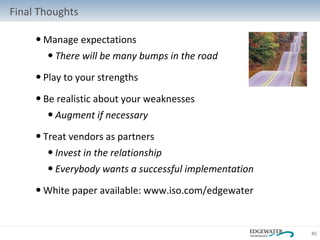
Manage expectations There will be many bumps in the road Play to your strengths Be realistic about your weaknesses Augment if necessary Treat vendors as partners Invest in the relationship Everybody wants a successful implementation White paper available: www.iso.com/edgewater Final Thoughts
Any Questions? Martin Higgins Edgewater Technology [email_address] (781) 224 9026 Todd Meyer ISO [email_address] (781) 224 9026 Susan Daly AQS [email_address] (603) 546 2434

Best Practices for Rating and Policy Administration System Replacement

  • 1.
    Best Practices for Rating and Policy Administration System Replacement June 18th 2009
  • 2.
    Martin Higgins Director, Edgewater Technology, Inc. Todd Meyer Senior Sales Consultant, ISO Susan Daly Sales Consultant, AQS Today’s Speakers
  • 3.
    About Edgewater TheNature of the Beast Best Practices Summary How AQS can help How ISO Rating Service can help Final Thoughts Q&A Agenda
  • 4.
    Technology Management ConsultingFirm Provide a unique blend of specialty IT services Leverage proven industry expertise in strategy, technology and enterprise performance management Focus on middle and Global 2000 market Stable and Proven Founded in 1992 Headquartered in Wakefield, MA 300 Employees, 240 Consultants 600 Clients Large North American footprint +2,000 projects completed to date Publicly traded (NASDAQ: EDGW) Insurance Practice Over 50 clients Expertise in policy administration, rating, system selection About Edgewater
  • 5.
    The Nature ofthe Beast (Why best practices are important) Best Practices
  • 6.
    Project Resolution StatisticsSource: Standish Group 2006
  • 7.
    The Challenges andFailures Source: WSR Consulting Group, LLC He Said… She Said… System doesn’t work; not what we needed. You changed your minds; You don’t know what you want or need. You delivered limited functionality. You continually changed project scope. The system failed in the field and in production. You didn’t perform the required “business process reengineering” to make it work. Your software, services, and expertise were oversold. You conducted your reference checks and due diligence. What didn’t you know? No one can use system! Poor training. “ Required staff” never came to primary training or refresher training. The system is “fundamentally flawed.” We only need 2 more months to test/fix issues. You never told us that! You gave poor advice! You didn’t follow our recommendations; you changed/delayed making key decisions. The system is full of bugs! Bad data conversion/poor interfaces caused the problems. Systems always have bugs! You baited, then switched! You provided unqualified, unstable, uncommitted staff, project manager(s), steering committee. No, you baited, then switched! You provided unqualified, unstable, uncommitted staff, project manager(s), steering committee.
  • 8.
    Excerpt from EdgewaterWhitepaper Best Practices Summary
  • 9.
    8 Steps toSystem Implementation Project Inception System Selection Requirement Definition Negotiation Planning System Integration Data Conversion Build or Modify Deploy & Maintain
  • 10.
    Common motivation fora new system Speed time to market for new products Improve efficiency of business processes Reduce cost of change (ISO updates) Enhance back-office integration Rising cost of legacy technology Improve agent communication and involvement Expand reporting capabilities Commitment & Investment Requirements Significant Risk What about refacing or repurposing existing systems? Do you really need a new system? Project Inception
  • 11.
    Build support forthe initiative internally Identify the team Sponsor and stakeholders Define a solid business case What do you hope to gain? Expected ROI or cost/benefit Your Criteria for Success Get to know the market Consider talking to industry experts Identify potential solutions (Is there a fit out there?) Custom Build? Yes! Now what? Project Inception
  • 12.
    Selecting a SystemHere be Dragons! Most treacherous step Mistake here can doom the initiative from the onset Clearly define the selection criteria Define approach schedule and team Invest the time to do it right! System Selection
  • 13.
    Vendor Market 101Over 50 rating and administration vendors Product Types Code vs. tool based Support for out of the box product definitions Best of breed vs. 1-stop-shop Delivery Models Ongoing Updates System Selection
  • 14.
    Is the technologysustainable? Is the vendor sustainable? Can the system be customized and still get maintenance releases from the vendor? Can I customize the system in house? What do really get out of the box? ISO content? Big part of the TCO How will it integrate with my back-end systems? Favor standard formats like XML What do your customers think of you? Questions to Ask System Selection
  • 15.
    Selecting a System:Requirements Business requirements Consider current and future Level of detail is very important For example, “The system must support OOS endorsements” Most vendors will meet this requirement What does that really mean? Do you expect automatic rollback and roll-forward? How will your back-end systems respond? What will the DEC look like? System Selection
  • 16.
    Selecting a System:Evaluation RFI and/or RFP? Limited short list Based on well-defined requirements Scripted demonstrations Script the demos! Proof of concept Really needed? What risk is being addressed? Make meaningful and reusable Perform the due diligence System Selection
  • 17.
    Project Management andPlanning Project Management Critical as selecting the right vendor Look for relevant prior experience Hire if necessary Building the Plan What lines and states first? Look for quick wins (low volume, low customization) Build on early success “ Don’t eat an elephant in one bite!” Conversion and roll-out Negotiation & Planning
  • 18.
    Requirements approach dependson product High functionality OOB -> Gap analysis Low or no functionality OOB -> Detailed requirements Gap analysis is lowest risk Involve the right combination of business users High Business Knowledge Progressive Thinkers Consider business process reengineering Consider cost of modifications Varies depending on vendor Code-based or limited content = $$$$ Configuration-based or high content = $ Requirements or Gap Analysis Requirement Definition
  • 19.
    Strongly consider ablended approach If vendor allows it Institutionalizes knowledge about system early Insist on frequent releases Only reliable way to track progress Testing Early and often Clearly defined test plans Plan for broken builds Include smoke, system, and user Development/Customization Build or Modify
  • 20.
    With integration, onesize does not fit all Pick the right product to start with Consider the following interfaces Agency upload and download (use a tool) Real-time interfaces Batch interfaces Reporting and business intelligence For all but the simplest cases, use a product! BizTalk, WebSphere Integrator, ESB Consider using experts to get you started System Integration System Integration
  • 21.
    Is automation required?Number of policies True cost of automation (specs, development, testing, environments, cleanup, etc.) How cl3an is y0ur d@ta? Exception cases Consider manual entry if practical Use the vendor’s API if possible Data integration (ETL) is last resort What about historical data? Consider a historical repository Consider BI up front Data Conversion Data Conversion
  • 22.
    Externally facing orinternal only Internal is better to start with Most common strategies Renewal (lower risk, higher cost) Big Bang (higher risk, lower cost) Consider limited agency rollout Automate regulatory updates Minimize interpretation Maintenance of ISO content 3,100 ISO filings in 2006 for commercial/lines Over 2,200 affect the 9 primary lines Deployment and Maintenance Deploy & Maintain
  • 23.
    Select the rightproduct Out-of-the-box functionality Ability to customize without forking Integration Friendly Build the right Team Project Management, Partners Don’t bite off more than you can chew Minimize Risk in all areas Requirements, Development, Conversion and Rollout Consider life after implementation Best Practices Summary
  • 24.
    How AQS CanHelp Best Practices
  • 25.
    AQS has 40customers Average tenure 16 years Stability and experience Founded in 1979 More than 200 dedicated employees Average employee tenure – 7 + years Average insurance experience – 12 years Why AQS? Experts in both insurance and technology Decision support tools Streamlined maintenance of ISO updates Experience delivering and implementing rating & policy system implementations for small, medium & large Carriers Multiple implementation options Vendor Support (full service) Self Service Hybrid (shared) AQS Overview
  • 26.
    AQS Access andISO Rating Service AQS Access Quote & Policy Access ISO Rating Service Designer Access Policy Management External Integration Browser-based UI that is client centric, insures valid policy data entry Premium calculation engine - ISO based algorithms - Extensible architecture Full policy life cycle management Toolset used to Create ISO & Client Customized Ratebooks ISO Rating Service ISO Rating Service Generates policy xml for each issued transaction. Stages and publishes xml for downstream systems.
  • 27.
    AQS Advantage: MajorFunctions AQS Advantage Enter Edit Engine Rating Engine Transaction Gateway Document Generation ISO Stat Generation Policy Management Integrator Sophisticated browser-based UI that ensures valid policy data entry Premium calculation engine - Data-driven algorithms - Extensible architecture Document selection, data capture, and pdf generation. Support for document delivery integration options. ISO Statistical record coding and generation Full transactional support. Maintains policy history. Policy storage and retrieval. Generates policy xml for each issued transaction. Stages and publishes xml for downstream systems. Unattended transaction processing initiated by external system. Advantage Toolset Rates / Document Rate & Document Management Toolset
  • 28.
    XML based integration‘ Call-Out’ capability Modern .NET architecture for all application components Highly configurable Preloaded ISO content Integrates with ISO Passport data sources Performance and Scalability Reports – impact analysis, functional specification Automated testing tools AQS Highlights
  • 29.
    AQS Approach Bestof breed Partnerships with functional components for enterprise solutions Claims Billing Etc.
  • 30.
    No duplicate dataentry Support for all policy types/lines of business Full policy life cycle transaction types Real-time data validation/error checking Real-time rate calculations Easy to use/intuitive navigation Automatic forms selection/assignment Automated workflow and referrals Rating worksheets Workflow/diary/notes Customer-centric view (vs. policy-centric) Benefits for Primary End Users
  • 31.
    Faster speed tomarket for new products Reduced premium leakage Reduced “adverse selection” Improved retention of profitable customers Easier to stay current with ISO Less costly to maintain content Web-based for ease of doing business Automatic “Stat Code” assignment Best-of-breed product component option Benefits for Management
  • 32.
    Single system supportsall P/C lines of business Tools based Decision-support tools Configurable page design (user interface) All changes are automatically documented Designer tools Ratebook inheritance leverages ISO base content Import/export capability (speed, accuracy) Ratebook modeling, comparison, and analysis tools Functional specification documents Benefits for Product Specialists
  • 33.
    Current technologies (.NET,SQL Server, XML) Highly configurable security model Proven performance/scalability Content updates distributed via ISOnet XML input/output Integration with downstream systems Version control (date-driven Ratebooks) Self-documenting system Benefits for IT/Systems Personnel
  • 34.
    The ISO RatingService Best Practices
  • 35.
    Maintenance of ISOcontent Over 4000 ISO filings last year alone Analysis and data entry can be costly Expert content from the source Legacy system maintenance can cost carriers millions of dollars per year! The Magnitude of the Challenge
  • 36.
  • 37.
    How does theISO Rating Service address this challenge?
  • 38.
    ISO Rating ServiceA single rating solution for multiple ISO programs Incorporates ISO-interpreted content Content inheritance model allows company-customized rating deviations and state exceptions Streamlined delivery of ISO content updates via ISOnet
  • 39.
  • 40.
  • 41.
    ISO Rating Service:Inheritance Methodology ISO Rating Service Base Company-Specific Base ISO LOB Countrywide Company-Specific LOB Countrywide ISO LOB State Company-Specific LOB State Spans lines of business for company Spans states for company Company, LOB-specific state exceptions
  • 42.
    ISO Rating ServiceTools and Information
  • 43.
    Key Benefits Whatdoes all of this mean for you? Quick access to ISO-defined content, leveraged to enable faster speed to market for bringing up new lines, states, and rate plans Ability to determine how close your company is with respect to following ISO for loss costs, rules, forms and stat code assignment, allowing your company to remain in compliance and thus reduce exposure to fines Use of development tools with a patented inheritance methodology that provide you the ISO-defined content to customize to your needs, resulting in greater accuracy, less redundancy, and reduced costs Use of analytical tools to assist with the analysis effort for maintenance going forward, resulting in less time spent preparing for the next release Powerful Tools Designed with Growth, Quality and Efficiency in Mind!
  • 44.
  • 45.
    Manage expectations Therewill be many bumps in the road Play to your strengths Be realistic about your weaknesses Augment if necessary Treat vendors as partners Invest in the relationship Everybody wants a successful implementation White paper available: www.iso.com/edgewater Final Thoughts
  • 46.
    Any Questions? MartinHiggins Edgewater Technology [email_address] (781) 224 9026 Todd Meyer ISO [email_address] (781) 224 9026 Susan Daly AQS [email_address] (603) 546 2434

Editor's Notes

  • #7 Over 70% troubled Entire Industry devoted to reasons why Vendor implementation are special same challenges, different weighting
  • #8 Both sides believe in their position Message: Truth is inevitably somewhere in the middle Relationship is key
  • #12 Industry Project based (Edgewater, BearingPoint, IBM), Research based (Gartner, Celent) Custom Build We have done it Large Custom software projects are notoriously difficult – requires different resources, methodology, process and experience Even software houses get it wrong
  • #17 RFI Short (4 pages), non exhaustive Due Diligence Not just references, use network
  • #18 Negotiation Define Change process Define Acceptance Criteria Delivery Milestones Project Management Use a project plan Regular status meetings Risk management
  • #20 Blended Development Share risk Keeps everybody honest Testing - Not an afterthought Use issue tracking, shared if possible
  • #23 Limited Agency Rollout Internal agency “ Friendly” agencies
  • #24 Consider life after implementation Can you support it? Blended team Can you keep it current?
  • #27 Susan
  • #38 Welcome and thank you for joining us. Today you’re going to be hearing a lot about change. More specifically how the collateral tools and information that come with the ISO Rating Service help you manage the change inherent in your business. As we have a large group today that may have various levels of knowledge about the ISO Rating Service product, let me start by providing some context to these tools by giving a brief overview of the core of the product. With the ISO Rating Service you get A powerful rating engine -it is Developed on the Microsoft .Net platform -it responds to rating requests in a defined XML format with all of the quote or policy information and returns an XML formatted response providing a premium And other information. -it also allows for integration with external systems A web based toolset that enables you to -maintain and customize content to your requirements ISO Defined Rating Content in packages of data and components called “ratebooks”. The ratebooks are used by the engine to process rating requests based on line of business, state and effective date. And ongoing maintenance of that content in response to changes in the ISO Manuals. This is a key element as it allows you to adopt changes to ISO information in an automated format in the same way that you adopt changes to ISO manual information today. As new ratebooks are released they carry the same ISO established effective date as the newly included content.
  • #39 Accessing updated content is easy. You can quickly download ratebooks via ISOnet to import into your ISO Rating Service environment.
  • #40 One solution gives you automated rating for all major ISO Commercial Lines. For personal lines we offer Personal Auto and Homeowners and we also offer Workers Compensation for Bureau and Independent states. This means one standardized data format, one set of tools for your content development and maintenance staff and one interface for external systems across all of these lines of business.
  • #41 That information includes: ISO’s Advisory lost costs ISO manual rules Forms attachment logic for mandatory and conditional forms And Statistical code assignment tying information from the Commercial Statistical Plan to the rating of your customer’s policies The Rating Service content maintenance team works with ISO’s Line, Actuarial and Statistical plan staff to verify the accuracy of the ratebook content.
  • #43 So let’s take look at 5 of these tools and their benefits. Ratebook Reports, Algorithm files, Technical Specifications, a Compare Utility and Release Notes.
  • #44 To summarize, The benefits you will see from these tools are: -Faster access to ISO content in formats that let you more effectively bring new lines, states and plans to market. -More easily evaluate you current status in following ISO rules. Better defining this makes it easier to stay in compliance and avoid fines. -Less expensive, more accurate initial customizations to ISO data. -Better impact analysis to manage your ongoing maintenance.