Integrating Analytics for Value-Based Healthcare
Joshua McHale
Maury DePalo
22
Today’s Topic …
Population Health Analytics
• Current Climate and Challenges - Program Objectives
• Driving Needs for Focused Analytics - to Improve Clinical and Financial Performance
• Mobilizing by Process Implementation & Improvement
Data Integration Challenges
• Enterprise Data Architecture
• Primary Components – Data Sourcing, Transformation, Delivery
• End-User Data Navigation Model – Integrated Data Repository
Business Intelligence and Data Exploration
• Empowering the End-User Experience – Examples
• Action-Oriented Performance Measures
Moving Forward
• Risk and Alternative Quality Contracts
• Reducing Clinical Variation
• Mobilizing for Value-Based Care
Q & A
33
Population Health Analytics
Current Business Climate & Challenges
• Relentless Pressures on Quality  Outcomes  Costs
• Need for Innovation in Care Delivery, Coordination, Risk Sharing, Cost Control
• Massachusetts Health Policy Commission – Phase 2 of Community Health Acceleration,
Revitalization, and Transformation investment program (CHART-2)
• Enhance delivery of efficient, effective care at community hospitals
• Promote care coordination, integration, delivery transformation
• Advance EHR adoption  information exchange among providers
• Increase adoption of alternative payment models  accountable care organizations
• Enhance patient safety  coordination between hospitals and community-based providers
• Leveraging resources of community partners
• Focus on Pressing Healthcare Needs in Local Communities
• Targeted At-Risk Populations  Behavioral Health; Diabetes
• High Utilizers  > 4 Inpatient Admissions; > 10 Emergency Room Visits
• Improve Coordination and Access to Care
• Improve engagement of high-risk diabetes patients  incorporate into care management programs
 development of disease management registries
44
Population Health Analytics
Driving Needs for Focused Analytics to Improve Clinical & Financial Performance
• Identify & Characterize Key Targeted Patient Populations
• At Risk Populations, Preventive Care, Patient Experience
• Identify Targets for Intervention & Improvement Programs
• Patient, Diagnosis
• Provider, Service Utilization, Care Coordination
• Track Quality and Financial Performance Metrics Against Baselines & Targets
• Individual and Aggregate Measures – Drill-Down on Quality & Financial Performance
• Individual Patients – Individual Providers
• Aggregate Providers – Aggregate Care Teams – Aggregate Practice Groups / Locations
• Track Attributed Populations Defined Under Risk Performance Contracts
• Track Response to Programs – Defined Quality Measures
• Track Assignment Consistency – Care Plan Compliance
• Disseminate Standards of Care Across Care Teams & Settings
• Track Variation in Outcomes, Utilization, Costs
55
Population Health Analytics
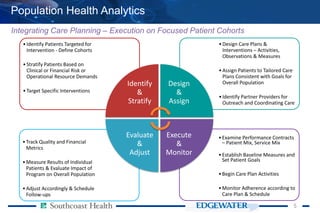
Integrating Care Planning – Execution on Focused Patient Cohorts
•Examine Performance Contracts
– Patient Mix, Service Mix
•Establish Baseline Measures and
Set Patient Goals
•Begin Care Plan Activities
•Monitor Adherence according to
Care Plan & Schedule
•Track Quality and Financial
Metrics
•Measure Results of Individual
Patients & Evaluate Impact of
Program on Overall Population
•Adjust Accordingly & Schedule
Follow-ups
•Design Care Plans &
Interventions – Activities,
Observations & Measures
•Assign Patients to Tailored Care
Plans Consistent with Goals for
Overall Population
•Identify Partner Providers for
Outreach and Coordinating Care
•Identify Patients Targeted for
Intervention - Define Cohorts
•Stratify Patients Based on
Clinical or Financial Risk or
Operational Resource Demands
•Target Specific Interventions
Identify
&
Stratify
Design
&
Assign
Execute
&
Monitor
Evaluate
&
Adjust
66
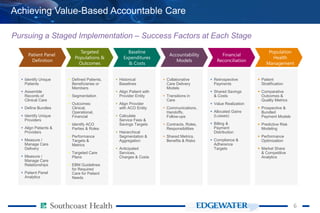
Achieving Value-Based Accountable Care
Pursuing a Staged Implementation – Success Factors at Each Stage
Patient Panel
Definition
Targeted
Populations &
Outcomes
Baseline
Expenditures
& Costs
Accountability
Models
Financial
Reconciliation
Population
Health
Management
 Identify Unique
Patients
 Assemble
Records of
Clinical Care
 Define Bundles
 Identify Unique
Providers
 Align Patients &
Providers
 Measure /
Manage Care
Delivery
 Measure /
Manage Care
Relationships
 Patient Panel
Analytics
 Defined Patients,
Beneficiaries or
Members
 Segmentation
 Outcomes:
Clinical,
Operational,
Financial
 Identify ACO
Parties & Roles
 Performance
Targets &
Metrics
 Targeted Care
Plans
 EBM Guidelines
for Required
Care for Patient
Needs
 Historical
Baselines
 Align Patient with
Provider Entity
 Align Provider
with ACO Entity
 Calculate
Service Fees &
Savings Targets
 Hierarchical
Segmentation &
Aggregation
 Anticipated
Services,
Charges & Costs
 Collaborative
Care Delivery
Models
 Transitions in
Care
 Communications,
Handoffs,
Follow-ups
 Contracts, Roles,
Responsibilities
 Shared Metrics,
Benefits & Risks
 Retrospective
Payments
 Shared Savings
& Costs
 Value Realization
 Allocated Gains
(Losses)
 Billing &
Payment
Distribution
 Compliance &
Adherence
Targets
 Patient
Stratification
 Comparative
Outcomes &
Quality Metrics
 Prospective &
Bundled
Payment Models
 Predictive Risk
Modeling
 Performance
Optimization
 Market Share
& Competitive
Analytics
77
Population Health Analytics
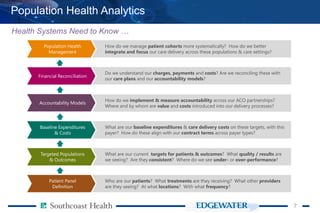
Health Systems Need to Know …
How do we manage patient cohorts more systematically? How do we better
integrate and focus our care delivery across these populations & care settings?
Population Health
Management
Do we understand our charges, payments and costs? Are we reconciling these with
our care plans and our accountability models?
Financial Reconciliation
How do we implement & measure accountability across our ACO partnerships?
Where and by whom are value and costs introduced into our delivery processes?
Accountability Models
What are our baseline expenditures & care delivery costs on these targets, with this
payer? How do these align with our contract terms across payer types?
Baseline Expenditures
& Costs
What are our current targets for patients & outcomes? What quality / results are
we seeing? Are they consistent? Where do we see under- or over-performance?
Targeted Populations
& Outcomes
Who are our patients? What treatments are they receiving? What other providers
are they seeing? At what locations? With what frequency?
Patient Panel
Definition
88
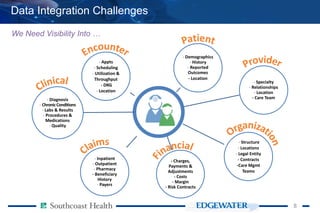
Data Integration Challenges
We Need Visibility Into …
- Demographics
- History
- Reported
Outcomes
- Location
- Specialty
- Relationships
- Location
- Care Team
- Structure
- Locations
- Legal Entity
- Contracts
-Care Mgmt
Teams
- Inpatient
- Outpatient
- Pharmacy
- Beneficiary
History
- Payers
- Charges,
Payments &
Adjustments
- Costs
- Margin
- Risk Contracts
- Diagnosis
- ChronicConditions
- Labs & Results
- Procedures &
Medications
- Quality
- Appts
- Scheduling
- Utilization &
Throughput
- DRG
- Location
99
Enterprise Data Architecture
DataIntegration&Transformation
Patient Panel Analytics
Targeted Populations
& Outcomes
Baseline Expenditures
& Costs
Accountability Models
Financial Reconciliation
Population Health
Management
Dashboards &
Analytic Views
Contract Measures
Performance
Summary
Baseline Expenditure
Provider Profile
EMR
Billing
Provider
Master
Health
System
Payers
Claims
DataAccess–Navigation&Security
Reports
Patient
Capture Integration and Transformation Consumption
Extensible Data
Architecture
Standard Data Models
MPI
Coding
Members
Provider
Claim
Reference
Other
Master
Data
Encounter
Location
1010
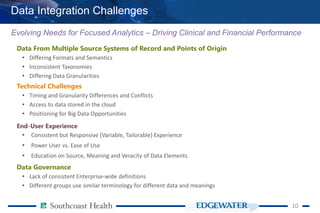
Data Integration Challenges
Data From Multiple Source Systems of Record and Points of Origin
• Differing Formats and Semantics
• Inconsistent Taxonomies
• Differing Data Granularities
Technical Challenges
• Timing and Granularity Differences and Conflicts
• Access to data stored in the cloud
• Positioning for Big Data Opportunities
End-User Experience
• Consistent but Responsive (Variable, Tailorable) Experience
• Power User vs. Ease of Use
• Education on Source, Meaning and Veracity of Data Elements
Data Governance
• Lack of consistent Enterprise-wide definitions
• Different groups use similar terminology for different data and meanings
Evolving Needs for Focused Analytics – Driving Clinical and Financial Performance
1111
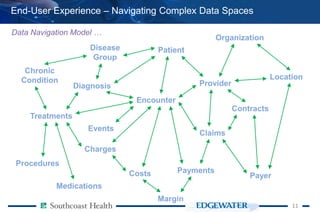
End-User Experience – Navigating Complex Data Spaces
Patient
Organization
Provider
Location
Contracts
Payer
Claims
Payments
Encounter
Charges
Costs
Diagnosis
Treatments
Chronic
Condition
Disease
Group
Procedures
Medications
Margin
Events
Data Navigation Model …
1212
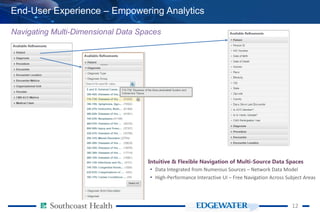
End-User Experience – Empowering Analytics
Navigating Multi-Dimensional Data Spaces
Intuitive & Flexible Navigation of Multi-Source Data Spaces
• Data Integrated from Numerous Sources – Network Data Model
• High-Performance Interactive UI – Free Navigation Across Subject Areas
1313
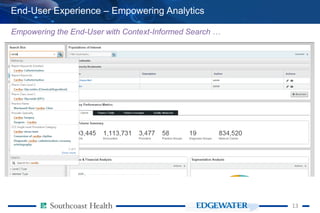
End-User Experience – Empowering Analytics
Empowering the End-User with Context-Informed Search …
1414
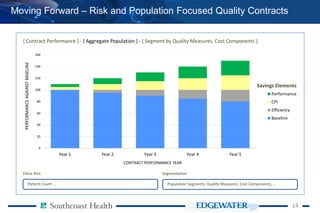
Moving Forward – Risk and Population Focused Quality Contracts
0
20
40
60
80
100
120
140
160
Year 1 Year 2 Year 3 Year 4 Year 5
PERFORMANCEAGAINSTBASELINE
CONTRACT PERFORMANCE YEAR
Performance
CPI
Efficiency
Baseline
Value Axis
Patient Count ...
{ Contract Performance } - { Aggregate Population } - { Segment by Quality Measures, Cost Components }
Segmentation
Population Segments, Quality Measures, Cost Components, ...
Savings Elements
1515
Risk and Population Focused Quality Contracts
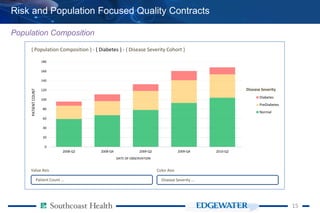
Population Composition
0
20
40
60
80
100
120
140
160
180
2008-Q2 2008-Q4 2009-Q2 2009-Q4 2010-Q2
PATIENTCOUNT
DATE OF OBSERVATION
Diabetes
PreDiabetes
Normal
Value Axis
Patient Count ...
{ Population Composition } - { Diabetes } - { Disease Severity Cohort }
Color Axis
Disease Severity ...
Disease Severity
1616
0
2000
4000
6000
8000
10000
12000
14000
16000 4.8
5.0
5.2
5.4
5.6
5.8
6.0
6.2
6.4
6.6
6.8
7.0
7.2
7.4
7.6
7.8
8.0
8.2
8.4
8.6
8.8
9.0
9.2
9.4
9.6
9.8
10.0
10.2
10.4
10.6
10.8
11.0
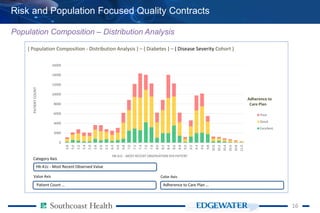
PATIENTCOUNT
HB A1C - MOST RECENT OBSERVATION PER PATIENT
Poor
Good
Excellent
{ Population Composition - Distribution Analysis } – { Diabetes } – { Disease Severity Cohort }
Adherence to
Care Plan
Value Axis Color Axis
Patient Count ... Adherence to Care Plan ...
Category Axis
Hb A1c - Most Recent Observed Value
Risk and Population Focused Quality Contracts
Population Composition – Distribution Analysis
1717
Risk and Population Focused Quality Contracts
Population Composition – Distribution Analysis
0
2000
4000
6000
8000
10000
12000
14000
16000
1.0
2.0
3.0
4.0
5.0
6.0
7.0
8.0
9.0
10.0
11.0
12.0
13.0
14.0
15.0
16.0
17.0
18.0
19.0
20.0
21.0
22.0
23.0
24.0
25.0
26.0
27.0
28.0
29.0
30.0
31.0
32.0
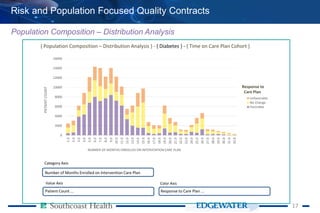
PATIENTCOUNT
NUMBER OF MONTHS ENROLLED ON INTERVENTION CARE PLAN
Unfavorable
No Change
Favorable
{ Population Composition – Distribution Analysis } - { Diabetes } - { Time on Care Plan Cohort }
Response to
Care Plan
Value Axis Color Axis
Category Axis
Patient Count ... Response to Care Plan ...
Number of Months Enrolled on Intervention Care Plan
1818
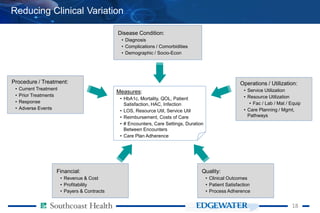
Reducing Clinical Variation
Procedure / Treatment:
• Current Treatment
• Prior Treatments
• Response
• Adverse Events
Disease Condition:
• Diagnosis
• Complications / Comorbidities
• Demographic / Socio-Econ
Operations / Utilization:
• Service Utilization
• Resource Utilization
• Fac / Lab / Mat / Equip
• Care Planning / Mgmt,
Pathways
Financial:
• Revenue & Cost
• Profitability
• Payers & Contracts
Quality:
• Clinical Outcomes
• Patient Satisfaction
• Process Adherence
Measures:
• HbA1c, Mortality, QOL, Patient
Satisfaction, HAC, Infection
• LOS, Resource Util, Service Util
• Reimbursement, Costs of Care
• # Encounters, Care Settings, Duration
Between Encounters
• Care Plan Adherence
1919
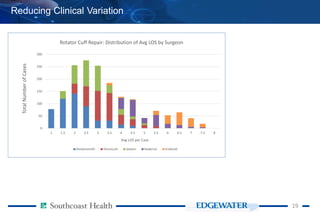
Reducing Clinical Variation
0
50
100
150
200
250
300
1 1.5 2 2.5 3 3.5 4 4.5 5 5.5 6 6.5 7 7.5 8
TotalNumberofCases
Avg LOS per Case
Rotator Cuff Repair: Distribution of Avg LOS by Surgeon
Hockensmith Hunnicutt Sexton Roderick Endicott
2020
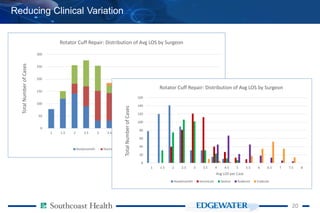
Reducing Clinical Variation
0
50
100
150
200
250
300
1 1.5 2 2.5 3 3.5 4 4.5 5 5.5 6 6.5 7 7.5 8
TotalNumberofCases
Avg LOS per Case
Rotator Cuff Repair: Distribution of Avg LOS by Surgeon
Hockensmith Hunnicutt Sexton Roderick Endicott
0
20
40
60
80
100
120
140
160
1 1.5 2 2.5 3 3.5 4 4.5 5 5.5 6 6.5 7 7.5 8
TotalNumberofCases
Avg LOS per Case
Rotator Cuff Repair: Distribution of Avg LOS by Surgeon
Hockensmith Hunnicutt Sexton Roderick Endicott
2121
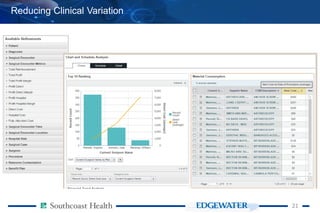
Reducing Clinical Variation
2222
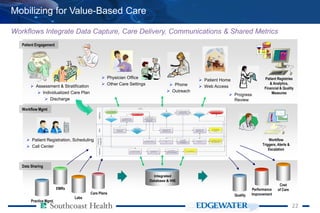
Mobilizing for Value-Based Care
Workflows Integrate Data Capture, Care Delivery, Communications & Shared Metrics
 Physician Office
 Other Care Settings
Integrated
Database & HIE
Patient Registries
& Analytics,
Financial & Quality
Measures
Workflow
Triggers, Alerts &
Escalation
 Patient Registration, Scheduling
 Call Center
 Patient Home
 Web Access Assessment & Stratification
 Individualized Care Plan
 Discharge
 Progress
Review
Labs
EMRs
Quality
Performance
Improvement
 Phone
 Outreach
Workflow Mgmt
Data Sharing
Patient Engagement
Care Plans
Practice Mgmt
Cost
of Care
2323
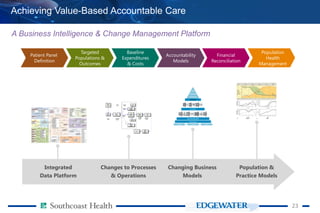
Achieving Value-Based Accountable Care
A Business Intelligence & Change Management Platform
Patient Panel
Definition
Targeted
Populations &
Outcomes
Baseline
Expenditures
& Costs
Accountability
Models
Financial
Reconciliation
Population
Health
Management
Integrated
Data Platform
Changes to Processes
& Operations
Changing Business
Models
Population &
Practice Models
2424
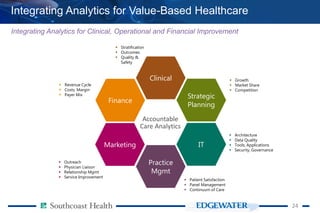
Integrating Analytics for Value-Based Healthcare
Accountable
Care Analytics
Clinical
Strategic
Planning
IT
Practice
Mgmt
Marketing
Finance
 Revenue Cycle
 Costs, Margin
 Payer Mix
 Stratification
 Outcomes
 Quality &
Safety
 Growth
 Market Share
 Competition
 Architecture
 Data Quality
 Tools, Applications
 Security, Governance
 Patient Satisfaction
 Panel Management
 Continuum of Care
 Outreach
 Physician Liaison
 Relationship Mgmt
 Service Improvement
Integrating Analytics for Clinical, Operational and Financial Improvement
2525
Questions?
Thank You!
2626
Dave Hegarty
Healthcare Business Development
Phone: 781-213-9864
Email: dhegarty@edgewater.com
Contact Us …
If you would like to see a demo of any of our analytics applications, please contact:

Integrating Analytics for Value-Based Healthcare

  • 1.
    Integrating Analytics forValue-Based Healthcare Joshua McHale Maury DePalo
  • 2.
    22 Today’s Topic … PopulationHealth Analytics • Current Climate and Challenges - Program Objectives • Driving Needs for Focused Analytics - to Improve Clinical and Financial Performance • Mobilizing by Process Implementation & Improvement Data Integration Challenges • Enterprise Data Architecture • Primary Components – Data Sourcing, Transformation, Delivery • End-User Data Navigation Model – Integrated Data Repository Business Intelligence and Data Exploration • Empowering the End-User Experience – Examples • Action-Oriented Performance Measures Moving Forward • Risk and Alternative Quality Contracts • Reducing Clinical Variation • Mobilizing for Value-Based Care Q & A
  • 3.
    33 Population Health Analytics CurrentBusiness Climate & Challenges • Relentless Pressures on Quality  Outcomes  Costs • Need for Innovation in Care Delivery, Coordination, Risk Sharing, Cost Control • Massachusetts Health Policy Commission – Phase 2 of Community Health Acceleration, Revitalization, and Transformation investment program (CHART-2) • Enhance delivery of efficient, effective care at community hospitals • Promote care coordination, integration, delivery transformation • Advance EHR adoption  information exchange among providers • Increase adoption of alternative payment models  accountable care organizations • Enhance patient safety  coordination between hospitals and community-based providers • Leveraging resources of community partners • Focus on Pressing Healthcare Needs in Local Communities • Targeted At-Risk Populations  Behavioral Health; Diabetes • High Utilizers  > 4 Inpatient Admissions; > 10 Emergency Room Visits • Improve Coordination and Access to Care • Improve engagement of high-risk diabetes patients  incorporate into care management programs  development of disease management registries
  • 4.
    44 Population Health Analytics DrivingNeeds for Focused Analytics to Improve Clinical & Financial Performance • Identify & Characterize Key Targeted Patient Populations • At Risk Populations, Preventive Care, Patient Experience • Identify Targets for Intervention & Improvement Programs • Patient, Diagnosis • Provider, Service Utilization, Care Coordination • Track Quality and Financial Performance Metrics Against Baselines & Targets • Individual and Aggregate Measures – Drill-Down on Quality & Financial Performance • Individual Patients – Individual Providers • Aggregate Providers – Aggregate Care Teams – Aggregate Practice Groups / Locations • Track Attributed Populations Defined Under Risk Performance Contracts • Track Response to Programs – Defined Quality Measures • Track Assignment Consistency – Care Plan Compliance • Disseminate Standards of Care Across Care Teams & Settings • Track Variation in Outcomes, Utilization, Costs
  • 5.
    55 Population Health Analytics IntegratingCare Planning – Execution on Focused Patient Cohorts •Examine Performance Contracts – Patient Mix, Service Mix •Establish Baseline Measures and Set Patient Goals •Begin Care Plan Activities •Monitor Adherence according to Care Plan & Schedule •Track Quality and Financial Metrics •Measure Results of Individual Patients & Evaluate Impact of Program on Overall Population •Adjust Accordingly & Schedule Follow-ups •Design Care Plans & Interventions – Activities, Observations & Measures •Assign Patients to Tailored Care Plans Consistent with Goals for Overall Population •Identify Partner Providers for Outreach and Coordinating Care •Identify Patients Targeted for Intervention - Define Cohorts •Stratify Patients Based on Clinical or Financial Risk or Operational Resource Demands •Target Specific Interventions Identify & Stratify Design & Assign Execute & Monitor Evaluate & Adjust
  • 6.
    66 Achieving Value-Based AccountableCare Pursuing a Staged Implementation – Success Factors at Each Stage Patient Panel Definition Targeted Populations & Outcomes Baseline Expenditures & Costs Accountability Models Financial Reconciliation Population Health Management  Identify Unique Patients  Assemble Records of Clinical Care  Define Bundles  Identify Unique Providers  Align Patients & Providers  Measure / Manage Care Delivery  Measure / Manage Care Relationships  Patient Panel Analytics  Defined Patients, Beneficiaries or Members  Segmentation  Outcomes: Clinical, Operational, Financial  Identify ACO Parties & Roles  Performance Targets & Metrics  Targeted Care Plans  EBM Guidelines for Required Care for Patient Needs  Historical Baselines  Align Patient with Provider Entity  Align Provider with ACO Entity  Calculate Service Fees & Savings Targets  Hierarchical Segmentation & Aggregation  Anticipated Services, Charges & Costs  Collaborative Care Delivery Models  Transitions in Care  Communications, Handoffs, Follow-ups  Contracts, Roles, Responsibilities  Shared Metrics, Benefits & Risks  Retrospective Payments  Shared Savings & Costs  Value Realization  Allocated Gains (Losses)  Billing & Payment Distribution  Compliance & Adherence Targets  Patient Stratification  Comparative Outcomes & Quality Metrics  Prospective & Bundled Payment Models  Predictive Risk Modeling  Performance Optimization  Market Share & Competitive Analytics
  • 7.
    77 Population Health Analytics HealthSystems Need to Know … How do we manage patient cohorts more systematically? How do we better integrate and focus our care delivery across these populations & care settings? Population Health Management Do we understand our charges, payments and costs? Are we reconciling these with our care plans and our accountability models? Financial Reconciliation How do we implement & measure accountability across our ACO partnerships? Where and by whom are value and costs introduced into our delivery processes? Accountability Models What are our baseline expenditures & care delivery costs on these targets, with this payer? How do these align with our contract terms across payer types? Baseline Expenditures & Costs What are our current targets for patients & outcomes? What quality / results are we seeing? Are they consistent? Where do we see under- or over-performance? Targeted Populations & Outcomes Who are our patients? What treatments are they receiving? What other providers are they seeing? At what locations? With what frequency? Patient Panel Definition
  • 8.
    88 Data Integration Challenges WeNeed Visibility Into … - Demographics - History - Reported Outcomes - Location - Specialty - Relationships - Location - Care Team - Structure - Locations - Legal Entity - Contracts -Care Mgmt Teams - Inpatient - Outpatient - Pharmacy - Beneficiary History - Payers - Charges, Payments & Adjustments - Costs - Margin - Risk Contracts - Diagnosis - ChronicConditions - Labs & Results - Procedures & Medications - Quality - Appts - Scheduling - Utilization & Throughput - DRG - Location
  • 9.
    99 Enterprise Data Architecture DataIntegration&Transformation PatientPanel Analytics Targeted Populations & Outcomes Baseline Expenditures & Costs Accountability Models Financial Reconciliation Population Health Management Dashboards & Analytic Views Contract Measures Performance Summary Baseline Expenditure Provider Profile EMR Billing Provider Master Health System Payers Claims DataAccess–Navigation&Security Reports Patient Capture Integration and Transformation Consumption Extensible Data Architecture Standard Data Models MPI Coding Members Provider Claim Reference Other Master Data Encounter Location
  • 10.
    1010 Data Integration Challenges DataFrom Multiple Source Systems of Record and Points of Origin • Differing Formats and Semantics • Inconsistent Taxonomies • Differing Data Granularities Technical Challenges • Timing and Granularity Differences and Conflicts • Access to data stored in the cloud • Positioning for Big Data Opportunities End-User Experience • Consistent but Responsive (Variable, Tailorable) Experience • Power User vs. Ease of Use • Education on Source, Meaning and Veracity of Data Elements Data Governance • Lack of consistent Enterprise-wide definitions • Different groups use similar terminology for different data and meanings Evolving Needs for Focused Analytics – Driving Clinical and Financial Performance
  • 11.
    1111 End-User Experience –Navigating Complex Data Spaces Patient Organization Provider Location Contracts Payer Claims Payments Encounter Charges Costs Diagnosis Treatments Chronic Condition Disease Group Procedures Medications Margin Events Data Navigation Model …
  • 12.
    1212 End-User Experience –Empowering Analytics Navigating Multi-Dimensional Data Spaces Intuitive & Flexible Navigation of Multi-Source Data Spaces • Data Integrated from Numerous Sources – Network Data Model • High-Performance Interactive UI – Free Navigation Across Subject Areas
  • 13.
    1313 End-User Experience –Empowering Analytics Empowering the End-User with Context-Informed Search …
  • 14.
    1414 Moving Forward –Risk and Population Focused Quality Contracts 0 20 40 60 80 100 120 140 160 Year 1 Year 2 Year 3 Year 4 Year 5 PERFORMANCEAGAINSTBASELINE CONTRACT PERFORMANCE YEAR Performance CPI Efficiency Baseline Value Axis Patient Count ... { Contract Performance } - { Aggregate Population } - { Segment by Quality Measures, Cost Components } Segmentation Population Segments, Quality Measures, Cost Components, ... Savings Elements
  • 15.
    1515 Risk and PopulationFocused Quality Contracts Population Composition 0 20 40 60 80 100 120 140 160 180 2008-Q2 2008-Q4 2009-Q2 2009-Q4 2010-Q2 PATIENTCOUNT DATE OF OBSERVATION Diabetes PreDiabetes Normal Value Axis Patient Count ... { Population Composition } - { Diabetes } - { Disease Severity Cohort } Color Axis Disease Severity ... Disease Severity
  • 16.
    1616 0 2000 4000 6000 8000 10000 12000 14000 16000 4.8 5.0 5.2 5.4 5.6 5.8 6.0 6.2 6.4 6.6 6.8 7.0 7.2 7.4 7.6 7.8 8.0 8.2 8.4 8.6 8.8 9.0 9.2 9.4 9.6 9.8 10.0 10.2 10.4 10.6 10.8 11.0 PATIENTCOUNT HB A1C- MOST RECENT OBSERVATION PER PATIENT Poor Good Excellent { Population Composition - Distribution Analysis } – { Diabetes } – { Disease Severity Cohort } Adherence to Care Plan Value Axis Color Axis Patient Count ... Adherence to Care Plan ... Category Axis Hb A1c - Most Recent Observed Value Risk and Population Focused Quality Contracts Population Composition – Distribution Analysis
  • 17.
    1717 Risk and PopulationFocused Quality Contracts Population Composition – Distribution Analysis 0 2000 4000 6000 8000 10000 12000 14000 16000 1.0 2.0 3.0 4.0 5.0 6.0 7.0 8.0 9.0 10.0 11.0 12.0 13.0 14.0 15.0 16.0 17.0 18.0 19.0 20.0 21.0 22.0 23.0 24.0 25.0 26.0 27.0 28.0 29.0 30.0 31.0 32.0 PATIENTCOUNT NUMBER OF MONTHS ENROLLED ON INTERVENTION CARE PLAN Unfavorable No Change Favorable { Population Composition – Distribution Analysis } - { Diabetes } - { Time on Care Plan Cohort } Response to Care Plan Value Axis Color Axis Category Axis Patient Count ... Response to Care Plan ... Number of Months Enrolled on Intervention Care Plan
  • 18.
    1818 Reducing Clinical Variation Procedure/ Treatment: • Current Treatment • Prior Treatments • Response • Adverse Events Disease Condition: • Diagnosis • Complications / Comorbidities • Demographic / Socio-Econ Operations / Utilization: • Service Utilization • Resource Utilization • Fac / Lab / Mat / Equip • Care Planning / Mgmt, Pathways Financial: • Revenue & Cost • Profitability • Payers & Contracts Quality: • Clinical Outcomes • Patient Satisfaction • Process Adherence Measures: • HbA1c, Mortality, QOL, Patient Satisfaction, HAC, Infection • LOS, Resource Util, Service Util • Reimbursement, Costs of Care • # Encounters, Care Settings, Duration Between Encounters • Care Plan Adherence
  • 19.
    1919 Reducing Clinical Variation 0 50 100 150 200 250 300 11.5 2 2.5 3 3.5 4 4.5 5 5.5 6 6.5 7 7.5 8 TotalNumberofCases Avg LOS per Case Rotator Cuff Repair: Distribution of Avg LOS by Surgeon Hockensmith Hunnicutt Sexton Roderick Endicott
  • 20.
    2020 Reducing Clinical Variation 0 50 100 150 200 250 300 11.5 2 2.5 3 3.5 4 4.5 5 5.5 6 6.5 7 7.5 8 TotalNumberofCases Avg LOS per Case Rotator Cuff Repair: Distribution of Avg LOS by Surgeon Hockensmith Hunnicutt Sexton Roderick Endicott 0 20 40 60 80 100 120 140 160 1 1.5 2 2.5 3 3.5 4 4.5 5 5.5 6 6.5 7 7.5 8 TotalNumberofCases Avg LOS per Case Rotator Cuff Repair: Distribution of Avg LOS by Surgeon Hockensmith Hunnicutt Sexton Roderick Endicott
  • 21.
  • 22.
    2222 Mobilizing for Value-BasedCare Workflows Integrate Data Capture, Care Delivery, Communications & Shared Metrics  Physician Office  Other Care Settings Integrated Database & HIE Patient Registries & Analytics, Financial & Quality Measures Workflow Triggers, Alerts & Escalation  Patient Registration, Scheduling  Call Center  Patient Home  Web Access Assessment & Stratification  Individualized Care Plan  Discharge  Progress Review Labs EMRs Quality Performance Improvement  Phone  Outreach Workflow Mgmt Data Sharing Patient Engagement Care Plans Practice Mgmt Cost of Care
  • 23.
    2323 Achieving Value-Based AccountableCare A Business Intelligence & Change Management Platform Patient Panel Definition Targeted Populations & Outcomes Baseline Expenditures & Costs Accountability Models Financial Reconciliation Population Health Management Integrated Data Platform Changes to Processes & Operations Changing Business Models Population & Practice Models
  • 24.
    2424 Integrating Analytics forValue-Based Healthcare Accountable Care Analytics Clinical Strategic Planning IT Practice Mgmt Marketing Finance  Revenue Cycle  Costs, Margin  Payer Mix  Stratification  Outcomes  Quality & Safety  Growth  Market Share  Competition  Architecture  Data Quality  Tools, Applications  Security, Governance  Patient Satisfaction  Panel Management  Continuum of Care  Outreach  Physician Liaison  Relationship Mgmt  Service Improvement Integrating Analytics for Clinical, Operational and Financial Improvement
  • 25.
  • 26.
    2626 Dave Hegarty Healthcare BusinessDevelopment Phone: 781-213-9864 Email: dhegarty@edgewater.com Contact Us … If you would like to see a demo of any of our analytics applications, please contact: