Best Practices for a FAR 15
Procurement
PART 1 – DEVELOPING THE SOLICITATION
Agenda
 Reviewing Customer Requirements
 Developing Evaluation Criteria
 Proposal Preparation Instructions
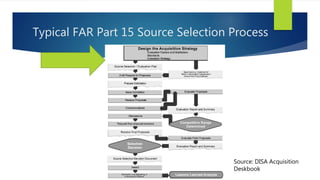
Typical FAR Part 15 Source Selection Process
Source: DISA Acquisition
Deskbook
Reviewing Customer Requirements
 Review the requirements and determine what it is the customer wants
 Set up Acquisition Team
 Subject matter experts
 Technical writers
 End users
 Financial branch
 Contracting
Exchanges with Industry
 FAR 15.201 Encourages agencies to promote early exchanges with industry prior
to receipt of proposals
 This can help clarify the contract requirements
 Interested parties are: potential offerors, end users, government acquisition and
support personnel
Information exchanged with interested
parties
 The following information can be exchanged with an interested party
 Acquisition strategy
 Proposed contract type
 Contract Terms and Conditions
 Acquisition planning schedules
 Data requirements
 Proposal instructions and potential evaluation factors
 Approach for processing past performance
Examples of Exchanges with Industry
 There are several ways contracting can engage with industry
 Industry or small business conference
 One on one meetings with potential offerors
 Public hearings
 Market research
 Pre-solicitation notice
 Draft RFP
 Industry day for requirement (Pre-Proposal Conferences)
 Site Visits
 Requests for Information (RFIs)
Market Research
 FAR requires market research for all procurements
 Key to determining if item is commercial or non-commercial
 Research contract types applicable to requirement
 Contact other agencies for lessons learned in purchasing the requirement
 Review evaluation factors used in similar procurements
Factors and Subfactors
 Factor: specific characteristics that are tied to significant requirements that will
have an impact on the selection of an offeror
 Subfactor: Descriptive elements of a principal factor. The subfactors should be
relevant to the selection of an offeror
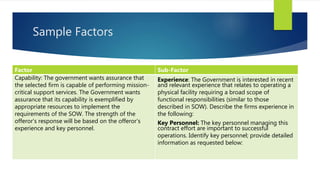
Sample Factors
Factor Sub-Factor
Capability: The government wants assurance that
the selected firm is capable of performing mission-
critical support services. The Government wants
assurance that its capability is exemplified by
appropriate resources to implement the
requirements of the SOW. The strength of the
offeror’s response will be based on the offeror’s
experience and key personnel.
Experience: The Government is interested in recent
and relevant experience that relates to operating a
physical facility requiring a broad scope of
functional responsibilities (similar to those
described in SOW). Describe the firms experience in
the following:
Key Personnel: The key personnel managing this
contract effort are important to successful
operations. Identify key personnel; provide detailed
information as requested below:
Developing Evaluation Criteria
 Use adjective scores rather than numerical scores
 Too many factors and technical factors will cause confusion
 If it is not meaningful to the outcome of the source selection – leave the factor
out
 Cannot be vague or ambiguous
Required Evaluation Factors
 FAR 15.304 (c)
 (1) Price or cost to the Government shall be evaluated in every source selection (10
U.S.C. 2305(a)(3)(A) (ii) and 41 U.S.C. 3306(c)(1)(B)) (also see Part 36 for architect-
engineer contracts).
 (2) The quality of the product or service shall be addressed in every source selection
through consideration of one or more non-cost evaluation factors such as past
performance, compliance with solicitation requirements, technical excellence,
management capability, personnel qualifications, and prior experience (10 U.S.C.
2305(a)(3)(A)(i) and 3306(c)(1)(A).
 (3) (i) Except as set forth in paragraph (c)(3)(iii) of this section, past performance shall
be evaluated in all source selections for negotiated competitive acquisitions
expected to exceed the simplified acquisition threshold.
Proposal Evaluation
 FAR 15.305 (a) Proposal evaluation is an assessment of the proposal and the
offeror’s ability to perform the prospective contract successfully. An agency shall
evaluate competitive proposals and then assess their relative qualities solely on
the factors and subfactors specified in the solicitation. Evaluations may be
conducted using any rating method or combination of methods, including color
or adjectival ratings, numerical weights, and ordinal rankings. The relative
strengths, deficiencies, significant weaknesses, and risks supporting proposal
evaluation shall be documented in the contract file.
Rating Methods
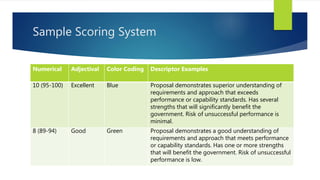
 There are three methods for rating proposals
 Numerical (95-100, 89-94, 83-88, 77-82, less than 77)
 Adjectival (Excellent, good, satisfactory, marginal, unsatisfactory)
 Color Coding (Blue, Green, Yellow, Amber, Red)
Sample Scoring System
Numerical Adjectival Color Coding Descriptor Examples
10 (95-100) Excellent Blue Proposal demonstrates superior understanding of
requirements and approach that exceeds
performance or capability standards. Has several
strengths that will significantly benefit the
government. Risk of unsuccessful performance is
minimal.
8 (89-94) Good Green Proposal demonstrates a good understanding of
requirements and approach that meets performance
or capability standards. Has one or more strengths
that will benefit the government. Risk of unsuccessful
performance is low.
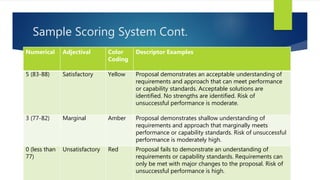
Sample Scoring System Cont.
Numerical Adjectival Color
Coding
Descriptor Examples
5 (83-88) Satisfactory Yellow Proposal demonstrates an acceptable understanding of
requirements and approach that can meet performance
or capability standards. Acceptable solutions are
identified. No strengths are identified. Risk of
unsuccessful performance is moderate.
3 (77-82) Marginal Amber Proposal demonstrates shallow understanding of
requirements and approach that marginally meets
performance or capability standards. Risk of unsuccessful
performance is moderately high.
0 (less than
77)
Unsatisfactory Red Proposal fails to demonstrate an understanding of
requirements or capability standards. Requirements can
only be met with major changes to the proposal. Risk of
unsuccessful performance is high.
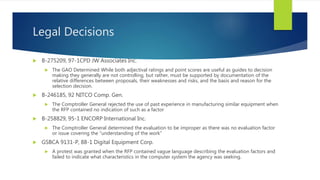
Legal Decisions
 B-275209, 97-1CPD JW Associates Inc.
 The GAO Determined While both adjectival ratings and point scores are useful as guides to decision
making they generally are not controlling, but rather, must be supported by documentation of the
relative differences between proposals, their weaknesses and risks, and the basis and reason for the
selection decision.
 B-246185, 92 NITCO Comp. Gen.
 The Comptroller General rejected the use of past experience in manufacturing similar equipment when
the RFP contained no indication of such as a factor
 B-258829, 95-1 ENCORP International Inc.
 The Comptroller General determined the evaluation to be improper as there was no evaluation factor
or issue covering the “understanding of the work”
 GSBCA 9131-P, 88-1 Digital Equipment Corp.
 A protest was granted when the RFP contained vague language describing the evaluation factors and
failed to indicate what characteristics in the computer system the agency was seeking.
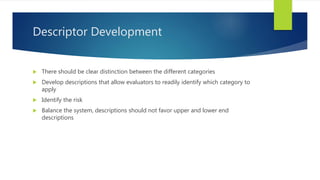
Descriptor Development
 There should be clear distinction between the different categories
 Develop descriptions that allow evaluators to readily identify which category to
apply
 Identify the risk
 Balance the system, descriptions should not favor upper and lower end
descriptions
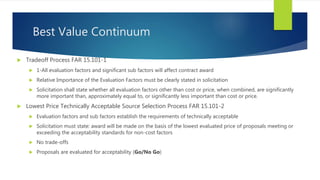
Best Value Continuum
 Tradeoff Process FAR 15.101-1
 1-All evaluation factors and significant sub factors will affect contract award
 Relative Importance of the Evaluation Factors must be clearly stated in solicitation
 Solicitation shall state whether all evaluation factors other than cost or price, when combined, are significantly
more important than, approximately equal to, or significantly less important than cost or price.
 Lowest Price Technically Acceptable Source Selection Process FAR 15.101-2
 Evaluation factors and sub factors establish the requirements of technically acceptable
 Solicitation must state: award will be made on the basis of the lowest evaluated price of proposals meeting or
exceeding the acceptability standards for non-cost factors
 No trade-offs
 Proposals are evaluated for acceptability (Go/No Go)
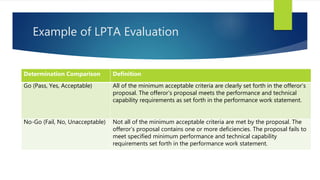
Example of LPTA Evaluation
Determination Comparison Definition
Go (Pass, Yes, Acceptable) All of the minimum acceptable criteria are clearly set forth in the offeror’s
proposal. The offeror’s proposal meets the performance and technical
capability requirements as set forth in the performance work statement.
No-Go (Fail, No, Unacceptable) Not all of the minimum acceptable criteria are met by the proposal. The
offeror’s proposal contains one or more deficiencies. The proposal fails to
meet specified minimum performance and technical capability
requirements set forth in the performance work statement.
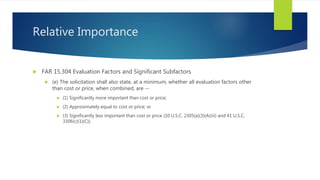
Relative Importance
 FAR 15.304 Evaluation Factors and Significant Subfactors
 (e) The solicitation shall also state, at a minimum, whether all evaluation factors other
than cost or price, when combined, are --
 (1) Significantly more important than cost or price;
 (2) Approximately equal to cost or price; or
 (3) Significantly less important than cost or price (10 U.S.C. 2305(a)(3)(A)(iii) and 41 U.S.C.
3306(c)(1)(C)).
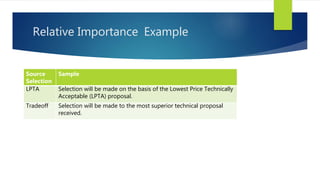
Relative Importance Example
Source
Selection
Sample
LPTA Selection will be made on the basis of the Lowest Price Technically
Acceptable (LPTA) proposal.
Tradeoff Selection will be made to the most superior technical proposal
received.
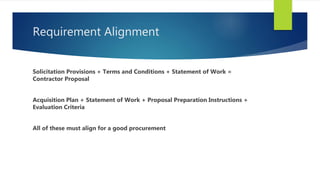
Requirement Alignment
Solicitation Provisions + Terms and Conditions + Statement of Work =
Contractor Proposal
Acquisition Plan + Statement of Work + Proposal Preparation Instructions +
Evaluation Criteria
All of these must align for a good procurement
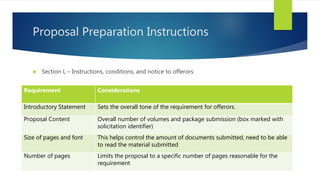
Proposal Preparation Instructions
 Section L – Instructions, conditions, and notice to offerors
Requirement Considerations
Introductory Statement Sets the overall tone of the requirement for offerors.
Proposal Content Overall number of volumes and package submission (box marked with
solicitation identifier)
Size of pages and font This helps control the amount of documents submitted, need to be able
to read the material submitted
Number of pages Limits the proposal to a specific number of pages reasonable for the
requirement
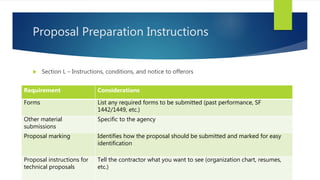
Proposal Preparation Instructions
 Section L – Instructions, conditions, and notice to offerors
Requirement Considerations
Forms List any required forms to be submitted (past performance, SF
1442/1449, etc.)
Other material
submissions
Specific to the agency
Proposal marking Identifies how the proposal should be submitted and marked for easy
identification
Proposal instructions for
technical proposals
Tell the contractor what you want to see (organization chart, resumes,
etc.)
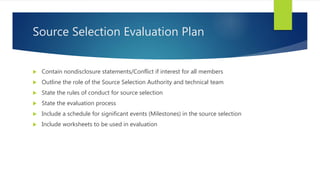
Source Selection Evaluation Plan
 Contain nondisclosure statements/Conflict if interest for all members
 Outline the role of the Source Selection Authority and technical team
 State the rules of conduct for source selection
 State the evaluation process
 Include a schedule for significant events (Milestones) in the source selection
 Include worksheets to be used in evaluation
Legal Decisions
 B-184825, 76-1 Grey Advertising
 While point scores, technical evaluation narratives, and adjectival ratings may well be
indicative of whether one proposal is technical superior to another and should therefore be
considered by source selection officials, we have recognized that selection officials are not
bound by the recommendations made by the evaluation and advisory groups,
 B-207847, 83-1 CRC Sys., Inc.
 Comptroller General agreed the SSA lowered the evaluation team’s score of a protestor
because the protestor’s offer did not meet all the request for proposal requirements
 B-259857.2, 95-2 Loral Aeronautronic
 Comptroller General agreed when the SSA acted reasonably and consistent with the
evaluation scheme, changed the risk assessment of an awardee from medium to low and
increased another awardee rating from satisfactory to exceptional

Best practices for a far 15 procurement part 1

  • 1.
    Best Practices fora FAR 15 Procurement PART 1 – DEVELOPING THE SOLICITATION
  • 2.
    Agenda  Reviewing CustomerRequirements  Developing Evaluation Criteria  Proposal Preparation Instructions
  • 3.
    Typical FAR Part15 Source Selection Process Source: DISA Acquisition Deskbook
  • 4.
    Reviewing Customer Requirements Review the requirements and determine what it is the customer wants  Set up Acquisition Team  Subject matter experts  Technical writers  End users  Financial branch  Contracting
  • 5.
    Exchanges with Industry FAR 15.201 Encourages agencies to promote early exchanges with industry prior to receipt of proposals  This can help clarify the contract requirements  Interested parties are: potential offerors, end users, government acquisition and support personnel
  • 6.
    Information exchanged withinterested parties  The following information can be exchanged with an interested party  Acquisition strategy  Proposed contract type  Contract Terms and Conditions  Acquisition planning schedules  Data requirements  Proposal instructions and potential evaluation factors  Approach for processing past performance
  • 7.
    Examples of Exchangeswith Industry  There are several ways contracting can engage with industry  Industry or small business conference  One on one meetings with potential offerors  Public hearings  Market research  Pre-solicitation notice  Draft RFP  Industry day for requirement (Pre-Proposal Conferences)  Site Visits  Requests for Information (RFIs)
  • 8.
    Market Research  FARrequires market research for all procurements  Key to determining if item is commercial or non-commercial  Research contract types applicable to requirement  Contact other agencies for lessons learned in purchasing the requirement  Review evaluation factors used in similar procurements
  • 9.
    Factors and Subfactors Factor: specific characteristics that are tied to significant requirements that will have an impact on the selection of an offeror  Subfactor: Descriptive elements of a principal factor. The subfactors should be relevant to the selection of an offeror
  • 10.
    Sample Factors Factor Sub-Factor Capability:The government wants assurance that the selected firm is capable of performing mission- critical support services. The Government wants assurance that its capability is exemplified by appropriate resources to implement the requirements of the SOW. The strength of the offeror’s response will be based on the offeror’s experience and key personnel. Experience: The Government is interested in recent and relevant experience that relates to operating a physical facility requiring a broad scope of functional responsibilities (similar to those described in SOW). Describe the firms experience in the following: Key Personnel: The key personnel managing this contract effort are important to successful operations. Identify key personnel; provide detailed information as requested below:
  • 11.
    Developing Evaluation Criteria Use adjective scores rather than numerical scores  Too many factors and technical factors will cause confusion  If it is not meaningful to the outcome of the source selection – leave the factor out  Cannot be vague or ambiguous
  • 12.
    Required Evaluation Factors FAR 15.304 (c)  (1) Price or cost to the Government shall be evaluated in every source selection (10 U.S.C. 2305(a)(3)(A) (ii) and 41 U.S.C. 3306(c)(1)(B)) (also see Part 36 for architect- engineer contracts).  (2) The quality of the product or service shall be addressed in every source selection through consideration of one or more non-cost evaluation factors such as past performance, compliance with solicitation requirements, technical excellence, management capability, personnel qualifications, and prior experience (10 U.S.C. 2305(a)(3)(A)(i) and 3306(c)(1)(A).  (3) (i) Except as set forth in paragraph (c)(3)(iii) of this section, past performance shall be evaluated in all source selections for negotiated competitive acquisitions expected to exceed the simplified acquisition threshold.
  • 13.
    Proposal Evaluation  FAR15.305 (a) Proposal evaluation is an assessment of the proposal and the offeror’s ability to perform the prospective contract successfully. An agency shall evaluate competitive proposals and then assess their relative qualities solely on the factors and subfactors specified in the solicitation. Evaluations may be conducted using any rating method or combination of methods, including color or adjectival ratings, numerical weights, and ordinal rankings. The relative strengths, deficiencies, significant weaknesses, and risks supporting proposal evaluation shall be documented in the contract file.
  • 14.
    Rating Methods  Thereare three methods for rating proposals  Numerical (95-100, 89-94, 83-88, 77-82, less than 77)  Adjectival (Excellent, good, satisfactory, marginal, unsatisfactory)  Color Coding (Blue, Green, Yellow, Amber, Red)
  • 15.
    Sample Scoring System NumericalAdjectival Color Coding Descriptor Examples 10 (95-100) Excellent Blue Proposal demonstrates superior understanding of requirements and approach that exceeds performance or capability standards. Has several strengths that will significantly benefit the government. Risk of unsuccessful performance is minimal. 8 (89-94) Good Green Proposal demonstrates a good understanding of requirements and approach that meets performance or capability standards. Has one or more strengths that will benefit the government. Risk of unsuccessful performance is low.
  • 16.
    Sample Scoring SystemCont. Numerical Adjectival Color Coding Descriptor Examples 5 (83-88) Satisfactory Yellow Proposal demonstrates an acceptable understanding of requirements and approach that can meet performance or capability standards. Acceptable solutions are identified. No strengths are identified. Risk of unsuccessful performance is moderate. 3 (77-82) Marginal Amber Proposal demonstrates shallow understanding of requirements and approach that marginally meets performance or capability standards. Risk of unsuccessful performance is moderately high. 0 (less than 77) Unsatisfactory Red Proposal fails to demonstrate an understanding of requirements or capability standards. Requirements can only be met with major changes to the proposal. Risk of unsuccessful performance is high.
  • 17.
    Legal Decisions  B-275209,97-1CPD JW Associates Inc.  The GAO Determined While both adjectival ratings and point scores are useful as guides to decision making they generally are not controlling, but rather, must be supported by documentation of the relative differences between proposals, their weaknesses and risks, and the basis and reason for the selection decision.  B-246185, 92 NITCO Comp. Gen.  The Comptroller General rejected the use of past experience in manufacturing similar equipment when the RFP contained no indication of such as a factor  B-258829, 95-1 ENCORP International Inc.  The Comptroller General determined the evaluation to be improper as there was no evaluation factor or issue covering the “understanding of the work”  GSBCA 9131-P, 88-1 Digital Equipment Corp.  A protest was granted when the RFP contained vague language describing the evaluation factors and failed to indicate what characteristics in the computer system the agency was seeking.
  • 18.
    Descriptor Development  Thereshould be clear distinction between the different categories  Develop descriptions that allow evaluators to readily identify which category to apply  Identify the risk  Balance the system, descriptions should not favor upper and lower end descriptions
  • 19.
    Best Value Continuum Tradeoff Process FAR 15.101-1  1-All evaluation factors and significant sub factors will affect contract award  Relative Importance of the Evaluation Factors must be clearly stated in solicitation  Solicitation shall state whether all evaluation factors other than cost or price, when combined, are significantly more important than, approximately equal to, or significantly less important than cost or price.  Lowest Price Technically Acceptable Source Selection Process FAR 15.101-2  Evaluation factors and sub factors establish the requirements of technically acceptable  Solicitation must state: award will be made on the basis of the lowest evaluated price of proposals meeting or exceeding the acceptability standards for non-cost factors  No trade-offs  Proposals are evaluated for acceptability (Go/No Go)
  • 20.
    Example of LPTAEvaluation Determination Comparison Definition Go (Pass, Yes, Acceptable) All of the minimum acceptable criteria are clearly set forth in the offeror’s proposal. The offeror’s proposal meets the performance and technical capability requirements as set forth in the performance work statement. No-Go (Fail, No, Unacceptable) Not all of the minimum acceptable criteria are met by the proposal. The offeror’s proposal contains one or more deficiencies. The proposal fails to meet specified minimum performance and technical capability requirements set forth in the performance work statement.
  • 21.
    Relative Importance  FAR15.304 Evaluation Factors and Significant Subfactors  (e) The solicitation shall also state, at a minimum, whether all evaluation factors other than cost or price, when combined, are --  (1) Significantly more important than cost or price;  (2) Approximately equal to cost or price; or  (3) Significantly less important than cost or price (10 U.S.C. 2305(a)(3)(A)(iii) and 41 U.S.C. 3306(c)(1)(C)).
  • 22.
    Relative Importance Example Source Selection Sample LPTASelection will be made on the basis of the Lowest Price Technically Acceptable (LPTA) proposal. Tradeoff Selection will be made to the most superior technical proposal received.
  • 23.
    Requirement Alignment Solicitation Provisions+ Terms and Conditions + Statement of Work = Contractor Proposal Acquisition Plan + Statement of Work + Proposal Preparation Instructions + Evaluation Criteria All of these must align for a good procurement
  • 24.
    Proposal Preparation Instructions Section L – Instructions, conditions, and notice to offerors Requirement Considerations Introductory Statement Sets the overall tone of the requirement for offerors. Proposal Content Overall number of volumes and package submission (box marked with solicitation identifier) Size of pages and font This helps control the amount of documents submitted, need to be able to read the material submitted Number of pages Limits the proposal to a specific number of pages reasonable for the requirement
  • 25.
    Proposal Preparation Instructions Section L – Instructions, conditions, and notice to offerors Requirement Considerations Forms List any required forms to be submitted (past performance, SF 1442/1449, etc.) Other material submissions Specific to the agency Proposal marking Identifies how the proposal should be submitted and marked for easy identification Proposal instructions for technical proposals Tell the contractor what you want to see (organization chart, resumes, etc.)
  • 26.
    Source Selection EvaluationPlan  Contain nondisclosure statements/Conflict if interest for all members  Outline the role of the Source Selection Authority and technical team  State the rules of conduct for source selection  State the evaluation process  Include a schedule for significant events (Milestones) in the source selection  Include worksheets to be used in evaluation
  • 27.
    Legal Decisions  B-184825,76-1 Grey Advertising  While point scores, technical evaluation narratives, and adjectival ratings may well be indicative of whether one proposal is technical superior to another and should therefore be considered by source selection officials, we have recognized that selection officials are not bound by the recommendations made by the evaluation and advisory groups,  B-207847, 83-1 CRC Sys., Inc.  Comptroller General agreed the SSA lowered the evaluation team’s score of a protestor because the protestor’s offer did not meet all the request for proposal requirements  B-259857.2, 95-2 Loral Aeronautronic  Comptroller General agreed when the SSA acted reasonably and consistent with the evaluation scheme, changed the risk assessment of an awardee from medium to low and increased another awardee rating from satisfactory to exceptional