Beryllium Treated Blue Sapphires 
Continuing market observations and update 
including the emergence of larger size stones 
Garry DuToit, Jitlapit Thanachakaphad and Kenneth 
Scarratt 
June 25th 
2009 
GIA Laboratory, Bangkok 
Shared by www.BuyGems.org 
Figure 1: A blue sapphire recently examined in the laboratory weighing 22.52ct was determined to contain 
7.50 Ͳ 
9.50 ppma of beryllium by using LAͲICPͲMS. Photo: Suchada Kittayachaiwattana © GIA
Abstract 
This paper, which constitutes a small portion of an onͲgoing project, is an update on the 
presence in the market of beryllium treated blue sapphires, the types of material and their 
identifying characteristics. Five commercial quality (in the 1ct range) beryllium treated blue 
sapphires that are representative of a large parcel recently purchased on the Bangkok 
market are described with details of their chemistry, inclusion scenes and optical data. 
Further, two large 22ct and 53ct beryllium treated blue sapphires that are reportedly 
treated by a different technique are also described. The data reveals several types of start 
material are used for the beryllium treatment of blue sapphires but that in each case there 
are important clues that lead the gemologist toward the nature of the treatment with the 
ultimate test being analysis using LAͲICPͲMS. 
Acknowledgements 
The authors acknowledge with thanks the continued assistance being given to them as this 
project progresses by John Emmett, Terry Coldham and Thawatchai Somjaineuk. 
Introduction 
In 2003 (Emmett, et al., 2003) Emmett discussed (“From our analysis of the impact of 
beryllium diffusion on very dark blue sapphires where [Ti4+] >> [Mg2+], we find that beryllium 
diffusion should produce the condition [Ti4+] > [Mg2+ + Be2+], substantially reducing the 
blue color saturation”) and showed how overͲdark blue sapphires could be lightened to a 
more commercial blue. It is also worthy of note that Emmett (Emmett, 2007) in a memo to 
the “corundum group” (a small group of gemologically minded individuals with a strong 
interest in the chemistry and physics of corundum) and following further research, states 
that the beryllium ppm range required for visible color alteration in blue sapphire is as little as 
between 0.5 and 1.5 ppma (1ppma = 0.45ppmw). 
In July 2003 and again in July 2004 Gemmological Association of All Japan reported to 
members of the Laboratory Manual Harmonization Committee that they seemed to be 
detecting concentrations of Be in some heated blue sapphires (Figure 15). In one instance in 
2004 they reported the amount to be 10 to 35ppmw. However, it was not clear at the time if 
these were intentionally treated along the lines of the Emmett explanation (above) or by some 
other process, or that they were some of the sapphires that had not turned yellow (but 
nevertheless were diffused with Be) during the beryllium treatment processes used to create 
the yellow and padparadscha colors that were the focus of treaters during that period 
(Figure 2). The GAAJ were also at this time using their newly acquired LAͲ ICPͲMS which 
began an era of easier detection of Be and other light elements by gemological 
laboratories. 
DuToit, G., Thanachakaphad, J., Scarratt, K. (2009) Beryllium Treated Blue Sapphires: Continuing market 
observations and
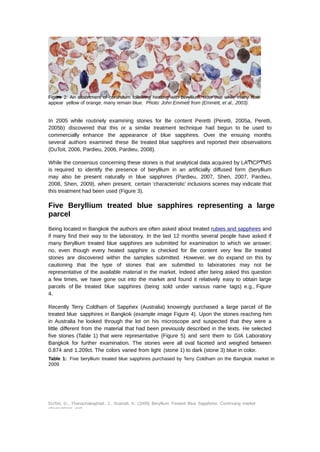
Figure 2: An assortment of corundum following heating with beryllium, note that while many now 
appear yellow of orange, many remain blue. Photo: John Emmett from (Emmett, et al., 2003). 
In 2005 while routinely examining stones for Be content Peretti (Peretti, 2005a, Peretti, 
2005b) discovered that this or a similar treatment technique had begun to be used to 
commercially enhance the appearance of blue sapphires. Over the ensuing months 
several authors examined these Be treated blue sapphires and reported their observations 
(DuToit, 2006, Pardieu, 2006, Pardieu, 2008). 
While the consensus concerning these stones is that analytical data acquired by LAͲICPͲMS 
is required to identify the presence of beryllium in an artificially diffused form (beryllium 
may also be present naturally in blue sapphires (Pardieu, 2007, Shen, 2007, Pardieu, 
2008, Shen, 2009), when present, certain ‘characteristic’ inclusions scenes may indicate that 
this treatment had been used (Figure 3). 
Five Beryllium treated blue sapphires representing a large 
parcel 
Being located in Bangkok the authors are often asked about treated rubies and sapphires and 
if many find their way to the laboratory. In the last 12 months several people have asked if 
many Beryllium treated blue sapphires are submitted for examination to which we answer; 
no, even though every heated sapphire is checked for Be content very few Be treated 
stones are discovered within the samples submitted. However, we do expand on this by 
cautioning that the type of stones that are submitted to laboratories may not be 
representative of the available material in the market. Indeed after being asked this question 
a few times, we have gone out into the market and found it relatively easy to obtain large 
parcels of Be treated blue sapphires (being sold under various name tags) e.g., Figure 
4. 
Recently Terry Coldham of Sapphex (Australia) knowingly purchased a large parcel of Be 
treated blue sapphires in Bangkok (example image Figure 4). Upon the stones reaching him 
in Australia he looked through the lot on his microscope and suspected that they were a 
little different from the material that had been previously described in the texts. He selected 
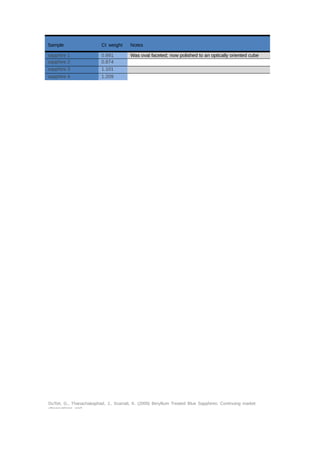
five stones (Table 1) that were representative (Figure 5) and sent them to GIA Laboratory 
Bangkok for further examination. The stones were all oval faceted and weighed between 
0.874 and 1.209ct. The colors varied from light (stone 1) to dark (stone 3) blue in color. 
Table 1: Five beryllium treated blue sapphires purchased by Terry Coldham on the Bangkok market in 
2009 
DuToit, G., Thanachakaphad, J., Scarratt, K. (2009) Beryllium Treated Blue Sapphires: Continuing market 
observations and
Sample Ct weight Notes 
sapphire 1 0.891 Was oval faceted; now polished to an optically oriented cube 
sapphire 2 0.874 
sapphire 3 1.101 
sapphire 4 1.209 
Was oval faceted; now polished to a thin section see Figure 5 
DuToit, G., Thanachakaphad, J., Scarratt, K. (2009) Beryllium Treated Blue Sapphires: Continuing market 
observations and
sapphire 5 0.883 
Figure 3: The web and springͲlike inclusion scene often recorded in Beryllium treated blue 
sapphires. 
Photo Shane McClure @ GIA 
DuToit, G., Thanachakaphad, J., Scarratt, K. (2009) Beryllium Treated Blue Sapphires: Continuing market 
observations and
Figure 4: An image example of Be treated blue sapphires currently on the Bangkok market (photo Terry 
Coldham) 
Figure 5: Five Be treated blue sapphires selected as a representative sample from a larger lot 
purchased in Bangkok in March 2009. They are from left to right 1 (0.891ct), 2 (0.874ct), 3 
(1.101ct), 4 (1.209ct) and 5 (0.883ct). 
Beryllium and other trace element content 
Upon receipt of the five stones (Figure 5) and as these had been sold as Be treated blue 
sapphires, they were firstly analyzed using LAͲICPͲMS. Three spots were chosen at random 
on the girdle of each stone for analysis and the results are set out in Table 1. All of the 
stones were found to contain beryllium, with some spots recording quite high levels. The Be 
levels recorded ranged from 11.77 to 45.15ppma. Other element levels were also recorded 
with Nb and Ta having no concentrations (in stones that contain beryllium naturally the Be 
tends to correlate with the presence of these two elements (and potentially others) which 
is not the case for artificially treated stones (Shen, 2007, Shen, 2009). In comparison with 
the Ti composition relatively high Mg concentrations were recorded for these samples which 
does not fit well with the [Ti4+] > [Mg2+ + Be2+] scenario for lightening dark blue sapphires 
as presented by Emmett (Emmett, et al., 2003) as one of the reasons for treating blue 
sapphires by this method. Indeed the description given of the process amongst traders in 
DuToit, G., Thanachakaphad, J., Scarratt, K. (2009) Beryllium Treated Blue Sapphires: Continuing market 
observations and
Bangkok is 
DuToit, G., Thanachakaphad, J., Scarratt, K. (2009) Beryllium Treated Blue Sapphires: Continuing market 
observations and
that the stones are darkened by the Be treatment and not lightened; something that is 
either reported conjecture or a process we do not presently understand. 
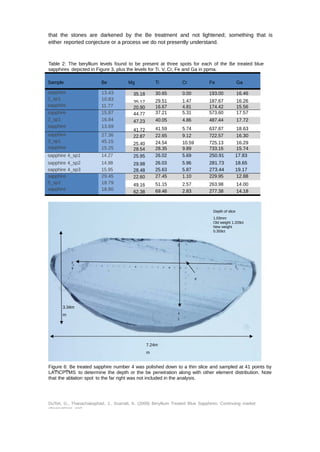
Table 2: The beryllium levels found to be present at three spots for each of the Be treated blue 
sapphires depicted in Figure 3, plus the levels for Ti. V, Cr, Fe and Ga in ppma. 
Sample Be Mg Ti Cr Fe Ga 
sapphire 
1_sp1 
sapphire 
1_sp2 
35.18 30.65 0.00 193.00 16.46 
35.17 29.51 1.47 187.67 16.26 
20.90 16.67 4.81 174.42 15.56 
44.77 37.21 5.31 573.60 17.57 
47.23 40.05 4.86 487.44 17.72 
41.72 41.59 5.74 637.87 18.63 
22.87 22.65 9.12 722.57 16.30 
25.40 24.54 10.59 725.13 16.29 
28.54 28.35 9.89 733.16 15.74 
sapphire 4_sp1 14.27 25.95 26.02 5.69 250.91 17.83 
sapphire 4_sp2 14.98 29.98 26.03 5.96 281.73 18.65 
sapphire 4_sp3 15.95 28.48 25.63 5.87 273.44 19.17 
sapphire 
5_sp1 
sapphire 
5_sp2 
22.60 27.45 1.10 229.95 12.88 
49.16 51.15 2.57 263.98 14.00 
62.38 69.46 2.83 277.38 14.18 
Depth of slice 
1.03mm 
Old weight 1.209ct 
New weight 
0.359ct 
3 
0 
13.43 
10.83 
11.77 
15.87 
16.84 
13.69 
27.36 
45.15 
15.25 
29.45 
18.79 
18.80 
2 
9 1 
9 
sapphire 
2_sp1 
sapphire 
2_sp2 
sapphire 
3_sp1 
sapphire 
3_sp2 
3.34m 
m 4 
1 
7.24m 
m 
Figure 6: Be treated sapphire number 4 was polished down to a thin slice and sampled at 41 points by 
LAͲICPͲMS to determine the depth or the be penetration along with other element distribution. Note 
that the ablation spot to the far right was not included in the analysis. 
DuToit, G., Thanachakaphad, J., Scarratt, K. (2009) Beryllium Treated Blue Sapphires: Continuing market 
observations and
To test the validity of the chemical data obtained at the surface of the faceted stones, and 
realize the penetration depth of the Be used in the process, stone number 4, originally an 
oval faceted stone weighing 1.209ct, was ground down and polished to a thin slice 
without shortening its greatest dimension (Figure 6). The slice was then cleaned in aqua 
regia 1 in preparation for chemical analysis by LAͲICPͲMS. The slice was then analyzed at 
41 points from the edges (girdle, culet and table) to the deepest points within the original 
faced stone (29 points parallel to the original girdle and 12 points from the original table to 
culet). 
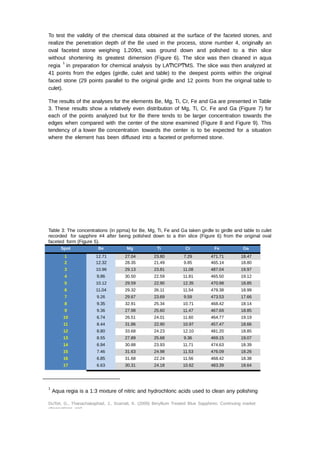
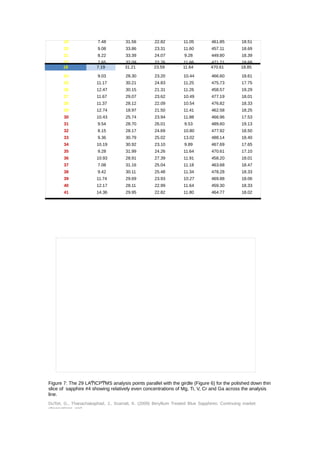
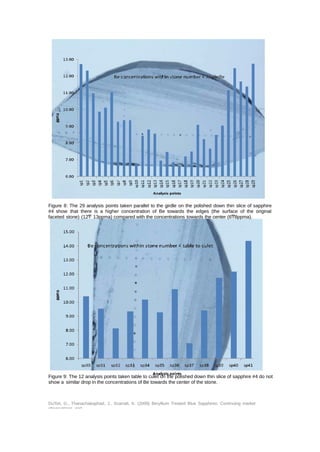
The results of the analyses for the elements Be, Mg, Ti, Cr, Fe and Ga are presented in Table 
3. These results show a relatively even distribution of Mg, Ti, Cr, Fe and Ga (Figure 7) for 
each of the points analyzed but for Be there tends to be larger concentration towards the 
edges when compared with the center of the stone examined (Figure 8 and Figure 9). This 
tendency of a lower Be concentration towards the center is to be expected for a situation 
where the element has been diffused into a faceted or preformed stone. 
Table 3: The concentrations (in ppma) for Be, Mg, Ti, Fe and Ga taken girdle to girdle and table to culet 
recorded for sapphire #4 after being polished down to a thin slice (Figure 6) from the original oval 
faceted form (Figure 5). 
Spot Be Mg Ti Cr Fe Ga 
1 12.71 27.04 23.80 7.29 471.71 18.47 
2 12.32 28.35 21.49 9.85 465.14 18.80 
3 10.96 29.13 23.81 11.08 487.04 19.97 
4 9.86 30.50 22.59 11.81 465.50 19.12 
5 10.12 29.59 22.90 12.35 470.98 18.85 
6 11.04 29.32 26.11 11.54 479.38 18.99 
7 9.26 29.67 23.69 9.59 473.53 17.66 
8 9.35 32.91 25.34 10.71 468.42 18.14 
9 9.36 27.98 25.60 11.47 467.69 18.85 
10 6.74 26.51 24.01 11.60 464.77 19.19 
11 8.44 31.86 22.90 10.97 457.47 18.66 
12 8.80 33.68 24.23 12.10 481.20 18.85 
13 8.55 27.89 25.68 9.36 469.15 19.07 
14 6.94 30.88 23.93 11.71 474.63 18.39 
15 7.46 31.63 24.98 11.53 476.09 18.26 
16 6.85 31.68 22.24 11.56 468.42 18.38 
17 6.63 30.31 24.18 10.62 483.39 18.64 
1 Aqua regia is a 1:3 mixture of nitric and hydrochloric acids used to clean any polishing 
DuToit, G., Thanachakaphad, J., Scarratt, K. (2009) Beryllium Treated Blue Sapphires: Continuing market 
observations and
residues that might interfere with a chemical analysis. 
DuToit, G., Thanachakaphad, J., Scarratt, K. (2009) Beryllium Treated Blue Sapphires: Continuing market 
observations and
19 7.48 31.56 22.82 11.05 461.85 18.51 
20 9.08 33.86 23.31 11.60 457.11 18.69 
21 8.22 33.39 24.07 9.28 449.80 18.39 
22 7.65 32.09 22.76 11.66 471.71 18.68 
23 8.48 32.51 25.08 9.89 464.41 18.52 
24 9.03 28.30 23.20 10.44 466.60 18.61 
25 11.17 30.21 24.83 11.25 475.73 17.75 
26 12.47 30.15 21.31 11.26 458.57 19.29 
27 11.67 29.07 23.62 10.49 477.19 18.01 
28 11.37 28.12 22.09 10.54 476.82 18.33 
29 12.74 18.97 21.50 11.41 462.58 18.25 
30 10.43 25.74 23.94 11.88 466.96 17.53 
31 9.54 28.70 26.01 9.53 489.60 19.13 
32 8.15 28.17 24.69 10.80 477.92 18.50 
33 9.36 30.79 25.02 13.02 488.14 18.40 
34 10.19 30.92 23.10 9.89 467.69 17.65 
35 9.28 31.99 24.26 11.64 470.61 17.10 
36 10.93 28.91 27.39 11.91 458.20 18.01 
37 7.08 31.16 25.04 11.18 463.68 18.47 
38 9.42 30.11 25.48 11.34 478.28 18.33 
39 11.74 29.69 23.93 10.27 469.88 18.06 
40 12.17 28.11 22.99 11.64 459.30 18.33 
41 14.36 29.95 22.82 11.80 464.77 18.02 
18 7.19 31.21 23.59 11.64 470.61 18.85 
Figure 7: The 29 LAͲICPͲMS analysis points parallel with the girdle (Figure 6) for the polished down thin 
slice of sapphire #4 showing relatively even concentrations of Mg, Ti, V, Cr and Ga across the analysis 
line. 
DuToit, G., Thanachakaphad, J., Scarratt, K. (2009) Beryllium Treated Blue Sapphires: Continuing market 
observations and
Figure 8: The 29 analysis points taken parallel to the girdle on the polished down thin slice of sapphire 
#4 show that there is a higher concentration of Be towards the edges (the surface of the original 
faceted stone) (12Ͳ 13ppma) compared with the concentrations towards the center (6Ͳ8ppma). 
Figure 9: The 12 analysis points taken table to culet on the polished down thin slice of sapphire #4 do not 
show a similar drop in the concentrations of Be towards the center of the stone. 
DuToit, G., Thanachakaphad, J., Scarratt, K. (2009) Beryllium Treated Blue Sapphires: Continuing market 
observations and
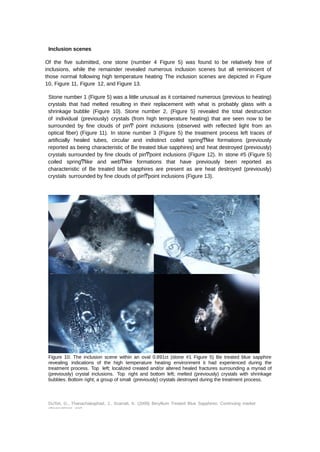
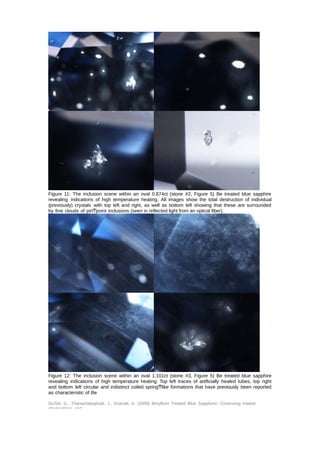
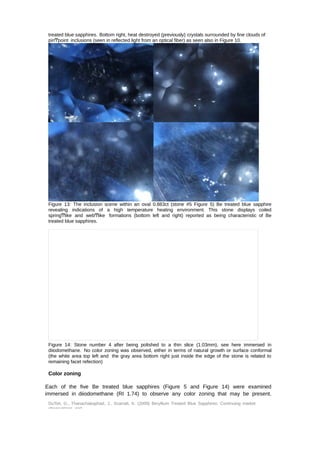
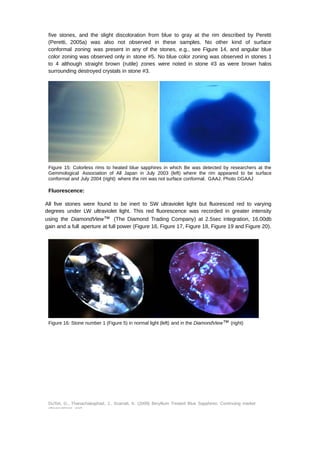
Inclusion scenes 
Of the five submitted, one stone (number 4 Figure 5) was found to be relatively free of 
inclusions, while the remainder revealed numerous inclusion scenes but all reminiscent of 
those normal following high temperature heating The inclusion scenes are depicted in Figure 
10, Figure 11, Figure 12, and Figure 13. 
Stone number 1 (Figure 5) was a little unusual as it contained numerous (previous to heating) 
crystals that had melted resulting in their replacement with what is probably glass with a 
shrinkage bubble (Figure 10). Stone number 2, (Figure 5) revealed the total destruction 
of individual (previously) crystals (from high temperature heating) that are seen now to be 
surrounded by fine clouds of pinͲ point inclusions (observed with reflected light from an 
optical fiber) (Figure 11). In stone number 3 (Figure 5) the treatment process left traces of 
artificially healed tubes, circular and indistinct coiled springͲlike formations (previously 
reported as being characteristic of Be treated blue sapphires) and heat destroyed (previously) 
crystals surrounded by fine clouds of pinͲpoint inclusions (Figure 12). In stone #5 (Figure 5) 
coiled springͲlike and webͲlike formations that have previously been reported as 
characteristic of Be treated blue sapphires are present as are heat destroyed (previously) 
crystals surrounded by fine clouds of pinͲpoint inclusions (Figure 13). 
Figure 10: The inclusion scene within an oval 0.891ct (stone #1 Figure 5) Be treated blue sapphire 
revealing indications of the high temperature heating environment it had experienced during the 
treatment process. Top left; localized created and/or altered healed fractures surrounding a myriad of 
(previously) crystal inclusions. Top right and bottom left; melted (previously) crystals with shrinkage 
bubbles. Bottom right; a group of small (previously) crystals destroyed during the treatment process. 
DuToit, G., Thanachakaphad, J., Scarratt, K. (2009) Beryllium Treated Blue Sapphires: Continuing market 
observations and
Figure 11: The inclusion scene within an oval 0.874ct (stone #2, Figure 5) Be treated blue sapphire 
revealing indications of high temperature heating. All images show the total destruction of individual 
(previously) crystals with top left and right, as well as bottom left showing that these are surrounded 
by fine clouds of pinͲpoint inclusions (seen in reflected light from an optical fiber). 
Figure 12: The inclusion scene within an oval 1.101ct (stone #3, Figure 5) Be treated blue sapphire 
revealing indications of high temperature heating. Top left traces of artificially healed tubes, top right 
and bottom left circular and indistinct coiled springͲlike formations that have previously been reported 
as characteristic of Be 
DuToit, G., Thanachakaphad, J., Scarratt, K. (2009) Beryllium Treated Blue Sapphires: Continuing market 
observations and
treated blue sapphires. Bottom right, heat destroyed (previously) crystals surrounded by fine clouds of 
pinͲpoint inclusions (seen in reflected light from an optical fiber) as seen also in Figure 10. 
Figure 13: The inclusion scene within an oval 0.883ct (stone #5 Figure 5) Be treated blue sapphire 
revealing indications of a high temperature heating environment. This stone displays coiled 
springͲlike and webͲlike formations (bottom left and right) reported as being characteristic of Be 
treated blue sapphires. 
Figure 14: Stone number 4 after being polished to a thin slice (1.03mm), see here immersed in 
diiodomethane. No color zoning was observed, either in terms of natural growth or surface conformal 
(the white area top left and the gray area bottom right just inside the edge of the stone is related to 
remaining facet refection) 
Color zoning 
Each of the five Be treated blue sapphires (Figure 5 and Figure 14) were examined 
immersed in diiodomethane (RI 1.74) to observe any color zoning that may be present. 
DuToit, G., Thanachakaphad, J., Scarratt, K. (2009) Beryllium Treated Blue Sapphires: Continuing market 
observations and
No colorless rims as observed and reported by GAAJ (Kitawaki, 2006) (Figure 15) were 
found to be present in any of the 
DuToit, G., Thanachakaphad, J., Scarratt, K. (2009) Beryllium Treated Blue Sapphires: Continuing market 
observations and
five stones, and the slight discoloration from blue to gray at the rim described by Peretti 
(Peretti, 2005a) was also not observed in these samples. No other kind of surface 
conformal zoning was present in any of the stones, e.g., see Figure 14, and angular blue 
color zoning was observed only in stone #5. No blue color zoning was observed in stones 1 
to 4 although straight brown (rutile) zones were noted in stone #3 as were brown halos 
surrounding destroyed crystals in stone #3. 
Figure 15: Colorless rims to heated blue sapphires in which Be was detected by researchers at the 
Gemmological Association of All Japan in July 2003 (left) where the rim appeared to be surface 
conformal and July 2004 (right) where the rim was not surface conformal. GAAJ. Photo ©GAAJ 
Fluorescence: 
All five stones were found to be inert to SW ultraviolet light but fluoresced red to varying 
degrees under LW ultraviolet light. This red fluorescence was recorded in greater intensity 
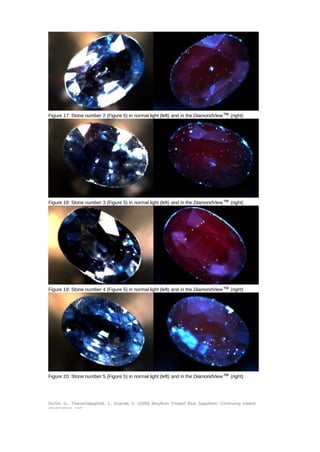
using the DiamondView™ (The Diamond Trading Company) at 2.5sec integration, 16.00db 
gain and a full aperture at full power (Figure 16, Figure 17, Figure 18, Figure 19 and Figure 20). 
Figure 16: Stone number 1 (Figure 5) in normal light (left) and in the DiamondView™ (right) 
DuToit, G., Thanachakaphad, J., Scarratt, K. (2009) Beryllium Treated Blue Sapphires: Continuing market 
observations and
Figure 17: Stone number 2 (Figure 5) in normal light (left) and in the DiamondView™ (right) 
Figure 18: Stone number 3 (Figure 5) in normal light (left) and in the DiamondView™ (right) 
Figure 19: Stone number 4 (Figure 5) in normal light (left) and in the DiamondView™ (right) 
Figure 20: Stone number 5 (Figure 5) in normal light (left) and in the DiamondView™ (right) 
DuToit, G., Thanachakaphad, J., Scarratt, K. (2009) Beryllium Treated Blue Sapphires: Continuing market 
observations and
UV/visible and IR spectroscopy 
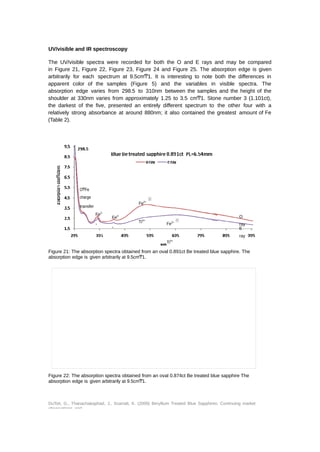
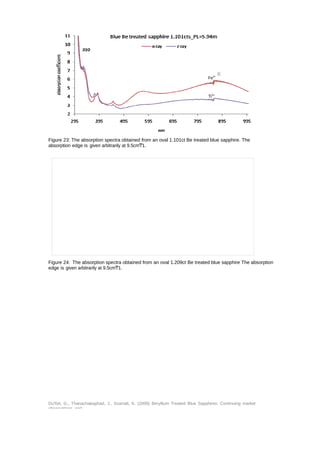
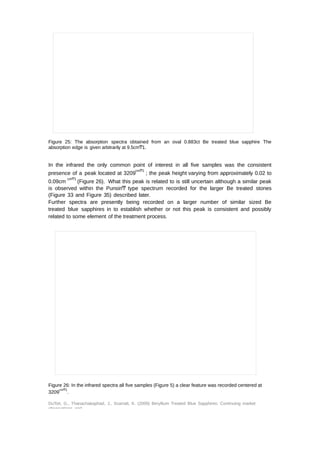
The UV/visible spectra were recorded for both the O and E rays and may be compared 
in Figure 21, Figure 22, Figure 23, Figure 24 and Figure 25. The absorption edge is given 
arbitrarily for each spectrum at 9.5cmͲ1. It is interesting to note both the differences in 
apparent color of the samples (Figure 5) and the variables in visible spectra. The 
absorption edge varies from 298.5 to 310nm between the samples and the height of the 
shoulder at 330nm varies from approximately 1.25 to 3.5 cmͲ1. Stone number 3 (1.101ct), 
the darkest of the five, presented an entirely different spectrum to the other four with a 
relatively strong absorbance at around 880nm; it also contained the greatest amount of Fe 
(Table 2). 
OͲFe 
charge 
transfer 
Fe2+ 
Ti4+ 
Fe3 
+ 
Fe3 
+ 
O 
Fe2+ ray 
Ti4+ 
E 
ray 
Figure 21: The absorption spectra obtained from an oval 0.891ct Be treated blue sapphire. The 
absorption edge is given arbitrarily at 9.5cmͲ1. 
Figure 22: The absorption spectra obtained from an oval 0.874ct Be treated blue sapphire The 
absorption edge is given arbitrarily at 9.5cmͲ1. 
DuToit, G., Thanachakaphad, J., Scarratt, K. (2009) Beryllium Treated Blue Sapphires: Continuing market 
observations and
Fe2+ 
Ti3+ 
Figure 23: The absorption spectra obtained from an oval 1.101ct Be treated blue sapphire. The 
absorption edge is given arbitrarily at 9.5cmͲ1. 
Figure 24: The absorption spectra obtained from an oval 1.209ct Be treated blue sapphire The absorption 
edge is given arbitrarily at 9.5cmͲ1. 
DuToit, G., Thanachakaphad, J., Scarratt, K. (2009) Beryllium Treated Blue Sapphires: Continuing market 
observations and
Figure 25: The absorption spectra obtained from an oval 0.883ct Be treated blue sapphire The 
absorption edge is given arbitrarily at 9.5cmͲ1. 
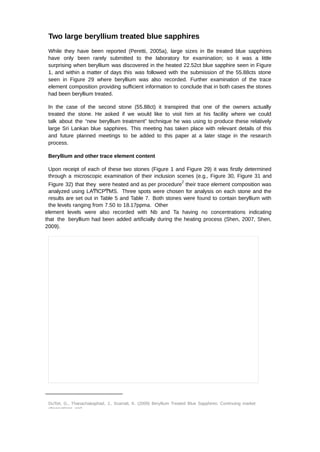
In the infrared the only common point of interest in all five samples was the consistent 
presence of a peak located at 3209cmͲ1 ; the peak height varying from approximately 0.02 to 
0.09cm cmͲ1 (Figure 26). What this peak is related to is still uncertain although a similar peak 
is observed within the PunsiriͲ type spectrum recorded for the larger Be treated stones 
(Figure 33 and Figure 35) described later. 
Further spectra are presently being recorded on a larger number of similar sized Be 
treated blue sapphires in to establish whether or not this peak is consistent and possibly 
related to some element of the treatment process. 
Figure 26: In the infrared spectra all five samples (Figure 5) a clear feature was recorded centered at 
3209cmͲ1. 
DuToit, G., Thanachakaphad, J., Scarratt, K. (2009) Beryllium Treated Blue Sapphires: Continuing market 
observations and
Figure 27: Greater detail of the 3209cmͲ1 in stone numbers 1 and 2. 
Figure 28: Greater detail of the 3209cmͲ1 in stone number 3 showing two small side bands at 3104 and 
3315 cmͲ1. 
DuToit, G., Thanachakaphad, J., Scarratt, K. (2009) Beryllium Treated Blue Sapphires: Continuing market 
observations and
Two large beryllium treated blue sapphires 
While they have been reported (Peretti, 2005a), large sizes in Be treated blue sapphires 
have only been rarely submitted to the laboratory for examination; so it was a little 
surprising when beryllium was discovered in the heated 22.52ct blue sapphire seen in Figure 
1, and within a matter of days this was followed with the submission of the 55.88cts stone 
seen in Figure 29 where beryllium was also recorded. Further examination of the trace 
element composition providing sufficient information to conclude that in both cases the stones 
had been beryllium treated. 
In the case of the second stone (55.88ct) it transpired that one of the owners actually 
treated the stone. He asked if we would like to visit him at his facility where we could 
talk about the “new beryllium treatment” technique he was using to produce these relatively 
large Sri Lankan blue sapphires. This meeting has taken place with relevant details of this 
and future planned meetings to be added to this paper at a later stage in the research 
process. 
Beryllium and other trace element content 
Upon receipt of each of these two stones (Figure 1 and Figure 29) it was firstly determined 
through a microscopic examination of their inclusion scenes (e.g., Figure 30, Figure 31 and 
Figure 32) that they were heated and as per procedure2 their trace element composition was 
analyzed using LAͲICPͲMS. Three spots were chosen for analysis on each stone and the 
results are set out in Table 5 and Table 7. Both stones were found to contain beryllium with 
the levels ranging from 7.50 to 18.17ppma. Other 
element levels were also recorded with Nb and Ta having no concentrations indicating 
that the beryllium had been added artificially during the heating process (Shen, 2007, Shen, 
2009). 
DuToit, G., Thanachakaphad, J., Scarratt, K. (2009) Beryllium Treated Blue Sapphires: Continuing market 
observations and
2 Procedure in such cases requires that heated corundum is analyzed using LAͲICPͲMS 
and that in particular the concentrations for Be, Ta, and Nb are recorded. 
DuToit, G., Thanachakaphad, J., Scarratt, K. (2009) Beryllium Treated Blue Sapphires: Continuing market 
observations and
Figure 29: A 55.88ct beryllium treated blue sapphire. 
Table 4: The Be concentrations (in ppma) in three spots examined on the 55.88ct Be treated blue 
sapphire depicted in Figure 9. Data collected by LAͲICPͲMS 
Sample Be in ppma 
53.88ct Be treated blue sapphire, 
13.00 
spot 1 53.88ct Be treated blue 
17.12 
sapphire, spot 2 53.88ct Be treated 
18.17 
blue sapphire, spot 3 
Table 5: Trace element concentrations (in ppma) in the 55.88ct Be treated blue sapphire depicted in 
Figure 9. Data collected by EDXRF 
Sample Ti V Cr Fe Ga 
53.88ct Be treated blue sapphire 38.3 3.8 0.04 168.07 19.98 
Table 6: The Be concentrations (in ppma) in three spots examined on the 22.52ct Be treated blue 
sapphire depicted in Figure 1. Data collected by LAͲICPͲMS 
Sample Be in ppma 
22.52ct Be treated blue sapphire, 
7.58 
spot 1 22.52ct Be treated blue 
7.65 
sapphire, spot 2 22.52ct Be treated 
9.46 
blue sapphire, spot 3 
Table 7 Trace element concentrations (in ppma) in the 22.52ct Be treated blue sapphire depicted in 
Figure 1. Data collected by EDXRF 
Sample Ti V Cr Fe Ga 
22.52ct Be treated blue sapphire 84.67 3.20 BDL 53.45 21.15 
Their chemistry was also analyzed using EDXRF 3 and the concentrations for Ti, V, Cr, Fe 
and Ga are listed in Table 6 and Table 8 
Inclusion scenes 
Both the 22.52ct and the 53.88ct beryllium treated blue sapphires are relatively clean 
internally. None of the inclusions typical of beryllium treated blue sapphires (Peretti, 2005a, 
Shen, 2007) as depicted in Figure 3, Figure 10, Figure 11, Figure 12 and Figure 13 are 
evident. Figure 30, Figure 31 and Figure 32 depict the only near surface and internal 
features present in the two stones; these features being indicative of heat treatment only. 
3 EDXRF (Energy Dispersive XͲray Fluorescence) is a fast technique used for bulk 
analyses where concentrations of elements Na and above are desired. The same standards 
are used both for EDXRF and LAͲICPͲMS. 
DuToit, G., Thanachakaphad, J., Scarratt, K. (2009) Beryllium Treated Blue Sapphires: Continuing market 
observations and
Figure 30: A surfaceͲbreaking heat altered healed fracture recorded in the he 55.88ct beryllium 
treated blue sapphire depicted in Figure 29. 
Figure 31: Near surface ‘feathering’, a feature often associated with heated sapphires, recorded in the he 
55.88ct beryllium treated blue sapphire depicted in Figure 29. 
DuToit, G., Thanachakaphad, J., Scarratt, K. (2009) Beryllium Treated Blue Sapphires: Continuing market 
observations and
Figure 32: An image of the inclusion scene within the 55.88ct beryllium treated blue sapphire depicted in 
Figure 
29. The stone is relatively clean internally and contained none of the inclusion types depicted in Figure 
10, Figure 11, Figure 12 or Figure 13. 
Fluorescence: 
Contrary to the smaller stones described above both of these large stones were found to be 
inert to LW and SW ultraviolet light. 
UV/visible and IR spectroscopy: 
Given that these two large sapphires are ‘production stones’ rather than ‘research stones’ 
the amount of data collected is limited to the requirements of the report and achieving a 
reliable result. In cases where an identification of the stone (and any treatments) is the 
only requirement the collection of IR spectra is normal procedure, however, unless an origin 
determination is required the collection of UV/visible spectra is not normal. 
For these two large stones the IR spectra were recorded with similar results. In addition to a 
peak at 3209 that is present in the five smaller stones described earlier (Figure 26), these 
large Be treated blue sapphires recorded broad peaks at 3112, 3057 and 2628 (Figure 
33 and Figure 35). These spectra resemble the multiband structure seen in some 
PunsiriͲtype heated blue sapphires recorded in the past (AGTAͲGTC, 2003, AGTAͲGTC, 
2004b, AGTAͲGTC, 2004a). 
DuToit, G., Thanachakaphad, J., Scarratt, K. (2009) Beryllium Treated Blue Sapphires: Continuing market 
observations and
Figure 33: In addition to the peak at 3209 that is present in the five smaller stones described earlier 
(Figure 26), this 22.52ct Be treated blue sapphire has peaks at 3112, 3057 and 2628. Showing a 
strong resemblance to the multiband structure seen in some PunsiriͲtype heated blue sapphires 
recorded in the past and to that of the 53.88ct described herein (Figure 35). 
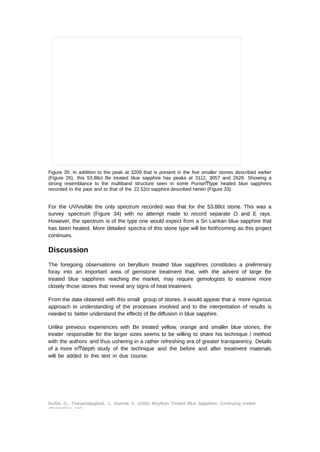
Figure 34: A mixed (O and E) ray spectrum of the 53.88ct beryllium treated blue sapphire depicted in 
Figure 29. The absorption edge at 9.5cmͲ1 is situated at 297nm. 
DuToit, G., Thanachakaphad, J., Scarratt, K. (2009) Beryllium Treated Blue Sapphires: Continuing market 
observations and
Figure 35: In addition to the peak at 3209 that is present in the five smaller stones described earlier 
(Figure 26), this 53.88ct Be treated blue sapphire has peaks at 3112, 3057 and 2628. Showing a 
strong resemblance to the multiband structure seen in some PunsiriͲtype heated blue sapphires 
recorded in the past and to that of the 22.52ct sapphire described herein (Figure 33). 
For the UV/visible the only spectrum recorded was that for the 53.88ct stone. This was a 
survey spectrum (Figure 34) with no attempt made to record separate O and E rays. 
However, the spectrum is of the type one would expect from a Sri Lankan blue sapphire that 
has been heated. More detailed spectra of this stone type will be forthcoming as this project 
continues. 
Discussion 
The foregoing observations on beryllium treated blue sapphires constitutes a preliminary 
foray into an important area of gemstone treatment that, with the advent of large Be 
treated blue sapphires reaching the market, may require gemologists to examine more 
closely those stones that reveal any signs of heat treatment. 
From the data obtained with this small group of stones, it would appear that a more rigorous 
approach to understanding of the processes involved and to the interpretation of results is 
needed to better understand the effects of Be diffusion in blue sapphire. 
Unlike previous experiences with Be treated yellow, orange and smaller blue stones, the 
treater responsible for the larger sizes seems to be willing to share his technique / method 
with the authors and thus ushering in a rather refreshing era of greater transparency. Details 
of a more inͲdepth study of the technique and the before and after treatment materials 
will be added to this text in due course. 
DuToit, G., Thanachakaphad, J., Scarratt, K. (2009) Beryllium Treated Blue Sapphires: Continuing market 
observations and
References 
Shared by BuyGems.org 
Buygems.org http://www.buygems.org 
AGTAͲGTC. (2003) Sapphire Treatment Update. 
AGTAͲGTC. (2004a) AGTA GTC to Issue "Standard Heat Treatment" Reports for Blue 
Sapphires with Unusual Color Distribution. 
AGTAͲGTC. (2004b) Status of Research Related to Blue Sapphires with Unusual 
Color Zoning. http://www.agta Ͳ gtc.org/2004 Ͳ 02 Ͳ 23_bluesapphireresearch.htm . 
DuToit, G., Hughes, R., Koivula, J. (2006) BerylliumͲTreated Blue Sapphires. 
http://www.agtaͲ gtc.org/sapphireͲberyllium.htm. April 2009 
Emmett, J., Scarratt, K., McClure, S.F., Moses, T., Douthit, T.R., Hughes, R., Novak, S., 
Shigley, J.E. and Wang, W., Bordelon, O., Kane, R.E. (2003) Beryllium diffusion of ruby and 
sapphire. Gems and Gemology. 39. 2. 84Ͳ135 
Emmett, J. E., (2007). W. Wang, the Corundum group, Memo to the Corundum Group: How 
much beryllium is too much in blue sapphire – the role of quantitative spectroscopy, 26 August 
2007 
Kitawaki, H., Abduriyim, A. . (2006) Research Lab. Report 2006.06.27 UpͲtoͲdate BeͲdiffused 
Blue Sapphire 
http://www.gaaj Ͳ zenhokyo.co.jp/researchroom/kanbetu/2006/2006_06 Ͳ 01en.html . 
Pardieu, V. (2006) Blue sapphire: Beryllium? AIGS Gemological 
Laboratory. http://www.aigsthailand.com/FieldTripsDetail.aspx?tID=32&lang=TH . 
Pardieu, V. (2007) Discovering beryllium in Madagascar blue sapphires. InColor Magazine. 41 
Pardieu, V. (2008) Nouvelles des travaux sur le béryllium et les saphirs bleus. Revue de 
Gemmologie 
a.f.g. 163. 7Ͳ9 
Peretti, A. (2005a) Report on the occurrence of a BeͲtreated blue sapphire of commercial 
importance (good quality of over 10cts in size) 
http://www.gemresearch.ch/news/Be_Treat/BeTreat.htm . April 2009 
Peretti, A., Gunther, D., . (2005b) The Beryllium Treatment of Natural Fancy Sapphires with a 
New HeatͲTreatment Technique Part A. Contributions to Gemology. 4. 58Ͳ60 
Shen, A., McClure S., Breeding C. M., Scarratt K., Wang W., Smith C., Shigley J. (2007) 
Beryllium in Corundum: The Consequences for Blue Sapphire. GIA Insider. January 26 
Shen, A., McClure, S., Scarratt, K. (2009) Beryllium in Pink and Yellow Sapphires (April 3, 
2009). News from Research. http://www.gia.edu/research Ͳ r esources/news Ͳ from Ͳ 
research/Beryllium%20in%20pink%20and%20yellow%20sapphire%20%2020090401_so 
%20ahs.pdf. 
DuToit, G., Thanachakaphad, J., Scarratt, K. (2009) Beryllium Treated Blue Sapphires: Continuing market 
observations and

Beryllium diffused blue sapphires

  • 1.
    Beryllium Treated BlueSapphires Continuing market observations and update including the emergence of larger size stones Garry DuToit, Jitlapit Thanachakaphad and Kenneth Scarratt June 25th 2009 GIA Laboratory, Bangkok Shared by www.BuyGems.org Figure 1: A blue sapphire recently examined in the laboratory weighing 22.52ct was determined to contain 7.50 Ͳ 9.50 ppma of beryllium by using LAͲICPͲMS. Photo: Suchada Kittayachaiwattana © GIA
  • 2.
    Abstract This paper,which constitutes a small portion of an onͲgoing project, is an update on the presence in the market of beryllium treated blue sapphires, the types of material and their identifying characteristics. Five commercial quality (in the 1ct range) beryllium treated blue sapphires that are representative of a large parcel recently purchased on the Bangkok market are described with details of their chemistry, inclusion scenes and optical data. Further, two large 22ct and 53ct beryllium treated blue sapphires that are reportedly treated by a different technique are also described. The data reveals several types of start material are used for the beryllium treatment of blue sapphires but that in each case there are important clues that lead the gemologist toward the nature of the treatment with the ultimate test being analysis using LAͲICPͲMS. Acknowledgements The authors acknowledge with thanks the continued assistance being given to them as this project progresses by John Emmett, Terry Coldham and Thawatchai Somjaineuk. Introduction In 2003 (Emmett, et al., 2003) Emmett discussed (“From our analysis of the impact of beryllium diffusion on very dark blue sapphires where [Ti4+] >> [Mg2+], we find that beryllium diffusion should produce the condition [Ti4+] > [Mg2+ + Be2+], substantially reducing the blue color saturation”) and showed how overͲdark blue sapphires could be lightened to a more commercial blue. It is also worthy of note that Emmett (Emmett, 2007) in a memo to the “corundum group” (a small group of gemologically minded individuals with a strong interest in the chemistry and physics of corundum) and following further research, states that the beryllium ppm range required for visible color alteration in blue sapphire is as little as between 0.5 and 1.5 ppma (1ppma = 0.45ppmw). In July 2003 and again in July 2004 Gemmological Association of All Japan reported to members of the Laboratory Manual Harmonization Committee that they seemed to be detecting concentrations of Be in some heated blue sapphires (Figure 15). In one instance in 2004 they reported the amount to be 10 to 35ppmw. However, it was not clear at the time if these were intentionally treated along the lines of the Emmett explanation (above) or by some other process, or that they were some of the sapphires that had not turned yellow (but nevertheless were diffused with Be) during the beryllium treatment processes used to create the yellow and padparadscha colors that were the focus of treaters during that period (Figure 2). The GAAJ were also at this time using their newly acquired LAͲ ICPͲMS which began an era of easier detection of Be and other light elements by gemological laboratories. DuToit, G., Thanachakaphad, J., Scarratt, K. (2009) Beryllium Treated Blue Sapphires: Continuing market observations and
  • 3.
    Figure 2: Anassortment of corundum following heating with beryllium, note that while many now appear yellow of orange, many remain blue. Photo: John Emmett from (Emmett, et al., 2003). In 2005 while routinely examining stones for Be content Peretti (Peretti, 2005a, Peretti, 2005b) discovered that this or a similar treatment technique had begun to be used to commercially enhance the appearance of blue sapphires. Over the ensuing months several authors examined these Be treated blue sapphires and reported their observations (DuToit, 2006, Pardieu, 2006, Pardieu, 2008). While the consensus concerning these stones is that analytical data acquired by LAͲICPͲMS is required to identify the presence of beryllium in an artificially diffused form (beryllium may also be present naturally in blue sapphires (Pardieu, 2007, Shen, 2007, Pardieu, 2008, Shen, 2009), when present, certain ‘characteristic’ inclusions scenes may indicate that this treatment had been used (Figure 3). Five Beryllium treated blue sapphires representing a large parcel Being located in Bangkok the authors are often asked about treated rubies and sapphires and if many find their way to the laboratory. In the last 12 months several people have asked if many Beryllium treated blue sapphires are submitted for examination to which we answer; no, even though every heated sapphire is checked for Be content very few Be treated stones are discovered within the samples submitted. However, we do expand on this by cautioning that the type of stones that are submitted to laboratories may not be representative of the available material in the market. Indeed after being asked this question a few times, we have gone out into the market and found it relatively easy to obtain large parcels of Be treated blue sapphires (being sold under various name tags) e.g., Figure 4. Recently Terry Coldham of Sapphex (Australia) knowingly purchased a large parcel of Be treated blue sapphires in Bangkok (example image Figure 4). Upon the stones reaching him in Australia he looked through the lot on his microscope and suspected that they were a little different from the material that had been previously described in the texts. He selected five stones (Table 1) that were representative (Figure 5) and sent them to GIA Laboratory Bangkok for further examination. The stones were all oval faceted and weighed between 0.874 and 1.209ct. The colors varied from light (stone 1) to dark (stone 3) blue in color. Table 1: Five beryllium treated blue sapphires purchased by Terry Coldham on the Bangkok market in 2009 DuToit, G., Thanachakaphad, J., Scarratt, K. (2009) Beryllium Treated Blue Sapphires: Continuing market observations and
  • 4.
    Sample Ct weightNotes sapphire 1 0.891 Was oval faceted; now polished to an optically oriented cube sapphire 2 0.874 sapphire 3 1.101 sapphire 4 1.209 Was oval faceted; now polished to a thin section see Figure 5 DuToit, G., Thanachakaphad, J., Scarratt, K. (2009) Beryllium Treated Blue Sapphires: Continuing market observations and
  • 5.
    sapphire 5 0.883 Figure 3: The web and springͲlike inclusion scene often recorded in Beryllium treated blue sapphires. Photo Shane McClure @ GIA DuToit, G., Thanachakaphad, J., Scarratt, K. (2009) Beryllium Treated Blue Sapphires: Continuing market observations and
  • 6.
    Figure 4: Animage example of Be treated blue sapphires currently on the Bangkok market (photo Terry Coldham) Figure 5: Five Be treated blue sapphires selected as a representative sample from a larger lot purchased in Bangkok in March 2009. They are from left to right 1 (0.891ct), 2 (0.874ct), 3 (1.101ct), 4 (1.209ct) and 5 (0.883ct). Beryllium and other trace element content Upon receipt of the five stones (Figure 5) and as these had been sold as Be treated blue sapphires, they were firstly analyzed using LAͲICPͲMS. Three spots were chosen at random on the girdle of each stone for analysis and the results are set out in Table 1. All of the stones were found to contain beryllium, with some spots recording quite high levels. The Be levels recorded ranged from 11.77 to 45.15ppma. Other element levels were also recorded with Nb and Ta having no concentrations (in stones that contain beryllium naturally the Be tends to correlate with the presence of these two elements (and potentially others) which is not the case for artificially treated stones (Shen, 2007, Shen, 2009). In comparison with the Ti composition relatively high Mg concentrations were recorded for these samples which does not fit well with the [Ti4+] > [Mg2+ + Be2+] scenario for lightening dark blue sapphires as presented by Emmett (Emmett, et al., 2003) as one of the reasons for treating blue sapphires by this method. Indeed the description given of the process amongst traders in DuToit, G., Thanachakaphad, J., Scarratt, K. (2009) Beryllium Treated Blue Sapphires: Continuing market observations and
  • 7.
    Bangkok is DuToit,G., Thanachakaphad, J., Scarratt, K. (2009) Beryllium Treated Blue Sapphires: Continuing market observations and
  • 8.
    that the stonesare darkened by the Be treatment and not lightened; something that is either reported conjecture or a process we do not presently understand. Table 2: The beryllium levels found to be present at three spots for each of the Be treated blue sapphires depicted in Figure 3, plus the levels for Ti. V, Cr, Fe and Ga in ppma. Sample Be Mg Ti Cr Fe Ga sapphire 1_sp1 sapphire 1_sp2 35.18 30.65 0.00 193.00 16.46 35.17 29.51 1.47 187.67 16.26 20.90 16.67 4.81 174.42 15.56 44.77 37.21 5.31 573.60 17.57 47.23 40.05 4.86 487.44 17.72 41.72 41.59 5.74 637.87 18.63 22.87 22.65 9.12 722.57 16.30 25.40 24.54 10.59 725.13 16.29 28.54 28.35 9.89 733.16 15.74 sapphire 4_sp1 14.27 25.95 26.02 5.69 250.91 17.83 sapphire 4_sp2 14.98 29.98 26.03 5.96 281.73 18.65 sapphire 4_sp3 15.95 28.48 25.63 5.87 273.44 19.17 sapphire 5_sp1 sapphire 5_sp2 22.60 27.45 1.10 229.95 12.88 49.16 51.15 2.57 263.98 14.00 62.38 69.46 2.83 277.38 14.18 Depth of slice 1.03mm Old weight 1.209ct New weight 0.359ct 3 0 13.43 10.83 11.77 15.87 16.84 13.69 27.36 45.15 15.25 29.45 18.79 18.80 2 9 1 9 sapphire 2_sp1 sapphire 2_sp2 sapphire 3_sp1 sapphire 3_sp2 3.34m m 4 1 7.24m m Figure 6: Be treated sapphire number 4 was polished down to a thin slice and sampled at 41 points by LAͲICPͲMS to determine the depth or the be penetration along with other element distribution. Note that the ablation spot to the far right was not included in the analysis. DuToit, G., Thanachakaphad, J., Scarratt, K. (2009) Beryllium Treated Blue Sapphires: Continuing market observations and
  • 9.
    To test thevalidity of the chemical data obtained at the surface of the faceted stones, and realize the penetration depth of the Be used in the process, stone number 4, originally an oval faceted stone weighing 1.209ct, was ground down and polished to a thin slice without shortening its greatest dimension (Figure 6). The slice was then cleaned in aqua regia 1 in preparation for chemical analysis by LAͲICPͲMS. The slice was then analyzed at 41 points from the edges (girdle, culet and table) to the deepest points within the original faced stone (29 points parallel to the original girdle and 12 points from the original table to culet). The results of the analyses for the elements Be, Mg, Ti, Cr, Fe and Ga are presented in Table 3. These results show a relatively even distribution of Mg, Ti, Cr, Fe and Ga (Figure 7) for each of the points analyzed but for Be there tends to be larger concentration towards the edges when compared with the center of the stone examined (Figure 8 and Figure 9). This tendency of a lower Be concentration towards the center is to be expected for a situation where the element has been diffused into a faceted or preformed stone. Table 3: The concentrations (in ppma) for Be, Mg, Ti, Fe and Ga taken girdle to girdle and table to culet recorded for sapphire #4 after being polished down to a thin slice (Figure 6) from the original oval faceted form (Figure 5). Spot Be Mg Ti Cr Fe Ga 1 12.71 27.04 23.80 7.29 471.71 18.47 2 12.32 28.35 21.49 9.85 465.14 18.80 3 10.96 29.13 23.81 11.08 487.04 19.97 4 9.86 30.50 22.59 11.81 465.50 19.12 5 10.12 29.59 22.90 12.35 470.98 18.85 6 11.04 29.32 26.11 11.54 479.38 18.99 7 9.26 29.67 23.69 9.59 473.53 17.66 8 9.35 32.91 25.34 10.71 468.42 18.14 9 9.36 27.98 25.60 11.47 467.69 18.85 10 6.74 26.51 24.01 11.60 464.77 19.19 11 8.44 31.86 22.90 10.97 457.47 18.66 12 8.80 33.68 24.23 12.10 481.20 18.85 13 8.55 27.89 25.68 9.36 469.15 19.07 14 6.94 30.88 23.93 11.71 474.63 18.39 15 7.46 31.63 24.98 11.53 476.09 18.26 16 6.85 31.68 22.24 11.56 468.42 18.38 17 6.63 30.31 24.18 10.62 483.39 18.64 1 Aqua regia is a 1:3 mixture of nitric and hydrochloric acids used to clean any polishing DuToit, G., Thanachakaphad, J., Scarratt, K. (2009) Beryllium Treated Blue Sapphires: Continuing market observations and
  • 10.
    residues that mightinterfere with a chemical analysis. DuToit, G., Thanachakaphad, J., Scarratt, K. (2009) Beryllium Treated Blue Sapphires: Continuing market observations and
  • 11.
    19 7.48 31.5622.82 11.05 461.85 18.51 20 9.08 33.86 23.31 11.60 457.11 18.69 21 8.22 33.39 24.07 9.28 449.80 18.39 22 7.65 32.09 22.76 11.66 471.71 18.68 23 8.48 32.51 25.08 9.89 464.41 18.52 24 9.03 28.30 23.20 10.44 466.60 18.61 25 11.17 30.21 24.83 11.25 475.73 17.75 26 12.47 30.15 21.31 11.26 458.57 19.29 27 11.67 29.07 23.62 10.49 477.19 18.01 28 11.37 28.12 22.09 10.54 476.82 18.33 29 12.74 18.97 21.50 11.41 462.58 18.25 30 10.43 25.74 23.94 11.88 466.96 17.53 31 9.54 28.70 26.01 9.53 489.60 19.13 32 8.15 28.17 24.69 10.80 477.92 18.50 33 9.36 30.79 25.02 13.02 488.14 18.40 34 10.19 30.92 23.10 9.89 467.69 17.65 35 9.28 31.99 24.26 11.64 470.61 17.10 36 10.93 28.91 27.39 11.91 458.20 18.01 37 7.08 31.16 25.04 11.18 463.68 18.47 38 9.42 30.11 25.48 11.34 478.28 18.33 39 11.74 29.69 23.93 10.27 469.88 18.06 40 12.17 28.11 22.99 11.64 459.30 18.33 41 14.36 29.95 22.82 11.80 464.77 18.02 18 7.19 31.21 23.59 11.64 470.61 18.85 Figure 7: The 29 LAͲICPͲMS analysis points parallel with the girdle (Figure 6) for the polished down thin slice of sapphire #4 showing relatively even concentrations of Mg, Ti, V, Cr and Ga across the analysis line. DuToit, G., Thanachakaphad, J., Scarratt, K. (2009) Beryllium Treated Blue Sapphires: Continuing market observations and
  • 12.
    Figure 8: The29 analysis points taken parallel to the girdle on the polished down thin slice of sapphire #4 show that there is a higher concentration of Be towards the edges (the surface of the original faceted stone) (12Ͳ 13ppma) compared with the concentrations towards the center (6Ͳ8ppma). Figure 9: The 12 analysis points taken table to culet on the polished down thin slice of sapphire #4 do not show a similar drop in the concentrations of Be towards the center of the stone. DuToit, G., Thanachakaphad, J., Scarratt, K. (2009) Beryllium Treated Blue Sapphires: Continuing market observations and
  • 13.
    Inclusion scenes Ofthe five submitted, one stone (number 4 Figure 5) was found to be relatively free of inclusions, while the remainder revealed numerous inclusion scenes but all reminiscent of those normal following high temperature heating The inclusion scenes are depicted in Figure 10, Figure 11, Figure 12, and Figure 13. Stone number 1 (Figure 5) was a little unusual as it contained numerous (previous to heating) crystals that had melted resulting in their replacement with what is probably glass with a shrinkage bubble (Figure 10). Stone number 2, (Figure 5) revealed the total destruction of individual (previously) crystals (from high temperature heating) that are seen now to be surrounded by fine clouds of pinͲ point inclusions (observed with reflected light from an optical fiber) (Figure 11). In stone number 3 (Figure 5) the treatment process left traces of artificially healed tubes, circular and indistinct coiled springͲlike formations (previously reported as being characteristic of Be treated blue sapphires) and heat destroyed (previously) crystals surrounded by fine clouds of pinͲpoint inclusions (Figure 12). In stone #5 (Figure 5) coiled springͲlike and webͲlike formations that have previously been reported as characteristic of Be treated blue sapphires are present as are heat destroyed (previously) crystals surrounded by fine clouds of pinͲpoint inclusions (Figure 13). Figure 10: The inclusion scene within an oval 0.891ct (stone #1 Figure 5) Be treated blue sapphire revealing indications of the high temperature heating environment it had experienced during the treatment process. Top left; localized created and/or altered healed fractures surrounding a myriad of (previously) crystal inclusions. Top right and bottom left; melted (previously) crystals with shrinkage bubbles. Bottom right; a group of small (previously) crystals destroyed during the treatment process. DuToit, G., Thanachakaphad, J., Scarratt, K. (2009) Beryllium Treated Blue Sapphires: Continuing market observations and
  • 14.
    Figure 11: Theinclusion scene within an oval 0.874ct (stone #2, Figure 5) Be treated blue sapphire revealing indications of high temperature heating. All images show the total destruction of individual (previously) crystals with top left and right, as well as bottom left showing that these are surrounded by fine clouds of pinͲpoint inclusions (seen in reflected light from an optical fiber). Figure 12: The inclusion scene within an oval 1.101ct (stone #3, Figure 5) Be treated blue sapphire revealing indications of high temperature heating. Top left traces of artificially healed tubes, top right and bottom left circular and indistinct coiled springͲlike formations that have previously been reported as characteristic of Be DuToit, G., Thanachakaphad, J., Scarratt, K. (2009) Beryllium Treated Blue Sapphires: Continuing market observations and
  • 15.
    treated blue sapphires.Bottom right, heat destroyed (previously) crystals surrounded by fine clouds of pinͲpoint inclusions (seen in reflected light from an optical fiber) as seen also in Figure 10. Figure 13: The inclusion scene within an oval 0.883ct (stone #5 Figure 5) Be treated blue sapphire revealing indications of a high temperature heating environment. This stone displays coiled springͲlike and webͲlike formations (bottom left and right) reported as being characteristic of Be treated blue sapphires. Figure 14: Stone number 4 after being polished to a thin slice (1.03mm), see here immersed in diiodomethane. No color zoning was observed, either in terms of natural growth or surface conformal (the white area top left and the gray area bottom right just inside the edge of the stone is related to remaining facet refection) Color zoning Each of the five Be treated blue sapphires (Figure 5 and Figure 14) were examined immersed in diiodomethane (RI 1.74) to observe any color zoning that may be present. DuToit, G., Thanachakaphad, J., Scarratt, K. (2009) Beryllium Treated Blue Sapphires: Continuing market observations and
  • 16.
    No colorless rimsas observed and reported by GAAJ (Kitawaki, 2006) (Figure 15) were found to be present in any of the DuToit, G., Thanachakaphad, J., Scarratt, K. (2009) Beryllium Treated Blue Sapphires: Continuing market observations and
  • 17.
    five stones, andthe slight discoloration from blue to gray at the rim described by Peretti (Peretti, 2005a) was also not observed in these samples. No other kind of surface conformal zoning was present in any of the stones, e.g., see Figure 14, and angular blue color zoning was observed only in stone #5. No blue color zoning was observed in stones 1 to 4 although straight brown (rutile) zones were noted in stone #3 as were brown halos surrounding destroyed crystals in stone #3. Figure 15: Colorless rims to heated blue sapphires in which Be was detected by researchers at the Gemmological Association of All Japan in July 2003 (left) where the rim appeared to be surface conformal and July 2004 (right) where the rim was not surface conformal. GAAJ. Photo ©GAAJ Fluorescence: All five stones were found to be inert to SW ultraviolet light but fluoresced red to varying degrees under LW ultraviolet light. This red fluorescence was recorded in greater intensity using the DiamondView™ (The Diamond Trading Company) at 2.5sec integration, 16.00db gain and a full aperture at full power (Figure 16, Figure 17, Figure 18, Figure 19 and Figure 20). Figure 16: Stone number 1 (Figure 5) in normal light (left) and in the DiamondView™ (right) DuToit, G., Thanachakaphad, J., Scarratt, K. (2009) Beryllium Treated Blue Sapphires: Continuing market observations and
  • 18.
    Figure 17: Stonenumber 2 (Figure 5) in normal light (left) and in the DiamondView™ (right) Figure 18: Stone number 3 (Figure 5) in normal light (left) and in the DiamondView™ (right) Figure 19: Stone number 4 (Figure 5) in normal light (left) and in the DiamondView™ (right) Figure 20: Stone number 5 (Figure 5) in normal light (left) and in the DiamondView™ (right) DuToit, G., Thanachakaphad, J., Scarratt, K. (2009) Beryllium Treated Blue Sapphires: Continuing market observations and
  • 19.
    UV/visible and IRspectroscopy The UV/visible spectra were recorded for both the O and E rays and may be compared in Figure 21, Figure 22, Figure 23, Figure 24 and Figure 25. The absorption edge is given arbitrarily for each spectrum at 9.5cmͲ1. It is interesting to note both the differences in apparent color of the samples (Figure 5) and the variables in visible spectra. The absorption edge varies from 298.5 to 310nm between the samples and the height of the shoulder at 330nm varies from approximately 1.25 to 3.5 cmͲ1. Stone number 3 (1.101ct), the darkest of the five, presented an entirely different spectrum to the other four with a relatively strong absorbance at around 880nm; it also contained the greatest amount of Fe (Table 2). OͲFe charge transfer Fe2+ Ti4+ Fe3 + Fe3 + O Fe2+ ray Ti4+ E ray Figure 21: The absorption spectra obtained from an oval 0.891ct Be treated blue sapphire. The absorption edge is given arbitrarily at 9.5cmͲ1. Figure 22: The absorption spectra obtained from an oval 0.874ct Be treated blue sapphire The absorption edge is given arbitrarily at 9.5cmͲ1. DuToit, G., Thanachakaphad, J., Scarratt, K. (2009) Beryllium Treated Blue Sapphires: Continuing market observations and
  • 20.
    Fe2+ Ti3+ Figure23: The absorption spectra obtained from an oval 1.101ct Be treated blue sapphire. The absorption edge is given arbitrarily at 9.5cmͲ1. Figure 24: The absorption spectra obtained from an oval 1.209ct Be treated blue sapphire The absorption edge is given arbitrarily at 9.5cmͲ1. DuToit, G., Thanachakaphad, J., Scarratt, K. (2009) Beryllium Treated Blue Sapphires: Continuing market observations and
  • 21.
    Figure 25: Theabsorption spectra obtained from an oval 0.883ct Be treated blue sapphire The absorption edge is given arbitrarily at 9.5cmͲ1. In the infrared the only common point of interest in all five samples was the consistent presence of a peak located at 3209cmͲ1 ; the peak height varying from approximately 0.02 to 0.09cm cmͲ1 (Figure 26). What this peak is related to is still uncertain although a similar peak is observed within the PunsiriͲ type spectrum recorded for the larger Be treated stones (Figure 33 and Figure 35) described later. Further spectra are presently being recorded on a larger number of similar sized Be treated blue sapphires in to establish whether or not this peak is consistent and possibly related to some element of the treatment process. Figure 26: In the infrared spectra all five samples (Figure 5) a clear feature was recorded centered at 3209cmͲ1. DuToit, G., Thanachakaphad, J., Scarratt, K. (2009) Beryllium Treated Blue Sapphires: Continuing market observations and
  • 22.
    Figure 27: Greaterdetail of the 3209cmͲ1 in stone numbers 1 and 2. Figure 28: Greater detail of the 3209cmͲ1 in stone number 3 showing two small side bands at 3104 and 3315 cmͲ1. DuToit, G., Thanachakaphad, J., Scarratt, K. (2009) Beryllium Treated Blue Sapphires: Continuing market observations and
  • 23.
    Two large berylliumtreated blue sapphires While they have been reported (Peretti, 2005a), large sizes in Be treated blue sapphires have only been rarely submitted to the laboratory for examination; so it was a little surprising when beryllium was discovered in the heated 22.52ct blue sapphire seen in Figure 1, and within a matter of days this was followed with the submission of the 55.88cts stone seen in Figure 29 where beryllium was also recorded. Further examination of the trace element composition providing sufficient information to conclude that in both cases the stones had been beryllium treated. In the case of the second stone (55.88ct) it transpired that one of the owners actually treated the stone. He asked if we would like to visit him at his facility where we could talk about the “new beryllium treatment” technique he was using to produce these relatively large Sri Lankan blue sapphires. This meeting has taken place with relevant details of this and future planned meetings to be added to this paper at a later stage in the research process. Beryllium and other trace element content Upon receipt of each of these two stones (Figure 1 and Figure 29) it was firstly determined through a microscopic examination of their inclusion scenes (e.g., Figure 30, Figure 31 and Figure 32) that they were heated and as per procedure2 their trace element composition was analyzed using LAͲICPͲMS. Three spots were chosen for analysis on each stone and the results are set out in Table 5 and Table 7. Both stones were found to contain beryllium with the levels ranging from 7.50 to 18.17ppma. Other element levels were also recorded with Nb and Ta having no concentrations indicating that the beryllium had been added artificially during the heating process (Shen, 2007, Shen, 2009). DuToit, G., Thanachakaphad, J., Scarratt, K. (2009) Beryllium Treated Blue Sapphires: Continuing market observations and
  • 24.
    2 Procedure insuch cases requires that heated corundum is analyzed using LAͲICPͲMS and that in particular the concentrations for Be, Ta, and Nb are recorded. DuToit, G., Thanachakaphad, J., Scarratt, K. (2009) Beryllium Treated Blue Sapphires: Continuing market observations and
  • 25.
    Figure 29: A55.88ct beryllium treated blue sapphire. Table 4: The Be concentrations (in ppma) in three spots examined on the 55.88ct Be treated blue sapphire depicted in Figure 9. Data collected by LAͲICPͲMS Sample Be in ppma 53.88ct Be treated blue sapphire, 13.00 spot 1 53.88ct Be treated blue 17.12 sapphire, spot 2 53.88ct Be treated 18.17 blue sapphire, spot 3 Table 5: Trace element concentrations (in ppma) in the 55.88ct Be treated blue sapphire depicted in Figure 9. Data collected by EDXRF Sample Ti V Cr Fe Ga 53.88ct Be treated blue sapphire 38.3 3.8 0.04 168.07 19.98 Table 6: The Be concentrations (in ppma) in three spots examined on the 22.52ct Be treated blue sapphire depicted in Figure 1. Data collected by LAͲICPͲMS Sample Be in ppma 22.52ct Be treated blue sapphire, 7.58 spot 1 22.52ct Be treated blue 7.65 sapphire, spot 2 22.52ct Be treated 9.46 blue sapphire, spot 3 Table 7 Trace element concentrations (in ppma) in the 22.52ct Be treated blue sapphire depicted in Figure 1. Data collected by EDXRF Sample Ti V Cr Fe Ga 22.52ct Be treated blue sapphire 84.67 3.20 BDL 53.45 21.15 Their chemistry was also analyzed using EDXRF 3 and the concentrations for Ti, V, Cr, Fe and Ga are listed in Table 6 and Table 8 Inclusion scenes Both the 22.52ct and the 53.88ct beryllium treated blue sapphires are relatively clean internally. None of the inclusions typical of beryllium treated blue sapphires (Peretti, 2005a, Shen, 2007) as depicted in Figure 3, Figure 10, Figure 11, Figure 12 and Figure 13 are evident. Figure 30, Figure 31 and Figure 32 depict the only near surface and internal features present in the two stones; these features being indicative of heat treatment only. 3 EDXRF (Energy Dispersive XͲray Fluorescence) is a fast technique used for bulk analyses where concentrations of elements Na and above are desired. The same standards are used both for EDXRF and LAͲICPͲMS. DuToit, G., Thanachakaphad, J., Scarratt, K. (2009) Beryllium Treated Blue Sapphires: Continuing market observations and
  • 26.
    Figure 30: AsurfaceͲbreaking heat altered healed fracture recorded in the he 55.88ct beryllium treated blue sapphire depicted in Figure 29. Figure 31: Near surface ‘feathering’, a feature often associated with heated sapphires, recorded in the he 55.88ct beryllium treated blue sapphire depicted in Figure 29. DuToit, G., Thanachakaphad, J., Scarratt, K. (2009) Beryllium Treated Blue Sapphires: Continuing market observations and
  • 27.
    Figure 32: Animage of the inclusion scene within the 55.88ct beryllium treated blue sapphire depicted in Figure 29. The stone is relatively clean internally and contained none of the inclusion types depicted in Figure 10, Figure 11, Figure 12 or Figure 13. Fluorescence: Contrary to the smaller stones described above both of these large stones were found to be inert to LW and SW ultraviolet light. UV/visible and IR spectroscopy: Given that these two large sapphires are ‘production stones’ rather than ‘research stones’ the amount of data collected is limited to the requirements of the report and achieving a reliable result. In cases where an identification of the stone (and any treatments) is the only requirement the collection of IR spectra is normal procedure, however, unless an origin determination is required the collection of UV/visible spectra is not normal. For these two large stones the IR spectra were recorded with similar results. In addition to a peak at 3209 that is present in the five smaller stones described earlier (Figure 26), these large Be treated blue sapphires recorded broad peaks at 3112, 3057 and 2628 (Figure 33 and Figure 35). These spectra resemble the multiband structure seen in some PunsiriͲtype heated blue sapphires recorded in the past (AGTAͲGTC, 2003, AGTAͲGTC, 2004b, AGTAͲGTC, 2004a). DuToit, G., Thanachakaphad, J., Scarratt, K. (2009) Beryllium Treated Blue Sapphires: Continuing market observations and
  • 28.
    Figure 33: Inaddition to the peak at 3209 that is present in the five smaller stones described earlier (Figure 26), this 22.52ct Be treated blue sapphire has peaks at 3112, 3057 and 2628. Showing a strong resemblance to the multiband structure seen in some PunsiriͲtype heated blue sapphires recorded in the past and to that of the 53.88ct described herein (Figure 35). Figure 34: A mixed (O and E) ray spectrum of the 53.88ct beryllium treated blue sapphire depicted in Figure 29. The absorption edge at 9.5cmͲ1 is situated at 297nm. DuToit, G., Thanachakaphad, J., Scarratt, K. (2009) Beryllium Treated Blue Sapphires: Continuing market observations and
  • 29.
    Figure 35: Inaddition to the peak at 3209 that is present in the five smaller stones described earlier (Figure 26), this 53.88ct Be treated blue sapphire has peaks at 3112, 3057 and 2628. Showing a strong resemblance to the multiband structure seen in some PunsiriͲtype heated blue sapphires recorded in the past and to that of the 22.52ct sapphire described herein (Figure 33). For the UV/visible the only spectrum recorded was that for the 53.88ct stone. This was a survey spectrum (Figure 34) with no attempt made to record separate O and E rays. However, the spectrum is of the type one would expect from a Sri Lankan blue sapphire that has been heated. More detailed spectra of this stone type will be forthcoming as this project continues. Discussion The foregoing observations on beryllium treated blue sapphires constitutes a preliminary foray into an important area of gemstone treatment that, with the advent of large Be treated blue sapphires reaching the market, may require gemologists to examine more closely those stones that reveal any signs of heat treatment. From the data obtained with this small group of stones, it would appear that a more rigorous approach to understanding of the processes involved and to the interpretation of results is needed to better understand the effects of Be diffusion in blue sapphire. Unlike previous experiences with Be treated yellow, orange and smaller blue stones, the treater responsible for the larger sizes seems to be willing to share his technique / method with the authors and thus ushering in a rather refreshing era of greater transparency. Details of a more inͲdepth study of the technique and the before and after treatment materials will be added to this text in due course. DuToit, G., Thanachakaphad, J., Scarratt, K. (2009) Beryllium Treated Blue Sapphires: Continuing market observations and
  • 30.
    References Shared byBuyGems.org Buygems.org http://www.buygems.org AGTAͲGTC. (2003) Sapphire Treatment Update. AGTAͲGTC. (2004a) AGTA GTC to Issue "Standard Heat Treatment" Reports for Blue Sapphires with Unusual Color Distribution. AGTAͲGTC. (2004b) Status of Research Related to Blue Sapphires with Unusual Color Zoning. http://www.agta Ͳ gtc.org/2004 Ͳ 02 Ͳ 23_bluesapphireresearch.htm . DuToit, G., Hughes, R., Koivula, J. (2006) BerylliumͲTreated Blue Sapphires. http://www.agtaͲ gtc.org/sapphireͲberyllium.htm. April 2009 Emmett, J., Scarratt, K., McClure, S.F., Moses, T., Douthit, T.R., Hughes, R., Novak, S., Shigley, J.E. and Wang, W., Bordelon, O., Kane, R.E. (2003) Beryllium diffusion of ruby and sapphire. Gems and Gemology. 39. 2. 84Ͳ135 Emmett, J. E., (2007). W. Wang, the Corundum group, Memo to the Corundum Group: How much beryllium is too much in blue sapphire – the role of quantitative spectroscopy, 26 August 2007 Kitawaki, H., Abduriyim, A. . (2006) Research Lab. Report 2006.06.27 UpͲtoͲdate BeͲdiffused Blue Sapphire http://www.gaaj Ͳ zenhokyo.co.jp/researchroom/kanbetu/2006/2006_06 Ͳ 01en.html . Pardieu, V. (2006) Blue sapphire: Beryllium? AIGS Gemological Laboratory. http://www.aigsthailand.com/FieldTripsDetail.aspx?tID=32&lang=TH . Pardieu, V. (2007) Discovering beryllium in Madagascar blue sapphires. InColor Magazine. 41 Pardieu, V. (2008) Nouvelles des travaux sur le béryllium et les saphirs bleus. Revue de Gemmologie a.f.g. 163. 7Ͳ9 Peretti, A. (2005a) Report on the occurrence of a BeͲtreated blue sapphire of commercial importance (good quality of over 10cts in size) http://www.gemresearch.ch/news/Be_Treat/BeTreat.htm . April 2009 Peretti, A., Gunther, D., . (2005b) The Beryllium Treatment of Natural Fancy Sapphires with a New HeatͲTreatment Technique Part A. Contributions to Gemology. 4. 58Ͳ60 Shen, A., McClure S., Breeding C. M., Scarratt K., Wang W., Smith C., Shigley J. (2007) Beryllium in Corundum: The Consequences for Blue Sapphire. GIA Insider. January 26 Shen, A., McClure, S., Scarratt, K. (2009) Beryllium in Pink and Yellow Sapphires (April 3, 2009). News from Research. http://www.gia.edu/research Ͳ r esources/news Ͳ from Ͳ research/Beryllium%20in%20pink%20and%20yellow%20sapphire%20%2020090401_so %20ahs.pdf. DuToit, G., Thanachakaphad, J., Scarratt, K. (2009) Beryllium Treated Blue Sapphires: Continuing market observations and