1
EPISTEMOLOGICAL
FOUNDATIONS OF
METHODOLOGICAL
PARADIGMS
Wendy Olsen, Reader in Socio-Economic Research, University
of Manchester July 2014 Berlin Summer
School
2
Abstract:
The aim of the session is to present a realist
approach that can be used for all kinds of social-
science research. The realist approach is easily
evident in statistical analysis (Boorsboom, et al.,
2003; Olsen, 2007) but the focus today is to stress
that it is also useful for qualitative methods (Olsen,
2012). An integrated mixed-methods approach would
allow a wide range of methods to be joined together
for data-collection stages of research and for the
analysis of data (Danermark, et al., 2002).
My thanks to all who helped me put together Data
Collection (London: Sage, 2012), with most of this
material.
3
Sections of the Talk
 First principles of
paradigms in Social Science
Research Methods/-ology
 1 Realism
 2 Retroduction not
deduction please
 3 Modes of analysis
 4 Ways to Logically Move
Toward Conclusions
 5 . Paradigm 3, Strong
Constructivism – worthy?
 6. Applied Retroduction in
Qualitative Research
 Findings
 The realist foundations
can be questioned, but
they are not meant to
oppose constructivist
methods of data-
analysis;
 Instead they offer a
challenge to post-
structuralist strong
constructivism.
 There is common
ground.
4
Exercises That Come Later
 1)
 An analysis of an
interview extract,
raising questions about
the paradigms and
epistemological issues
 2)
 : a set of 3 mini debates,
for 3 groups. I think
groups of 6 would do
fine, summing up to 18
folks, which is half of the
whole group of 48,
approx..
5
WHAT RELEVANCE
CAN REALISM HAVE
TO DOING
QUALITATIVE
RESEARCH?
This is the real issue.
1. Realism: some definitions.
1a) A ‘systems’ approach?
 Defining “Systematic Mixed Methods
Research” requires definitions of open
systems and closed systems – useful for many
projects:
 an OPEN SYSTEM has permeability, organic
capacity to change itself, and/or multiple causes
 a CLOSED SYSTEM (e.g. a set of equations) has
routinised workings, has parameters
 The study of systems requires that we realise
that social systems are open systems.
 This creates a rationale for trans-disciplinarity.
It is also sociological. But water and farming
6
7
1b) “Substantivist” Views
 Bhaskar argued in 1975 that it is the WORLD we
are talking about. It is not the DATA we are
talking about.
 This is known as ontology – being expert about
that which is being referred to.
 A substantivist argues that the nature of cause
depends on what we are referring to.
 E.g. events vs. structures;
 institutional change vs. institutional reproduction, and
so on.
 Best books by Bhaskar: The Possibility of
Naturalism 1979, 1989, 1998) and
 A Realist Theory of Science (1975)
The Realist Approach to
Evidence
 Empirical data, observations, records are at a
superficial level.
 Actual events and things that existed in the
past are or were real – and very numerous!
(Quine)
 Real structures are not directly or easily
observable
8
The Realist Approach to
Evidence
 Empirical data, observations, records
are at a superficial level.
 Actual events and things that existed
in the past are or were real – and
very numerous! (Quine)
 Real structures are not directly or
easily observable
9
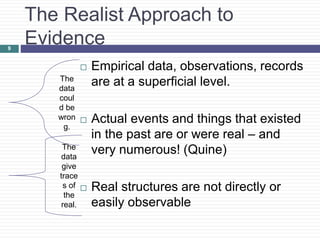
The
data
coul
d be
wron
g.
The
data
give
trace
s of
the
real.
SMMR is the study of open systems using a
mixture of methods of social research which
recognise patterns but also acknowledging the
tendency of patterns to change at different rates.
 The rates of change and the nature of change depend
on what factors are causing change and what can
cause new changes.
 See Sayer 1992 on durable structures
 Method in Social Science: A Realist Approach
 See Fay 1987 on embodied habits and rates of
change (Critical Social Science)
10
2. Retroduction – how to ask
‘why’
 See Downward, Mearman, Dow (article on
“Structured Pluralism”) on mixing methods by
doing retroduction = asking why....
 Ask why the data look the way they do.
 Ask why the culture accepts as ‘normal’ what is
thought to be normal
 Ask why something has happened which seems
deviant;
to some agent, this is ethical or right action?
This is a small step in building up a picture
11
Read about Retroduction, Causal
Analysis, Causality, and Causes
 Olsen, 2012, Key Concepts in Data
Collection.
 A whole section on retroduction is found in
Danermark, et al., 2009.
 Hunt, S. (1994). “A Realist Theory of Empirical
Testing: Resolving the Theory-Ladenness/
Objectivity Debate.” The Philosophy of Social
Sciences 24:2.
 Danermark, B., et al., eds. (2002). Explaining
Society: Critical realism in the social sciences.
London, New York: Routledge, pages 60, 79,
12
13
3. Think about your own empirical methods.
What data/ how do you interpret the data?
 Three main methodologies exist: – 1)
Popperian, 2) realist, and 3) strong constructivist.
 If you are mixing the three most common methodologies, or cutting across
them, then you will need a methodology that is fairly comprehensive, open
to new knowledge, and not simply falsificationist. The Popperian
falsification framework was questioned by Quine and Kuhn.
 Quine: 3 Dogmas of Empiricism, 1951
 Kuhn: The Structure of Scientific Revolutions (anomaly, normal science)
 You also need to work out whether values inform your work, and if so, in
what ways they are ‘premises’ versus in what way learning about them or
exploring them could generate changes in your value stance.
 FIRST METHOD – STATISTICAL ANALYSIS – Do not simply follow
Popperian critical rationalism. The hypothesis-testing approach is faulty as
methodology. See:
 ‘A Critical Epistemology of Analytical Statistics: Addressing the Sceptical
Realist’, Wendy Olsen and Jamie Morgan Journal for the Theory of Social
Ways to Logically Move Toward Conclusions
 METHODS are tools and techniques,
which can be used by any researcher.
 MODES OF ANALYSIS are the small-
scale bits of logic that we use to move our
‘claims’ forward, e.g. in statistics, the
arguments are often:
• deductive: adducing from laws or theory to the
specific prediction for a given case, then testing
that hypothesis, the drawing the conclusion.
I recommend instead:
• retroduction: asking why the data show their
patterns. This is more exploratory. Triangulate
14
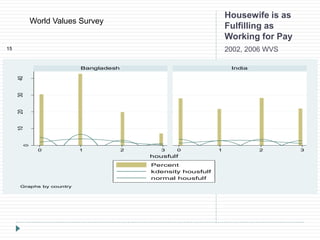
Housewife is as
Fulfilling as
Working for Pay
2002, 2006 WVS15
0
10203040
0 1 2 3 0 1 2 3
Bangladesh India
Percent
kdensity housfulf
normal housfulf
housfulf
Graphs by country
World Values Survey
Statisticians make a
single factor out of
these.
16
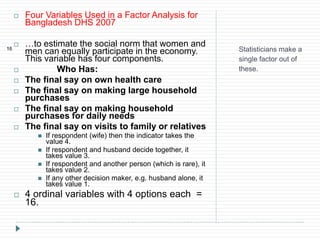
 Four Variables Used in a Factor Analysis for
Bangladesh DHS 2007
 …to estimate the social norm that women and
men can equally participate in the economy.
This variable has four components.
 Who Has:
 The final say on own health care
 The final say on making large household
purchases
 The final say on making household
purchases for daily needs
 The final say on visits to family or relatives
 If respondent (wife) then the indicator takes the
value 4.
 If respondent and husband decide together, it
takes value 3.
 If respondent and another person (which is rare), it
takes value 2.
 If any other decision maker, e.g. husband alone, it
takes value 1.
 4 ordinal variables with 4 options each =
16.
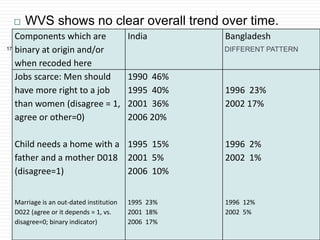
Components which are
binary at origin and/or
when recoded here
India Bangladesh
Jobs scarce: Men should
have more right to a job
than women (disagree = 1,
agree or other=0)
Child needs a home with a
father and a mother D018
(disagree=1)
Marriage is an out-dated institution
D022 (agree or it depends = 1, vs.
disagree=0; binary indicator)
1990 46%
1995 40%
2001 36%
2006 20%
1995 15%
2001 5%
2006 10%
1995 23%
2001 18%
2006 17%
1996 23%
2002 17%
1996 2%
2002 1%
1996 12%
2002 5%
DIFFERENT PATTERN17
 WVS shows no clear overall trend over time.
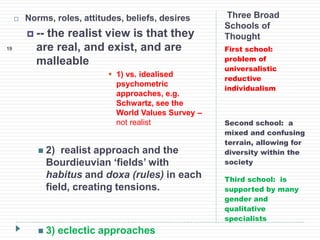
Three Broad
Schools of
Thought
First school:
problem of
universalistic
reductive
individualism
Second school: a
mixed and confusing
terrain, allowing for
diversity within the
society
Third school: is
supported by many
gender and
qualitative
specialists
 Norms, roles, attitudes, beliefs, desires
 -- the realist view is that they
are real, and exist, and are
malleable
 1) vs. idealised psychometric
approaches, e.g. Schwartz, see
the World Values Survey – not
realist
 2) realist approach and the
Bourdieuvian ‘fields’ with
habitus and doxa (rules) in each
field, creating tensions.
 3) eclectic approaches
18
Three Broad
Schools of
Thought
First school:
problem of
universalistic
reductive
individualism
Second school: a
mixed and confusing
terrain, allowing for
diversity within the
society
Third school: is
supported by many
gender and
qualitative
specialists
 Norms, roles, attitudes, beliefs, desires
 -- the realist view is that they
are real, and exist, and are
malleable
 1) vs. idealised
psychometric
approaches, e.g.
Schwartz, see the
World Values Survey –
not realist
 2) realist approach and the
Bourdieuvian ‘fields’ with
habitus and doxa (rules) in each
field, creating tensions.
 3) eclectic approaches
19
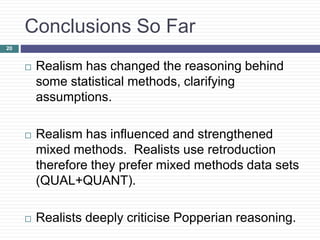
Conclusions So Far
 Realism has changed the reasoning behind
some statistical methods, clarifying
assumptions.
 Realism has influenced and strengthened
mixed methods. Realists use retroduction
therefore they prefer mixed methods data sets
(QUAL+QUANT).
 Realists deeply criticise Popperian reasoning.
20
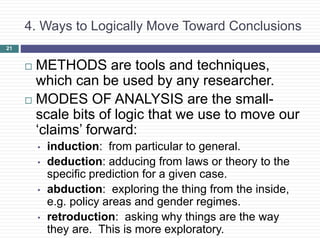
4. Ways to Logically Move Toward Conclusions
 METHODS are tools and techniques,
which can be used by any researcher.
 MODES OF ANALYSIS are the small-
scale bits of logic that we use to move our
‘claims’ forward:
• induction: from particular to general.
• deduction: adducing from laws or theory to the
specific prediction for a given case.
• abduction: exploring the thing from the inside,
e.g. policy areas and gender regimes.
• retroduction: asking why things are the way
they are. This is more exploratory.
21
22
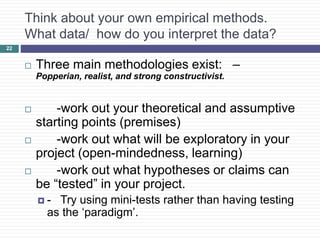
Think about your own empirical methods.
What data/ how do you interpret the data?
 Three main methodologies exist: –
Popperian, realist, and strong constructivist.
 -work out your theoretical and assumptive
starting points (premises)
 -work out what will be exploratory in your
project (open-mindedness, learning)
 -work out what hypotheses or claims can
be “tested” in your project.
 - Try using mini-tests rather than having testing
as the ‘paradigm’.
23
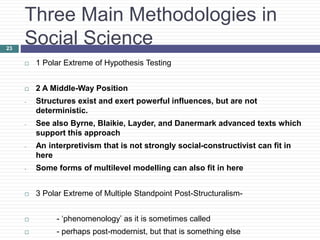
Three Main Methodologies in
Social Science
 1 Polar Extreme of Hypothesis Testing
 2 A Middle-Way Position
- Structures exist and exert powerful influences, but are not
deterministic.
- See also Byrne, Blaikie, Layder, and Danermark advanced texts which
support this approach
- An interpretivism that is not strongly social-constructivist can fit in
here
- Some forms of multilevel modelling can also fit in here
 3 Polar Extreme of Multiple Standpoint Post-Structuralism-
 - ‘phenomenology’ as it is sometimes called
 - perhaps post-modernist, but that is something else
5. Paradigm 3, Strong Constructivism:
Theories Underlie The Interpretation of Texts
 Analyse narratives…. Analyse social constructions….
Deconstruct
 [ Deconstruction is a method not a methodology]
 Analyse agents’ habituation to socially-normal meanings: HABITUS /
DOXA (Bourdieu) and BIOPOWER (Foucault);
 Be careful of FUNCTIONALISM (Parsons) – obviously weaknesses;
 BEWARE of accidentally falling into the functionalist trap.
 Avoid saying ‘the discourse of X [muslim Pakistani culture] causes
her to do all the household work’ - this misattributes agency.
 ‘Phenomenology’ has specific strengths, such as insight:
ETHNOMETHODOLOGY
 can this be done in a CULTURALLY COMPARATIVE CONTEXT?
Difficult.
 Institutional Ethnography is often said to be phenomenological. This is
24
25
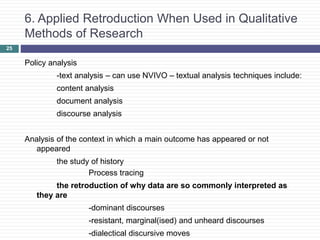
6. Applied Retroduction When Used in Qualitative
Methods of Research
Policy analysis
-text analysis – can use NVIVO – textual analysis techniques include:
content analysis
document analysis
discourse analysis
Analysis of the context in which a main outcome has appeared or not
appeared
the study of history
Process tracing
the retroduction of why data are so commonly interpreted as
they are
-dominant discourses
-resistant, marginal(ised) and unheard discourses
-dialectical discursive moves
26
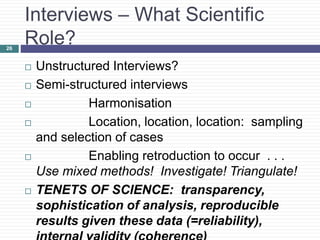
Interviews – What Scientific
Role?
 Unstructured Interviews?
 Semi-structured interviews
 Harmonisation
 Location, location, location: sampling
and selection of cases
 Enabling retroduction to occur . . .
Use mixed methods! Investigate! Triangulate!
 TENETS OF SCIENCE: transparency,
sophistication of analysis, reproducible
results given these data (=reliability),
27
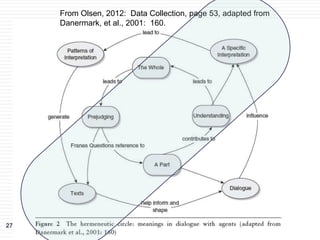
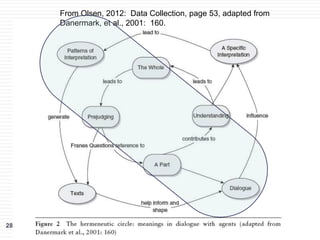
From Olsen, 2012: Data Collection, page 53, adapted from
Danermark, et al., 2001: 160.
28
From Olsen, 2012: Data Collection, page 53, adapted from
Danermark, et al., 2001: 160.
29
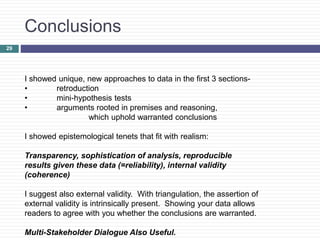
Conclusions
I showed unique, new approaches to data in the first 3 sections-
• retroduction
• mini-hypothesis tests
• arguments rooted in premises and reasoning,
which uphold warranted conclusions
I showed epistemological tenets that fit with realism:
Transparency, sophistication of analysis, reproducible
results given these data (=reliability), internal validity
(coherence)
I suggest also external validity. With triangulation, the assertion of
external validity is intrinsically present. Showing your data allows
readers to agree with you whether the conclusions are warranted.
Multi-Stakeholder Dialogue Also Useful.
30
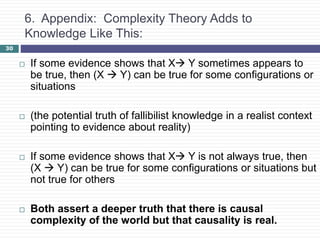
6. Appendix: Complexity Theory Adds to
Knowledge Like This:
 If some evidence shows that X Y sometimes appears to
be true, then (X  Y) can be true for some configurations or
situations
 (the potential truth of fallibilist knowledge in a realist context
pointing to evidence about reality)
 If some evidence shows that X Y is not always true, then
(X  Y) can be true for some configurations or situations but
not true for others
 Both assert a deeper truth that there is causal
complexity of the world but that causality is real.
31
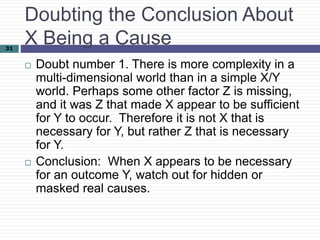
Doubting the Conclusion About
X Being a Cause
 Doubt number 1. There is more complexity in a
multi-dimensional world than in a simple X/Y
world. Perhaps some other factor Z is missing,
and it was Z that made X appear to be sufficient
for Y to occur. Therefore it is not X that is
necessary for Y, but rather Z that is necessary
for Y.
 Conclusion: When X appears to be necessary
for an outcome Y, watch out for hidden or
masked real causes.
32
Doubt Number Two:
Contingency is Required
 2. Even if in all observed or recorded cases, X and
Y appear together or are absent together, this does
not imply that X necessarily causes Y. Other data
would be necessary to establish this as a well-
justified argument. Evidence could be of several
kinds. See Sayer (1992).
 Bhaskar argues that X may simply be a part of Y.
This is called ‘natural necessity’ or ontic
embeddedness of X in Y. In such cases, X and Y
are not contingently related. These are identifiable
by the total absence of X~Y and of ~YX. See
Bhaskar 1975.~=‘not’

Berlin Summer School Presentation Olsen Data Epistemology and Methods Paradigms 2012 2014

  • 1.
    1 EPISTEMOLOGICAL FOUNDATIONS OF METHODOLOGICAL PARADIGMS Wendy Olsen,Reader in Socio-Economic Research, University of Manchester July 2014 Berlin Summer School
  • 2.
    2 Abstract: The aim ofthe session is to present a realist approach that can be used for all kinds of social- science research. The realist approach is easily evident in statistical analysis (Boorsboom, et al., 2003; Olsen, 2007) but the focus today is to stress that it is also useful for qualitative methods (Olsen, 2012). An integrated mixed-methods approach would allow a wide range of methods to be joined together for data-collection stages of research and for the analysis of data (Danermark, et al., 2002). My thanks to all who helped me put together Data Collection (London: Sage, 2012), with most of this material.
  • 3.
    3 Sections of theTalk  First principles of paradigms in Social Science Research Methods/-ology  1 Realism  2 Retroduction not deduction please  3 Modes of analysis  4 Ways to Logically Move Toward Conclusions  5 . Paradigm 3, Strong Constructivism – worthy?  6. Applied Retroduction in Qualitative Research  Findings  The realist foundations can be questioned, but they are not meant to oppose constructivist methods of data- analysis;  Instead they offer a challenge to post- structuralist strong constructivism.  There is common ground.
  • 4.
    4 Exercises That ComeLater  1)  An analysis of an interview extract, raising questions about the paradigms and epistemological issues  2)  : a set of 3 mini debates, for 3 groups. I think groups of 6 would do fine, summing up to 18 folks, which is half of the whole group of 48, approx..
  • 5.
    5 WHAT RELEVANCE CAN REALISMHAVE TO DOING QUALITATIVE RESEARCH? This is the real issue.
  • 6.
    1. Realism: somedefinitions. 1a) A ‘systems’ approach?  Defining “Systematic Mixed Methods Research” requires definitions of open systems and closed systems – useful for many projects:  an OPEN SYSTEM has permeability, organic capacity to change itself, and/or multiple causes  a CLOSED SYSTEM (e.g. a set of equations) has routinised workings, has parameters  The study of systems requires that we realise that social systems are open systems.  This creates a rationale for trans-disciplinarity. It is also sociological. But water and farming 6
  • 7.
    7 1b) “Substantivist” Views Bhaskar argued in 1975 that it is the WORLD we are talking about. It is not the DATA we are talking about.  This is known as ontology – being expert about that which is being referred to.  A substantivist argues that the nature of cause depends on what we are referring to.  E.g. events vs. structures;  institutional change vs. institutional reproduction, and so on.  Best books by Bhaskar: The Possibility of Naturalism 1979, 1989, 1998) and  A Realist Theory of Science (1975)
  • 8.
    The Realist Approachto Evidence  Empirical data, observations, records are at a superficial level.  Actual events and things that existed in the past are or were real – and very numerous! (Quine)  Real structures are not directly or easily observable 8
  • 9.
    The Realist Approachto Evidence  Empirical data, observations, records are at a superficial level.  Actual events and things that existed in the past are or were real – and very numerous! (Quine)  Real structures are not directly or easily observable 9 The data coul d be wron g. The data give trace s of the real.
  • 10.
    SMMR is thestudy of open systems using a mixture of methods of social research which recognise patterns but also acknowledging the tendency of patterns to change at different rates.  The rates of change and the nature of change depend on what factors are causing change and what can cause new changes.  See Sayer 1992 on durable structures  Method in Social Science: A Realist Approach  See Fay 1987 on embodied habits and rates of change (Critical Social Science) 10
  • 11.
    2. Retroduction –how to ask ‘why’  See Downward, Mearman, Dow (article on “Structured Pluralism”) on mixing methods by doing retroduction = asking why....  Ask why the data look the way they do.  Ask why the culture accepts as ‘normal’ what is thought to be normal  Ask why something has happened which seems deviant; to some agent, this is ethical or right action? This is a small step in building up a picture 11
  • 12.
    Read about Retroduction,Causal Analysis, Causality, and Causes  Olsen, 2012, Key Concepts in Data Collection.  A whole section on retroduction is found in Danermark, et al., 2009.  Hunt, S. (1994). “A Realist Theory of Empirical Testing: Resolving the Theory-Ladenness/ Objectivity Debate.” The Philosophy of Social Sciences 24:2.  Danermark, B., et al., eds. (2002). Explaining Society: Critical realism in the social sciences. London, New York: Routledge, pages 60, 79, 12
  • 13.
    13 3. Think aboutyour own empirical methods. What data/ how do you interpret the data?  Three main methodologies exist: – 1) Popperian, 2) realist, and 3) strong constructivist.  If you are mixing the three most common methodologies, or cutting across them, then you will need a methodology that is fairly comprehensive, open to new knowledge, and not simply falsificationist. The Popperian falsification framework was questioned by Quine and Kuhn.  Quine: 3 Dogmas of Empiricism, 1951  Kuhn: The Structure of Scientific Revolutions (anomaly, normal science)  You also need to work out whether values inform your work, and if so, in what ways they are ‘premises’ versus in what way learning about them or exploring them could generate changes in your value stance.  FIRST METHOD – STATISTICAL ANALYSIS – Do not simply follow Popperian critical rationalism. The hypothesis-testing approach is faulty as methodology. See:  ‘A Critical Epistemology of Analytical Statistics: Addressing the Sceptical Realist’, Wendy Olsen and Jamie Morgan Journal for the Theory of Social
  • 14.
    Ways to LogicallyMove Toward Conclusions  METHODS are tools and techniques, which can be used by any researcher.  MODES OF ANALYSIS are the small- scale bits of logic that we use to move our ‘claims’ forward, e.g. in statistics, the arguments are often: • deductive: adducing from laws or theory to the specific prediction for a given case, then testing that hypothesis, the drawing the conclusion. I recommend instead: • retroduction: asking why the data show their patterns. This is more exploratory. Triangulate 14
  • 15.
    Housewife is as Fulfillingas Working for Pay 2002, 2006 WVS15 0 10203040 0 1 2 3 0 1 2 3 Bangladesh India Percent kdensity housfulf normal housfulf housfulf Graphs by country World Values Survey
  • 16.
    Statisticians make a singlefactor out of these. 16  Four Variables Used in a Factor Analysis for Bangladesh DHS 2007  …to estimate the social norm that women and men can equally participate in the economy. This variable has four components.  Who Has:  The final say on own health care  The final say on making large household purchases  The final say on making household purchases for daily needs  The final say on visits to family or relatives  If respondent (wife) then the indicator takes the value 4.  If respondent and husband decide together, it takes value 3.  If respondent and another person (which is rare), it takes value 2.  If any other decision maker, e.g. husband alone, it takes value 1.  4 ordinal variables with 4 options each = 16.
  • 17.
    Components which are binaryat origin and/or when recoded here India Bangladesh Jobs scarce: Men should have more right to a job than women (disagree = 1, agree or other=0) Child needs a home with a father and a mother D018 (disagree=1) Marriage is an out-dated institution D022 (agree or it depends = 1, vs. disagree=0; binary indicator) 1990 46% 1995 40% 2001 36% 2006 20% 1995 15% 2001 5% 2006 10% 1995 23% 2001 18% 2006 17% 1996 23% 2002 17% 1996 2% 2002 1% 1996 12% 2002 5% DIFFERENT PATTERN17  WVS shows no clear overall trend over time.
  • 18.
    Three Broad Schools of Thought Firstschool: problem of universalistic reductive individualism Second school: a mixed and confusing terrain, allowing for diversity within the society Third school: is supported by many gender and qualitative specialists  Norms, roles, attitudes, beliefs, desires  -- the realist view is that they are real, and exist, and are malleable  1) vs. idealised psychometric approaches, e.g. Schwartz, see the World Values Survey – not realist  2) realist approach and the Bourdieuvian ‘fields’ with habitus and doxa (rules) in each field, creating tensions.  3) eclectic approaches 18
  • 19.
    Three Broad Schools of Thought Firstschool: problem of universalistic reductive individualism Second school: a mixed and confusing terrain, allowing for diversity within the society Third school: is supported by many gender and qualitative specialists  Norms, roles, attitudes, beliefs, desires  -- the realist view is that they are real, and exist, and are malleable  1) vs. idealised psychometric approaches, e.g. Schwartz, see the World Values Survey – not realist  2) realist approach and the Bourdieuvian ‘fields’ with habitus and doxa (rules) in each field, creating tensions.  3) eclectic approaches 19
  • 20.
    Conclusions So Far Realism has changed the reasoning behind some statistical methods, clarifying assumptions.  Realism has influenced and strengthened mixed methods. Realists use retroduction therefore they prefer mixed methods data sets (QUAL+QUANT).  Realists deeply criticise Popperian reasoning. 20
  • 21.
    4. Ways toLogically Move Toward Conclusions  METHODS are tools and techniques, which can be used by any researcher.  MODES OF ANALYSIS are the small- scale bits of logic that we use to move our ‘claims’ forward: • induction: from particular to general. • deduction: adducing from laws or theory to the specific prediction for a given case. • abduction: exploring the thing from the inside, e.g. policy areas and gender regimes. • retroduction: asking why things are the way they are. This is more exploratory. 21
  • 22.
    22 Think about yourown empirical methods. What data/ how do you interpret the data?  Three main methodologies exist: – Popperian, realist, and strong constructivist.  -work out your theoretical and assumptive starting points (premises)  -work out what will be exploratory in your project (open-mindedness, learning)  -work out what hypotheses or claims can be “tested” in your project.  - Try using mini-tests rather than having testing as the ‘paradigm’.
  • 23.
    23 Three Main Methodologiesin Social Science  1 Polar Extreme of Hypothesis Testing  2 A Middle-Way Position - Structures exist and exert powerful influences, but are not deterministic. - See also Byrne, Blaikie, Layder, and Danermark advanced texts which support this approach - An interpretivism that is not strongly social-constructivist can fit in here - Some forms of multilevel modelling can also fit in here  3 Polar Extreme of Multiple Standpoint Post-Structuralism-  - ‘phenomenology’ as it is sometimes called  - perhaps post-modernist, but that is something else
  • 24.
    5. Paradigm 3,Strong Constructivism: Theories Underlie The Interpretation of Texts  Analyse narratives…. Analyse social constructions…. Deconstruct  [ Deconstruction is a method not a methodology]  Analyse agents’ habituation to socially-normal meanings: HABITUS / DOXA (Bourdieu) and BIOPOWER (Foucault);  Be careful of FUNCTIONALISM (Parsons) – obviously weaknesses;  BEWARE of accidentally falling into the functionalist trap.  Avoid saying ‘the discourse of X [muslim Pakistani culture] causes her to do all the household work’ - this misattributes agency.  ‘Phenomenology’ has specific strengths, such as insight: ETHNOMETHODOLOGY  can this be done in a CULTURALLY COMPARATIVE CONTEXT? Difficult.  Institutional Ethnography is often said to be phenomenological. This is 24
  • 25.
    25 6. Applied RetroductionWhen Used in Qualitative Methods of Research Policy analysis -text analysis – can use NVIVO – textual analysis techniques include: content analysis document analysis discourse analysis Analysis of the context in which a main outcome has appeared or not appeared the study of history Process tracing the retroduction of why data are so commonly interpreted as they are -dominant discourses -resistant, marginal(ised) and unheard discourses -dialectical discursive moves
  • 26.
    26 Interviews – WhatScientific Role?  Unstructured Interviews?  Semi-structured interviews  Harmonisation  Location, location, location: sampling and selection of cases  Enabling retroduction to occur . . . Use mixed methods! Investigate! Triangulate!  TENETS OF SCIENCE: transparency, sophistication of analysis, reproducible results given these data (=reliability),
  • 27.
    27 From Olsen, 2012:Data Collection, page 53, adapted from Danermark, et al., 2001: 160.
  • 28.
    28 From Olsen, 2012:Data Collection, page 53, adapted from Danermark, et al., 2001: 160.
  • 29.
    29 Conclusions I showed unique,new approaches to data in the first 3 sections- • retroduction • mini-hypothesis tests • arguments rooted in premises and reasoning, which uphold warranted conclusions I showed epistemological tenets that fit with realism: Transparency, sophistication of analysis, reproducible results given these data (=reliability), internal validity (coherence) I suggest also external validity. With triangulation, the assertion of external validity is intrinsically present. Showing your data allows readers to agree with you whether the conclusions are warranted. Multi-Stakeholder Dialogue Also Useful.
  • 30.
    30 6. Appendix: ComplexityTheory Adds to Knowledge Like This:  If some evidence shows that X Y sometimes appears to be true, then (X  Y) can be true for some configurations or situations  (the potential truth of fallibilist knowledge in a realist context pointing to evidence about reality)  If some evidence shows that X Y is not always true, then (X  Y) can be true for some configurations or situations but not true for others  Both assert a deeper truth that there is causal complexity of the world but that causality is real.
  • 31.
    31 Doubting the ConclusionAbout X Being a Cause  Doubt number 1. There is more complexity in a multi-dimensional world than in a simple X/Y world. Perhaps some other factor Z is missing, and it was Z that made X appear to be sufficient for Y to occur. Therefore it is not X that is necessary for Y, but rather Z that is necessary for Y.  Conclusion: When X appears to be necessary for an outcome Y, watch out for hidden or masked real causes.
  • 32.
    32 Doubt Number Two: Contingencyis Required  2. Even if in all observed or recorded cases, X and Y appear together or are absent together, this does not imply that X necessarily causes Y. Other data would be necessary to establish this as a well- justified argument. Evidence could be of several kinds. See Sayer (1992).  Bhaskar argues that X may simply be a part of Y. This is called ‘natural necessity’ or ontic embeddedness of X in Y. In such cases, X and Y are not contingently related. These are identifiable by the total absence of X~Y and of ~YX. See Bhaskar 1975.~=‘not’

Editor's Notes

  • #2 Presentation slide for courses, classes, lectures et al.
  • #3 Presentation slide for courses, classes, lectures et al.
  • #4 Beginning course details and/or books/materials needed for a class/project.
  • #5 Beginning course details and/or books/materials needed for a class/project.