CONTENTS.
 Introduction
 Brief history
 An overview of treatment mechanics
 Appliance specification –
Variations and Versatility
 Bracket positioning
 Arch form
 Anchorage control during levelling and aligning
 Arch wire sequence
 Over bite control
 Space closure by Sliding mechanics
 Finishing the case
 Appliance removal and retention protocol
 References
Introduction
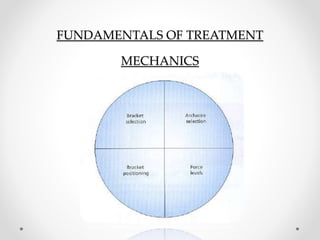
FUNDAMENTALS OF TREATMENT
MECHANICS
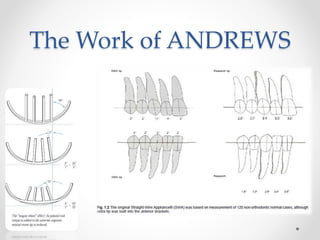
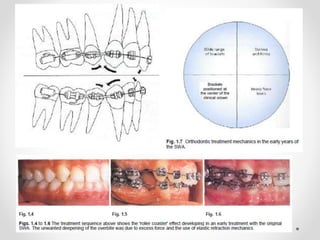
The Work of ANDREWS
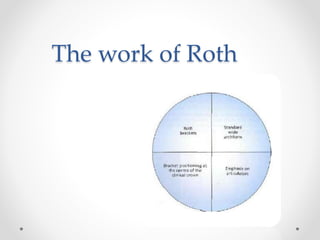
The work of Roth
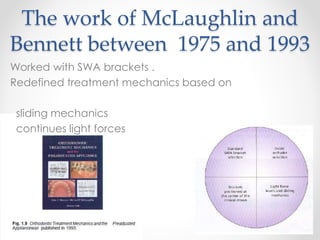
The work of McLaughlin and
Bennett between 1975 and 1993
Worked with SWA brackets .
Redefined treatment mechanics based on
sliding mechanics
continues light forces
The work of McLaughlin Bennett
and Trevisi between 1993 and 1997
• Redesigned entire bracket system
• MBTTM is a version of Preadjusted bracket system
specifically for use with Light continuous forces
,Lacebacks ,bendbacks and designed to work with
sliding mechanics
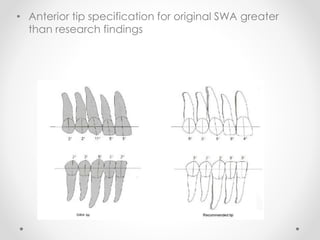
• Anterior tip specification for original SWA greater
than research findings
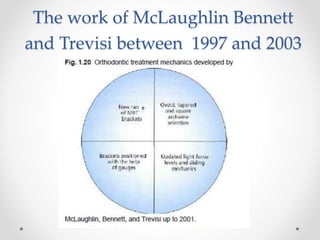
The work of McLaughlin Bennett
and Trevisi between 1997 and 2003
Overview of the MBT
treatment philosophy
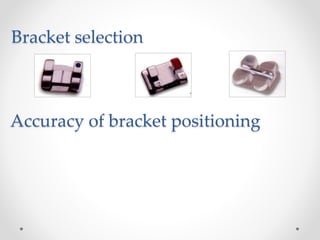
• Bracket selection
• Versatility of the bracket system
• Accuracy of bracket positioning
• Light continues forces
• The .022 vs the .018 slot
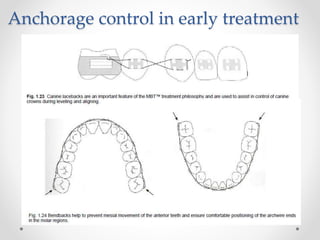
• Anchorage control in early treatment
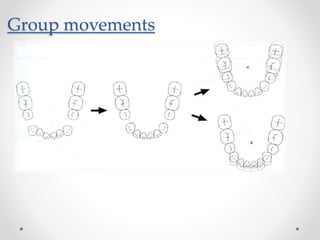
• Group movement
• The use of three arch forms
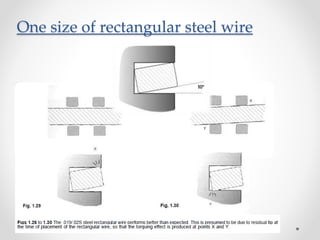
• One size rectangular steel wires
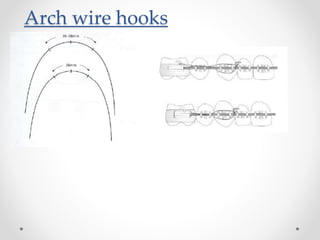
• Arch wire hooks
• Method of archwire ligation
• Awareness of tooth size discrepancies
• Persistence in finishing
Bracket selection
Accuracy of bracket positioning
Light continues forces
• Most effective way to move teeth is being
comfortable to patient and minimizing the threat to
anchorage
• Thin, flexible wires early on ,with minimal deflection
and avoid too frequent arch wire changes.
• Clinician needs to recognize the signs of excess
forces
• Later in sliding mechanics ,light continues forces are
applied using active tie backs and rigid .019x.025
steel working wires
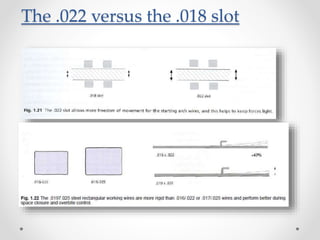
The .022 versus the .018 slot
Anchorage control in early treatment
Group movements
One size of rectangular steel wire
Arch wire hooks
Appliance Specification
-Variations and
Versatility
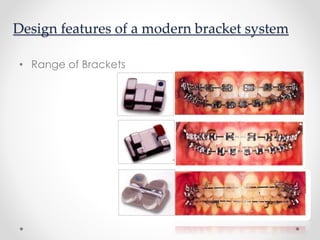
Design features of a modern bracket system
• Range of Brackets
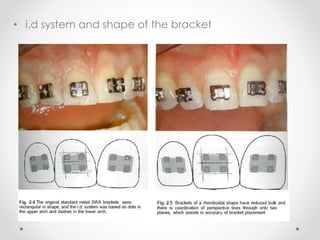
• i.d system and shape of the bracket
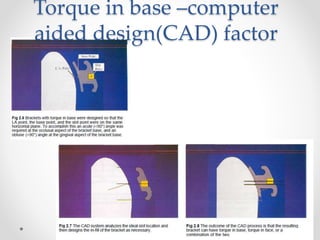
Torque in base –computer
aided design(CAD) factor
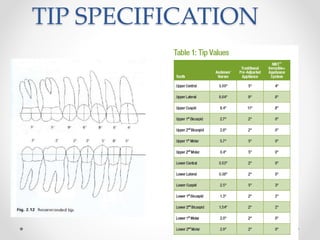
TIP SPECIFICATION
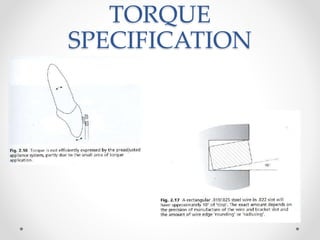
TORQUE
SPECIFICATION
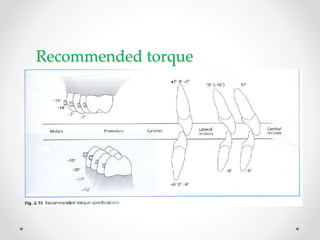
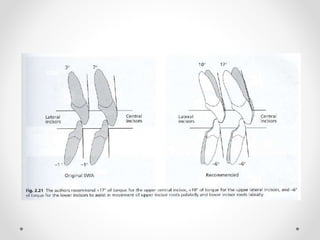
Recommended torque
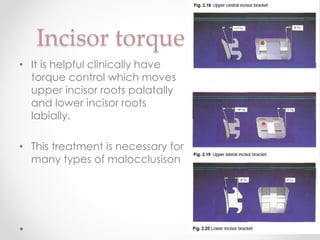
Incisor torque
• It is helpful clinically have
torque control which moves
upper incisor roots palatally
and lower incisor roots
labially.
• This treatment is necessary for
many types of malocclusison
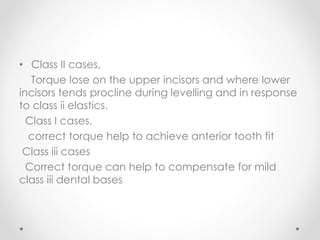
• Class II cases,
Torque lose on the upper incisors and where lower
incisors tends procline during levelling and in response
to class ii elastics.
Class I cases,
correct torque help to achieve anterior tooth fit
Class iii cases
Correct torque can help to compensate for mild
class iii dental bases
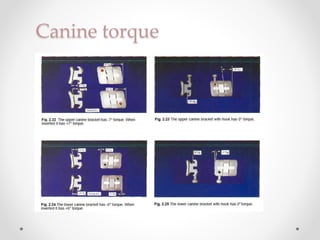
Canine torque
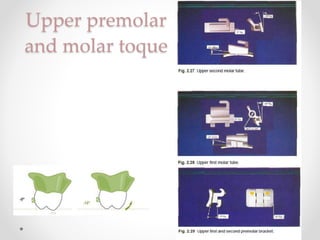
Upper premolar
and molar toque
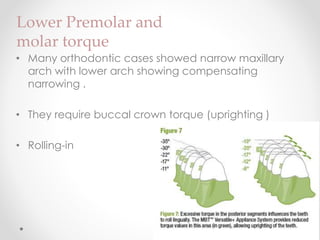
Lower Premolar and
molar torque
• Many orthodontic cases showed narrow maxillary
arch with lower arch showing compensating
narrowing .
• They require buccal crown torque (uprighting )
• Rolling-in
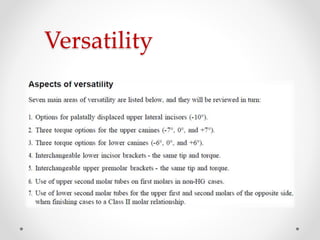
The Versatility of the
MBT Bracket System
Versatility
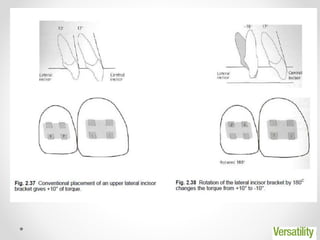
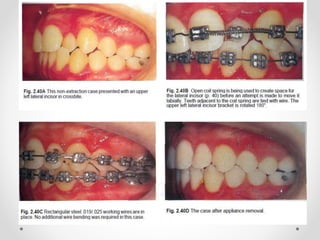
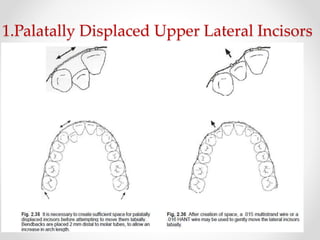
1.Palatally Displaced Upper Lateral Incisors
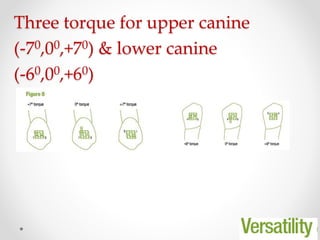
Three torque for upper canine
(-70,00,+70) & lower canine
(-60,00,+60)
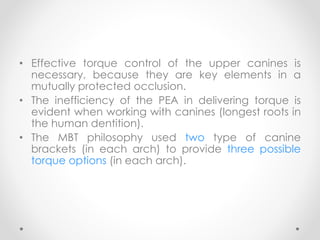
• Effective torque control of the upper canines is
necessary, because they are key elements in a
mutually protected occlusion.
• The inefficiency of the PEA in delivering torque is
evident when working with canines (longest roots in
the human dentition).
• The MBT philosophy used two type of canine
brackets (in each arch) to provide three possible
torque options (in each arch).
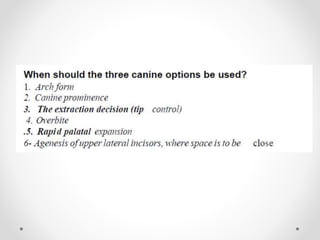
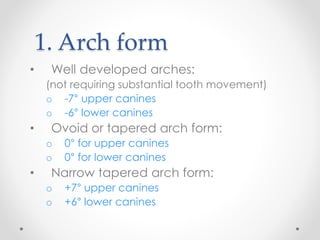
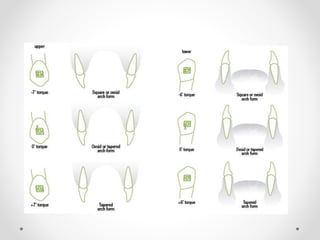
1. Arch form
• Well developed arches:
(not requiring substantial tooth movement)
o -7° upper canines
o -6° lower canines
• Ovoid or tapered arch form:
o 0° for upper canines
o 0° for lower canines
• Narrow tapered arch form:
o +7° upper canines
o +6° lower canines
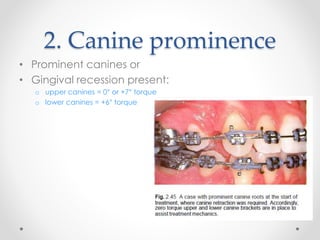
2. Canine prominence
• Prominent canines or
• Gingival recession present:
o upper canines = 0° or +7° torque
o lower canines = +6° torque
47
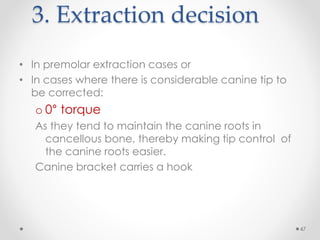
3. Extraction decision
• In premolar extraction cases or
• In cases where there is considerable canine tip to
be corrected:
o 0° torque
As they tend to maintain the canine roots in
cancellous bone, thereby making tip control of
the canine roots easier.
Canine bracket carries a hook
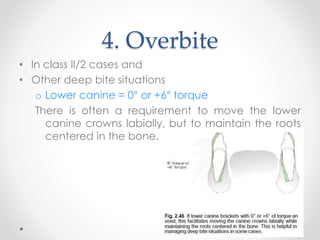
4. Overbite
• In class II/2 cases and
• Other deep bite situations
o Lower canine = 0° or +6° torque
There is often a requirement to move the lower
canine crowns labially, but to maintain the roots
centered in the bone.
49
5. Rapid palatal expansion
cases
• Widening of the upper arch creates a secondary
widening in the lower arch = torque changes
among lower teeth.
o lower canine = 0° or +6° torque
Recommended to assist this favorable
change.
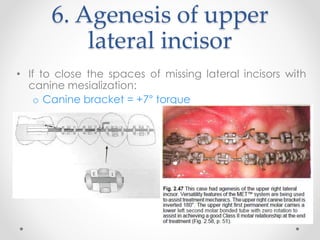
6. Agenesis of upper
lateral incisor
• If to close the spaces of missing lateral incisors with
canine mesialization:
o Canine bracket = +7° torque
51
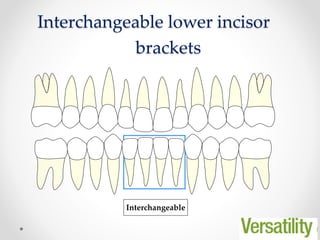
Interchangeable lower incisor
brackets
Interchangeable
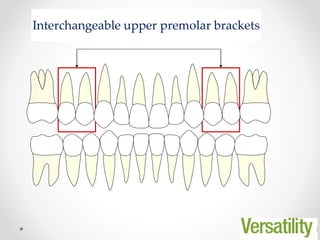
Interchangeable upper premolar brackets
53
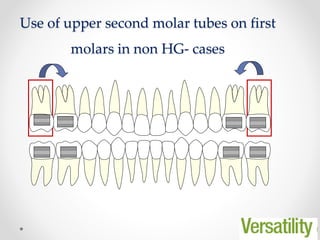
Use of upper second molar tubes on first
molars in non HG- cases
54
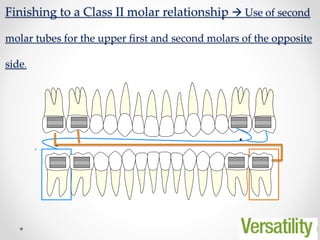
Finishing to a Class II molar relationship  Use of second
molar tubes for the upper first and second molars of the opposite
side.
.
Bracket positioning and
case setup
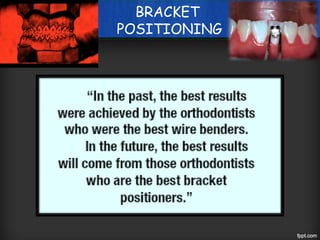
BRACKET
POSITIONING
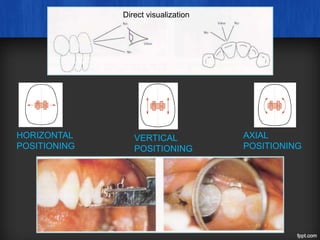
Direct visualization
HORIZONTAL
POSITIONING
VERTICAL
POSITIONING
AXIAL
POSITIONING
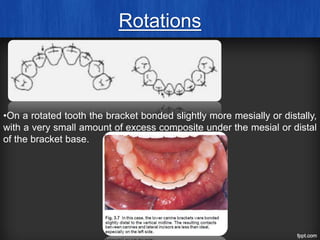
Rotations
•On a rotated tooth the bracket bonded slightly more mesially or distally,
with a very small amount of excess composite under the mesial or distal
of the bracket base.
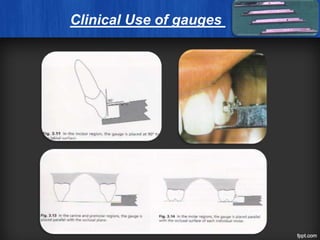
Clinical Use of gauges
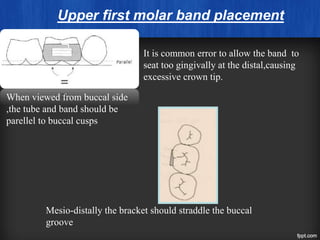
Upper first molar band placement
When viewed from buccal side
,the tube and band should be
parellel to buccal cusps
It is common error to allow the band to
seat too gingivally at the distal,causing
excessive crown tip.
Mesio-distally the bracket should straddle the buccal
groove
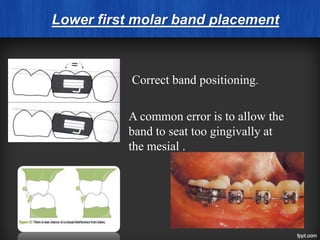
Lower first molar band placement
Correct band positioning.
A common error is to allow the
band to seat too gingivally at
the mesial .
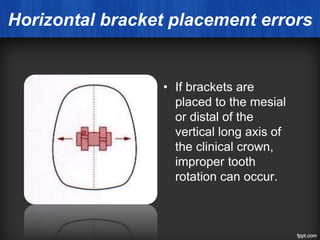
Horizontal bracket placement errors
• If brackets are
placed to the mesial
or distal of the
vertical long axis of
the clinical crown,
improper tooth
rotation can occur.
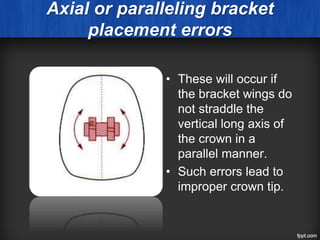
Axial or paralleling bracket
placement errors
• These will occur if
the bracket wings do
not straddle the
vertical long axis of
the crown in a
parallel manner.
• Such errors lead to
improper crown tip.
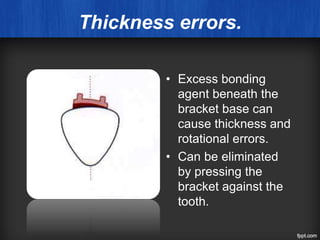
Thickness errors.
• Excess bonding
agent beneath the
bracket base can
cause thickness and
rotational errors.
• Can be eliminated
by pressing the
bracket against the
tooth.
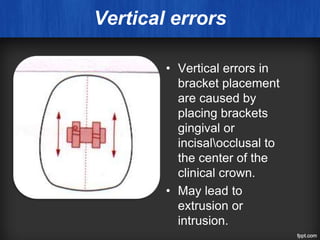
Vertical errors
• Vertical errors in
bracket placement
are caused by
placing brackets
gingival or
incisalocclusal to
the center of the
clinical crown.
• May lead to
extrusion or
intrusion.
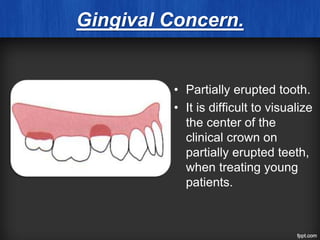
Gingival Concern.
• Partially erupted tooth.
• It is difficult to visualize
the center of the
clinical crown on
partially erupted teeth,
when treating young
patients.
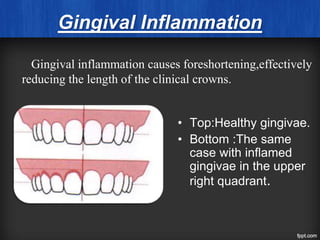
Gingival Inflammation
• Top:Healthy gingivae.
• Bottom :The same
case with inflamed
gingivae in the upper
right quadrant.
Gingival inflammation causes foreshortening,effectively
reducing the length of the clinical crowns.
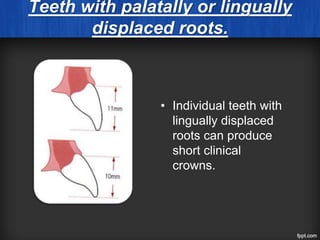
Teeth with palatally or lingually
displaced roots.
• Individual teeth with
lingually displaced
roots can produce
short clinical
crowns.
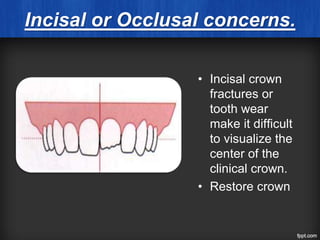
Incisal or Occlusal concerns.
• Incisal crown
fractures or
tooth wear
make it difficult
to visualize the
center of the
clinical crown.
• Restore crown
71
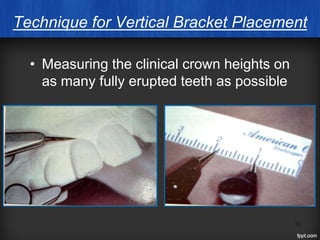
Technique for Vertical Bracket Placement
• Measuring the clinical crown heights on
as many fully erupted teeth as possible
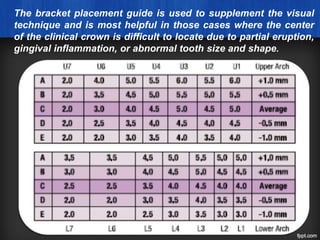
The bracket placement guide is used to supplement the visual
technique and is most helpful in those cases where the center
of the clinical crown is difficult to locate due to partial eruption,
gingival inflammation, or abnormal tooth size and shape.
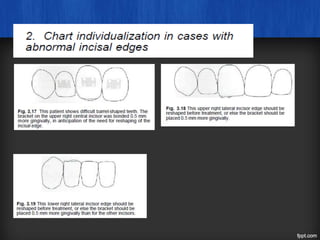
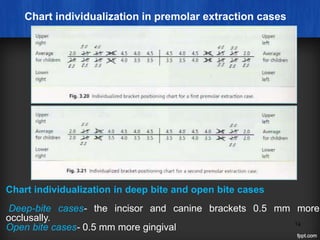
Chart individualization in premolar extraction cases
74
Chart individualization in deep bite and open bite cases
Deep-bite cases- the incisor and canine brackets 0.5 mm more
occlusally.
Open bite cases- 0.5 mm more gingival

Mbt technique part

  • 2.
    CONTENTS.  Introduction  Briefhistory  An overview of treatment mechanics  Appliance specification – Variations and Versatility  Bracket positioning  Arch form  Anchorage control during levelling and aligning  Arch wire sequence  Over bite control  Space closure by Sliding mechanics  Finishing the case  Appliance removal and retention protocol  References
  • 3.
  • 4.
  • 5.
    The Work ofANDREWS
  • 7.
  • 8.
    The work ofMcLaughlin and Bennett between 1975 and 1993 Worked with SWA brackets . Redefined treatment mechanics based on sliding mechanics continues light forces
  • 9.
    The work ofMcLaughlin Bennett and Trevisi between 1993 and 1997 • Redesigned entire bracket system • MBTTM is a version of Preadjusted bracket system specifically for use with Light continuous forces ,Lacebacks ,bendbacks and designed to work with sliding mechanics
  • 10.
    • Anterior tipspecification for original SWA greater than research findings
  • 11.
    The work ofMcLaughlin Bennett and Trevisi between 1997 and 2003
  • 12.
    Overview of theMBT treatment philosophy • Bracket selection • Versatility of the bracket system • Accuracy of bracket positioning • Light continues forces • The .022 vs the .018 slot • Anchorage control in early treatment • Group movement • The use of three arch forms • One size rectangular steel wires
  • 13.
    • Arch wirehooks • Method of archwire ligation • Awareness of tooth size discrepancies • Persistence in finishing
  • 14.
    Bracket selection Accuracy ofbracket positioning
  • 15.
    Light continues forces •Most effective way to move teeth is being comfortable to patient and minimizing the threat to anchorage • Thin, flexible wires early on ,with minimal deflection and avoid too frequent arch wire changes. • Clinician needs to recognize the signs of excess forces • Later in sliding mechanics ,light continues forces are applied using active tie backs and rigid .019x.025 steel working wires
  • 16.
    The .022 versusthe .018 slot
  • 17.
    Anchorage control inearly treatment
  • 18.
  • 19.
    One size ofrectangular steel wire
  • 20.
  • 22.
  • 23.
    Design features ofa modern bracket system • Range of Brackets
  • 24.
    • i.d systemand shape of the bracket
  • 25.
    Torque in base–computer aided design(CAD) factor
  • 26.
  • 28.
  • 29.
  • 30.
    Incisor torque • Itis helpful clinically have torque control which moves upper incisor roots palatally and lower incisor roots labially. • This treatment is necessary for many types of malocclusison
  • 31.
    • Class IIcases, Torque lose on the upper incisors and where lower incisors tends procline during levelling and in response to class ii elastics. Class I cases, correct torque help to achieve anterior tooth fit Class iii cases Correct torque can help to compensate for mild class iii dental bases
  • 33.
  • 34.
  • 35.
    Lower Premolar and molartorque • Many orthodontic cases showed narrow maxillary arch with lower arch showing compensating narrowing . • They require buccal crown torque (uprighting ) • Rolling-in
  • 36.
    The Versatility ofthe MBT Bracket System
  • 37.
  • 38.
  • 41.
    Three torque forupper canine (-70,00,+70) & lower canine (-60,00,+60)
  • 42.
    • Effective torquecontrol of the upper canines is necessary, because they are key elements in a mutually protected occlusion. • The inefficiency of the PEA in delivering torque is evident when working with canines (longest roots in the human dentition). • The MBT philosophy used two type of canine brackets (in each arch) to provide three possible torque options (in each arch).
  • 44.
    1. Arch form •Well developed arches: (not requiring substantial tooth movement) o -7° upper canines o -6° lower canines • Ovoid or tapered arch form: o 0° for upper canines o 0° for lower canines • Narrow tapered arch form: o +7° upper canines o +6° lower canines
  • 46.
    2. Canine prominence •Prominent canines or • Gingival recession present: o upper canines = 0° or +7° torque o lower canines = +6° torque
  • 47.
    47 3. Extraction decision •In premolar extraction cases or • In cases where there is considerable canine tip to be corrected: o 0° torque As they tend to maintain the canine roots in cancellous bone, thereby making tip control of the canine roots easier. Canine bracket carries a hook
  • 48.
    4. Overbite • Inclass II/2 cases and • Other deep bite situations o Lower canine = 0° or +6° torque There is often a requirement to move the lower canine crowns labially, but to maintain the roots centered in the bone.
  • 49.
    49 5. Rapid palatalexpansion cases • Widening of the upper arch creates a secondary widening in the lower arch = torque changes among lower teeth. o lower canine = 0° or +6° torque Recommended to assist this favorable change.
  • 50.
    6. Agenesis ofupper lateral incisor • If to close the spaces of missing lateral incisors with canine mesialization: o Canine bracket = +7° torque
  • 51.
  • 52.
  • 53.
    53 Use of uppersecond molar tubes on first molars in non HG- cases
  • 54.
    54 Finishing to aClass II molar relationship  Use of second molar tubes for the upper first and second molars of the opposite side. .
  • 56.
  • 57.
  • 58.
  • 59.
    Rotations •On a rotatedtooth the bracket bonded slightly more mesially or distally, with a very small amount of excess composite under the mesial or distal of the bracket base.
  • 60.
  • 61.
    Upper first molarband placement When viewed from buccal side ,the tube and band should be parellel to buccal cusps It is common error to allow the band to seat too gingivally at the distal,causing excessive crown tip. Mesio-distally the bracket should straddle the buccal groove
  • 62.
    Lower first molarband placement Correct band positioning. A common error is to allow the band to seat too gingivally at the mesial .
  • 63.
    Horizontal bracket placementerrors • If brackets are placed to the mesial or distal of the vertical long axis of the clinical crown, improper tooth rotation can occur.
  • 64.
    Axial or parallelingbracket placement errors • These will occur if the bracket wings do not straddle the vertical long axis of the crown in a parallel manner. • Such errors lead to improper crown tip.
  • 65.
    Thickness errors. • Excessbonding agent beneath the bracket base can cause thickness and rotational errors. • Can be eliminated by pressing the bracket against the tooth.
  • 66.
    Vertical errors • Verticalerrors in bracket placement are caused by placing brackets gingival or incisalocclusal to the center of the clinical crown. • May lead to extrusion or intrusion.
  • 67.
    Gingival Concern. • Partiallyerupted tooth. • It is difficult to visualize the center of the clinical crown on partially erupted teeth, when treating young patients.
  • 68.
    Gingival Inflammation • Top:Healthygingivae. • Bottom :The same case with inflamed gingivae in the upper right quadrant. Gingival inflammation causes foreshortening,effectively reducing the length of the clinical crowns.
  • 69.
    Teeth with palatallyor lingually displaced roots. • Individual teeth with lingually displaced roots can produce short clinical crowns.
  • 70.
    Incisal or Occlusalconcerns. • Incisal crown fractures or tooth wear make it difficult to visualize the center of the clinical crown. • Restore crown
  • 71.
    71 Technique for VerticalBracket Placement • Measuring the clinical crown heights on as many fully erupted teeth as possible
  • 72.
    The bracket placementguide is used to supplement the visual technique and is most helpful in those cases where the center of the clinical crown is difficult to locate due to partial eruption, gingival inflammation, or abnormal tooth size and shape.
  • 74.
    Chart individualization inpremolar extraction cases 74 Chart individualization in deep bite and open bite cases Deep-bite cases- the incisor and canine brackets 0.5 mm more occlusally. Open bite cases- 0.5 mm more gingival

Editor's Notes

  • #4 After introduction of PEA it became clear that the bracket system required a whole new program of rx mechanics and force to fully realize its potential Applaince designs and mechanics are closely interrelated
  • #5 4 elements . If balance combination of these elements r used, efficient systemised treatment can be achieved. Variation in one can sustantially influence other elements and undermine effectiveness of treatment approach.
  • #6 Father of PEA 1972 SWA introduced ,based on science ,included many features of siamise edgewise brackets. Paper on 120 non orth norm cases, Heavy edgewise forces wr used,no special anchorage control measures( 2nd order bends) wre employed Wagon wheel – Center clincial crown-bracket positioned .less wire bending std arch form was needed Basal bone of mandi an arch form reference
  • #7 Difficuties in rx mechanics in early years due to heavy forces and possibly due increased tip in ant brackets Roller coaster Wide range of brackets .canine – anti tip…… 3 incisor bracket with varying torque
  • #8 Recommended single appliance system Arch form wider than that of andrews broad or square type Articulators for diagnostic records and for early splint construction.
  • #9 Instead of modifying the bracket design ,the developed redefined the rx mechnics
  • #10 They reexamined andrews orginal findings and account of japanese sources when designing the Mbt bracket systm Dash and dot – laser numbering STD metal size brackets Rectangular form replaced by rhomboid-reduced the bulk
  • #11 For eg Canine tip for first generation SWA 11 ,13 in roth 2nd gen compared researc findin of 8 Additional ant tip cause 3 dis adv 1,created significant drain A/p anchorage 2.Increased tendency of bite deepening during alignment 3.It brought upper canine root apex too close to first premolar root in some cases
  • #12 Arch wire selection and force levels necsseary subject to adress .for complete modern systemized method of treatment mechanics Ovoid proved useful in early years Due extensive arrch form research ,advocated use of three arch forms ,tapered square ovoid … When superimposed they maily vary in the inter canine and inter premolar width upto 6mm.inter molar width were similar.wided as needed
  • #13 Following elements make up MBT treatment philosphy
  • #15 The heart of this techinque is high quality,versatile bracket. Range of bracket systems r available Accuracy:- gauges and individual bracket postioning charts r recommnd ,indirect bonding
  • #16 Not possible to Quantify light forces .traditionally <200 gm and 600 >gm heavy forces such as tissue blancing,patient discomfort and unwanted tooth movement
  • #17 Pea perfomes wells in 022 slot . Larger slot more freedom of movement for starting wires hence keep light forces Later .019/025 rectangular working wires are used have fpund to perfom well 018 slot

  • #18 Assist the control of canine in premolar extraction cases and some non extraction cases Bendbacks and laceback continued through leveling aligning until rectangular steel wire.
  • #19 Possible to do tooth movements .lacebacks control canine and retract them sufficiently After this en mass a group of six to eight anterior teeth can b moved
  • #20 One size rectangular wire=19/25 .larger full thinkness less effective in sliding mechanics Althought 21/25 wires in steel or HANT may be considered later to obtain full expression of the bracket Techique is full arch approcah and closing loops and sectional wires r seldom used Theoratically 10 degree slop
  • #24 Std metal brackets where control is the main requirment Mid size bracket –less control,avg to small teeth ,whr thr is poor oral hygeine control need is modest Esthetic brackets –older patients
  • #27  MOLARS PREMOLAR:
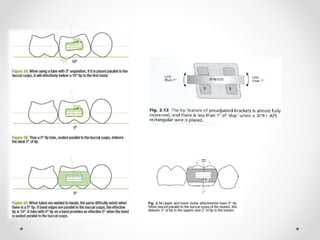
  • #28 CANINE ; tip feature of pre adjusted bracket is fully expressed when .019/.025 wire in upper canine .8 degree and 7 degree is expressed Molar 0 degree tip recommended Upper premolar author prefer 0 tip with compared tp that 2 degree tip of SWA,crowns of the teeth more upright ,anchorage needs .
  • #29 Torque is not efficently expressed in contrast tip and in out features . 2 mechanical reasons Area of torque application is small and depends on the twist effect of realtively small wire compared to bulk of the tooth .in order to slide in normal practice we use 19/25 in 022 slot .full thickness wire prevent sliding .10 degree slop….
  • #30 As a result of inefficacy of preadjusted brackets delivering torque extra torque was added to insicors ,molar & lower premolar
  • #33 Thre is generally need for greater palatal root torque of the upper incisors and labial root toque of lowers.
  • #34 Upper canine -7 proved to be satisfactory but original SWA value of -11 torque for lower canine has not been satisfactory as tends to leave the canine in a more prominent position. Canine bracket has got versitality upper 7.-7 ,0 and lower 6,-6,0
  • #35 For upper premolar -7 proved to satisfactory in clinical use For upper molars -9 of original SWA has proven inadequate and they prefer -14.better control of palatal cusp,reduce interfereneces during fuctions and prevent frm hanging
  • #39 Coil spring is used to create space
  • #40 Assist labial root torque in rectangular wire
  • #48 Hook as it is often considered for cases which require canine retraction or class ii mechanics
  • #53 O degree tip
  • #54 -14 torque 0 tip and 10 antirotation
  • #55 After xtraction of two upper premolars it helpful finishing and detailing Lower second molars have 0 rotation (compared to 10 degree upper) and normally in these cases it is appropriate to encourage upper molar to rotate mesio-palatallly.
  • #59 Important to view from correct prespective
  • #61 Incisors it placed 90 degree to labial surface In canine and premolar area it placed parallel to occlusal plane In the molar region ,gauge is placed parellel to occlusal surface individual molar tooth
  • #63 Non Converatble tubes often preferable to convertible tubes ,cos they are less bulky , Stonger ,more comforable and cause fewer interferences
  • #73 Bracket postioning chart . Measure tooth size either from the patients mouth or plaster models .a row could be chosen for upper arch and a row for lower . Gauges is used placed these measurements