Paradigmatic Struggles in Academia  Emerging Difficulties with Delivering Learning Online Kelly Edmonds University of Calgary
Main topics 1. Trends in Online Learning   2. Fundamental Issues 3. Organizational Implications   2a. Economic Forces 2b. Philosophical Resistance 2c. Political Tensions Context: Mainstream North American universities
Higher Education Pressures Knowledge-driven economies Emerging technologies Mobility of people Growing student enrolment Changing student demographics Lifelong learning needs Globalization – broader markets
Offering distance education in online, internet-based environments fulfills a need, and emerges as a favoured method by allowing for more diversified and flexible education through multimedia and advanced communication technologies
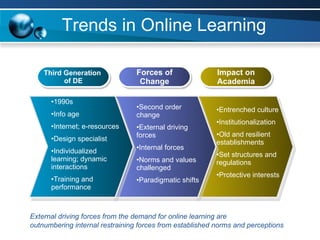
Trends in Online Learning Third Generation  of DE Forces of Change Impact on Academia 1990s Info age Internet; e-resources Design specialist Individualized learning; dynamic interactions Training and performance Second order change External driving forces Internal forces Norms and values challenged Paradigmatic shifts Entrenched culture Institutionalization Old and resilient establishments Set structures and regulations Protective interests External driving forces from the demand for online learning are  outnumbering internal restraining forces from established norms and perceptions
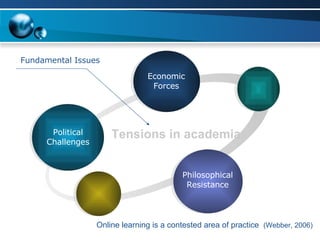
Economic Forces Philosophical Resistance Political Challenges Tensions in academia Fundamental Issues Online learning is a contested area of practice  (Webber, 2006)
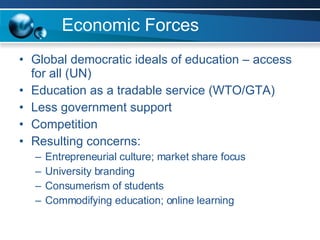
Economic Forces Global democratic ideals of education – access for all (UN) Education as a tradable service (WTO/GTA) Less government support Competition Resulting concerns: Entrepreneurial culture; market share focus University branding Consumerism of students Commodifying education; online learning
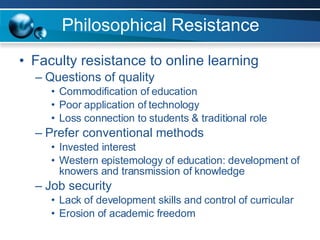
Philosophical Resistance Faculty resistance to online learning Questions of quality Commodification of education Poor application of technology Loss connection to students & traditional role Prefer conventional methods Invested interest Western epistemology of education: development of knowers and transmission of knowledge Job security Lack of development skills and control of curricular Erosion of academic freedom
Political Challenges of Leaders Macro level Global competition; for-profit institutions Competing budgets Institutional level Academic structure, governance, policies restrictive Lack of e-learning policies Micro level Academic freedom; faculty member resistance Role as change agent
If online learning as a delivery method is deemed worthwhile, a change in institutional culture on all levels will be necessary. Moore (2004)
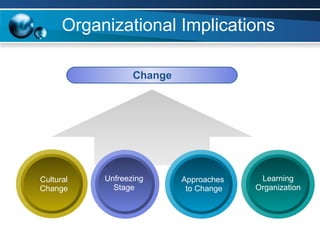
Organizational Implications Change Cultural Change Approaches  to Change Unfreezing Stage Learning Organization
Cultural Changes Changing existing culture Protection of norms and values Second order change Deliberate Drastic Disequilibrium Threatening  Difficult to implement
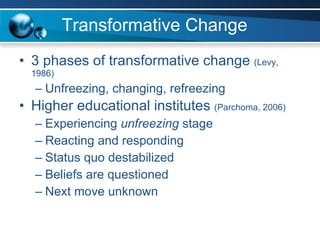
Transformative Change 3 phases of transformative change  (Levy, 1986) Unfreezing, changing, refreezing Higher educational institutes  (Parchoma, 2006) Experiencing  unfreezing  stage Reacting and responding Status quo destabilized Beliefs are questioned Next move unknown
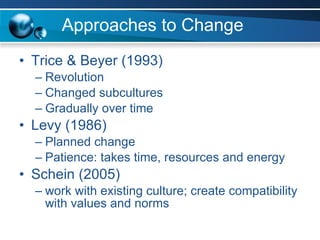
Approaches to Change Trice & Beyer (1993) Revolution Changed subcultures Gradually over time  Levy (1986) Planned change Patience: takes time, resources and energy Schein (2005) work with existing culture; create compatibility with values and norms
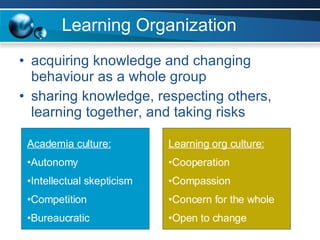
Learning Organization acquiring knowledge and changing behaviour as a whole group  sharing knowledge, respecting others, learning together, and taking risks  Academia culture: Autonomy Intellectual skepticism Competition Bureaucratic Learning org culture: Cooperation Compassion Concern for the whole Open to change
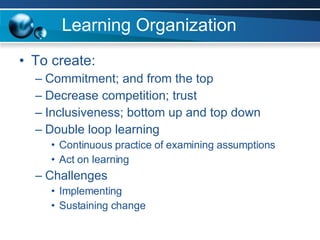
Learning Organization To create: Commitment; and from the top Decrease competition; trust Inclusiveness; bottom up and top down Double loop learning Continuous practice of examining assumptions Act on learning Challenges  Implementing Sustaining change
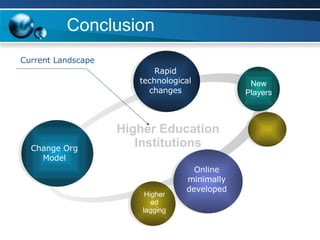
Conclusion Change Org Model Rapid technological changes Online minimally developed Higher Education Institutions Current Landscape New Players Higher ed lagging

CNIE: Paradigmatic Struggles In Academia

  • 1.
    Paradigmatic Struggles inAcademia Emerging Difficulties with Delivering Learning Online Kelly Edmonds University of Calgary
  • 2.
    Main topics 1.Trends in Online Learning 2. Fundamental Issues 3. Organizational Implications 2a. Economic Forces 2b. Philosophical Resistance 2c. Political Tensions Context: Mainstream North American universities
  • 3.
    Higher Education PressuresKnowledge-driven economies Emerging technologies Mobility of people Growing student enrolment Changing student demographics Lifelong learning needs Globalization – broader markets
  • 4.
    Offering distance educationin online, internet-based environments fulfills a need, and emerges as a favoured method by allowing for more diversified and flexible education through multimedia and advanced communication technologies
  • 5.
    Trends in OnlineLearning Third Generation of DE Forces of Change Impact on Academia 1990s Info age Internet; e-resources Design specialist Individualized learning; dynamic interactions Training and performance Second order change External driving forces Internal forces Norms and values challenged Paradigmatic shifts Entrenched culture Institutionalization Old and resilient establishments Set structures and regulations Protective interests External driving forces from the demand for online learning are outnumbering internal restraining forces from established norms and perceptions
  • 6.
    Economic Forces PhilosophicalResistance Political Challenges Tensions in academia Fundamental Issues Online learning is a contested area of practice (Webber, 2006)
  • 7.
    Economic Forces Globaldemocratic ideals of education – access for all (UN) Education as a tradable service (WTO/GTA) Less government support Competition Resulting concerns: Entrepreneurial culture; market share focus University branding Consumerism of students Commodifying education; online learning
  • 8.
    Philosophical Resistance Facultyresistance to online learning Questions of quality Commodification of education Poor application of technology Loss connection to students & traditional role Prefer conventional methods Invested interest Western epistemology of education: development of knowers and transmission of knowledge Job security Lack of development skills and control of curricular Erosion of academic freedom
  • 9.
    Political Challenges ofLeaders Macro level Global competition; for-profit institutions Competing budgets Institutional level Academic structure, governance, policies restrictive Lack of e-learning policies Micro level Academic freedom; faculty member resistance Role as change agent
  • 10.
    If online learningas a delivery method is deemed worthwhile, a change in institutional culture on all levels will be necessary. Moore (2004)
  • 11.
    Organizational Implications ChangeCultural Change Approaches to Change Unfreezing Stage Learning Organization
  • 12.
    Cultural Changes Changingexisting culture Protection of norms and values Second order change Deliberate Drastic Disequilibrium Threatening Difficult to implement
  • 13.
    Transformative Change 3phases of transformative change (Levy, 1986) Unfreezing, changing, refreezing Higher educational institutes (Parchoma, 2006) Experiencing unfreezing stage Reacting and responding Status quo destabilized Beliefs are questioned Next move unknown
  • 14.
    Approaches to ChangeTrice & Beyer (1993) Revolution Changed subcultures Gradually over time Levy (1986) Planned change Patience: takes time, resources and energy Schein (2005) work with existing culture; create compatibility with values and norms
  • 15.
    Learning Organization acquiringknowledge and changing behaviour as a whole group sharing knowledge, respecting others, learning together, and taking risks Academia culture: Autonomy Intellectual skepticism Competition Bureaucratic Learning org culture: Cooperation Compassion Concern for the whole Open to change
  • 16.
    Learning Organization Tocreate: Commitment; and from the top Decrease competition; trust Inclusiveness; bottom up and top down Double loop learning Continuous practice of examining assumptions Act on learning Challenges Implementing Sustaining change
  • 17.
    Conclusion Change OrgModel Rapid technological changes Online minimally developed Higher Education Institutions Current Landscape New Players Higher ed lagging