Influence of Instructor Behaviors on Student Perceptions of the Online Learning Experience Sheri Beasley, Ph.D. – Baker College
Agenda Study Introduction Relevant Literature Findings Theoretical Orientation  Baker College Online Methodology Sample Variable Mean Bivariate Correlations Research Questions/Hypotheses Study Findings Implications & Implications for Practice Future Research  Real-Use Benefits & Best Practices
Study Introduction Study examined Student Perceptions in the Online Learning Experience (OLE) Instructor Behaviors (IVs) Extent of Interactions Type of Interactions Quality of Feedback Perceived Student Learning (DV) General Course Satisfaction (DV)
Study Introduction (cont.) IV and DV relationships also examined covariates Age Gender Number of online courses taken (experience) Class size/Course duration
Relevant Literature Findings Asynchronous discussion boards Interaction is necessary and instructor needs to have a presence Student perceptions of the OLE Important to examine further
Relevant Literature Findings (cont.) Online instructor behaviors Interaction is vital  Instructor has multi-faceted role Feedback essential and needs to be timely Instructor-student interaction Some controversy on types of interaction, need for further research
Relevant Literature Findings (cont.) Covariates No significance of gender in recent studies Age groups – learners are diverse – some studies found no differences Experience with online courses showed some contrasts Class size showed discrepancies in literature, need for further research Course duration had scant literature for online classes and inconsistent
Theoretical Orientation Moore’s Transactional Distance Theory Introduced 1972 and recognized 1980 Relevant for distance learning Systems approach that includes instructor-student interaction
Baker College Online Online 1996 Curriculum – Student learning objectives are the same in system (campus or online class) 15,000 students taking online courses at any one time 70 staff/Online & Grad 700+ Faculty (all but six/grad are adjunct) Every 12 weeks offer 1,300 sections (two six-week terms) 600 sections are business 127 different business classes 300+ courses between  BUS/CIS/Health & Gen Ed Max class size 13
Methodology Non-experimental research design Sample size 175 (203 participants obtained) Validated survey instrument using Likert-type scale 1-7 Pilot study (14 valid responses) Survey invitation provided link to Hosted Survey SPSS software used to analyze data Descriptive and bivariate analyses Multivariate – hierarchical multiple regression (RQ1, RQ2, and RQ3) Perceived student learning, extent and type of interactions, covariates General course satisfaction, extent and type of interactions, covariates Perceived student learning, feedback, extent and type of interactions, covariates  General course satisfaction, feedback, extent and type of interactions, covariates ANCOVA (RQ4) examined perceived student learning and class size/course duration
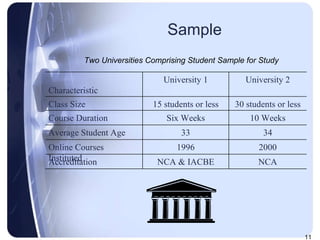
Sample Two Universities Comprising Student Sample for Study NCA NCA & IACBE Accreditation 2000 1996 Online Courses Instituted 34 33 Average Student Age 10 Weeks Six Weeks Course Duration 30 students or less 15 students or less Class Size University 2 University 1 Characteristic
Sample (cont.) Winter 2006/2007 survey via Hosted Survey Sample - 203 undergrad business students University 1 - 117 (58%) University 2 – 86 (42%) Female – 148 (73%) Age group – 32 years or older – 131 (65%) Attended school full-time – 126 (62%) Worked full-time – 158 (78%) Taken 7 or more online courses – 72 (36%) Associate – 91 (45%) Bachelor’s – 112 (55%)
Variable Mean Results Likert-type scale 1-7  (1= strongly disagree and 7 = strongly agree) Variable Mean Perceived student learning & general course satisfaction ( M  = 6 “ agree ”) Positive response for both Extent of interactions ( M  = 6 “ agree ”) Type of interactions ( M  = 5 “ slightly agree ”) Individual Instructor Feedback ( M  = 6 “ agree ”) All three instructor behaviors showed a positive response on survey scale
Bivariate Correlations Statistically significant relationships 56% shared variance between levels of  perceived student learning  and  general course satisfaction If student satisfied reasonable to believe experience good 35% shared variance between levels of  perceived student learning  and  extent of interactions  29% shared variance between levels of  perceived student learning  and  type of interactions  27% shared variance between levels of  perceived student learning  and  individual instructor feedback  All three instructor behaviors account for perceived student learning
Bivariate Correlations (cont.) 34% shared variance between levels of  general course satisfaction  and  extent of interactions  23% shared variance between levels of  general course satisfaction  and  type of interactions 18% shared variance between levels of  general course satisfaction  and  individual instructor feedback All three instructor behaviors account for general course satisfaction
Bivariate Correlations (cont.) 58% shared variance between  extent of interactions  and  type of interactions 52% shared variance between  extent of interactions  and  individual instructor feedback 59% shared variance between  type of interactions  and  individual instructor feedback Tone of feedback and way it is personalized could be very important to the student’s online learning experience Little if any correlation  No significant relationship for covariates
Research Question 1 RQ 1: Do levels of perceived student learning in the OLE vary with respect to the extent (extent of interactions) and manner (type of interactions that are of a personable demeanor) in which instructors interact with students in asynchronous discussion boards? Does this relationship vary with respect to: (a) student age group, (b) gender, and (c) class size/course duration controlling for (d) experience with online courses?
RQ1/Hypotheses Reject null in favor of alternate hypothesis H1a1 There is a significant relationship between perceived student learning in the OLE and instructor interaction with students.  36% of the variation in levels of  perceived student learning  can be predicted by two instructor behaviors,  extent of interactions   (largest unique contribution)   and   type of interactions As ratings of instructor behaviors increased, levels of  perceived student learning  increased
RQ1/Hypotheses (cont.) H1b0 There is no relationship between perceived student learning in the OLE and instructor interaction with students with respect to (a) student age group, (b) gender, and (c) class size/course duration and controlling for (d) experience with online courses.  Cannot reject the null hypothesis because none of the covariates were statistically significant
Research Question 2 RQ 2: Does general course satisfaction in the OLE vary with respect to the extent and manner in which instructors interact with students in asynchronous discussion boards? Does this relationship vary with respect to: (a) student age group, (b) gender, and (c) class size/course duration, controlling for (d) experience with online courses?
RQ2/Hypotheses Reject null hypothesis in favor of alternate H2a1 There is a significant relationship between general course satisfaction in the OLE and instructor interaction with students in asynchronous discussion boards.  35% of the variation in levels of  general course satisfaction  can be predicted by one instructor behavior,  extent of interactions As  extent of instructor interactions   increased,  general course satisfaction   increased Note: Only  extent of interactions  was statistically significant
RQ2/Hypotheses (cont.) H2b0 There is no relationship between general course satisfaction in the OLE and instructor interaction with students in asynchronous discussion boards with respect to (a) student age group, (b) gender, and (c) class size/course duration and controlling for (d) experience with online courses.  Cannot reject the null hypothesis because none of the covariates were statistically significant
Research Question 3 RQ 3: Does the relationship between levels of perceived student learning in the OLE and the extent and manner in which instructors interact with students in asynchronous discussion boards vary with respect to the perceived quality of individual instructor feedback? i.e., Does the perceived quality of individual instructor feedback have a greater effect on levels of perceived student learning and general course satisfaction than the effect of instructor interactions (extent and type) in the asynchronous discussion forum?
RQ3/Hypotheses Reject null hypothesis in favor of alternate H3a1 There is a significant relationship between levels of perceived student learning in the OLE and the extent and manner in which instructors interact with students in asynchronous discussion boards with respect to perceived quality of individual instructor feedback to the student. 37% of the total variation from Stage 1 (26%) to Stage 2 (11%) in levels of  perceived student learning   can be accounted for by the perceived quality of  individual instructor feedback  and  extent of interactions
RQ3/Hypotheses (cont.) Reject null hypothesis in favor of alternate H3b1 There is a significant relationship between general course satisfaction and the extent and manner in which instructors interact with students in asynchronous discussion boards with respect to perceived quality of individual instructor feedback to student. 35% of the total variation from Stage 2 (19%) to Stage 3 (16%) in levels of  general course satisfaction   can be accounted for by two instructor behaviors, perceived quality of  individual instructor feedback,  and  extent of interactions
RQ3/Hypotheses (cont.) H3c0 There is no difference in the effect of individual instructor feedback on levels of perceived student learning with respect to age group and/or gender. H3d0 There is no difference in the effect of individual instructor feedback on general course satisfaction with respect to age group and/or gender. Cannot reject ‘c’ or ‘d’ null hypotheses because none of the covariates were statistically significant
Research Question 4 RQ 4: Is there a difference between class size/course duration (15 or fewer students in 6-week courses and 30 or fewer students in 10-week courses) with respect to levels of perceived student learning? Do differences between 6- and 10- week courses   and perceived learning vary with respect to (a) student age group, (b) gender, and (c) number of online courses taken?
Research Question 4/Hypotheses H4a0 There is no difference between class size/course duration (15 or fewer students in 6-week courses and 30 or fewer students in 10-week courses) with respect to levels of perceived student learning. H4b0 There is no difference between class size/course duration (15 or fewer students in 6-week courses and 30 or fewer students in 10-week courses) with respect to levels of perceived student learning with respect to (a) student age group, (b) gender, and (c) number of online courses taken. Cannot reject the ‘a’ null hypothesis because none of the variables were statistically significant Cannot reject the ‘b’ null hypothesis because no statistical significant interactions were found among the variables
Study Findings Majority of students felt they benefited from the online learning experience (OLE), learned course material and are able to apply information Two universities (sample) are achieving objectives to prepare students for business world so the graduate is employable Majority of students very satisfied with OLE Many online instructors at two universities are utilizing ‘extent of interactions’
Implications Variable Mean Highlights  All three instructor behaviors are significant from student perspectives Extent of interactions  and  individual instructor feedback  had a greater statistical significance than  type of interactions Perceived student learning  and  general course satisfaction  are equal and students were satisfied with learning and course Conclusions Educators can determine best practices for faculty teaching expectations Educators can provide necessary training to faculty  Educators can understand the interaction components most valuable to students
Implications (cont.) Correlations Highlights  Perceived student learning  and  general course satisfaction  are both high/positive Extent of interactions, type of interactions , and  individual instructor feedback  are statistically significant for  perceived student learning  and  general course satisfaction Extent of interactions  have the greatest statistical significance of all three instructor behaviors for  perceived student learning  and  general course satisfaction Each instructor behavior demonstrated a statistically significant relationship with the other two Conclusions  Logical that  perceived student learning  and  general course satisfaction  would be dependent upon each other Students satisfied with learning are likely to be satisfied with course Instructor behaviors influence students  perceived student learning  and  general course satisfaction   The more instructor interaction, the higher the student’s perception of learning Instructor behaviors has an effect on online learning experience (OLE) Need to humanize the OLE and create learning climate for students Instructor sets the tone for the classroom
Implications (cont.) Two-Step Hierarchical Regression Analysis Perceived Student Learning (RQ1) Highlights  Extent of interactions  and  type of interactions  predicted levels of  perceived student learning Conclusions Logical that  extent of interactions  and  type of interactions   impact  perceived student learning Instructor interaction would help students understand material
Implications (cont.)  General Course Satisfaction (RQ2) Highlights  Only  extent of interactions  predicted  general course satisfaction Conclusions  When instructor interaction increased, course satisfaction increased Instructor needs to have a presence in the virtual classroom Ties back to Moore’s transactional distance theory
Implications (cont.) Three-Step Hierarchical Regression Analysis (RQ3) Individual Instructor Feedback Highlights  Perceived student learning  and  general course satisfaction  can be predicted by  individual instructor feedback  in Step 2 Perceived student learning  and  general course satisfaction  can be predicted by  extent of interactions  in Step 3 Conclusions  Feedback impacts learning and course satisfaction Quality and timely feedback is important Extent of interactions makes a greater impact on student perceptions of the online learning experience and supersedes feedback Quantity (or extent) of interaction influences to students
Implications (cont.) ANCOVA – Class Size/Course Duration (RQ4) Highlights – no statistical significance Conclusions Smaller or larger groups do not make a difference to students Length of class does not make a difference to students
Implications (cont.) Summary All three instructor behaviors are significant Extent of interactions  had the greatest contribution to model, followed by  individual instructor feedback , and  type of interactions Online instructors need to: Have frequent interaction in discussion boards Provide timely and quality feedback on work submitted by each student Be aware that  extent of interaction  is the most important element that contributes to  perceived student learning  and  general course satisfaction There is a strong connection between  extent of interactions  and quality of  individual instructor feedback  to students – these factors are important to the student’s online learning experience and have implications for online faculty, training, administrative functions, and policies and procedures in the online university
Implications for Practice Instructors/Instructional Practices Impact instructor behaviors can have on student’s perception of the online learning experience  Extent of interactions  and timely  individual instructor feedback  make greatest positive difference in  perceived student learning  and  general course satisfaction  Need for dialogue and communication Type of interactions  includes sharing real-life expertise Feedback templates and customize Meaningful quality and timely feedback best practice Extent of interactions  is most important – daily interaction – instructor presence and visibility in the classroom
Implications for Practice (cont.) Instructor Preparation/Training Professional development  Visibility and presence in classroom, communications, timely and quality feedback New faculty training and mentoring/peer observation
Implications for Practice (cont.) Administrative Practices Extent of interactions and feedback requirements – best practices Recruit faculty who are willing to meet best practices  Repeated training and professional development
Implications for Practice (cont.) Institutional Policies and Practices Extent of interactions required Feedback requirements mandated
Future Research Recommendations for Future Research Replicate Study in Other Environments Explore Extent of Interactions Explore Individual Instructor Feedback Explore Best Practices Explore Exemplary Instructor Attributes Explore Instructor Teaching Styles Explore Instructor Personalities and Teaching Disciplines Professional Development Student Learning Styles Compared to Instructor Behaviors Class Size and/or Course Duration Covariate From a  Faculty Perspective Discussion Board Threads
Real-Use Benefits  & Best Practices Faculty Bio Be a ‘real person’ to your students Warm and friendly Welcome Message Sets tone of class Weekly Announcements Wrap-up and introduction to new week Grading completed & feedback available
Benefits & Best Practices (cont.) Utilize student nicknames they prefer Discussion Board forums are locations for discussion and interaction between the students and the faculty member Create templates to grade and customize for each student’s work Sandwich method feedback Suggest ways students can strengthen weak areas
Benefits & Best Practices (cont.) First Week of Class Check your class discussion boards AM and PM  Initiate a new thread (warm and friendly response that reflects their personal interests) to welcome each student after they submit homepage (within 24 hours) Be active and visible in discussion boards – you set the class tone Use conversation starters, and use variety of ways/items to engage students on topic(s) covered in class week – keep your class interesting! Answer questions ASAP (within 24 hours) Grade assignment work ASAP so students know what you expect Hello Students!
Benefits & Best Practices (cont.) Be Visible and Present in DBs Plan ahead!  Be prepared! Be visible daily! Engage students! Add value (ask questions to encourage  critical thinking and draw students out, share expertise, provide handouts, relevant Internet links to expand on topic, current events, YouTube or other videos, motivational thought or topic related quote, etc.)!  Respond to Questions!
Benefits & Best Practices (cont.)   Ideas to Engage Students Keep the class discussion boards interesting Interactive items are great (i.e., video, games, fun quiz, simulations, or a web field trip) Optional exercises can help to broaden perspective Add additional questions
Benefits & Best Practices (cont.)   Ideas to Engage Students Use a motivational quote on topic  Incorporate relevant current events  Use a variety of topic items to encourage critical thinking (i.e., handout) Have something in the discussion board daily students can comment on
Questions?
References Beasley, S.L. (2007).  Influence of instructor behaviors on student perceptions of the online learning experience.  (Doctoral Dissertation, Touro University International, 2007).   (UMI No. 3282352)
10 29 09 Sloan C

  • 1.
    Influence of InstructorBehaviors on Student Perceptions of the Online Learning Experience Sheri Beasley, Ph.D. – Baker College
  • 2.
    Agenda Study IntroductionRelevant Literature Findings Theoretical Orientation Baker College Online Methodology Sample Variable Mean Bivariate Correlations Research Questions/Hypotheses Study Findings Implications & Implications for Practice Future Research Real-Use Benefits & Best Practices
  • 3.
    Study Introduction Studyexamined Student Perceptions in the Online Learning Experience (OLE) Instructor Behaviors (IVs) Extent of Interactions Type of Interactions Quality of Feedback Perceived Student Learning (DV) General Course Satisfaction (DV)
  • 4.
    Study Introduction (cont.)IV and DV relationships also examined covariates Age Gender Number of online courses taken (experience) Class size/Course duration
  • 5.
    Relevant Literature FindingsAsynchronous discussion boards Interaction is necessary and instructor needs to have a presence Student perceptions of the OLE Important to examine further
  • 6.
    Relevant Literature Findings(cont.) Online instructor behaviors Interaction is vital Instructor has multi-faceted role Feedback essential and needs to be timely Instructor-student interaction Some controversy on types of interaction, need for further research
  • 7.
    Relevant Literature Findings(cont.) Covariates No significance of gender in recent studies Age groups – learners are diverse – some studies found no differences Experience with online courses showed some contrasts Class size showed discrepancies in literature, need for further research Course duration had scant literature for online classes and inconsistent
  • 8.
    Theoretical Orientation Moore’sTransactional Distance Theory Introduced 1972 and recognized 1980 Relevant for distance learning Systems approach that includes instructor-student interaction
  • 9.
    Baker College OnlineOnline 1996 Curriculum – Student learning objectives are the same in system (campus or online class) 15,000 students taking online courses at any one time 70 staff/Online & Grad 700+ Faculty (all but six/grad are adjunct) Every 12 weeks offer 1,300 sections (two six-week terms) 600 sections are business 127 different business classes 300+ courses between BUS/CIS/Health & Gen Ed Max class size 13
  • 10.
    Methodology Non-experimental researchdesign Sample size 175 (203 participants obtained) Validated survey instrument using Likert-type scale 1-7 Pilot study (14 valid responses) Survey invitation provided link to Hosted Survey SPSS software used to analyze data Descriptive and bivariate analyses Multivariate – hierarchical multiple regression (RQ1, RQ2, and RQ3) Perceived student learning, extent and type of interactions, covariates General course satisfaction, extent and type of interactions, covariates Perceived student learning, feedback, extent and type of interactions, covariates General course satisfaction, feedback, extent and type of interactions, covariates ANCOVA (RQ4) examined perceived student learning and class size/course duration
  • 11.
    Sample Two UniversitiesComprising Student Sample for Study NCA NCA & IACBE Accreditation 2000 1996 Online Courses Instituted 34 33 Average Student Age 10 Weeks Six Weeks Course Duration 30 students or less 15 students or less Class Size University 2 University 1 Characteristic
  • 12.
    Sample (cont.) Winter2006/2007 survey via Hosted Survey Sample - 203 undergrad business students University 1 - 117 (58%) University 2 – 86 (42%) Female – 148 (73%) Age group – 32 years or older – 131 (65%) Attended school full-time – 126 (62%) Worked full-time – 158 (78%) Taken 7 or more online courses – 72 (36%) Associate – 91 (45%) Bachelor’s – 112 (55%)
  • 13.
    Variable Mean ResultsLikert-type scale 1-7 (1= strongly disagree and 7 = strongly agree) Variable Mean Perceived student learning & general course satisfaction ( M = 6 “ agree ”) Positive response for both Extent of interactions ( M = 6 “ agree ”) Type of interactions ( M = 5 “ slightly agree ”) Individual Instructor Feedback ( M = 6 “ agree ”) All three instructor behaviors showed a positive response on survey scale
  • 14.
    Bivariate Correlations Statisticallysignificant relationships 56% shared variance between levels of perceived student learning and general course satisfaction If student satisfied reasonable to believe experience good 35% shared variance between levels of perceived student learning and extent of interactions 29% shared variance between levels of perceived student learning and type of interactions 27% shared variance between levels of perceived student learning and individual instructor feedback All three instructor behaviors account for perceived student learning
  • 15.
    Bivariate Correlations (cont.)34% shared variance between levels of general course satisfaction and extent of interactions 23% shared variance between levels of general course satisfaction and type of interactions 18% shared variance between levels of general course satisfaction and individual instructor feedback All three instructor behaviors account for general course satisfaction
  • 16.
    Bivariate Correlations (cont.)58% shared variance between extent of interactions and type of interactions 52% shared variance between extent of interactions and individual instructor feedback 59% shared variance between type of interactions and individual instructor feedback Tone of feedback and way it is personalized could be very important to the student’s online learning experience Little if any correlation No significant relationship for covariates
  • 17.
    Research Question 1RQ 1: Do levels of perceived student learning in the OLE vary with respect to the extent (extent of interactions) and manner (type of interactions that are of a personable demeanor) in which instructors interact with students in asynchronous discussion boards? Does this relationship vary with respect to: (a) student age group, (b) gender, and (c) class size/course duration controlling for (d) experience with online courses?
  • 18.
    RQ1/Hypotheses Reject nullin favor of alternate hypothesis H1a1 There is a significant relationship between perceived student learning in the OLE and instructor interaction with students. 36% of the variation in levels of perceived student learning can be predicted by two instructor behaviors, extent of interactions (largest unique contribution) and type of interactions As ratings of instructor behaviors increased, levels of perceived student learning increased
  • 19.
    RQ1/Hypotheses (cont.) H1b0There is no relationship between perceived student learning in the OLE and instructor interaction with students with respect to (a) student age group, (b) gender, and (c) class size/course duration and controlling for (d) experience with online courses. Cannot reject the null hypothesis because none of the covariates were statistically significant
  • 20.
    Research Question 2RQ 2: Does general course satisfaction in the OLE vary with respect to the extent and manner in which instructors interact with students in asynchronous discussion boards? Does this relationship vary with respect to: (a) student age group, (b) gender, and (c) class size/course duration, controlling for (d) experience with online courses?
  • 21.
    RQ2/Hypotheses Reject nullhypothesis in favor of alternate H2a1 There is a significant relationship between general course satisfaction in the OLE and instructor interaction with students in asynchronous discussion boards. 35% of the variation in levels of general course satisfaction can be predicted by one instructor behavior, extent of interactions As extent of instructor interactions increased, general course satisfaction increased Note: Only extent of interactions was statistically significant
  • 22.
    RQ2/Hypotheses (cont.) H2b0There is no relationship between general course satisfaction in the OLE and instructor interaction with students in asynchronous discussion boards with respect to (a) student age group, (b) gender, and (c) class size/course duration and controlling for (d) experience with online courses. Cannot reject the null hypothesis because none of the covariates were statistically significant
  • 23.
    Research Question 3RQ 3: Does the relationship between levels of perceived student learning in the OLE and the extent and manner in which instructors interact with students in asynchronous discussion boards vary with respect to the perceived quality of individual instructor feedback? i.e., Does the perceived quality of individual instructor feedback have a greater effect on levels of perceived student learning and general course satisfaction than the effect of instructor interactions (extent and type) in the asynchronous discussion forum?
  • 24.
    RQ3/Hypotheses Reject nullhypothesis in favor of alternate H3a1 There is a significant relationship between levels of perceived student learning in the OLE and the extent and manner in which instructors interact with students in asynchronous discussion boards with respect to perceived quality of individual instructor feedback to the student. 37% of the total variation from Stage 1 (26%) to Stage 2 (11%) in levels of perceived student learning can be accounted for by the perceived quality of individual instructor feedback and extent of interactions
  • 25.
    RQ3/Hypotheses (cont.) Rejectnull hypothesis in favor of alternate H3b1 There is a significant relationship between general course satisfaction and the extent and manner in which instructors interact with students in asynchronous discussion boards with respect to perceived quality of individual instructor feedback to student. 35% of the total variation from Stage 2 (19%) to Stage 3 (16%) in levels of general course satisfaction can be accounted for by two instructor behaviors, perceived quality of individual instructor feedback, and extent of interactions
  • 26.
    RQ3/Hypotheses (cont.) H3c0There is no difference in the effect of individual instructor feedback on levels of perceived student learning with respect to age group and/or gender. H3d0 There is no difference in the effect of individual instructor feedback on general course satisfaction with respect to age group and/or gender. Cannot reject ‘c’ or ‘d’ null hypotheses because none of the covariates were statistically significant
  • 27.
    Research Question 4RQ 4: Is there a difference between class size/course duration (15 or fewer students in 6-week courses and 30 or fewer students in 10-week courses) with respect to levels of perceived student learning? Do differences between 6- and 10- week courses and perceived learning vary with respect to (a) student age group, (b) gender, and (c) number of online courses taken?
  • 28.
    Research Question 4/HypothesesH4a0 There is no difference between class size/course duration (15 or fewer students in 6-week courses and 30 or fewer students in 10-week courses) with respect to levels of perceived student learning. H4b0 There is no difference between class size/course duration (15 or fewer students in 6-week courses and 30 or fewer students in 10-week courses) with respect to levels of perceived student learning with respect to (a) student age group, (b) gender, and (c) number of online courses taken. Cannot reject the ‘a’ null hypothesis because none of the variables were statistically significant Cannot reject the ‘b’ null hypothesis because no statistical significant interactions were found among the variables
  • 29.
    Study Findings Majorityof students felt they benefited from the online learning experience (OLE), learned course material and are able to apply information Two universities (sample) are achieving objectives to prepare students for business world so the graduate is employable Majority of students very satisfied with OLE Many online instructors at two universities are utilizing ‘extent of interactions’
  • 30.
    Implications Variable MeanHighlights All three instructor behaviors are significant from student perspectives Extent of interactions and individual instructor feedback had a greater statistical significance than type of interactions Perceived student learning and general course satisfaction are equal and students were satisfied with learning and course Conclusions Educators can determine best practices for faculty teaching expectations Educators can provide necessary training to faculty Educators can understand the interaction components most valuable to students
  • 31.
    Implications (cont.) CorrelationsHighlights Perceived student learning and general course satisfaction are both high/positive Extent of interactions, type of interactions , and individual instructor feedback are statistically significant for perceived student learning and general course satisfaction Extent of interactions have the greatest statistical significance of all three instructor behaviors for perceived student learning and general course satisfaction Each instructor behavior demonstrated a statistically significant relationship with the other two Conclusions Logical that perceived student learning and general course satisfaction would be dependent upon each other Students satisfied with learning are likely to be satisfied with course Instructor behaviors influence students perceived student learning and general course satisfaction The more instructor interaction, the higher the student’s perception of learning Instructor behaviors has an effect on online learning experience (OLE) Need to humanize the OLE and create learning climate for students Instructor sets the tone for the classroom
  • 32.
    Implications (cont.) Two-StepHierarchical Regression Analysis Perceived Student Learning (RQ1) Highlights Extent of interactions and type of interactions predicted levels of perceived student learning Conclusions Logical that extent of interactions and type of interactions impact perceived student learning Instructor interaction would help students understand material
  • 33.
    Implications (cont.) General Course Satisfaction (RQ2) Highlights Only extent of interactions predicted general course satisfaction Conclusions When instructor interaction increased, course satisfaction increased Instructor needs to have a presence in the virtual classroom Ties back to Moore’s transactional distance theory
  • 34.
    Implications (cont.) Three-StepHierarchical Regression Analysis (RQ3) Individual Instructor Feedback Highlights Perceived student learning and general course satisfaction can be predicted by individual instructor feedback in Step 2 Perceived student learning and general course satisfaction can be predicted by extent of interactions in Step 3 Conclusions Feedback impacts learning and course satisfaction Quality and timely feedback is important Extent of interactions makes a greater impact on student perceptions of the online learning experience and supersedes feedback Quantity (or extent) of interaction influences to students
  • 35.
    Implications (cont.) ANCOVA– Class Size/Course Duration (RQ4) Highlights – no statistical significance Conclusions Smaller or larger groups do not make a difference to students Length of class does not make a difference to students
  • 36.
    Implications (cont.) SummaryAll three instructor behaviors are significant Extent of interactions had the greatest contribution to model, followed by individual instructor feedback , and type of interactions Online instructors need to: Have frequent interaction in discussion boards Provide timely and quality feedback on work submitted by each student Be aware that extent of interaction is the most important element that contributes to perceived student learning and general course satisfaction There is a strong connection between extent of interactions and quality of individual instructor feedback to students – these factors are important to the student’s online learning experience and have implications for online faculty, training, administrative functions, and policies and procedures in the online university
  • 37.
    Implications for PracticeInstructors/Instructional Practices Impact instructor behaviors can have on student’s perception of the online learning experience Extent of interactions and timely individual instructor feedback make greatest positive difference in perceived student learning and general course satisfaction Need for dialogue and communication Type of interactions includes sharing real-life expertise Feedback templates and customize Meaningful quality and timely feedback best practice Extent of interactions is most important – daily interaction – instructor presence and visibility in the classroom
  • 38.
    Implications for Practice(cont.) Instructor Preparation/Training Professional development Visibility and presence in classroom, communications, timely and quality feedback New faculty training and mentoring/peer observation
  • 39.
    Implications for Practice(cont.) Administrative Practices Extent of interactions and feedback requirements – best practices Recruit faculty who are willing to meet best practices Repeated training and professional development
  • 40.
    Implications for Practice(cont.) Institutional Policies and Practices Extent of interactions required Feedback requirements mandated
  • 41.
    Future Research Recommendationsfor Future Research Replicate Study in Other Environments Explore Extent of Interactions Explore Individual Instructor Feedback Explore Best Practices Explore Exemplary Instructor Attributes Explore Instructor Teaching Styles Explore Instructor Personalities and Teaching Disciplines Professional Development Student Learning Styles Compared to Instructor Behaviors Class Size and/or Course Duration Covariate From a Faculty Perspective Discussion Board Threads
  • 42.
    Real-Use Benefits & Best Practices Faculty Bio Be a ‘real person’ to your students Warm and friendly Welcome Message Sets tone of class Weekly Announcements Wrap-up and introduction to new week Grading completed & feedback available
  • 43.
    Benefits & BestPractices (cont.) Utilize student nicknames they prefer Discussion Board forums are locations for discussion and interaction between the students and the faculty member Create templates to grade and customize for each student’s work Sandwich method feedback Suggest ways students can strengthen weak areas
  • 44.
    Benefits & BestPractices (cont.) First Week of Class Check your class discussion boards AM and PM Initiate a new thread (warm and friendly response that reflects their personal interests) to welcome each student after they submit homepage (within 24 hours) Be active and visible in discussion boards – you set the class tone Use conversation starters, and use variety of ways/items to engage students on topic(s) covered in class week – keep your class interesting! Answer questions ASAP (within 24 hours) Grade assignment work ASAP so students know what you expect Hello Students!
  • 45.
    Benefits & BestPractices (cont.) Be Visible and Present in DBs Plan ahead! Be prepared! Be visible daily! Engage students! Add value (ask questions to encourage critical thinking and draw students out, share expertise, provide handouts, relevant Internet links to expand on topic, current events, YouTube or other videos, motivational thought or topic related quote, etc.)! Respond to Questions!
  • 46.
    Benefits & BestPractices (cont.) Ideas to Engage Students Keep the class discussion boards interesting Interactive items are great (i.e., video, games, fun quiz, simulations, or a web field trip) Optional exercises can help to broaden perspective Add additional questions
  • 47.
    Benefits & BestPractices (cont.) Ideas to Engage Students Use a motivational quote on topic Incorporate relevant current events Use a variety of topic items to encourage critical thinking (i.e., handout) Have something in the discussion board daily students can comment on
  • 48.
  • 49.
    References Beasley, S.L.(2007). Influence of instructor behaviors on student perceptions of the online learning experience. (Doctoral Dissertation, Touro University International, 2007). (UMI No. 3282352)
Editor's Notes

  • #6 Contructivist Theory Focus on learner Student involved in process Instructor plays role of facilitator Primarily social where interaction is integral part of learning Does not specifically address e-learning or distance education Moore’s theory is relevant to distance learning, addresses human interaction components examined in this study. Moore & Kearsley note primary role of instructor is to facilitate interaction. Moore’s framework provides a good fit for e-learning because it is a systems approach and addresses distance education