
BENCHMARKING
What is benchmarking?
• Benchmarking is the process of comparing one's
business processes and performance metrics to
industry bests or best practices from other
industries.
• Benchmarking is a systematic method by
which an organization can continuously
measure themselves against the best
industry practices or world class and
improve accordingly.
The Evolution of Benchmarking
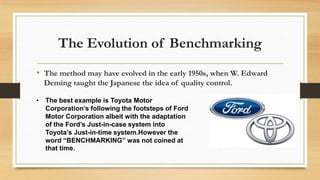
• The method may have evolved in the early 1950s, when W. Edward
Deming taught the Japanese the idea of quality control.
• The best example is Toyota Motor
Corporation’s following the footsteps of Ford
Motor Corporation albeit with the adaptation
of the Ford’s Just-in-case system into
Toyota’s Just-in-time system.However the
word “BENCHMARKING” was not coined at
that time.
TYPES OF BENCHMARKING
• Internal benchmarking : Benchmarking against its own unit or branches.
• External Benchmarking : Comparison of the same product or service
produced by direct market competitors.
• International Benchmarking : Involves benchmarking against companies
outside the country.
Benefits of Benchmarking
• Promotes a thorough understanding of company’s own process
• Saves time and money
• Identify non value added activities
• Focuses on performance measures and processes and not on products
• It provides a basis for training human resource
The Xerox Case
• The company invented the photocopier in 1959 and maintained a virtual
monopoly for many years thereafter.
• By 1981, however ,the companies market shrunk to 35% as IBM and Kodak
developed high-end machines and Canon, Richo and Savin dominated the
low-end segment of market.
• Xerox’s products had over 30,000 defective parts per million—about 30
times more than its competitors.
Benchmarking Model at Xerox
• Planning: Determining the subject to be benchmarked, identify the relevant best practice and
develop most appropriate data collection technique.
• Analysis: Assess the strengths of competitors and compare Xerox’s performance with
competitors.
• Integration: Establish necessary goals and integrate these goals into the companys formal
planning processes.
• Action: Implement action plans established and assess them periodically to determine whether
the company is achieving its objective.
• Maturity: Determine whether the company has attained a superior performance level.
Supplier management system
Japanese Companies
• It has 1000 suppliers
• They trained Vendor’s Employee in Quality Control , manufacturing automation.
• Just-in-time i.e. Delivery in small quantities, as per customer’s production
Xerox
• Reduced the vendors from 5000 to 400.
• Created a Vendor Certification Process in which suppliers were offered training & told their areas of improvement.
• Vendors were consulted for better Designs & Improved Customer service.
Inventory Management
Inventory holding Time reduction
• Xerox asked Branch managers to match the Stocking Policy with
Customer’s installation Orders .
• Minimize Inventory Carrying Cost was to delay the assembly of product
into the final Configuration.
Marketing
• Company sent 55,000 questionnaires to monthly to customers to measure
customer Satisfaction & record Competitor’s performance.
• Those Competitors who have scored higher, Xerox benchmark itself
against it.
Quality
• As a part of “Leadership Through Quality” program, Xerox started providing its
customers( External & Internal) innovative products & services.
Total Quality Management
• Team consists of Senior managers & Consultants from McKinsey help to make
TQM
• Under which New three SBUs were introduced:
Enterprise Service Business
Office Copiers
Home Copiers
• All these have autonomy in Engineering, marketing & pricing.
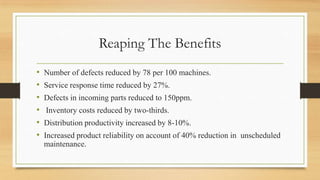
Reaping The Benefits
• Number of defects reduced by 78 per 100 machines.
• Service response time reduced by 27%.
• Defects in incoming parts reduced to 150ppm.
• Inventory costs reduced by two-thirds.
• Distribution productivity increased by 8-10%.
• Increased product reliability on account of 40% reduction in unscheduled
maintenance.
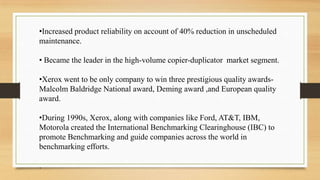
•Increased product reliability on account of 40% reduction in unscheduled
maintenance.
• Became the leader in the high-volume copier-duplicator market segment.
•Xerox went to be only company to win three prestigious quality awards-
Malcolm Baldridge National award, Deming award ,and European quality
award.
•During 1990s, Xerox, along with companies like Ford, AT&T, IBM,
Motorola created the International Benchmarking Clearinghouse (IBC) to
promote Benchmarking and guide companies across the world in
benchmarking efforts.
.
Benchmarking

Benchmarking

  • 1.
  • 2.
    What is benchmarking? •Benchmarking is the process of comparing one's business processes and performance metrics to industry bests or best practices from other industries. • Benchmarking is a systematic method by which an organization can continuously measure themselves against the best industry practices or world class and improve accordingly.
  • 3.
    The Evolution ofBenchmarking • The method may have evolved in the early 1950s, when W. Edward Deming taught the Japanese the idea of quality control. • The best example is Toyota Motor Corporation’s following the footsteps of Ford Motor Corporation albeit with the adaptation of the Ford’s Just-in-case system into Toyota’s Just-in-time system.However the word “BENCHMARKING” was not coined at that time.
  • 4.
    TYPES OF BENCHMARKING •Internal benchmarking : Benchmarking against its own unit or branches. • External Benchmarking : Comparison of the same product or service produced by direct market competitors. • International Benchmarking : Involves benchmarking against companies outside the country.
  • 6.
    Benefits of Benchmarking •Promotes a thorough understanding of company’s own process • Saves time and money • Identify non value added activities • Focuses on performance measures and processes and not on products • It provides a basis for training human resource
  • 7.
    The Xerox Case •The company invented the photocopier in 1959 and maintained a virtual monopoly for many years thereafter. • By 1981, however ,the companies market shrunk to 35% as IBM and Kodak developed high-end machines and Canon, Richo and Savin dominated the low-end segment of market. • Xerox’s products had over 30,000 defective parts per million—about 30 times more than its competitors.
  • 8.
    Benchmarking Model atXerox • Planning: Determining the subject to be benchmarked, identify the relevant best practice and develop most appropriate data collection technique. • Analysis: Assess the strengths of competitors and compare Xerox’s performance with competitors. • Integration: Establish necessary goals and integrate these goals into the companys formal planning processes. • Action: Implement action plans established and assess them periodically to determine whether the company is achieving its objective. • Maturity: Determine whether the company has attained a superior performance level.
  • 9.
    Supplier management system JapaneseCompanies • It has 1000 suppliers • They trained Vendor’s Employee in Quality Control , manufacturing automation. • Just-in-time i.e. Delivery in small quantities, as per customer’s production Xerox • Reduced the vendors from 5000 to 400. • Created a Vendor Certification Process in which suppliers were offered training & told their areas of improvement. • Vendors were consulted for better Designs & Improved Customer service.
  • 10.
    Inventory Management Inventory holdingTime reduction • Xerox asked Branch managers to match the Stocking Policy with Customer’s installation Orders . • Minimize Inventory Carrying Cost was to delay the assembly of product into the final Configuration.
  • 11.
    Marketing • Company sent55,000 questionnaires to monthly to customers to measure customer Satisfaction & record Competitor’s performance. • Those Competitors who have scored higher, Xerox benchmark itself against it.
  • 12.
    Quality • As apart of “Leadership Through Quality” program, Xerox started providing its customers( External & Internal) innovative products & services. Total Quality Management • Team consists of Senior managers & Consultants from McKinsey help to make TQM • Under which New three SBUs were introduced: Enterprise Service Business Office Copiers Home Copiers • All these have autonomy in Engineering, marketing & pricing.
  • 13.
    Reaping The Benefits •Number of defects reduced by 78 per 100 machines. • Service response time reduced by 27%. • Defects in incoming parts reduced to 150ppm. • Inventory costs reduced by two-thirds. • Distribution productivity increased by 8-10%. • Increased product reliability on account of 40% reduction in unscheduled maintenance.
  • 14.
    •Increased product reliabilityon account of 40% reduction in unscheduled maintenance. • Became the leader in the high-volume copier-duplicator market segment. •Xerox went to be only company to win three prestigious quality awards- Malcolm Baldridge National award, Deming award ,and European quality award. •During 1990s, Xerox, along with companies like Ford, AT&T, IBM, Motorola created the International Benchmarking Clearinghouse (IBC) to promote Benchmarking and guide companies across the world in benchmarking efforts. .