3 POINTS:

1.    About benchmarking
2.    Focus on benchmarking
3.    A real case history

                              2

09/03/2013
1. ABOUT BENCHMARKING

Definition
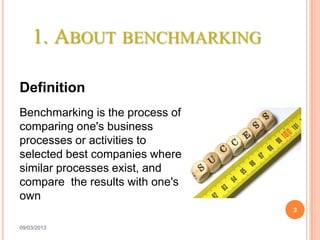
Benchmarking is the process of
comparing one's business
processes or activities to
selected best companies where
similar processes exist, and
compare the results with one's
own
                                 3

09/03/2013
1. ABOUT BENCHMARKING
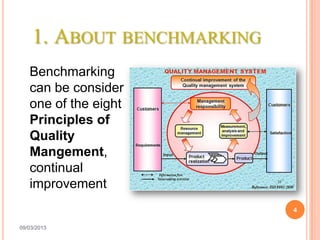
   Benchmarking
   can be consider
   one of the eight
   Principles of
   Quality
   Mangement,
   continual
   improvement
                            4

09/03/2013
1. ABOUT BENCHMARKING

The history
•   Cobblers and Benchmarking


•   Xerox case study

                                5

09/03/2013
1. ABOUT BENCHMARKING
Advantages
Benchmarking helps companies to:
• meet the customers' requirements

• define and hone the company strategy

• prevent failure

• involve staff at all levels
• promote an effective method of problem-
  solving                                   6

09/03/2013
2. FOCUS ON BENCHMARKING
 Activities generally addressed by benchmarking
 are:
 • Calculating the percentage cost impact of an
   activity on total costs
 • Assessing impact on quality, costs and time
 • Identifying strategic processes or functions
 • Identifying factors that distinguish the company
   from competitors
 • Analyzing activities that need improving
                                                  7

09/03/2013
2. FOCUS ON BENCHMARKING

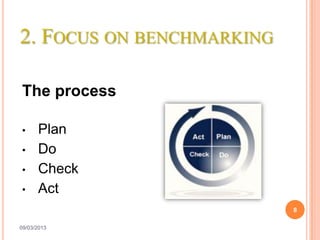
The process

•     Plan
•     Do
•     Check
•     Act
                           8

09/03/2013
2. FOCUS ON BENCHMARKING

The process: Plan

•    Identify what aspects to benchmark
•    Organize a working group
•    Train all the employees
•    Visit the organizations
                                          9

09/03/2013
2. FOCUS ON BENCHMARKING

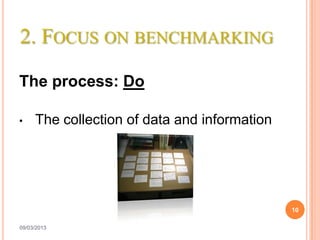
The process: Do

•    The collection of data and information


                                              10

09/03/2013
2. FOCUS ON BENCHMARKING

The process: Check

•    Assessing the strengths of competitors and
     compare the performance
•    Establishing goals
•    Integrating the goals into the company's
     formal planning processes and check their
     effective improvement in quality
                                                  11

09/03/2013
2. FOCUS ON BENCHMARKING

The process: Act

•    Implement action plans established and
     assess them periodically
•    Determine whether the company has
     attained a superior performance level
•    Return to the planning stage
                                              12

09/03/2013
2. FOCUS ON BENCHMARKING

Types
•   Strategic Benchmarking
•   Competitive Benchmarking
•   Process Benchmarking
•   Functional Benchmarking
•   Internal Benchmarking
•   External Benchmarking
•   International Benchmarking   13

09/03/2013
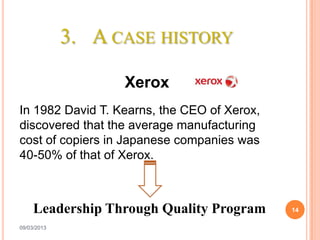
3. A CASE HISTORY

                   Xerox
In 1982 David T. Kearns, the CEO of Xerox,
discovered that the average manufacturing
cost of copiers in Japanese companies was
40-50% of that of Xerox.


     Leadership Through Quality Program      14

09/03/2013
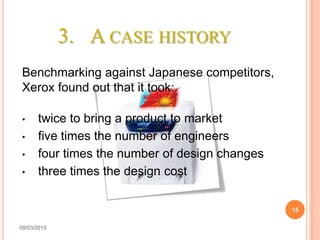
3. A CASE HISTORY
Benchmarking against Japanese competitors,
Xerox found out that it took:

•     twice to bring a product to market
•     five times the number of engineers
•     four times the number of design changes
•     three times the design cost

                                                15

09/03/2013
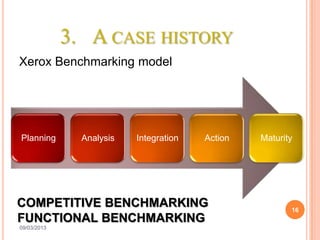
3. A CASE HISTORY
Xerox Benchmarking model


Planning       Analysis   Integration   Action   Maturity


COMPETITIVE BENCHMARKING                                16
FUNCTIONAL BENCHMARKING
09/03/2013
3. A CASE HISTORY


                                 17

09/03/2013
3. A CASE HISTORY
The analysis and the study of the collected data
led Xerox to improve its internal function:

•    Supplier Management System

•    Marketing Management

•    Quality Policy


                                                   18

09/03/2013
3. A CASE HISTORY
As far as the Supplier Management System,
Xerox:

•       reduced the number of vendors from 5,000 to
        just 400

•       created a vendor certification
        process

                                                  19

    09/03/2013
3. A CASE HISTORY
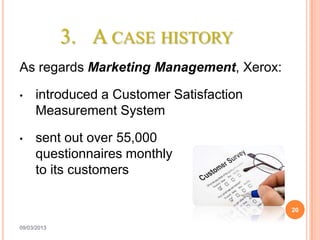
As regards Marketing Management, Xerox:

•    introduced a Customer Satisfaction
     Measurement System

•    sent out over 55,000
     questionnaires monthly
     to its customers

                                          20

09/03/2013
3. A CASE HISTORY
As concerns Quality, Xerox:

•    formed 24 senior managers to help them
     make Total Quality Management (TQM) a
     part of its organizational culture

•    integrated benchmarking with the company's
     overall strategies

                                              21

09/03/2013
3. A CASE HISTORY
    Other benefits

                     - 27%

                             + 18%


                                     + 40%


                                       - 60%

                                             + 39%


                                       + 38%


                                                     22

09/03/2013
3. A CASE HISTORY
        During the 1990s, Xerox created
        the International Benchmarking
        Clearinghouse (IBC)


                                          23

09/03/2013
SOME FINAL THOUGHTS
•    Benchmarking = Industrial espionage?

•    Main difficulty: to find information

•    Benchmarking causes companies to critically
     consider their process and strategies

•    Positive stimulus in an ever changing socio-
     economic and cultural environment
                                                    24

09/03/2013
25

09/03/2013   Laura Cafaro, Eleonora Marinucci, Giulia Focchi
GLOSSARY
•   Process: a series of actions that are done in order to achieve a particular result
•   Compare to/with (v.): when you are stressing similarities between the items compared, the most common word is “to”: “She
    compared his home-made wine to toxic waste.” If you are examining both similarities and differences, use “with”: “The teacher
    compared Steve’s exam with Robert’s to see whether they had cheated.”
•   Principles of Quality Management: a quality management principle is a comprehensive and fundamental rule / belief, for
    leading and operating an organization, aimed at continually improving performance over the long term by focusing on customers
    while addressing the needs of all other stake holders
•   Improvement: the act of improving something or the state of being improved; i.e. improvement in/on/to: “There's been a big
    improvement in the children's behaviour.” “an improvement on earlier models” “We need to carry out some improvements to the
    system.”
•   Technique: a special way of doing something
•   Improve (v.): to make something better, or to become better
•   With a view to growing evolution: [with a view to (doing) something]: used to state that an action is performed with the
    intention of obtaining a particular result in the future: ex. I came to this university with a view to getting a medical degree
•   Measure (v.): to judge the importance, value, or true nature of something
•   Performance: how well or badly a person, company etc does a particular job or activity
•   Bench: a long heavy table used for working on with tools or equipment
•   Meet the customers' requirements: satisfy the customers’ expectations
•   Procedure: a way of doing something, especially the correct or usual way
•   Hone vs. refine (v.): to hone: to improve your skill at doing something, especially when you are already very good at it; to
    refine: to improve a method, plan, system etc. by gradually making slight changes to it.
•   To address: direct one’s attention to / deal with, eg.: addressed by benchmarking: subjected to benchmarking
•   Ways of (doing something): method that you use to do something
•   Benchmark (v.): to use a company's good performance as a standard by which to judge the performance of other companies of
    the same type                                                                                                           26

09/03/2013
•   Be in charge (of doing something) (v.): if someone or something is in your charge, you are responsible for looking
    after them
•   Data collection tools: a piece of equipment or a skill that collects information or facts
•   Assess (v.): to make a judgment about a person or situation after thinking carefully about it
•   Establish (v.): to start/set up a company, organization, system, etc that is intended to exist or continue for a long time
•   Integrate (v.): if two or more things integrate, or if you integrate them, they combine or work together in a way that
    makes something more effective
•   Achieve (v.): to successfully complete something or get a good result, especially by working hard
•   Examine (v.): to look at something carefully and thoroughly because you want to find out more about it
•   Involve (v.): if an activity or situation involves something, that thing is part of it or a result of it.
•   On account of (something): quite a formal expression meaning owing to, because of as in On account of the recent
    rise in the price of oil food prices are bound to rise.
•   CEO (BOBBBChief Executive Officer): the person with the most authority in a large company
•   Develop (v.): to design or make a new idea, product, system etc over a period of time
•   Best-in-class: the highest current performance level in an industry, used as a standard or benchmark to equaled or
    exceeded. Also called best of breast
•   Led: past tense and past participle of “lead”.
•   Lead vs. Take (v.): to lead: to take someone somewhere by going in front of them while they follow, or by pulling
    them gently; to take: to move or go with someone or something from one place to another.
•   Increase (v.): if you increase something, or if it increases, it becomes bigger in amount, number, or degree
•   Reduce (v.): make something smaller or less in size, amount, or price
•   Effort: the physical or mental energy that is needed to do something. Particular situation: effort can also be used in the
    sense of work that people do to achieve something in a particular situation and could be translated into Italian as
    “iniziativa”, “impegno”, ecc.. according to the different contexts
•   Deliver (v.): here used in the sense of giving results that are promised, expected, or desired. Generally in business
    English it is used in the sense of taking goods, letters, packages etc to a particular place or person.
                                                                                                                                 27

09/03/2013
•   Payoff: an advantage or profit that you get as a result of doing something
•   Increase (v.): if you increase something, or if it increases, it becomes bigger in amount, number, or degree
•   Reduce (v.): make something smaller or less in size, amount, or price
•   Effort: the physical or mental energy that is needed to do something. Particular situation: effort can also be used in the
    sense of work that people do to achieve something in a particular situation and could be translated into Italian as
    “iniziativa”, “impegno”, ecc.. according to the different contexts
•   Deliver (v.): here used in the sense of giving results that are promised, expected, or desired. Generally in business
    English it is used in the sense of taking goods, letters, packages etc to a particular place or person.


SOURCES:
•   www.wikipedia.org
•   www.qualitiamo.com
•   www.qualityi.it
•   www.icmrindia.org
•   management.about.com
•   www.businessdictionary.com
•   www.ldoceonline.com
•   tutor2u.net
•   Dizionario Garzanti
•   Business Environment – Michael Black
•   Economia e Management delle imprese – Hoepli


                                                                                                                                 28

09/03/2013

Presentazione benchmarking laura_cafaro

  • 2.
    3 POINTS: 1. About benchmarking 2. Focus on benchmarking 3. A real case history 2 09/03/2013
  • 3.
    1. ABOUT BENCHMARKING Definition Benchmarkingis the process of comparing one's business processes or activities to selected best companies where similar processes exist, and compare the results with one's own 3 09/03/2013
  • 4.
    1. ABOUT BENCHMARKING Benchmarking can be consider one of the eight Principles of Quality Mangement, continual improvement 4 09/03/2013
  • 5.
    1. ABOUT BENCHMARKING Thehistory • Cobblers and Benchmarking • Xerox case study 5 09/03/2013
  • 6.
    1. ABOUT BENCHMARKING Advantages Benchmarkinghelps companies to: • meet the customers' requirements • define and hone the company strategy • prevent failure • involve staff at all levels • promote an effective method of problem- solving 6 09/03/2013
  • 7.
    2. FOCUS ONBENCHMARKING Activities generally addressed by benchmarking are: • Calculating the percentage cost impact of an activity on total costs • Assessing impact on quality, costs and time • Identifying strategic processes or functions • Identifying factors that distinguish the company from competitors • Analyzing activities that need improving 7 09/03/2013
  • 8.
    2. FOCUS ONBENCHMARKING The process • Plan • Do • Check • Act 8 09/03/2013
  • 9.
    2. FOCUS ONBENCHMARKING The process: Plan • Identify what aspects to benchmark • Organize a working group • Train all the employees • Visit the organizations 9 09/03/2013
  • 10.
    2. FOCUS ONBENCHMARKING The process: Do • The collection of data and information 10 09/03/2013
  • 11.
    2. FOCUS ONBENCHMARKING The process: Check • Assessing the strengths of competitors and compare the performance • Establishing goals • Integrating the goals into the company's formal planning processes and check their effective improvement in quality 11 09/03/2013
  • 12.
    2. FOCUS ONBENCHMARKING The process: Act • Implement action plans established and assess them periodically • Determine whether the company has attained a superior performance level • Return to the planning stage 12 09/03/2013
  • 13.
    2. FOCUS ONBENCHMARKING Types • Strategic Benchmarking • Competitive Benchmarking • Process Benchmarking • Functional Benchmarking • Internal Benchmarking • External Benchmarking • International Benchmarking 13 09/03/2013
  • 14.
    3. A CASEHISTORY Xerox In 1982 David T. Kearns, the CEO of Xerox, discovered that the average manufacturing cost of copiers in Japanese companies was 40-50% of that of Xerox. Leadership Through Quality Program 14 09/03/2013
  • 15.
    3. A CASEHISTORY Benchmarking against Japanese competitors, Xerox found out that it took: • twice to bring a product to market • five times the number of engineers • four times the number of design changes • three times the design cost 15 09/03/2013
  • 16.
    3. A CASEHISTORY Xerox Benchmarking model Planning Analysis Integration Action Maturity COMPETITIVE BENCHMARKING 16 FUNCTIONAL BENCHMARKING 09/03/2013
  • 17.
    3. A CASEHISTORY 17 09/03/2013
  • 18.
    3. A CASEHISTORY The analysis and the study of the collected data led Xerox to improve its internal function: • Supplier Management System • Marketing Management • Quality Policy 18 09/03/2013
  • 19.
    3. A CASEHISTORY As far as the Supplier Management System, Xerox: • reduced the number of vendors from 5,000 to just 400 • created a vendor certification process 19 09/03/2013
  • 20.
    3. A CASEHISTORY As regards Marketing Management, Xerox: • introduced a Customer Satisfaction Measurement System • sent out over 55,000 questionnaires monthly to its customers 20 09/03/2013
  • 21.
    3. A CASEHISTORY As concerns Quality, Xerox: • formed 24 senior managers to help them make Total Quality Management (TQM) a part of its organizational culture • integrated benchmarking with the company's overall strategies 21 09/03/2013
  • 22.
    3. A CASEHISTORY Other benefits - 27% + 18% + 40% - 60% + 39% + 38% 22 09/03/2013
  • 23.
    3. A CASEHISTORY During the 1990s, Xerox created the International Benchmarking Clearinghouse (IBC) 23 09/03/2013
  • 24.
    SOME FINAL THOUGHTS • Benchmarking = Industrial espionage? • Main difficulty: to find information • Benchmarking causes companies to critically consider their process and strategies • Positive stimulus in an ever changing socio- economic and cultural environment 24 09/03/2013
  • 25.
    25 09/03/2013 Laura Cafaro, Eleonora Marinucci, Giulia Focchi
  • 26.
    GLOSSARY • Process: a series of actions that are done in order to achieve a particular result • Compare to/with (v.): when you are stressing similarities between the items compared, the most common word is “to”: “She compared his home-made wine to toxic waste.” If you are examining both similarities and differences, use “with”: “The teacher compared Steve’s exam with Robert’s to see whether they had cheated.” • Principles of Quality Management: a quality management principle is a comprehensive and fundamental rule / belief, for leading and operating an organization, aimed at continually improving performance over the long term by focusing on customers while addressing the needs of all other stake holders • Improvement: the act of improving something or the state of being improved; i.e. improvement in/on/to: “There's been a big improvement in the children's behaviour.” “an improvement on earlier models” “We need to carry out some improvements to the system.” • Technique: a special way of doing something • Improve (v.): to make something better, or to become better • With a view to growing evolution: [with a view to (doing) something]: used to state that an action is performed with the intention of obtaining a particular result in the future: ex. I came to this university with a view to getting a medical degree • Measure (v.): to judge the importance, value, or true nature of something • Performance: how well or badly a person, company etc does a particular job or activity • Bench: a long heavy table used for working on with tools or equipment • Meet the customers' requirements: satisfy the customers’ expectations • Procedure: a way of doing something, especially the correct or usual way • Hone vs. refine (v.): to hone: to improve your skill at doing something, especially when you are already very good at it; to refine: to improve a method, plan, system etc. by gradually making slight changes to it. • To address: direct one’s attention to / deal with, eg.: addressed by benchmarking: subjected to benchmarking • Ways of (doing something): method that you use to do something • Benchmark (v.): to use a company's good performance as a standard by which to judge the performance of other companies of the same type 26 09/03/2013
  • 27.
    Be in charge (of doing something) (v.): if someone or something is in your charge, you are responsible for looking after them • Data collection tools: a piece of equipment or a skill that collects information or facts • Assess (v.): to make a judgment about a person or situation after thinking carefully about it • Establish (v.): to start/set up a company, organization, system, etc that is intended to exist or continue for a long time • Integrate (v.): if two or more things integrate, or if you integrate them, they combine or work together in a way that makes something more effective • Achieve (v.): to successfully complete something or get a good result, especially by working hard • Examine (v.): to look at something carefully and thoroughly because you want to find out more about it • Involve (v.): if an activity or situation involves something, that thing is part of it or a result of it. • On account of (something): quite a formal expression meaning owing to, because of as in On account of the recent rise in the price of oil food prices are bound to rise. • CEO (BOBBBChief Executive Officer): the person with the most authority in a large company • Develop (v.): to design or make a new idea, product, system etc over a period of time • Best-in-class: the highest current performance level in an industry, used as a standard or benchmark to equaled or exceeded. Also called best of breast • Led: past tense and past participle of “lead”. • Lead vs. Take (v.): to lead: to take someone somewhere by going in front of them while they follow, or by pulling them gently; to take: to move or go with someone or something from one place to another. • Increase (v.): if you increase something, or if it increases, it becomes bigger in amount, number, or degree • Reduce (v.): make something smaller or less in size, amount, or price • Effort: the physical or mental energy that is needed to do something. Particular situation: effort can also be used in the sense of work that people do to achieve something in a particular situation and could be translated into Italian as “iniziativa”, “impegno”, ecc.. according to the different contexts • Deliver (v.): here used in the sense of giving results that are promised, expected, or desired. Generally in business English it is used in the sense of taking goods, letters, packages etc to a particular place or person. 27 09/03/2013
  • 28.
    Payoff: an advantage or profit that you get as a result of doing something • Increase (v.): if you increase something, or if it increases, it becomes bigger in amount, number, or degree • Reduce (v.): make something smaller or less in size, amount, or price • Effort: the physical or mental energy that is needed to do something. Particular situation: effort can also be used in the sense of work that people do to achieve something in a particular situation and could be translated into Italian as “iniziativa”, “impegno”, ecc.. according to the different contexts • Deliver (v.): here used in the sense of giving results that are promised, expected, or desired. Generally in business English it is used in the sense of taking goods, letters, packages etc to a particular place or person. SOURCES: • www.wikipedia.org • www.qualitiamo.com • www.qualityi.it • www.icmrindia.org • management.about.com • www.businessdictionary.com • www.ldoceonline.com • tutor2u.net • Dizionario Garzanti • Business Environment – Michael Black • Economia e Management delle imprese – Hoepli 28 09/03/2013