XEROXPRINCIPLES OF MANAGEMENT
VAIBHAV CHAVANJUBIN BALAKRISHNANVARUN SALIANGROUP MEMBERS
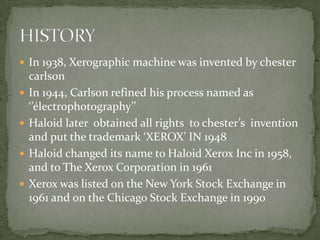
In 1938, Xerographic machine was invented by chestercarlsonIn 1944, Carlson refined his process named as ‘’électrophotography’’Haloid later  obtained all rights  to chester’s  invention and put the trademark ‘XEROX’ IN 1948Haloid changed its name to Haloid Xerox Inc in 1958, and to The Xerox Corporation in 1961Xerox was listed on the New York Stock Exchange in 1961 and on the Chicago Stock Exchange in 1990HISTORY
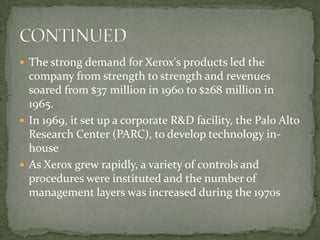
The strong demand for Xerox's products led the company from strength to strength and revenues soared from $37 million in 1960 to $268 million in 1965.In 1969, it set up a corporate R&D facility, the Palo Alto Research Center (PARC), to develop technology in-houseAs Xerox grew rapidly, a variety of controls and procedures were instituted and the number of management layers was increased during the 1970sCONTINUED
The 'Leadership through Quality' program introduced by Kearns revitalized the company. The program encouraged Xerox to find ways to reduce their manufacturing costs.Xerox defined benchmarking as 'the process of measuring its products, Services, and practices against its toughest competitors, identifying the gaps and establishing goals. Benchmarking at Xerox
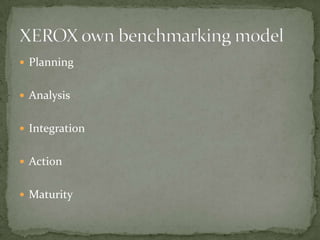
PlanningAnalysisIntegrationActionMaturityXEROX own benchmarking model
Adopted Functional benchmarking with the study of the warehousing and inventory management system of L.L. Bean (Bean)Bean had developed a computer program that made order filling very efficientIt allowed stock pickers to travel the shortest possible distance in collecting goods at the warehouseThe increased speed and accuracy of order filling achieved by Bean attracted XeroxCONTINUED
American Express -for billing and collectionCummins Engines and Ford -for factory floor layoutFlorida Power and Light -for quality improvementHonda -for supplier developmentToyota -for quality managementHewlett-Packard -for research and product developmentSaturn -a division of General MotorsFuji Xerox -for manufacturing operationsDuPont -for manufacturing safetyBenchmark other processes
Japanese copier companies put together had only 1,000 suppliers, while Xerox alone had 5,000Xerox reduced the number of vendors for the copier business from 5,000 to just 400.Xerox also created a vendor certification process .Vendors were consulted for ideas on better designs and improved customer service alsoSUPPLIER MANAGEMENT SYSTEM
Traditionally, technical representatives decided the level of spare parts inventory to be carried; little information was available on the actual usage pattern of the spare partsThe stocking policy followed by Xerox branch managers was to hold fully finished, fully configured products near to the customerCompany changed the above setupWorking capital cycle time was cut by 70% leading to savings of about $200 million.INVENTORY MANAGEMENT
Xerox introduced a Customer Satisfaction Measurement SystemThe company sent out over 55,000 questionnaires monthly to its customers.It then benchmarked against those competitors that had scored high marks on specific measures of customer satisfactionMARKETING
Xerox formed a transition team consisting of 24 senior managers and consultants from McKinsey & CoThe transition team took action at two levels    - Firstly, it conveyed the message clearly to the world that Xerox was pursuing more widespread use of TQM.    -It identified and addressed the obstacles that were likely to slow down the spread of TQM.QUALITY
The transition team also replaced the existing complex matrix by three Strategic Business Units (SBUs)    - Enterprise Service Business   - Office Copiers     - Home CopiersIn 1991, Xerox developed Business Excellence Certification (BEC) to integrate benchmarking with the company's overall strategiesBy the mid-1990s, benchmarking was extended to over 240 key areas of product, service and business performance at XeroxCONTINUED
Highly satisfied customers for its copier/duplicator and printing systems increased by 38% and 39% respectivelyCustomer complaints to the president's office declined by more than 60%Overall customer satisfaction was rated at more than 90% in 1991Xerox went on to become the only company worldwide to win all the three prestigious quality awards    - Deming Award (Japan) in 1980    - Malcolm Baldridge National Quality Award in 1989    - European Quality Award in 1992REAPING THE BENEFITS
Xerox Corporation (NYSE: XRX) ranked as the worldwide market share leader in Managed Print Services (MPS) based on revenue.Xerox believes this data further  validates its approach to provide services and solutions that deliver business value.North America alone , Xerox accounts for 56 percent of the MPS market.XEROX IN CURRENT SITUATION
THANK  YOU

Principles Of Management Ppt

  • 1.
  • 2.
  • 3.
    In 1938, Xerographicmachine was invented by chestercarlsonIn 1944, Carlson refined his process named as ‘’électrophotography’’Haloid later obtained all rights to chester’s invention and put the trademark ‘XEROX’ IN 1948Haloid changed its name to Haloid Xerox Inc in 1958, and to The Xerox Corporation in 1961Xerox was listed on the New York Stock Exchange in 1961 and on the Chicago Stock Exchange in 1990HISTORY
  • 4.
    The strong demandfor Xerox's products led the company from strength to strength and revenues soared from $37 million in 1960 to $268 million in 1965.In 1969, it set up a corporate R&D facility, the Palo Alto Research Center (PARC), to develop technology in-houseAs Xerox grew rapidly, a variety of controls and procedures were instituted and the number of management layers was increased during the 1970sCONTINUED
  • 5.
    The 'Leadership throughQuality' program introduced by Kearns revitalized the company. The program encouraged Xerox to find ways to reduce their manufacturing costs.Xerox defined benchmarking as 'the process of measuring its products, Services, and practices against its toughest competitors, identifying the gaps and establishing goals. Benchmarking at Xerox
  • 6.
  • 7.
    Adopted Functional benchmarkingwith the study of the warehousing and inventory management system of L.L. Bean (Bean)Bean had developed a computer program that made order filling very efficientIt allowed stock pickers to travel the shortest possible distance in collecting goods at the warehouseThe increased speed and accuracy of order filling achieved by Bean attracted XeroxCONTINUED
  • 8.
    American Express -forbilling and collectionCummins Engines and Ford -for factory floor layoutFlorida Power and Light -for quality improvementHonda -for supplier developmentToyota -for quality managementHewlett-Packard -for research and product developmentSaturn -a division of General MotorsFuji Xerox -for manufacturing operationsDuPont -for manufacturing safetyBenchmark other processes
  • 9.
    Japanese copier companiesput together had only 1,000 suppliers, while Xerox alone had 5,000Xerox reduced the number of vendors for the copier business from 5,000 to just 400.Xerox also created a vendor certification process .Vendors were consulted for ideas on better designs and improved customer service alsoSUPPLIER MANAGEMENT SYSTEM
  • 10.
    Traditionally, technical representativesdecided the level of spare parts inventory to be carried; little information was available on the actual usage pattern of the spare partsThe stocking policy followed by Xerox branch managers was to hold fully finished, fully configured products near to the customerCompany changed the above setupWorking capital cycle time was cut by 70% leading to savings of about $200 million.INVENTORY MANAGEMENT
  • 11.
    Xerox introduced aCustomer Satisfaction Measurement SystemThe company sent out over 55,000 questionnaires monthly to its customers.It then benchmarked against those competitors that had scored high marks on specific measures of customer satisfactionMARKETING
  • 12.
    Xerox formed atransition team consisting of 24 senior managers and consultants from McKinsey & CoThe transition team took action at two levels - Firstly, it conveyed the message clearly to the world that Xerox was pursuing more widespread use of TQM. -It identified and addressed the obstacles that were likely to slow down the spread of TQM.QUALITY
  • 13.
    The transition teamalso replaced the existing complex matrix by three Strategic Business Units (SBUs) - Enterprise Service Business - Office Copiers - Home CopiersIn 1991, Xerox developed Business Excellence Certification (BEC) to integrate benchmarking with the company's overall strategiesBy the mid-1990s, benchmarking was extended to over 240 key areas of product, service and business performance at XeroxCONTINUED
  • 14.
    Highly satisfied customersfor its copier/duplicator and printing systems increased by 38% and 39% respectivelyCustomer complaints to the president's office declined by more than 60%Overall customer satisfaction was rated at more than 90% in 1991Xerox went on to become the only company worldwide to win all the three prestigious quality awards - Deming Award (Japan) in 1980 - Malcolm Baldridge National Quality Award in 1989 - European Quality Award in 1992REAPING THE BENEFITS
  • 15.
    Xerox Corporation (NYSE:XRX) ranked as the worldwide market share leader in Managed Print Services (MPS) based on revenue.Xerox believes this data further validates its approach to provide services and solutions that deliver business value.North America alone , Xerox accounts for 56 percent of the MPS market.XEROX IN CURRENT SITUATION
  • 16.