Four Keys to Successfully Deploying
         a Social Business Network

                   Harry Klein, Softjoe Collaborative
                    Tad Staley, Softjoe Collaborative
                             Brian Malone, Yammer
Welcome










Agenda














What Are Social Business Networks?










                                     4
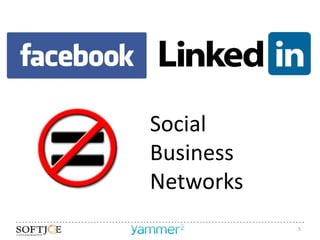
Social
Business
Networks
           5
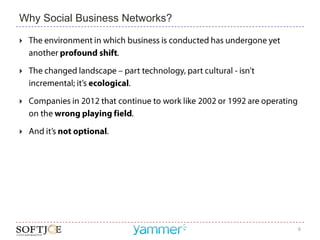
Why Social Business Networks?













                                6
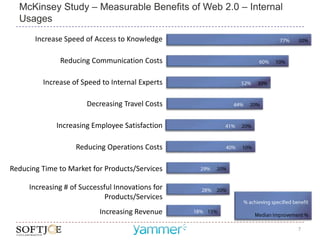
McKinsey Study – Measurable Benefits of Web 2.0 – Internal
  Usages

       Increase Speed of Access to Knowledge

              Reducing Communication Costs

         Increase of Speed to Internal Experts

                       Decreasing Travel Costs

             Increasing Employee Satisfaction

                   Reducing Operations Costs

Reducing Time to Market for Products/Services

     Increasing # of Successful Innovations for
                             Products/Services
                           Increasing Revenue

                                                               7
Social Business Means Business

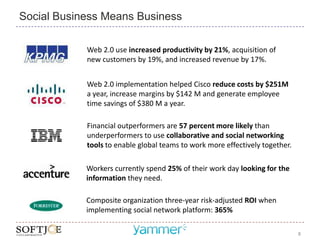
            Web 2.0 use increased productivity by 21%, acquisition of
            new customers by 19%, and increased revenue by 17%.


            Web 2.0 implementation helped Cisco reduce costs by $251M
            a year, increase margins by $142 M and generate employee
            time savings of $380 M a year.

            Financial outperformers are 57 percent more likely than
            underperformers to use collaborative and social networking
            tools to enable global teams to work more effectively together.

            Workers currently spend 25% of their work day looking for the
            information they need.

            Composite organization three-year risk-adjusted ROI when
            implementing social network platform: 365%

                                                                              8
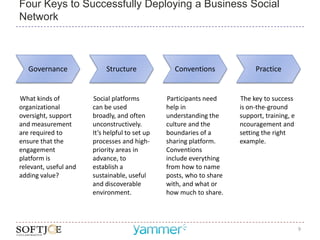
Four Keys to Successfully Deploying a Business Social
Network


   Governance               Structure             Conventions              Practice


What kinds of          Social platforms         Participants need     The key to success
organizational         can be used              help in               is on-the-ground
oversight, support     broadly, and often       understanding the     support, training, e
and measurement        unconstructively.        culture and the       ncouragement and
are required to        It’s helpful to set up   boundaries of a       setting the right
ensure that the        processes and high-      sharing platform.     example.
engagement             priority areas in        Conventions
platform is            advance, to              include everything
relevant, useful and   establish a              from how to name
adding value?          sustainable, useful      posts, who to share
                       and discoverable         with, and what or
                       environment.             how much to share.


                                                                                             9
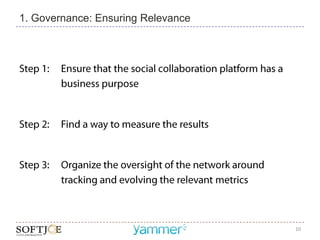
1. Governance: Ensuring Relevance


                                    10
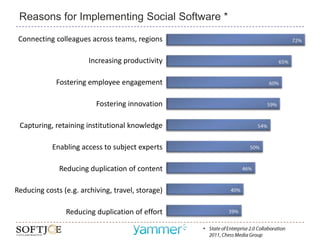
Reasons for Implementing Social Software *
 Connecting colleagues across teams, regions

                        Increasing productivity

             Fostering employee engagement

                          Fostering innovation

 Capturing, retaining institutional knowledge

            Enabling access to subject experts

              Reducing duplication of content

Reducing costs (e.g. archiving, travel, storage)

                Reducing duplication of effort

                                                   •
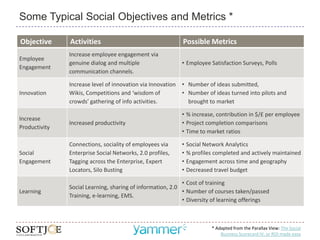
Some Typical Social Objectives and Metrics *

Objective      Activities                                    Possible Metrics
               Increase employee engagement via
Employee
               genuine dialog and multiple                   • Employee Satisfaction Surveys, Polls
Engagement
               communication channels.

               Increase level of innovation via Innovation   • Number of ideas submitted,
Innovation     Wikis, Competitions and ‘wisdom of            • Number of ideas turned into pilots and
               crowds’ gathering of info activities.           brought to market

                                                             • % increase, contribution in $/£ per employee
Increase
               Increased productivity                        • Project completion comparisons
Productivity
                                                             • Time to market ratios

               Connections, sociality of employees via       •   Social Network Analytics
Social         Enterprise Social Networks, 2.0 profiles,     •   % profiles completed and actively maintained
Engagement     Tagging across the Enterprise, Expert         •   Engagement across time and geography
               Locators, Silo Busting                        •   Decreased travel budget

                                                            • Cost of training
               Social Learning, sharing of information, 2.0
Learning                                                    • Number of courses taken/passed
               Training, e-learning, EMS.
                                                            • Diversity of learning offerings


                                                                          * Adapted from the Parallax View: The Social
                                                                                                                   12
                                                                              Business Scorecard IV, or ROI made easy
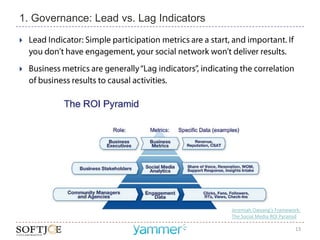
1. Governance: Lead vs. Lag Indicators






                                         Jeremiah Owyang's Framework:
                                         The Social Media ROI Pyramid

                                                                  13
Case Study: Finding the Right Metric
Project: Large enterprise which grew by
acquisition, looking to implement new
social Intranet to build integrated
company culture.

Reality: Annual employee engagement
surveys showed apathy and distrust of
executive leadership.

Result: Board of directors tied exec
compensation to improved employee
engagement scores.

Solution: correlate several employee
engagement areas to benefits
anticipated from social platform.


                                          14
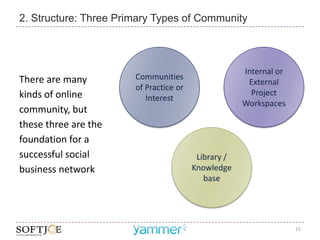
2. Structure: Three Primary Types of Community


                                                     Internal or
There are many         Communities
                                                      External
                       of Practice or
kinds of online                                        Project
                          Interest
                                                     Workspaces
community, but
these three are the
foundation for a
successful social                        Library /
business network                        Knowledge
                                           base


                                                                   15
Communities: Keys and Value

   Supervision Highly Recommended
       Identify one or more facilitators or leaders to keep stirring the pot, who
        is accountable for ensuring that value accrues within the group and that
        the contributions remain relevant.
       Also congratulating / recognizing people for their contributions


   Value: Intellectual Capital
       Sharing knowledge, insights from experience, best practices should raise
        everyone’s game
       These communities become effective learning environments for
        onboarding and junior members.


                                                                                 16
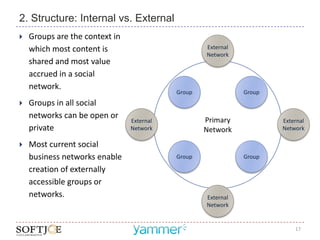
2. Structure: Internal vs. External
   Groups are the context in
    which most content is                          External
                                                   Network
    shared and most value
    accrued in a social
    network.
                                           Group              Group
   Groups in all social
    networks can be open or
                                External           Primary            External
    private                     Network            Network            Network

   Most current social
    business networks enable               Group              Group

    creation of externally
    accessible groups or
    networks.                                      External
                                                   Network


                                                                          17
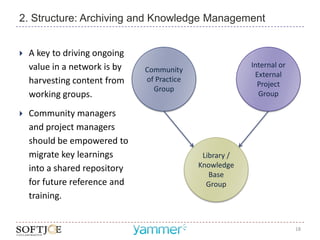
2. Structure: Archiving and Knowledge Management


   A key to driving ongoing
    value in a network is by                              Internal or
                               Community
                                                           External
    harvesting content from    of Practice
                                                            Project
                                 Group
    working groups.                                         Group

   Community managers
    and project managers
    should be empowered to
    migrate key learnings                     Library /
    into a shared repository                 Knowledge
                                                Base
    for future reference and                   Group
    training.


                                                                        18
3. Conventions: Clarifying

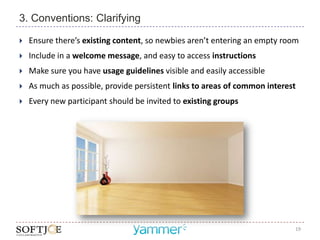
   Ensure there’s existing content, so newbies aren’t entering an empty room
   Include in a welcome message, and easy to access instructions
   Make sure you have usage guidelines visible and easily accessible
   As much as possible, provide persistent links to areas of common interest
   Every new participant should be invited to existing groups


                                                                            19
4. Practice: Notifications and Email Integration

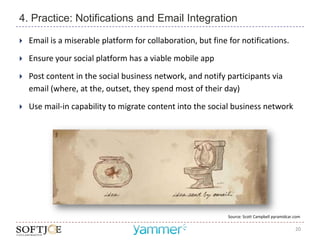
   Email is a miserable platform for collaboration, but fine for notifications.
   Ensure your social platform has a viable mobile app
   Post content in the social business network, and notify participants via
    email (where, at the, outset, they spend most of their day)

   Use mail-in capability to migrate content into the social business network


                                                              Source: Scott Campbell pyramidcar.com

                                                                                                20
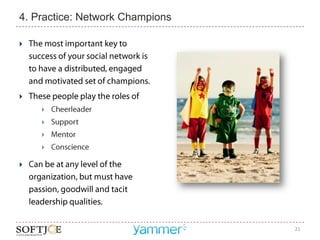
4. Practice: Network Champions





    

    

    

    




                                 21
Recap: Four Keys in Brief


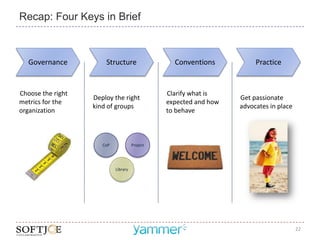
   Governance          Structure                  Conventions           Practice


Choose the right                                Clarify what is
                   Deploy the right                                Get passionate
metrics for the                                 expected and how
                   kind of groups                                  advocates in place
organization                                    to behave


                      CoP             Project


                            Library


                                                                                        22
Yammer Overview
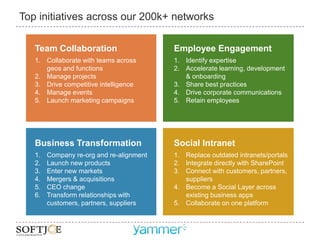
Top initiatives across our 200k+ networks

   Team Collaboration                     Employee Engagement
   1. Collaborate with teams across       1. Identify expertise
      geos and functions                  2. Accelerate learning, development
   2. Manage projects                        & onboarding
   3. Drive competitive intelligence      3. Share best practices
   4. Manage events                       4. Drive corporate communications
   5. Launch marketing campaigns          5. Retain employees


   Business Transformation                Social Intranet
   1.   Company re-org and re-alignment   1. Replace outdated intranets/portals
   2.   Launch new products               2. Integrate directly with SharePoint
   3.   Enter new markets                 3. Connect with customers, partners,
   4.   Mergers & acquisitions               suppliers
   5.   CEO change                        4. Become a Social Layer across
   6.   Transform relationships with         existing business apps
        customers, partners, suppliers    5. Collaborate on one platform
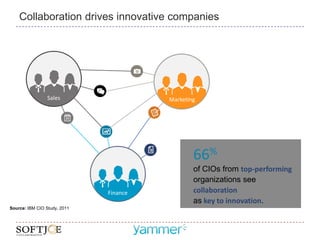
Collaboration drives innovative companies


                 Sales                  Marketing


                                                66%
                                                of CIOs from top-performing
                                                organizations see
                              Finance           collaboration
                                                as key to innovation.
Source: IBM CIO Study, 2011
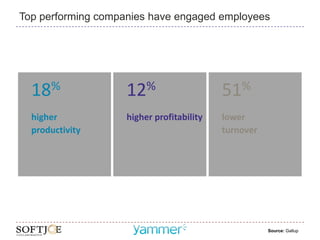
Top performing companies have engaged employees


  18%               12%                    51%
  higher            higher profitability   lower
  productivity                             turnover


                                                      Source: Gallup
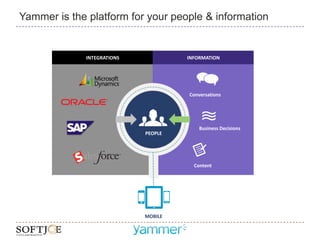
Yammer is the platform for your people & information


             INTEGRATIONS            INFORMATION


                                     Conversations


                                         Business Decisions
                            PEOPLE


                                       Content


                            MOBILE
Q&A


      Your Turn


                  28
About Softjoe Collaborative, LLC










        
        
        
        





    

    


                                   29
Contact Us


                                          

                                              

                                              

    

    


        Links to presentation archive and presentation for download will
        be emailed to all participants as well as hosted at Softjoe.com.


                                                                           30

Softjoe Webinar 092512

  • 1.
    Four Keys toSuccessfully Deploying a Social Business Network Harry Klein, Softjoe Collaborative Tad Staley, Softjoe Collaborative Brian Malone, Yammer
  • 2.
  • 3.
  • 4.
    What Are SocialBusiness Networks?     4
  • 5.
  • 6.
    Why Social BusinessNetworks?     6
  • 7.
    McKinsey Study –Measurable Benefits of Web 2.0 – Internal Usages Increase Speed of Access to Knowledge Reducing Communication Costs Increase of Speed to Internal Experts Decreasing Travel Costs Increasing Employee Satisfaction Reducing Operations Costs Reducing Time to Market for Products/Services Increasing # of Successful Innovations for Products/Services Increasing Revenue 7
  • 8.
    Social Business MeansBusiness Web 2.0 use increased productivity by 21%, acquisition of new customers by 19%, and increased revenue by 17%. Web 2.0 implementation helped Cisco reduce costs by $251M a year, increase margins by $142 M and generate employee time savings of $380 M a year. Financial outperformers are 57 percent more likely than underperformers to use collaborative and social networking tools to enable global teams to work more effectively together. Workers currently spend 25% of their work day looking for the information they need. Composite organization three-year risk-adjusted ROI when implementing social network platform: 365% 8
  • 9.
    Four Keys toSuccessfully Deploying a Business Social Network Governance Structure Conventions Practice What kinds of Social platforms Participants need The key to success organizational can be used help in is on-the-ground oversight, support broadly, and often understanding the support, training, e and measurement unconstructively. culture and the ncouragement and are required to It’s helpful to set up boundaries of a setting the right ensure that the processes and high- sharing platform. example. engagement priority areas in Conventions platform is advance, to include everything relevant, useful and establish a from how to name adding value? sustainable, useful posts, who to share and discoverable with, and what or environment. how much to share. 9
  • 10.
  • 11.
    Reasons for ImplementingSocial Software * Connecting colleagues across teams, regions Increasing productivity Fostering employee engagement Fostering innovation Capturing, retaining institutional knowledge Enabling access to subject experts Reducing duplication of content Reducing costs (e.g. archiving, travel, storage) Reducing duplication of effort •
  • 12.
    Some Typical SocialObjectives and Metrics * Objective Activities Possible Metrics Increase employee engagement via Employee genuine dialog and multiple • Employee Satisfaction Surveys, Polls Engagement communication channels. Increase level of innovation via Innovation • Number of ideas submitted, Innovation Wikis, Competitions and ‘wisdom of • Number of ideas turned into pilots and crowds’ gathering of info activities. brought to market • % increase, contribution in $/£ per employee Increase Increased productivity • Project completion comparisons Productivity • Time to market ratios Connections, sociality of employees via • Social Network Analytics Social Enterprise Social Networks, 2.0 profiles, • % profiles completed and actively maintained Engagement Tagging across the Enterprise, Expert • Engagement across time and geography Locators, Silo Busting • Decreased travel budget • Cost of training Social Learning, sharing of information, 2.0 Learning • Number of courses taken/passed Training, e-learning, EMS. • Diversity of learning offerings * Adapted from the Parallax View: The Social 12 Business Scorecard IV, or ROI made easy
  • 13.
    1. Governance: Leadvs. Lag Indicators   Jeremiah Owyang's Framework: The Social Media ROI Pyramid 13
  • 14.
    Case Study: Findingthe Right Metric Project: Large enterprise which grew by acquisition, looking to implement new social Intranet to build integrated company culture. Reality: Annual employee engagement surveys showed apathy and distrust of executive leadership. Result: Board of directors tied exec compensation to improved employee engagement scores. Solution: correlate several employee engagement areas to benefits anticipated from social platform. 14
  • 15.
    2. Structure: ThreePrimary Types of Community Internal or There are many Communities External of Practice or kinds of online Project Interest Workspaces community, but these three are the foundation for a successful social Library / business network Knowledge base 15
  • 16.
    Communities: Keys andValue  Supervision Highly Recommended  Identify one or more facilitators or leaders to keep stirring the pot, who is accountable for ensuring that value accrues within the group and that the contributions remain relevant.  Also congratulating / recognizing people for their contributions  Value: Intellectual Capital  Sharing knowledge, insights from experience, best practices should raise everyone’s game  These communities become effective learning environments for onboarding and junior members. 16
  • 17.
    2. Structure: Internalvs. External  Groups are the context in which most content is External Network shared and most value accrued in a social network. Group Group  Groups in all social networks can be open or External Primary External private Network Network Network  Most current social business networks enable Group Group creation of externally accessible groups or networks. External Network 17
  • 18.
    2. Structure: Archivingand Knowledge Management  A key to driving ongoing value in a network is by Internal or Community External harvesting content from of Practice Project Group working groups. Group  Community managers and project managers should be empowered to migrate key learnings Library / into a shared repository Knowledge Base for future reference and Group training. 18
  • 19.
    3. Conventions: Clarifying  Ensure there’s existing content, so newbies aren’t entering an empty room  Include in a welcome message, and easy to access instructions  Make sure you have usage guidelines visible and easily accessible  As much as possible, provide persistent links to areas of common interest  Every new participant should be invited to existing groups 19
  • 20.
    4. Practice: Notificationsand Email Integration  Email is a miserable platform for collaboration, but fine for notifications.  Ensure your social platform has a viable mobile app  Post content in the social business network, and notify participants via email (where, at the, outset, they spend most of their day)  Use mail-in capability to migrate content into the social business network Source: Scott Campbell pyramidcar.com 20
  • 21.
    4. Practice: NetworkChampions        21
  • 22.
    Recap: Four Keysin Brief Governance Structure Conventions Practice Choose the right Clarify what is Deploy the right Get passionate metrics for the expected and how kind of groups advocates in place organization to behave CoP Project Library 22
  • 23.
  • 24.
    Top initiatives acrossour 200k+ networks Team Collaboration Employee Engagement 1. Collaborate with teams across 1. Identify expertise geos and functions 2. Accelerate learning, development 2. Manage projects & onboarding 3. Drive competitive intelligence 3. Share best practices 4. Manage events 4. Drive corporate communications 5. Launch marketing campaigns 5. Retain employees Business Transformation Social Intranet 1. Company re-org and re-alignment 1. Replace outdated intranets/portals 2. Launch new products 2. Integrate directly with SharePoint 3. Enter new markets 3. Connect with customers, partners, 4. Mergers & acquisitions suppliers 5. CEO change 4. Become a Social Layer across 6. Transform relationships with existing business apps customers, partners, suppliers 5. Collaborate on one platform
  • 25.
    Collaboration drives innovativecompanies Sales Marketing 66% of CIOs from top-performing organizations see Finance collaboration as key to innovation. Source: IBM CIO Study, 2011
  • 26.
    Top performing companieshave engaged employees 18% 12% 51% higher higher profitability lower productivity turnover Source: Gallup
  • 27.
    Yammer is theplatform for your people & information INTEGRATIONS INFORMATION Conversations Business Decisions PEOPLE Content MOBILE
  • 28.
    Q&A Your Turn 28
  • 29.
    About Softjoe Collaborative,LLC             29
  • 30.
    Contact Us         Links to presentation archive and presentation for download will be emailed to all participants as well as hosted at Softjoe.com. 30

Editor's Notes

  • #3 Welcome to “Four Keys to Social Business Network Success”. My name is Harry Klein and I’m a member of the Softjoe Collaborative. The Softjoe Collaborative is focused on Engagement Solutions, using social and collaborative platforms to deliver internal, external and mixed networks that drive productivity, responsiveness and engagement.Today we’ll be exploring how to deploy a social business network that will drive business success through better internal and external collaboration and innovation. Tad Staley, my colleague at Softjoe, will share his strategic building blocks for deploying a social business network and the types of collaboration that can be accomplished. Last and certainly not least, Brian Malone from Yammer will speak to us about how Yammer can help you can implement Tad’s strategy. Tad and I would like to thank Brian and Yammer for their support.First a few logistics:Tomorrow you’ll receive a link to a very brief survey that we would really appreciate you completing. We want to be certain to meet or exceed your expectations in the future.During the session feel free to submit questions. You’ll see a space to enter questions in the middle of the GoToWebinar interface. We’ll hold questions until the end and answer as many as we can. Any questions that we don’t answer during this session we will answer in a blog post at softjoe.com.We’ll also provide full contact information at the end of the presentation if you wish to continue the discussion. Lastly, the webinar will be available on demand at Softjoe.com and the presentation file available for download as well at softjoe.com.Our agenda today is as follows:
  • #4 First I’ll share how we define social business networks, answering why you should care about them and highlighting some data about the benefits of using deploying a social business network.Then we’ll share the Four Keys….We’ll take a look at how Yammer can help you achieve SBN successAnd then we’ll take some questions
  • #5 Let me briefly answer the question “What are social business networks?”Essentially they are the modern version of an intranet:SBNs are private, business domains that include social capabilities such as update feeds, community creation, file sharing, real-time collaboration, content creation and moreSBNs help companies succeed by enabling better communication and the discovery and use of internal SMEs, resources, data, insight, knowledgeSBNs eliminate communication silos, fostering better engagement between management, employees, customers and other stakeholders and across any and all functional business units from sales to engineering to HR and beyond. They give employees a voice.The result is the sparking of innovation, productivity and organizational responsiveness, all key ingredients to business success.
  • #6 What SBNs are not is Facebook or LinkedIn. Don’t mishear me – I use both Facebook and LinkedIn every day.But these platforms don’t enable the power and flexibility of a social business network. You can certainly connect with people and opine on products, issues, personal likes, etc. While LinkedIn is a great resource for work related networking and building communities of interest that’s about as far as it goes.FB and LI are not platforms for creating a project team and building a timeline, collaborating on files or internal information. You won’t create a mixed network with internal and external members. OK, so what? So why should you care?
  • #7 The business environment has undergone yet another sea change. There’s a lot driving this change. First, we’ve been living in the Age of the Customer for at least 2 and I think more like 5 years. Customers are publishers whose opinions are valued more than corporate marketing. Customers are mobile so they can access or provide opinions from anywhere at anytime. Alternatives sources of solutions that fulfill their needs are never more than a few key strokes or a question to Siri away. Customers are more fickle than ever. And, if all of that isn’t challenging enough, customers are really in control of defining all of our brands. Their expectations and experiences carry more weight than any messaging we can deliver. In order to remain competitive, companies need to push customer care decisions to the edge of their organizations, i.e., they must empower those employees dealing with customers to make the call about that customer’s experience. Employees need the knowledge sharing capabilities of social business networks. In fact, I was reading a blog post just yesterday about how IKEA – a Yammer customer in the interest of full disclosure – is deploying their Yammer network to do just this – make their “edge” employees more effective and efficient when dealing with customers.Second, this change is not just about great technology solutions or engaging customers. Some of this shift is cultural:Gen Ys, Millenials, 8095ers, Digital Natives – they’rein the work place. We are experiencing the opposite technology shift of the Information Age that saw business technology migrate into our homes and consumer lives. This current shift is changing the communication and engagement ecosystem. It’s about social tools moving into the business realm. More importantly it’s about the interdependence of companies and employees, management and employees, companies and customers, customers and employees. It’s about B2B and B2C becoming more about P2P or people to people.Third, this is about competition and addressing market needs. This is about treating customers the way they want to be treated. This is a way to be more agile as an organization dealing with today’s fickle customers.Lastly, this isn’t a trend that will fade away. We are living the in the Age of the Social/Mobile customer AND employee. They want to use tools that keep them connected, informed, empowered and untethered.Not to mention, there are real business benefits already being realized.
  • #8 This study by McKinsey and Company highlights the measurable benefits of the internal usage of Web 2.0 technologies. There are two data points for each benefit – the % of companies realizing the benefit and the median improvement.Increased speed of access to knowledge, reduced communication costs, increased speed to internal subject matter experts, lower travel costs, higher levels of employee satisfaction and more – all important and the level of improvement is meaningful.While an increase in revenue is only reported by 18% of the respondents, those reporting it are seeing a 15% increase as a result.So how do you achieve these and other benefits by deploying a social business network? To answer that question let me introduce Tad Staley from The Softjoe Collaborative. Tad has almost thirty years in the software industry, designing, implementing, delivering and supporting software solutions. He’s been working in the social business space as a consultant conducting needs assessments, strategy and business development and more.Combining a deep understanding of the technology and implementation issues underlying social business platforms with the experience of business and strategic frameworks, Tad is well qualified to help organizations not only choose and implement a communications and knowledge-sharing platform, but also to understand what benefits they can and should expect, how to measure those benefits, and align them with the organization's business objectives.
  • #9 Here are a few specific examples of the ROI of social business networksSo how do you achieve these and other benefits by deploying a social business network? To answer that question let me introduce Tad Staley from The Softjoe Collaborative. Tad has almost thirty years in the software industry, designing, implementing, delivering and supporting software solutions. He’s been working in the social business space as a consultant conducting needs assessments, strategy and business development and more.Combining a deep understanding of the technology and implementation issues underlying social business platforms with the experience of business and strategic frameworks, Tad is well qualified to help organizations not only choose and implement a communications and knowledge-sharing platform, but also to understand what benefits they can and should expect, how to measure those benefits, and align them with the organization's business objectives.
  • #14 Social networks should determine which metrics matter most to stakeholders and correlate social network value to those drivers.
  • #16 The opportunity here is to coordinate the learning and insights across offices by setting up shared environments – for tools like Yammer or Jive, these are generally in the form of groups. Imagine, for example, you set up a group for all business development people working on a particular sector - say media and entertainment. In that group, you would have the practitioners share their experience, ask questions, post presentations and other artifacts that worked well in specific cases. Essentially, you’re looking to help build best practices, and this becomes not only the repository for the content, but an environment to ask questions and evolve the state of the art.Communities of Practice / InterestSocial platforms that allow members of a community to share ideas and discussion. They are focused on a particular issue or topic, and provide interpersonal knowledge exchange.Particularly useful in multiple location environmentsPractice areas may be verticals (e.g. financial services) or skill-based (e.g. graphic design) or some other dimensionProjects: Internal and External CollaborationSocial platforms provide much of the support required especially for distributed teams, including files sharing. Calendars, participant directory and discussionsEspecially valuable when working with external participantsShared Library: Content CollaborationParticipants post relevant content, and thus collaboratively build the library over time. This can also include the collaborative authoring of new content.Knowledge Management 101: Treating IP as an organizational assetSocial platforms can provide facility for interaction on reference documents
  • #17 The opportunity here is to coordinate the learning and insights across offices by setting up shared environments – for tools like Yammer or Jive, these are generally in the form of groups. Imagine, for example, you set up a group for all business development people working on a particular sector - say media and entertainment. In that group, you would have the practitioners share their experience, ask questions, post presentations and other artifacts that worked well in specific cases. Essentially, you’re looking to help build best practices, and this becomes not only the repository for the content, but an environment to ask questions and evolve the state of the art.
  • #20 Joining a social platform for the first time is like entering any new environment. Most people are very cautious about how to act (and the incautious often regret their early actions).
  • #26 Collaboration drives innovative companies.Today’s companies need to move quickly in order to compete.To do that, teams need to:+ connect, + learn from each other + and thrive in a world of rapid change. According to IBM, 66% of CIOs from top-performing organizations see collaboration as key to innovation.That’s just one reason why it’s the #1 trait CEOs are seeking in their employees this year.
  • #27 Studies have shown they experience 18% higher productivity, 12% higher profitability and 51% lower turnover than companies with disengaged workforces.What does employee engagement mean? The definition often varies by company, but typically engagement means or is tied to the following: employees feel their work is recognized, they also believe their work is contributing to the company’s success, they have a voice and feel that it’s heard, they feel a connection with the company culture, their coworkers, manager and executives.Sources:Companies with engaged employees have 51% lower turnover, 27% less absenteeism, 18% more productivity and 12% higher profitability (Gallup Consulting "Employee Engagement, What's your Engagement Ratio?" 2008)
  • #28 First, it’s all about the users. Yammer has outstanding usability- which leads to high engagement and voluntary adoption. Employees have empowerment and choice which they have never had before with IT software. Yammer is the one place for your people, conversations, content, and business data with the appropriate security, analytics and admin controls that you need. Yammer is available on all your company’s platforms and devices- web, desktop, embed, and sharepoint, and especially mobile.Because Yammer is in the cloud and built on multi-tenant Saas Architecture, it is low cost, instantly deployed, and most of all has ease of integration for 3rd party applications. I’ll now go into a bit more depth on these integrations.
  • #30 Softjoe is a collaborative of software, technology, community and customer engagement veterans, focused on matters related to cloud computing, collaboration, social apps, web business and design. Members hail from Boston-area software companies such as Lotus, Interleaf, Rational, Dragon, Macromedia, Adobe, IBM and more.Starting in 1999, the collaborative has delivered projects with team sizes ranging from 1 to 25. The Collaborative has evolved to focus on Engagement Solutions, using social and collaborative platforms to deliver internal, external and mixed networks that drive productivity, responsiveness and engagement.Our services include strategy, design, content, implementation and ongoing measurement and management of these solutions. We bring experience and relationships with key industry platforms, including Jive, Yammer, Convo, Drupal (and Drupal Commons), Ning, Lotus Notes and more.Known for our pragmatic and effective approach, we also bring a strategic focus, looking to align engagement solutions with business objectives. This may include formal or informal use of Balanced Scorecard principles in aligning initiatives and measuring results.