Belief VS Proof
Evi Chaviari
Maria Tsiapi
Alex Psarrou
Definition: Belief
Generally, belief is the mental attitude that some proposition is true with
or without there being empirical evidence to prove with certainty that this
is the case. For every given proposition, every person either has or lacks
the mental attitude that it is true — there is no middle ground between the
presence of absence of a belief.
This idea is accepted as being true based on
observation, opinion, faith (trust) or reason (logic).
Beliefs are frequently passed along from generation
to generation and may be part of a person’s religious,
social and/or cultural background. Beliefs are not
used to explain things scientifically.
Examples:
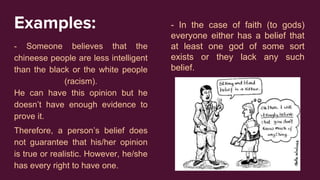
- Someone believes that the
chineese people are less intelligent
than the black or the white people
(racism).
He can have this opinion but he
doesn’t have enough evidence to
prove it.
Therefore, a person’s belief does
not guarantee that his/her opinion
is true or realistic. However, he/she
has every right to have one.
- In the case of faith (to gods)
everyone either has a belief that
at least one god of some sort
exists or they lack any such
belief.
Definition: Proof
Proof provides sufficent evidence (instead of belief) to establish something
as true, or to produce belief in its truth. In casual conversations, most people
use the word "proof" when they mean that there is indisputable evidence that
supports an idea. Proof is based on observations and logical conclusions, so
it is more absolutist and generally true for everyone.
Example: Someone believes that Earth is flat. We have evidence to prove
that it is circular. (According to Galileo Galilei)
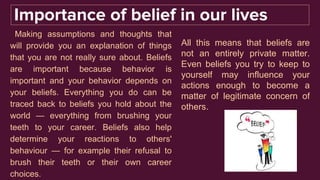
Importance of belief in our lives
Making assumptions and thoughts that
will provide you an explanation of things
that you are not really sure about. Beliefs
are important because behavior is
important and your behavior depends on
your beliefs. Everything you do can be
traced back to beliefs you hold about the
world — everything from brushing your
teeth to your career. Beliefs also help
determine your reactions to others'
behaviour — for example their refusal to
brush their teeth or their own career
choices.
All this means that beliefs are
not an entirely private matter.
Even beliefs you try to keep to
yourself may influence your
actions enough to become a
matter of legitimate concern of
others.
Importance of proof in our lives
Having proof to support your belief reassures you that something is true
and actual, which will make you feel safe. The major difference between
proof and belief is that, while belief helps you create an explanation of the
world that may or may not be true, proof provides you an explanation that
is certainly true. Let’s take the first example. A person believes that the
earth is flat, but he has no evidence to prove it. That means he may or
may not be wrong. That doubt makes him feel insecure about whether he
should believe that or not. Proof provides an accurate opinion based on
facts and not simple assumptions. And that provides safeness.
Belief & subjectivity
A belief is something you create with your own mind,
whether it’s true or not. So it’s based on a personal
opinion. Other people can disagree with you because
they have an opposite belief. That results to belief being
more subjective, not true for everyone, even though
many people can share your opinion.
Proof & objectivity
On the other hand, when we have proof to support an
idea, it becomes a general opinion that most people
share and it’s based on real facts, so it’s more absolute.
If you prove something true, then you can convince the
others and spread that opinion. Then, your opinion
becomes true to most people, until there is evidence to
prove it wrong. So, proof is really more about objectivity.
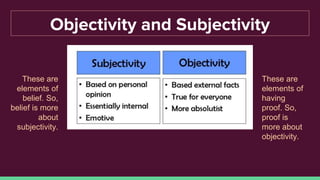
Objectivity and Subjectivity
These are
elements of
belief. So,
belief is more
about
subjectivity.
These are
elements of
having
proof. So,
proof is
more about
objectivity.
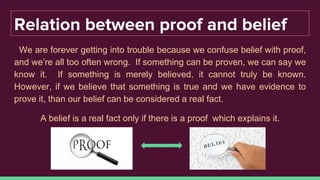
Relation between proof and belief
We are forever getting into trouble because we confuse belief with proof,
and we’re all too often wrong. If something can be proven, we can say we
know it. If something is merely believed, it cannot truly be known.
However, if we believe that something is true and we have evidence to
prove it, than our belief can be considered a real fact.
A belief is a real fact only if there is a proof which explains it.
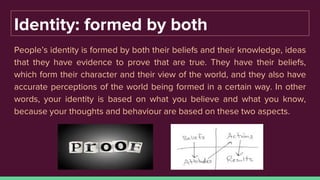
Identity: formed by both
People’s identity is formed by both their beliefs and their knowledge, ideas
that they have evidence to prove that are true. They have their beliefs,
which form their character and their view of the world, and they also have
accurate perceptions of the world being formed in a certain way. In other
words, your identity is based on what you believe and what you know,
because your thoughts and behaviour are based on these two aspects.
Sources
• https://en.wikipedia.org/wiki/Belief
• http://www.ial.goldthread.com/plausibility.html
• http://oregonstate.edu/instruction/bb317/scientifictheories.html
• http://frobinett.edublogs.org/files/2009/09/Language-of-Science-Theory-Law-
Hyp-etc.pdf
• http://atheism.about.com/od/definitionofatheism/a/BeliefImportant.htm
• http://www.digipac.ca/chemical/proof/index.htm
• http://jerobison.blogspot.gr/2013/09/the-difference-between-knowing-and.html
Thank you!

Belief vs proof Evi

  • 1.
    Belief VS Proof EviChaviari Maria Tsiapi Alex Psarrou
  • 2.
    Definition: Belief Generally, beliefis the mental attitude that some proposition is true with or without there being empirical evidence to prove with certainty that this is the case. For every given proposition, every person either has or lacks the mental attitude that it is true — there is no middle ground between the presence of absence of a belief. This idea is accepted as being true based on observation, opinion, faith (trust) or reason (logic). Beliefs are frequently passed along from generation to generation and may be part of a person’s religious, social and/or cultural background. Beliefs are not used to explain things scientifically.
  • 3.
    Examples: - Someone believesthat the chineese people are less intelligent than the black or the white people (racism). He can have this opinion but he doesn’t have enough evidence to prove it. Therefore, a person’s belief does not guarantee that his/her opinion is true or realistic. However, he/she has every right to have one. - In the case of faith (to gods) everyone either has a belief that at least one god of some sort exists or they lack any such belief.
  • 4.
    Definition: Proof Proof providessufficent evidence (instead of belief) to establish something as true, or to produce belief in its truth. In casual conversations, most people use the word "proof" when they mean that there is indisputable evidence that supports an idea. Proof is based on observations and logical conclusions, so it is more absolutist and generally true for everyone. Example: Someone believes that Earth is flat. We have evidence to prove that it is circular. (According to Galileo Galilei)
  • 5.
    Importance of beliefin our lives Making assumptions and thoughts that will provide you an explanation of things that you are not really sure about. Beliefs are important because behavior is important and your behavior depends on your beliefs. Everything you do can be traced back to beliefs you hold about the world — everything from brushing your teeth to your career. Beliefs also help determine your reactions to others' behaviour — for example their refusal to brush their teeth or their own career choices. All this means that beliefs are not an entirely private matter. Even beliefs you try to keep to yourself may influence your actions enough to become a matter of legitimate concern of others.
  • 6.
    Importance of proofin our lives Having proof to support your belief reassures you that something is true and actual, which will make you feel safe. The major difference between proof and belief is that, while belief helps you create an explanation of the world that may or may not be true, proof provides you an explanation that is certainly true. Let’s take the first example. A person believes that the earth is flat, but he has no evidence to prove it. That means he may or may not be wrong. That doubt makes him feel insecure about whether he should believe that or not. Proof provides an accurate opinion based on facts and not simple assumptions. And that provides safeness.
  • 7.
    Belief & subjectivity Abelief is something you create with your own mind, whether it’s true or not. So it’s based on a personal opinion. Other people can disagree with you because they have an opposite belief. That results to belief being more subjective, not true for everyone, even though many people can share your opinion.
  • 8.
    Proof & objectivity Onthe other hand, when we have proof to support an idea, it becomes a general opinion that most people share and it’s based on real facts, so it’s more absolute. If you prove something true, then you can convince the others and spread that opinion. Then, your opinion becomes true to most people, until there is evidence to prove it wrong. So, proof is really more about objectivity.
  • 9.
    Objectivity and Subjectivity Theseare elements of belief. So, belief is more about subjectivity. These are elements of having proof. So, proof is more about objectivity.
  • 10.
    Relation between proofand belief We are forever getting into trouble because we confuse belief with proof, and we’re all too often wrong. If something can be proven, we can say we know it. If something is merely believed, it cannot truly be known. However, if we believe that something is true and we have evidence to prove it, than our belief can be considered a real fact. A belief is a real fact only if there is a proof which explains it.
  • 11.
    Identity: formed byboth People’s identity is formed by both their beliefs and their knowledge, ideas that they have evidence to prove that are true. They have their beliefs, which form their character and their view of the world, and they also have accurate perceptions of the world being formed in a certain way. In other words, your identity is based on what you believe and what you know, because your thoughts and behaviour are based on these two aspects.
  • 12.
    Sources • https://en.wikipedia.org/wiki/Belief • http://www.ial.goldthread.com/plausibility.html •http://oregonstate.edu/instruction/bb317/scientifictheories.html • http://frobinett.edublogs.org/files/2009/09/Language-of-Science-Theory-Law- Hyp-etc.pdf • http://atheism.about.com/od/definitionofatheism/a/BeliefImportant.htm • http://www.digipac.ca/chemical/proof/index.htm • http://jerobison.blogspot.gr/2013/09/the-difference-between-knowing-and.html
  • 13.