Anastasia Karava
Renia Dimopoulou
C’2
2nd Experimental Junior High School of
Athens
Teacher : Ms Dertili Dimitra
Project 2017
 Introduction
 Etymology of anthropocene
 The Argarian Era
 The Modern Era
 The Digital Era
 The future
 Conclusion
Human civilization has seen three major eras in history. We
had the Argarian era of the ancient times, the Modern era in
the late 18th century and finally, the Digital era in which we
currently live.
Each revolution is marked by a drastic change from the
regular, resulting in innovations.
 The Agrarian era brought about ancient Chinese and
ancient Egyptian cities.
 The Modern era brought about efficiency in production
allowing for an almost worldwide economic boom.
 Now, the Digital Revolution is bringing impressive changes
of its own, throwing the world into a timthat is called the
Information Age.
Etymology :
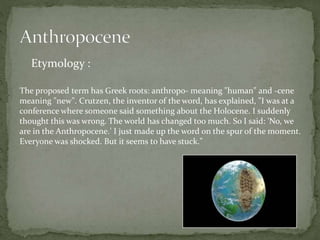
The proposed term has Greek roots: anthropo- meaning "human" and -cene
meaning "new". Crutzen, the inventor of the word, has explained, "I was at a
conference where someone said something about the Holocene. I suddenly
thought this was wrong. The world has changed too much. So I said: 'No, we
are in the Anthropocene.' I just made up the word on the spur of the moment.
Everyone was shocked. But it seems to have stuck."
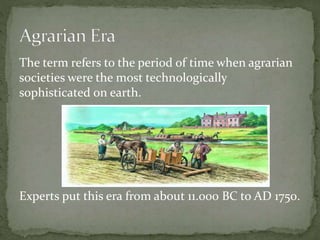
The term refers to the period of time when agrarian
societies were the most technologically
sophisticated on earth.
Experts put this era from about 11.000 BC to AD 1750.
 Agricultural machines have been
designed for practically every stage of
the agricultural process.
 Some people begin to live in settled
communities. This is important
because it leads up to villages.
 Eurasia trade networks develop.
 The secondary products revolution takes place in parts
of Afro-Eurasia.
The secondary products revolution was a series of
innovations that allowed farmers to make more efficient
use of products that could be used without killing
animals.
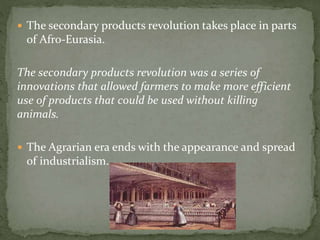
 The Agrarian era ends with the appearance and spread
of industrialism.
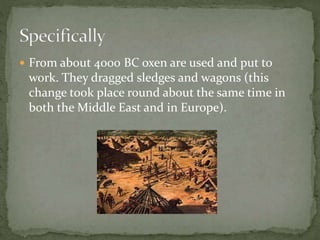
 From about 4000 BC oxen are used and put to
work. They dragged sledges and wagons (this
change took place round about the same time in
both the Middle East and in Europe).
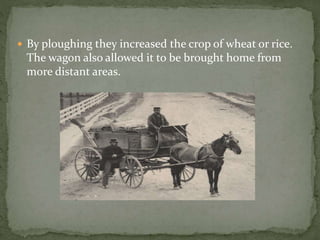
 By ploughing they increased the crop of wheat or rice.
The wagon also allowed it to be brought home from
more distant areas.
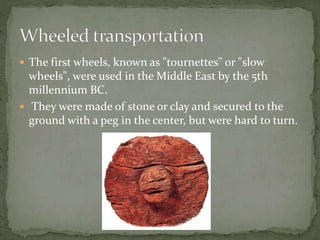
 The first wheels, known as "tournettes" or "slow
wheels", were used in the Middle East by the 5th
millennium BC.
 They were made of stone or clay and secured to the
ground with a peg in the center, but were hard to turn.
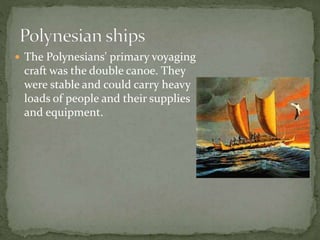
 The Polynesians' primary voyaging
craft was the double canoe. They
were stable and could carry heavy
loads of people and their supplies
and equipment.
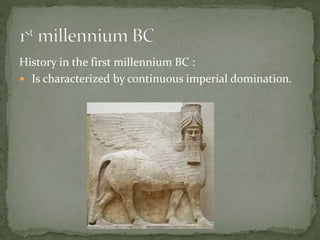
History in the first millennium BC :
 Is characterized by continuous imperial domination.
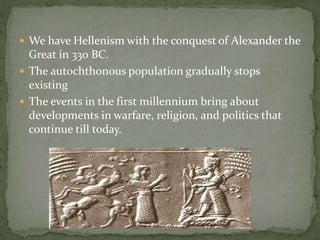
 We have Hellenism with the conquest of Alexander the
Great in 330 BC.
 The autochthonous population gradually stops
existing
 The events in the first millennium bring about
developments in warfare, religion, and politics that
continue till today.
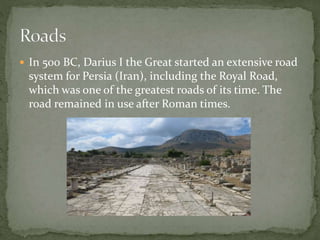
 In 500 BC, Darius I the Great started an extensive road
system for Persia (Iran), including the Royal Road,
which was one of the greatest roads of its time. The
road remained in use after Roman times.
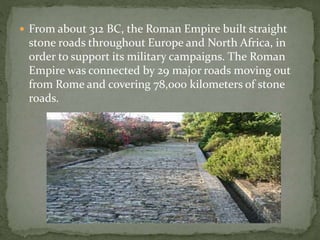
 From about 312 BC, the Roman Empire built straight
stone roads throughout Europe and North Africa, in
order to support its military campaigns. The Roman
Empire was connected by 29 major roads moving out
from Rome and covering 78,000 kilometers of stone
roads.
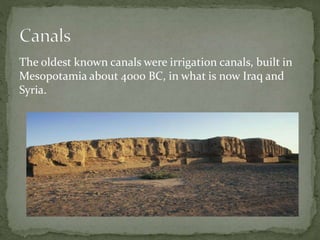
The oldest known canals were irrigation canals, built in
Mesopotamia about 4000 BC, in what is now Iraq and
Syria.
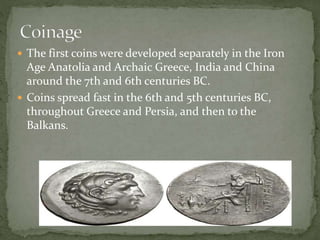
 The first coins were developed separately in the Iron
Age Anatolia and Archaic Greece, India and China
around the 7th and 6th centuries BC.
 Coins spread fast in the 6th and 5th centuries BC,
throughout Greece and Persia, and then to the
Balkans.
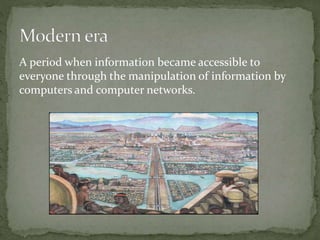
A period when information became accessible to
everyone through the manipulation of information by
computers and computer networks.
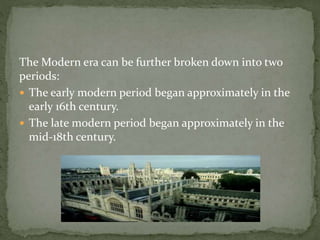
The Modern era can be further broken down into two
periods:
 The early modern period began approximately in the
early 16th century.
 The late modern period began approximately in the
mid-18th century.
 The modern period has been a period of significant
development in the fields of science, politics, warfare,
and technology. It is also known for its discoveries and
globalization.
 By the late 19th and 20th centuries, art, politics,
science and culture are popular throughout the world.
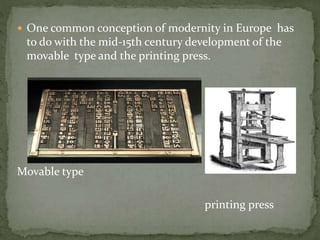
 One common conception of modernity in Europe has
to do with the mid-15th century development of the
movable type and the printing press.
Movable type
printing press
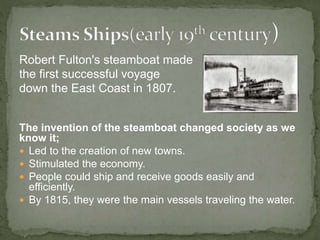
Robert Fulton's steamboat made
the first successful voyage
down the East Coast in 1807.
The invention of the steamboat changed society as we
know it;
 Led to the creation of new towns.
 Stimulated the economy.
 People could ship and receive goods easily and
efficiently.
 By 1815, they were the main vessels traveling the water.
Railways had led to significant changes within
society;
 Railway expansion at this time was rapid.
 Between 1826 and 1836, 378 miles of track had
opened.
 Travelling was faster, comfortable and not
expensive.
 It allowed people to travel further and fast
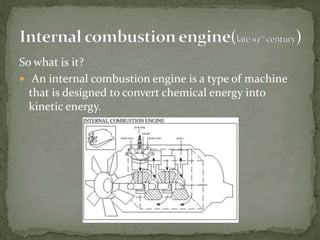
So what is it?
 An internal combustion engine is a type of machine
that is designed to convert chemical energy into
kinetic energy.
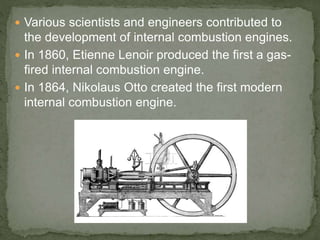
 Various scientists and engineers contributed to
the development of internal combustion engines.
 In 1860, Etienne Lenoir produced the first a gas-
fired internal combustion engine.
 In 1864, Nikolaus Otto created the first modern
internal combustion engine.
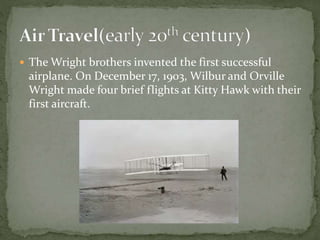
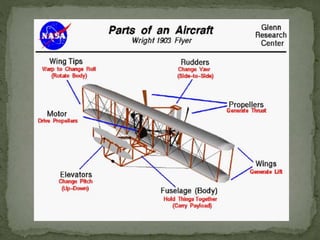
 The Wright brothers invented the first successful
airplane. On December 17, 1903, Wilbur and Orville
Wright made four brief flights at Kitty Hawk with their
first aircraft.
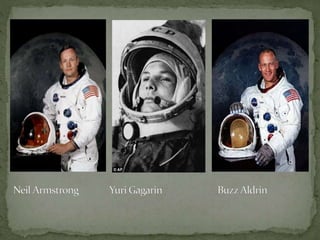
 The first successful human spaceflight was Vostok 1
carrying 27-year-old Russian Yuri Gagarin on 12 April
1961.
 Apollo 11 was the spaceflight that landed the first two
humans on the Moon.
 Neil Armstrong and pilot Buzz Aldrin, both
American, landed on July 20, 1969.
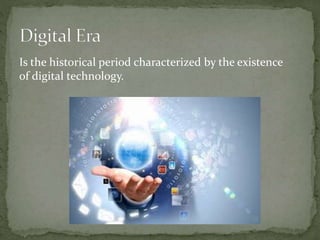
Is the historical period characterized by the existence
of digital technology.
Technology is the collection of :
 techniques,
 skills,
 methods
 processes
used in the production of goods or services or in the
accomplishment of objectives.
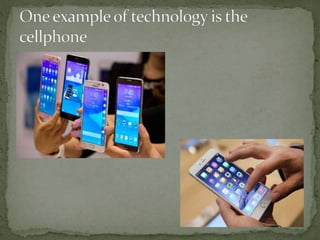
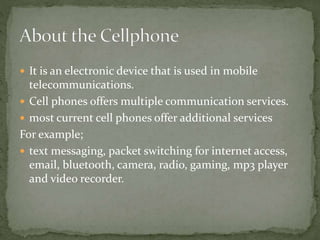
 It is an electronic device that is used in mobile
telecommunications.
 Cell phones offers multiple communication services.
 most current cell phones offer additional services
For example;
 text messaging, packet switching for internet access,
email, bluetooth, camera, radio, gaming, mp3 player
and video recorder.
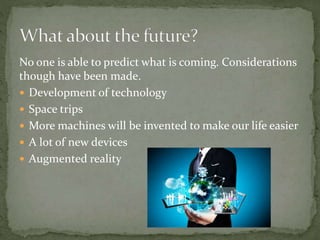
No one is able to predict what is coming. Considerations
though have been made.
 Development of technology
 Space trips
 More machines will be invented to make our life easier
 A lot of new devices
 Augmented reality
The future is for sure an unknown world. However we
already know through the passage of years that evolution
is what keeps us alive and that which keeps changing our
world. So what we assume is that the humans and their
choices will determine the future of humanity and the
world.
 http://elitedaily.com/news/technology/tech-revolution-industrial-revolution-time/
 http://www.liquisearch.com/anthropocene/etymology
 http://www.alanpedia.com/sociology_glossary_of_the_social_sciences/agrarian_era.html
 http://www.newworldencyclopedia.org/entry/Agricultural_technology
 https://prezi.com/tdyozpspg3an/timeline-of-the-agrarian-era/
 https://haskelgreenfield.wordpress.com/research/7-secondary-products-revolution-origins-of-use-
of-animals-for-milk-wool-and-traction/
 https://haskelgreenfield.wordpress.com/research/7-secondary-products-revolution-origins-of-use-
of-animals-for-milk-wool-and-traction/
 https://www.library.hbs.edu/hc/railroads/pre-industrial-era.html
 https://en.wikipedia.org/wiki/Wheel
 http://www.pbs.org/wayfinders/polynesian2.html
 http://cdli.ox.ac.uk/wiki/doku.php?id=1st_millennium
 https://en.wikipedia.org/wiki/Coin
 https://en.wikipedia.org/wiki/Road#History
 https://www.vocabulary.com/dictionary/modern%20era
 https://en.wikipedia.org/wiki/Modern_history
 https://en.wikipedia.org/wiki/Shipbuilding#Early_1st_millennium_AD
 http://www.scienceclarified.com/He-In/Internal-Combustion-Engine.html
 https://www.reference.com/history/did-steamboat-impact-society-
51c27562535dd16d
 http://www.parliament.uk/about/living-
heritage/transformingsociety/transportcomms/roadsrail/kent-case-
study/introduction/railways-in-early-nineteenth-century-britain/
 https://en.wikipedia.org/wiki/History_of_the_internal_combustion_engine
 http://www.livescience.com/2765-wright-brothers-changed-world.html
 https://en.wikipedia.org/wiki/Space_exploration
 https://en.wikipedia.org/wiki/Apollo_11
 https://en.wikipedia.org/wiki/Technology
 https://www.ukessays.com/essays/information-technology/cell-phone-is-an-
electronic-device-information-technology-essay.php

The Athropocene

  • 1.
    Anastasia Karava Renia Dimopoulou C’2 2ndExperimental Junior High School of Athens Teacher : Ms Dertili Dimitra Project 2017
  • 2.
     Introduction  Etymologyof anthropocene  The Argarian Era  The Modern Era  The Digital Era  The future  Conclusion
  • 3.
    Human civilization hasseen three major eras in history. We had the Argarian era of the ancient times, the Modern era in the late 18th century and finally, the Digital era in which we currently live. Each revolution is marked by a drastic change from the regular, resulting in innovations.  The Agrarian era brought about ancient Chinese and ancient Egyptian cities.  The Modern era brought about efficiency in production allowing for an almost worldwide economic boom.  Now, the Digital Revolution is bringing impressive changes of its own, throwing the world into a timthat is called the Information Age.
  • 4.
    Etymology : The proposedterm has Greek roots: anthropo- meaning "human" and -cene meaning "new". Crutzen, the inventor of the word, has explained, "I was at a conference where someone said something about the Holocene. I suddenly thought this was wrong. The world has changed too much. So I said: 'No, we are in the Anthropocene.' I just made up the word on the spur of the moment. Everyone was shocked. But it seems to have stuck."
  • 5.
    The term refersto the period of time when agrarian societies were the most technologically sophisticated on earth. Experts put this era from about 11.000 BC to AD 1750.
  • 6.
     Agricultural machineshave been designed for practically every stage of the agricultural process.  Some people begin to live in settled communities. This is important because it leads up to villages.  Eurasia trade networks develop.
  • 7.
     The secondaryproducts revolution takes place in parts of Afro-Eurasia. The secondary products revolution was a series of innovations that allowed farmers to make more efficient use of products that could be used without killing animals.  The Agrarian era ends with the appearance and spread of industrialism.
  • 8.
     From about4000 BC oxen are used and put to work. They dragged sledges and wagons (this change took place round about the same time in both the Middle East and in Europe).
  • 9.
     By ploughingthey increased the crop of wheat or rice. The wagon also allowed it to be brought home from more distant areas.
  • 10.
     The firstwheels, known as "tournettes" or "slow wheels", were used in the Middle East by the 5th millennium BC.  They were made of stone or clay and secured to the ground with a peg in the center, but were hard to turn.
  • 11.
     The Polynesians'primary voyaging craft was the double canoe. They were stable and could carry heavy loads of people and their supplies and equipment.
  • 12.
    History in thefirst millennium BC :  Is characterized by continuous imperial domination.
  • 13.
     We haveHellenism with the conquest of Alexander the Great in 330 BC.  The autochthonous population gradually stops existing  The events in the first millennium bring about developments in warfare, religion, and politics that continue till today.
  • 14.
     In 500BC, Darius I the Great started an extensive road system for Persia (Iran), including the Royal Road, which was one of the greatest roads of its time. The road remained in use after Roman times.
  • 15.
     From about312 BC, the Roman Empire built straight stone roads throughout Europe and North Africa, in order to support its military campaigns. The Roman Empire was connected by 29 major roads moving out from Rome and covering 78,000 kilometers of stone roads.
  • 16.
    The oldest knowncanals were irrigation canals, built in Mesopotamia about 4000 BC, in what is now Iraq and Syria.
  • 17.
     The firstcoins were developed separately in the Iron Age Anatolia and Archaic Greece, India and China around the 7th and 6th centuries BC.  Coins spread fast in the 6th and 5th centuries BC, throughout Greece and Persia, and then to the Balkans.
  • 18.
    A period wheninformation became accessible to everyone through the manipulation of information by computers and computer networks.
  • 19.
    The Modern eracan be further broken down into two periods:  The early modern period began approximately in the early 16th century.  The late modern period began approximately in the mid-18th century.
  • 20.
     The modernperiod has been a period of significant development in the fields of science, politics, warfare, and technology. It is also known for its discoveries and globalization.  By the late 19th and 20th centuries, art, politics, science and culture are popular throughout the world.
  • 21.
     One commonconception of modernity in Europe has to do with the mid-15th century development of the movable type and the printing press. Movable type printing press
  • 22.
    Robert Fulton's steamboatmade the first successful voyage down the East Coast in 1807. The invention of the steamboat changed society as we know it;  Led to the creation of new towns.  Stimulated the economy.  People could ship and receive goods easily and efficiently.  By 1815, they were the main vessels traveling the water.
  • 23.
    Railways had ledto significant changes within society;  Railway expansion at this time was rapid.  Between 1826 and 1836, 378 miles of track had opened.  Travelling was faster, comfortable and not expensive.  It allowed people to travel further and fast
  • 24.
    So what isit?  An internal combustion engine is a type of machine that is designed to convert chemical energy into kinetic energy.
  • 25.
     Various scientistsand engineers contributed to the development of internal combustion engines.  In 1860, Etienne Lenoir produced the first a gas- fired internal combustion engine.  In 1864, Nikolaus Otto created the first modern internal combustion engine.
  • 26.
     The Wrightbrothers invented the first successful airplane. On December 17, 1903, Wilbur and Orville Wright made four brief flights at Kitty Hawk with their first aircraft.
  • 28.
     The firstsuccessful human spaceflight was Vostok 1 carrying 27-year-old Russian Yuri Gagarin on 12 April 1961.  Apollo 11 was the spaceflight that landed the first two humans on the Moon.  Neil Armstrong and pilot Buzz Aldrin, both American, landed on July 20, 1969.
  • 30.
    Is the historicalperiod characterized by the existence of digital technology.
  • 31.
    Technology is thecollection of :  techniques,  skills,  methods  processes used in the production of goods or services or in the accomplishment of objectives.
  • 33.
     It isan electronic device that is used in mobile telecommunications.  Cell phones offers multiple communication services.  most current cell phones offer additional services For example;  text messaging, packet switching for internet access, email, bluetooth, camera, radio, gaming, mp3 player and video recorder.
  • 38.
    No one isable to predict what is coming. Considerations though have been made.  Development of technology  Space trips  More machines will be invented to make our life easier  A lot of new devices  Augmented reality
  • 39.
    The future isfor sure an unknown world. However we already know through the passage of years that evolution is what keeps us alive and that which keeps changing our world. So what we assume is that the humans and their choices will determine the future of humanity and the world.
  • 40.
     http://elitedaily.com/news/technology/tech-revolution-industrial-revolution-time/  http://www.liquisearch.com/anthropocene/etymology http://www.alanpedia.com/sociology_glossary_of_the_social_sciences/agrarian_era.html  http://www.newworldencyclopedia.org/entry/Agricultural_technology  https://prezi.com/tdyozpspg3an/timeline-of-the-agrarian-era/  https://haskelgreenfield.wordpress.com/research/7-secondary-products-revolution-origins-of-use- of-animals-for-milk-wool-and-traction/  https://haskelgreenfield.wordpress.com/research/7-secondary-products-revolution-origins-of-use- of-animals-for-milk-wool-and-traction/  https://www.library.hbs.edu/hc/railroads/pre-industrial-era.html  https://en.wikipedia.org/wiki/Wheel  http://www.pbs.org/wayfinders/polynesian2.html  http://cdli.ox.ac.uk/wiki/doku.php?id=1st_millennium  https://en.wikipedia.org/wiki/Coin  https://en.wikipedia.org/wiki/Road#History  https://www.vocabulary.com/dictionary/modern%20era  https://en.wikipedia.org/wiki/Modern_history  https://en.wikipedia.org/wiki/Shipbuilding#Early_1st_millennium_AD
  • 41.
     http://www.scienceclarified.com/He-In/Internal-Combustion-Engine.html  https://www.reference.com/history/did-steamboat-impact-society- 51c27562535dd16d http://www.parliament.uk/about/living- heritage/transformingsociety/transportcomms/roadsrail/kent-case- study/introduction/railways-in-early-nineteenth-century-britain/  https://en.wikipedia.org/wiki/History_of_the_internal_combustion_engine  http://www.livescience.com/2765-wright-brothers-changed-world.html  https://en.wikipedia.org/wiki/Space_exploration  https://en.wikipedia.org/wiki/Apollo_11  https://en.wikipedia.org/wiki/Technology  https://www.ukessays.com/essays/information-technology/cell-phone-is-an- electronic-device-information-technology-essay.php