Classifying biological information
the promise and perils of DNA sequences
Rob Beiko
September 19
DCSI 2013
Norm MacDonald Donovan Parks
1
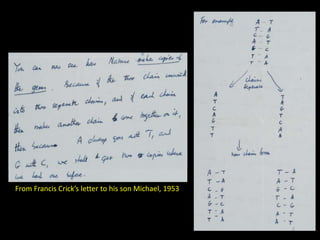
From Francis Crick’s letter to his son Michael, 1953
2
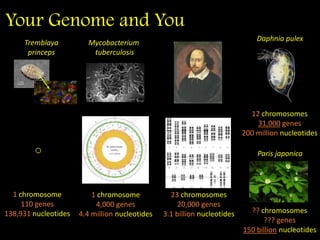
Your Genome and You
23 chromosomes
20,000 genes
3.1 billion nucleotides
Mycobacterium
tuberculosis
1 chromosome
4,000 genes
4.4 million nucleotides
Tremblaya
princeps
1 chromosome
110 genes
138,931 nucleotides
Daphnia pulex
12 chromosomes
31,000 genes
200 million nucleotides
Paris japonica
?? chromosomes
??? genes
150 billion nucleotides3
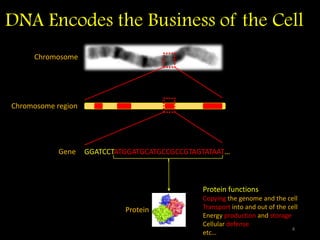
DNA Encodes the Business of the Cell
Chromosome
Chromosome region
Gene GGATCCTATGGATGCATGCCGCCGTAGTATAAT…
Protein
Protein functions
Copying the genome and the cell
Transport into and out of the cell
Energy production and storage
Cellular defense
etc…
4
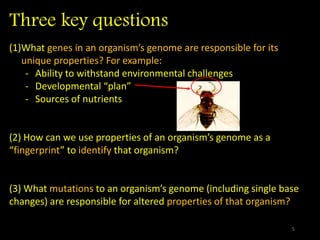
Three key questions
(1)What genes in an organism’s genome are responsible for its
unique properties? For example:
- Ability to withstand environmental challenges
- Developmental “plan”
- Sources of nutrients
(2) How can we use properties of an organism’s genome as a
“fingerprint” to identify that organism?
(3) What mutations to an organism’s genome (including single base
changes) are responsible for altered properties of that organism?
5
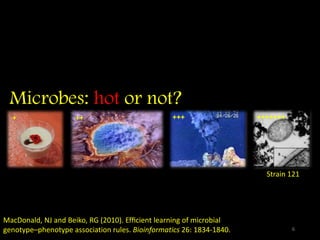
Microbes: hot or not?
+ ++ +++ +++++++
Strain 121
MacDonald, NJ and Beiko, RG (2010). Efficient learning of microbial
genotype–phenotype association rules. Bioinformatics 26: 1834-1840. 6
Beating the heat
Proteins tend to stop working at temperatures above 37-40° C
Heat shock – “Things are getting uncomfortable here”
Extreme heat shock – “Make it stop make it stop make it stop!!!!”
What does an organism need to get by at higher temperatures?
(1) Specific proteins that help keep everything working
(2) Changes to all proteins that make them more heat tolerant
(3) Various other things
Proteins tend to stop working at temperatures above 37-40° C
Heat shock – “Things are getting uncomfortable here”
Extreme heat shock – “Make it stop make it stop make it stop!!!!”
What does an organism need to get by at higher temperatures?
(1) Specific proteins that help keep everything working
(2) Changes to all proteins that make them more heat tolerant
(3) Various other things
7
The “genotype-phenotype association” problem
Genotype: An organism’s DNA sequence, somehow defined
Phenotype: An organism’s physical properties
In this case, “genotype” will refer to the presence of genes that
are similar enough that they likely share the same function
8
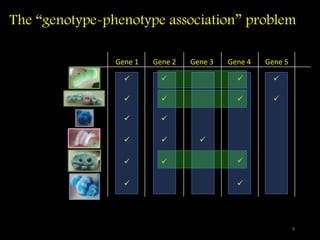
The “genotype-phenotype association” problem
Gene 1 Gene 2 Gene 3 Gene 4 Gene 5


















9
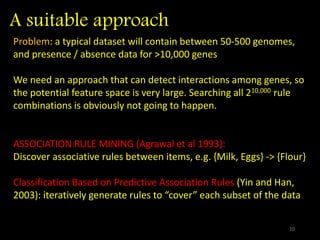
A suitable approach
Problem: a typical dataset will contain between 50-500 genomes,
and presence / absence data for >10,000 genes
We need an approach that can detect interactions among genes, so
the potential feature space is very large. Searching all 210,000 rule
combinations is obviously not going to happen.
ASSOCIATION RULE MINING (Agrawal et al 1993):
Discover associative rules between items, e.g. {Milk, Eggs} -> {Flour}
Classification Based on Predictive Association Rules (Yin and Han,
2003): iteratively generate rules to “cover” each subset of the data
10
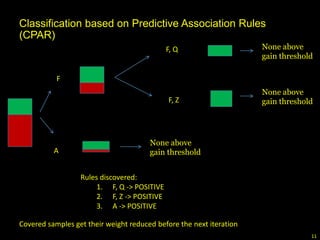
11
F
F, Q
F, Z
A
None above
gain threshold
Rules discovered:
1. F, Q -> POSITIVE
2. F, Z -> POSITIVE
3. A -> POSITIVE
Covered samples get their weight reduced before the next iteration
None above
gain threshold
None above
gain threshold
Classification based on Predictive Association Rules
(CPAR)
CPAR results
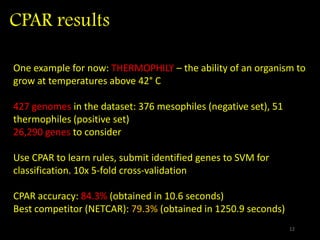
One example for now: THERMOPHILY – the ability of an organism to
grow at temperatures above 42° C
427 genomes in the dataset: 376 mesophiles (negative set), 51
thermophiles (positive set)
26,290 genes to consider
Use CPAR to learn rules, submit identified genes to SVM for
classification. 10x 5-fold cross-validation
CPAR accuracy: 84.3% (obtained in 10.6 seconds)
Best competitor (NETCAR): 79.3% (obtained in 1250.9 seconds)
12
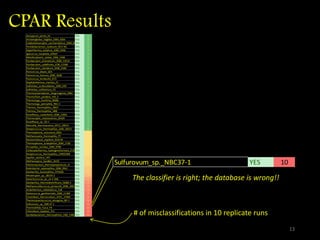
CPAR Results
Aeropyrum_pernix_K1 YES 0
Archaeoglobus_fulgidus_DSM_4304 YES 0
Caldicellulosiruptor_saccharolyticus_DSM_8903YES 0
Fervidobacterium_nodosum_Rt17-B1 YES 0
Hyperthermus_butylicus_DSM_5456 YES 0
Ignicoccus_hospitalis_KIN4/I YES 0
Metallosphaera_sedula_DSM_5348 YES 0
Pyrobaculum_arsenaticum_DSM_13514 YES 0
Pyrobaculum_calidifontis_JCM_11548 YES 0
Pyrobaculum_islandicum_DSM_4184 YES 0
Pyrococcus_abyssi_GE5 YES 0
Pyrococcus_furiosus_DSM_3638 YES 0
Pyrococcus_horikoshii_OT3 YES 0
Staphylothermus_marinus_F1 YES 0
Sulfolobus_acidocaldarius_DSM_639 YES 0
Sulfolobus_solfataricus_P2 YES 0
Thermoanaerobacter_tengcongensis_MB4 YES 0
Thermofilum_pendens_Hrk_5 YES 0
Thermotoga_maritima_MSB8 YES 0
Thermotoga_petrophila_RKU-1 YES 0
Thermus_thermophilus_HB27 YES 0
Thermus_thermophilus_HB8 YES 0
Roseiflexus_castenholzii_DSM_13941 YES 0
Thermosipho_melanesiensis_BI429 YES 0
Roseiflexus_sp._RS-1 YES 0
Moorella_thermoacetica_ATCC_39073 YES 0
Streptococcus_thermophilus_LMG_18311 YES 0
Thermoplasma_volcanium_GSS1 YES 1
Methanosaeta_thermophila_PT YES 1
Nanoarchaeum_equitans_Kin4-M YES 1
Thermoplasma_acidophilum_DSM_1728 YES 1
Picrophilus_torridus_DSM_9790 YES 1
Carboxydothermus_hydrogenoformans_Z-2901YES 1
Streptococcus_thermophilus_CNRZ1066 YES 1
Aquifex_aeolicus_VF5 YES 2
Methanopyrus_kandleri_AV19 YES 2
Pelotomaculum_thermopropionicum_SI YES 2
Rubrobacter_xylanophilus_DSM_9941 YES 3
Geobacillus_kaustophilus_HTA426 YES 3
Nitratiruptor_sp._SB155-2 YES 4
Synechococcus_sp._JA-3-3Ab YES 6
Geobacillus_thermodenitrificans_NG80-2 YES 7
Methanocaldococcus_jannaschii_DSM_2661 YES 8
Acidothermus_cellulolyticus_11B YES 8
Deinococcus_geothermalis_DSM_11300 YES 9
Clostridium_thermocellum_ATCC_27405 YES 9
Thermosynechococcus_elongatus_BP-1 YES 9
Sulfurovum_sp._NBC37-1 YES 10
Thermobifida_fusca_YX YES 10
Chlorobium_tepidum_TLS YES 10
Symbiobacterium_thermophilum_IAM_14863YES 10 # of misclassifications in 10 replicate runs
Sulfurovum_sp._NBC37-1 YES 10
The classifier is right; the database is wrong!!
13
A complication
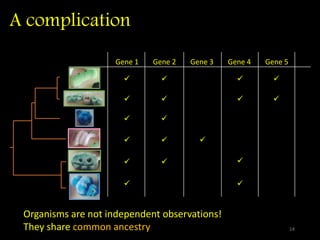
Organisms are not independent observations!
They share common ancestry
Gene 1 Gene 2 Gene 3 Gene 4 Gene 5


















14
What to do?
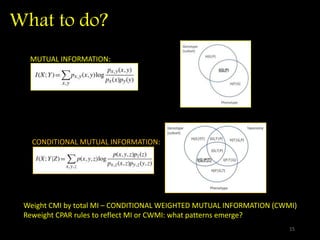
MUTUAL INFORMATION:
CONDITIONAL MUTUAL INFORMATION:
Weight CMI by total MI – CONDITIONAL WEIGHTED MUTUAL INFORMATION (CWMI)
Reweight CPAR rules to reflect MI or CWMI: what patterns emerge?
15
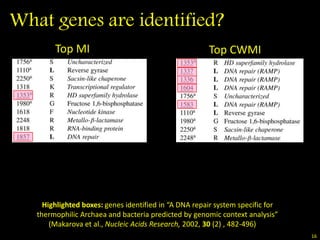
What genes are identified?
16
Highlighted boxes: genes identified in “A DNA repair system specific for
thermophilic Archaea and bacteria predicted by genomic context analysis”
(Makarova et al., Nucleic Acids Research, 2002, 30 (2) , 482-496)
Top CWMITop MI
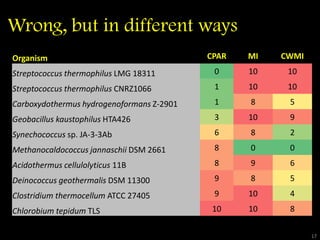
Wrong, but in different ways
1717
Organism CPAR MI CWMI
Streptococcus thermophilus LMG 18311 0 10 10
Streptococcus thermophilus CNRZ1066 1 10 10
Carboxydothermus hydrogenoformans Z-2901 1 8 5
Geobacillus kaustophilus HTA426 3 10 9
Synechococcus sp. JA-3-3Ab 6 8 2
Methanocaldococcus jannaschii DSM 2661 8 0 0
Acidothermus cellulolyticus 11B 8 9 6
Deinococcus geothermalis DSM 11300 9 8 5
Clostridium thermocellum ATCC 27405 9 10 4
Chlorobium tepidum TLS 10 10 8
Summary
18
Misclassifications (10 replicates)
18
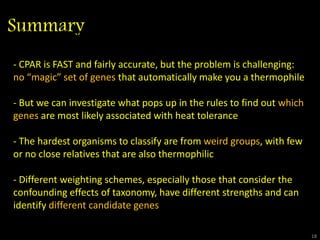
- CPAR is FAST and fairly accurate, but the problem is challenging:
no “magic” set of genes that automatically make you a thermophile
- But we can investigate what pops up in the rules to find out which
genes are most likely associated with heat tolerance
- The hardest organisms to classify are from weird groups, with few
or no close relatives that are also thermophilic
- Different weighting schemes, especially those that consider the
confounding effects of taxonomy, have different strengths and can
identify different candidate genes
What’s next?
1919
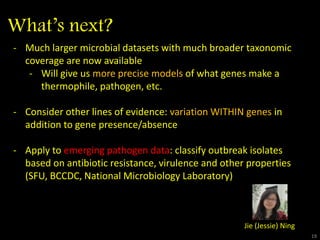
- Much larger microbial datasets with much broader taxonomic
coverage are now available
- Will give us more precise models of what genes make a
thermophile, pathogen, etc.
- Consider other lines of evidence: variation WITHIN genes in
addition to gene presence/absence
- Apply to emerging pathogen data: classify outbreak isolates
based on antibiotic resistance, virulence and other properties
(SFU, BCCDC, National Microbiology Laboratory)
Jie (Jessie) Ning
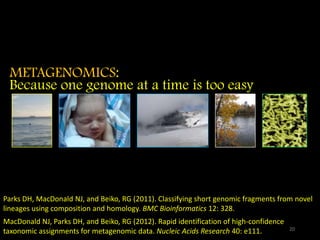
METAGENOMICS:
Because one genome at a time is too easy
MacDonald NJ, Parks DH, and Beiko, RG (2012). Rapid identification of high-confidence
taxonomic assignments for metagenomic data. Nucleic Acids Research 40: e111.
Parks DH, MacDonald NJ, and Beiko, RG (2011). Classifying short genomic fragments from novel
lineages using composition and homology. BMC Bioinformatics 12: 328.
20
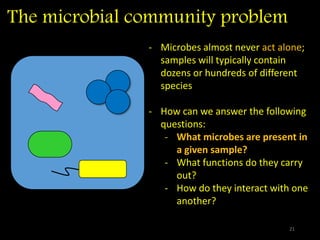
The microbial community problem
- Microbes almost never act alone;
samples will typically contain
dozens or hundreds of different
species
- How can we answer the following
questions:
- What microbes are present in
a given sample?
- What functions do they carry
out?
- How do they interact with one
another?
21
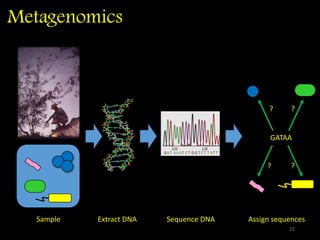
Metagenomics
Sample Extract DNA Sequence DNA Assign sequences
GATAA
? ?
??
22
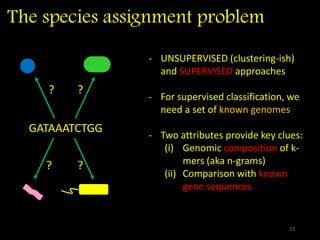
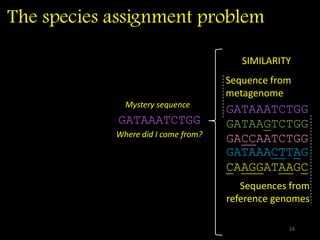
The species assignment problem
GATAAATCTGG
? ?
??
- UNSUPERVISED (clustering-ish)
and SUPERVISED approaches
- For supervised classification, we
need a set of known genomes
- Two attributes provide key clues:
(i) Genomic composition of k-
mers (aka n-grams)
(ii) Comparison with known
gene sequences
23
The species assignment problem
GATAAATCTGG
24
Mystery sequence
Where did I come from?
COMPOSITION
(k-mers)
k-mer frequency
AA 2/10
AC 0/10
AG 0/10
AT 1/10
k-mer frequency
AA 2/10
AC 0/10
AG 0/10
AT 1/10
k-mer frequency
AA 2/10
AC 0/10
AG 0/10
AT 1/10
k-mer frequency
AA 2/10
AC 0/10
AG 0/10
AT 1/10
k-mer frequency
AA 2/10
AC 0/10
AG 0/10
AT 1/10
Genome models
SIMILARITY
GATAAATCTGG
GATAAGTCTGG
GACCAATCTGG
GATAAACTTAG
CAAGGATAAGC
Sequences from
reference genomes
Sequence from
metagenome
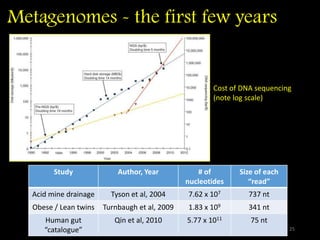
Metagenomes - the first few years
25
Cost of DNA sequencing
(note log scale)
Study Author, Year # of
nucleotides
Size of each
“read”
Acid mine drainage Tyson et al, 2004 7.62 x 10⁷ 737 nt
Obese / Lean twins Turnbaugh et al, 2009 1.83 x 10⁹ 341 nt
Human gut
“catalogue”
Qin et al, 2010 5.77 x 10¹¹ 75 nt
Summary of challenges
26
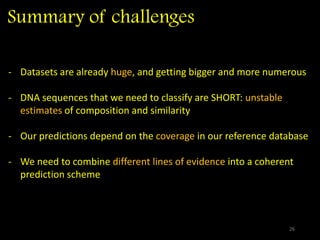
- Datasets are already huge, and getting bigger and more numerous
- DNA sequences that we need to classify are SHORT: unstable
estimates of composition and similarity
- Our predictions depend on the coverage in our reference database
- We need to combine different lines of evidence into a coherent
prediction scheme
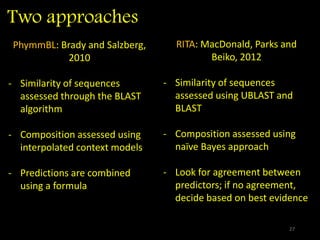
Two approaches
27
PhymmBL: Brady and Salzberg,
2010
- Similarity of sequences
assessed through the BLAST
algorithm
- Composition assessed using
interpolated context models
- Predictions are combined
using a formula
RITA: MacDonald, Parks and
Beiko, 2012
- Similarity of sequences
assessed using UBLAST and
BLAST
- Composition assessed using
naïve Bayes approach
- Look for agreement between
predictors; if no agreement,
decide based on best evidence
The naïve Bayes approach
28
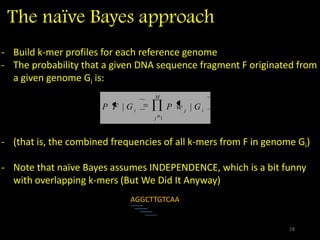
- Build k-mer profiles for each reference genome
- The probability that a given DNA sequence fragment F originated from
a given genome Gi is:
- (that is, the combined frequencies of all k-mers from F in genome Gi)
- Note that naïve Bayes assumes INDEPENDENCE, which is a bit funny
with overlapping k-mers (But We Did It Anyway)
M
j
iji GwPGFP
1
||
AGGCTTGTCAA
Naïve Bayes in action
29
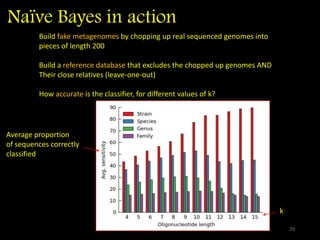
Build fake metagenomes by chopping up real sequenced genomes into
pieces of length 200
Build a reference database that excludes the chopped up genomes AND
Their close relatives (leave-one-out)
How accurate is the classifier, for different values of k?
k
Average proportion
of sequences correctly
classified
Composition versus Similarity
30
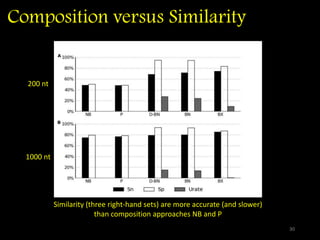
Similarity (three right-hand sets) are more accurate (and slower)
than composition approaches NB and P
1000 nt
200 nt
RITA:
Rapid Identification of Taxonomic Assignments
31
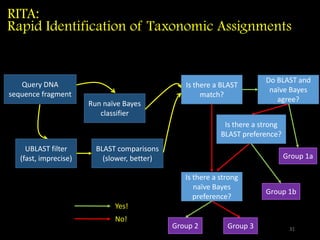
Query DNA
sequence fragment
Run naïve Bayes
classifier
UBLAST filter
(fast, imprecise)
BLAST comparisons
(slower, better)
Is there a BLAST
match?
Is there a strong
naïve Bayes
preference?
Do BLAST and
naïve Bayes
agree?
Is there a strong
BLAST preference?
Group 2 Group 3
Group 1a
Group 1b
Yes!
No!
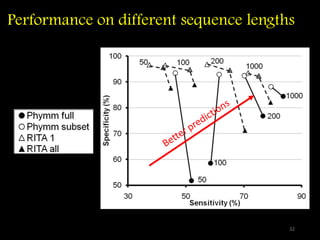
Performance on different sequence lengths
32
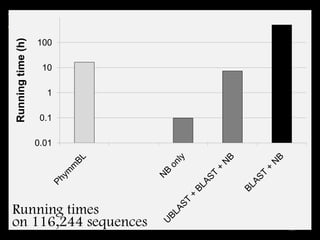
Running time
33
0.01
0.1
1
10
100
Runningtime(h)
Running times
on 116,244 sequences
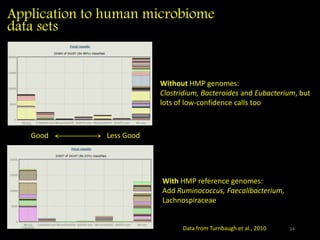
Application to human microbiome
data sets
34
Homology+CompositionComposition
Without HMP genomes:
Clostridium, Bacteroides and Eubacterium, but
lots of low-confidence calls too
With HMP reference genomes:
Add Ruminococcus, Faecalibacterium,
Lachnospiraceae
Good Less Good
Data from Turnbaugh et al., 2010
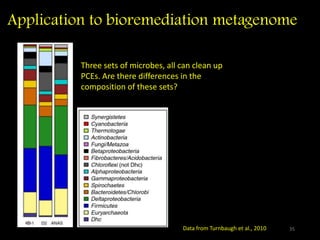
Application to bioremediation metagenome
35Hug et al., 2012
Three sets of microbes, all can clean up
PCEs. Are there differences in the
composition of these sets?
Summary
36
- Naïve Bayes is FAST and performs as well as alternative, more
complicated approaches
- The combination of composition and similarity is superior to either
approach in isolation
- The accuracy on short reads is good, but a substantial minority of
reads are misclassified so the question of “who is doing what”
remains somewhat open
What’s next?
37
- Apply to emerging metagenomic data sets:
- Bioremediation
- Aging and frailty in mice and humans
- Refine the approach to include both
unsupervised and supervised components
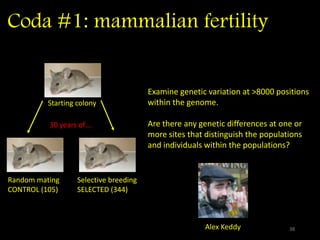
Coda #1: mammalian fertility
38
Random mating
CONTROL (105)
Selective breeding
SELECTED (344)
Starting colony
30 years of….
Examine genetic variation at >8000 positions
within the genome.
Are there any genetic differences at one or
more sites that distinguish the populations
and individuals within the populations?
Alex Keddy
Katherine
Rutherford
Machine-learning results
39
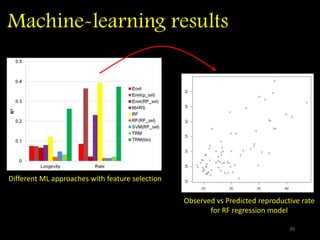
Different ML approaches with feature selection
Observed vs Predicted reproductive rate
for RF regression model
What’s next?
40Jeremy Koenig
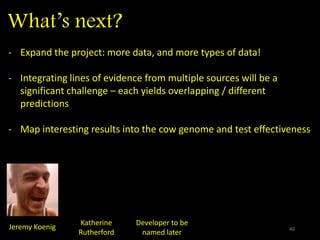
- Expand the project: more data, and more types of data!
- Integrating lines of evidence from multiple sources will be a
significant challenge – each yields overlapping / different
predictions
- Map interesting results into the cow genome and test effectiveness
Developer to be
named later
Coda #2: data retrieval and GIS
41
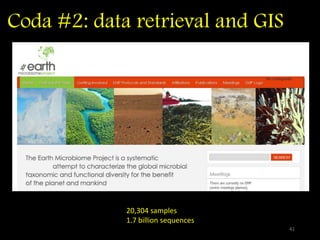
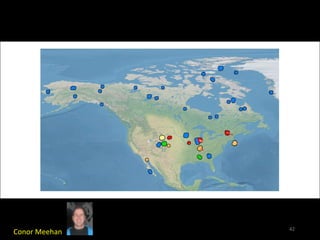
20,304 samples
1.7 billion sequences
42
Conor Meehan
Objectives
43
- Automated classification of data from sources such as the EMP
- Retrieval of data from EMP via Web services under development
(some plugins already completed – come in October for the story)
What’s next?
44
My Dal Homecoming lecture on October 4
Classifying DNA: Adventures in
Multidisciplinarity
45
Genetics
Evolution
Statistics
Machine
Learning
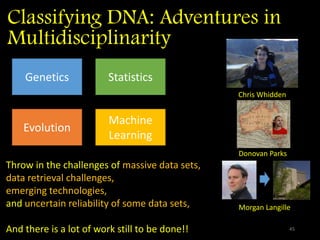
Throw in the challenges of massive data sets,
data retrieval challenges,
emerging technologies,
and uncertain reliability of some data sets,
And there is a lot of work still to be done!!
Chris Whidden
Donovan Parks
Morgan Langille
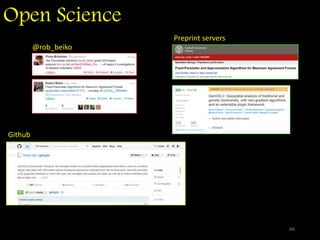
Open Science
46
@rob_beiko
Github
Preprint servers
This presentation:
http://www.slideshare.net/beiko/beiko-dcsi2013
Fin
47
Fin
Image credits
Please follow links for copyright information
Slide 1: http://commons.wikimedia.org/wiki/File:DNA Overview2.png
Slide 2: s3.documentcloud.org/documents/706661/francis-crick-letter.pdf
Slide 3: http://www.nature.com/nature/journal/v393/n6685/full/393537a0.html
http://www.ncbi.nlm.nih.gov/sutils/static/GP IMAGE/Mycobacterium.jpg
http://commons.wikimedia.org/wiki/File:Shakespeare.jpg
http://commons.wikimedia.org/wiki/File:Wolllaus.jpg
http://phenomena.nationalgeographic.com/files/2013/06/Tremblaya Moranella.jpg (Ryuichi Koga, National Institute of Advanced Industrial
Science and Technology, Japan)
http://commons.wikimedia.org/wiki/File:Daphnia pulex.png
http://commons.wikimedia.org/wiki/File:Paris japonica Kinugasasou in Hakusan 2003 7 27.jpg
Slide 4: http://upload.wikimedia.org/wikipedia/commons/2/21/DNA human male chromosomes.gif
http://commons.wikimedia.org/wiki/File:LKB1 complex structure 2WTK.png
Slide 6: http://commons.wikimedia.org/wiki/File:Yogurt of the Bulgarija Pavilion of Expo 2005 Aichi Japan.jpg
http://en.wikipedia.org/wiki/File:Grand prismatic spring.jpg
http://www.nsf.gov/od/lpa/news/03/images/scsmoker2th.jpg
http://www.nsf.gov/od/lpa/news/03/images/strain121 thin th.jpg
Slide 21:
http://commons.wikimedia.org/wiki/File:EPA_TECHNICIAN_COLLECTS_WATER_SAMPLE_FROM_PAHRANAGAT_LAKE_ABOUT_10_MILES_SOUTH
_OF_ALAMO_-_NARA_-_549007.jpg
http://commons.wikimedia.org/wiki/File:DNA_orbit_animated_small.gif
http://commons.wikimedia.org/wiki/File:DNA_sequence.svg
Slide 24:Stein, L. Genome Biology 2010 11:207
Slide 36: http://commons.wikimedia.org/wiki/File:Mouse-19-Dec-2004.jpg
48

Beiko dcsi2013

  • 1.
    Classifying biological information thepromise and perils of DNA sequences Rob Beiko September 19 DCSI 2013 Norm MacDonald Donovan Parks 1
  • 2.
    From Francis Crick’sletter to his son Michael, 1953 2
  • 3.
    Your Genome andYou 23 chromosomes 20,000 genes 3.1 billion nucleotides Mycobacterium tuberculosis 1 chromosome 4,000 genes 4.4 million nucleotides Tremblaya princeps 1 chromosome 110 genes 138,931 nucleotides Daphnia pulex 12 chromosomes 31,000 genes 200 million nucleotides Paris japonica ?? chromosomes ??? genes 150 billion nucleotides3
  • 4.
    DNA Encodes theBusiness of the Cell Chromosome Chromosome region Gene GGATCCTATGGATGCATGCCGCCGTAGTATAAT… Protein Protein functions Copying the genome and the cell Transport into and out of the cell Energy production and storage Cellular defense etc… 4
  • 5.
    Three key questions (1)Whatgenes in an organism’s genome are responsible for its unique properties? For example: - Ability to withstand environmental challenges - Developmental “plan” - Sources of nutrients (2) How can we use properties of an organism’s genome as a “fingerprint” to identify that organism? (3) What mutations to an organism’s genome (including single base changes) are responsible for altered properties of that organism? 5
  • 6.
    Microbes: hot ornot? + ++ +++ +++++++ Strain 121 MacDonald, NJ and Beiko, RG (2010). Efficient learning of microbial genotype–phenotype association rules. Bioinformatics 26: 1834-1840. 6
  • 7.
    Beating the heat Proteinstend to stop working at temperatures above 37-40° C Heat shock – “Things are getting uncomfortable here” Extreme heat shock – “Make it stop make it stop make it stop!!!!” What does an organism need to get by at higher temperatures? (1) Specific proteins that help keep everything working (2) Changes to all proteins that make them more heat tolerant (3) Various other things Proteins tend to stop working at temperatures above 37-40° C Heat shock – “Things are getting uncomfortable here” Extreme heat shock – “Make it stop make it stop make it stop!!!!” What does an organism need to get by at higher temperatures? (1) Specific proteins that help keep everything working (2) Changes to all proteins that make them more heat tolerant (3) Various other things 7
  • 8.
    The “genotype-phenotype association”problem Genotype: An organism’s DNA sequence, somehow defined Phenotype: An organism’s physical properties In this case, “genotype” will refer to the presence of genes that are similar enough that they likely share the same function 8
  • 9.
    The “genotype-phenotype association”problem Gene 1 Gene 2 Gene 3 Gene 4 Gene 5                   9
  • 10.
    A suitable approach Problem:a typical dataset will contain between 50-500 genomes, and presence / absence data for >10,000 genes We need an approach that can detect interactions among genes, so the potential feature space is very large. Searching all 210,000 rule combinations is obviously not going to happen. ASSOCIATION RULE MINING (Agrawal et al 1993): Discover associative rules between items, e.g. {Milk, Eggs} -> {Flour} Classification Based on Predictive Association Rules (Yin and Han, 2003): iteratively generate rules to “cover” each subset of the data 10
  • 11.
    11 F F, Q F, Z A Noneabove gain threshold Rules discovered: 1. F, Q -> POSITIVE 2. F, Z -> POSITIVE 3. A -> POSITIVE Covered samples get their weight reduced before the next iteration None above gain threshold None above gain threshold Classification based on Predictive Association Rules (CPAR)
  • 12.
    CPAR results One examplefor now: THERMOPHILY – the ability of an organism to grow at temperatures above 42° C 427 genomes in the dataset: 376 mesophiles (negative set), 51 thermophiles (positive set) 26,290 genes to consider Use CPAR to learn rules, submit identified genes to SVM for classification. 10x 5-fold cross-validation CPAR accuracy: 84.3% (obtained in 10.6 seconds) Best competitor (NETCAR): 79.3% (obtained in 1250.9 seconds) 12
  • 13.
    CPAR Results Aeropyrum_pernix_K1 YES0 Archaeoglobus_fulgidus_DSM_4304 YES 0 Caldicellulosiruptor_saccharolyticus_DSM_8903YES 0 Fervidobacterium_nodosum_Rt17-B1 YES 0 Hyperthermus_butylicus_DSM_5456 YES 0 Ignicoccus_hospitalis_KIN4/I YES 0 Metallosphaera_sedula_DSM_5348 YES 0 Pyrobaculum_arsenaticum_DSM_13514 YES 0 Pyrobaculum_calidifontis_JCM_11548 YES 0 Pyrobaculum_islandicum_DSM_4184 YES 0 Pyrococcus_abyssi_GE5 YES 0 Pyrococcus_furiosus_DSM_3638 YES 0 Pyrococcus_horikoshii_OT3 YES 0 Staphylothermus_marinus_F1 YES 0 Sulfolobus_acidocaldarius_DSM_639 YES 0 Sulfolobus_solfataricus_P2 YES 0 Thermoanaerobacter_tengcongensis_MB4 YES 0 Thermofilum_pendens_Hrk_5 YES 0 Thermotoga_maritima_MSB8 YES 0 Thermotoga_petrophila_RKU-1 YES 0 Thermus_thermophilus_HB27 YES 0 Thermus_thermophilus_HB8 YES 0 Roseiflexus_castenholzii_DSM_13941 YES 0 Thermosipho_melanesiensis_BI429 YES 0 Roseiflexus_sp._RS-1 YES 0 Moorella_thermoacetica_ATCC_39073 YES 0 Streptococcus_thermophilus_LMG_18311 YES 0 Thermoplasma_volcanium_GSS1 YES 1 Methanosaeta_thermophila_PT YES 1 Nanoarchaeum_equitans_Kin4-M YES 1 Thermoplasma_acidophilum_DSM_1728 YES 1 Picrophilus_torridus_DSM_9790 YES 1 Carboxydothermus_hydrogenoformans_Z-2901YES 1 Streptococcus_thermophilus_CNRZ1066 YES 1 Aquifex_aeolicus_VF5 YES 2 Methanopyrus_kandleri_AV19 YES 2 Pelotomaculum_thermopropionicum_SI YES 2 Rubrobacter_xylanophilus_DSM_9941 YES 3 Geobacillus_kaustophilus_HTA426 YES 3 Nitratiruptor_sp._SB155-2 YES 4 Synechococcus_sp._JA-3-3Ab YES 6 Geobacillus_thermodenitrificans_NG80-2 YES 7 Methanocaldococcus_jannaschii_DSM_2661 YES 8 Acidothermus_cellulolyticus_11B YES 8 Deinococcus_geothermalis_DSM_11300 YES 9 Clostridium_thermocellum_ATCC_27405 YES 9 Thermosynechococcus_elongatus_BP-1 YES 9 Sulfurovum_sp._NBC37-1 YES 10 Thermobifida_fusca_YX YES 10 Chlorobium_tepidum_TLS YES 10 Symbiobacterium_thermophilum_IAM_14863YES 10 # of misclassifications in 10 replicate runs Sulfurovum_sp._NBC37-1 YES 10 The classifier is right; the database is wrong!! 13
  • 14.
    A complication Organisms arenot independent observations! They share common ancestry Gene 1 Gene 2 Gene 3 Gene 4 Gene 5                   14
  • 15.
    What to do? MUTUALINFORMATION: CONDITIONAL MUTUAL INFORMATION: Weight CMI by total MI – CONDITIONAL WEIGHTED MUTUAL INFORMATION (CWMI) Reweight CPAR rules to reflect MI or CWMI: what patterns emerge? 15
  • 16.
    What genes areidentified? 16 Highlighted boxes: genes identified in “A DNA repair system specific for thermophilic Archaea and bacteria predicted by genomic context analysis” (Makarova et al., Nucleic Acids Research, 2002, 30 (2) , 482-496) Top CWMITop MI
  • 17.
    Wrong, but indifferent ways 1717 Organism CPAR MI CWMI Streptococcus thermophilus LMG 18311 0 10 10 Streptococcus thermophilus CNRZ1066 1 10 10 Carboxydothermus hydrogenoformans Z-2901 1 8 5 Geobacillus kaustophilus HTA426 3 10 9 Synechococcus sp. JA-3-3Ab 6 8 2 Methanocaldococcus jannaschii DSM 2661 8 0 0 Acidothermus cellulolyticus 11B 8 9 6 Deinococcus geothermalis DSM 11300 9 8 5 Clostridium thermocellum ATCC 27405 9 10 4 Chlorobium tepidum TLS 10 10 8
  • 18.
    Summary 18 Misclassifications (10 replicates) 18 -CPAR is FAST and fairly accurate, but the problem is challenging: no “magic” set of genes that automatically make you a thermophile - But we can investigate what pops up in the rules to find out which genes are most likely associated with heat tolerance - The hardest organisms to classify are from weird groups, with few or no close relatives that are also thermophilic - Different weighting schemes, especially those that consider the confounding effects of taxonomy, have different strengths and can identify different candidate genes
  • 19.
    What’s next? 1919 - Muchlarger microbial datasets with much broader taxonomic coverage are now available - Will give us more precise models of what genes make a thermophile, pathogen, etc. - Consider other lines of evidence: variation WITHIN genes in addition to gene presence/absence - Apply to emerging pathogen data: classify outbreak isolates based on antibiotic resistance, virulence and other properties (SFU, BCCDC, National Microbiology Laboratory) Jie (Jessie) Ning
  • 20.
    METAGENOMICS: Because one genomeat a time is too easy MacDonald NJ, Parks DH, and Beiko, RG (2012). Rapid identification of high-confidence taxonomic assignments for metagenomic data. Nucleic Acids Research 40: e111. Parks DH, MacDonald NJ, and Beiko, RG (2011). Classifying short genomic fragments from novel lineages using composition and homology. BMC Bioinformatics 12: 328. 20
  • 21.
    The microbial communityproblem - Microbes almost never act alone; samples will typically contain dozens or hundreds of different species - How can we answer the following questions: - What microbes are present in a given sample? - What functions do they carry out? - How do they interact with one another? 21
  • 22.
    Metagenomics Sample Extract DNASequence DNA Assign sequences GATAA ? ? ?? 22
  • 23.
    The species assignmentproblem GATAAATCTGG ? ? ?? - UNSUPERVISED (clustering-ish) and SUPERVISED approaches - For supervised classification, we need a set of known genomes - Two attributes provide key clues: (i) Genomic composition of k- mers (aka n-grams) (ii) Comparison with known gene sequences 23
  • 24.
    The species assignmentproblem GATAAATCTGG 24 Mystery sequence Where did I come from? COMPOSITION (k-mers) k-mer frequency AA 2/10 AC 0/10 AG 0/10 AT 1/10 k-mer frequency AA 2/10 AC 0/10 AG 0/10 AT 1/10 k-mer frequency AA 2/10 AC 0/10 AG 0/10 AT 1/10 k-mer frequency AA 2/10 AC 0/10 AG 0/10 AT 1/10 k-mer frequency AA 2/10 AC 0/10 AG 0/10 AT 1/10 Genome models SIMILARITY GATAAATCTGG GATAAGTCTGG GACCAATCTGG GATAAACTTAG CAAGGATAAGC Sequences from reference genomes Sequence from metagenome
  • 25.
    Metagenomes - thefirst few years 25 Cost of DNA sequencing (note log scale) Study Author, Year # of nucleotides Size of each “read” Acid mine drainage Tyson et al, 2004 7.62 x 10⁷ 737 nt Obese / Lean twins Turnbaugh et al, 2009 1.83 x 10⁹ 341 nt Human gut “catalogue” Qin et al, 2010 5.77 x 10¹¹ 75 nt
  • 26.
    Summary of challenges 26 -Datasets are already huge, and getting bigger and more numerous - DNA sequences that we need to classify are SHORT: unstable estimates of composition and similarity - Our predictions depend on the coverage in our reference database - We need to combine different lines of evidence into a coherent prediction scheme
  • 27.
    Two approaches 27 PhymmBL: Bradyand Salzberg, 2010 - Similarity of sequences assessed through the BLAST algorithm - Composition assessed using interpolated context models - Predictions are combined using a formula RITA: MacDonald, Parks and Beiko, 2012 - Similarity of sequences assessed using UBLAST and BLAST - Composition assessed using naïve Bayes approach - Look for agreement between predictors; if no agreement, decide based on best evidence
  • 28.
    The naïve Bayesapproach 28 - Build k-mer profiles for each reference genome - The probability that a given DNA sequence fragment F originated from a given genome Gi is: - (that is, the combined frequencies of all k-mers from F in genome Gi) - Note that naïve Bayes assumes INDEPENDENCE, which is a bit funny with overlapping k-mers (But We Did It Anyway) M j iji GwPGFP 1 || AGGCTTGTCAA
  • 29.
    Naïve Bayes inaction 29 Build fake metagenomes by chopping up real sequenced genomes into pieces of length 200 Build a reference database that excludes the chopped up genomes AND Their close relatives (leave-one-out) How accurate is the classifier, for different values of k? k Average proportion of sequences correctly classified
  • 30.
    Composition versus Similarity 30 Similarity(three right-hand sets) are more accurate (and slower) than composition approaches NB and P 1000 nt 200 nt
  • 31.
    RITA: Rapid Identification ofTaxonomic Assignments 31 Query DNA sequence fragment Run naïve Bayes classifier UBLAST filter (fast, imprecise) BLAST comparisons (slower, better) Is there a BLAST match? Is there a strong naïve Bayes preference? Do BLAST and naïve Bayes agree? Is there a strong BLAST preference? Group 2 Group 3 Group 1a Group 1b Yes! No!
  • 32.
    Performance on differentsequence lengths 32
  • 33.
  • 34.
    Application to humanmicrobiome data sets 34 Homology+CompositionComposition Without HMP genomes: Clostridium, Bacteroides and Eubacterium, but lots of low-confidence calls too With HMP reference genomes: Add Ruminococcus, Faecalibacterium, Lachnospiraceae Good Less Good Data from Turnbaugh et al., 2010
  • 35.
    Application to bioremediationmetagenome 35Hug et al., 2012 Three sets of microbes, all can clean up PCEs. Are there differences in the composition of these sets?
  • 36.
    Summary 36 - Naïve Bayesis FAST and performs as well as alternative, more complicated approaches - The combination of composition and similarity is superior to either approach in isolation - The accuracy on short reads is good, but a substantial minority of reads are misclassified so the question of “who is doing what” remains somewhat open
  • 37.
    What’s next? 37 - Applyto emerging metagenomic data sets: - Bioremediation - Aging and frailty in mice and humans - Refine the approach to include both unsupervised and supervised components
  • 38.
    Coda #1: mammalianfertility 38 Random mating CONTROL (105) Selective breeding SELECTED (344) Starting colony 30 years of…. Examine genetic variation at >8000 positions within the genome. Are there any genetic differences at one or more sites that distinguish the populations and individuals within the populations? Alex Keddy Katherine Rutherford
  • 39.
    Machine-learning results 39 Different MLapproaches with feature selection Observed vs Predicted reproductive rate for RF regression model
  • 40.
    What’s next? 40Jeremy Koenig -Expand the project: more data, and more types of data! - Integrating lines of evidence from multiple sources will be a significant challenge – each yields overlapping / different predictions - Map interesting results into the cow genome and test effectiveness Developer to be named later
  • 41.
    Coda #2: dataretrieval and GIS 41 20,304 samples 1.7 billion sequences
  • 42.
  • 43.
    Objectives 43 - Automated classificationof data from sources such as the EMP - Retrieval of data from EMP via Web services under development (some plugins already completed – come in October for the story)
  • 44.
    What’s next? 44 My DalHomecoming lecture on October 4
  • 45.
    Classifying DNA: Adventuresin Multidisciplinarity 45 Genetics Evolution Statistics Machine Learning Throw in the challenges of massive data sets, data retrieval challenges, emerging technologies, and uncertain reliability of some data sets, And there is a lot of work still to be done!! Chris Whidden Donovan Parks Morgan Langille
  • 46.
    Open Science 46 @rob_beiko Github Preprint servers Thispresentation: http://www.slideshare.net/beiko/beiko-dcsi2013
  • 47.
  • 48.
    Image credits Please followlinks for copyright information Slide 1: http://commons.wikimedia.org/wiki/File:DNA Overview2.png Slide 2: s3.documentcloud.org/documents/706661/francis-crick-letter.pdf Slide 3: http://www.nature.com/nature/journal/v393/n6685/full/393537a0.html http://www.ncbi.nlm.nih.gov/sutils/static/GP IMAGE/Mycobacterium.jpg http://commons.wikimedia.org/wiki/File:Shakespeare.jpg http://commons.wikimedia.org/wiki/File:Wolllaus.jpg http://phenomena.nationalgeographic.com/files/2013/06/Tremblaya Moranella.jpg (Ryuichi Koga, National Institute of Advanced Industrial Science and Technology, Japan) http://commons.wikimedia.org/wiki/File:Daphnia pulex.png http://commons.wikimedia.org/wiki/File:Paris japonica Kinugasasou in Hakusan 2003 7 27.jpg Slide 4: http://upload.wikimedia.org/wikipedia/commons/2/21/DNA human male chromosomes.gif http://commons.wikimedia.org/wiki/File:LKB1 complex structure 2WTK.png Slide 6: http://commons.wikimedia.org/wiki/File:Yogurt of the Bulgarija Pavilion of Expo 2005 Aichi Japan.jpg http://en.wikipedia.org/wiki/File:Grand prismatic spring.jpg http://www.nsf.gov/od/lpa/news/03/images/scsmoker2th.jpg http://www.nsf.gov/od/lpa/news/03/images/strain121 thin th.jpg Slide 21: http://commons.wikimedia.org/wiki/File:EPA_TECHNICIAN_COLLECTS_WATER_SAMPLE_FROM_PAHRANAGAT_LAKE_ABOUT_10_MILES_SOUTH _OF_ALAMO_-_NARA_-_549007.jpg http://commons.wikimedia.org/wiki/File:DNA_orbit_animated_small.gif http://commons.wikimedia.org/wiki/File:DNA_sequence.svg Slide 24:Stein, L. Genome Biology 2010 11:207 Slide 36: http://commons.wikimedia.org/wiki/File:Mouse-19-Dec-2004.jpg 48