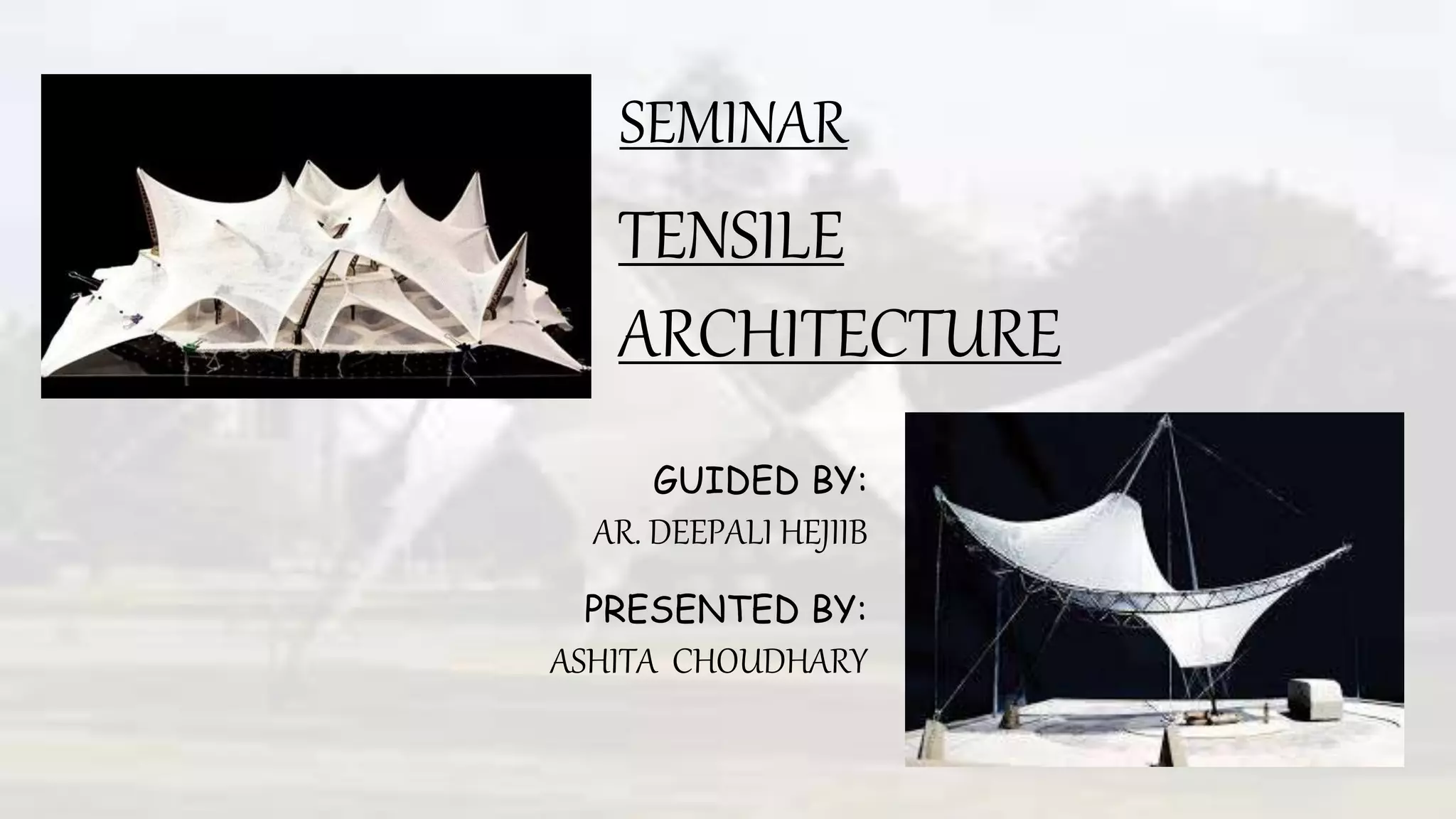
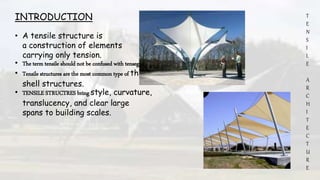
SEMINAR
TENSILE
ARCHITECTURE
GUIDED BY:
AR. DEEPALI HEJIIB
PRESENTED BY:
ASHITA CHOUDHARY
T
E
N
S
I
L
E
A
R
C
H
I
T
E
C
T
U
R
E
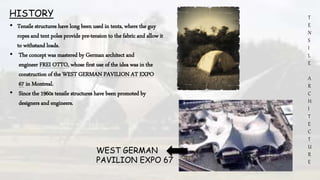
INTRODUCTION
• A tensile structure is
a construction of elements
carrying only tension.
• The term tensile should not be confused with tensegrity.
• Tensile structures are the most common type of thin-
shell structures.
• TENSILE STRUCTRES bring style, curvature,
translucency, and clear large
spans to building scales.
T
E
N
S
I
L
E
A
R
C
H
I
T
E
C
T
U
R
E
HISTORY
• Tensile structures have long been used in tents, where the guy
ropes and tent poles provide pre-tension to the fabric and allow it
to withstand loads.
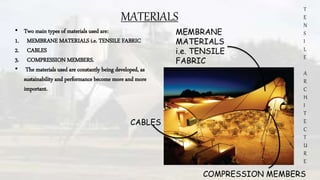
• The concept was mastered by German architect and
engineer FREI OTTO, whose first use of the idea was in the
construction of the WEST GERMAN PAVILION AT EXPO
67 in Montreal.
• Since the 1960s tensile structures have been promoted by
designers and engineers.
WEST GERMAN
PAVILION EXPO 67
T
E
N
S
I
L
E
A
R
C
H
I
T
E
C
T
U
R
E
MATERIALS
• Two main types of materials used are:
1. MEMBRANE MATERIALS i.e. TENSILE FABRIC
2. CABLES
3. COMPRESSION MEMBERS.
• The materials used are constantly being developed, as
sustainability and performance become more and more
important.
MEMBRANE
MATERIALS
i.e. TENSILE
FABRIC
CABLES
COMPRESSION MEMBERS
T
E
N
S
I
L
E
A
R
C
H
I
T
E
C
T
U
R
E
MEMBRANE MATERIALS
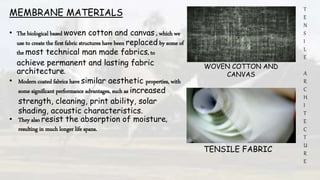
• The biological based woven cotton and canvas , which we
use to create the first fabric structures have been replaced by some of
the most technical man made fabrics, to
achieve permanent and lasting fabric
architecture.
• Modern coated fabrics have similar aesthetic properties, with
some significant performance advantages, such as increased
strength, cleaning, print ability, solar
shading, acoustic characteristics.
• They also resist the absorption of moisture,
resulting in much longer life spans.
WOVEN COTTON AND
CANVAS
TENSILE FABRIC
T
E
N
S
I
L
E
A
R
C
H
I
T
E
C
T
U
R
E
In general we use two generic types of coated fabrics:
1. STRUCTURAL COATED FABRICS
2. MESH FABRICS
STRUCTURAL COATED FABRICS:
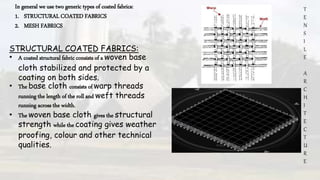
• A coated structural fabric consists of a woven base
cloth stabilized and protected by a
coating on both sides.
• The base cloth consists of warp threads
running the length of the roll and weft threads
running across the width.
• The woven base cloth gives the structural
strength while the coating gives weather
proofing, colour and other technical
qualities.
T
E
N
S
I
L
E
A
R
C
H
I
T
E
C
T
U
R
E
MESH FABRICS
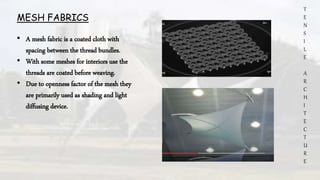
• A mesh fabric is a coated cloth with
spacing between the thread bundles.
• With some meshes for interiors use the
threads are coated before weaving.
• Due to openness factor of the mesh they
are primarily used as shading and light
diffusing device.
T
E
N
S
I
L
E
A
R
C
H
I
T
E
C
T
U
R
E
FABRICS For External Use
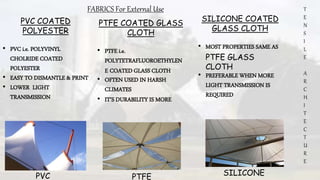
PVC COATED
POLYESTER
• PVC i.e. POLYVINYL
CHOLRIDE COATED
POLYESTER
• EASY TO DISMANTLE & PRINT
• LOWER LIGHT
TRANSMISSION
PTFE COATED GLASS
CLOTH
• PTFE i.e.
POLYTETRAFLUOROETHYLEN
E COATED GLASS CLOTH
• OFTEN USED IN HARSH
CLIMATES
• IT’S DURABILITY IS MORE
SILICONE COATED
GLASS CLOTH
• MOST PROPERTIES SAME AS
PTFE GLASS
CLOTH
• PREFERABLE WHEN MORE
LIGHT TRANSMISSION IS
REQUIRED
PVC PTFE SILICONE
T
E
N
S
I
L
E
A
R
C
H
I
T
E
C
T
U
R
E
CABLES
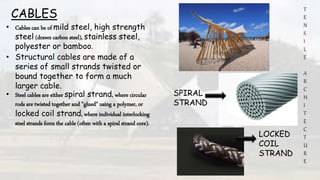
• Cables can be of mild steel, high strength
steel (drawn carbon steel), stainless steel,
polyester or bamboo.
• Structural cables are made of a
series of small strands twisted or
bound together to form a much
larger cable.
• Steel cables are either spiral strand, where circular
rods are twisted together and "glued" using a polymer, or
locked coil strand, where individual interlocking
steel strands form the cable (often with a spiral strand core).
SPIRAL
STRAND
LOCKED
COIL
STRAND
T
E
N
S
I
L
E
A
R
C
H
I
T
E
C
T
U
R
E
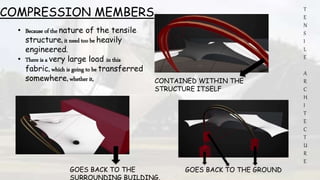
• Because of the nature of the tensile
structure, it need too be heavily
engineered.
• There is a very large load in this
fabric, which is going to be transferred
somewhere, whether it, CONTAINED WITHIN THE
STRUCTURE ITSELF
GOES BACK TO THE GROUNDGOES BACK TO THE
SURROUNDING BUILDING.
COMPRESSION MEMBERS
T
E
N
S
I
L
E
A
R
C
H
I
T
E
C
T
U
R
E
FORMS
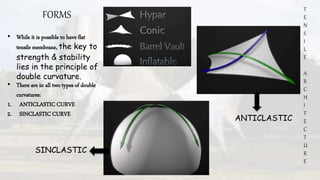
• While it is possible to have flat
tensile membrane, the key to
strength & stability
lies in the principle of
double curvature.
• There are in all two types of double
curvatures:
1. ANTICLASTIC CURVE
2. SINCLASTIC CURVE
ANTICLASTIC
SINCLASTIC
T
E
N
S
I
L
E
A
R
C
H
I
T
E
C
T
U
R
E
THE BASIC FORMS OF TENSILE ARCHITECTURE
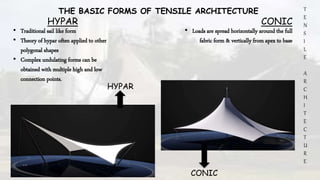
HYPAR
• Traditional sail like form
• Theory of hypar often applied to other
polygonal shapes
• Complex undulating forms can be
obtained with multiple high and low
connection points.
CONIC
• Loads are spread horizontally around the full
fabric form & vertically from apex to base
HYPAR
CONIC
T
E
N
S
I
L
E
A
R
C
H
I
T
E
C
T
U
R
E
THE BASIC FORMS OF TENSILE ARCHITECTURE
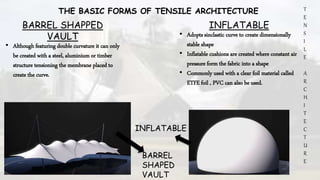
BARREL SHAPPED
VAULT
• Although featuring double curvature it can only
be created with a steel, aluminium or timber
structure tensioning the membrane placed to
create the curve.
INFLATABLE
• Adopts sinclastic curve to create dimensionally
stable shape
• Inflatable cushions are created where constant air
pressure form the fabric into a shape
• Commonly used with a clear foil material called
ETFE foil , PVC can also be used.
BARREL
SHAPED
VAULT
INFLATABLE
T
E
N
S
I
L
E
A
R
C
H
I
T
E
C
T
U
R
E
BENEFITS
MAKING A STATEMENT
• A fabric is useful while designing , it lets you bring the dynamic shapes to otherwise rudimentary structure.
THE VENUE: BRISTOL
 Entrance canopy
 CONIC design
 PVC COATED
POYESTER
 Feature lighting
T
E
N
S
I
L
E
A
R
C
H
I
T
E
C
T
U
R
E
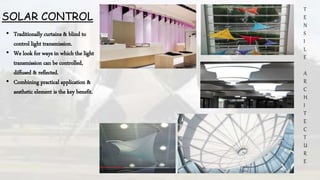
SOLAR CONTROL
• Traditionally curtains & blind to
control light transmission.
• We look for ways in which the light
transmission can be controlled,
diffused & reflected.
• Combining practical application &
aesthetic element is the key benefit.
T
E
N
S
I
L
E
A
R
C
H
I
T
E
C
T
U
R
E
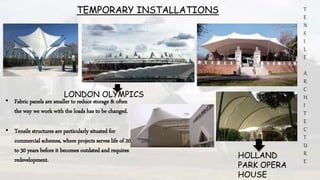
TEMPORARY INSTALLATIONS
• Fabric panels are smaller to reduce storage & often
the way we work with the loads has to be changed.
• Tensile structures are particularly situated for
commercial schemes, where projects serves life of 20
to 30 years before it becomes outdated and requires
redevelopment.
LONDON OLYMPICS
HOLLAND
PARK OPERA
HOUSE
T
E
N
S
I
L
E
A
R
C
H
I
T
E
C
T
U
R
E
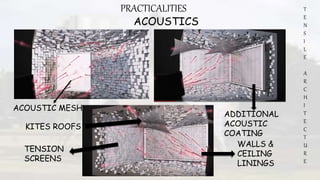
PRACTICALITIES
ACOUSTICS
ACOUSTIC MESH
TENSION
SCREENS
KITES ROOFS
WALLS &
CEILING
LININGS
ADDITIONAL
ACOUSTIC
COATING
T
E
N
S
I
L
E
A
R
C
H
I
T
E
C
T
U
R
E
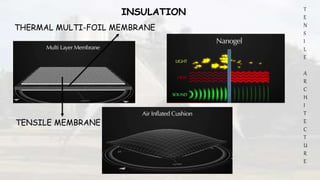
INSULATION
TENSILE MEMBRANE
THERMAL MULTI-FOIL MEMBRANE
T
E
N
S
I
L
E
A
R
C
H
I
T
E
C
T
U
R
E
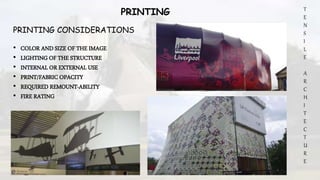
PRINTING
PRINTING CONSIDERATIONS
• COLOR AND SIZE OF THE IMAGE
• LIGHTING OF THE STRUCTURE
• INTERNAL OR EXTERNAL USE
• PRINT/FABRIC OPACITY
• REQUIRED REMOUNT-ABILITY
• FIRE RATING
T
E
N
S
I
L
E
A
R
C
H
I
T
E
C
T
U
R
E
ENVIRONMENTAL
• As most of the materials can recycled or
reused, the environmental impact
of TENSILE STRUCTURE is far less.
T
E
N
S
I
L
E
A
R
C
H
I
T
E
C
T
U
R
E
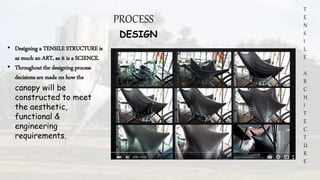
PROCESS
DESIGN
• Designing a TENSILE STRUCTURE is
as much an ART, as it is a SCIENCE.
• Throughout the designing process
decisions are made on how the
canopy will be
constructed to meet
the aesthetic,
functional &
engineering
requirements.
T
E
N
S
I
L
E
A
R
C
H
I
T
E
C
T
U
R
E
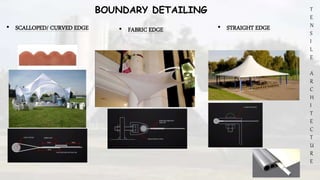
BOUNDARY DETAILING
• SCALLOPED/ CURVED EDGE • FABRIC EDGE • STRAIGHT EDGE
T
E
N
S
I
L
E
A
R
C
H
I
T
E
C
T
U
R
E
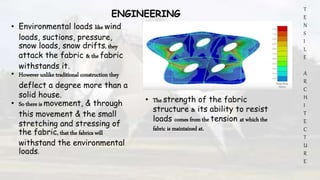
ENGINEERING
• Environmental loads like wind
loads, suctions, pressure,
snow loads, snow drifts, they
attack the fabric & the fabric
withstands it.
• However unlike traditional construction they
deflect a degree more than a
solid house.
• So there is movement, & through
this movement & the small
stretching and stressing of
the fabric, that the fabrics will
withstand the environmental
loads.
• The strength of the fabric
structure & its ability to resist
loads comes from the tension at which the
fabric is maintained at.
T
E
N
S
I
L
E
A
R
C
H
I
T
E
C
T
U
R
E
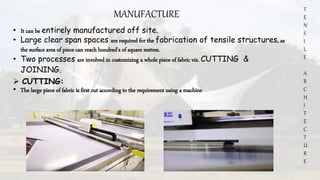
MANUFACTURE
• It can be entirely manufactured off site.
• Large clear span spaces are required for the fabrication of tensile structures, as
the surface area of piece can reach hundred’s of square metres.
• Two processes are involved in customizing a whole piece of fabric viz. CUTTING &
JOINING.
 CUTTING:
• The large piece of fabric is first cut according to the requirement using a machine
T
E
N
S
I
L
E
A
R
C
H
I
T
E
C
T
U
R
E
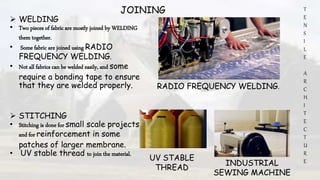
JOINING
 WELDING
• Two pieces of fabric are mostly joined by WELDING
them together.
• Some fabric are joined using RADIO
FREQUENCY WELDING.
• Not all fabrics can be welded easily, and some
require a bonding tape to ensure
that they are welded properly.
 STITCHING
• Stitching is done for small scale projects
and for reinforcement in some
patches of larger membrane.
• UV stable thread to join the material.
RADIO FREQUENCY WELDING.
INDUSTRIAL
SEWING MACHINE
UV STABLE
THREAD
T
E
N
S
I
L
E
A
R
C
H
I
T
E
C
T
U
R
E
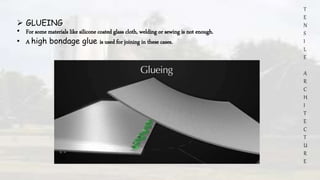
 GLUEING
• For some materials like silicone coated glass cloth, welding or sewing is not enough.
• A high bondage glue is used for joining in these cases.
T
E
N
S
I
L
E
A
R
C
H
I
T
E
C
T
U
R
E
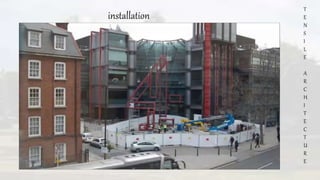
installation
T
E
N
S
I
L
E
A
R
C
H
I
T
E
C
T
U
R
E
CONCLUSION
• Tensile Architecture also known as FABRIC ARCHITECTURE, is one of the fast growing
industry.
• New METHODS & TECHNOLGY is being invented & adopted to make its working more
easy.
• TENSILE ARCHITECTURE introduced FABRIC as a new AESTHETIC & TECHNICAL
ELEMENT that can be used in construction.
• It also made ERECTING & MOVING TEMPORARY STRUCTURES around easy.
T
E
N
S
I
L
E
A
R
C
H
I
T
E
C
T
U
R
E
REFERENCES
• Youtube.com(channel: Architent Landrell)
• LINK:
https://www.youtube.com/watch?v=f98QM_2Nje8&list=PLngV00bNM-
VoctL-uPyP46sstj81JNpMy
• Google.com
• Wikipedia
T
E
N
S
I
L
E
A
R
C
H
I
T
E
C
T
U
R
E
THANK YOU.

TENSILE / FABRIC ARCHITECTURE SEMINAR

  • 1.
    SEMINAR TENSILE ARCHITECTURE GUIDED BY: AR. DEEPALIHEJIIB PRESENTED BY: ASHITA CHOUDHARY
  • 2.
    T E N S I L E A R C H I T E C T U R E INTRODUCTION • A tensilestructure is a construction of elements carrying only tension. • The term tensile should not be confused with tensegrity. • Tensile structures are the most common type of thin- shell structures. • TENSILE STRUCTRES bring style, curvature, translucency, and clear large spans to building scales.
  • 3.
    T E N S I L E A R C H I T E C T U R E HISTORY • Tensile structureshave long been used in tents, where the guy ropes and tent poles provide pre-tension to the fabric and allow it to withstand loads. • The concept was mastered by German architect and engineer FREI OTTO, whose first use of the idea was in the construction of the WEST GERMAN PAVILION AT EXPO 67 in Montreal. • Since the 1960s tensile structures have been promoted by designers and engineers. WEST GERMAN PAVILION EXPO 67
  • 4.
    T E N S I L E A R C H I T E C T U R E MATERIALS • Two maintypes of materials used are: 1. MEMBRANE MATERIALS i.e. TENSILE FABRIC 2. CABLES 3. COMPRESSION MEMBERS. • The materials used are constantly being developed, as sustainability and performance become more and more important. MEMBRANE MATERIALS i.e. TENSILE FABRIC CABLES COMPRESSION MEMBERS
  • 5.
    T E N S I L E A R C H I T E C T U R E MEMBRANE MATERIALS • Thebiological based woven cotton and canvas , which we use to create the first fabric structures have been replaced by some of the most technical man made fabrics, to achieve permanent and lasting fabric architecture. • Modern coated fabrics have similar aesthetic properties, with some significant performance advantages, such as increased strength, cleaning, print ability, solar shading, acoustic characteristics. • They also resist the absorption of moisture, resulting in much longer life spans. WOVEN COTTON AND CANVAS TENSILE FABRIC
  • 6.
    T E N S I L E A R C H I T E C T U R E In general weuse two generic types of coated fabrics: 1. STRUCTURAL COATED FABRICS 2. MESH FABRICS STRUCTURAL COATED FABRICS: • A coated structural fabric consists of a woven base cloth stabilized and protected by a coating on both sides. • The base cloth consists of warp threads running the length of the roll and weft threads running across the width. • The woven base cloth gives the structural strength while the coating gives weather proofing, colour and other technical qualities.
  • 7.
    T E N S I L E A R C H I T E C T U R E MESH FABRICS • Amesh fabric is a coated cloth with spacing between the thread bundles. • With some meshes for interiors use the threads are coated before weaving. • Due to openness factor of the mesh they are primarily used as shading and light diffusing device.
  • 8.
    T E N S I L E A R C H I T E C T U R E FABRICS For ExternalUse PVC COATED POLYESTER • PVC i.e. POLYVINYL CHOLRIDE COATED POLYESTER • EASY TO DISMANTLE & PRINT • LOWER LIGHT TRANSMISSION PTFE COATED GLASS CLOTH • PTFE i.e. POLYTETRAFLUOROETHYLEN E COATED GLASS CLOTH • OFTEN USED IN HARSH CLIMATES • IT’S DURABILITY IS MORE SILICONE COATED GLASS CLOTH • MOST PROPERTIES SAME AS PTFE GLASS CLOTH • PREFERABLE WHEN MORE LIGHT TRANSMISSION IS REQUIRED PVC PTFE SILICONE
  • 9.
    T E N S I L E A R C H I T E C T U R E CABLES • Cables canbe of mild steel, high strength steel (drawn carbon steel), stainless steel, polyester or bamboo. • Structural cables are made of a series of small strands twisted or bound together to form a much larger cable. • Steel cables are either spiral strand, where circular rods are twisted together and "glued" using a polymer, or locked coil strand, where individual interlocking steel strands form the cable (often with a spiral strand core). SPIRAL STRAND LOCKED COIL STRAND
  • 10.
    T E N S I L E A R C H I T E C T U R E • Because ofthe nature of the tensile structure, it need too be heavily engineered. • There is a very large load in this fabric, which is going to be transferred somewhere, whether it, CONTAINED WITHIN THE STRUCTURE ITSELF GOES BACK TO THE GROUNDGOES BACK TO THE SURROUNDING BUILDING. COMPRESSION MEMBERS
  • 11.
    T E N S I L E A R C H I T E C T U R E FORMS • While itis possible to have flat tensile membrane, the key to strength & stability lies in the principle of double curvature. • There are in all two types of double curvatures: 1. ANTICLASTIC CURVE 2. SINCLASTIC CURVE ANTICLASTIC SINCLASTIC
  • 12.
    T E N S I L E A R C H I T E C T U R E THE BASIC FORMSOF TENSILE ARCHITECTURE HYPAR • Traditional sail like form • Theory of hypar often applied to other polygonal shapes • Complex undulating forms can be obtained with multiple high and low connection points. CONIC • Loads are spread horizontally around the full fabric form & vertically from apex to base HYPAR CONIC
  • 13.
    T E N S I L E A R C H I T E C T U R E THE BASIC FORMSOF TENSILE ARCHITECTURE BARREL SHAPPED VAULT • Although featuring double curvature it can only be created with a steel, aluminium or timber structure tensioning the membrane placed to create the curve. INFLATABLE • Adopts sinclastic curve to create dimensionally stable shape • Inflatable cushions are created where constant air pressure form the fabric into a shape • Commonly used with a clear foil material called ETFE foil , PVC can also be used. BARREL SHAPED VAULT INFLATABLE
  • 14.
    T E N S I L E A R C H I T E C T U R E BENEFITS MAKING A STATEMENT •A fabric is useful while designing , it lets you bring the dynamic shapes to otherwise rudimentary structure. THE VENUE: BRISTOL  Entrance canopy  CONIC design  PVC COATED POYESTER  Feature lighting
  • 15.
    T E N S I L E A R C H I T E C T U R E SOLAR CONTROL • Traditionallycurtains & blind to control light transmission. • We look for ways in which the light transmission can be controlled, diffused & reflected. • Combining practical application & aesthetic element is the key benefit.
  • 16.
    T E N S I L E A R C H I T E C T U R E TEMPORARY INSTALLATIONS • Fabricpanels are smaller to reduce storage & often the way we work with the loads has to be changed. • Tensile structures are particularly situated for commercial schemes, where projects serves life of 20 to 30 years before it becomes outdated and requires redevelopment. LONDON OLYMPICS HOLLAND PARK OPERA HOUSE
  • 17.
  • 18.
  • 19.
    T E N S I L E A R C H I T E C T U R E PRINTING PRINTING CONSIDERATIONS • COLORAND SIZE OF THE IMAGE • LIGHTING OF THE STRUCTURE • INTERNAL OR EXTERNAL USE • PRINT/FABRIC OPACITY • REQUIRED REMOUNT-ABILITY • FIRE RATING
  • 20.
    T E N S I L E A R C H I T E C T U R E ENVIRONMENTAL • As mostof the materials can recycled or reused, the environmental impact of TENSILE STRUCTURE is far less.
  • 21.
    T E N S I L E A R C H I T E C T U R E PROCESS DESIGN • Designing aTENSILE STRUCTURE is as much an ART, as it is a SCIENCE. • Throughout the designing process decisions are made on how the canopy will be constructed to meet the aesthetic, functional & engineering requirements.
  • 22.
  • 23.
    T E N S I L E A R C H I T E C T U R E ENGINEERING • Environmental loadslike wind loads, suctions, pressure, snow loads, snow drifts, they attack the fabric & the fabric withstands it. • However unlike traditional construction they deflect a degree more than a solid house. • So there is movement, & through this movement & the small stretching and stressing of the fabric, that the fabrics will withstand the environmental loads. • The strength of the fabric structure & its ability to resist loads comes from the tension at which the fabric is maintained at.
  • 24.
    T E N S I L E A R C H I T E C T U R E MANUFACTURE • It canbe entirely manufactured off site. • Large clear span spaces are required for the fabrication of tensile structures, as the surface area of piece can reach hundred’s of square metres. • Two processes are involved in customizing a whole piece of fabric viz. CUTTING & JOINING.  CUTTING: • The large piece of fabric is first cut according to the requirement using a machine
  • 25.
    T E N S I L E A R C H I T E C T U R E JOINING  WELDING • Twopieces of fabric are mostly joined by WELDING them together. • Some fabric are joined using RADIO FREQUENCY WELDING. • Not all fabrics can be welded easily, and some require a bonding tape to ensure that they are welded properly.  STITCHING • Stitching is done for small scale projects and for reinforcement in some patches of larger membrane. • UV stable thread to join the material. RADIO FREQUENCY WELDING. INDUSTRIAL SEWING MACHINE UV STABLE THREAD
  • 26.
    T E N S I L E A R C H I T E C T U R E  GLUEING • Forsome materials like silicone coated glass cloth, welding or sewing is not enough. • A high bondage glue is used for joining in these cases.
  • 27.
  • 28.
    T E N S I L E A R C H I T E C T U R E CONCLUSION • Tensile Architecturealso known as FABRIC ARCHITECTURE, is one of the fast growing industry. • New METHODS & TECHNOLGY is being invented & adopted to make its working more easy. • TENSILE ARCHITECTURE introduced FABRIC as a new AESTHETIC & TECHNICAL ELEMENT that can be used in construction. • It also made ERECTING & MOVING TEMPORARY STRUCTURES around easy.
  • 29.
    T E N S I L E A R C H I T E C T U R E REFERENCES • Youtube.com(channel: ArchitentLandrell) • LINK: https://www.youtube.com/watch?v=f98QM_2Nje8&list=PLngV00bNM- VoctL-uPyP46sstj81JNpMy • Google.com • Wikipedia
  • 30.