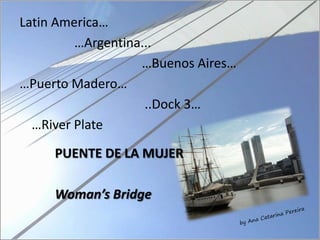
Latin America…
         …Argentina...
                   …Buenos Aires…
…Puerto Madero…
                    ..Dock 3…
  …River Plate

     PUENTE DE LA MUJER

     Woman’s Bridge
PUENTE DE LA MUJER


  Designed by Santiago Calatrava


                           Started in 1998
                           Completed on 20th December 2001
PUENTE DE LA MUJER

 •Cantilever spar cable-stayed bridge (this design has been pioneered by Calatrava)
 •Was built by the company URSSA, at its plant in Victoria, in Bilbao, Spain, and brought to
 Buenos Aires in several shipments.
 •One stabilizing pylon, pointing skyward at a 45-degree angle
 •Its design represents a couple dancing tango - unique asymmetrical arrangement
 •White pylon represents the man with rope holding the central curvature of the bridge
 that symbolizes the woman – a typical step of tango.
 •Footbridge
PUENTE DE LA MUJER

              Swing bridge
PUENTE DE LA MUJER
 •Has two fixed sections and one movable part
 •The pylon has cables suspending the part of the bridge that rotates 90 degrees in order
 to allow water traffic to pass
 •When it swings the far end comes to a resting point
 •The rotary section relies on a central pile of white concrete that houses the rotating
 mechanism
 •It has a unique rotation mechanism; it’s one of the biggest of the world, with 20 electric
 engines commanded by a computer
PUENTE DE LA MUJER

                     Watching it closing…
PUENTE DE LA MUJER

 •The metal structure of the bridge has been entirely made of steel and the straps
 (suspendors) are made up of galvanized steel wires of high resistance of circular section
 •The big inclinated pylon it is formed by sheets of steel of different thicknesses with rigid
 material interiors
PUENTE DE LA MUJER


     Numbers:
     •Total length: 170 m
     •Central rotating span: 102 m
     •Width of deck: 6,20 m
     •Height of pylon: 39 m
     •Weight: 800 tons
     •Time to open: less than 2 min
     •Sustaining cables: 19
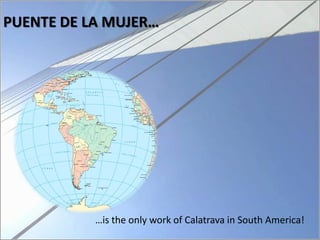
PUENTE DE LA MUJER…


           …is the only work of Calatrava in South America!
Thanks for your attention!


                  Ana Catarina Pereira
                  ISEL, 28th November 2011

Woman's bridge

  • 1.
    Latin America… …Argentina... …Buenos Aires… …Puerto Madero… ..Dock 3… …River Plate PUENTE DE LA MUJER Woman’s Bridge
  • 2.
    PUENTE DE LAMUJER Designed by Santiago Calatrava Started in 1998 Completed on 20th December 2001
  • 3.
    PUENTE DE LAMUJER •Cantilever spar cable-stayed bridge (this design has been pioneered by Calatrava) •Was built by the company URSSA, at its plant in Victoria, in Bilbao, Spain, and brought to Buenos Aires in several shipments. •One stabilizing pylon, pointing skyward at a 45-degree angle •Its design represents a couple dancing tango - unique asymmetrical arrangement •White pylon represents the man with rope holding the central curvature of the bridge that symbolizes the woman – a typical step of tango. •Footbridge
  • 4.
    PUENTE DE LAMUJER Swing bridge
  • 5.
    PUENTE DE LAMUJER •Has two fixed sections and one movable part •The pylon has cables suspending the part of the bridge that rotates 90 degrees in order to allow water traffic to pass •When it swings the far end comes to a resting point •The rotary section relies on a central pile of white concrete that houses the rotating mechanism •It has a unique rotation mechanism; it’s one of the biggest of the world, with 20 electric engines commanded by a computer
  • 6.
    PUENTE DE LAMUJER Watching it closing…
  • 7.
    PUENTE DE LAMUJER •The metal structure of the bridge has been entirely made of steel and the straps (suspendors) are made up of galvanized steel wires of high resistance of circular section •The big inclinated pylon it is formed by sheets of steel of different thicknesses with rigid material interiors
  • 8.
    PUENTE DE LAMUJER Numbers: •Total length: 170 m •Central rotating span: 102 m •Width of deck: 6,20 m •Height of pylon: 39 m •Weight: 800 tons •Time to open: less than 2 min •Sustaining cables: 19
  • 9.
    PUENTE DE LAMUJER… …is the only work of Calatrava in South America!
  • 10.
    Thanks for yourattention! Ana Catarina Pereira ISEL, 28th November 2011