The Bright-side and the Dark-side
of Leadership
Sean McCann
The Solution to all Your People Problems
Identity and Reputation
The Solution to all Your People Problems
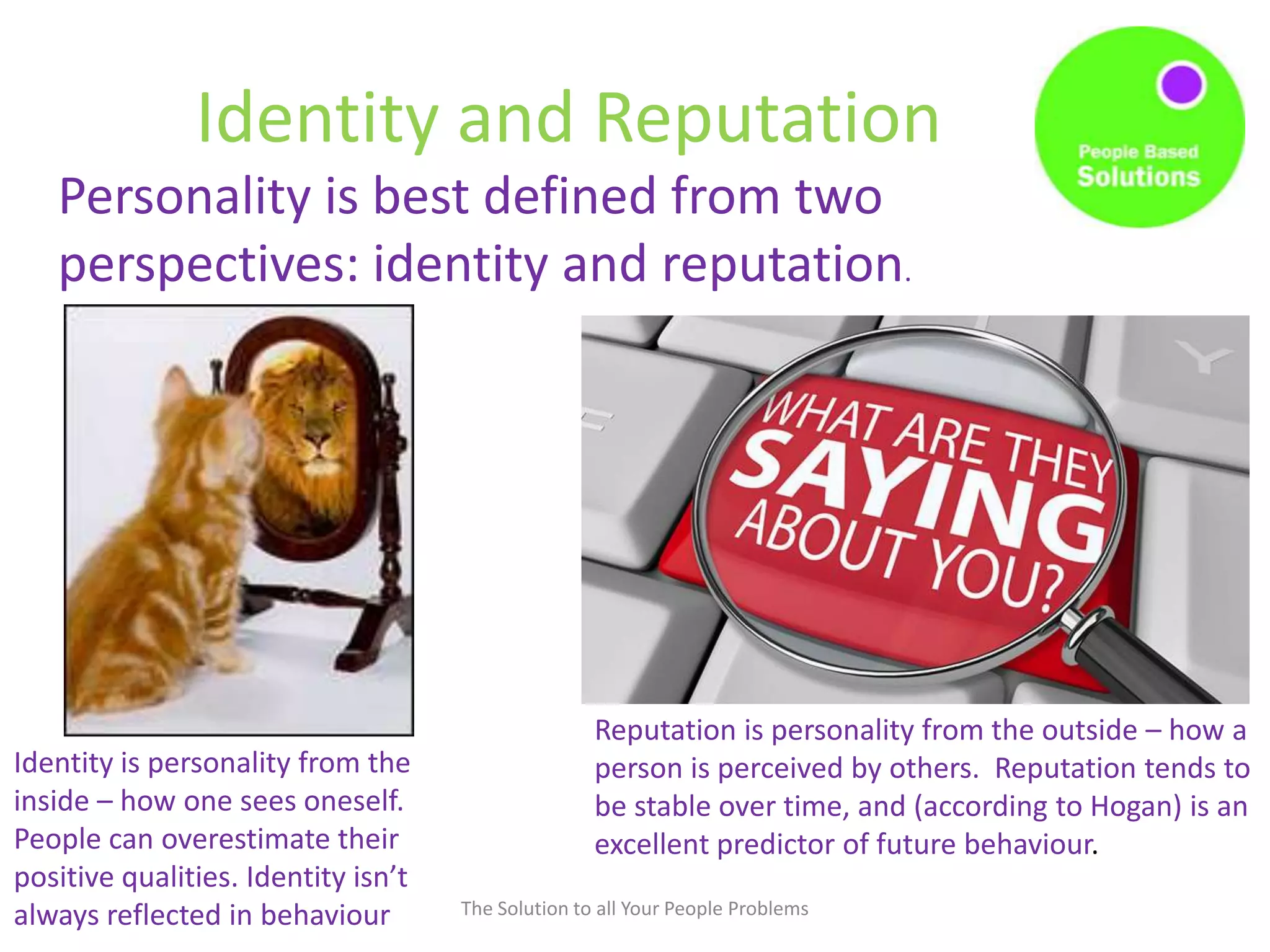
Personality is best defined from two
perspectives: identity and reputation.
Reputation is personality from the outside – how a
person is perceived by others. Reputation tends to
be stable over time, and (according to Hogan) is an
excellent predictor of future behaviour.
Identity is personality from the
inside – how one sees oneself.
People can overestimate their
positive qualities. Identity isn’t
always reflected in behaviour
The Bright-side and the Dark-side
of Leadership
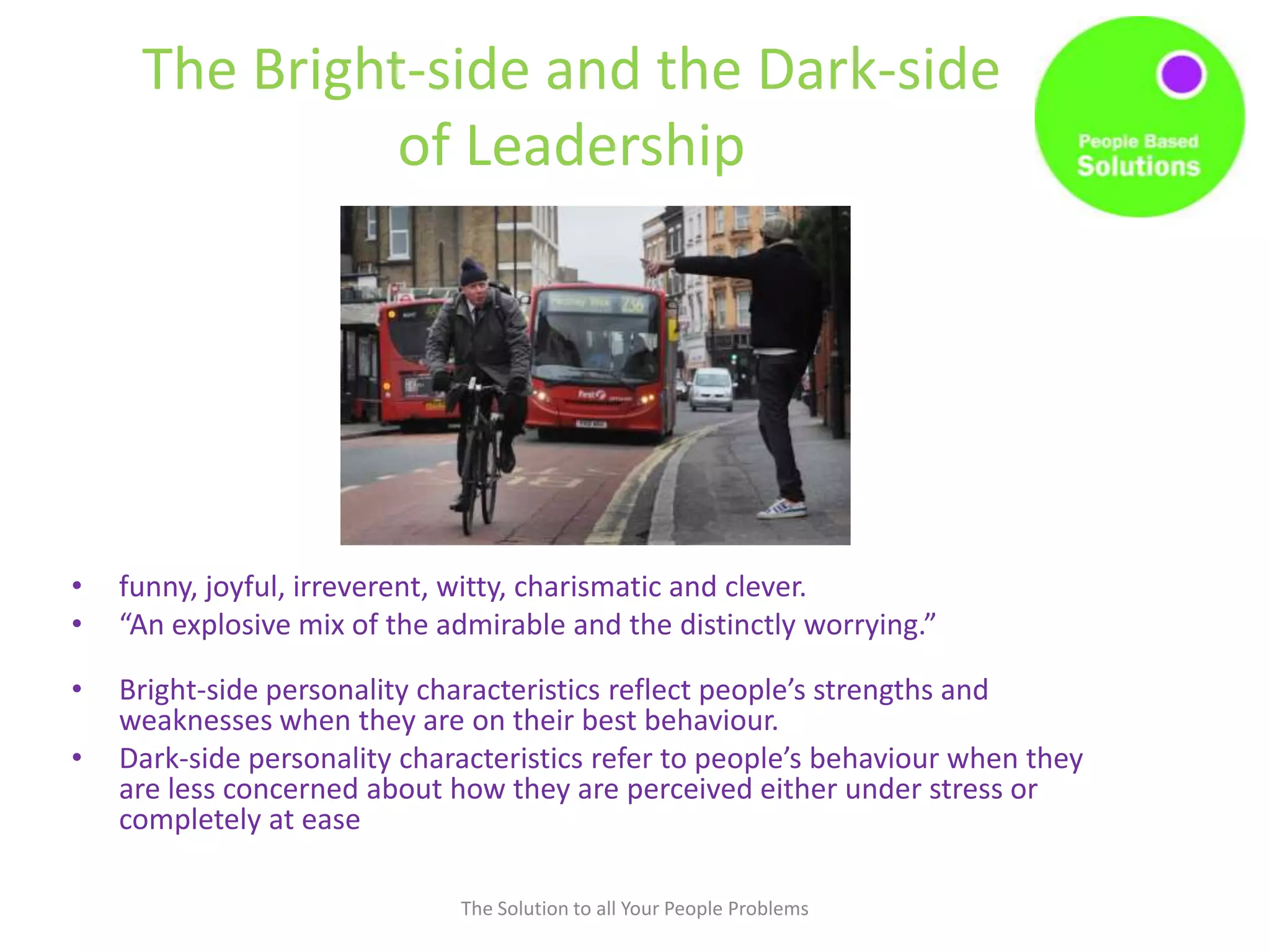
• funny, joyful, irreverent, witty, charismatic and clever.
• “An explosive mix of the admirable and the distinctly worrying.”
• Bright-side personality characteristics reflect people’s strengths and
weaknesses when they are on their best behaviour.
• Dark-side personality characteristics refer to people’s behaviour when they
are less concerned about how they are perceived either under stress or
completely at ease
The Solution to all Your People Problems
Hogan competent leaders are
perceived as having bright-side
characteristics of
• Integrity, keeping their word and telling the
truth.
• Decisiveness, making sound, defensible and
timely decisions.
• Competence, good at some aspects of
business.
With reference to Jim Collins they also show:
• Humility and
• Persistence
The Solution to all Your People Problems
A key fact of Leadership
The Solution to all Your People Problems
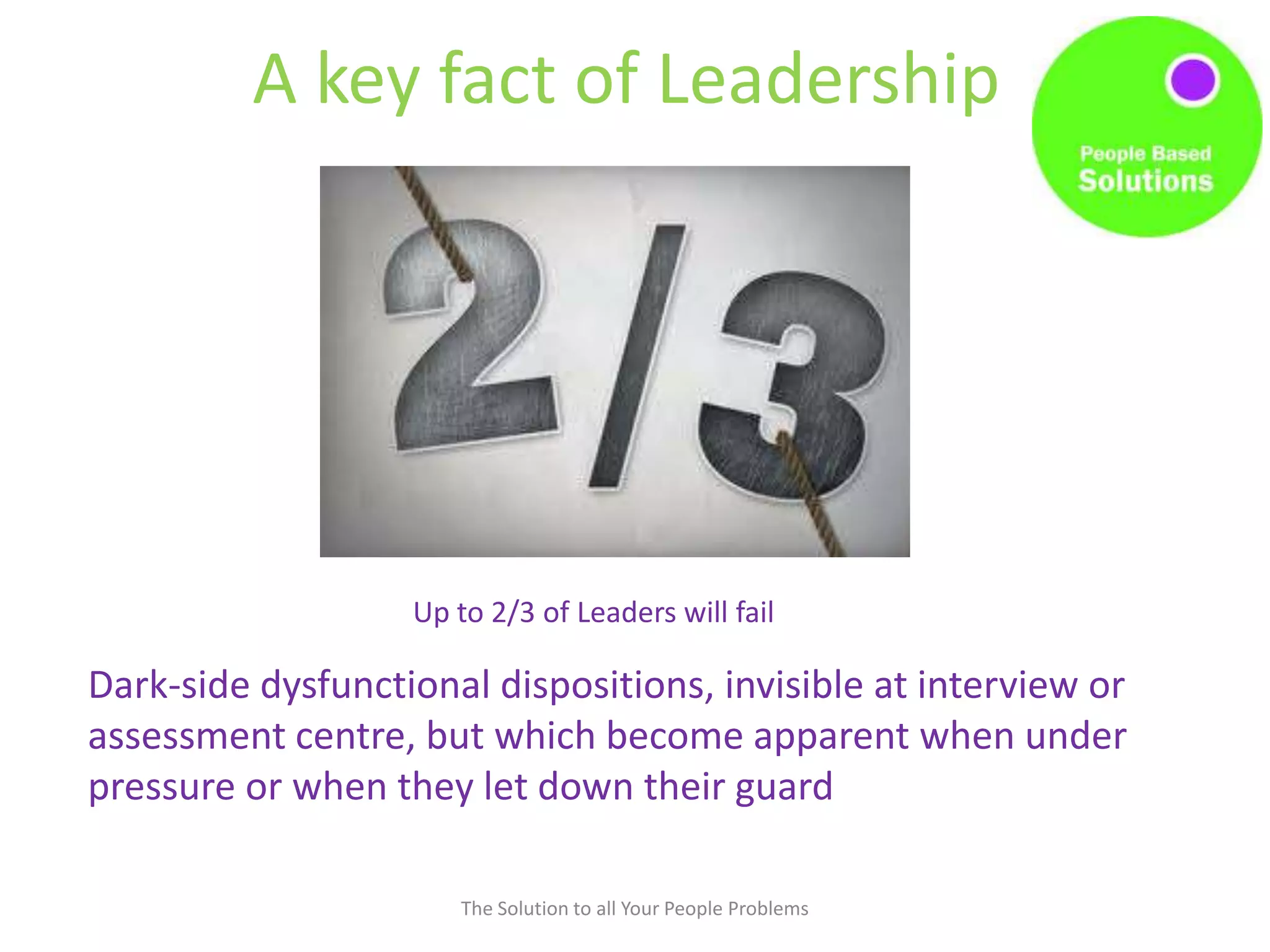
Up to 2/3 of Leaders will fail
Dark-side dysfunctional dispositions, invisible at interview or
assessment centre, but which become apparent when under
pressure or when they let down their guard
Why do leaders fail?
The Solution to all Your People Problems
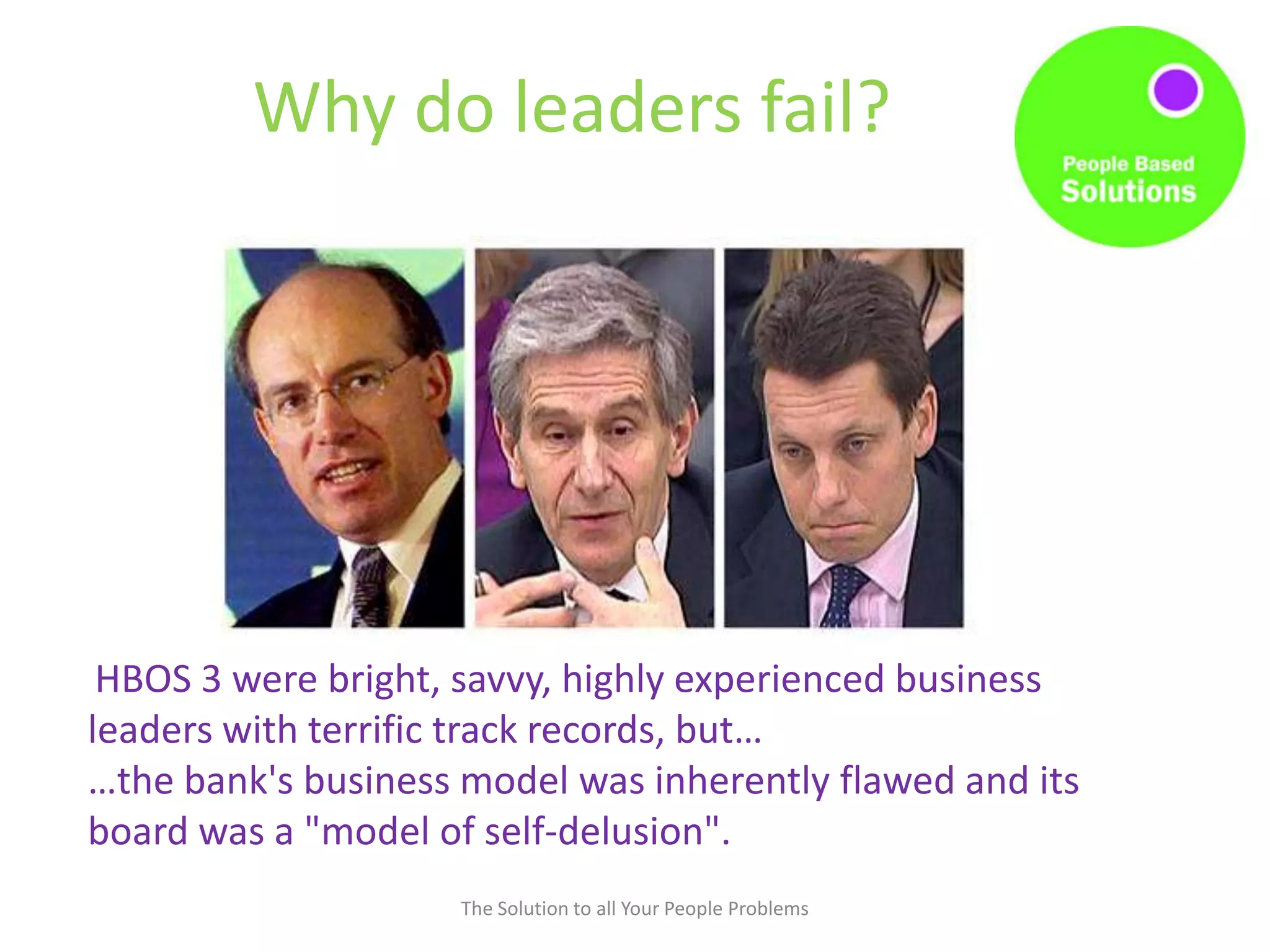
HBOS 3 were bright, savvy, highly experienced business
leaders with terrific track records, but…
…the bank's business model was inherently flawed and its
board was a "model of self-delusion".
Why we engage in self defeating
behaviour
• Events between people
• Childhood experience everyone feels
inadequate about something
• People have expectations of how others will
treat them
• If those expectations are wrong may behave in
ways others find annoying. This may interfere
with their life goals
The Solution to all Your People Problems
Horney’s taxonomy
• According to Horney people manage their self
doubt, inadequacies and insecurities in one of
3 ways:
• Moving Away: Manage feelings of inadequacy
by avoiding contact with others
• Moving Against: Manage feelings of self doubt
by dominating and intimidating others
• Moving Towards: Manage their insecurities by
building alliances
The Solution to all Your People Problems
Dysfunctional Dispositions
The Solution to all Your People Problems
Strategies developed in
childhood, but continue to be
used in adulthood in ways that
are dysfunctional
Not so much about bad people, but the
wrong strategies. It’s about behavioural
flexibility.
Dysfunctional Dispositions
The Solution to all Your People Problems
Too much of a good thing:
Leaders can be:
• Too vigilant
• Too tough
• Too hardworking
Paradoxically the factors that helped
achieve success can be the very factors
that are responsible for derailment
According to the HDS there 11
potential de-railers
The Solution to all Your People Problems
Confidence and Assertiveness can becomes self-promotion and competitiveness
(Bold)
Detail consciousness and hard-working can turn to demanding perfectionism
(Diligent)
Charming and interesting can become manipulative and exploitative schmoozing and finessing mistakes. May take risks without
considering the consequences. (Bo Jo)
(Mischievous)
Intensity and energy can becomes moody and Hard to please
Requiring “mood management”
(Excitable)
Co-operative and cheerful can become stubborn and resentful when things don’t go their way . Quintessential passive aggression.
(Leisurely)
Vigilance, rarely being caught of guard and hard to “fool” can become sceptical and pessimistic.
(Sceptical)
Innovative and unpredictable may become odd and self absorbed.
(Imaginative)
Tough mindedness and independent thinking can become aloof , detached and invisible.
(Reserved)
Fun and socially skilled can become attention seeker who are quickly bored. (Bo Jo)
(Colourful)
Conforming and unassuming can become Ingratiating and deferential
(Dutiful)
Prudence can become excessive caution and an inability to make decisions
(Cautious)
Dysfunctional Dispositions
The Solution to all Your People Problems
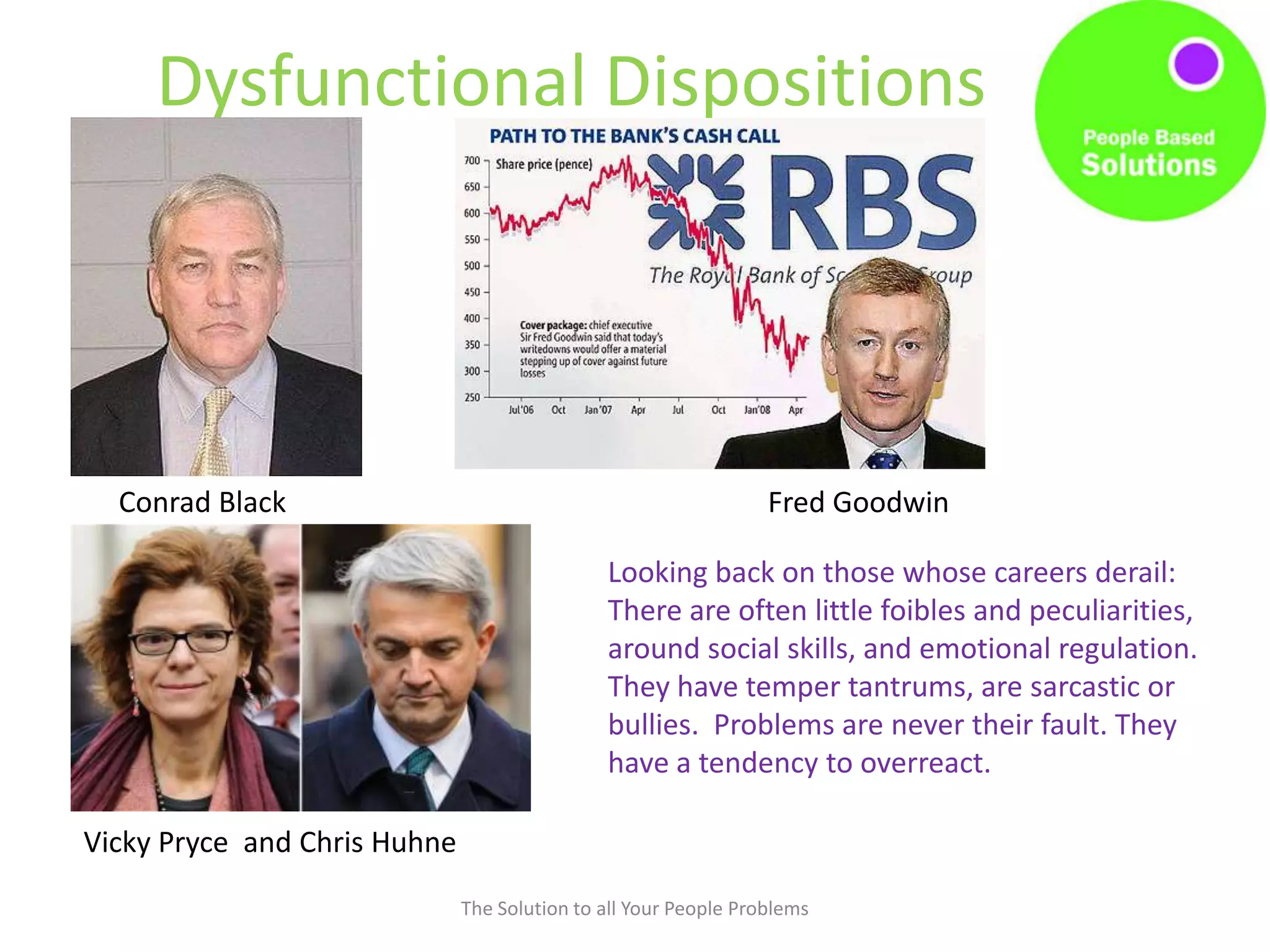
Looking back on those whose careers derail:
There are often little foibles and peculiarities,
around social skills, and emotional regulation.
They have temper tantrums, are sarcastic or
bullies. Problems are never their fault. They
have a tendency to overreact.
Conrad Black Fred Goodwin
Vicky Pryce and Chris Huhne
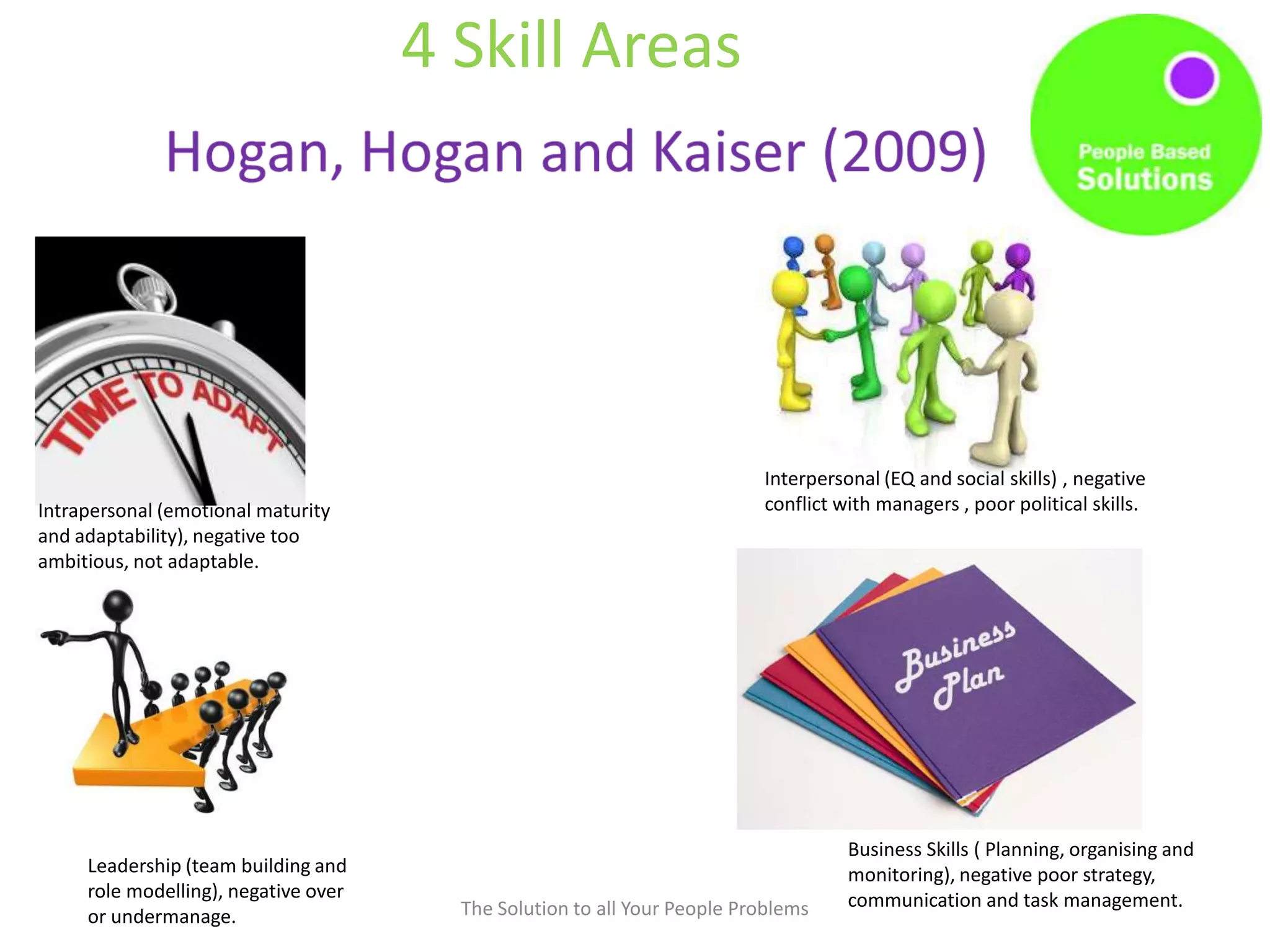
4 Skill Areas
The Solution to all Your People Problems
Intrapersonal (emotional maturity
and adaptability), negative too
ambitious, not adaptable.
Interpersonal (EQ and social skills) , negative
conflict with managers , poor political skills.
Leadership (team building and
role modelling), negative over
or undermanage.
Business Skills ( Planning, organising and
monitoring), negative poor strategy,
communication and task management.
Hogan, Hogan and Kaiser the
5 Early warning signs:
• Poor results (missed objectives, poor
budget control, customer complaints)
• Narrow perspective ( (too detail conscious
reliant on technical skills, out of date)
• Poor team building (autocratic,
micromanagement)
• Working relationships (Insensitivity)
• Inappropriate or immature behaviour
(gossiping, refusing to accept responsibility)
The Solution to all Your People Problems
Is derailment avoidable?
The Solution to all Your People Problems
YES!!
Dysfunctional dispositions will not
inevitably prevail if Leaders are:
• Motivated to change
• Open and responsive to feedback
• Emotionally literate
• Behaviourally flexible
How should we train tomorrow’s
leaders?
Development programmes for the leaders of the
future will benefit from modules that
•Develop emotional intelligence
•Encourage self awareness
•Promote behavioural flexibility
The Solution to all Your People Problems

Why successful people fail

  • 1.
    The Bright-side andthe Dark-side of Leadership Sean McCann The Solution to all Your People Problems
  • 2.
    Identity and Reputation TheSolution to all Your People Problems Personality is best defined from two perspectives: identity and reputation. Reputation is personality from the outside – how a person is perceived by others. Reputation tends to be stable over time, and (according to Hogan) is an excellent predictor of future behaviour. Identity is personality from the inside – how one sees oneself. People can overestimate their positive qualities. Identity isn’t always reflected in behaviour
  • 3.
    The Bright-side andthe Dark-side of Leadership • funny, joyful, irreverent, witty, charismatic and clever. • “An explosive mix of the admirable and the distinctly worrying.” • Bright-side personality characteristics reflect people’s strengths and weaknesses when they are on their best behaviour. • Dark-side personality characteristics refer to people’s behaviour when they are less concerned about how they are perceived either under stress or completely at ease The Solution to all Your People Problems
  • 4.
    Hogan competent leadersare perceived as having bright-side characteristics of • Integrity, keeping their word and telling the truth. • Decisiveness, making sound, defensible and timely decisions. • Competence, good at some aspects of business. With reference to Jim Collins they also show: • Humility and • Persistence The Solution to all Your People Problems
  • 5.
    A key factof Leadership The Solution to all Your People Problems Up to 2/3 of Leaders will fail Dark-side dysfunctional dispositions, invisible at interview or assessment centre, but which become apparent when under pressure or when they let down their guard
  • 6.
    Why do leadersfail? The Solution to all Your People Problems HBOS 3 were bright, savvy, highly experienced business leaders with terrific track records, but… …the bank's business model was inherently flawed and its board was a "model of self-delusion".
  • 7.
    Why we engagein self defeating behaviour • Events between people • Childhood experience everyone feels inadequate about something • People have expectations of how others will treat them • If those expectations are wrong may behave in ways others find annoying. This may interfere with their life goals The Solution to all Your People Problems
  • 8.
    Horney’s taxonomy • Accordingto Horney people manage their self doubt, inadequacies and insecurities in one of 3 ways: • Moving Away: Manage feelings of inadequacy by avoiding contact with others • Moving Against: Manage feelings of self doubt by dominating and intimidating others • Moving Towards: Manage their insecurities by building alliances The Solution to all Your People Problems
  • 9.
    Dysfunctional Dispositions The Solutionto all Your People Problems Strategies developed in childhood, but continue to be used in adulthood in ways that are dysfunctional Not so much about bad people, but the wrong strategies. It’s about behavioural flexibility.
  • 10.
    Dysfunctional Dispositions The Solutionto all Your People Problems Too much of a good thing: Leaders can be: • Too vigilant • Too tough • Too hardworking Paradoxically the factors that helped achieve success can be the very factors that are responsible for derailment
  • 11.
    According to theHDS there 11 potential de-railers The Solution to all Your People Problems Confidence and Assertiveness can becomes self-promotion and competitiveness (Bold) Detail consciousness and hard-working can turn to demanding perfectionism (Diligent) Charming and interesting can become manipulative and exploitative schmoozing and finessing mistakes. May take risks without considering the consequences. (Bo Jo) (Mischievous) Intensity and energy can becomes moody and Hard to please Requiring “mood management” (Excitable) Co-operative and cheerful can become stubborn and resentful when things don’t go their way . Quintessential passive aggression. (Leisurely) Vigilance, rarely being caught of guard and hard to “fool” can become sceptical and pessimistic. (Sceptical) Innovative and unpredictable may become odd and self absorbed. (Imaginative) Tough mindedness and independent thinking can become aloof , detached and invisible. (Reserved) Fun and socially skilled can become attention seeker who are quickly bored. (Bo Jo) (Colourful) Conforming and unassuming can become Ingratiating and deferential (Dutiful) Prudence can become excessive caution and an inability to make decisions (Cautious)
  • 12.
    Dysfunctional Dispositions The Solutionto all Your People Problems Looking back on those whose careers derail: There are often little foibles and peculiarities, around social skills, and emotional regulation. They have temper tantrums, are sarcastic or bullies. Problems are never their fault. They have a tendency to overreact. Conrad Black Fred Goodwin Vicky Pryce and Chris Huhne
  • 13.
    4 Skill Areas TheSolution to all Your People Problems Intrapersonal (emotional maturity and adaptability), negative too ambitious, not adaptable. Interpersonal (EQ and social skills) , negative conflict with managers , poor political skills. Leadership (team building and role modelling), negative over or undermanage. Business Skills ( Planning, organising and monitoring), negative poor strategy, communication and task management.
  • 14.
    Hogan, Hogan andKaiser the 5 Early warning signs: • Poor results (missed objectives, poor budget control, customer complaints) • Narrow perspective ( (too detail conscious reliant on technical skills, out of date) • Poor team building (autocratic, micromanagement) • Working relationships (Insensitivity) • Inappropriate or immature behaviour (gossiping, refusing to accept responsibility) The Solution to all Your People Problems
  • 15.
    Is derailment avoidable? TheSolution to all Your People Problems YES!! Dysfunctional dispositions will not inevitably prevail if Leaders are: • Motivated to change • Open and responsive to feedback • Emotionally literate • Behaviourally flexible
  • 16.
    How should wetrain tomorrow’s leaders? Development programmes for the leaders of the future will benefit from modules that •Develop emotional intelligence •Encourage self awareness •Promote behavioural flexibility The Solution to all Your People Problems

Editor's Notes

  • #3 Identity is personality from the inside – how one sees oneself.Reputation is personality from the outside – how a person is perceived by othersReputation tends to be stable over time, and (according to Hogan) is an excellent predictor of future behaviour.
  • #4 Bright-side personality characteristics reflect people’s strengths and weaknesses when they are on their best behaviour.Dark-side personality characteristics refer to people’s behaviour when they are less concerned about how they are perceived either under stress or completely at ease
  • #6 According to Hogan 2/3 are firedAre DemotedMoved sidewaysKicked upstairs
  • #7 HBOS 3 were bright, savvy, highly experienced business leaders with terrific track records Good leaders need to:Communicate a corporate visionMotivate and organise productive teamsManage their subordinates efficientlySet clear and realistic targets for attainmentN.B. poor leadership is not simply just an absence of these skillsIndividuals can have Dysfunctional Dispositions
  • #8 If those expectations are wrong may behave in ways others find annoyingThis may interfere with their life goals
  • #14 Interpersonal (EQ and social skills) –ve conflict with managers , poor political skillsLeadership (team building and role modelling) –ve over or undermanageBusiness Skills ( Planning, organising and monitoring) –vepoor strategy, communication and task management5 Early warning signs:Poor results (missed objectives, poor budget control, customer complaints)Narrow perspective ( (too detail conscious reliant on technical skills, out of date)Poor team building (autocratic, micromanagement)Working relationships (Insensitivity)Inappropriate or immature behaviour (gossiping, refusing to accept responsibility)