BEHAVIORAL COACHING
WHAT IS IT?
Dr. Shayne Tracy, CMC, OCC
ASSOCIATION OF CORPORATE EXECUTIVE COACHES
HTTP://WWW.ACEC-WEBSITE.ORG CB@ACEC-WEBSITE.ORG
908.509.1744
DR. SHAYNE TRACY CMC
Senior Facilitator, Behavioral Coaching Institute
Consultant, Newhouse Partners
 Dr. Shayne Tracy is a Strategic Organization Development
Specialist and Master Coach. He is a trusted advisor to
senior managers and executives in the creation of
personal and corporate value.
 Dr Tracy has joined the Board and is a Shareholder of
Odyssey Transformational Strategies and Odyssey
Consulting Institute
 Shayne’s activities include strategic planning, business
restructuring, performance
management, assessment, diagnostics and executive
coaching.
 Shayne is also a Senior Facilitator with the Behavioral
Coaching Institute and he certifies Master Coaches
worldwide.
ABOUT DR. SHAYNE TRACY CMC, OCC
 Educator: Teacher, Principal, Assistant Superintendent Human
Resources
 Business founder: HR Technologies Inc.
 Shareholder: www.hyperstreet.com
 Organizational Development Specialist: www.newhousepartners.com
 Certified Behavioral, Values, Attributes, Skills
Professional, Pathfinder Career System
 Odyssey: The Business of Consulting-Director and Facilitator
www.odysseyconsultinginstitute.com
 Certified Master Coach: www.executivecoachworx.com
 Senior Facilitator-Behavioral Coaching Institute
www.1to1coachingschool.com
OPPORTUNITIES FOR BEHAVIORAL
COACHING
Climate of continuous change
Environment of “tight” economic realities
Corporate awareness of need for internal coaches
International corporate growth
Multi-generational workplace environment
Cross-cultural interpersonal dynamics
Expanding body of research supporting behavioral coaching
initiatives
INFLUENCE OF BEHAVIOR
BASED COACHING
Behavior-based (evidenced-based)
coaching is a third wave psychological
approach (looking forward and not
backward) to achieving sustainable
behavioral change in a relatively short
time frame
“Do not judge, and you will
never be mistaken.”
—Jean Jacques Rousseau
MASTER COACH PRINCIPLE
Jean Jacques Rousseau
One's Reality
is Their Reality
CORE MASTER COACH PRINCIPLE
WHAT IS BEHAVIORAL COACHING?
Behavioral Coaching emphasizes generative behavioral
change, concentrating on strengthening self- identity and
values, and bringing new or reframed vision and goals into
practical, achievable reality
Behavioral Coaching involves helping people effectively
achieve outcomes on a wider range of levels
(emotional, social, skillful, intellectual, self-
conceptual, motivational, valueful)
THE ROLE OF BEHAVIORAL
COACHING
Consulting
Training
Mentoring
Counseling
Behavioral Coaching
Knowledge
Competencies
Psych-Social Practices
Learning Processes
Behavioral Models
Change Processes
BEHAVIORAL RESPONSES ARE LEARNED
EARLY
WHAT IS BEHAVIORAL COACHING?
 is creating a safe, supportive environment for
someone to have their “internal conversation”
out loud
lives in use of language—language of change—
change language
 2 interchangeable power verbs “think” and
“feel”
is creating a behavioral context for planned, self
directed action and focused results
 engaging emotions and feelings
WHAT IS BEHAVIORAL COACHING?
is getting to “soul-talk vs. self-talk”
depth of “Understanding’ is the beginning of behavioral possibilities
is designing “actions and behaviors” that match “new conversations”
adopts a scientific approach to coaching to bring about
measurable, sustained learning acquisition and change
THE ELEMENTS OF A VALUES-BASED
BEHAVIORAL COACHING PRACTICE
Behavioral Based Coaching is grounded in a distinctive set of core
values and principles that guide behavior and actions
Democratization
Self-awareness
Authenticity
Empowerment
Self-Esteem — Intrinsic Valuing
Self-Awareness + Self-Acceptance = Self-Concept
(Self-Esteem, Personal Vision, Intrinsic Valuing)
Self-Concept
ClientRiskTaking
Preliminary Innocuous
Probing Exploratory
Clarifying Confirming
QuestioningProcess
Low
High
BEHAVIORAL COACHING AND
LANGUAGE
Behavioral Coaching acknowledges the medium for influencing is
language*
Consequently most of the strategy and dialogue about coaching is
about the use of different value words and how they are applied to
coaching situations
*The language of change is change language
—Dr. Shayne G. Tracy
What kind of person do I want to be?
What do I want to do?
What do I want to have?
BEHAVIORAL COACHING PATHWAYS
Helping Change Path
A set of values aimed at helping others change
Implicit in this developmental path are different approaches to personal
change and personal goal achievement
Helping Path:
amending, teaching, counseling, servicing, wisdom, compassion, interpre
ter, presence
BEHAVIORAL COACHING PATHWAYS
Empathy Path
A set of values that suspend ones own self-interest in the interest of
understanding and appreciating the “values” of others
Empathy Path:
affection, reciprocation, inquiry, consideration, appreciation, open-
mindedness, empathy, inclusion, or interdependence, selflessness
BEHAVIORAL COACHING PATHWAYS
Leadership Path
Values oriented towards using others to achieve your organizational
coaching goals
Leadership Path: achieving, supporting, managing, influencing, leading,
architecting, navigating
The Behavioral Coach Arena of Influence
Emotions
Feelings
Physiology
The Brain Beliefs Values Attitudes
Behavior
What We Do and Say
Development
Issue
Needs
Learning
PROCESS LEVELS IN BEHAVIORAL
COACHING
Behavioral performance/outcomes/ actions: what, specifically,
must be done or accomplished
Environmental factors, the where and when, are determined by the
organizational culture
Capabilities refer to the mental maps, plans or strategies, the how
actions are selected and monitored
PROCESS LEVELS IN BEHAVIORAL
COACHING
Beliefs and values reinforce or inhibit capabilities, actions and
motivation, the why a particular path is taken
Identity factors relate to people’s sense of their role or mission, a
function of who a person or group perceives themselves to be
Spiritual factors relate to people’s view of the larger system of which
they are a part, the for whom or for what a particular action step or
path has been taken (the purpose)
CORE IDENTITIES OF THE BEHAVIORAL COACH
The Custodian
The Guide
The Trained Observer
The Teacher
The Mentor
The Sponsor
The Awakener
The Facilitator
Point A
Current State
Inner Dialogue
Point B
Future
State?
Possibilities
Empowerment
Ownership
Accountability
Responsibility
Behavioral Change
Start With the End in View
Sustainable
Positive
Behavioral
Change
Generate
Insight and
Self-
Awareness
Change
Behavioral
Driver
Change
Thinking
Change
Outcomes
Change
Decision-
Making
Change
Actions
The Behavioral Change Road Map
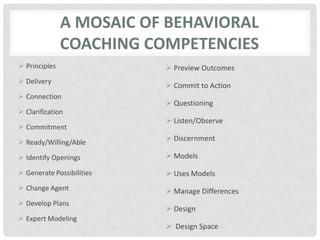
A MOSAIC OF BEHAVIORAL
COACHING COMPETENCIES
 Principles
 Delivery
 Connection
 Clarification
 Commitment
 Ready/Willing/Able
 Identify Openings
 Generate Possibilities
 Change Agent
 Develop Plans
 Expert Modeling
 Preview Outcomes
 Commit to Action
 Questioning
 Listen/Observe
 Discernment
 Models
 Uses Models
 Manage Differences
 Design
 Design Space
“There is nothing permanent except change.
Change is the only constant. Change alone is
unchanging.”
—Heraclitus
PROCHASKA’S TRANS-THEORETICAL CHANGE MODEL
No single model or theory can explain all of the personal variables that an
individual experiences in the process of change
As coaching professionals become familiar with behavior change models
and access validated behavioral change tools they can facilitate creative
solutions to serve client needs and situations
PRIMARY DISCIPLINES INFORMING
BEHAVIORAL BASED COACHING
Cognitive-Behavioral Approach
How to enhance thinking skills, conceptual thinking and decision making
Solution-Focused Approach
Identifying what works and doing more of it while replacing what doesn’t
work with alternative behaviors
SECONDARY DISCIPLINES INFORMING
BEHAVIORAL BASED COACHING
Organizational and social psychology focuses on and explains
individual and group behaviors
Clinical psychology provides validated methods of assessment and
self-management
Systems approach looks at the organizational forces supporting or
sabotaging progress
Humanistic psychology explores meaning and authenticity
SECONDARY DISCIPLINES INFORMING
BEHAVIORAL BASED COACHING
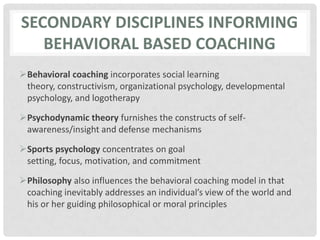
Behavioral coaching incorporates social learning
theory, constructivism, organizational psychology, developmental
psychology, and logotherapy
Psychodynamic theory furnishes the constructs of self-
awareness/insight and defense mechanisms
Sports psychology concentrates on goal
setting, focus, motivation, and commitment
Philosophy also influences the behavioral coaching model in that
coaching inevitably addresses an individual’s view of the world and
his or her guiding philosophical or moral principles
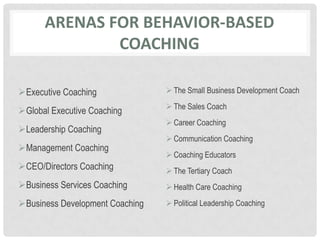
ARENAS FOR BEHAVIOR-BASED
COACHING
Executive Coaching
Global Executive Coaching
Leadership Coaching
Management Coaching
CEO/Directors Coaching
Business Services Coaching
Business Development Coaching
 The Small Business Development Coach
 The Sales Coach
 Career Coaching
 Communication Coaching
 Coaching Educators
 The Tertiary Coach
 Health Care Coaching
 Political Leadership Coaching
Recommended Books
Behavioral Coaching-Dr. Suzanne Skiffington and Perry Zeus
Coaching With The Brain in Mind-David Rock, Linda J. Page
Executive Coaching With Backbone and Heart- Mary-Beth O’Neil
Psychology of Executive Coaching-Theory and Application-Bruce
Peltier
Thank you for your participation!
ASSOCIATION OF CORPORATE EXECUTIVE COACHES
HTTP://WWW.ACEC-WEBSITE.ORG CB@ACEC-WEBSITE.ORG
CB BOWMAN 908.509.1744
SPEAKER INFORMATION:
Dr Shayne Tracy CMC, OCC drtracy@behavioralcoachinginstitute.com
1.416.737.0407
Skype: shayne.tracy

Behavioral Coaching-What is It?

  • 1.
    BEHAVIORAL COACHING WHAT ISIT? Dr. Shayne Tracy, CMC, OCC ASSOCIATION OF CORPORATE EXECUTIVE COACHES HTTP://WWW.ACEC-WEBSITE.ORG CB@ACEC-WEBSITE.ORG 908.509.1744
  • 2.
    DR. SHAYNE TRACYCMC Senior Facilitator, Behavioral Coaching Institute Consultant, Newhouse Partners  Dr. Shayne Tracy is a Strategic Organization Development Specialist and Master Coach. He is a trusted advisor to senior managers and executives in the creation of personal and corporate value.  Dr Tracy has joined the Board and is a Shareholder of Odyssey Transformational Strategies and Odyssey Consulting Institute  Shayne’s activities include strategic planning, business restructuring, performance management, assessment, diagnostics and executive coaching.  Shayne is also a Senior Facilitator with the Behavioral Coaching Institute and he certifies Master Coaches worldwide.
  • 3.
    ABOUT DR. SHAYNETRACY CMC, OCC  Educator: Teacher, Principal, Assistant Superintendent Human Resources  Business founder: HR Technologies Inc.  Shareholder: www.hyperstreet.com  Organizational Development Specialist: www.newhousepartners.com  Certified Behavioral, Values, Attributes, Skills Professional, Pathfinder Career System  Odyssey: The Business of Consulting-Director and Facilitator www.odysseyconsultinginstitute.com  Certified Master Coach: www.executivecoachworx.com  Senior Facilitator-Behavioral Coaching Institute www.1to1coachingschool.com
  • 4.
    OPPORTUNITIES FOR BEHAVIORAL COACHING Climateof continuous change Environment of “tight” economic realities Corporate awareness of need for internal coaches International corporate growth Multi-generational workplace environment Cross-cultural interpersonal dynamics Expanding body of research supporting behavioral coaching initiatives
  • 5.
    INFLUENCE OF BEHAVIOR BASEDCOACHING Behavior-based (evidenced-based) coaching is a third wave psychological approach (looking forward and not backward) to achieving sustainable behavioral change in a relatively short time frame
  • 6.
    “Do not judge,and you will never be mistaken.” —Jean Jacques Rousseau MASTER COACH PRINCIPLE Jean Jacques Rousseau
  • 7.
    One's Reality is TheirReality CORE MASTER COACH PRINCIPLE
  • 8.
    WHAT IS BEHAVIORALCOACHING? Behavioral Coaching emphasizes generative behavioral change, concentrating on strengthening self- identity and values, and bringing new or reframed vision and goals into practical, achievable reality Behavioral Coaching involves helping people effectively achieve outcomes on a wider range of levels (emotional, social, skillful, intellectual, self- conceptual, motivational, valueful)
  • 9.
    THE ROLE OFBEHAVIORAL COACHING Consulting Training Mentoring Counseling Behavioral Coaching Knowledge Competencies Psych-Social Practices Learning Processes Behavioral Models Change Processes
  • 10.
  • 11.
    WHAT IS BEHAVIORALCOACHING?  is creating a safe, supportive environment for someone to have their “internal conversation” out loud lives in use of language—language of change— change language  2 interchangeable power verbs “think” and “feel” is creating a behavioral context for planned, self directed action and focused results  engaging emotions and feelings
  • 12.
    WHAT IS BEHAVIORALCOACHING? is getting to “soul-talk vs. self-talk” depth of “Understanding’ is the beginning of behavioral possibilities is designing “actions and behaviors” that match “new conversations” adopts a scientific approach to coaching to bring about measurable, sustained learning acquisition and change
  • 13.
    THE ELEMENTS OFA VALUES-BASED BEHAVIORAL COACHING PRACTICE Behavioral Based Coaching is grounded in a distinctive set of core values and principles that guide behavior and actions Democratization Self-awareness Authenticity Empowerment
  • 14.
    Self-Esteem — IntrinsicValuing Self-Awareness + Self-Acceptance = Self-Concept (Self-Esteem, Personal Vision, Intrinsic Valuing) Self-Concept ClientRiskTaking Preliminary Innocuous Probing Exploratory Clarifying Confirming QuestioningProcess Low High
  • 15.
    BEHAVIORAL COACHING AND LANGUAGE BehavioralCoaching acknowledges the medium for influencing is language* Consequently most of the strategy and dialogue about coaching is about the use of different value words and how they are applied to coaching situations *The language of change is change language —Dr. Shayne G. Tracy
  • 16.
    What kind ofperson do I want to be? What do I want to do? What do I want to have?
  • 17.
    BEHAVIORAL COACHING PATHWAYS HelpingChange Path A set of values aimed at helping others change Implicit in this developmental path are different approaches to personal change and personal goal achievement Helping Path: amending, teaching, counseling, servicing, wisdom, compassion, interpre ter, presence
  • 18.
    BEHAVIORAL COACHING PATHWAYS EmpathyPath A set of values that suspend ones own self-interest in the interest of understanding and appreciating the “values” of others Empathy Path: affection, reciprocation, inquiry, consideration, appreciation, open- mindedness, empathy, inclusion, or interdependence, selflessness
  • 19.
    BEHAVIORAL COACHING PATHWAYS LeadershipPath Values oriented towards using others to achieve your organizational coaching goals Leadership Path: achieving, supporting, managing, influencing, leading, architecting, navigating
  • 20.
    The Behavioral CoachArena of Influence Emotions Feelings Physiology The Brain Beliefs Values Attitudes Behavior What We Do and Say Development Issue Needs Learning
  • 21.
    PROCESS LEVELS INBEHAVIORAL COACHING Behavioral performance/outcomes/ actions: what, specifically, must be done or accomplished Environmental factors, the where and when, are determined by the organizational culture Capabilities refer to the mental maps, plans or strategies, the how actions are selected and monitored
  • 22.
    PROCESS LEVELS INBEHAVIORAL COACHING Beliefs and values reinforce or inhibit capabilities, actions and motivation, the why a particular path is taken Identity factors relate to people’s sense of their role or mission, a function of who a person or group perceives themselves to be Spiritual factors relate to people’s view of the larger system of which they are a part, the for whom or for what a particular action step or path has been taken (the purpose)
  • 23.
    CORE IDENTITIES OFTHE BEHAVIORAL COACH The Custodian The Guide The Trained Observer The Teacher The Mentor The Sponsor The Awakener The Facilitator
  • 24.
    Point A Current State InnerDialogue Point B Future State? Possibilities Empowerment Ownership Accountability Responsibility Behavioral Change Start With the End in View
  • 25.
  • 26.
    A MOSAIC OFBEHAVIORAL COACHING COMPETENCIES  Principles  Delivery  Connection  Clarification  Commitment  Ready/Willing/Able  Identify Openings  Generate Possibilities  Change Agent  Develop Plans  Expert Modeling  Preview Outcomes  Commit to Action  Questioning  Listen/Observe  Discernment  Models  Uses Models  Manage Differences  Design  Design Space
  • 27.
    “There is nothingpermanent except change. Change is the only constant. Change alone is unchanging.” —Heraclitus
  • 28.
  • 29.
    No single modelor theory can explain all of the personal variables that an individual experiences in the process of change As coaching professionals become familiar with behavior change models and access validated behavioral change tools they can facilitate creative solutions to serve client needs and situations
  • 30.
    PRIMARY DISCIPLINES INFORMING BEHAVIORALBASED COACHING Cognitive-Behavioral Approach How to enhance thinking skills, conceptual thinking and decision making Solution-Focused Approach Identifying what works and doing more of it while replacing what doesn’t work with alternative behaviors
  • 31.
    SECONDARY DISCIPLINES INFORMING BEHAVIORALBASED COACHING Organizational and social psychology focuses on and explains individual and group behaviors Clinical psychology provides validated methods of assessment and self-management Systems approach looks at the organizational forces supporting or sabotaging progress Humanistic psychology explores meaning and authenticity
  • 32.
    SECONDARY DISCIPLINES INFORMING BEHAVIORALBASED COACHING Behavioral coaching incorporates social learning theory, constructivism, organizational psychology, developmental psychology, and logotherapy Psychodynamic theory furnishes the constructs of self- awareness/insight and defense mechanisms Sports psychology concentrates on goal setting, focus, motivation, and commitment Philosophy also influences the behavioral coaching model in that coaching inevitably addresses an individual’s view of the world and his or her guiding philosophical or moral principles
  • 33.
    ARENAS FOR BEHAVIOR-BASED COACHING ExecutiveCoaching Global Executive Coaching Leadership Coaching Management Coaching CEO/Directors Coaching Business Services Coaching Business Development Coaching  The Small Business Development Coach  The Sales Coach  Career Coaching  Communication Coaching  Coaching Educators  The Tertiary Coach  Health Care Coaching  Political Leadership Coaching
  • 34.
    Recommended Books Behavioral Coaching-Dr.Suzanne Skiffington and Perry Zeus Coaching With The Brain in Mind-David Rock, Linda J. Page Executive Coaching With Backbone and Heart- Mary-Beth O’Neil Psychology of Executive Coaching-Theory and Application-Bruce Peltier
  • 35.
    Thank you foryour participation! ASSOCIATION OF CORPORATE EXECUTIVE COACHES HTTP://WWW.ACEC-WEBSITE.ORG CB@ACEC-WEBSITE.ORG CB BOWMAN 908.509.1744 SPEAKER INFORMATION: Dr Shayne Tracy CMC, OCC drtracy@behavioralcoachinginstitute.com 1.416.737.0407 Skype: shayne.tracy

Editor's Notes

  • #3 As one of the largest fee-only investment managers in the state of Georgia, our job is to help you chart out your own course to retirement. Here, presenters should place their credibility statement, education, title, and/or years of experience.