©2016 The Cornerstone Group Page | 1
EXECUTIVE COACHING
REVEALED
WHAT YOU NEED TO KNOW
A whitepaper by The Cornerstone Group
Jeffrey Cicone, PhD
Director of Executive Development
INTRODUCTION
Despite the pervasive use of executive coaches across
industries, roles, and even levels, most business leaders
are still mystified by: 1) When to use coaching, 2) How
to select a coach, and 3) How it works. Small to mid-
sized client organizations, in particular, are not as
familiar with executive coaching as are larger clients.
Even within organizations where coaching has occurred,
unless an individual has experienced the process for him
or herself, the process can still be quite intimidating.
While individual coaching has a relatively high price
tag on a per person basis when compared to other
developmental programs (e.g., classroom training and
leadership workshops), the intensive nature of coaching
provides the greatest return on investment for critical
employees.
In order to secure the best return, the purchaser of this
service must be informed about the critical factors that
determine a successful coaching engagement.
The purpose of this paper is to provide a deeper
understanding of coaching, to clarify when coaching
is indicated, and to provide criteria for selecting the
right coach.
A BRIEF HISTORY OF
EXECUTIVE COACHING
Over the last few decades, “executive coaching” has
become a widely accepted approach for the personalized
and intensive development of business leaders. Early in
its evolution, executive coaching was most typically
used as an intervention to improve the performance of
struggling senior leaders and executives.
Although still used for “fixing” struggling employees,
coaching is now most commonly used to accelerate the
development of high potentials and those ramping up
in new roles, and also as a means to enhance the
performance of senior leaders and executives in strategic
roles. [Note: Because “executive coaching” is currently
used to support leaders at various levels, we will simply
©2016 The Cornerstone Group Page | 2
refer to this process as “coaching.”] Unlike the past, in
today’s organizations having a coach is often a point of
pride and indicates that leadership is willing to make
a significant investment in one’s professional
development.
Since the mid-1990s, the number of individuals calling
themselves “coaches” has increased exponentially.
Training and certification for prospective coaches has
also grown in relative proportion to the use of coaches.
Most coaches have business and/or psychology
backgrounds, and great strides have been made in
professionalizing the discipline. However, certification
does not mean that an individual is an effective coach,
and anyone can call themselves a “coach.”
A TYPICAL COACHING ENGAGEMENT
Source: “What Can Coaches Do for You?” by Diane Coutu and Carol
Kauffman, HBR, January 2009.
COACH QUALIFICATIONS
Coaches will often use their unique backgrounds to
differentiate themselves from the vast pool of
competitors. For example, those with executive
experience will position themselves as more competent
than a coach with a psychology background. In a
previous role, this author was responsible for vetting
candidates as part of an initiative to assemble a cadre of
qualified coaches for use within a large organization.
Several candidates spoke glowingly of their business
background and diminished coaches with psychology
backgrounds as impractical and not grounded in the
realities of business.
I would wait until the end of our conversation to inform
them of my work as a coach, and also my doctorate in
clinical psychology, leaving them little time to explain
what they really meant to say. Because coaching is not
the same as providing business advice, a business
background does not guarantee someone will be
effective.
However, a business background will provide a coach
with insight into organizational dynamics (e.g., politics),
business issues (e.g., reorganizations or mergers), and
the general pressures facing leaders. Those with
psychology backgrounds also like to promote their
assessment and “people” skills, however if they lack an
understanding of the business environment their
effectiveness will be diminished.
Both business and psychology backgrounds can be valuable,
however well-rounded coaches who possess business savvy,
competence in assessment, and who understand the
underlying mechanisms of behavior change will ultimately
be the most effective.
So while tremendous progress has been made in
establishing the value of this relatively new discipline,
there remains significant variation in the capability
of coaches.
48% develop high potentials
or facilitatetransition
26% act as a sounding board
THE TOP 3 REASONS
WHY COACHES ARE ENGAGED:
12% address derailing behavior
Based on a survey of 140 coaches...
THE MEDIAN HOURLY
COST OF COACHING IS:
$500
THE TYPICAL DURATION
OF COACHING IS BETWEEN:
7–12 Months
©2016 The Cornerstone Group Page | 3
THE COACHING PROCESS
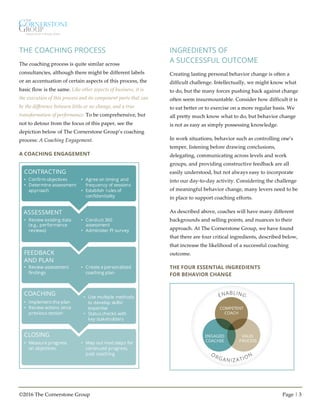
The coaching process is quite similar across
consultancies, although there might be different labels
or an accentuation of certain aspects of this process, the
basic flow is the same. Like other aspects of business, it is
the execution of this process and its component parts that can
be the difference between little or no change, and a true
transformation of performance. To be comprehensive, but
not to detour from the focus of this paper, see the
depiction below of The Cornerstone Group’s coaching
process: A Coaching Engagement.
A COACHING ENGAGEMENT
INGREDIENTS OF
A SUCCESSFUL OUTCOME
Creating lasting personal behavior change is often a
difficult challenge. Intellectually, we might know what
to do, but the many forces pushing back against change
often seem insurmountable. Consider how difficult it is
to eat better or to exercise on a more regular basis. We
all pretty much know what to do, but behavior change
is not as easy as simply possessing knowledge.
In work situations, behavior such as controlling one’s
temper, listening before drawing conclusions,
delegating, communicating across levels and work
groups, and providing constructive feedback are all
easily understood, but not always easy to incorporate
into our day-to-day activity. Considering the challenge
of meaningful behavior change, many levers need to be
in place to support coaching efforts.
As described above, coaches will have many different
backgrounds and selling points, and nuances to their
approach. At The Cornerstone Group, we have found
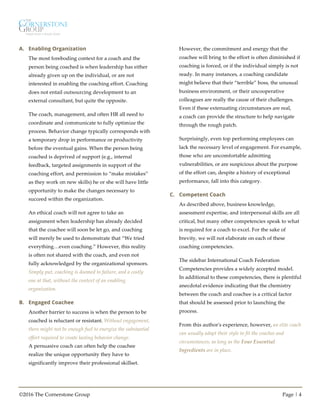
that there are four critical ingredients, described below,
that increase the likelihood of a successful coaching
outcome.
THE FOUR ESSENTIAL INGREDIENTS
FOR BEHAVIOR CHANGE
CONTRACTING
ASSESSMENT
FEEDBACK
AND PLAN
COACHING
CLOSING
• Confirm objectives
• Determine assessment
approach
• Agree on timing and
frequency of sessions
• Establish rules of
confidentiality
• Review existing data
(e.g., performance
reviews)
• Conduct 360
assessment
• Administer PI survey
• Review assessment
findings
• Create a personalized
coaching plan
• Implement the plan
• Review actions since
previous session
• Use multiple methods
to develop skills/
expertise
• Status checks with
key stakeholders
• Measure progress
on objectives
• Map out next steps for
continued progress,
post coaching
COMPETENT
COACH
ENGAGED
COACHEE
VALID
PROCESS
©2016 The Cornerstone Group Page | 4
A. Enabling Organization
The most foreboding context for a coach and the
person being coached is when leadership has either
already given up on the individual, or are not
interested in enabling the coaching effort. Coaching
does not entail outsourcing development to an
external consultant, but quite the opposite.
The coach, management, and often HR all need to
coordinate and communicate to fully optimize the
process. Behavior change typically corresponds with
a temporary drop in performance or productivity
before the eventual gains. When the person being
coached is deprived of support (e.g., internal
feedback, targeted assignments in support of the
coaching effort, and permission to “make mistakes”
as they work on new skills) he or she will have little
opportunity to make the changes necessary to
succeed within the organization.
An ethical coach will not agree to take an
assignment when leadership has already decided
that the coachee will soon be let go, and coaching
will merely be used to demonstrate that “We tried
everything…even coaching.” However, this reality
is often not shared with the coach, and even not
fully acknowledged by the organizational sponsors.
Simply put, coaching is doomed to failure, and a costly
one at that, without the context of an enabling
organization.
B. Engaged Coachee
Another barrier to success is when the person to be
coached is reluctant or resistant. Without engagement,
there might not be enough fuel to energize the substantial
effort required to create lasting behavior change.
A persuasive coach can often help the coachee
realize the unique opportunity they have to
significantly improve their professional skillset.
However, the commitment and energy that the
coachee will bring to the effort is often diminished if
coaching is forced, or if the individual simply is not
ready. In many instances, a coaching candidate
might believe that their “terrible” boss, the unusual
business environment, or their uncooperative
colleagues are really the cause of their challenges.
Even if these extenuating circumstances are real,
a coach can provide the structure to help navigate
through the rough patch.
Surprisingly, even top performing employees can
lack the necessary level of engagement. For example,
those who are uncomfortable admitting
vulnerabilities, or are suspicious about the purpose
of the effort can, despite a history of exceptional
performance, fall into this category.
C. Competent Coach
As described above, business knowledge,
assessment expertise, and interpersonal skills are all
critical, but many other competencies speak to what
is required for a coach to excel. For the sake of
brevity, we will not elaborate on each of these
coaching competencies.
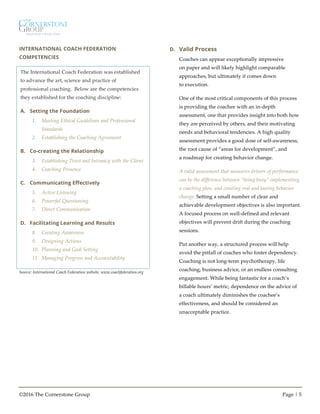
The sidebar International Coach Federation
Competencies provides a widely accepted model.
In additional to these competencies, there is plentiful
anecdotal evidence indicating that the chemistry
between the coach and coachee is a critical factor
that should be assessed prior to launching the
process.
From this author's experience, however, an elite coach
can usually adapt their style to fit the coachee and
circumstances, as long as the Four Essential
Ingredients are in place.
©2016 The Cornerstone Group Page | 5
INTERNATIONAL COACH FEDERATION
COMPETENCIES
Source: International Coach Federation website, www.coachfederation.org
D. Valid Process
Coaches can appear exceptionally impressive
on paper and will likely highlight comparable
approaches, but ultimately it comes down
to execution.
One of the most critical components of this process
is providing the coachee with an in-depth
assessment, one that provides insight into both how
they are perceived by others, and their motivating
needs and behavioral tendencies. A high quality
assessment provides a good dose of self-awareness,
the root cause of “areas for development”, and
a roadmap for creating behavior change.
A valid assessment that measures drivers of performance
can be the difference between “being busy” implementing
a coaching plan, and creating real and lasting behavior
change. Setting a small number of clear and
achievable development objectives is also important.
A focused process on well-defined and relevant
objectives will prevent drift during the coaching
sessions.
Put another way, a structured process will help
avoid the pitfall of coaches who foster dependency.
Coaching is not long-term psychotherapy, life
coaching, business advice, or an endless consulting
engagement. While being fantastic for a coach’s
billable hours’ metric, dependence on the advice of
a coach ultimately diminishes the coachee’s
effectiveness, and should be considered an
unacceptable practice.
The International Coach Federation was established
to advance the art, science and practice of
professional coaching. Below are the competencies
they established for the coaching discipline:
A. Setting the Foundation
1. Meeting Ethical Guidelines and Professional
Standards
2. Establishing the Coaching Agreement
B. Co-creating the Relationship
3. Establishing Trust and Intimacy with the Client
4. Coaching Presence
C. Communicating Effectively
5. Active Listening
6. Powerful Questioning
7. Direct Communication
D. Facilitating Learning and Results
8. Creating Awareness
9. Designing Actions
10. Planning and Goal Setting
11. Managing Progress and Accountability
©2016 The Cornerstone Group Page | 6
SUMMARY AND CONCLUSION
The discipline of coaching provides an important lever
for optimizing executive and leadership performance.
Considering the many factors influencing the coaching
process, ultimate success cannot be guaranteed.
However, when the Four Essential Ingredients as
described above are in place, there is a high probability
that meaningful behavior change will occur. We
recommend that prior to engaging in a coaching process,
you review the Coaching Checklist to determine if
coaching is a viable option, and if you have the right
coach for the job.
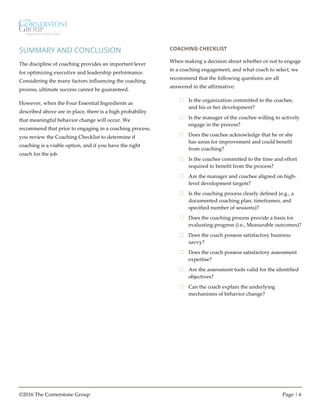
COACHING CHECKLIST
When making a decision about whether or not to engage
in a coaching engagement, and what coach to select, we
recommend that the following questions are all
answered in the affirmative:
£ Is the organization committed to the coachee,
and his or her development?
£ Is the manager of the coachee willing to actively
engage in the process?
£ Does the coachee acknowledge that he or she
has areas for improvement and could benefit
from coaching?
£ Is the coachee committed to the time and effort
required to benefit from the process?
£ Are the manager and coachee aligned on high-
level development targets?
£ Is the coaching process clearly defined (e.g., a
documented coaching plan, timeframes, and
specified number of sessions)?
£ Does the coaching process provide a basis for
evaluating progress (i.e., Measurable outcomes)?
£ Does the coach possess satisfactory business
savvy?
£ Does the coach possess satisfactory assessment
expertise?
£ Are the assessment tools valid for the identified
objectives?
£ Can the coach explain the underlying
mechanisms of behavior change?

Cornerstone Whitepaper: Executive Coaching Revealed

  • 1.
    ©2016 The CornerstoneGroup Page | 1 EXECUTIVE COACHING REVEALED WHAT YOU NEED TO KNOW A whitepaper by The Cornerstone Group Jeffrey Cicone, PhD Director of Executive Development INTRODUCTION Despite the pervasive use of executive coaches across industries, roles, and even levels, most business leaders are still mystified by: 1) When to use coaching, 2) How to select a coach, and 3) How it works. Small to mid- sized client organizations, in particular, are not as familiar with executive coaching as are larger clients. Even within organizations where coaching has occurred, unless an individual has experienced the process for him or herself, the process can still be quite intimidating. While individual coaching has a relatively high price tag on a per person basis when compared to other developmental programs (e.g., classroom training and leadership workshops), the intensive nature of coaching provides the greatest return on investment for critical employees. In order to secure the best return, the purchaser of this service must be informed about the critical factors that determine a successful coaching engagement. The purpose of this paper is to provide a deeper understanding of coaching, to clarify when coaching is indicated, and to provide criteria for selecting the right coach. A BRIEF HISTORY OF EXECUTIVE COACHING Over the last few decades, “executive coaching” has become a widely accepted approach for the personalized and intensive development of business leaders. Early in its evolution, executive coaching was most typically used as an intervention to improve the performance of struggling senior leaders and executives. Although still used for “fixing” struggling employees, coaching is now most commonly used to accelerate the development of high potentials and those ramping up in new roles, and also as a means to enhance the performance of senior leaders and executives in strategic roles. [Note: Because “executive coaching” is currently used to support leaders at various levels, we will simply
  • 2.
    ©2016 The CornerstoneGroup Page | 2 refer to this process as “coaching.”] Unlike the past, in today’s organizations having a coach is often a point of pride and indicates that leadership is willing to make a significant investment in one’s professional development. Since the mid-1990s, the number of individuals calling themselves “coaches” has increased exponentially. Training and certification for prospective coaches has also grown in relative proportion to the use of coaches. Most coaches have business and/or psychology backgrounds, and great strides have been made in professionalizing the discipline. However, certification does not mean that an individual is an effective coach, and anyone can call themselves a “coach.” A TYPICAL COACHING ENGAGEMENT Source: “What Can Coaches Do for You?” by Diane Coutu and Carol Kauffman, HBR, January 2009. COACH QUALIFICATIONS Coaches will often use their unique backgrounds to differentiate themselves from the vast pool of competitors. For example, those with executive experience will position themselves as more competent than a coach with a psychology background. In a previous role, this author was responsible for vetting candidates as part of an initiative to assemble a cadre of qualified coaches for use within a large organization. Several candidates spoke glowingly of their business background and diminished coaches with psychology backgrounds as impractical and not grounded in the realities of business. I would wait until the end of our conversation to inform them of my work as a coach, and also my doctorate in clinical psychology, leaving them little time to explain what they really meant to say. Because coaching is not the same as providing business advice, a business background does not guarantee someone will be effective. However, a business background will provide a coach with insight into organizational dynamics (e.g., politics), business issues (e.g., reorganizations or mergers), and the general pressures facing leaders. Those with psychology backgrounds also like to promote their assessment and “people” skills, however if they lack an understanding of the business environment their effectiveness will be diminished. Both business and psychology backgrounds can be valuable, however well-rounded coaches who possess business savvy, competence in assessment, and who understand the underlying mechanisms of behavior change will ultimately be the most effective. So while tremendous progress has been made in establishing the value of this relatively new discipline, there remains significant variation in the capability of coaches. 48% develop high potentials or facilitatetransition 26% act as a sounding board THE TOP 3 REASONS WHY COACHES ARE ENGAGED: 12% address derailing behavior Based on a survey of 140 coaches... THE MEDIAN HOURLY COST OF COACHING IS: $500 THE TYPICAL DURATION OF COACHING IS BETWEEN: 7–12 Months
  • 3.
    ©2016 The CornerstoneGroup Page | 3 THE COACHING PROCESS The coaching process is quite similar across consultancies, although there might be different labels or an accentuation of certain aspects of this process, the basic flow is the same. Like other aspects of business, it is the execution of this process and its component parts that can be the difference between little or no change, and a true transformation of performance. To be comprehensive, but not to detour from the focus of this paper, see the depiction below of The Cornerstone Group’s coaching process: A Coaching Engagement. A COACHING ENGAGEMENT INGREDIENTS OF A SUCCESSFUL OUTCOME Creating lasting personal behavior change is often a difficult challenge. Intellectually, we might know what to do, but the many forces pushing back against change often seem insurmountable. Consider how difficult it is to eat better or to exercise on a more regular basis. We all pretty much know what to do, but behavior change is not as easy as simply possessing knowledge. In work situations, behavior such as controlling one’s temper, listening before drawing conclusions, delegating, communicating across levels and work groups, and providing constructive feedback are all easily understood, but not always easy to incorporate into our day-to-day activity. Considering the challenge of meaningful behavior change, many levers need to be in place to support coaching efforts. As described above, coaches will have many different backgrounds and selling points, and nuances to their approach. At The Cornerstone Group, we have found that there are four critical ingredients, described below, that increase the likelihood of a successful coaching outcome. THE FOUR ESSENTIAL INGREDIENTS FOR BEHAVIOR CHANGE CONTRACTING ASSESSMENT FEEDBACK AND PLAN COACHING CLOSING • Confirm objectives • Determine assessment approach • Agree on timing and frequency of sessions • Establish rules of confidentiality • Review existing data (e.g., performance reviews) • Conduct 360 assessment • Administer PI survey • Review assessment findings • Create a personalized coaching plan • Implement the plan • Review actions since previous session • Use multiple methods to develop skills/ expertise • Status checks with key stakeholders • Measure progress on objectives • Map out next steps for continued progress, post coaching COMPETENT COACH ENGAGED COACHEE VALID PROCESS
  • 4.
    ©2016 The CornerstoneGroup Page | 4 A. Enabling Organization The most foreboding context for a coach and the person being coached is when leadership has either already given up on the individual, or are not interested in enabling the coaching effort. Coaching does not entail outsourcing development to an external consultant, but quite the opposite. The coach, management, and often HR all need to coordinate and communicate to fully optimize the process. Behavior change typically corresponds with a temporary drop in performance or productivity before the eventual gains. When the person being coached is deprived of support (e.g., internal feedback, targeted assignments in support of the coaching effort, and permission to “make mistakes” as they work on new skills) he or she will have little opportunity to make the changes necessary to succeed within the organization. An ethical coach will not agree to take an assignment when leadership has already decided that the coachee will soon be let go, and coaching will merely be used to demonstrate that “We tried everything…even coaching.” However, this reality is often not shared with the coach, and even not fully acknowledged by the organizational sponsors. Simply put, coaching is doomed to failure, and a costly one at that, without the context of an enabling organization. B. Engaged Coachee Another barrier to success is when the person to be coached is reluctant or resistant. Without engagement, there might not be enough fuel to energize the substantial effort required to create lasting behavior change. A persuasive coach can often help the coachee realize the unique opportunity they have to significantly improve their professional skillset. However, the commitment and energy that the coachee will bring to the effort is often diminished if coaching is forced, or if the individual simply is not ready. In many instances, a coaching candidate might believe that their “terrible” boss, the unusual business environment, or their uncooperative colleagues are really the cause of their challenges. Even if these extenuating circumstances are real, a coach can provide the structure to help navigate through the rough patch. Surprisingly, even top performing employees can lack the necessary level of engagement. For example, those who are uncomfortable admitting vulnerabilities, or are suspicious about the purpose of the effort can, despite a history of exceptional performance, fall into this category. C. Competent Coach As described above, business knowledge, assessment expertise, and interpersonal skills are all critical, but many other competencies speak to what is required for a coach to excel. For the sake of brevity, we will not elaborate on each of these coaching competencies. The sidebar International Coach Federation Competencies provides a widely accepted model. In additional to these competencies, there is plentiful anecdotal evidence indicating that the chemistry between the coach and coachee is a critical factor that should be assessed prior to launching the process. From this author's experience, however, an elite coach can usually adapt their style to fit the coachee and circumstances, as long as the Four Essential Ingredients are in place.
  • 5.
    ©2016 The CornerstoneGroup Page | 5 INTERNATIONAL COACH FEDERATION COMPETENCIES Source: International Coach Federation website, www.coachfederation.org D. Valid Process Coaches can appear exceptionally impressive on paper and will likely highlight comparable approaches, but ultimately it comes down to execution. One of the most critical components of this process is providing the coachee with an in-depth assessment, one that provides insight into both how they are perceived by others, and their motivating needs and behavioral tendencies. A high quality assessment provides a good dose of self-awareness, the root cause of “areas for development”, and a roadmap for creating behavior change. A valid assessment that measures drivers of performance can be the difference between “being busy” implementing a coaching plan, and creating real and lasting behavior change. Setting a small number of clear and achievable development objectives is also important. A focused process on well-defined and relevant objectives will prevent drift during the coaching sessions. Put another way, a structured process will help avoid the pitfall of coaches who foster dependency. Coaching is not long-term psychotherapy, life coaching, business advice, or an endless consulting engagement. While being fantastic for a coach’s billable hours’ metric, dependence on the advice of a coach ultimately diminishes the coachee’s effectiveness, and should be considered an unacceptable practice. The International Coach Federation was established to advance the art, science and practice of professional coaching. Below are the competencies they established for the coaching discipline: A. Setting the Foundation 1. Meeting Ethical Guidelines and Professional Standards 2. Establishing the Coaching Agreement B. Co-creating the Relationship 3. Establishing Trust and Intimacy with the Client 4. Coaching Presence C. Communicating Effectively 5. Active Listening 6. Powerful Questioning 7. Direct Communication D. Facilitating Learning and Results 8. Creating Awareness 9. Designing Actions 10. Planning and Goal Setting 11. Managing Progress and Accountability
  • 6.
    ©2016 The CornerstoneGroup Page | 6 SUMMARY AND CONCLUSION The discipline of coaching provides an important lever for optimizing executive and leadership performance. Considering the many factors influencing the coaching process, ultimate success cannot be guaranteed. However, when the Four Essential Ingredients as described above are in place, there is a high probability that meaningful behavior change will occur. We recommend that prior to engaging in a coaching process, you review the Coaching Checklist to determine if coaching is a viable option, and if you have the right coach for the job. COACHING CHECKLIST When making a decision about whether or not to engage in a coaching engagement, and what coach to select, we recommend that the following questions are all answered in the affirmative: £ Is the organization committed to the coachee, and his or her development? £ Is the manager of the coachee willing to actively engage in the process? £ Does the coachee acknowledge that he or she has areas for improvement and could benefit from coaching? £ Is the coachee committed to the time and effort required to benefit from the process? £ Are the manager and coachee aligned on high- level development targets? £ Is the coaching process clearly defined (e.g., a documented coaching plan, timeframes, and specified number of sessions)? £ Does the coaching process provide a basis for evaluating progress (i.e., Measurable outcomes)? £ Does the coach possess satisfactory business savvy? £ Does the coach possess satisfactory assessment expertise? £ Are the assessment tools valid for the identified objectives? £ Can the coach explain the underlying mechanisms of behavior change?