Top 10 Misconceptions
About 5G
@3g4gUK
Misconception #1: 5G will be revolution, not Evolution
©3G4G
20 Gbps
At home
Misconception #1: 5G will be revolution, not Evolution
©3G4G
• The initial 5G will be very similar to 4G, just a bit faster in most places
• In other places there will be islands of very fast coverage
• But the initial 5G will just be an evolution – the revolution part will
come after a few years
• We will look at some of these points while discussing other
misconceptions
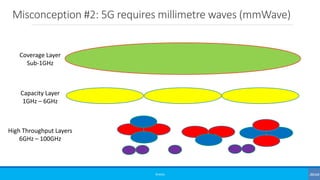
Misconception #2: 5G requires millimetre waves (mmWave)
©3G4G
Coverage Layer
Sub-1GHz
Capacity Layer
1GHz – 6GHz
High Throughput Layers
6GHz – 100GHz
Misconception #2: 5G requires millimetre waves (mmWave)
©3G4G
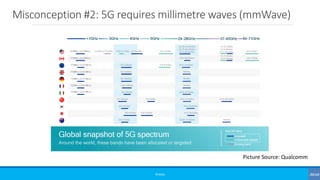
Picture Source: Qualcomm
Misconception #2: 5G requires millimetre waves (mmWave)
©3G4G
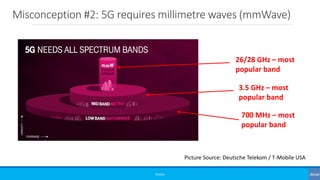
Picture Source: Deutsche Telekom / T-Mobile USA
700 MHz – most
popular band
3.5 GHz – most
popular band
26/28 GHz – most
popular band
Misconception #3: 5G needs new spectrum
©3G4G
You can roll out 5G in new spectrum but
no one is stopping you from using an
existing spectrum / band
Misconception #3: 5G needs new spectrum
©3G4G
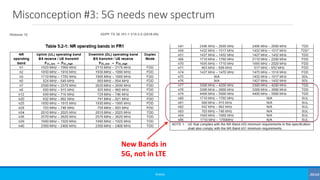
New Bands in
5G, not in LTE
Misconception #3: 5G needs new spectrum
©3G4G
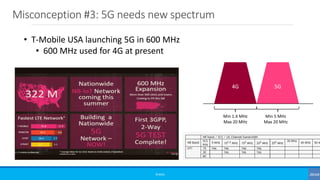
• T-Mobile USA launching 5G in 600 MHz
• 600 MHz used for 4G at present
4G 5G
Min 1.4 MHz
Max 20 MHz
Min 5 MHz
Max 20 MHz
Misconception #3: 5G needs new spectrum
©3G4G
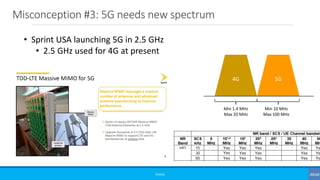
• Sprint USA launching 5G in 2.5 GHz
• 2.5 GHz used for 4G at present
4G 5G
Min 1.4 MHz
Max 20 MHz
Min 10 MHz
Max 100 MHz
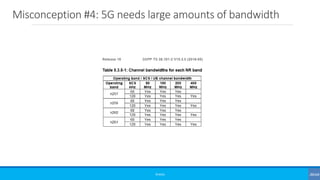
Misconception #4: 5G needs large amounts of bandwidth
©3G4G
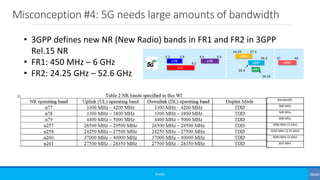
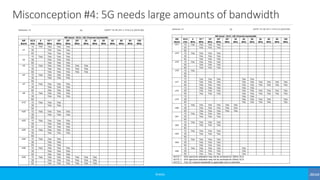
• 3GPP defines new NR (New Radio) bands in FR1 and FR2 in 3GPP
Rel.15 NR
• FR1: 450 MHz – 6 GHz
• FR2: 24.25 GHz – 52.6 GHz
3.3 3.8
4.2
4.4 5.0
24.25 27.5
29.5 37 40
26.5
n78 n79
n77
n258
n260
n261
28.35
n257
Bandwidth
900 MHz
500 MHz
600 MHz
3000 MHz (3 GHz)
3250 MHz (3.25 GHz)
3000 MHz (3 GHz)
850 MHz
Misconception #4: 5G needs large amounts of bandwidth
©3G4G
Misconception #4: 5G needs large amounts of bandwidth
©3G4G
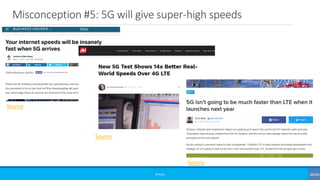
Misconception #5: 5G will give super-high speeds
©3G4G
Source
Source
Source
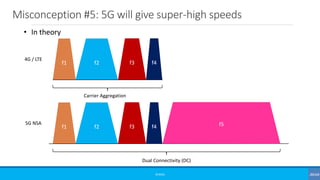
Misconception #5: 5G will give super-high speeds
©3G4G
f1 f2 f3 f4
Carrier Aggregation
4G / LTE
f1 f2 f3 f4
Dual Connectivity (DC)
5G NSA f5
• In theory
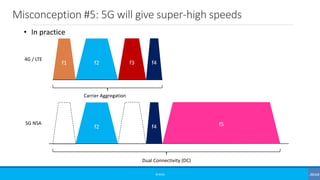
Misconception #5: 5G will give super-high speeds
©3G4G
f1 f2 f3 f4
Carrier Aggregation
4G / LTE
f1 f2 f3 f4
Dual Connectivity (DC)
5G NSA f5
• In practice
Misconception #5: 5G will give super-high speeds
©3G4G
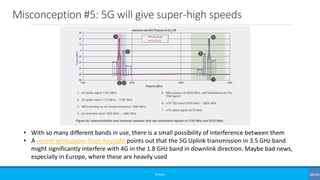
• With so many different bands in use, there is a small possibility of interference between them
• A recent whitepaper from Keysight points out that the 5G Uplink transmission in 3.5 GHz band
might significantly interfere with 4G in the 1.8 GHz band in downlink direction. Maybe bad news,
especially in Europe, where these are heavily used
Misconception #5: 5G will give super-high speeds
©3G4G
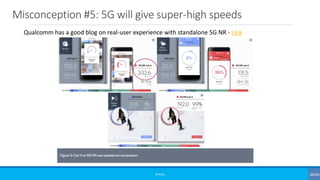
Qualcomm has a good blog on real-user experience with standalone 5G NR - Link
Misconception #5: 5G will give super-high speeds
©3G4G
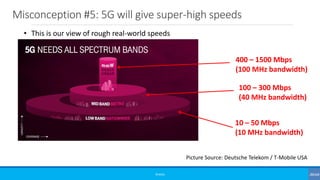
Picture Source: Deutsche Telekom / T-Mobile USA
10 – 50 Mbps
(10 MHz bandwidth)
100 – 300 Mbps
(40 MHz bandwidth)
400 – 1500 Mbps
(100 MHz bandwidth)
• This is our view of rough real-world speeds
Misconception #6: 5G networks will have less than 1ms latency
©3G4G
Latency is generally defined as the time it takes for a source to send a packet
of data to a receiver. In simple terms, half of Ping time. This is also referred to
as one way latency.
Sometimes the term Round trip latency or round trip time (RTT) is also used
to define latency. This is the same as ping time.
Misconception #6: 5G networks will have less than 1ms latency
©3G4G
In 3GPP and ITU, control-plane latency and user-plane latency is discussed
for a particular technology
Control-plane latency is defined as the transition time from idle state to
connected state.
The user-plane latency, also known as transport delay, is defined as the one-
way transit time between a packet being available at the IP layer of the origin
and the availability of this packet at IP layer of the destination.
Misconception #6: 5G networks will have less than 1ms latency
©3G4G
End-to-end (E2E) latency: the time that takes to transfer a given piece of
information from a source to a destination, measured at the communication
interface, from the moment it is transmitted by the source to the moment it
is successfully received at the destination.
Misconception #6: 5G networks will have less than 1ms latency
©3G4G
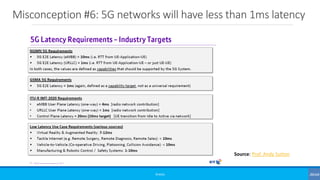
Source: Prof. Andy Sutton
Misconception #6: 5G networks will have less than 1ms latency
©3G4G
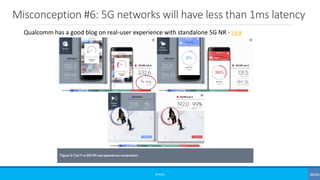
Qualcomm has a good blog on real-user experience with standalone 5G NR - Link
Misconception #6: 5G networks will have less than 1ms latency
©3G4G
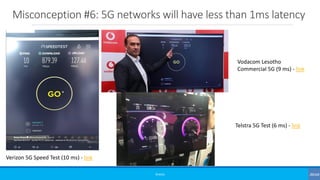
Verizon 5G Speed Test (10 ms) - link
Vodacom Lesotho
Commercial 5G (9 ms) - link
Telstra 5G Test (6 ms) - link
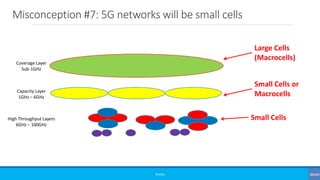
Misconception #7: 5G networks will be small cells
©3G4G
Small Cells
Small Cells or
Macrocells
Large Cells
(Macrocells)
Misconception #8: 5G needs Massive MIMO
©3G4G
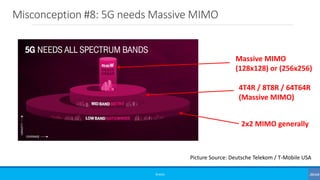
Picture Source: Deutsche Telekom / T-Mobile USA
2x2 MIMO generally
4T4R / 8T8R / 64T64R
(Massive MIMO)
Massive MIMO
(128x128) or (256x256)
Misconception #8: 5G needs Massive MIMO
©3G4G
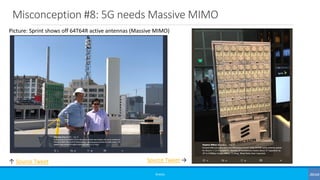
Picture: Sprint shows off 64T64R active antennas (Massive MIMO)
↑ Source Tweet Source Tweet →
Misconception #8: 5G needs Massive MIMO
©3G4G
• 5G Massive MIMO will introduce its own challenges. Mainly:
• The antennas will be heavier, meaning that the existing poles may
not be able to bear the load. Upgrade would be required
• It can work for some sites but may not be economical for all sites
• Power upgrade would be required too as the new active antennas
would consume more power
• Since each site serves multiple sectors and frequencies, it is quite
possible that backhaul upgrades would be necessary as well.
Existing backhaul may not be able to cope with massive increase in
data traffic
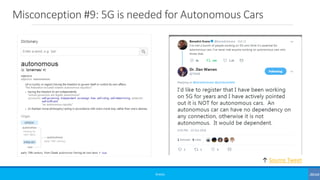
Misconception #9: 5G is needed for Autonomous Cars
©3G4G
↑ Source Tweet
Misconception #9: 5G is needed for Autonomous Cars
©3G4G
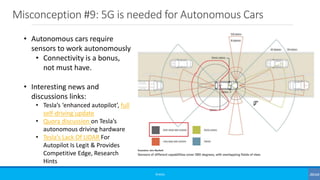
• Autonomous cars require
sensors to work autonomously
• Connectivity is a bonus,
not must have.
• Interesting news and
discussions links:
• Tesla’s ‘enhanced autopilot’, full
self-driving update
• Quora discussion on Tesla’s
autonomous driving hardware
• Tesla’s Lack Of LIDAR For
Autopilot Is Legit & Provides
Competitive Edge, Research
Hints
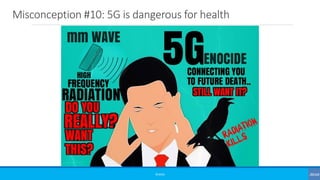
Misconception #10: 5G is dangerous for health
©3G4G
Misconception #10: 5G is dangerous for health
©3G4G
• Every new generation of mobile technology gives rise to many news
and research items suggesting that this new technology is dangerous to
health.
• For example, back in 2004, Stewart Report looked at all the health
concerns and reported that there is no real evidence of health risk. It
however also said:
“A recent paper has suggested possible effects on brain functioning form the use of 3G or
third generation mobile phones. Populations are not homogenous and people can vary in
their susceptibility to environmental and other challenges. It was considered that children
might be more vulnerable to any effects arising from the use of mobile phones because of
their developing nervous system, the greater absorption of energy in the tissues of the head
and a longer lifetime exposure.”
Misconception #10: 5G is dangerous for health
©3G4G
Numerous articles have been written mentioning that there is no real
evidence of any health issues because of mobile phones.
• The Observer: Mobile phones and cancer – the full picture
• The Argus: New superfast internet won't kill you: expert calms 5G
safety fears
• Forbes: Is 5G a CIA plot?
Finally:
• RADIATION HAZARDS - A dabbler’s perspective by Jess H. Brewer
Misconception #10: 5G is dangerous for health
©3G4G
• International Commission on Non-Ionizing Radiation Protection
(ICNIRP): An independent organization provides scientific advice and
guidance on the health and environmental effects of non-ionizing
radiation (NIR) to protect people and the environment from
detrimental NIR exposure.
• NIR refers to electromagnetic radiation such as ultraviolet, light,
infrared, and radiowaves, and mechanical waves such as infra- and
ultrasound. In daily life, common sources of NIR include the sun,
household electrical appliances, mobile phones, Wi-Fi, and
microwave ovens.
Misconception #10: 5G is dangerous for health
©3G4G
• As mentioned earlier, the coverage layer 5G and capacity layer 5G (sub-
6GHz) have similar properties. With regards to mmWave frequencies,
ICNIRP have set safety margins far higher than those for below 6GHz
• ICNIRP also provided a Health risk assessment literature with an
interesting list of research references. Here is the conclusion regarding
Cancer:
“Studies of exposure to environmental radiofrequency EMF fields, for example from radio and television
transmitters, have not provided evidence of an increased cancer risk either in children or in adults. Studies of
cancer in relation to occupational radiofrequency EMF exposure have suffered substantial methodological
limitations and do not provide sufficient information for the assessment of carcinogenicity of radiofrequency
EMF fields. Taken together, the epidemiological studies do not provide evidence of a carcinogenic effect of
radiofrequency EMF exposure at levels encountered in the general population. In summary, no effects of
radiofrequency EMF on cancer have been substantiated.”
Misconception #10: 5G is dangerous for health
©3G4G
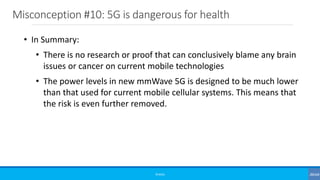
• In Summary:
• There is no research or proof that can conclusively blame any brain
issues or cancer on current mobile technologies
• The power levels in new mmWave 5G is designed to be much lower
than that used for current mobile cellular systems. This means that
the risk is even further removed.
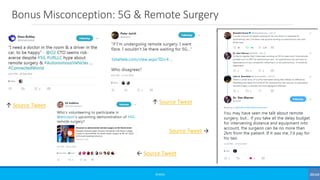
Bonus Misconception: 5G & Remote Surgery
©3G4G
↑ Source Tweet
↑ Source Tweet
← Source Tweet
Source Tweet →
Thank You
To learn more, visit:
3G4G Website – http://www.3g4g.co.uk/
3G4G Blog – http://blog.3g4g.co.uk/
3G4G Small Cells Blog – http://smallcells.3g4g.co.uk/
Operator Watch - http://operatorwatch.3g4g.co.uk/
Follow us on Twitter: https://twitter.com/3g4gUK
Follow us on Facebook: https://www.facebook.com/3g4gUK/
Follow us on Linkedin: https://www.linkedin.com/company/3g4g
Follow us on Slideshare: https://www.slideshare.net/3G4GLtd
Follow us on Youtube: https://www.youtube.com/3G4G5G
©3G4G

Beginners: Top 10 Misconceptions About 5G

  • 1.
  • 2.
    Misconception #1: 5Gwill be revolution, not Evolution ©3G4G 20 Gbps At home
  • 3.
    Misconception #1: 5Gwill be revolution, not Evolution ©3G4G • The initial 5G will be very similar to 4G, just a bit faster in most places • In other places there will be islands of very fast coverage • But the initial 5G will just be an evolution – the revolution part will come after a few years • We will look at some of these points while discussing other misconceptions
  • 4.
    Misconception #2: 5Grequires millimetre waves (mmWave) ©3G4G Coverage Layer Sub-1GHz Capacity Layer 1GHz – 6GHz High Throughput Layers 6GHz – 100GHz
  • 5.
    Misconception #2: 5Grequires millimetre waves (mmWave) ©3G4G Picture Source: Qualcomm
  • 6.
    Misconception #2: 5Grequires millimetre waves (mmWave) ©3G4G Picture Source: Deutsche Telekom / T-Mobile USA 700 MHz – most popular band 3.5 GHz – most popular band 26/28 GHz – most popular band
  • 7.
    Misconception #3: 5Gneeds new spectrum ©3G4G You can roll out 5G in new spectrum but no one is stopping you from using an existing spectrum / band
  • 8.
    Misconception #3: 5Gneeds new spectrum ©3G4G New Bands in 5G, not in LTE
  • 9.
    Misconception #3: 5Gneeds new spectrum ©3G4G • T-Mobile USA launching 5G in 600 MHz • 600 MHz used for 4G at present 4G 5G Min 1.4 MHz Max 20 MHz Min 5 MHz Max 20 MHz
  • 10.
    Misconception #3: 5Gneeds new spectrum ©3G4G • Sprint USA launching 5G in 2.5 GHz • 2.5 GHz used for 4G at present 4G 5G Min 1.4 MHz Max 20 MHz Min 10 MHz Max 100 MHz
  • 11.
    Misconception #4: 5Gneeds large amounts of bandwidth ©3G4G • 3GPP defines new NR (New Radio) bands in FR1 and FR2 in 3GPP Rel.15 NR • FR1: 450 MHz – 6 GHz • FR2: 24.25 GHz – 52.6 GHz 3.3 3.8 4.2 4.4 5.0 24.25 27.5 29.5 37 40 26.5 n78 n79 n77 n258 n260 n261 28.35 n257 Bandwidth 900 MHz 500 MHz 600 MHz 3000 MHz (3 GHz) 3250 MHz (3.25 GHz) 3000 MHz (3 GHz) 850 MHz
  • 12.
    Misconception #4: 5Gneeds large amounts of bandwidth ©3G4G
  • 13.
    Misconception #4: 5Gneeds large amounts of bandwidth ©3G4G
  • 14.
    Misconception #5: 5Gwill give super-high speeds ©3G4G Source Source Source
  • 15.
    Misconception #5: 5Gwill give super-high speeds ©3G4G f1 f2 f3 f4 Carrier Aggregation 4G / LTE f1 f2 f3 f4 Dual Connectivity (DC) 5G NSA f5 • In theory
  • 16.
    Misconception #5: 5Gwill give super-high speeds ©3G4G f1 f2 f3 f4 Carrier Aggregation 4G / LTE f1 f2 f3 f4 Dual Connectivity (DC) 5G NSA f5 • In practice
  • 17.
    Misconception #5: 5Gwill give super-high speeds ©3G4G • With so many different bands in use, there is a small possibility of interference between them • A recent whitepaper from Keysight points out that the 5G Uplink transmission in 3.5 GHz band might significantly interfere with 4G in the 1.8 GHz band in downlink direction. Maybe bad news, especially in Europe, where these are heavily used
  • 18.
    Misconception #5: 5Gwill give super-high speeds ©3G4G Qualcomm has a good blog on real-user experience with standalone 5G NR - Link
  • 19.
    Misconception #5: 5Gwill give super-high speeds ©3G4G Picture Source: Deutsche Telekom / T-Mobile USA 10 – 50 Mbps (10 MHz bandwidth) 100 – 300 Mbps (40 MHz bandwidth) 400 – 1500 Mbps (100 MHz bandwidth) • This is our view of rough real-world speeds
  • 20.
    Misconception #6: 5Gnetworks will have less than 1ms latency ©3G4G Latency is generally defined as the time it takes for a source to send a packet of data to a receiver. In simple terms, half of Ping time. This is also referred to as one way latency. Sometimes the term Round trip latency or round trip time (RTT) is also used to define latency. This is the same as ping time.
  • 21.
    Misconception #6: 5Gnetworks will have less than 1ms latency ©3G4G In 3GPP and ITU, control-plane latency and user-plane latency is discussed for a particular technology Control-plane latency is defined as the transition time from idle state to connected state. The user-plane latency, also known as transport delay, is defined as the one- way transit time between a packet being available at the IP layer of the origin and the availability of this packet at IP layer of the destination.
  • 22.
    Misconception #6: 5Gnetworks will have less than 1ms latency ©3G4G End-to-end (E2E) latency: the time that takes to transfer a given piece of information from a source to a destination, measured at the communication interface, from the moment it is transmitted by the source to the moment it is successfully received at the destination.
  • 23.
    Misconception #6: 5Gnetworks will have less than 1ms latency ©3G4G Source: Prof. Andy Sutton
  • 24.
    Misconception #6: 5Gnetworks will have less than 1ms latency ©3G4G Qualcomm has a good blog on real-user experience with standalone 5G NR - Link
  • 25.
    Misconception #6: 5Gnetworks will have less than 1ms latency ©3G4G Verizon 5G Speed Test (10 ms) - link Vodacom Lesotho Commercial 5G (9 ms) - link Telstra 5G Test (6 ms) - link
  • 26.
    Misconception #7: 5Gnetworks will be small cells ©3G4G Small Cells Small Cells or Macrocells Large Cells (Macrocells)
  • 27.
    Misconception #8: 5Gneeds Massive MIMO ©3G4G Picture Source: Deutsche Telekom / T-Mobile USA 2x2 MIMO generally 4T4R / 8T8R / 64T64R (Massive MIMO) Massive MIMO (128x128) or (256x256)
  • 28.
    Misconception #8: 5Gneeds Massive MIMO ©3G4G Picture: Sprint shows off 64T64R active antennas (Massive MIMO) ↑ Source Tweet Source Tweet →
  • 29.
    Misconception #8: 5Gneeds Massive MIMO ©3G4G • 5G Massive MIMO will introduce its own challenges. Mainly: • The antennas will be heavier, meaning that the existing poles may not be able to bear the load. Upgrade would be required • It can work for some sites but may not be economical for all sites • Power upgrade would be required too as the new active antennas would consume more power • Since each site serves multiple sectors and frequencies, it is quite possible that backhaul upgrades would be necessary as well. Existing backhaul may not be able to cope with massive increase in data traffic
  • 30.
    Misconception #9: 5Gis needed for Autonomous Cars ©3G4G ↑ Source Tweet
  • 31.
    Misconception #9: 5Gis needed for Autonomous Cars ©3G4G • Autonomous cars require sensors to work autonomously • Connectivity is a bonus, not must have. • Interesting news and discussions links: • Tesla’s ‘enhanced autopilot’, full self-driving update • Quora discussion on Tesla’s autonomous driving hardware • Tesla’s Lack Of LIDAR For Autopilot Is Legit & Provides Competitive Edge, Research Hints
  • 32.
    Misconception #10: 5Gis dangerous for health ©3G4G
  • 33.
    Misconception #10: 5Gis dangerous for health ©3G4G • Every new generation of mobile technology gives rise to many news and research items suggesting that this new technology is dangerous to health. • For example, back in 2004, Stewart Report looked at all the health concerns and reported that there is no real evidence of health risk. It however also said: “A recent paper has suggested possible effects on brain functioning form the use of 3G or third generation mobile phones. Populations are not homogenous and people can vary in their susceptibility to environmental and other challenges. It was considered that children might be more vulnerable to any effects arising from the use of mobile phones because of their developing nervous system, the greater absorption of energy in the tissues of the head and a longer lifetime exposure.”
  • 34.
    Misconception #10: 5Gis dangerous for health ©3G4G Numerous articles have been written mentioning that there is no real evidence of any health issues because of mobile phones. • The Observer: Mobile phones and cancer – the full picture • The Argus: New superfast internet won't kill you: expert calms 5G safety fears • Forbes: Is 5G a CIA plot? Finally: • RADIATION HAZARDS - A dabbler’s perspective by Jess H. Brewer
  • 35.
    Misconception #10: 5Gis dangerous for health ©3G4G • International Commission on Non-Ionizing Radiation Protection (ICNIRP): An independent organization provides scientific advice and guidance on the health and environmental effects of non-ionizing radiation (NIR) to protect people and the environment from detrimental NIR exposure. • NIR refers to electromagnetic radiation such as ultraviolet, light, infrared, and radiowaves, and mechanical waves such as infra- and ultrasound. In daily life, common sources of NIR include the sun, household electrical appliances, mobile phones, Wi-Fi, and microwave ovens.
  • 36.
    Misconception #10: 5Gis dangerous for health ©3G4G • As mentioned earlier, the coverage layer 5G and capacity layer 5G (sub- 6GHz) have similar properties. With regards to mmWave frequencies, ICNIRP have set safety margins far higher than those for below 6GHz • ICNIRP also provided a Health risk assessment literature with an interesting list of research references. Here is the conclusion regarding Cancer: “Studies of exposure to environmental radiofrequency EMF fields, for example from radio and television transmitters, have not provided evidence of an increased cancer risk either in children or in adults. Studies of cancer in relation to occupational radiofrequency EMF exposure have suffered substantial methodological limitations and do not provide sufficient information for the assessment of carcinogenicity of radiofrequency EMF fields. Taken together, the epidemiological studies do not provide evidence of a carcinogenic effect of radiofrequency EMF exposure at levels encountered in the general population. In summary, no effects of radiofrequency EMF on cancer have been substantiated.”
  • 37.
    Misconception #10: 5Gis dangerous for health ©3G4G • In Summary: • There is no research or proof that can conclusively blame any brain issues or cancer on current mobile technologies • The power levels in new mmWave 5G is designed to be much lower than that used for current mobile cellular systems. This means that the risk is even further removed.
  • 38.
    Bonus Misconception: 5G& Remote Surgery ©3G4G ↑ Source Tweet ↑ Source Tweet ← Source Tweet Source Tweet →
  • 39.
    Thank You To learnmore, visit: 3G4G Website – http://www.3g4g.co.uk/ 3G4G Blog – http://blog.3g4g.co.uk/ 3G4G Small Cells Blog – http://smallcells.3g4g.co.uk/ Operator Watch - http://operatorwatch.3g4g.co.uk/ Follow us on Twitter: https://twitter.com/3g4gUK Follow us on Facebook: https://www.facebook.com/3g4gUK/ Follow us on Linkedin: https://www.linkedin.com/company/3g4g Follow us on Slideshare: https://www.slideshare.net/3G4GLtd Follow us on Youtube: https://www.youtube.com/3G4G5G ©3G4G