5th Generation
Technology
THE LATEST BREAKTHROUGH EXPLAINED
Learn how 5G is changing the world of communication
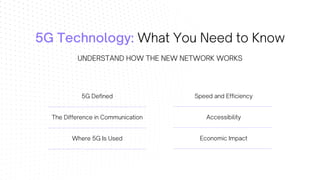
5G Technology: What You Need to Know
UNDERSTAND HOW THE NEW NETWORK WORKS
Speed and Efficiency
Accessibility
Economic Impact
5G Defined
The Difference in Communication
Where 5G Is Used
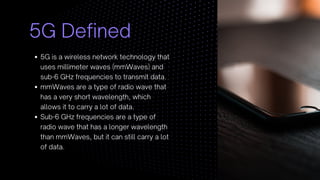
5G Defined
5G is a wireless network technology that
uses millimeter waves (mmWaves) and
sub-6 GHz frequencies to transmit data.
mmWaves are a type of radio wave that
has a very short wavelength, which
allows it to carry a lot of data.
Sub-6 GHz frequencies are a type of
radio wave that has a longer wavelength
than mmWaves, but it can still carry a lot
of data.
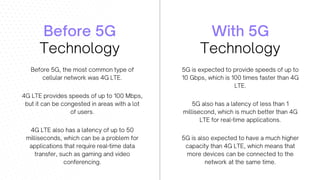
Before 5G
Technology
With 5G
Technology
4G LTE provides speeds of up to 100 Mbps,
but it can be congested in areas with a lot
of users.
Before 5G, the most common type of
cellular network was 4G LTE.
4G LTE also has a latency of up to 50
milliseconds, which can be a problem for
applications that require real-time data
transfer, such as gaming and video
conferencing.
5G also has a latency of less than 1
millisecond, which is much better than 4G
LTE for real-time applications.
5G is expected to provide speeds of up to
10 Gbps, which is 100 times faster than 4G
LTE.
5G is also expected to have a much higher
capacity than 4G LTE, which means that
more devices can be connected to the
network at the same time.
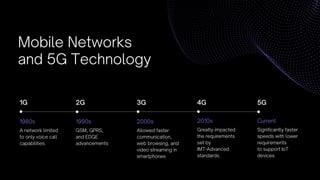
Mobile Networks
and 5G Technology
2G
GSM, GPRS,
and EDGE
advancements
1990s
1G
A network limited
to only voice call
capabilities.
1980s
3G
Allowed faster
communication,
web browsing, and
video streaming in
smartphones
2000s
4G
Greatly impacted
the requirements
set by
IMT-Advanced
standards.
2010s
5G
Significantly faster
speeds with lower
requirements
to support IoT
devices
Current
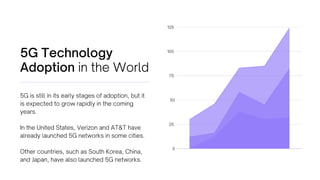
125
100
75
50
25
0
5G Technology
Adoption in the World
5G is still in its early stages of adoption, but it
is expected to grow rapidly in the coming
years.
In the United States, Verizon and AT&T have
already launched 5G networks in some cities.
Other countries, such as South Korea, China,
and Japan, have also launched 5G networks.
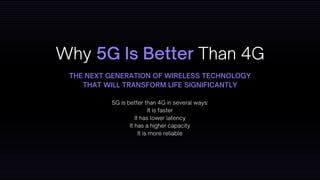
Why 5G Is Better Than 4G
THE NEXT GENERATION OF WIRELESS TECHNOLOGY
THAT WILL TRANSFORM LIFE SIGNIFICANTLY
5G is better than 4G in several ways:
It is faster
It has lower latency
It has a higher capacity
It is more reliable
The Benefits
of 5G Technology
Benefits for Businesses
5G technology can support operations to improve processes,
produce better results, and remain at the top of their game
No network issues
5G will bring a connection
speed that's significantly faster
than 4G, meaning more data
transfer in less time, promising
results without delay.
Lower latency
Lower latency will improve IoT
devices' safety and
functionality, allowing real-time
viewing and guaranteeing zero
lags in operations.
Greater data capacity
5G can support more devices
and allow simultaneous data
transfer because of its larger
spectrum band.
Elevated streaming experience
It can make it possible to stream high-definition video without
buffering
Better coverage for smartphones
No more difficulty getting connected -- 5G brings better signal to
places that were once difficult to reach. Enjoy stronger
connections and better communication with 5G.
Road safety
Self-driving cars will soon become the new norm. But motorists
can also enjoy better data processing between vehicles and
networks - that means safety on the road and improved traffic
management.
Benefits in
Daily Life
5G can benefit people in their
daily lives in several ways
Does 5G
technology really
pose health risks?
HEALTH RISKS FROM
USING 5G, DEBUNKED
There is no scientific evidence that 5G poses
any health risks.
However, some people have raised concerns
about the potential health risks of 5G, due to the
fact that it uses mmWaves.
mmWaves are a type of radio wave that has a
very high frequency, which means that they can
penetrate the human body more easily than
other types of radio waves.
However, there is no evidence that mmWaves
can cause any harm to the human body.
As exciting and appealing as 5G technology is,
there are a few cons to it: its impact on battery
life, high costs for rollout, and imbalance
in upload and download speeds.
Trends and the Future
of Telecommunications
Artificial intelligence that keeps behind-the-scenes
operations rolling faster will guarantee business
optimization like never before.
Robotic Process Automation will significantly reduce
error rates and boost customer service/operational
efficiency.
Cloud technology will allow telecoms to operate with
more efficiency as this guarantees scalability and cost-
effectiveness, allowing them to adjust better to market
demands.
The IoT or the Internet of Things is a technology that
helps ensure minimal downtime for data centers and
base stations. The telecom industry will continue to
develop its services to improve IoT technology.
In-house software development is crucial in ramping up
security and productivity. New software (with new tools
and services that shift security efforts) will prevent any
technological breach leading to systemwide failures.will
guarantee business optimization like never before.
"Any sufficiently
advanced technology is
equivalent to magic."
SAMEER SIDDIQUI

Fifth Generation Technology

  • 1.
    5th Generation Technology THE LATESTBREAKTHROUGH EXPLAINED Learn how 5G is changing the world of communication
  • 2.
    5G Technology: WhatYou Need to Know UNDERSTAND HOW THE NEW NETWORK WORKS Speed and Efficiency Accessibility Economic Impact 5G Defined The Difference in Communication Where 5G Is Used
  • 3.
    5G Defined 5G isa wireless network technology that uses millimeter waves (mmWaves) and sub-6 GHz frequencies to transmit data. mmWaves are a type of radio wave that has a very short wavelength, which allows it to carry a lot of data. Sub-6 GHz frequencies are a type of radio wave that has a longer wavelength than mmWaves, but it can still carry a lot of data.
  • 4.
    Before 5G Technology With 5G Technology 4GLTE provides speeds of up to 100 Mbps, but it can be congested in areas with a lot of users. Before 5G, the most common type of cellular network was 4G LTE. 4G LTE also has a latency of up to 50 milliseconds, which can be a problem for applications that require real-time data transfer, such as gaming and video conferencing. 5G also has a latency of less than 1 millisecond, which is much better than 4G LTE for real-time applications. 5G is expected to provide speeds of up to 10 Gbps, which is 100 times faster than 4G LTE. 5G is also expected to have a much higher capacity than 4G LTE, which means that more devices can be connected to the network at the same time.
  • 5.
    Mobile Networks and 5GTechnology 2G GSM, GPRS, and EDGE advancements 1990s 1G A network limited to only voice call capabilities. 1980s 3G Allowed faster communication, web browsing, and video streaming in smartphones 2000s 4G Greatly impacted the requirements set by IMT-Advanced standards. 2010s 5G Significantly faster speeds with lower requirements to support IoT devices Current
  • 6.
    125 100 75 50 25 0 5G Technology Adoption inthe World 5G is still in its early stages of adoption, but it is expected to grow rapidly in the coming years. In the United States, Verizon and AT&T have already launched 5G networks in some cities. Other countries, such as South Korea, China, and Japan, have also launched 5G networks.
  • 7.
    Why 5G IsBetter Than 4G THE NEXT GENERATION OF WIRELESS TECHNOLOGY THAT WILL TRANSFORM LIFE SIGNIFICANTLY 5G is better than 4G in several ways: It is faster It has lower latency It has a higher capacity It is more reliable
  • 8.
  • 9.
    Benefits for Businesses 5Gtechnology can support operations to improve processes, produce better results, and remain at the top of their game No network issues 5G will bring a connection speed that's significantly faster than 4G, meaning more data transfer in less time, promising results without delay. Lower latency Lower latency will improve IoT devices' safety and functionality, allowing real-time viewing and guaranteeing zero lags in operations. Greater data capacity 5G can support more devices and allow simultaneous data transfer because of its larger spectrum band.
  • 10.
    Elevated streaming experience Itcan make it possible to stream high-definition video without buffering Better coverage for smartphones No more difficulty getting connected -- 5G brings better signal to places that were once difficult to reach. Enjoy stronger connections and better communication with 5G. Road safety Self-driving cars will soon become the new norm. But motorists can also enjoy better data processing between vehicles and networks - that means safety on the road and improved traffic management. Benefits in Daily Life 5G can benefit people in their daily lives in several ways
  • 11.
    Does 5G technology really posehealth risks? HEALTH RISKS FROM USING 5G, DEBUNKED There is no scientific evidence that 5G poses any health risks. However, some people have raised concerns about the potential health risks of 5G, due to the fact that it uses mmWaves. mmWaves are a type of radio wave that has a very high frequency, which means that they can penetrate the human body more easily than other types of radio waves. However, there is no evidence that mmWaves can cause any harm to the human body.
  • 12.
    As exciting andappealing as 5G technology is, there are a few cons to it: its impact on battery life, high costs for rollout, and imbalance in upload and download speeds.
  • 13.
    Trends and theFuture of Telecommunications Artificial intelligence that keeps behind-the-scenes operations rolling faster will guarantee business optimization like never before. Robotic Process Automation will significantly reduce error rates and boost customer service/operational efficiency. Cloud technology will allow telecoms to operate with more efficiency as this guarantees scalability and cost- effectiveness, allowing them to adjust better to market demands. The IoT or the Internet of Things is a technology that helps ensure minimal downtime for data centers and base stations. The telecom industry will continue to develop its services to improve IoT technology. In-house software development is crucial in ramping up security and productivity. New software (with new tools and services that shift security efforts) will prevent any technological breach leading to systemwide failures.will guarantee business optimization like never before.
  • 14.
    "Any sufficiently advanced technologyis equivalent to magic." SAMEER SIDDIQUI