CENTRAL UNIVERSITY
OF RAJASTHAN
ED-501 & 502
• Presented by :-
• Devkaran Dhanwant
• Int. M.Sc B.Ed physics
• (E.no-2017IMSBPH002)
CONTENTS
1. Initiatory experience
2. School as an ‘enabling
learning’ environment
3. Classroom as learning
site
4. Design learning sequence
in the school subject
5. Classroom as learning
site
6. Sociogram
7. Community survey
8. Case study
9. Action research
10. Lesson plan
11. Unit plan
12. Remedial teaching
INTRODUCTION
School name – scl. Govt. sr.
sec. school Dhanota,
Shahpura, Jaipur
Working as a student – teacher
of physics
Joining date of institution on 2nd
Aug 2019
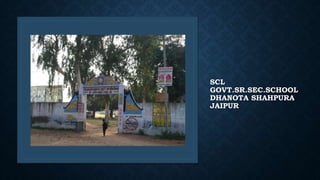
SCL
GOVT.SR.SEC.SCHOOL
DHANOTA SHAHPURA
JAIPUR
INITIATORY
EXPERIENCE
First day :2nd August 2019.
Reached school at 7:30 am during assembly.
Observed the activtites during assembly.
Meeting with the principal and subject teacher
of physics.
Class assigned for 1st day –English
substitution in class 8th .
Coordinative and supportive staff and
students
NURTURANTS
• Mid - day meal
• Green environment
• Scout facility
• Sports ground
• Good drinking water
• Large building
• Annapurna milk scheme for up to 8th class
• Practical labs
• Library
• Eco club
• Bicycle scheme for class 9th girls
• Different type Scholarship schemes
• Free NEET coaching and guide books
• Good drinking water
DETERRNTS
• Condition of washroom not good
• No white board
• Less game activity
• No boundary
• No NCC and NSS
• Improper maintenance of resources.
• Old infrastructure in damage condition
• Poor cleanliness
• Inadequate quantity of furniture for primary classes.
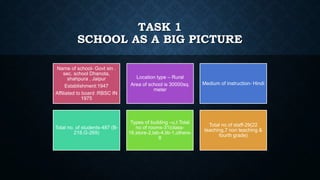
TASK 1
SCHOOL AS A BIG PICTURE
Name of school- Govt sin .
sec. school Dhanota,
shahpura , Jaipur
Establishment:1947
Affiliated to board :RBSC IN
1975
Location type – Rural
Area of school is 30000sq.
meter
Medium of instruction- Hindi
Total no. of students-487 (B-
218,G-269)
Types of building –u,t Total
no of rooms-31(class-
16,store-2,lab-4,lib-1,others-
8
Total no of staff-29(22
teaching,7 non teaching &
fourth grade)
TASK
2:SCHOOL AS
AN
ORGANIZED
ENDEVOUR
FUNCTIONING OF SCHOOL
• PRINCIPAL
• DEANS OF SUBJECTS<TEACHING STAAF
• OFFICE STAAF
• NON TEACHING STAAF
TASK 3:SCHOOL AS ENABLING LEARNING
ENVIRONMENT
Academic environment
• Clean classroom
• Hygienic food & drinking water
• Peaceful environment
• Accessible to nearby students
Physical environment
• Remedial classes
• Extra class for class 10th,11th,12th
• Scholarships
• Co-curricular activities
TASK 4: CLASSROOM AS
LEARNING SITE
 CLASSROOM ORGANIZATION
• Furniture
• Well ventilated & lighted classrooms
• Chalkboard (green board)
• Reference books & practical books
 class room management
 Routines
• Attendance
• board entries
 Rules
• Uniform checking
• Cleanliness checking
INTERRELATIONSHIP
 principal-teacher
• Cooperative and friendly relationship
 Teacher –teacher
• Healthy and friendly relationship
 Teacher –student
Teacher acts as guide and students respect their teachers
 Student –student relationship
 Cooperative and friendly
• Perception
Teacher’s perception
• Co curricular activity are important as well as syllabus completion
Student’s perception
• Peaceful & clean environment & motivating teachers
Parents perception
• Teachers are hardworking and school environment ia healthy
CLASSROOM AS LEARNING SITE
• Classroom organization and management
Proper furniture
Green board
Proper ventilation and lighting
Roll number wise duty of students to clean the chalkboard and classroom.
Not more than 2 students allowed to leave classroom
Leave application is mandatory for every student
TASK 5 DESIGN A LEARNING SEQUENCE IN
SCHOOL SUBJECT
• Subject- Physics
• Create weekly schedule of teaching
• Learning sequence for courses:
1. Class 11th
2. Class 12th
• Syllabus divided into sequential way
Curriculum> unit>lesson>topic>subtopic
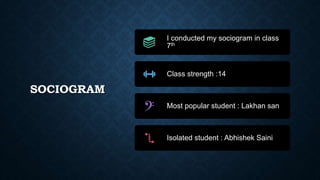
SOCIOGRAM
I conducted my sociogram in class
7th
Class strength :14
Most popular student : Lakhan san
Isolated student : Abhishek Saini
COMMUNITY SURVEY
Topic: Child tracking system
Sample: Parents of children of
age group 0-5 (56 families) of
ward 10&11 Dhanota
Objective:
•To identify the no. of students who will
enroll in school in next 5 years (according
to age and parents mental readiness)
•To identify the enrollment ratio of girl child
to boy child
•Parents perception towards govt school
COMMUNITY
SURVEY
Methodology:
Survey was conducted in 56 families.(Door to
Door survey)
Asking the question to obtain the views of
sample.
Variable: no. of child below the five year , and
the parents perception towards ,age,& govt
schools.
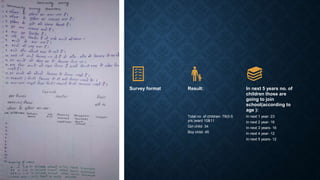
Survey format Result:
Total no. of children- 79(0-5
yrs.)ward 10&11
Girl child- 34
Boy child- 45
In next 5 years no. of
children those are
going to join
school(according to
age ):
In next 1 year- 23
In next 2 year- 16
In next 3 years- 16
In next 4 year- 12
In next 5 years- 12
RESULTS
According to parents mental readiness in
next 5 years no of children those are going
to join school:
In next 1 year -14
In next 2 year-9
In next 3 year -11
In next 4 year -4
In next 5 year-1
Gender ratio= 3/4 (0-5 yrs.) in area of ward
no 10&11 Dhanota
• Negative perception towards govt school-45
• Positive perception towards govt school-11
• No. of families that are 1-8 in private school after govt school/institute-21
• No. of families that are 1-10 in private school after govt school/institute-11
• No. of families that are 1-12 in private school after govt school/institute-7
• No. of families that no give clear response-6
CASE STUDY
Case study subject –
student Ankit Saini of
class 6th
Purpose of this case
study: To understand the
reason behind shy
nature and weak in study
Objective: To study the
results of applied
solution in solving the
problem of student
Diagnosing problem:
• Reason of weakness in studies
is poor condition of education
in previous school
• Low confidence due to
negative feedback from peers
and teachers
Intervention: 3days (03oct to o5 oct) :I take him with me in break time and play with him.
Result : he did not hesitate & easily talking to me.
3 days (07 oct to 11 oct): Counselling of peer groups
Result :now pear group help in the study of student
7 days(12oct to 21 oct):Involving him in group activities with academically bright students.
Result :he doing activity with classmates and making some new friend also
10 days(07oct to 20 Nov ):I teach him into the break time .
Result : he is able to reading easy word
3 days(21Nov to 23 Nov):Give some colour full and attractive poem and story books.
Result : he take interest in story and poems
7 days(25 Nov to 2 Dec):I will give some small home work for remembering in English alphabet
Result : For reading English latter also
3 days(03 Dec to 05 Dec):I will give some puzzle game to solve spelling problem.
Result : he is making small words and writing also
IMPROVEMENT
His confidence is increase
He is talk freely to other
He takes part in classroom activity
and co curricular activity
Now he has 3 best friend also
He is share her problem with teacher
and friend also.
ACTION RESEARCH
• action research is a method of systematic enquiry that teacher undertake as researcher
of their own practice.
• It can be performed by individual or a group.
• Action research is a cycle of inquiry and reflection.
• The cycle follows these steps :
1. Identifying the problem.
2. List alternative solutions.
3. Select one solution and implement.

4. Evaluate the effect.
5. Problem solved :
• If yes being into practice
• If no implement other solution
ACTION RESEARCH
TOPIC: HOME WORK PROBLEM OF
CLASS 12TH STUDENTS
OBJECTIVE: TO COMPARE THE DAILY
HOME WORK IN CLASSROOM OF
STUDENTS AFTER CHANGING HOME
WORK GIVING STRATEGIES
SAMPLE: CLASS 12TH
STUDENTS(TOTAL:47) OF GOVT.
SCHOOL DHANOTA
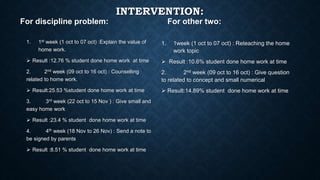
INTERVENTION:
For discipline problem:
1. 1st week (1 oct to 07 oct) :Explain the value of
home work.
 Result :12.76 % student done home work at time
2. 2nd week (09 oct to 16 oct) : Counselling
related to home work.
 Result:25.53 %student done home work at time
3. 3rd week (22 oct to 15 Nov ) : Give small and
easy home work
 Result :23.4 % student done home work at time
4. 4th week (18 Nov to 26 Nov) : Send a note to
be signed by parents
 Result :8.51 % student done home work at time
For other two:
1. 1week (1 oct to 07 oct) : Reteaching the home
work topic
 Result :10.6% student done home work at time
2. 2nd week (09 oct to 16 oct) : Give question
to related to concept and small numerical
 Result:14.89% student done home work at time
LESSON
PLANS AND
UNIT PLAN
 lesson plan of class 12th
 lesson plans of class 11th
 2 unit plan of class
 Out of 30 lesson plans , innovative lesson plans include:
• Concept attainment model
• 5- E lesson plans
• 4A lesson plan
 Redial lesson plan
• Unit plan
• Result
• Diagnostic test
• Achievement test
• Achievement report
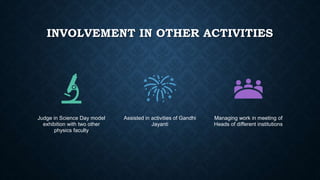
INVOLVEMENT IN OTHER ACTIVITIES
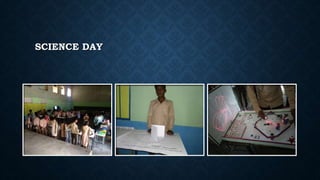
Judge in Science Day model
exhibition with two other
physics faculty
Assisted in activities of Gandhi
Jayanti
Managing work in meeting of
Heads of different institutions
TEACHING AS A SUBSTITUTE TEACHER
• Teaching as a substitute teacher of English in class 6th ,7th ,8th
• Teaching as a maths teacher in class 8th ,10th
• Teaching as a economics teacher in class 11th
SCIENCE DAY
THANK YOU

B.Ed internship final presentation

  • 1.
    CENTRAL UNIVERSITY OF RAJASTHAN ED-501& 502 • Presented by :- • Devkaran Dhanwant • Int. M.Sc B.Ed physics • (E.no-2017IMSBPH002)
  • 2.
    CONTENTS 1. Initiatory experience 2.School as an ‘enabling learning’ environment 3. Classroom as learning site 4. Design learning sequence in the school subject 5. Classroom as learning site 6. Sociogram 7. Community survey 8. Case study 9. Action research 10. Lesson plan 11. Unit plan 12. Remedial teaching
  • 3.
    INTRODUCTION School name –scl. Govt. sr. sec. school Dhanota, Shahpura, Jaipur Working as a student – teacher of physics Joining date of institution on 2nd Aug 2019
  • 4.
  • 5.
    INITIATORY EXPERIENCE First day :2ndAugust 2019. Reached school at 7:30 am during assembly. Observed the activtites during assembly. Meeting with the principal and subject teacher of physics. Class assigned for 1st day –English substitution in class 8th . Coordinative and supportive staff and students
  • 6.
    NURTURANTS • Mid -day meal • Green environment • Scout facility • Sports ground • Good drinking water • Large building • Annapurna milk scheme for up to 8th class • Practical labs • Library • Eco club • Bicycle scheme for class 9th girls • Different type Scholarship schemes • Free NEET coaching and guide books • Good drinking water
  • 7.
    DETERRNTS • Condition ofwashroom not good • No white board • Less game activity • No boundary • No NCC and NSS • Improper maintenance of resources. • Old infrastructure in damage condition • Poor cleanliness • Inadequate quantity of furniture for primary classes.
  • 8.
    TASK 1 SCHOOL ASA BIG PICTURE Name of school- Govt sin . sec. school Dhanota, shahpura , Jaipur Establishment:1947 Affiliated to board :RBSC IN 1975 Location type – Rural Area of school is 30000sq. meter Medium of instruction- Hindi Total no. of students-487 (B- 218,G-269) Types of building –u,t Total no of rooms-31(class- 16,store-2,lab-4,lib-1,others- 8 Total no of staff-29(22 teaching,7 non teaching & fourth grade)
  • 9.
    TASK 2:SCHOOL AS AN ORGANIZED ENDEVOUR FUNCTIONING OFSCHOOL • PRINCIPAL • DEANS OF SUBJECTS<TEACHING STAAF • OFFICE STAAF • NON TEACHING STAAF
  • 10.
    TASK 3:SCHOOL ASENABLING LEARNING ENVIRONMENT Academic environment • Clean classroom • Hygienic food & drinking water • Peaceful environment • Accessible to nearby students Physical environment • Remedial classes • Extra class for class 10th,11th,12th • Scholarships • Co-curricular activities
  • 11.
    TASK 4: CLASSROOMAS LEARNING SITE  CLASSROOM ORGANIZATION • Furniture • Well ventilated & lighted classrooms • Chalkboard (green board) • Reference books & practical books  class room management  Routines • Attendance • board entries  Rules • Uniform checking • Cleanliness checking
  • 12.
    INTERRELATIONSHIP  principal-teacher • Cooperativeand friendly relationship  Teacher –teacher • Healthy and friendly relationship  Teacher –student Teacher acts as guide and students respect their teachers  Student –student relationship  Cooperative and friendly
  • 13.
    • Perception Teacher’s perception •Co curricular activity are important as well as syllabus completion Student’s perception • Peaceful & clean environment & motivating teachers Parents perception • Teachers are hardworking and school environment ia healthy
  • 14.
    CLASSROOM AS LEARNINGSITE • Classroom organization and management Proper furniture Green board Proper ventilation and lighting Roll number wise duty of students to clean the chalkboard and classroom. Not more than 2 students allowed to leave classroom Leave application is mandatory for every student
  • 15.
    TASK 5 DESIGNA LEARNING SEQUENCE IN SCHOOL SUBJECT • Subject- Physics • Create weekly schedule of teaching • Learning sequence for courses: 1. Class 11th 2. Class 12th • Syllabus divided into sequential way Curriculum> unit>lesson>topic>subtopic
  • 16.
    SOCIOGRAM I conducted mysociogram in class 7th Class strength :14 Most popular student : Lakhan san Isolated student : Abhishek Saini
  • 17.
    COMMUNITY SURVEY Topic: Childtracking system Sample: Parents of children of age group 0-5 (56 families) of ward 10&11 Dhanota Objective: •To identify the no. of students who will enroll in school in next 5 years (according to age and parents mental readiness) •To identify the enrollment ratio of girl child to boy child •Parents perception towards govt school
  • 18.
    COMMUNITY SURVEY Methodology: Survey was conductedin 56 families.(Door to Door survey) Asking the question to obtain the views of sample. Variable: no. of child below the five year , and the parents perception towards ,age,& govt schools.
  • 19.
    Survey format Result: Totalno. of children- 79(0-5 yrs.)ward 10&11 Girl child- 34 Boy child- 45 In next 5 years no. of children those are going to join school(according to age ): In next 1 year- 23 In next 2 year- 16 In next 3 years- 16 In next 4 year- 12 In next 5 years- 12
  • 20.
    RESULTS According to parentsmental readiness in next 5 years no of children those are going to join school: In next 1 year -14 In next 2 year-9 In next 3 year -11 In next 4 year -4 In next 5 year-1 Gender ratio= 3/4 (0-5 yrs.) in area of ward no 10&11 Dhanota
  • 21.
    • Negative perceptiontowards govt school-45 • Positive perception towards govt school-11 • No. of families that are 1-8 in private school after govt school/institute-21 • No. of families that are 1-10 in private school after govt school/institute-11 • No. of families that are 1-12 in private school after govt school/institute-7 • No. of families that no give clear response-6
  • 22.
    CASE STUDY Case studysubject – student Ankit Saini of class 6th Purpose of this case study: To understand the reason behind shy nature and weak in study Objective: To study the results of applied solution in solving the problem of student Diagnosing problem: • Reason of weakness in studies is poor condition of education in previous school • Low confidence due to negative feedback from peers and teachers
  • 23.
    Intervention: 3days (03octto o5 oct) :I take him with me in break time and play with him. Result : he did not hesitate & easily talking to me. 3 days (07 oct to 11 oct): Counselling of peer groups Result :now pear group help in the study of student 7 days(12oct to 21 oct):Involving him in group activities with academically bright students. Result :he doing activity with classmates and making some new friend also 10 days(07oct to 20 Nov ):I teach him into the break time . Result : he is able to reading easy word 3 days(21Nov to 23 Nov):Give some colour full and attractive poem and story books. Result : he take interest in story and poems 7 days(25 Nov to 2 Dec):I will give some small home work for remembering in English alphabet Result : For reading English latter also 3 days(03 Dec to 05 Dec):I will give some puzzle game to solve spelling problem. Result : he is making small words and writing also
  • 24.
    IMPROVEMENT His confidence isincrease He is talk freely to other He takes part in classroom activity and co curricular activity Now he has 3 best friend also He is share her problem with teacher and friend also.
  • 25.
    ACTION RESEARCH • actionresearch is a method of systematic enquiry that teacher undertake as researcher of their own practice. • It can be performed by individual or a group.
  • 26.
    • Action researchis a cycle of inquiry and reflection. • The cycle follows these steps : 1. Identifying the problem. 2. List alternative solutions. 3. Select one solution and implement. 4. Evaluate the effect. 5. Problem solved : • If yes being into practice • If no implement other solution
  • 27.
    ACTION RESEARCH TOPIC: HOMEWORK PROBLEM OF CLASS 12TH STUDENTS OBJECTIVE: TO COMPARE THE DAILY HOME WORK IN CLASSROOM OF STUDENTS AFTER CHANGING HOME WORK GIVING STRATEGIES SAMPLE: CLASS 12TH STUDENTS(TOTAL:47) OF GOVT. SCHOOL DHANOTA
  • 28.
    INTERVENTION: For discipline problem: 1.1st week (1 oct to 07 oct) :Explain the value of home work.  Result :12.76 % student done home work at time 2. 2nd week (09 oct to 16 oct) : Counselling related to home work.  Result:25.53 %student done home work at time 3. 3rd week (22 oct to 15 Nov ) : Give small and easy home work  Result :23.4 % student done home work at time 4. 4th week (18 Nov to 26 Nov) : Send a note to be signed by parents  Result :8.51 % student done home work at time For other two: 1. 1week (1 oct to 07 oct) : Reteaching the home work topic  Result :10.6% student done home work at time 2. 2nd week (09 oct to 16 oct) : Give question to related to concept and small numerical  Result:14.89% student done home work at time
  • 29.
    LESSON PLANS AND UNIT PLAN lesson plan of class 12th  lesson plans of class 11th  2 unit plan of class  Out of 30 lesson plans , innovative lesson plans include: • Concept attainment model • 5- E lesson plans • 4A lesson plan  Redial lesson plan • Unit plan • Result • Diagnostic test • Achievement test • Achievement report
  • 30.
    INVOLVEMENT IN OTHERACTIVITIES Judge in Science Day model exhibition with two other physics faculty Assisted in activities of Gandhi Jayanti Managing work in meeting of Heads of different institutions
  • 31.
    TEACHING AS ASUBSTITUTE TEACHER • Teaching as a substitute teacher of English in class 6th ,7th ,8th • Teaching as a maths teacher in class 8th ,10th • Teaching as a economics teacher in class 11th
  • 32.
  • 33.