Expectation Setting Overview (Day-1)
BCS302-Digital Design and Computer
Organization
Semester : III Semester (A &B Section)
Course Instructor: Ciyamala Kushbu S
Assistant Professor
ISE Dept.
Agenda
Day-01
 Introduction
 Student perspective
 Introduction to subject
 Why subject is important
 Real World Applications
 Course Objectives
 Pre-requisites
 Course Outcomes
 CO-PO mapping
 Quiz
2
Day-02
 Textbooks and Reference books
 Lesson Plan
 Assessment Plan
 Expected classroom behavior
 Some useful links
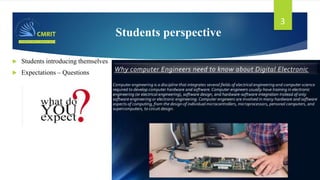
Students perspective
 Students introducing themselves
 Expectations – Questions
3
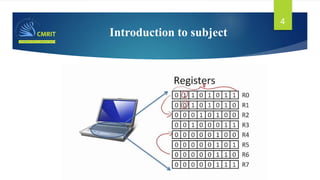
Introduction to subject
4
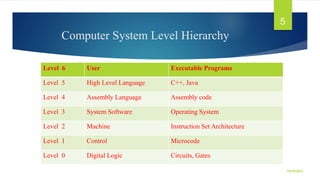
Computer System Level Hierarchy
10/19/2023
5
Level 6 User Executable Programs
Level 5 High Level Language C++, Java
Level 4 Assembly Language Assembly code
Level 3 System Software Operating System
Level 2 Machine Instruction Set Architecture
Level 1 Control Microcode
Level 0 Digital Logic Circuits, Gates
10/19/2023
6
10/19/2023
7
10/19/2023
8
10/19/2023
9
10/19/2023
10
10/19/2023
11
10/19/2023
12
10/19/2023
13
10/19/2023
14
10/19/2023
15
10/19/2023
16
10/19/2023
17
10/19/2023
18
10/19/2023
19
10/19/2023
20
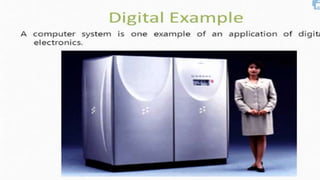
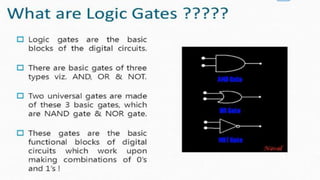
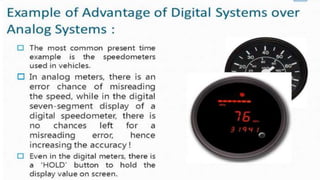
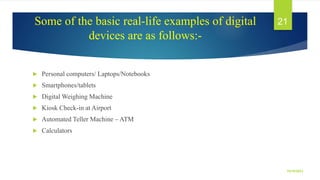
Some of the basic real-life examples of digital
devices are as follows:-
 Personal computers/ Laptops/Notebooks
 Smartphones/tablets
 Digital Weighing Machine
 Kiosk Check-in at Airport
 Automated Teller Machine – ATM
 Calculators
10/19/2023
21
Why Python programming is important?
22
10/19/2023
23
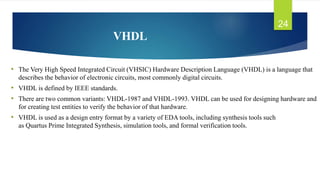
VHDL
24
• The Very High Speed Integrated Circuit (VHSIC) Hardware Description Language (VHDL) is a language that
describes the behavior of electronic circuits, most commonly digital circuits.
• VHDL is defined by IEEE standards.
• There are two common variants: VHDL-1987 and VHDL-1993. VHDL can be used for designing hardware and
for creating test entities to verify the behavior of that hardware.
• VHDL is used as a design entry format by a variety of EDA tools, including synthesis tools such
as Quartus Prime Integrated Synthesis, simulation tools, and formal verification tools.
10/19/2023
25
Scope-Higher Studies Perspective
 Masters in India/Abroad
 Online Degree programs
 Digital Electronics - Complete Course | Udemy
 Free Course: Digital Electronics from Neso Academy
 MOOC courses
 Digital Electronic Circuits-https://onlinecourses.nptel.ac.in/noc22_ee55/preview
 Computer Organization-https://archive.nptel.ac.in/courses/106/106/106106092/
10/19/2023
26
What does a Digital Design Engineer do?
 Digital design engineers create, develop, and improve digital systems and tools, taking a lead role in overseeing
the entire process from concept to implementation.
 They configure and evaluate system architecture, and use modeling and testing to assess and refine designs.
 They take an active role in leading validation and verification processes and developing testing programs.
 They regularly use coding and programming languages, and customize designs for real-world use settings.
 Digital design engineers typically have at least a bachelor’s degree in engineering, although some employers
require a master’s degree or other advanced training.
 Must be comfortable working with digital design architecture and related tools and technologies.
 Requires proficiency with standard programming and coding languages, and hands-on experience with modeling
tools, along with excellent analytical and problem-solving skills.
10/19/2023
27
What responsibilities are common for
Digital Design Engineer jobs?
 Provide assignments, direction and manage priorities for team members.
 Partner with graphics researchers and silicon designers on IP development and implementation.
 Perform architectural, design, and RTL reviews that improve and enable more efficient and effective research.
 Contribute to project scope and schedule goal-setting and consistently meet and exceed those goals.
 Design for maintainability, manufacturability, ease of use, and overall quality.
 Provide technical leadership towards the goals of research IP simulation and test chip development, and people
management and support for your team.
 Drive development progress through task identification, scheduling, and monitoring.
 Responsible for defining and optimizing overall system level block diagrams, communication pathways, and
measurement performance.
 Work with software/firmware manager and program manager to perform assigned development tasks.
 Assume technical leadership responsibilities for small- to medium-size projects.
10/19/2023
28
What are the typical qualifications for
Digital Design Engineer jobs?
 Bachelor's or Graduate's Degree in computer engineering, computer science,
electrical engineering or science Degree.
 Experience with FPGA, ASIC Design, SOV, C, Python, FPGA Design, FPGA
VHDL, C# and PERL software and systems.
 Comfortable interfacing, scripting, and debugging.
 Experience with firmware and algorithmic design.

 An eye for task and project closure.

10/19/2023
29
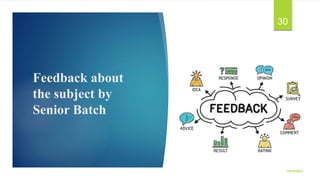
Feedback about
the subject by
Senior Batch
10/19/2023
30
Course Objectives
31
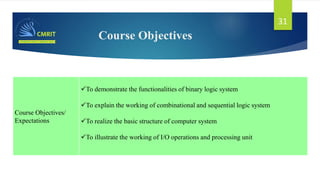
Course Objectives/
Expectations
To demonstrate the functionalities of binary logic system
To explain the working of combinational and sequential logic system
To realize the basic structure of computer system
To illustrate the working of I/O operations and processing unit
Course Outcomes
32
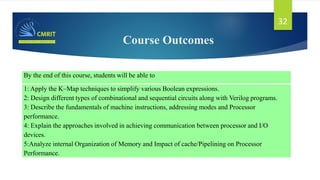
By the end of this course, students will be able to
1: Apply the K–Map techniques to simplify various Boolean expressions.
2: Design different types of combinational and sequential circuits along with Verilog programs.
3: Describe the fundamentals of machine instructions, addressing modes and Processor
performance.
4: Explain the approaches involved in achieving communication between processor and I/O
devices.
5:Analyze internal Organization of Memory and Impact of cache/Pipelining on Processor
Performance.
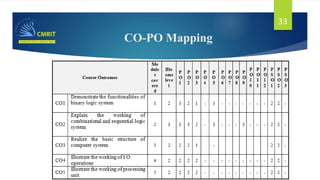
CO-PO Mapping
33
Text books and Reference Books
34
Suggested Learning Resources:
Books
1. M. Morris Mano & Michael D. Ciletti, Digital Design With an Introduction to Verilog Design, 5e,
Pearson Education.
2. Carl Hamacher, ZvonkoVranesic, SafwatZaky, Computer Organization, 5th Edition, Tata McGraw Hill.
Web links and Video Lectures (e-Resources):
https://cse11-iiith.vlabs.ac.in/
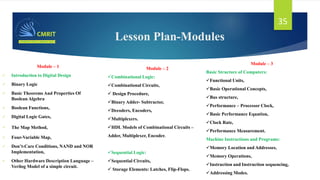
Lesson Plan-Modules
Module – 1
 Introduction to Digital Design
 Binary Logic
 Basic Theorems And Properties Of
Boolean Algebra
 Boolean Functions,
 Digital Logic Gates,
 The Map Method,
 Four-Variable Map,
 Don’t-Care Conditions, NAND and NOR
Implementation,
 Other Hardware Description Language –
Verilog Model of a simple circuit.
35
Module – 2
Combinational Logic:
Combinational Circuits,
 Design Procedure,
Binary Adder- Subtractor,
Decoders, Encoders,
Multiplexers.
HDL Models of Combinational Circuits –
Adder, Multiplexer, Encoder.
Sequential Logic:
Sequential Circuits,
 Storage Elements: Latches, Flip-Flops.
Module – 3
Basic Structure of Computers:
Functional Units,
Basic Operational Concepts,
Bus structure,
Performance – Processor Clock,
Basic Performance Equation,
Clock Rate,
Performance Measurement.
Machine Instructions and Programs:
Memory Location and Addresses,
Memory Operations,
Instruction and Instruction sequencing,
Addressing Modes.
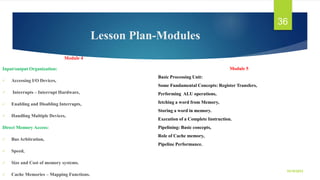
Lesson Plan-Modules
10/19/2023
36
Module 4
Input/output Organization:
 Accessing I/O Devices,
 Interrupts – Interrupt Hardware,
 Enabling and Disabling Interrupts,
 Handling Multiple Devices,
Direct Memory Access:
 Bus Arbitration,
 Speed,
 Size and Cost of memory systems.
 Cache Memories – Mapping Functions.
Module 5
Basic Processing Unit:
Some Fundamental Concepts: Register Transfers,
Performing ALU operations,
fetching a word from Memory,
Storing a word in memory.
Execution of a Complete Instruction.
Pipelining: Basic concepts,
Role of Cache memory,
Pipeline Performance.
Assessment plan 37
CIE-50 marks (20 out of 50 )
SEE-50 marks (18 out of 50)
Total-100 marks( 40 out of 100)
CIE-Continuous Internal Evaluation
20 (IAT)+20 (Practical IAT)+10 (Assignment)
Each IAT is for 50 marks whose average will be scaled down to 20 marks
Each Practical Exam is for 50 marks whose average will be scaled down to 20 marks
Minimum 2 Assignments will be given with 10 marks each whose average will be scaled down to 10 marks
SEE-Semester End Exam
1. The question paper will have ten questions. Each question is set for 20 marks.
2. There will be 2 questions from each module. Each of the two questions under a module (with a maximum of 3
sub-questions), should have a mix of topics under that module.
3. The students have to answer 5 full questions, selecting one full question from each module.
4. Marks scored by the student shall be proportionally scaled down to 50 Marks.
Expected Classroom Behaviour
 Active, Hands on based Interactive Learning
 Quizzes
 Attendance: 85%
 Hand written assignments (no plagiarism etc),
 Sticking to deadlines for submissions
 No disruption
 Strict action against Abusers
38
Some Useful Links
 https://archive.nptel.ac.in/courses/108/105/108105113/
 https://nptel.ac.in/courses/106/103/106103068/
 https://nptel.ac.in/content/storage2/courses/106103068/pdf/coa.pdf
 https://nptel.ac.in/courses/106/105/106105163/
 https://nptel.ac.in/courses/106/106/106106092/
 https://nptel.ac.in/courses/106/106/106106166/
 http://www.nptelvideos.in/2012/11/computer-organization.html
39
10/19/2023
40
41

BCS302- Digital Design and computer organization -VTU-2022 scheme-Expectation setting ppt

  • 1.
    Expectation Setting Overview(Day-1) BCS302-Digital Design and Computer Organization Semester : III Semester (A &B Section) Course Instructor: Ciyamala Kushbu S Assistant Professor ISE Dept.
  • 2.
    Agenda Day-01  Introduction  Studentperspective  Introduction to subject  Why subject is important  Real World Applications  Course Objectives  Pre-requisites  Course Outcomes  CO-PO mapping  Quiz 2 Day-02  Textbooks and Reference books  Lesson Plan  Assessment Plan  Expected classroom behavior  Some useful links
  • 3.
    Students perspective  Studentsintroducing themselves  Expectations – Questions 3
  • 4.
  • 5.
    Computer System LevelHierarchy 10/19/2023 5 Level 6 User Executable Programs Level 5 High Level Language C++, Java Level 4 Assembly Language Assembly code Level 3 System Software Operating System Level 2 Machine Instruction Set Architecture Level 1 Control Microcode Level 0 Digital Logic Circuits, Gates
  • 6.
  • 7.
  • 8.
  • 9.
  • 10.
  • 11.
  • 12.
  • 13.
  • 14.
  • 15.
  • 16.
  • 17.
  • 18.
  • 19.
  • 20.
  • 21.
    Some of thebasic real-life examples of digital devices are as follows:-  Personal computers/ Laptops/Notebooks  Smartphones/tablets  Digital Weighing Machine  Kiosk Check-in at Airport  Automated Teller Machine – ATM  Calculators 10/19/2023 21
  • 22.
    Why Python programmingis important? 22
  • 23.
  • 24.
    VHDL 24 • The VeryHigh Speed Integrated Circuit (VHSIC) Hardware Description Language (VHDL) is a language that describes the behavior of electronic circuits, most commonly digital circuits. • VHDL is defined by IEEE standards. • There are two common variants: VHDL-1987 and VHDL-1993. VHDL can be used for designing hardware and for creating test entities to verify the behavior of that hardware. • VHDL is used as a design entry format by a variety of EDA tools, including synthesis tools such as Quartus Prime Integrated Synthesis, simulation tools, and formal verification tools.
  • 25.
  • 26.
    Scope-Higher Studies Perspective Masters in India/Abroad  Online Degree programs  Digital Electronics - Complete Course | Udemy  Free Course: Digital Electronics from Neso Academy  MOOC courses  Digital Electronic Circuits-https://onlinecourses.nptel.ac.in/noc22_ee55/preview  Computer Organization-https://archive.nptel.ac.in/courses/106/106/106106092/ 10/19/2023 26
  • 27.
    What does aDigital Design Engineer do?  Digital design engineers create, develop, and improve digital systems and tools, taking a lead role in overseeing the entire process from concept to implementation.  They configure and evaluate system architecture, and use modeling and testing to assess and refine designs.  They take an active role in leading validation and verification processes and developing testing programs.  They regularly use coding and programming languages, and customize designs for real-world use settings.  Digital design engineers typically have at least a bachelor’s degree in engineering, although some employers require a master’s degree or other advanced training.  Must be comfortable working with digital design architecture and related tools and technologies.  Requires proficiency with standard programming and coding languages, and hands-on experience with modeling tools, along with excellent analytical and problem-solving skills. 10/19/2023 27
  • 28.
    What responsibilities arecommon for Digital Design Engineer jobs?  Provide assignments, direction and manage priorities for team members.  Partner with graphics researchers and silicon designers on IP development and implementation.  Perform architectural, design, and RTL reviews that improve and enable more efficient and effective research.  Contribute to project scope and schedule goal-setting and consistently meet and exceed those goals.  Design for maintainability, manufacturability, ease of use, and overall quality.  Provide technical leadership towards the goals of research IP simulation and test chip development, and people management and support for your team.  Drive development progress through task identification, scheduling, and monitoring.  Responsible for defining and optimizing overall system level block diagrams, communication pathways, and measurement performance.  Work with software/firmware manager and program manager to perform assigned development tasks.  Assume technical leadership responsibilities for small- to medium-size projects. 10/19/2023 28
  • 29.
    What are thetypical qualifications for Digital Design Engineer jobs?  Bachelor's or Graduate's Degree in computer engineering, computer science, electrical engineering or science Degree.  Experience with FPGA, ASIC Design, SOV, C, Python, FPGA Design, FPGA VHDL, C# and PERL software and systems.  Comfortable interfacing, scripting, and debugging.  Experience with firmware and algorithmic design.  An eye for task and project closure. 10/19/2023 29
  • 30.
    Feedback about the subjectby Senior Batch 10/19/2023 30
  • 31.
    Course Objectives 31 Course Objectives/ Expectations Todemonstrate the functionalities of binary logic system To explain the working of combinational and sequential logic system To realize the basic structure of computer system To illustrate the working of I/O operations and processing unit
  • 32.
    Course Outcomes 32 By theend of this course, students will be able to 1: Apply the K–Map techniques to simplify various Boolean expressions. 2: Design different types of combinational and sequential circuits along with Verilog programs. 3: Describe the fundamentals of machine instructions, addressing modes and Processor performance. 4: Explain the approaches involved in achieving communication between processor and I/O devices. 5:Analyze internal Organization of Memory and Impact of cache/Pipelining on Processor Performance.
  • 33.
  • 34.
    Text books andReference Books 34 Suggested Learning Resources: Books 1. M. Morris Mano & Michael D. Ciletti, Digital Design With an Introduction to Verilog Design, 5e, Pearson Education. 2. Carl Hamacher, ZvonkoVranesic, SafwatZaky, Computer Organization, 5th Edition, Tata McGraw Hill. Web links and Video Lectures (e-Resources): https://cse11-iiith.vlabs.ac.in/
  • 35.
    Lesson Plan-Modules Module –1  Introduction to Digital Design  Binary Logic  Basic Theorems And Properties Of Boolean Algebra  Boolean Functions,  Digital Logic Gates,  The Map Method,  Four-Variable Map,  Don’t-Care Conditions, NAND and NOR Implementation,  Other Hardware Description Language – Verilog Model of a simple circuit. 35 Module – 2 Combinational Logic: Combinational Circuits,  Design Procedure, Binary Adder- Subtractor, Decoders, Encoders, Multiplexers. HDL Models of Combinational Circuits – Adder, Multiplexer, Encoder. Sequential Logic: Sequential Circuits,  Storage Elements: Latches, Flip-Flops. Module – 3 Basic Structure of Computers: Functional Units, Basic Operational Concepts, Bus structure, Performance – Processor Clock, Basic Performance Equation, Clock Rate, Performance Measurement. Machine Instructions and Programs: Memory Location and Addresses, Memory Operations, Instruction and Instruction sequencing, Addressing Modes.
  • 36.
    Lesson Plan-Modules 10/19/2023 36 Module 4 Input/outputOrganization:  Accessing I/O Devices,  Interrupts – Interrupt Hardware,  Enabling and Disabling Interrupts,  Handling Multiple Devices, Direct Memory Access:  Bus Arbitration,  Speed,  Size and Cost of memory systems.  Cache Memories – Mapping Functions. Module 5 Basic Processing Unit: Some Fundamental Concepts: Register Transfers, Performing ALU operations, fetching a word from Memory, Storing a word in memory. Execution of a Complete Instruction. Pipelining: Basic concepts, Role of Cache memory, Pipeline Performance.
  • 37.
    Assessment plan 37 CIE-50marks (20 out of 50 ) SEE-50 marks (18 out of 50) Total-100 marks( 40 out of 100) CIE-Continuous Internal Evaluation 20 (IAT)+20 (Practical IAT)+10 (Assignment) Each IAT is for 50 marks whose average will be scaled down to 20 marks Each Practical Exam is for 50 marks whose average will be scaled down to 20 marks Minimum 2 Assignments will be given with 10 marks each whose average will be scaled down to 10 marks SEE-Semester End Exam 1. The question paper will have ten questions. Each question is set for 20 marks. 2. There will be 2 questions from each module. Each of the two questions under a module (with a maximum of 3 sub-questions), should have a mix of topics under that module. 3. The students have to answer 5 full questions, selecting one full question from each module. 4. Marks scored by the student shall be proportionally scaled down to 50 Marks.
  • 38.
    Expected Classroom Behaviour Active, Hands on based Interactive Learning  Quizzes  Attendance: 85%  Hand written assignments (no plagiarism etc),  Sticking to deadlines for submissions  No disruption  Strict action against Abusers 38
  • 39.
    Some Useful Links https://archive.nptel.ac.in/courses/108/105/108105113/  https://nptel.ac.in/courses/106/103/106103068/  https://nptel.ac.in/content/storage2/courses/106103068/pdf/coa.pdf  https://nptel.ac.in/courses/106/105/106105163/  https://nptel.ac.in/courses/106/106/106106092/  https://nptel.ac.in/courses/106/106/106106166/  http://www.nptelvideos.in/2012/11/computer-organization.html 39
  • 40.
  • 41.