Risk Management Strategy and Performance MetricsNAPEO Risk Management ConferenceTampa, Florida
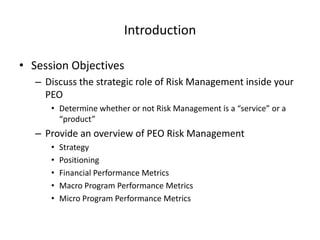
IntroductionSession ObjectivesDiscuss the strategic role of Risk Management inside your PEODetermine whether or not Risk Management is a “service” or a “product”Provide an overview of PEO Risk ManagementStrategyPositioningFinancial Performance MetricsMacro Program Performance MetricsMicro Program Performance Metrics
We Sold Our AIG Stock and Bought A Coastal View Retirement Home
You Might be a Redneck if…(Jeff Foxworthy)Your richest relative buys a new house and you have to help take the wheels off of itYour lifetime goal is to own your own fireworks standYour dog and your wallet are both on a chainYou have more than two brothers named Bubba or Junior
You Might be a PEO Risk Manager If…(The Voice of Experience)Your idea of being entertained is  collateral return discussions with your broker and carrierYou have a different insurance carrier in each region of the countryYou are single handedly the underwriting, risk  control, claims, and policy administration functionsYour picture is on a dartboard in the sales VP’s office
Strategy/Positioning(A Vital PEO Function?)Why is Risk Management important to PEO clients?98% of businesses in America today have < 100 wses87% of businesses in America today have < 20 wses50% of all workplace fatalities occur in businesses with < 100 wses33% of all workplace fatalities occur in businesses with < 20 wses  (statistics based on NIOSH White Paper)PEOs are uniquely positioned to provide critical risk control and claims management services to their clients
Strategy/Positioning(A Vital PEO Function?)Effects of the EconomyHuman Resources Risk due to layoff, termination, etc…Use of the workers compensation system in lieu of health benefits (especially if benefits are not offered)Use of the workers compensation system to replace unemployment benefitsPEOs can add value beyond traditional risk management assistance
Strategy/Positioning(Barriers)Issue:  Geographic client spread/average client size Question:  Where are my clients?Issue:  Effective, scalable service platform to effectively reach clients  Question:  What value proposition can I offer?Issue:  Budget constraints/limited internal resources and staffQuestion:  What’s the right service model and staffing level for my client base and operating budget
Strategy/Positioning (Barriers)Issue:  Insurance carrier platform Questions:  	What’s the carrier’s financial strength (rating)?   What support can the carrier provide?   What is the carrier’s admitted geography?   What is the carrier’s underwriting appetite?  Whatauthority does my PEO have?
Strategy/PositioningWhat’s troubling CEOs? Sustained and steady top line growth (is Risk Management adding to or detracting from this effort?)Speed, flexibility, and adaptability to change Customer loyalty /retention  (2004 Conference Board Survey—539 respondents)
Strategy/PositioningDo you want risk management to be a sustainable competitive advantage or a contestable competitive advantage?Program ComponentsCarrier Quality and Plan DesignValue PropositionPEO Risk Management Operating PlatformClient experienceIn either case, competitive advantages erode over time and must stay freshWhat will you excel at?  What won’t you do?
The “Myth of Excellence”(by Fred Crawford and Ryan Matthews)Five Customer Touches—Price, Service, Access, Product, and Customer ExperienceNo company (even excellent companies) can perform at a level of excellence in all five areas at onceDominate in one area, differentiate in one area, and meet the industry par in the remaining three areas
How Will You Achieve “Excellence”?Carrier Reputation/RelationshipExcellent Service—Claims and Risk ControlEase of Doing Business—Underwriting ApprovalCoverage Design— National PlatformClient Experience and Stewardship
MR2P(Managing Risk to Profitability)Early PEOs—depended on workers compensation arbitrage in their pricing modelsToday’s profitable PEOsRecognize the importance of high quality, long-term carrier relationshipsStrive to implement “best in class” risk management practicesManage workers compensation as a “product” with a profit/loss mindset
 $how Me the Money(If I’ve Got To Do This)
Financial Performance MeasuresTotal Cost of Risk (TCOR)Loss RatioExpense RatioRisk Management Income Statement
Total Cost of RiskLosses due to Accidents (fully developed)Program Costs (reinsurance, claims handling expenses, carrier loss control, taxes, etc…)Agent/Broker Fee or CommissionInternal Staff expense (administration, claims management, risk control, etc…)
Financial Performance RatiosLoss Ratio = losses/premium(what’s acceptable?)Expense Ratio = expenses/premium Combined Ratio = losses + expenses/premium	These are common ratios used by carriers in evaluating their performance—why should you think differently?
Risk Management Income StatementRevenuesPremiumConsulting Fees (if any)Total RevenuesExpensesLossesProgram CostsAgent/Broker FeesInternal ExpensesTotal ExpensesProfit/Loss
Challenges in Current EnvironmentIssue:  Premium reductions in certain states are resulting in   	substantially less program revenue 	Results:  1.  Higher loss ratios  2.  Higher expense ratios—staffing costs remain constant or increase   3.  Less pricing flexibility   4.  Compressed margins
Mental Health Break
Macro Performance MeasuresTable of TruthNew Claims FrequencyNew Claims Reporting Lag TimeClaims Closing RateLoss RatioExposure Base
New Claims FrequencyNumber of New Claims per period X 200,000/# of hours  workedWhat it tells you:  a.  Is the number of claims per 100 full time employees             increasing or decreasing over time?       b.  Where does my program stand with respect to BLS               benchmarks?Response:Focus on accident prevention/risk control           programming and service delivery
New Claims Reporting Lag TimeMeasure the percentage of claims reported within 24 hours of the injury to the carrierWhat it tells you:a.  The effectiveness of your medical care delivery systemb.  How seriously your client (s) are viewing their safety andworkers compensation responsibilitiesResponse:  Focus on pre-injury management program to includeprovider network, injury reporting requirements, and accident investigation
Claims Closing RatePercentage of Claims Closed by Policy PeriodWhat it tells you:a.  The attention your claims handler (carrier or TPA) is paying to claims generated by your clientsResponses:a.  Periodic audits to determine claims handling effective-ness, reserving practices, and closing strategiesb.  Determine performance criteria and issue a monthly                numerical scorecard to each claims handling office with                a copy to the carrier’s claims liaison
Loss RatioLosses for a period divided by premium for the same periodWhat it tells you:Whether or not your book is performing in a profitablemannerResponses:a.  This is the “bottom line” performance measure.  Revisiteach of the items previously listed for effectiveness         b.  Reevaluate your risk selection process         c.  Evaluate individual client performance (next section)
Micro Performance MeasuresIndividual client performanceClient “watch list”Client compliance with risk control practicesField risk control activities to control and grow the book of business
Why Bother—What’s in it for Me?Goldman Sachs/JBWere Study (October 2007)“Research shows that over the period November 2004 to October 2007 companies who did not adequately manage workplace health and safety issues underperformed those who did…“investors could have increased returns over the past four years had they incorporated WHS measure into their investment strategies (+38%)…“This approach is also appealing because “blow ups” caused by something such as poor WHA or governance may pose unacceptable risks due to the reputational risks being often disproportionately large for issues of this nature.”Hint:  Think PEO Valuation
“A mind once stretched to a new idea can never return to its former shape”				--Oliver Wendell Holmes
So…What’s your strategy?Risk Management – a “service”, a “product”, or a “necessary evil”?
“A Parting Shot”

Risk Management Presentation Powerpoint 2008

  • 1.
    Risk Management Strategyand Performance MetricsNAPEO Risk Management ConferenceTampa, Florida
  • 2.
    IntroductionSession ObjectivesDiscuss thestrategic role of Risk Management inside your PEODetermine whether or not Risk Management is a “service” or a “product”Provide an overview of PEO Risk ManagementStrategyPositioningFinancial Performance MetricsMacro Program Performance MetricsMicro Program Performance Metrics
  • 3.
    We Sold OurAIG Stock and Bought A Coastal View Retirement Home
  • 4.
    You Might bea Redneck if…(Jeff Foxworthy)Your richest relative buys a new house and you have to help take the wheels off of itYour lifetime goal is to own your own fireworks standYour dog and your wallet are both on a chainYou have more than two brothers named Bubba or Junior
  • 5.
    You Might bea PEO Risk Manager If…(The Voice of Experience)Your idea of being entertained is collateral return discussions with your broker and carrierYou have a different insurance carrier in each region of the countryYou are single handedly the underwriting, risk control, claims, and policy administration functionsYour picture is on a dartboard in the sales VP’s office
  • 6.
    Strategy/Positioning(A Vital PEOFunction?)Why is Risk Management important to PEO clients?98% of businesses in America today have < 100 wses87% of businesses in America today have < 20 wses50% of all workplace fatalities occur in businesses with < 100 wses33% of all workplace fatalities occur in businesses with < 20 wses (statistics based on NIOSH White Paper)PEOs are uniquely positioned to provide critical risk control and claims management services to their clients
  • 7.
    Strategy/Positioning(A Vital PEOFunction?)Effects of the EconomyHuman Resources Risk due to layoff, termination, etc…Use of the workers compensation system in lieu of health benefits (especially if benefits are not offered)Use of the workers compensation system to replace unemployment benefitsPEOs can add value beyond traditional risk management assistance
  • 8.
    Strategy/Positioning(Barriers)Issue: Geographicclient spread/average client size Question: Where are my clients?Issue: Effective, scalable service platform to effectively reach clients Question: What value proposition can I offer?Issue: Budget constraints/limited internal resources and staffQuestion: What’s the right service model and staffing level for my client base and operating budget
  • 9.
    Strategy/Positioning (Barriers)Issue: Insurance carrier platform Questions: What’s the carrier’s financial strength (rating)? What support can the carrier provide? What is the carrier’s admitted geography? What is the carrier’s underwriting appetite? Whatauthority does my PEO have?
  • 10.
    Strategy/PositioningWhat’s troubling CEOs?Sustained and steady top line growth (is Risk Management adding to or detracting from this effort?)Speed, flexibility, and adaptability to change Customer loyalty /retention (2004 Conference Board Survey—539 respondents)
  • 11.
    Strategy/PositioningDo you wantrisk management to be a sustainable competitive advantage or a contestable competitive advantage?Program ComponentsCarrier Quality and Plan DesignValue PropositionPEO Risk Management Operating PlatformClient experienceIn either case, competitive advantages erode over time and must stay freshWhat will you excel at? What won’t you do?
  • 12.
    The “Myth ofExcellence”(by Fred Crawford and Ryan Matthews)Five Customer Touches—Price, Service, Access, Product, and Customer ExperienceNo company (even excellent companies) can perform at a level of excellence in all five areas at onceDominate in one area, differentiate in one area, and meet the industry par in the remaining three areas
  • 13.
    How Will YouAchieve “Excellence”?Carrier Reputation/RelationshipExcellent Service—Claims and Risk ControlEase of Doing Business—Underwriting ApprovalCoverage Design— National PlatformClient Experience and Stewardship
  • 14.
    MR2P(Managing Risk toProfitability)Early PEOs—depended on workers compensation arbitrage in their pricing modelsToday’s profitable PEOsRecognize the importance of high quality, long-term carrier relationshipsStrive to implement “best in class” risk management practicesManage workers compensation as a “product” with a profit/loss mindset
  • 15.
    $how Methe Money(If I’ve Got To Do This)
  • 16.
    Financial Performance MeasuresTotalCost of Risk (TCOR)Loss RatioExpense RatioRisk Management Income Statement
  • 17.
    Total Cost ofRiskLosses due to Accidents (fully developed)Program Costs (reinsurance, claims handling expenses, carrier loss control, taxes, etc…)Agent/Broker Fee or CommissionInternal Staff expense (administration, claims management, risk control, etc…)
  • 18.
    Financial Performance RatiosLossRatio = losses/premium(what’s acceptable?)Expense Ratio = expenses/premium Combined Ratio = losses + expenses/premium These are common ratios used by carriers in evaluating their performance—why should you think differently?
  • 19.
    Risk Management IncomeStatementRevenuesPremiumConsulting Fees (if any)Total RevenuesExpensesLossesProgram CostsAgent/Broker FeesInternal ExpensesTotal ExpensesProfit/Loss
  • 20.
    Challenges in CurrentEnvironmentIssue: Premium reductions in certain states are resulting in substantially less program revenue Results: 1. Higher loss ratios 2. Higher expense ratios—staffing costs remain constant or increase 3. Less pricing flexibility 4. Compressed margins
  • 21.
  • 22.
    Macro Performance MeasuresTableof TruthNew Claims FrequencyNew Claims Reporting Lag TimeClaims Closing RateLoss RatioExposure Base
  • 23.
    New Claims FrequencyNumberof New Claims per period X 200,000/# of hours workedWhat it tells you: a. Is the number of claims per 100 full time employees increasing or decreasing over time? b. Where does my program stand with respect to BLS benchmarks?Response:Focus on accident prevention/risk control programming and service delivery
  • 24.
    New Claims ReportingLag TimeMeasure the percentage of claims reported within 24 hours of the injury to the carrierWhat it tells you:a. The effectiveness of your medical care delivery systemb. How seriously your client (s) are viewing their safety andworkers compensation responsibilitiesResponse: Focus on pre-injury management program to includeprovider network, injury reporting requirements, and accident investigation
  • 25.
    Claims Closing RatePercentageof Claims Closed by Policy PeriodWhat it tells you:a. The attention your claims handler (carrier or TPA) is paying to claims generated by your clientsResponses:a. Periodic audits to determine claims handling effective-ness, reserving practices, and closing strategiesb. Determine performance criteria and issue a monthly numerical scorecard to each claims handling office with a copy to the carrier’s claims liaison
  • 26.
    Loss RatioLosses fora period divided by premium for the same periodWhat it tells you:Whether or not your book is performing in a profitablemannerResponses:a. This is the “bottom line” performance measure. Revisiteach of the items previously listed for effectiveness b. Reevaluate your risk selection process c. Evaluate individual client performance (next section)
  • 27.
    Micro Performance MeasuresIndividualclient performanceClient “watch list”Client compliance with risk control practicesField risk control activities to control and grow the book of business
  • 28.
    Why Bother—What’s init for Me?Goldman Sachs/JBWere Study (October 2007)“Research shows that over the period November 2004 to October 2007 companies who did not adequately manage workplace health and safety issues underperformed those who did…“investors could have increased returns over the past four years had they incorporated WHS measure into their investment strategies (+38%)…“This approach is also appealing because “blow ups” caused by something such as poor WHA or governance may pose unacceptable risks due to the reputational risks being often disproportionately large for issues of this nature.”Hint: Think PEO Valuation
  • 29.
    “A mind oncestretched to a new idea can never return to its former shape” --Oliver Wendell Holmes
  • 30.
    So…What’s your strategy?RiskManagement – a “service”, a “product”, or a “necessary evil”?
  • 31.