Protein Estimation and Detection
BCA (Bicinchoninic Acid) Protein Assay
Principle:
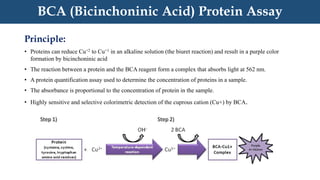
• Proteins can reduce Cu+2 to Cu+1 in an alkaline solution (the biuret reaction) and result in a purple color
formation by bicinchoninic acid
• The reaction between a protein and the BCA reagent form a complex that absorbs light at 562 nm.
• A protein quantification assay used to determine the concentration of proteins in a sample.
• The absorbance is proportional to the concentration of protein in the sample.
• Highly sensitive and selective colorimetric detection of the cuprous cation (Cu+) by BCA.
Materials
Materials provided in the kit:
• BCA reagent A
• BCA reagent B
• Materials required, but not provided in the
kit:
• Tubes
• Spectrophotometer
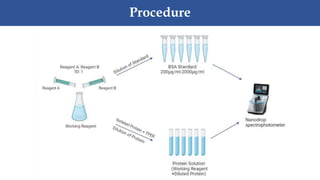
Procedure
Analysis of the Result
562
nm
BSA Standard Calibration Curve
Advantages:
• As sensitive as Lowry but simpler.
• Reagents more stable than Lowry.
Disadvantages:
• Color not stable with time… Precise timing.
• Color variations between proteins occur.
Advantages and Disadvantages of BCA Method
Western Blotting
 Western blotting is a widely used analytic technique in molecular
biology and immunogenetics to detect specific proteins from a
complex mixture of proteins extracted from cells.
 Was first described on Towbin, et. al in 1979.
 The SDS PAGE technique is prerequisite for Western blotting.
 Proteins are separated based on their size on polyacrylamide gel.
 The technique uses three elements to accomplish this task:
i. Separation by size
ii. Transfer to a solid support
iii. Marking target protein using a proper primary and secondary
antibody to visualize.
 Very delicate and time consuming process.
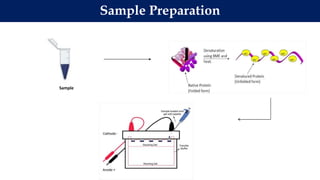
Sample Preparation
Sample
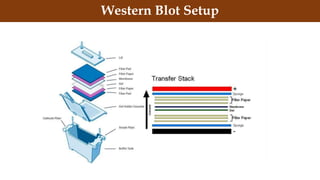
Western Blot Setup
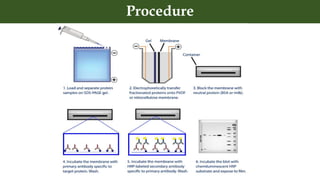
Procedure
Advantages and Limitations of Western Blot
Advantages of Western Blot:
• Specific interaction of antibody and antigen can be directly visualized.
• Analytical tool to identify a protein of interest in a complex mixture.
• To identify molecular weight of the protein.
• Widely accepted method.
Limitations of Western Blot:
• Very delicate and time consuming process.
• If protein degrade quickly, western blot wont detect it well.
• Technically demanding.
• Costly.
• Immunogenic responses from infectious agents (ex. viruses, bacteria) are easy to detect by this
technique.
• Analysis of IgG fractions purifies from human plasma.
• Diagnosis of HIV by ELISA involves western blotting technique.
• To detect some forms Lyme disease.
• Confirmatory test for hepatitis-B involves western blotting technique.
• This technique employed in gene expression studies.
Applications of Western Blot
BCA and Western blot (1).pptx

BCA and Western blot (1).pptx

  • 1.
  • 2.
    BCA (Bicinchoninic Acid)Protein Assay Principle: • Proteins can reduce Cu+2 to Cu+1 in an alkaline solution (the biuret reaction) and result in a purple color formation by bicinchoninic acid • The reaction between a protein and the BCA reagent form a complex that absorbs light at 562 nm. • A protein quantification assay used to determine the concentration of proteins in a sample. • The absorbance is proportional to the concentration of protein in the sample. • Highly sensitive and selective colorimetric detection of the cuprous cation (Cu+) by BCA.
  • 3.
    Materials Materials provided inthe kit: • BCA reagent A • BCA reagent B • Materials required, but not provided in the kit: • Tubes • Spectrophotometer
  • 4.
  • 5.
    Analysis of theResult 562 nm BSA Standard Calibration Curve
  • 6.
    Advantages: • As sensitiveas Lowry but simpler. • Reagents more stable than Lowry. Disadvantages: • Color not stable with time… Precise timing. • Color variations between proteins occur. Advantages and Disadvantages of BCA Method
  • 7.
    Western Blotting  Westernblotting is a widely used analytic technique in molecular biology and immunogenetics to detect specific proteins from a complex mixture of proteins extracted from cells.  Was first described on Towbin, et. al in 1979.  The SDS PAGE technique is prerequisite for Western blotting.  Proteins are separated based on their size on polyacrylamide gel.  The technique uses three elements to accomplish this task: i. Separation by size ii. Transfer to a solid support iii. Marking target protein using a proper primary and secondary antibody to visualize.  Very delicate and time consuming process.
  • 8.
  • 9.
  • 10.
  • 11.
    Advantages and Limitationsof Western Blot Advantages of Western Blot: • Specific interaction of antibody and antigen can be directly visualized. • Analytical tool to identify a protein of interest in a complex mixture. • To identify molecular weight of the protein. • Widely accepted method. Limitations of Western Blot: • Very delicate and time consuming process. • If protein degrade quickly, western blot wont detect it well. • Technically demanding. • Costly.
  • 12.
    • Immunogenic responsesfrom infectious agents (ex. viruses, bacteria) are easy to detect by this technique. • Analysis of IgG fractions purifies from human plasma. • Diagnosis of HIV by ELISA involves western blotting technique. • To detect some forms Lyme disease. • Confirmatory test for hepatitis-B involves western blotting technique. • This technique employed in gene expression studies. Applications of Western Blot