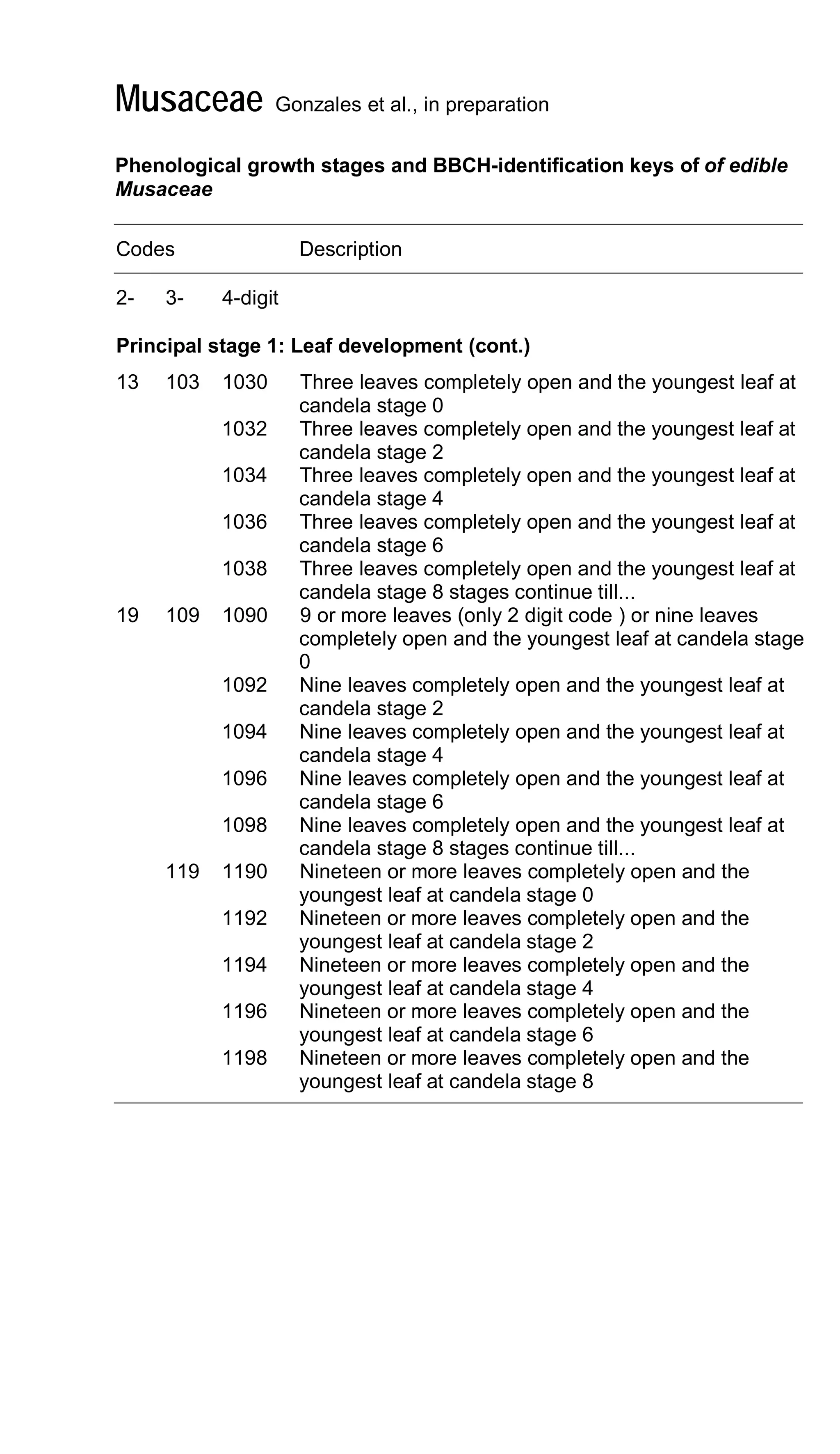
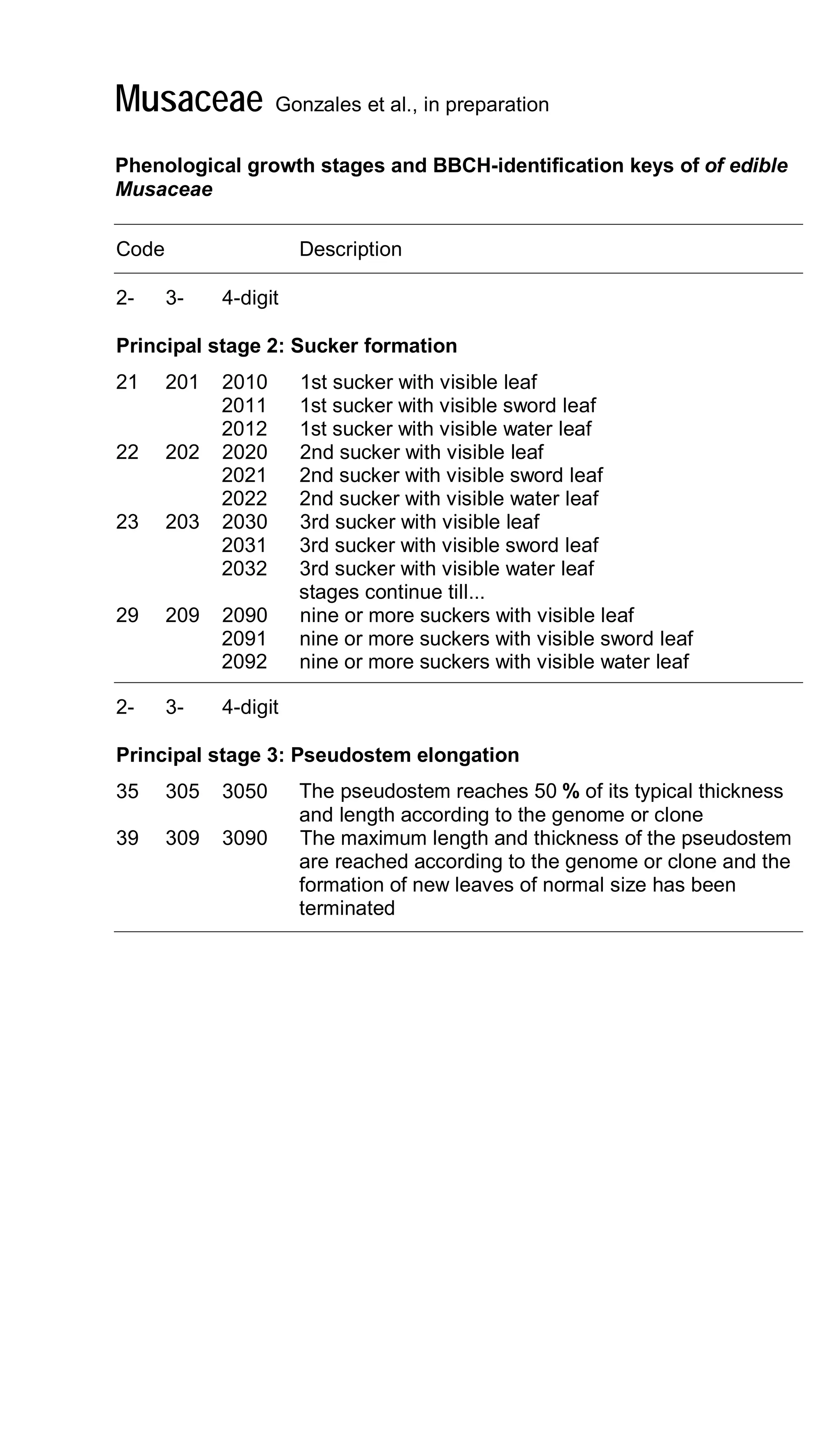
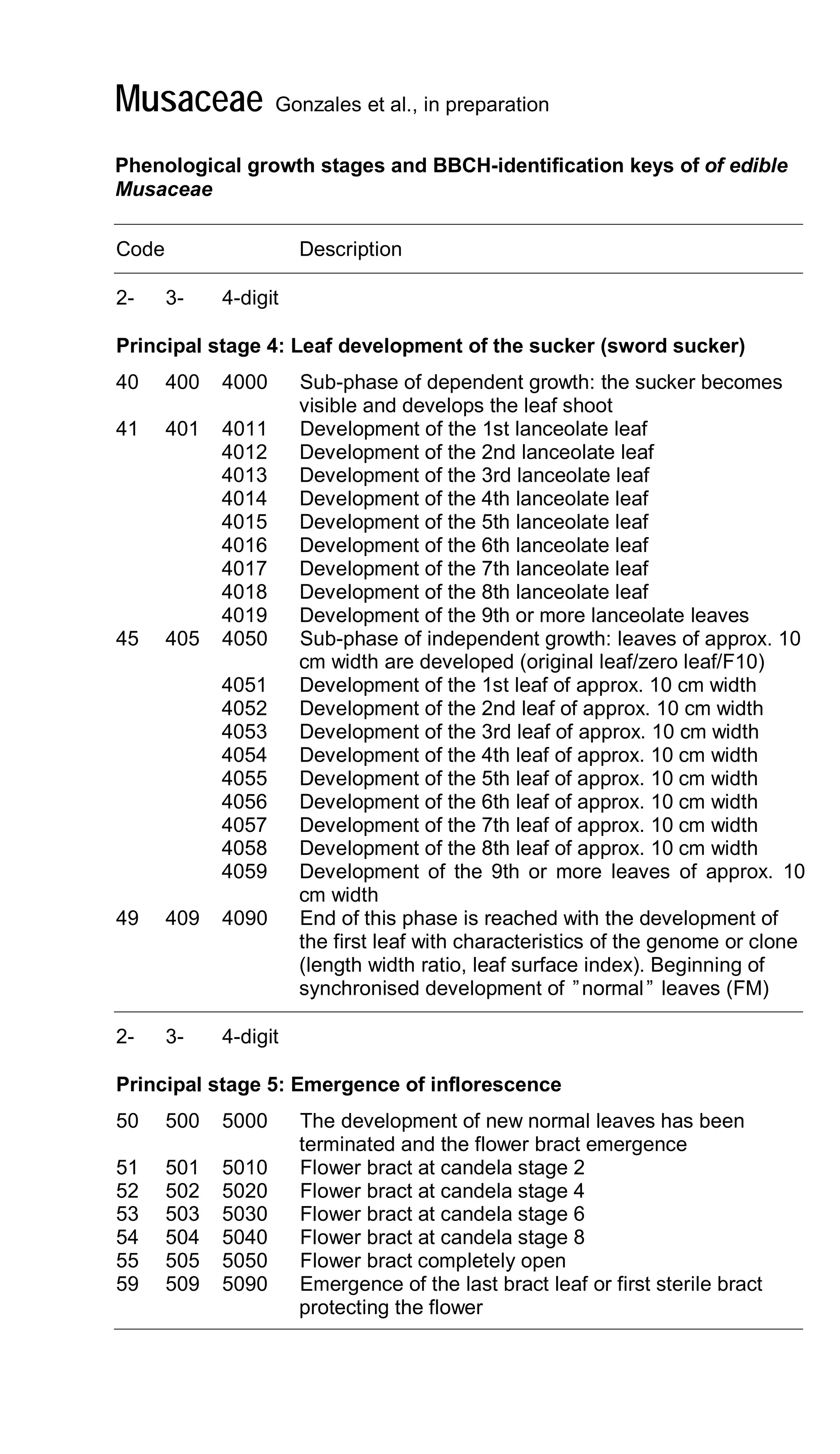
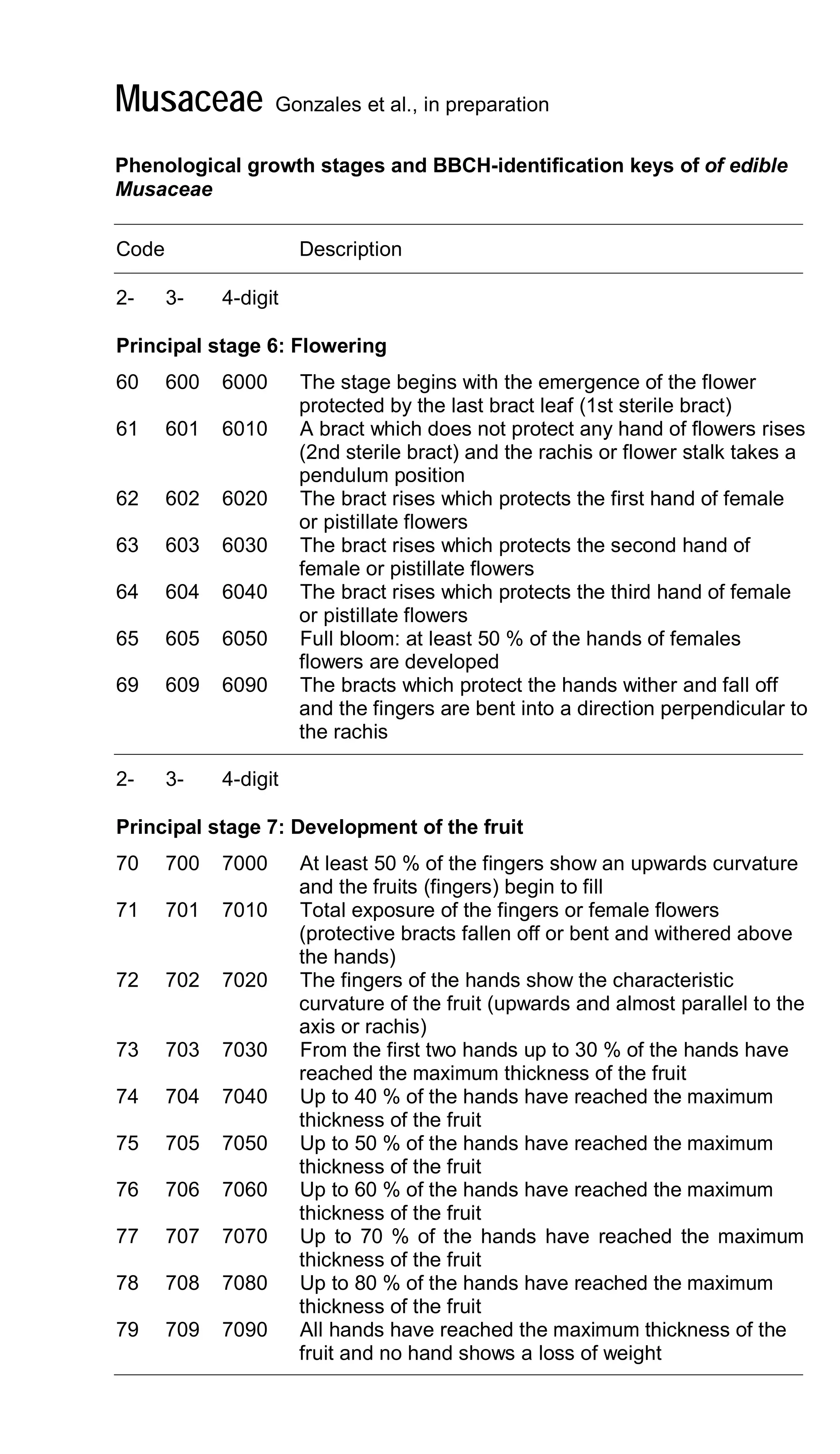
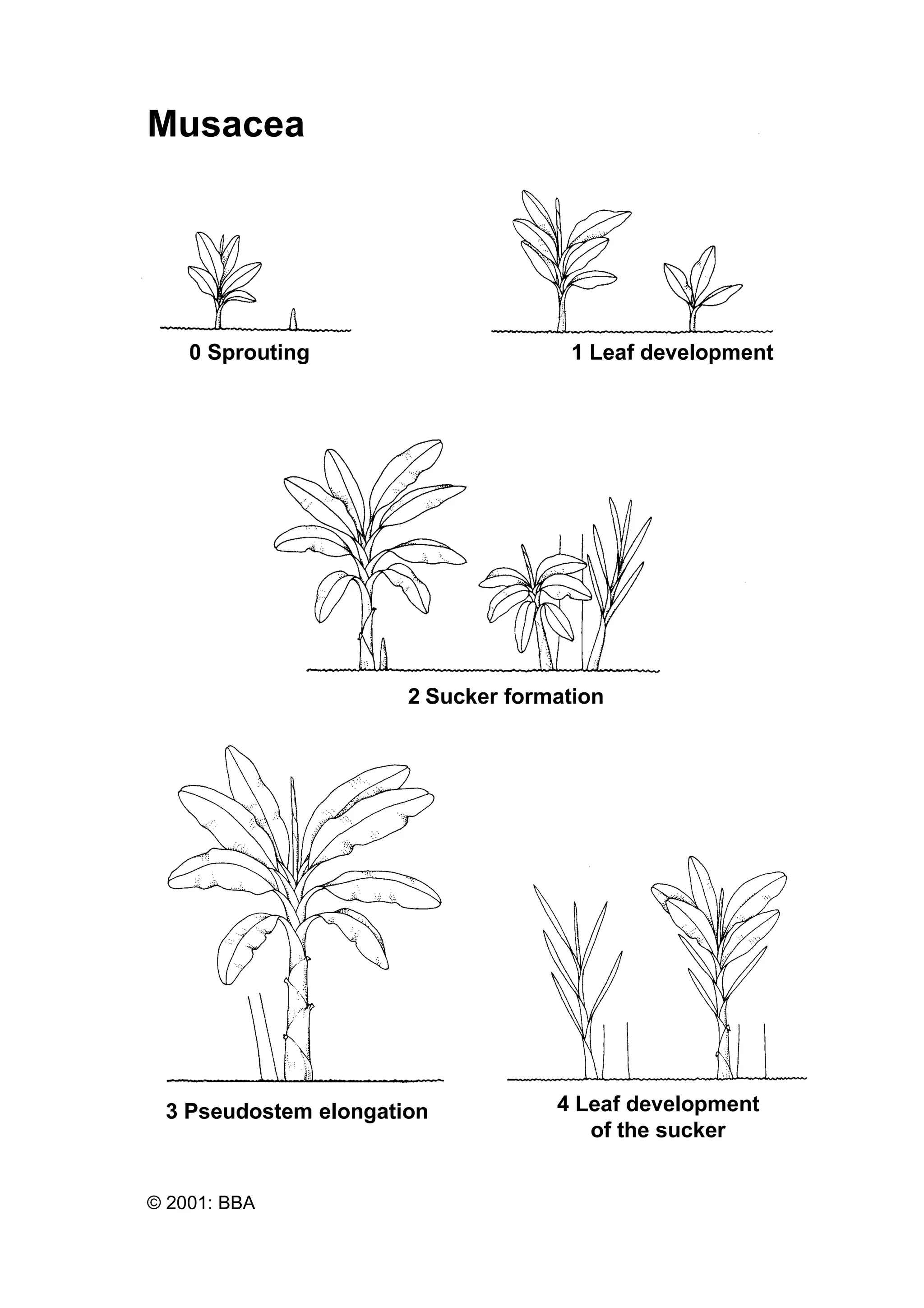
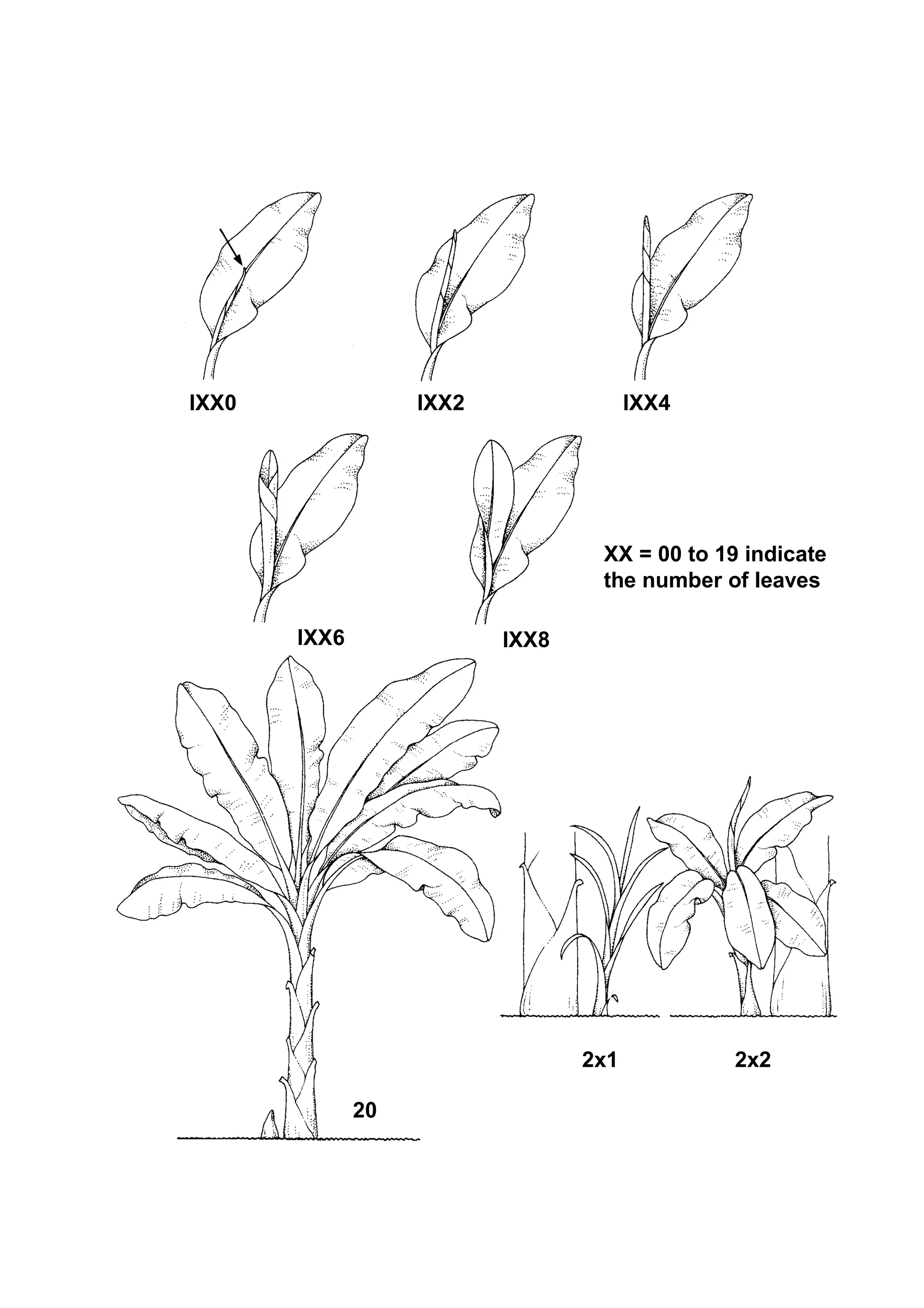
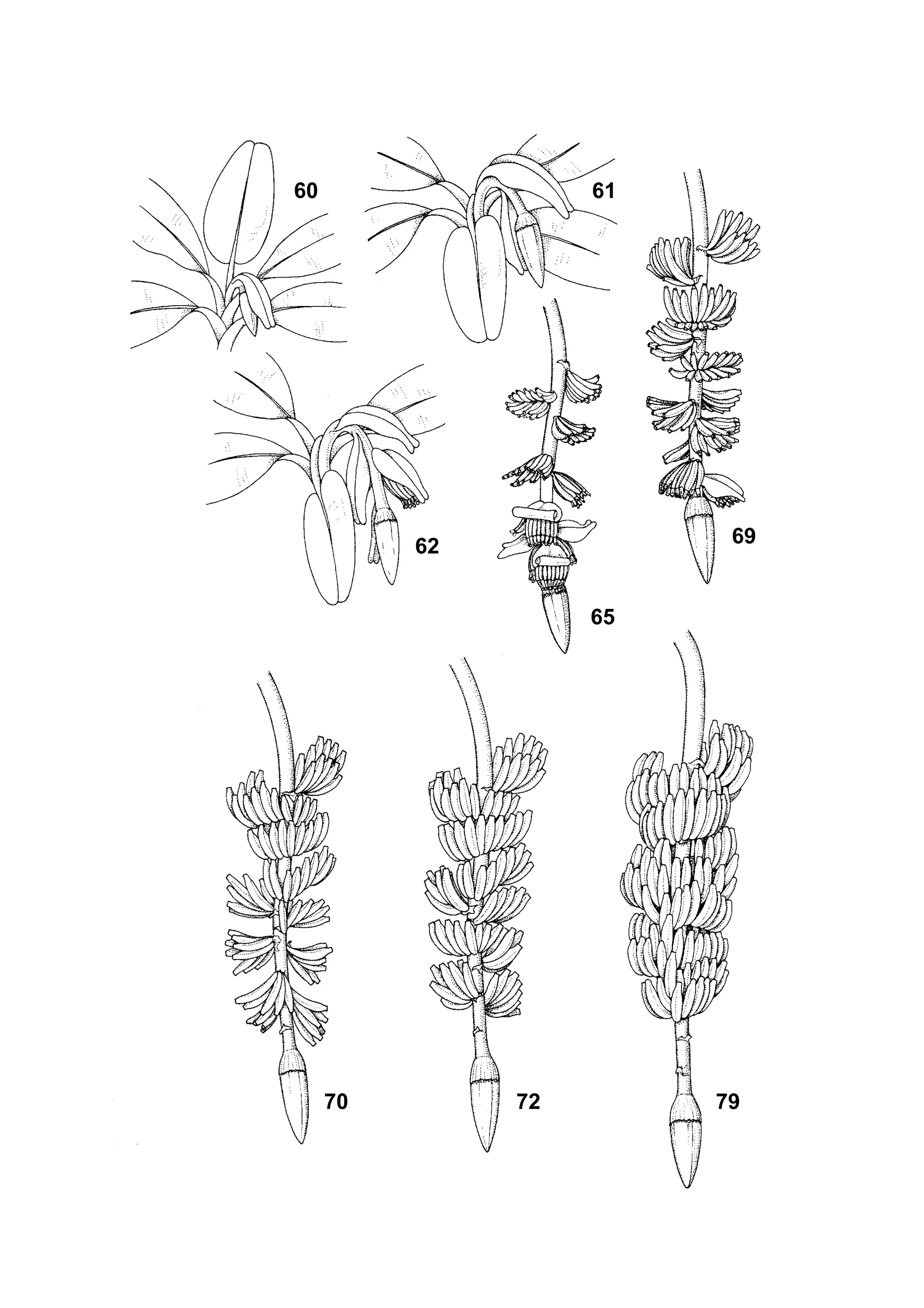
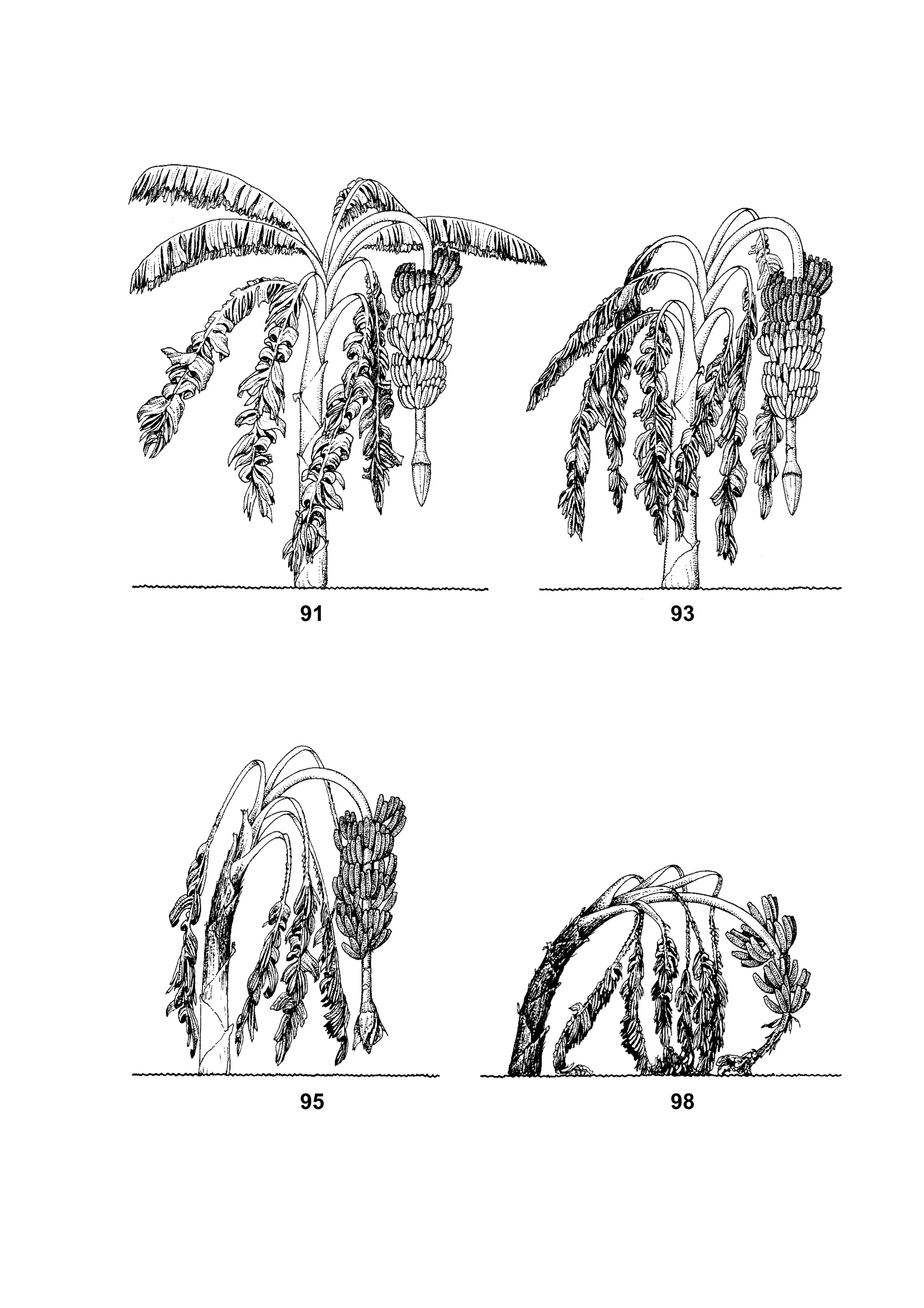
Growth stages of mono-and dicotyledonous plants
BBCH Monograph
2. Edition, 2001
Edited by Uwe Meier
Federal Biological Research Centre for Agriculture and Forestry
The code has been jointly by
– German Federal Biological Research Centre for Agriculture and
Forestry (BBA)
– German Federal Office of Plant Varieties (BSA)
– German Agrochemical Association (IVA)
– Institute for Vegetables and Ornamentals in Grossbeeren/Erfurt,
Germany
Members of the BBCH working group
H. Bleiholder und Frau E.
Weber
BASF AG
Landwirtschaftliche Ver-
suchsstation
Carl-Bosch-Strasse 64
D-67117 Limburgerhof
C. Feller
Institut für Gemüse & Zier-
pflanzenbau
Theodor-Echtermeyer-Weg 1
D-14979 Grossbeeren
M. Hess und H. Wicke
Aventis
D-65926 Frankfurt/Main
U. Meier
Biologische Bundesanstalt
für Land- und Forstwirtschaft
Messeweg 11/12
D-38104 Braunschweig
T. van den Boom
Bayer AG
Landwirtschaftszentrum
Monheim
Alfred-Nobel-Strasse 50
D-51368 Leverkusen-
Bayerwerk
P. D. Lancashire
Bayer plc.
Eastern Way
Bury St. Edmunds
Suffolk IP 32 7 AH, UK
Frau L. Buhr
Biologische Bundesanstalt
für Land- und Forstwirtschaft
Stahnsdorfer Damm 81
D-14532 Kleinmachnow
H. Hack
Industrieverband Agrar (IVA)
Theodor-Storm-Weg 2
D-51519 Odenthal
Frau R. Klose
Bundessortenamt
Osterfelddamm 80
D-30604 Hannover
R. Stauss
Ministerium für ländliche
Räume, Landwirtschaft,
Ernährung und Tourismus
des Landes Schleswig-
Holstein
Düsternbrooker Weg 104
D-24105 Kiel
General Scale
Cereals, Rice, Maize
Oilseed rape, Faba bean, Sunflower
Beta beets
Potato
Fruits
Citrus, Olive, Coffee, Banana
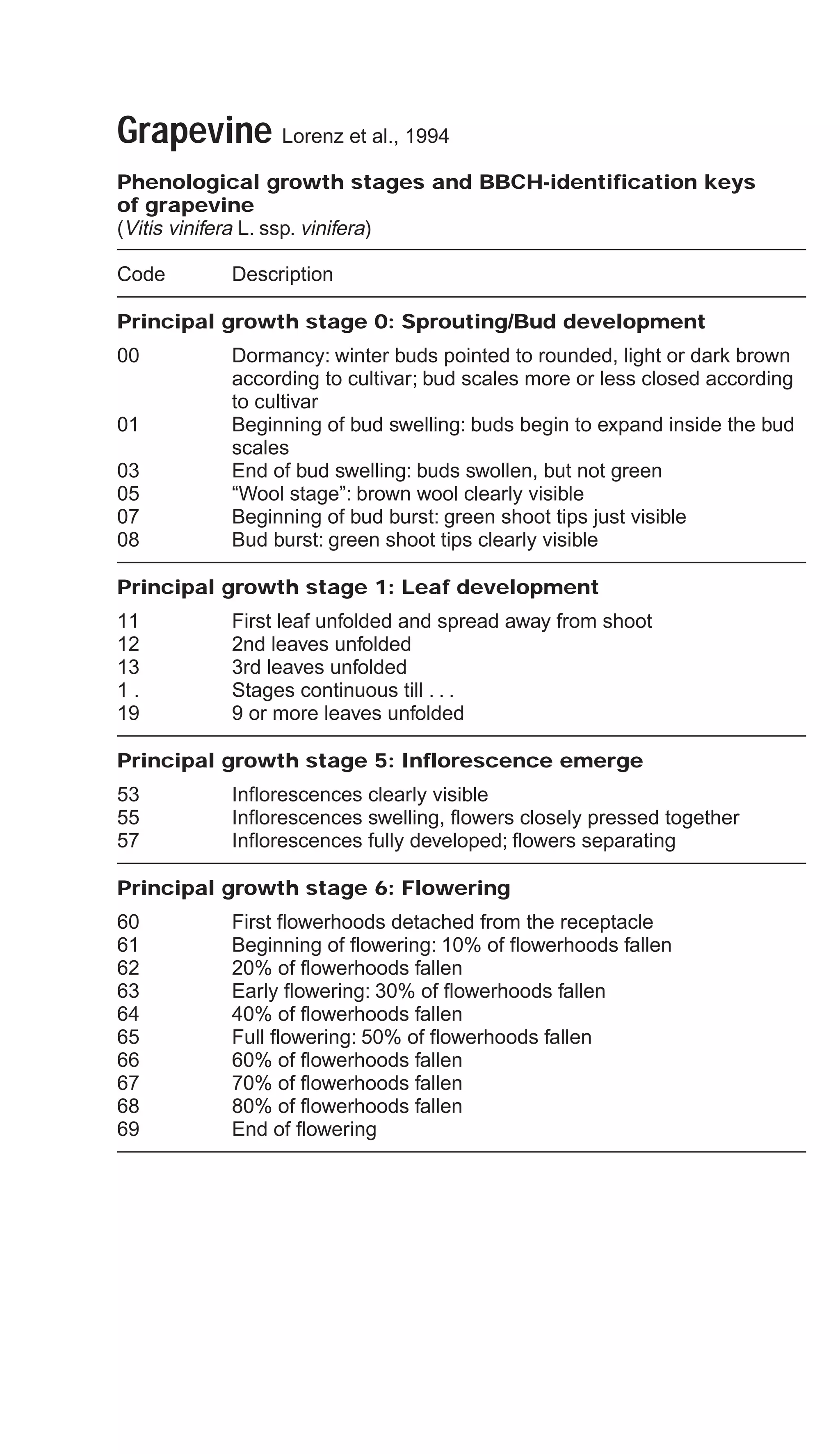
Grapevine
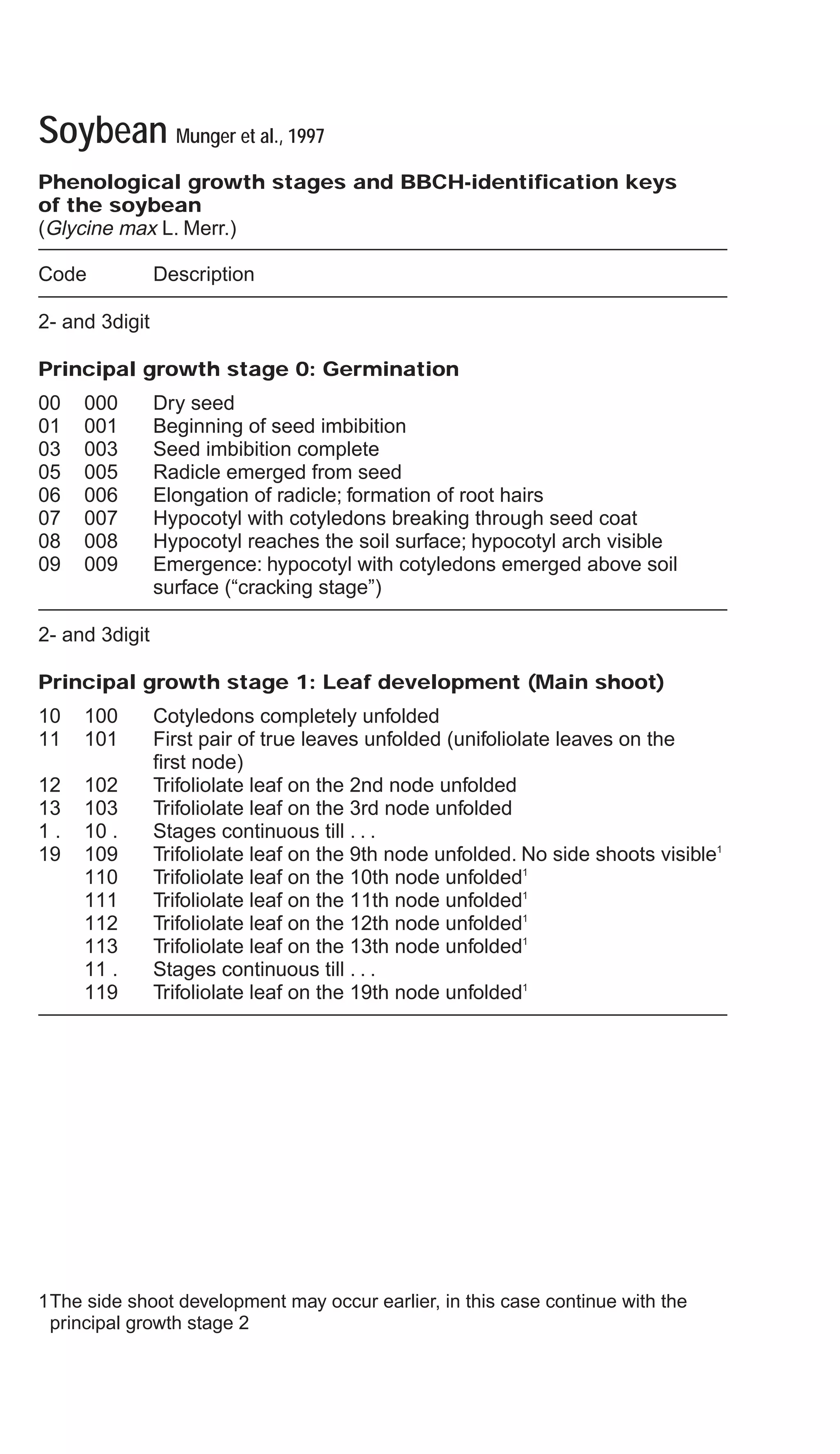
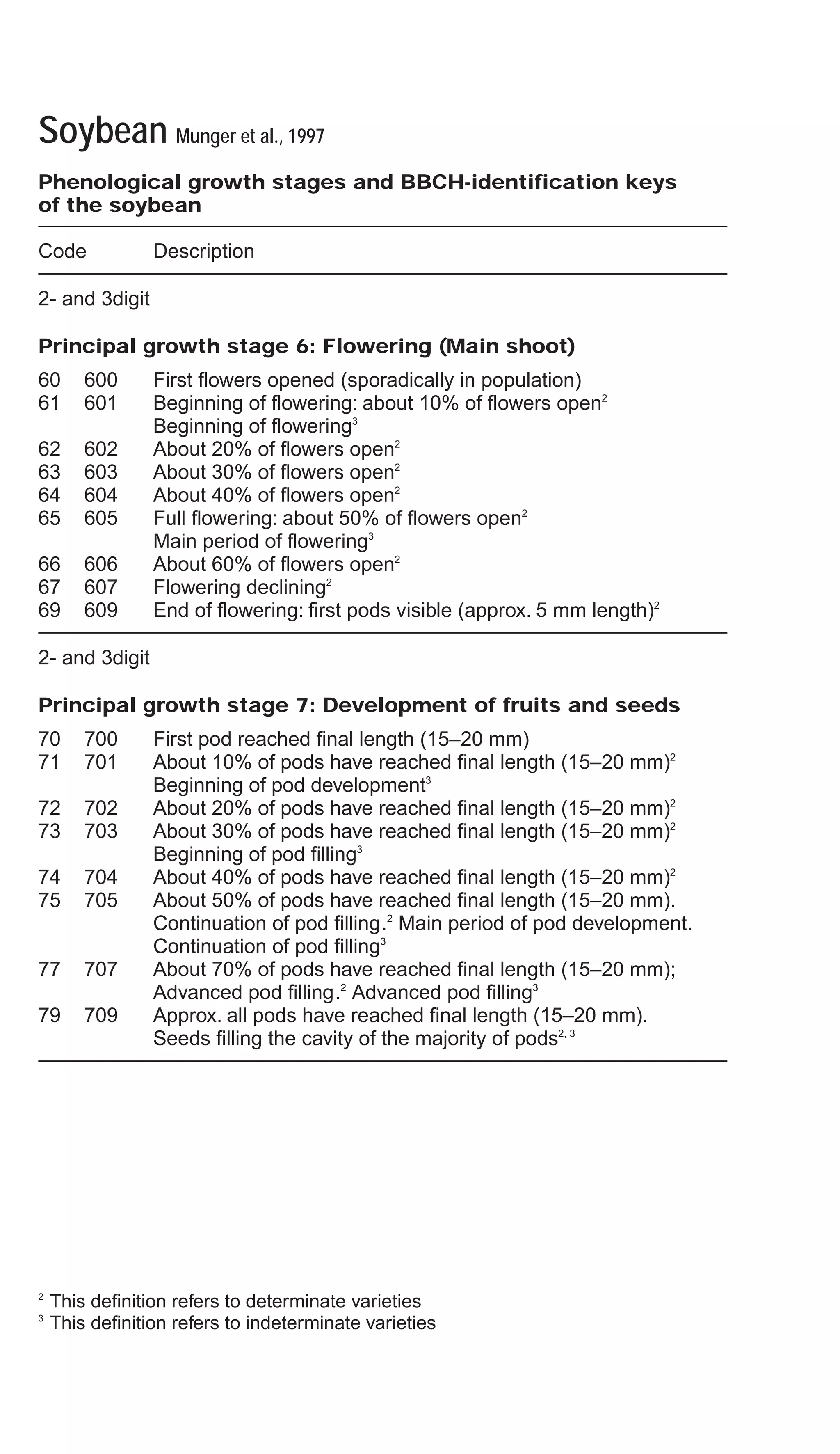
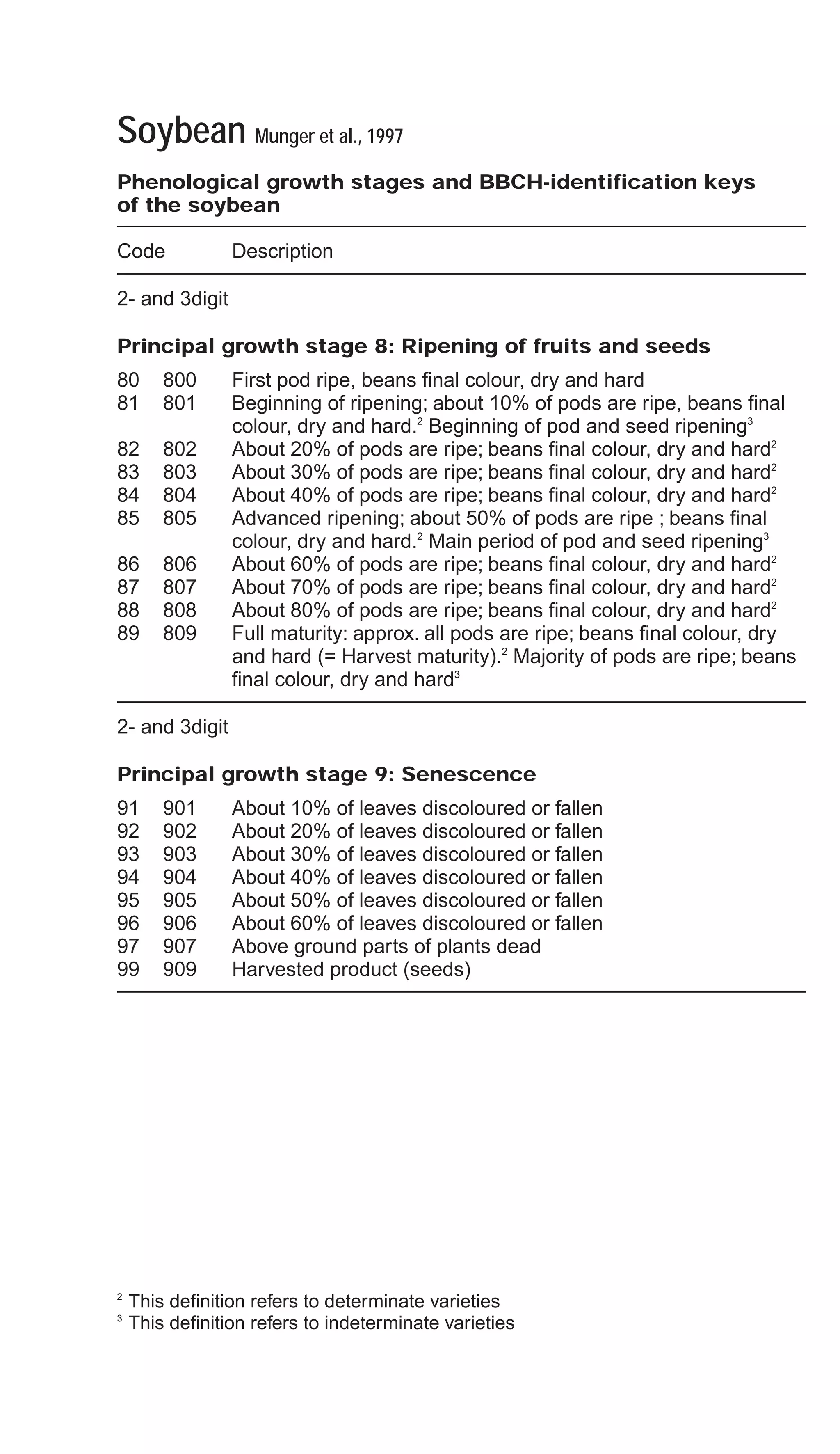
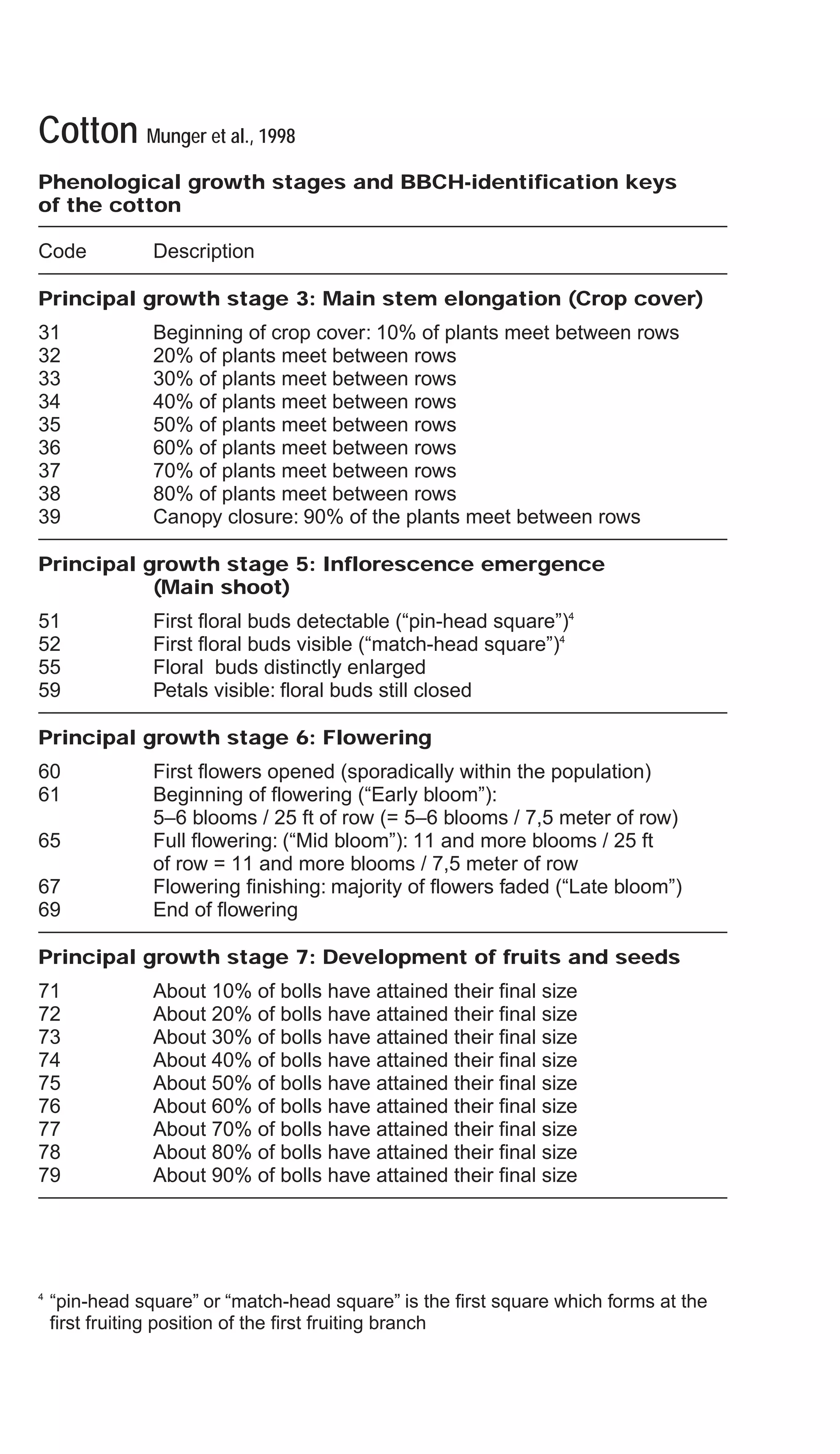
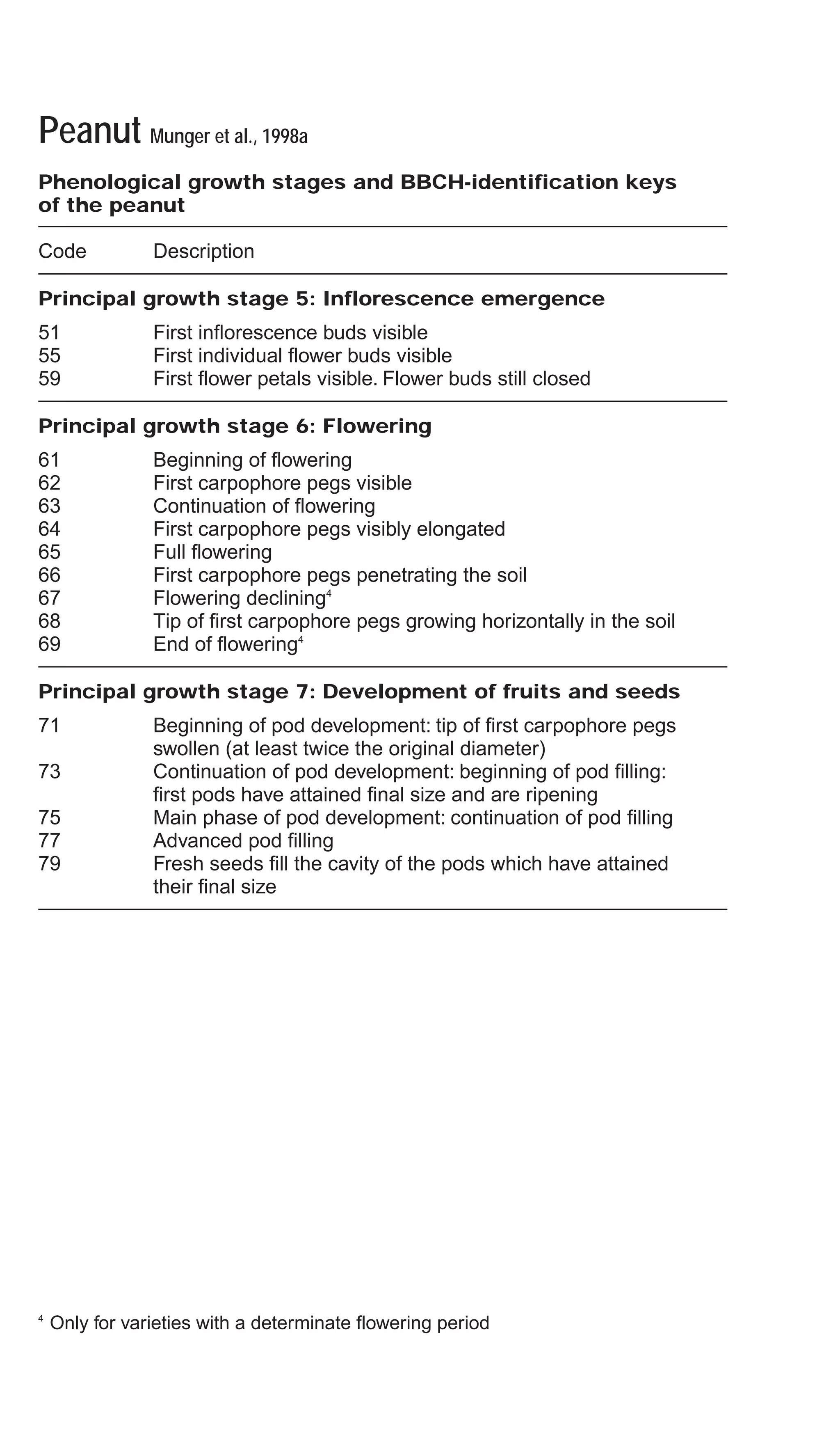
Soybean, Cotton, Peanuts
Hop
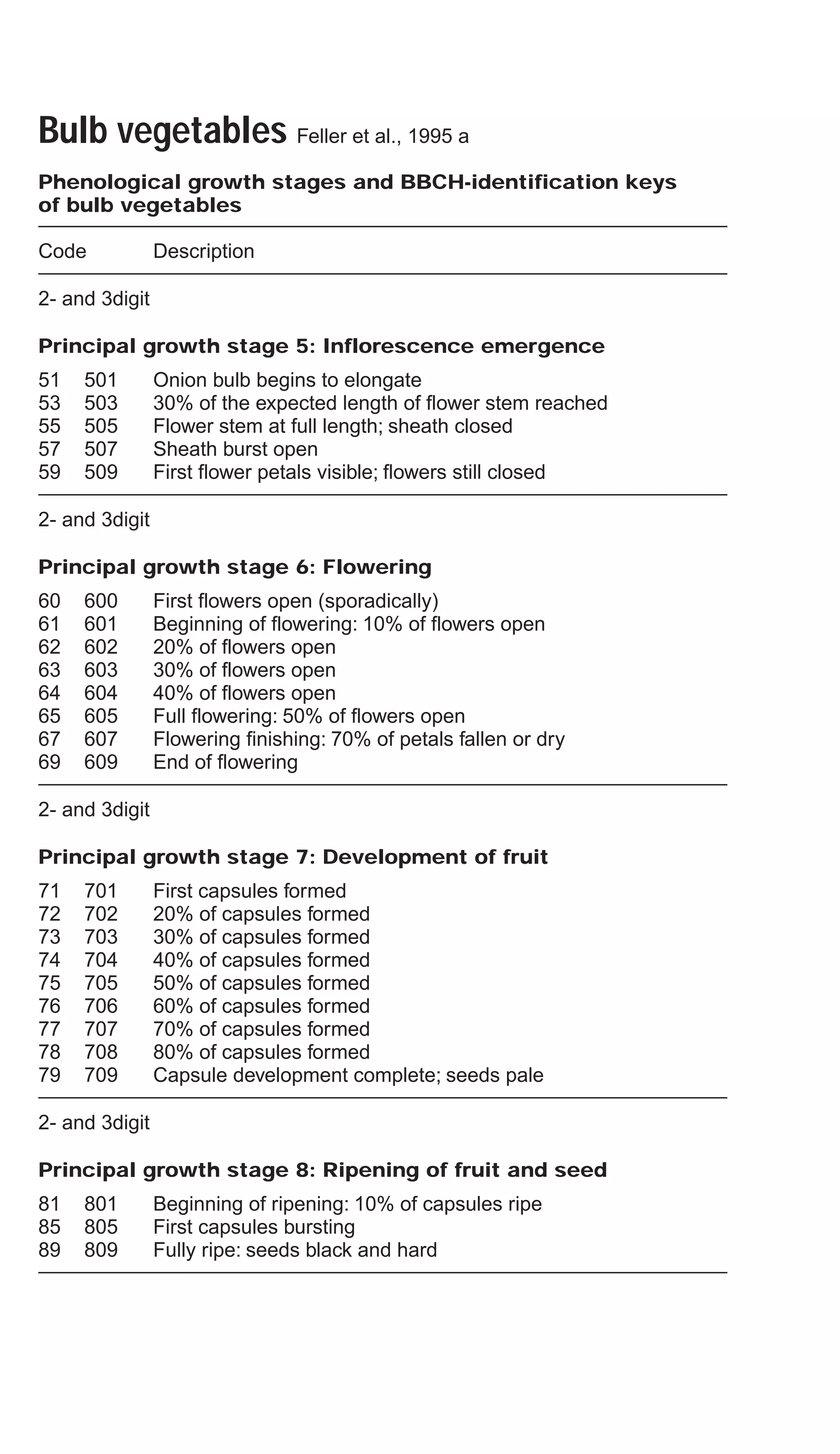
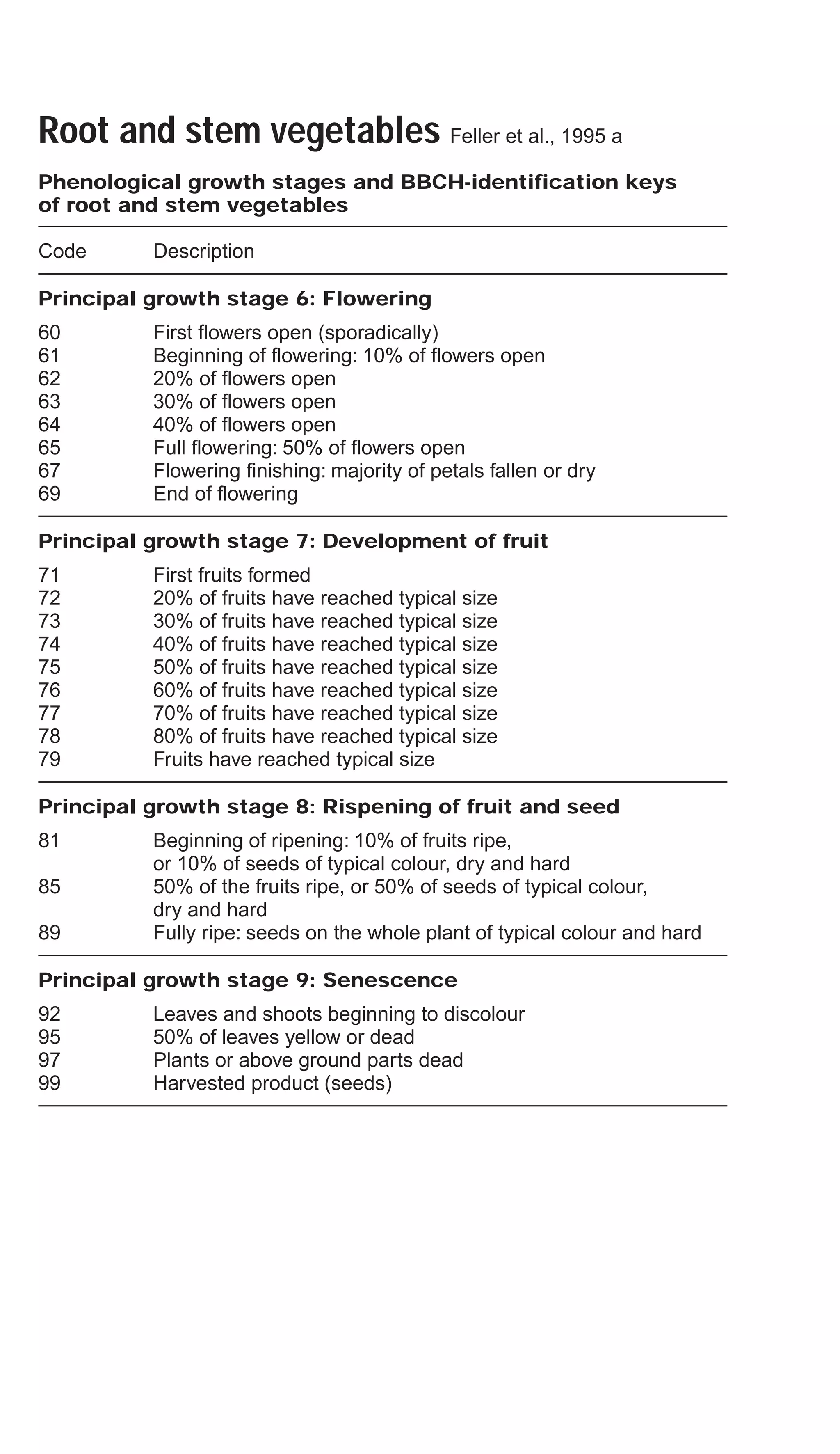
Vegetable crops I
Vegetable crops II
Weeds
BBCH-Publications
Foreword
As all branches of science, the individual disciplines in agricultural plant
research also work more closely together, and, in addition, have become
more international. The exchange of new findings and joint work on projects
presuppose, however, that all those involved have the same understanding
of the terms they use. This calls the need for an extensively standardised
description of plant development stages in order of their phenological
characteristics and their coding.
The phenological development stages of plants are also used in
agricultural practice, agrometeorology and agricultural insurance, each with
its own varying individual objectives. Moreover, the applied botanical
sciences also make use of phenological development stages.
This book about plant development stages – and their corresponding
codes – aims at satisfying all these demands. Of particular significance is
the fact that the work appears in four languages and thus contributes to a
large extent to reducing linguistic communication problems. It thus fulfils in a
special way the intertwinement in research, trade, production and service
present today.
The book thanks its existence to the close co-operation between
scientists from variously oriented agricultural authorities and companies
from the chemical industry with agricultural research departments. It is
hoped that this fruitful co-operation, in the course of which knowledge has
been gathered by all sides over many years, will contribute to furnishing
decision makers with more surety, and will promote international co-
operation.
Prof. Dr. F. Klingauf
President of the
Federal Biological Research Centre
for Agriculture and Forestry,
Berlin and Braunschweig
Note of Thanks
This book was made possible by a joint initiative of the Institute for
Vegetables and Ornamentals in Großbeeren/Erfurt (IGZ), the German
Federal Office of Plant Varieties (BSA), the concerns Aventis, Bayer, BASF
and Syngenta, the German Agrochemical Association (IVA) and the German
Federal Biological Research Centre for Agriculture and Forestry (BBA). Not
only have these institutions and concerns provided substantial funds, but
also scientific and technical employees, whose joint work over several years
has made this book possible. Indispensable however has been the work of
numerous cooperating scientists and co-authors who have enabled the
description of the development stages of the crops with their crop specific
knowledge. I would like to thank them at this point for their help.
An essential aim of this book is to facilitate scientific communication on
an international level. Fortunately I was able to find specialist translators
.The Spanish translations were done by Mr. Enrique Gonzales Medina,
Bogotá/Kolumbien, Mr. José Antonio Guerra, Ciba, Barcelona, as well as Dr.
Herrman Bleiholder, BASF AG, who earns the credit for unifying versions in
the Spanish language from South America and Spain. The French text was
translated by Mrs. Sybil Rometsch, Université de Lausanne. The English
text was corrected by Dr. P. D. Lancashire, Bayer, Bury St. Edmunds, UK.
Mr. Ernst Halwaß from Nossen agreed as commercial artist to produce
the main part of the graphical representations, enabling the clear visual
portrayal of the important development stages of the particular crops.
Thanks go to him for the creation of drawings of all vegetable and fruit
plants, and those of the beet, potato, cotton, peanut, hop, faba bean,
sunflower, maize, soybean, musacea, coffe, olive and grapevine. Thanks
also to the Gesellschaft der Freunde und Förderer der Biologischen
Bundesanstalt for financing the pictures and Mr. Tottman and Mrs. Broad for
their drawings of cereals.
The authors would also like to thank those colleagues who carried out
the necessary technical work with so much patience and perseverance.
The production of a book in this form requires substantial financial
means. We would therefore like to thank the following companies and
institutions at this point for the financial resources provided: Aventis, BASF,
Bayer, Syngenta, Dow Elanco, Du Pont de Nemours, Rhône-Poulenc Agro,
and the German Agrochemical Association (IVA).
Uwe Meier
The extended BBCH-scale
Hack et al., 1992
The extended BBCH-scale is a system for a uniform coding of phenologically
similar growth stages of all mono- and dicotyledonous plant species.
It results from teamwork between the German Federal Biological Research
Centre for Agriculture and Forestry (BBA), the German Federal Office of
Plant Varieties (BSA), the German Agrochemical Association (IVA) and the
Institute for Vegetables and Ornamentals in Grossbeeren/Erfurt, Germany
(IGZ). The decimal code, which is divided into principal and secondary
growth stages, is based on the well-known cereal code developed by ZADOKS
et al. (1974) in order to avoid major changes from this widely used phenological
key.The abbreviation BBCH derives from Biologische Bundesanstalt,
Bundessortenamt and CHemical industry.
The basic principles of the scale
– The general scale forms the framework within which the individual scales
are developed. It can also be used for those plant species for which no
special scale is currently available.
– Similar phenological stages of each plant species are given the same
code.
– For each code, a description is given, and for some important stages,
drawings are included.
– For the description of the phenological development stages, clear and
easily recognised (external) morphological characte-ristics are used.
– Except where stated otherwise, only the development of the main stem is
taken into consideration.
– The growth stages refer to representative individual plants within the crop
stand. Crop stand characteristics may also be considered.
– Relative values relating to species- and/or variety-specific ultimate sizes
are used for the indication of sizes.
– The secondary growth stages 0 to 8 correspond to the respective ordinal
numbers or percentage values. For example stage 3 could represent:
3rd true leaf, 3rd tiller, 3rd node or 30% of the final length or size typical of
the species or 30% of the flowers open.
– Post harvest or storage treatment is coded 99.
– Seed treatment before planting is coded 00.
Organisation of the scale
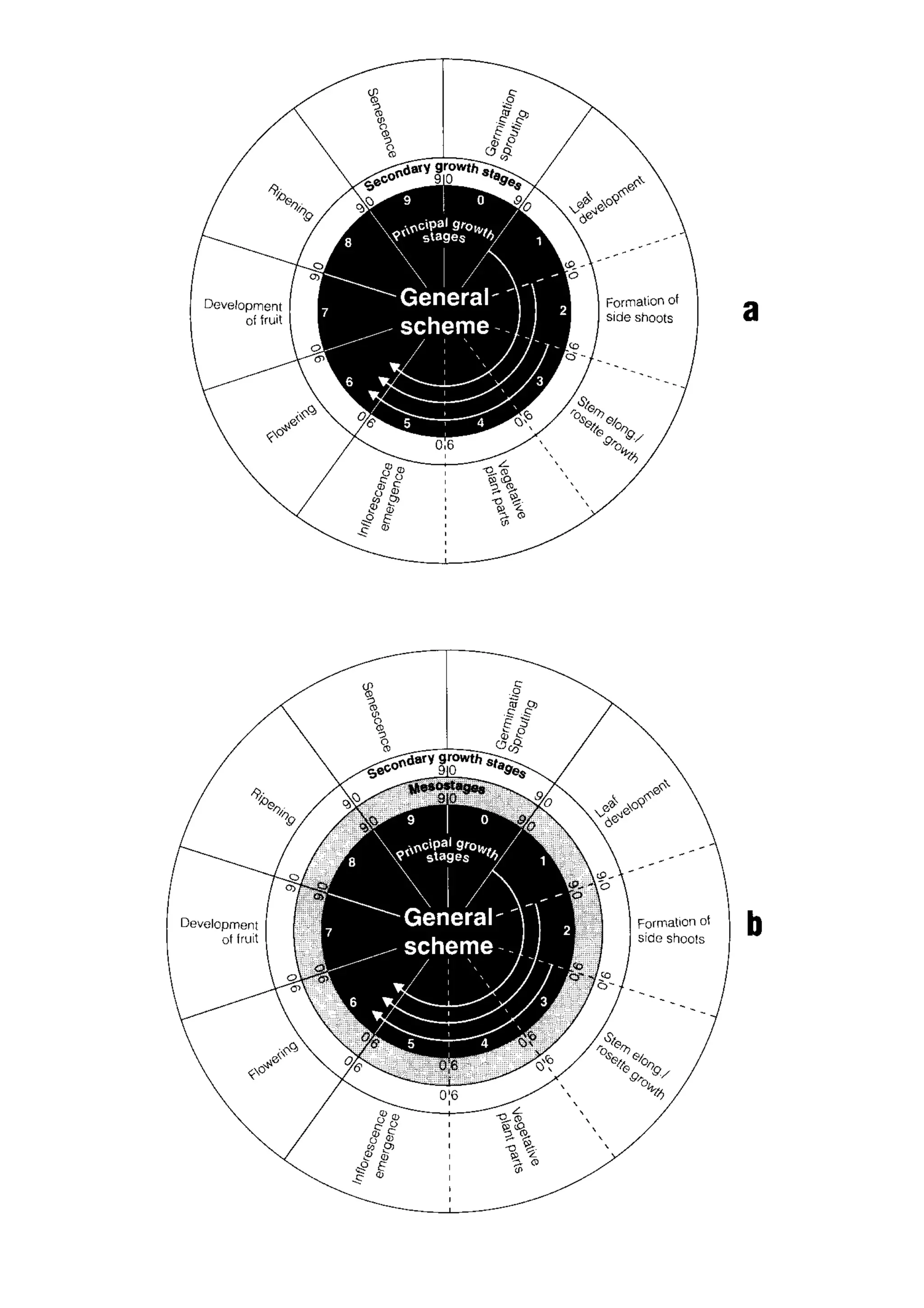
The entire developmental cycle of the plants is subdivided into ten clearly
recognizable and distinguishable longer-lasting developmental phases. These
principal growth stages are described using numbers from 0 to 9 in ascending
order (see Figures 1a and b). The principal growth stages are described
in Table 1. Owing to the very many different plant species there may be shifts
in the course of the development or certain stages may even be omitted.
The principal growth stages need not proceed in the strict sequence
defined by the ascending order of the figures, but can occasionally also
proceed in parallel.
Table 1:
Principal growth stages
Stage Description
0 Germination / sprouting / bud development
1 Leaf development (main shoot)
2 Formation of side shoots / tillering
3 Stem elongation or rosette growth / shoot development
(main shoot)
4 Development of harvestable vegetative plant parts or vegetatively
propagated organs / booting (main shoot)
5 Inflorescence emergence (main shoot) / heading
6 Flowering (main shoot)
7 Development of fruit
8 Ripening or maturity of fruit and seed
9 Senescence, beginning of dormancy
If two or more principal growth stages proceed in parallel, both can be
indicated by using a diagonal stroke (example 16/22). If only one stage is to
be indicated, either the more advanced growth stage must be chosen or
the principal growth stage of particular interest, depending upon the plant
species.
The principal growth stages alone are not sufficient to define exactly
application or evaluation dates, since they always describe time spans in the
course of the development of a plant.
Secondary stages are used if points of time or steps in the plant
development must be indicated precisely. In contrast to the principal growth
stages they are defined as short developmental steps characteristic of the
respective plant species, which are passed successively during the respective
principal growth stage.They are also coded by using the figures 0 to 9.
The combination of figures for the principal and the secondary stages, results in
the two-digit code.
The two-digit code is a scale which offers the possibility of precisely defining
all phenological growth stages for the majority of plant species.
Only in the case of some plant species (e.g. cucumber, onion, potato, soybean,
tomato) is further subdivision necessary within a principal growth stage
beyond that possible using the secondary stages from 0 to 9.
For these cases a three-digit scale is presented alongside the two-digit scale.
This involves the inclusion of the so-called mesostage between the principal
and the secondary stage, which provides a further subdivision with figures
0 and 1 describing the development on the main stem and figures 2 to 9
that of the side shoots 2nd to 9th order (see Figures 1a and b). In this way
up to 19 leaves can be counted on the main stem or the branching can
be described.
The BBCH-scales allow the comparison of individual codes only within one
principal growth stage: an arithmetically greater code indicates a plant
at a later growth stage. Sorting codes into numerical order therefore allows
a listing in order of the stage of plant development.
The time span of certain developmental phases of a plant can be exactly
defined and coded by indicating two stages. For this purpose two codes are
connected with a hyphen. Thus, for instance, the code 51–69 describes the
developmental phase from the appearance of the first inflorescence or
flower buds until the end of flowering. This allows the computer-supported
monitoring of crop stands.
For a uniform coding which covers the maximum number of plant species,
it is necessary to use primarily phenological criteria rather than homologous
or analogous stages. Thus, for instance, germination of plants from true
seed and sprouting from buds are classified in one principal growth stage,
the principal growth stage 0, even though they are completely different
biological processes.
In case of the BBCH-scales the descriptions are based on the actual
characteristic features of the individual plant. If the scales are used for the
definition of the development stage of a plant stand, the description
should apply to at least 50% of the plants.
Greater differences in the course of the development of different plant
groupshave to be taken into consideration for the description of the general
scale (see 1.2). This problem is dealt with by offering several definitions
for one specific stage wherever the formulation of a uniform text is impossible.
The following letters show to which plant group the respective definition refers.
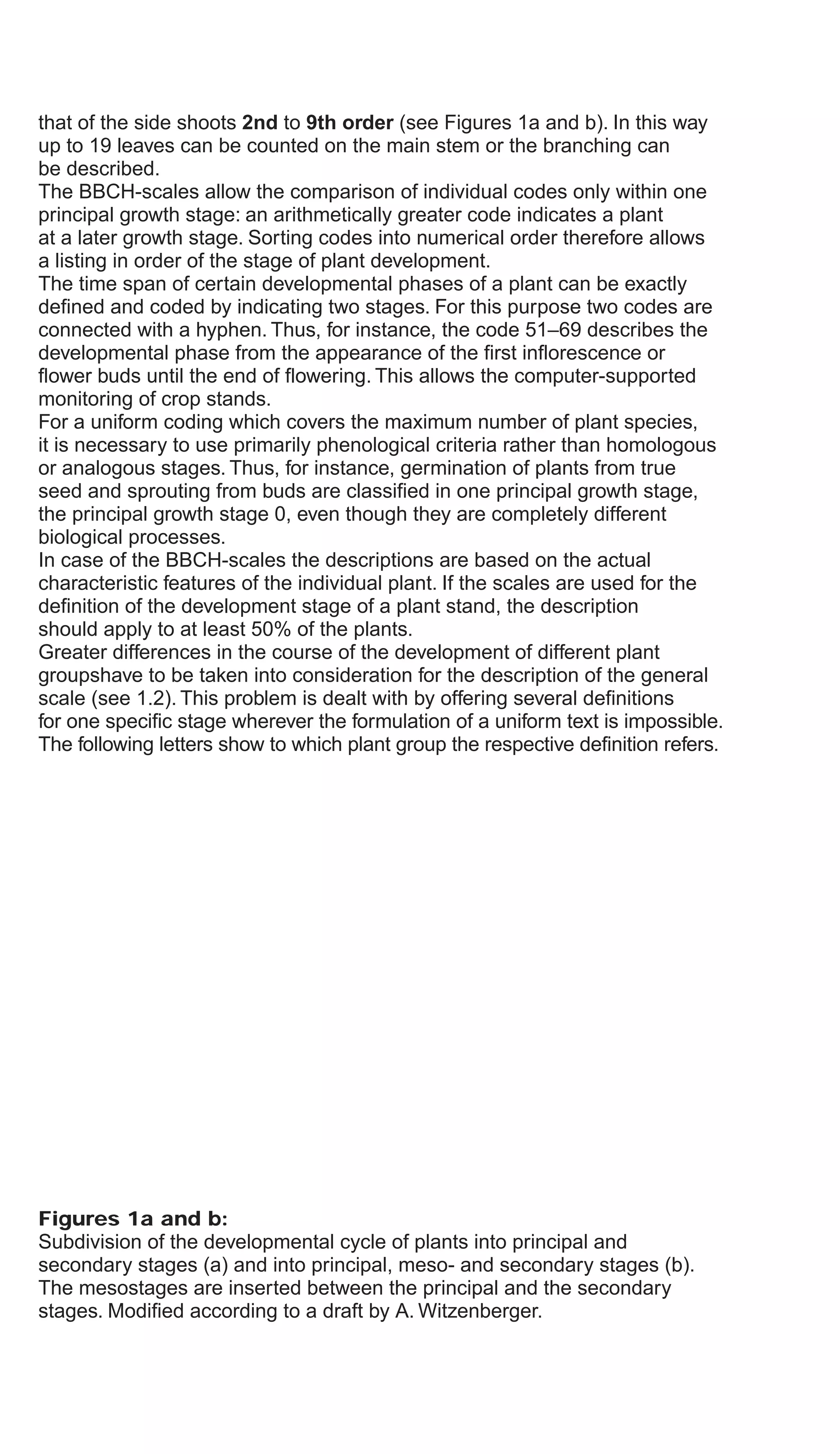
Figures 1a and b:
Subdivision of the developmental cycle of plants into principal and
secondary stages (a) and into principal, meso- and secondary stages (b).
The mesostages are inserted between the principal and the secondary
stages. Modified according to a draft by A. Witzenberger.
The extended BBCH-scale, general Hack et al., 1992
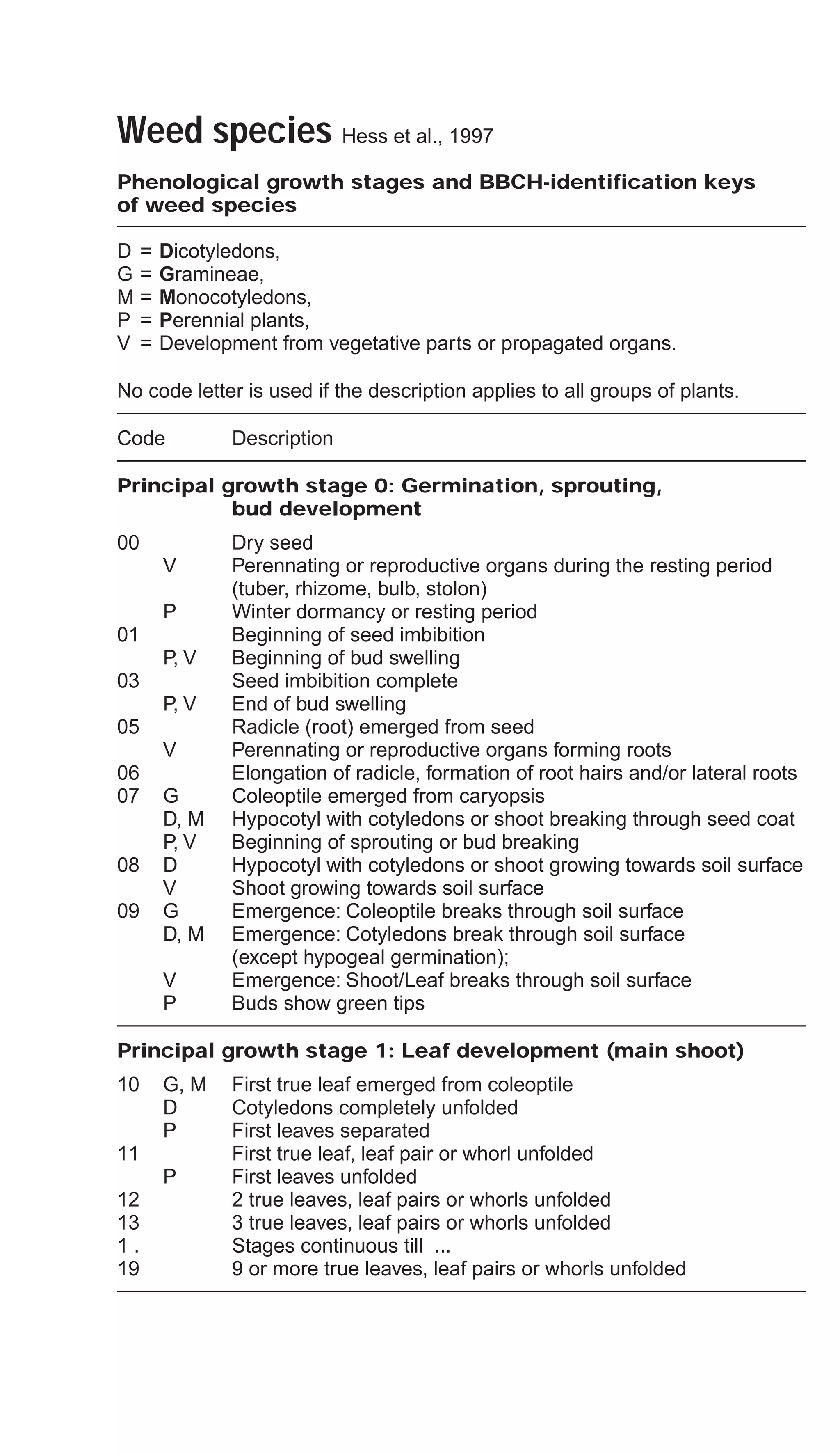
D = Dicotyledons
M = Monocotyledons
V = Development from vegetative parts or propagated organs.
G = Gramineae
P = Perennial plants
No code letter is used if the description applies to all groups of plants.
Code Description
Principal growth stage 0: Germination, sprouting,
bud development
00 Dry seed (seed dressing takes place at stage 00)
P, V Winter dormancy or resting period
01 Beginning of seed imbibition;
P, V Beginning of bud swelling
03 Seed imbibition complete;
P, V End of bud swelling
05 Radicle (root) emerged from seed;
P, V Perennating organs forming roots
06 Elongation of radicle, formation of root hairs and/or lateral roots
07 G Coleoptile emerged from caryopsis;
D, M Hypocotyl with cotyledons or shoot breaking through seed coat;
P, V Beginning of sprouting or bud breaking
08 D Hypocotyl with cotyledons growing towards soil surface;
P, V Shoot growing towards soil surface
09 G Emergence: Coleoptile breaks through soil surface;
D, M Emergence: Cotyledons break through soil surface
(except hypogeal germination);
D, V Emergence: Shoot/leaf breaks through soil surface;
P Bud shows green tips
Principal growth stage 1: Leaf development (main shoot)
10 G First true leaf emerged from coleoptile;
D, M Cotyledons completely unfolded;
P First leaves separated
11 First true leaf, leaf pair or whorl unfolded;
P First leaves unfolded
12 2 true leaves, leaf pairs or whorls unfolded
13 3 true leaves, leaf pairs or whorls unfolded
1 . Stages continuous till . . .
19 9 or more true leaves, leaf pairs or whorls unfolded
The extended BBCH-scale, general Hack et al., 1992
Code Description
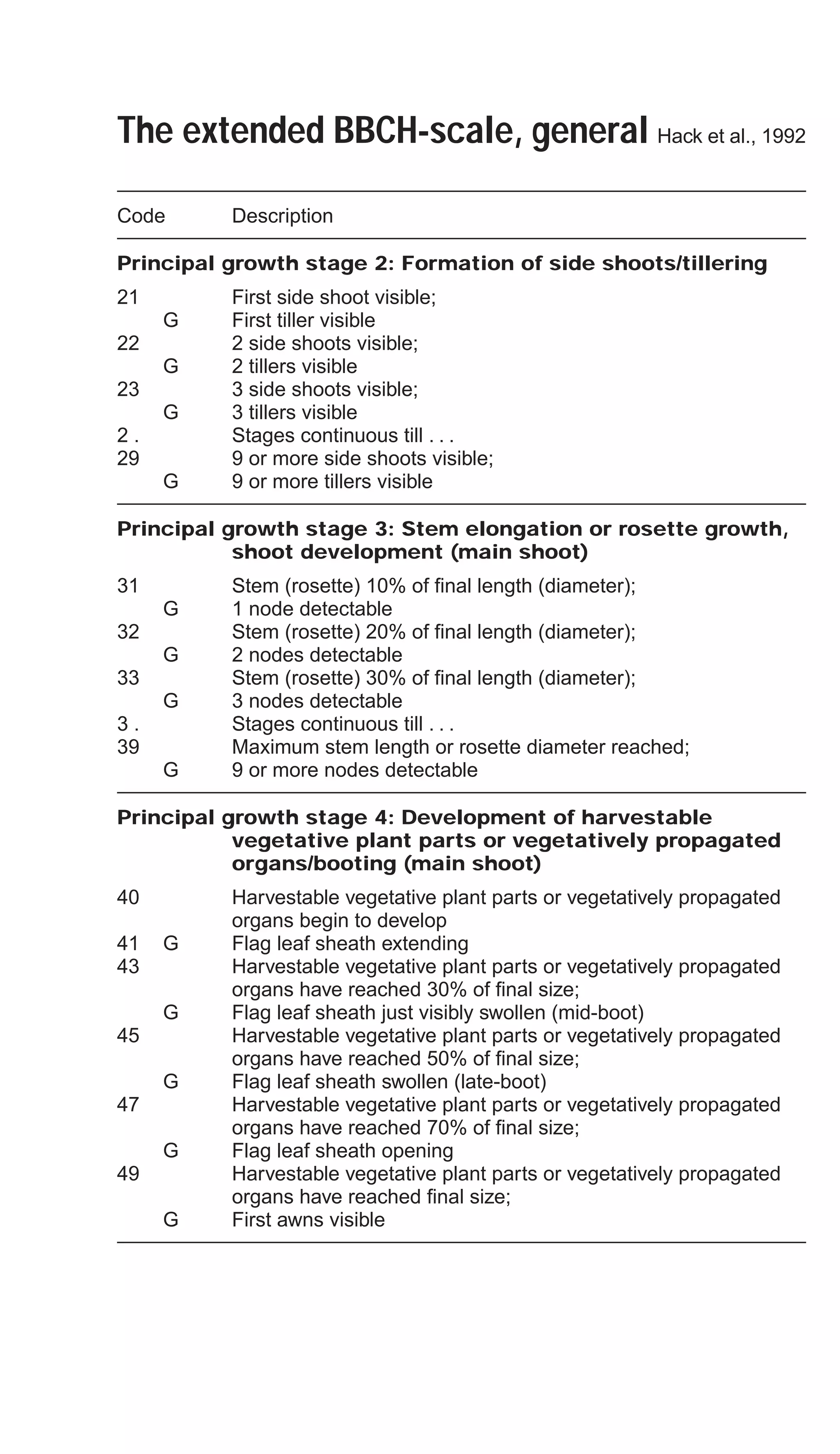
Principal growth stage 2: Formation of side shoots/tillering
21 First side shoot visible;
G First tiller visible
22 2 side shoots visible;
G 2 tillers visible
23 3 side shoots visible;
G 3 tillers visible
2 . Stages continuous till . . .
29 9 or more side shoots visible;
G 9 or more tillers visible
Principal growth stage 3: Stem elongation or rosette growth,
shoot development (main shoot)
31 Stem (rosette) 10% of final length (diameter);
G 1 node detectable
32 Stem (rosette) 20% of final length (diameter);
G 2 nodes detectable
33 Stem (rosette) 30% of final length (diameter);
G 3 nodes detectable
3 . Stages continuous till . . .
39 Maximum stem length or rosette diameter reached;
G 9 or more nodes detectable
Principal growth stage 4: Development of harvestable
vegetative plant parts or vegetatively propagated
organs/booting (main shoot)
40 Harvestable vegetative plant parts or vegetatively propagated
organs begin to develop
41 G Flag leaf sheath extending
43 Harvestable vegetative plant parts or vegetatively propagated
organs have reached 30% of final size;
G Flag leaf sheath just visibly swollen (mid-boot)
45 Harvestable vegetative plant parts or vegetatively propagated
organs have reached 50% of final size;
G Flag leaf sheath swollen (late-boot)
47 Harvestable vegetative plant parts or vegetatively propagated
organs have reached 70% of final size;
G Flag leaf sheath opening
49 Harvestable vegetative plant parts or vegetatively propagated
organs have reached final size;
G First awns visible
The extended BBCH-scale, general Hack et al., 1992
Code Description
Principal growth stage 5: Inflorescence emergence
(main shoot) / heading
51 Inflorescence or flower buds visible;
G Beginning of heading
55 First individual flowers visible (still closed);
G Half of inflorescence emerged (middle of heading)
59 First flower petals visible (in petalled forms);
G Inflorescence fully emerged (end of heading)
Principal growth stage 6: Flowering (main shoot)
60 First flowers open (sporadically)
61 Beginning of flowering: 10% of flowers open
62 20% of flowers open
63 30% of flowers open
64 40% of flowers open
65 Full flowering: 50% of flowers open, first petals may be fallen
67 Flowering finishing: majority of petals fallen or dry
69 End of flowering: fruit set visible
Principal growth stage 7: Development of fruit
71 10% of fruits have reached final size or fruit has reached
10% of final size1
G Caryopsis watery ripe
72 20% of fruits have reached final size or fruit has reached
20% of final size1
73 30% of fruits have reached final size or fruit has reached
30% of final size1
G Early milk
74 40% of fruits have reached final size or fruit has reached
40% of final size1
75 50% of fruits have reached final size or fruit has reached
50% of final size1
G Milky ripe, medium milk
76 60% of fruits have reached final size or fruit has reached
60% of final size1
77 70% of fruits have reached final size or fruit has reached
70% of final size1
G Late milk
78 80% of fruits have reached final size or fruit has reached
80% of final size1
79 Nearly all fruits have reached final size1
1
This stage is not used, if the main fruit growth happens in principal growth stage 8
The extended BBCH-scale, general Hack et al., 1992
Code Description
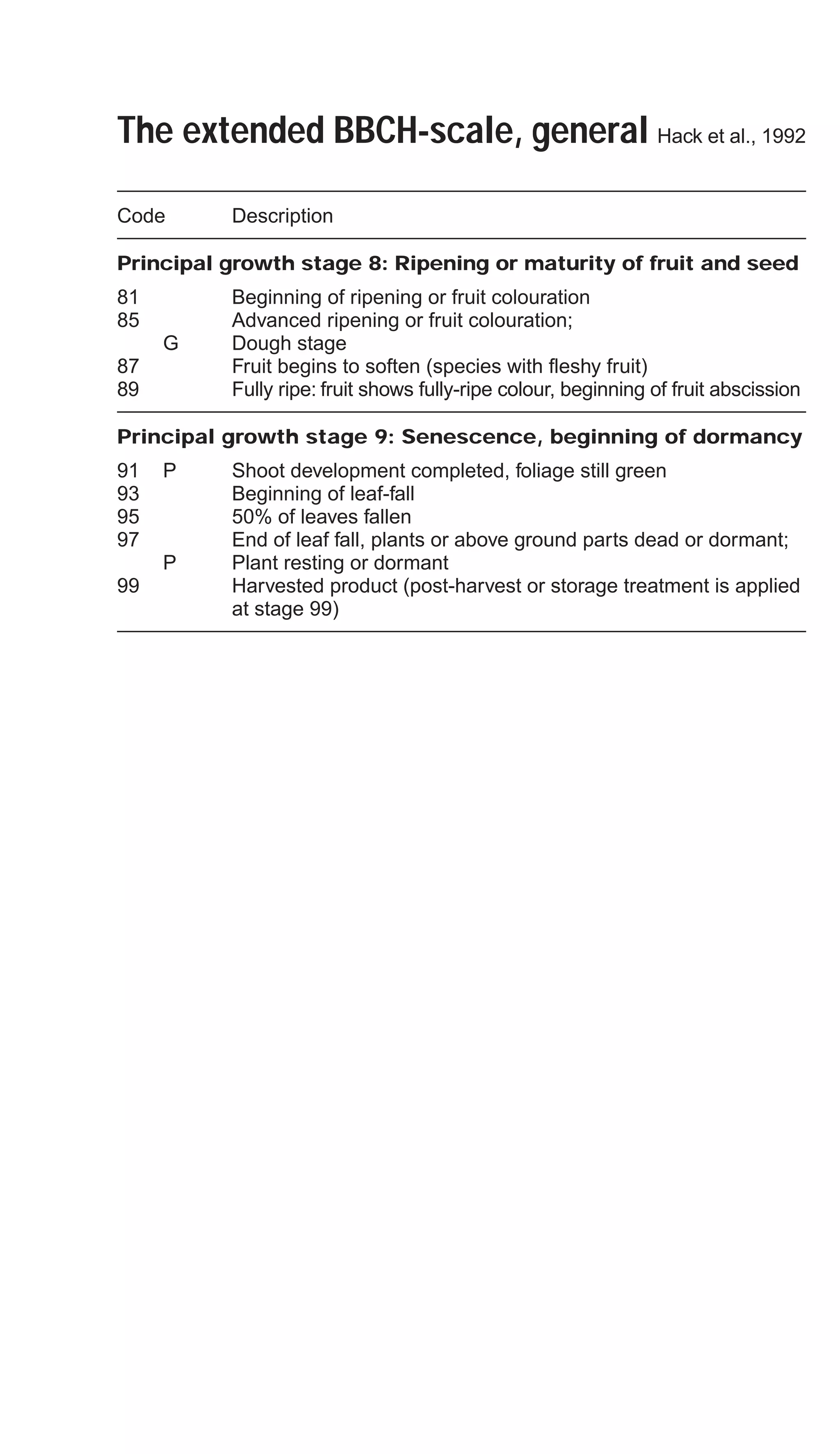
Principal growth stage 8: Ripening or maturity of fruit and seed
81 Beginning of ripening or fruit colouration
85 Advanced ripening or fruit colouration;
G Dough stage
87 Fruit begins to soften (species with fleshy fruit)
89 Fully ripe: fruit shows fully-ripe colour, beginning of fruit abscission
Principal growth stage 9: Senescence, beginning of dormancy
91 P Shoot development completed, foliage still green
93 Beginning of leaf-fall
95 50% of leaves fallen
97 End of leaf fall, plants or above ground parts dead or dormant;
P Plant resting or dormant
99 Harvested product (post-harvest or storage treatment is applied
at stage 99)
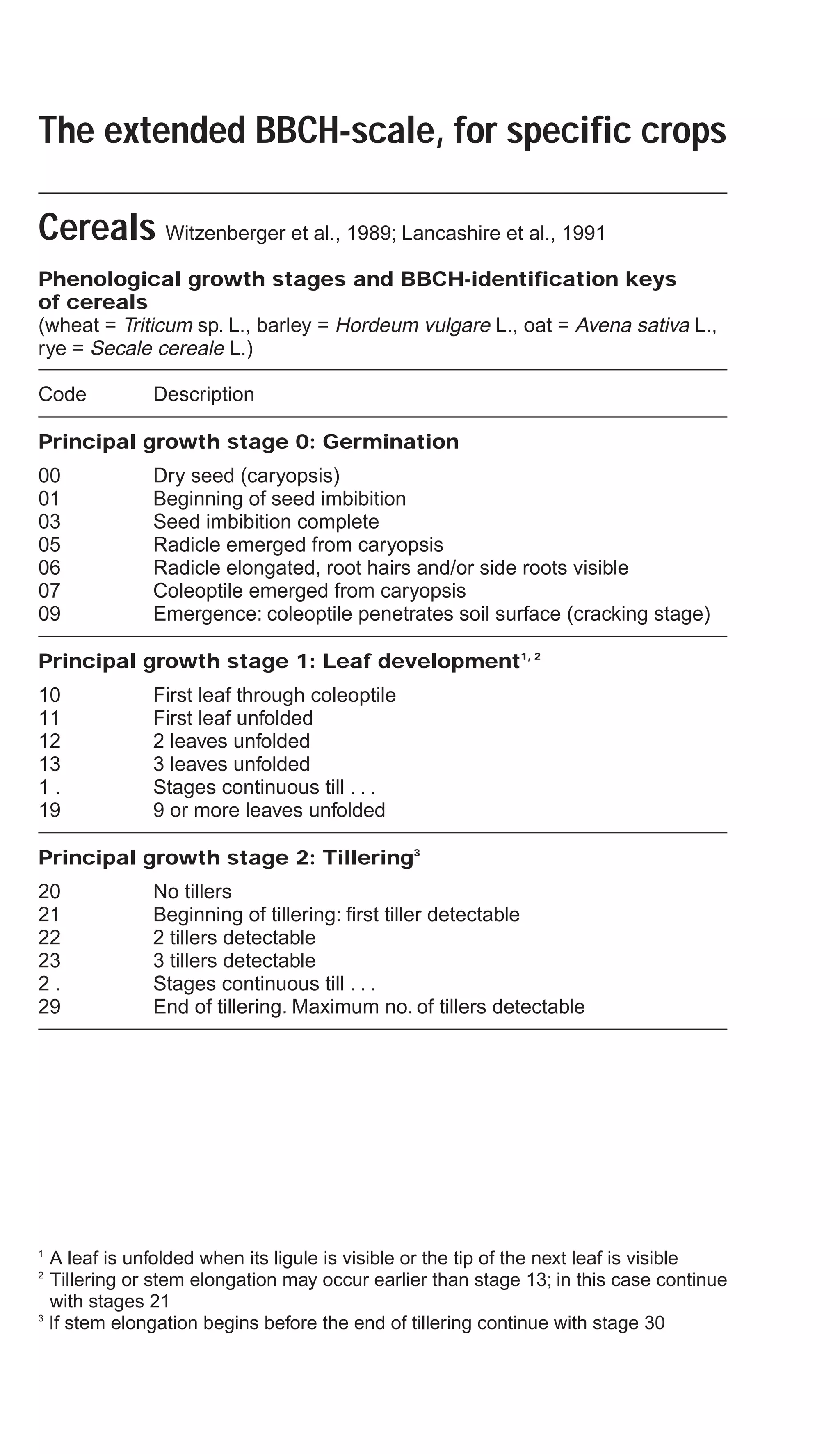
The extended BBCH-scale, for specific crops
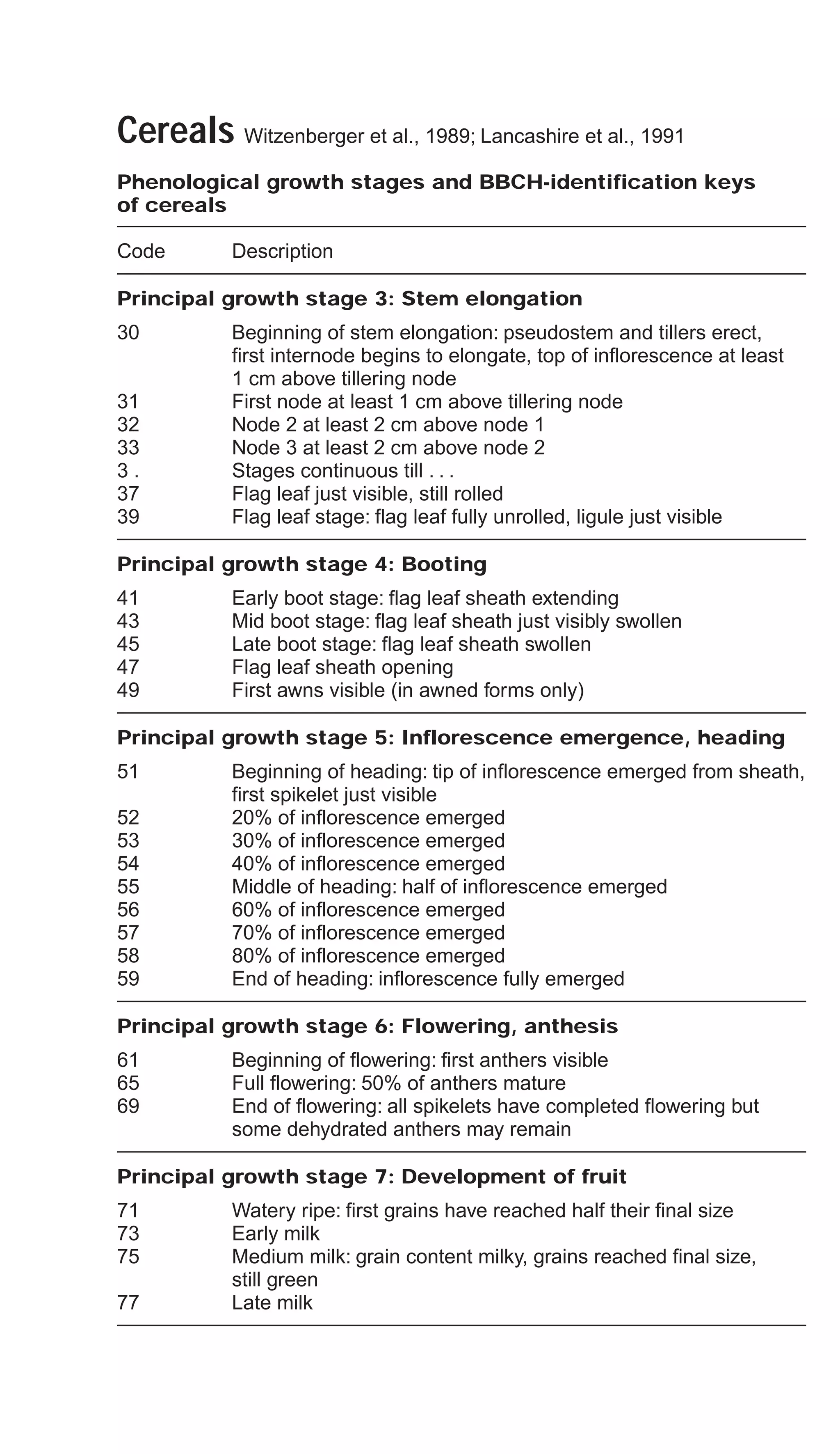
Cereals Witzenberger et al., 1989; Lancashire et al., 1991
Phenological growth stages and BBCH-identification keys
of cereals
(wheat = Triticum sp. L., barley = Hordeum vulgare L., oat = Avena sativa L.,
rye = Secale cereale L.)
Code Description
Principal growth stage 0: Germination
00 Dry seed (caryopsis)
01 Beginning of seed imbibition
03 Seed imbibition complete
05 Radicle emerged from caryopsis
06 Radicle elongated, root hairs and/or side roots visible
07 Coleoptile emerged from caryopsis
09 Emergence: coleoptile penetrates soil surface (cracking stage)
Principal growth stage 1: Leaf development1, 2
10 First leaf through coleoptile
11 First leaf unfolded
12 2 leaves unfolded
13 3 leaves unfolded
1 . Stages continuous till . . .
19 9 or more leaves unfolded
Principal growth stage 2: Tillering3
20 No tillers
21 Beginning of tillering: first tiller detectable
22 2 tillers detectable
23 3 tillers detectable
2 . Stages continuous till . . .
29 End of tillering. Maximum no. of tillers detectable
1
A leaf is unfolded when its ligule is visible or the tip of the next leaf is visible
2
Tillering or stem elongation may occur earlier than stage 13; in this case continue
with stages 21
3
If stem elongation begins before the end of tillering continue with stage 30
Cereals Witzenberger et al., 1989; Lancashire et al., 1991
Phenological growth stages and BBCH-identification keys
of cereals
Code Description
Principal growth stage 3: Stem elongation
30 Beginning of stem elongation: pseudostem and tillers erect,
first internode begins to elongate, top of inflorescence at least
1 cm above tillering node
31 First node at least 1 cm above tillering node
32 Node 2 at least 2 cm above node 1
33 Node 3 at least 2 cm above node 2
3 . Stages continuous till . . .
37 Flag leaf just visible, still rolled
39 Flag leaf stage: flag leaf fully unrolled, ligule just visible
Principal growth stage 4: Booting
41 Early boot stage: flag leaf sheath extending
43 Mid boot stage: flag leaf sheath just visibly swollen
45 Late boot stage: flag leaf sheath swollen
47 Flag leaf sheath opening
49 First awns visible (in awned forms only)
Principal growth stage 5: Inflorescence emergence, heading
51 Beginning of heading: tip of inflorescence emerged from sheath,
first spikelet just visible
52 20% of inflorescence emerged
53 30% of inflorescence emerged
54 40% of inflorescence emerged
55 Middle of heading: half of inflorescence emerged
56 60% of inflorescence emerged
57 70% of inflorescence emerged
58 80% of inflorescence emerged
59 End of heading: inflorescence fully emerged
Principal growth stage 6: Flowering, anthesis
61 Beginning of flowering: first anthers visible
65 Full flowering: 50% of anthers mature
69 End of flowering: all spikelets have completed flowering but
some dehydrated anthers may remain
Principal growth stage 7: Development of fruit
71 Watery ripe: first grains have reached half their final size
73 Early milk
75 Medium milk: grain content milky, grains reached final size,
still green
77 Late milk
Cereals Witzenberger et al., 1989; Lancashire et al., 1991
Phenological growth stages and BBCH-identification keys
of cereals
Code Description
Principal growth stage 8: Ripening
83 Early dough
85 Soft dough: grain content soft but dry. Fingernail impression not held
87 Hard dough: grain content solid. Fingernail impression held
89 Fully ripe: grain hard, difficult to divide with thumbnail
Principal growth stage 9: Senescence
92 Over-ripe: grain very hard, cannot be dented by thumbnail
93 Grains loosening in day-time
97 Plant dead and collapsing
99 Harvested product
Cereals
© 1989: Bayer
Cereals
Rice Lancashire et al., 1991
Phenological growth stages and BBCH-identification keys of rice
(Oryza sativa L.)
Code Description
Principal growth stage 0: Germination
00 Dry seed (caryopsis)
01 Beginning of seed imbibition
03 Seed imbibition complete (pigeon breast)
05 Radicle emerged from caryopsis
06 Radicle elongated, root hairs and/or side roots visible
07 Coleoptile emerged from caryopsis
(in water-rice this stage occurs before stage 05)
09 Imperfect leaf emerges (still rolled) at the tip of the coleoptile
Principal growth stage 1: Leaf development1, 2
10 Imperfect leaf unrolled, tip of first true leaf visible
11 First leaf unfolded
12 2 leaves unfolded
13 3 leaves unfolded
1 . Stages continuous till . . .
19 9 or more leaves unfolded
Principal growth stage 2: Tillering3
21 Beginning of tillering: first tiller detectable
22 2 tillers detectable
23 3 tillers detectable
2 . Stages continuous till ...
29 Maximum number of tillers detectable
Principal growth stage 3: Stem elongation
30 Panicle initiation or green ring stage: chlorophyll accumulates
in the stem tissue, forming a green ring
32 Panicle formation: panicle 1–2 mm in length
34 Internode elongation or jointing stage: internodes begin to
elongate, panicle more than 2 mm long (variety-dependent)
37 Flag leaf just visible, still rolled, panicle moving upwards
39 Flag leaf stage: flag leaf unfolded, collar regions (auricle and
ligule) of flag leaf and penultimate leaf aligned (pre-boot stage)
1
A leaf is unfolded when its ligule is visible or the tip of the next leaf is visible
2
Tillering or stem elongation may occur earlier than stage 13; in this case continue
with stages 21 or 30
3
If stem elongation begins before the end of tillering continue with stage 30
Rice Lancashire et al., 1991
Phenological growth stages and BBCH-identification keys of rice
Code Description
Principal growth stage 4: Booting
41 Early boot stage: upper part of stem slightly thickened,
sheath of flag leaf about 5 cm out of penultimate leaf sheath
43 Mid boot stage: sheath of flag leaf 5–10 cm out of the
penultimate leaf sheath
45 Late boot stage: flag leaf sheath swollen, sheath of flag leaf
more than 10 cm out of penultimate leaf sheath
47 Flag leaf sheath opening
49 Flag leaf sheath open
Principal growth stage 5: Inflorescence emergence, heading4
51 Beginning of panicle emergence: tip of inflorescence emerged
from sheath
52 20% of panicle emerged
53 30% of panicle emerged
54 40% of panicle emerged
55 Middle of panicle emergence: neck node still in sheath
56 60% of panicle emerged
57 70% of panicle emerged
58 80% of panicle emerged
59 End of panicle emergence: neck node level with the flag leaf
auricle, anthers not yet visible
Principal growth stage 6: Flowering, anthesis
61 Beginning of flowering: anthers visible at top of panicle
65 Full flowering: anthers visible on most spikelets
69 End of flowering: all spikelets have completed flowering but
some dehydrated anthers may remain
Principal growth stage 7: Development of fruit
71 Watery ripe: first grains have reached half their final size
73 Early milk
75 Medium milk: grain content milky
77 Late milk
Principal growth stage 8: Ripening
83 Early dough
85 Soft dough: grain content soft but dry, fingernail impression
not held, grains and glumes still green
87 Hard dough: grain content solid, fingernail impression held
89 Fully ripe: grain hard, difficult to divide with thumbnail
4
Flowering usually starts before stage 55; continue with principal stage 6
Rice Lancashire et al., 1991
Phenological growth stages and BBCH-identification keys of rice
Code Description
Principal growth stage 9: Senescence
92 Over-ripe: grain very hard, cannot be dented by thumbnail
97 Plant dead and collapsing
99 Harvested product
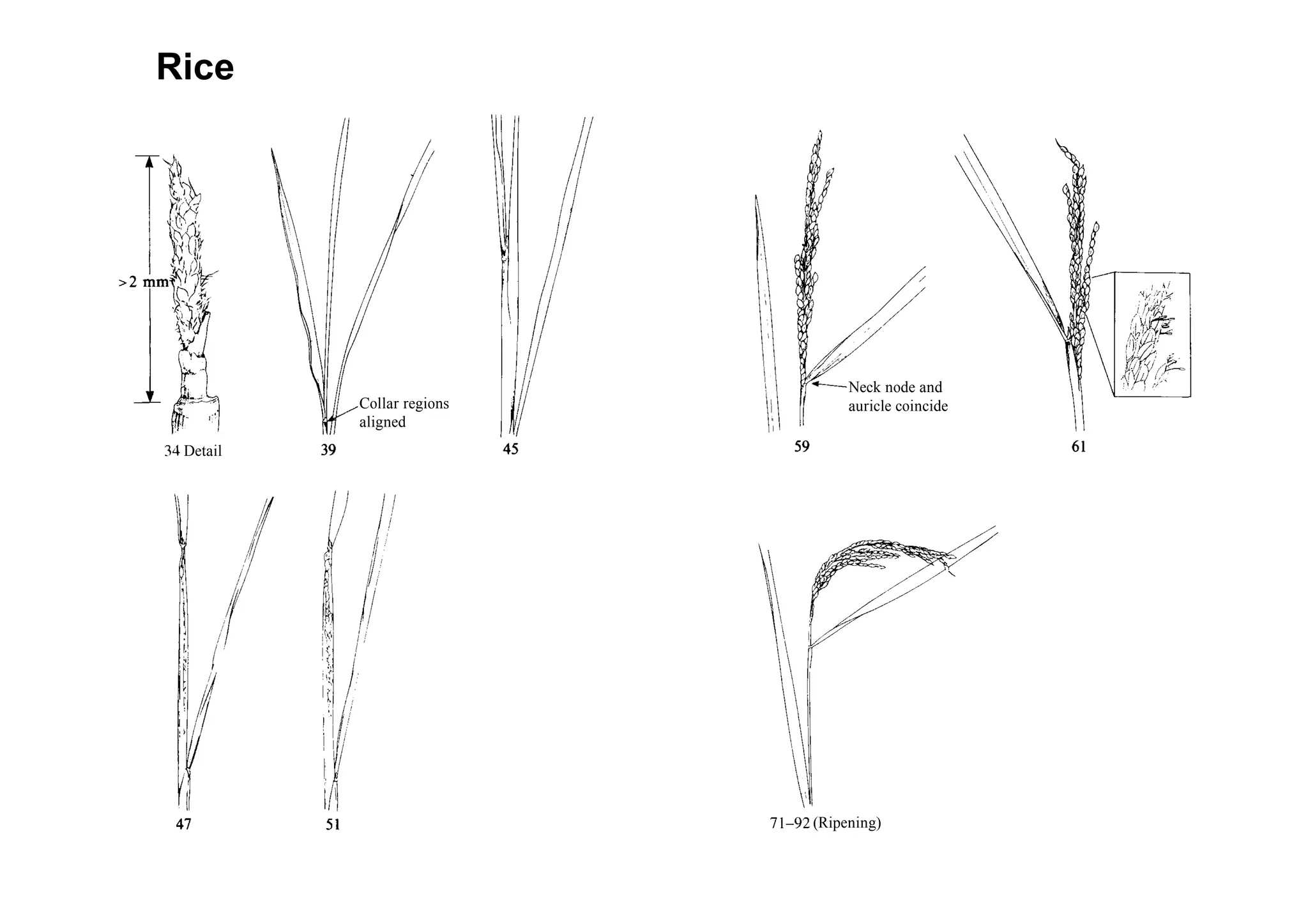
Rice
© 1989: Bayer
Detail
Rice
Collar regions
aligned
Detail
Neck node and
auricle coincide
(Ripening)
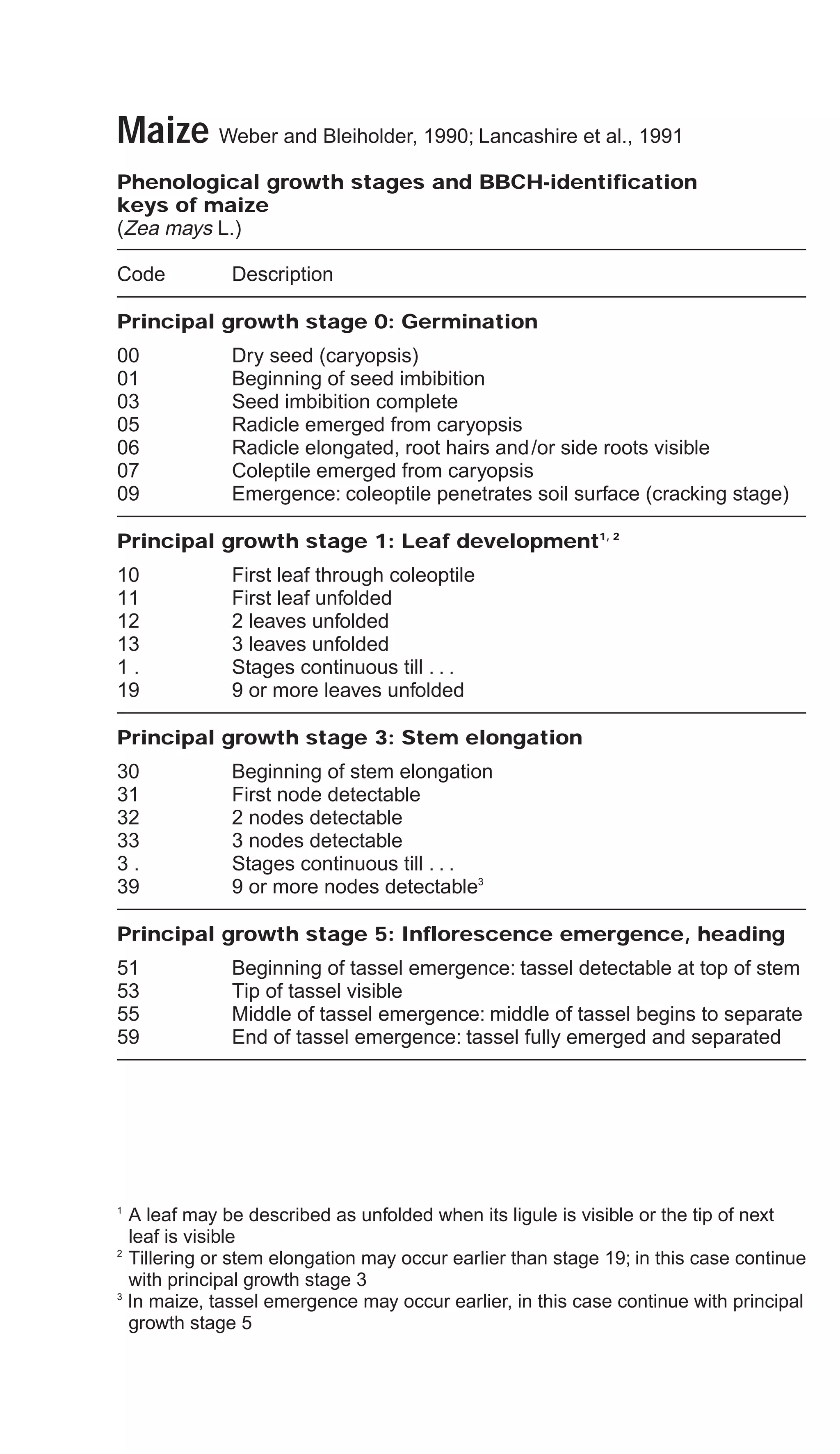
Maize Weber and Bleiholder, 1990; Lancashire et al., 1991
Phenological growth stages and BBCH-identification
keys of maize
(Zea mays L.)
Code Description
Principal growth stage 0: Germination
00 Dry seed (caryopsis)
01 Beginning of seed imbibition
03 Seed imbibition complete
05 Radicle emerged from caryopsis
06 Radicle elongated, root hairs and/or side roots visible
07 Coleptile emerged from caryopsis
09 Emergence: coleoptile penetrates soil surface (cracking stage)
Principal growth stage 1: Leaf development1, 2
10 First leaf through coleoptile
11 First leaf unfolded
12 2 leaves unfolded
13 3 leaves unfolded
1 . Stages continuous till . . .
19 9 or more leaves unfolded
Principal growth stage 3: Stem elongation
30 Beginning of stem elongation
31 First node detectable
32 2 nodes detectable
33 3 nodes detectable
3 . Stages continuous till . . .
39 9 or more nodes detectable3
Principal growth stage 5: Inflorescence emergence, heading
51 Beginning of tassel emergence: tassel detectable at top of stem
53 Tip of tassel visible
55 Middle of tassel emergence: middle of tassel begins to separate
59 End of tassel emergence: tassel fully emerged and separated
1
A leaf may be described as unfolded when its ligule is visible or the tip of next
leaf is visible
2
Tillering or stem elongation may occur earlier than stage 19; in this case continue
with principal growth stage 3
3
In maize, tassel emergence may occur earlier, in this case continue with principal
growth stage 5
Maize Weber and Bleiholder, 1990; Lancashire et al., 1991
Phenological growth stages and BBCH-identification
keys of maize
Code Description
Principal growth stage 6: Flowering, anthesis
61 Male: stamens in middle of tassel visible
Female: tip of ear emerging from leaf sheath
63 Male: beginning of pollen shedding
Female: tips of stigmata visible
65 Male: upper and lower parts of tassel in flower
Female: stigmata fully emerged
67 Male: flowering completed
Female: stigmata drying
69 End of flowering: stigmata completely dry
Principal growth stage 7: Development of fruit
71 Beginning of grain development: kernels at blister stage, about
16% dry matter
73 Early milk
75 Kernels in middle of cob yellowish-white (variety-dependent),
content milky, about 40% dry matter
79 Nearly all kernels have reached final size
Principal growth stage 8: Ripening
83 Early dough: kernel content soft, about 45% dry matter
85 Dough stage: kernels yellowish to yellow (variety dependent),
about 55% dry matter
87 Physiological maturity: black dot/layer visible at base of kernels,
about 60% dry matter
89 Fully ripe: kernels hard and shiny, about 65% dry matter
Principal growth stage 9: Senescence
97 Plant dead and collapsing
99 Harvested product
Maize
© 1989: BASF AG
Maize
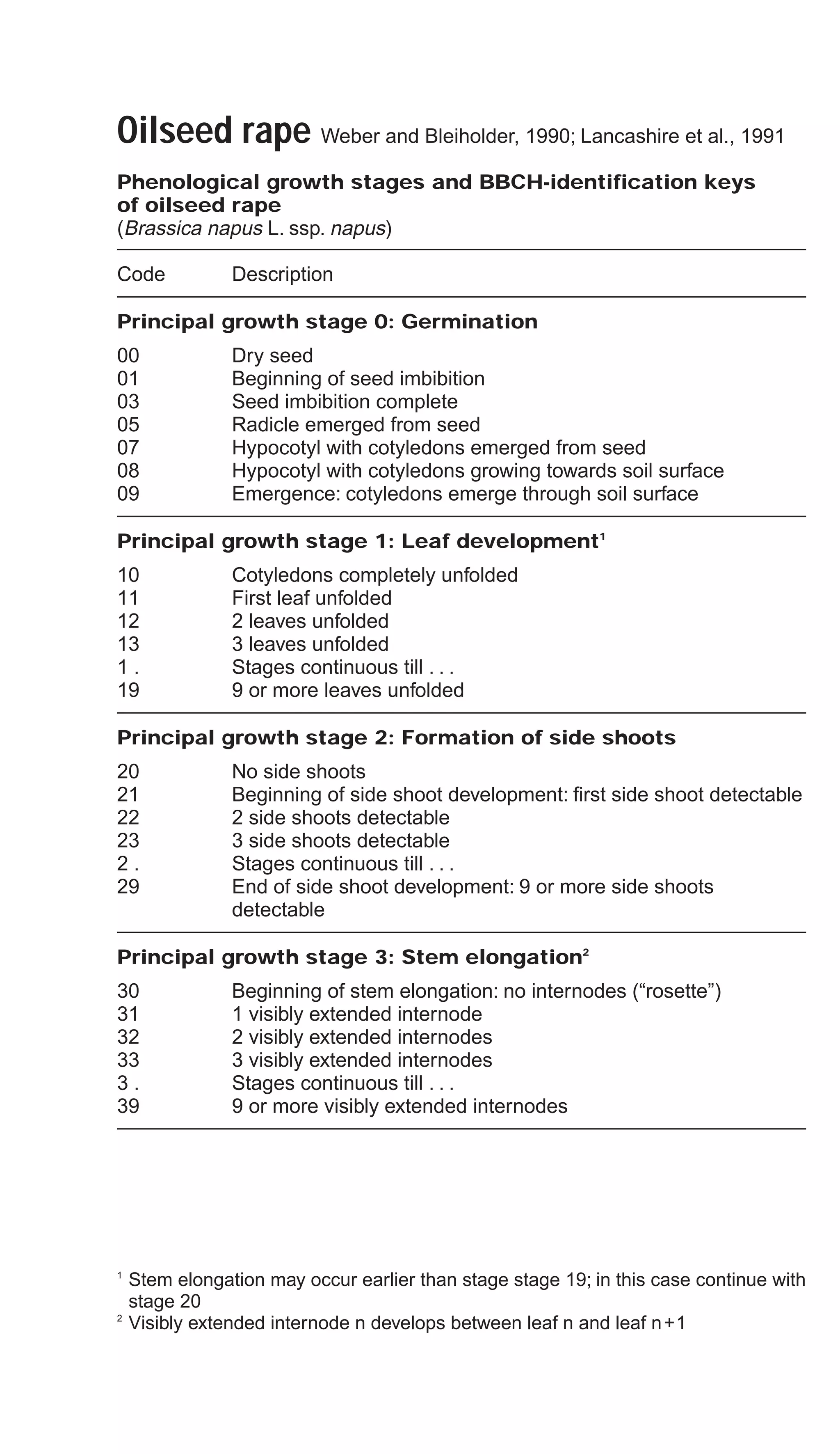
Oilseed rape Weber and Bleiholder, 1990; Lancashire et al., 1991
Phenological growth stages and BBCH-identification keys
of oilseed rape
(Brassica napus L. ssp. napus)
Code Description
Principal growth stage 0: Germination
00 Dry seed
01 Beginning of seed imbibition
03 Seed imbibition complete
05 Radicle emerged from seed
07 Hypocotyl with cotyledons emerged from seed
08 Hypocotyl with cotyledons growing towards soil surface
09 Emergence: cotyledons emerge through soil surface
Principal growth stage 1: Leaf development1
10 Cotyledons completely unfolded
11 First leaf unfolded
12 2 leaves unfolded
13 3 leaves unfolded
1 . Stages continuous till . . .
19 9 or more leaves unfolded
Principal growth stage 2: Formation of side shoots
20 No side shoots
21 Beginning of side shoot development: first side shoot detectable
22 2 side shoots detectable
23 3 side shoots detectable
2 . Stages continuous till . . .
29 End of side shoot development: 9 or more side shoots
detectable
Principal growth stage 3: Stem elongation2
30 Beginning of stem elongation: no internodes (“rosette”)
31 1 visibly extended internode
32 2 visibly extended internodes
33 3 visibly extended internodes
3 . Stages continuous till . . .
39 9 or more visibly extended internodes
1
Stem elongation may occur earlier than stage stage 19; in this case continue with
stage 20
2
Visibly extended internode n develops between leaf n and leaf n+1
Oilseed rape Weber and Bleiholder, 1990; Lancashire et al., 1991
Phenological growth stages and BBCH-identification keys
of oilseed rape
Code Description
Principal growth stage 5: Inflorescence emergence
50 Flower buds present, still enclosed by leaves
51 Flower buds visible from above (“green bud”)
52 Flower buds free, level with the youngest leaves
53 Flower buds raised above the youngest leaves
55 Individual flower buds (main inflorescence) visible but still closed
57 Individual flower buds (secondary inflorescences) visible but still
closed
59 First petals visible, flower buds still closed (“yellow bud”)
Principal growth stage 6: Flowering
60 First flowers open
61 10% of flowers on main raceme open, main raceme elongating
62 20% of flowers on main raceme open
63 30% of flowers on main raceme open
64 40% of flowers on main raceme open
65 Full flowering: 50% flowers on main raceme open,
older petals falling
67 Flowering declining: majority of petals fallen
69 End of flowering
Principal growth stage 7: Development of fruit
71 10% of pods have reached final size
72 20% of pods have reached final size
73 30% of pods have reached final size
74 40% of pods have reached final size
75 50% of pods have reached final size
76 60% of pods have reached final size
77 70% of pods have reached final size
78 80% of pods have reached final size
79 Nearly all pods have reached final size
Oilseed rape Weber and Bleiholder, 1990; Lancashire et al., 1991
Phenological growth stages and BBCH-identification keys
of oilseed rape
Code Description
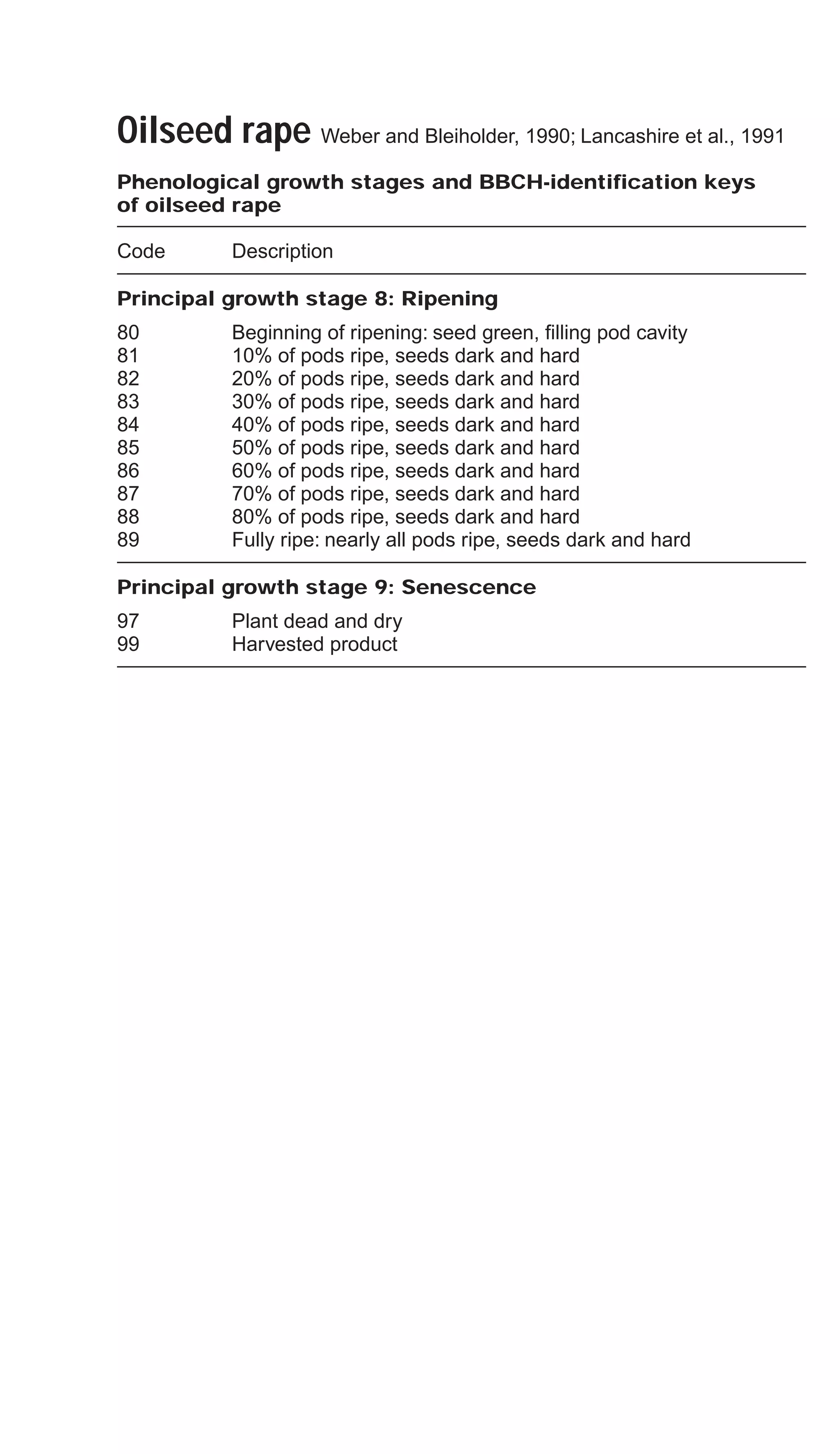
Principal growth stage 8: Ripening
80 Beginning of ripening: seed green, filling pod cavity
81 10% of pods ripe, seeds dark and hard
82 20% of pods ripe, seeds dark and hard
83 30% of pods ripe, seeds dark and hard
84 40% of pods ripe, seeds dark and hard
85 50% of pods ripe, seeds dark and hard
86 60% of pods ripe, seeds dark and hard
87 70% of pods ripe, seeds dark and hard
88 80% of pods ripe, seeds dark and hard
89 Fully ripe: nearly all pods ripe, seeds dark and hard
Principal growth stage 9: Senescence
97 Plant dead and dry
99 Harvested product
Oilseed rape
© 1990: BASF AG
51 (Detail)
Oilseed rape
53 (Detail)
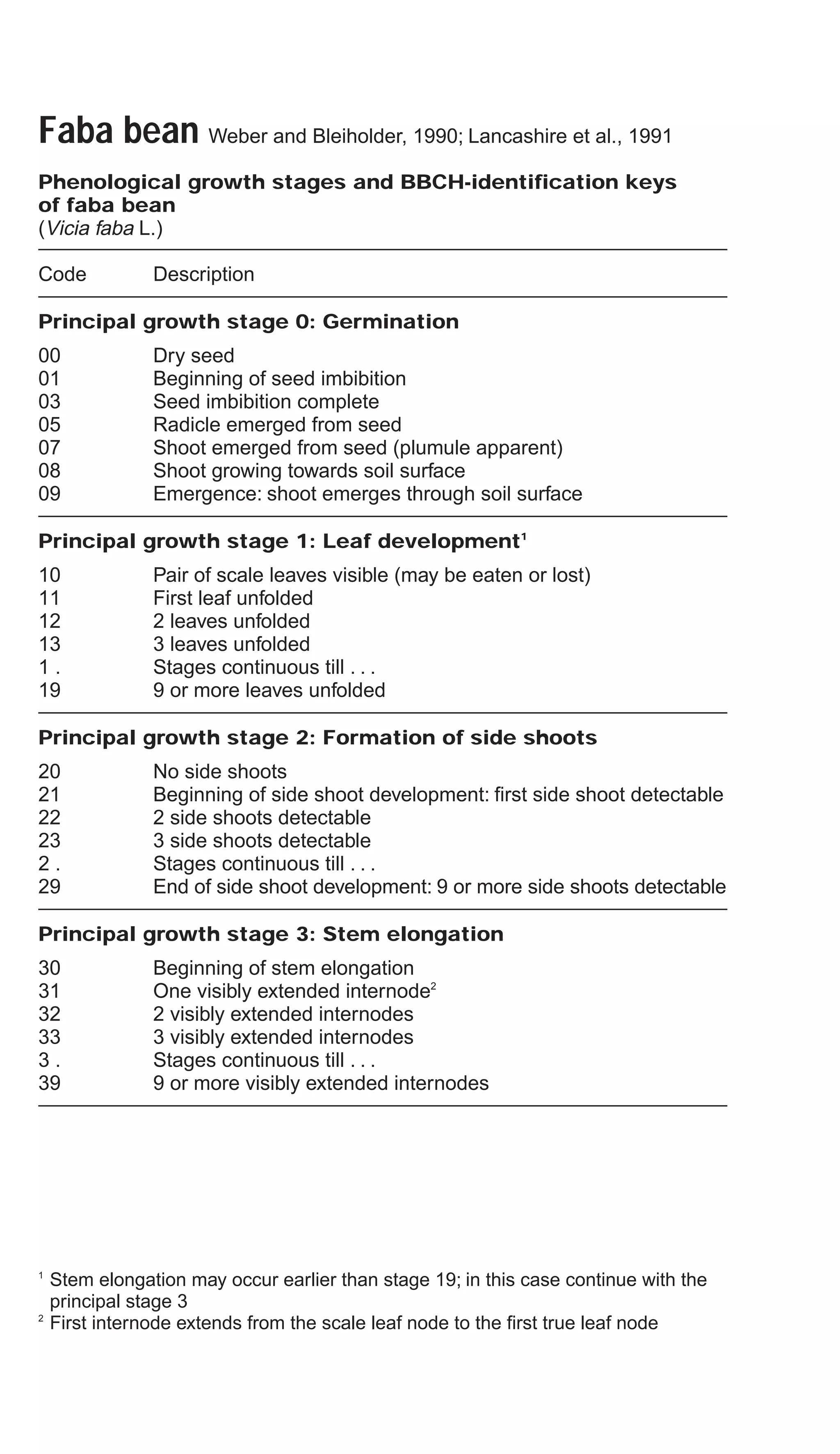
Faba bean Weber and Bleiholder, 1990; Lancashire et al., 1991
Phenological growth stages and BBCH-identification keys
of faba bean
(Vicia faba L.)
Code Description
Principal growth stage 0: Germination
00 Dry seed
01 Beginning of seed imbibition
03 Seed imbibition complete
05 Radicle emerged from seed
07 Shoot emerged from seed (plumule apparent)
08 Shoot growing towards soil surface
09 Emergence: shoot emerges through soil surface
Principal growth stage 1: Leaf development1
10 Pair of scale leaves visible (may be eaten or lost)
11 First leaf unfolded
12 2 leaves unfolded
13 3 leaves unfolded
1 . Stages continuous till . . .
19 9 or more leaves unfolded
Principal growth stage 2: Formation of side shoots
20 No side shoots
21 Beginning of side shoot development: first side shoot detectable
22 2 side shoots detectable
23 3 side shoots detectable
2 . Stages continuous till . . .
29 End of side shoot development: 9 or more side shoots detectable
Principal growth stage 3: Stem elongation
30 Beginning of stem elongation
31 One visibly extended internode2
32 2 visibly extended internodes
33 3 visibly extended internodes
3 . Stages continuous till . . .
39 9 or more visibly extended internodes
1
Stem elongation may occur earlier than stage 19; in this case continue with the
principal stage 3
2
First internode extends from the scale leaf node to the first true leaf node
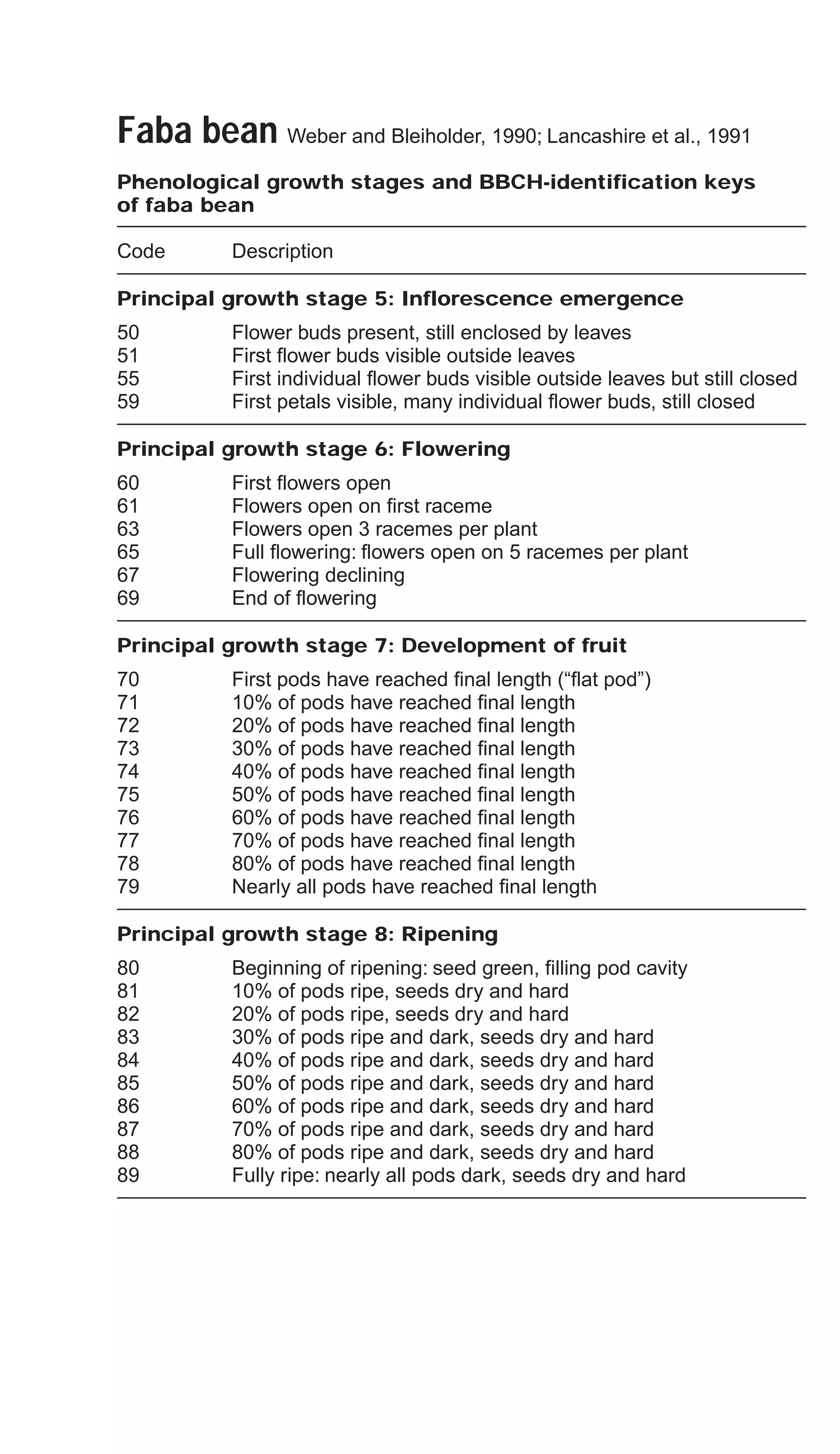
Faba bean Weber and Bleiholder, 1990; Lancashire et al., 1991
Phenological growth stages and BBCH-identification keys
of faba bean
Code Description
Principal growth stage 5: Inflorescence emergence
50 Flower buds present, still enclosed by leaves
51 First flower buds visible outside leaves
55 First individual flower buds visible outside leaves but still closed
59 First petals visible, many individual flower buds, still closed
Principal growth stage 6: Flowering
60 First flowers open
61 Flowers open on first raceme
63 Flowers open 3 racemes per plant
65 Full flowering: flowers open on 5 racemes per plant
67 Flowering declining
69 End of flowering
Principal growth stage 7: Development of fruit
70 First pods have reached final length (“flat pod”)
71 10% of pods have reached final length
72 20% of pods have reached final length
73 30% of pods have reached final length
74 40% of pods have reached final length
75 50% of pods have reached final length
76 60% of pods have reached final length
77 70% of pods have reached final length
78 80% of pods have reached final length
79 Nearly all pods have reached final length
Principal growth stage 8: Ripening
80 Beginning of ripening: seed green, filling pod cavity
81 10% of pods ripe, seeds dry and hard
82 20% of pods ripe, seeds dry and hard
83 30% of pods ripe and dark, seeds dry and hard
84 40% of pods ripe and dark, seeds dry and hard
85 50% of pods ripe and dark, seeds dry and hard
86 60% of pods ripe and dark, seeds dry and hard
87 70% of pods ripe and dark, seeds dry and hard
88 80% of pods ripe and dark, seeds dry and hard
89 Fully ripe: nearly all pods dark, seeds dry and hard
Faba bean Weber and Bleiholder, 1990; Lancashire et al., 1991
Phenological growth stages and BBCH-identification keys
of faba bean
Code Description
Principal growth stage 9: Senescence
93 Stems begin to darken
95 50% of stems brown or black
97 Plant dead and dry
99 Harvested product
Faba bean
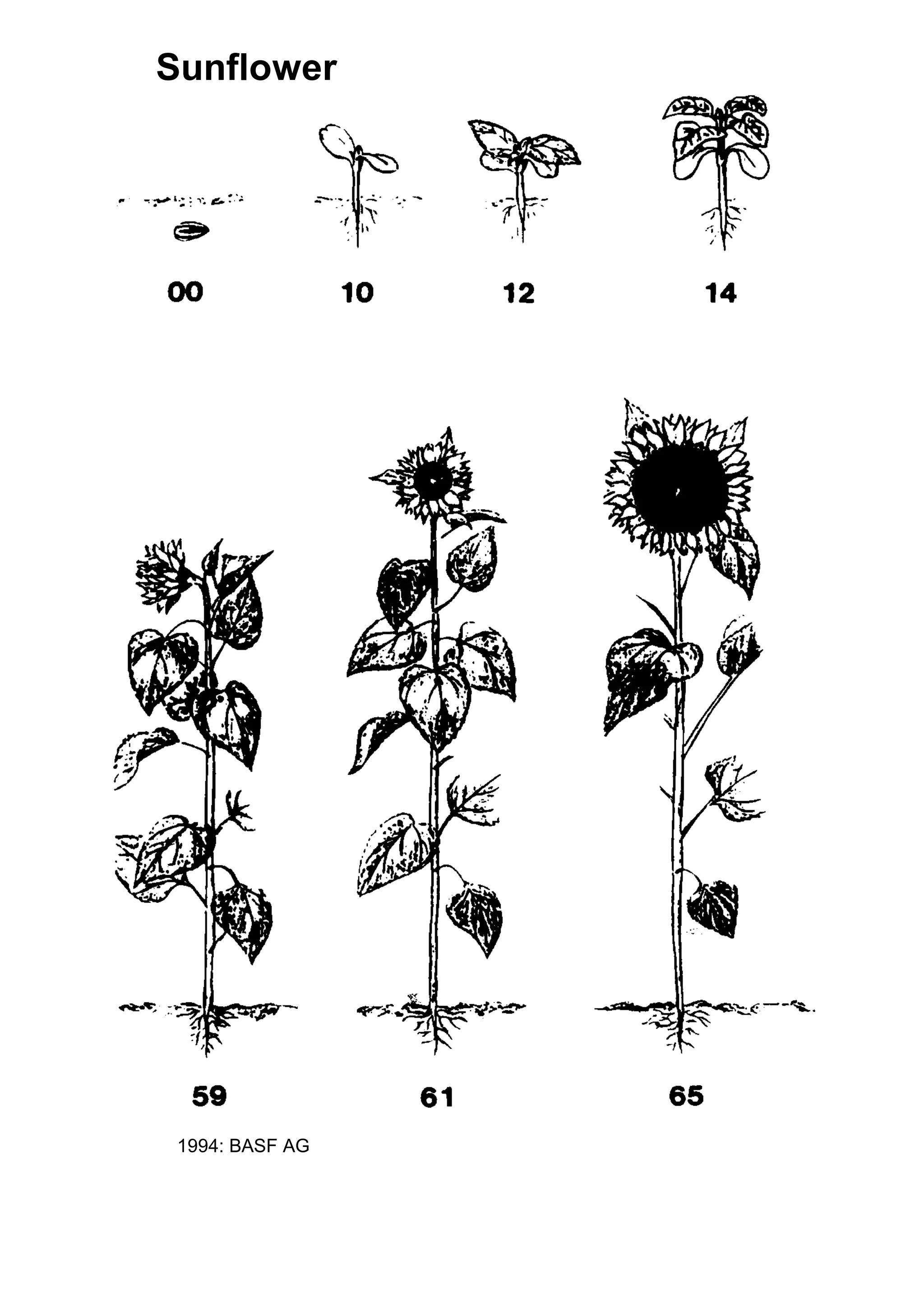
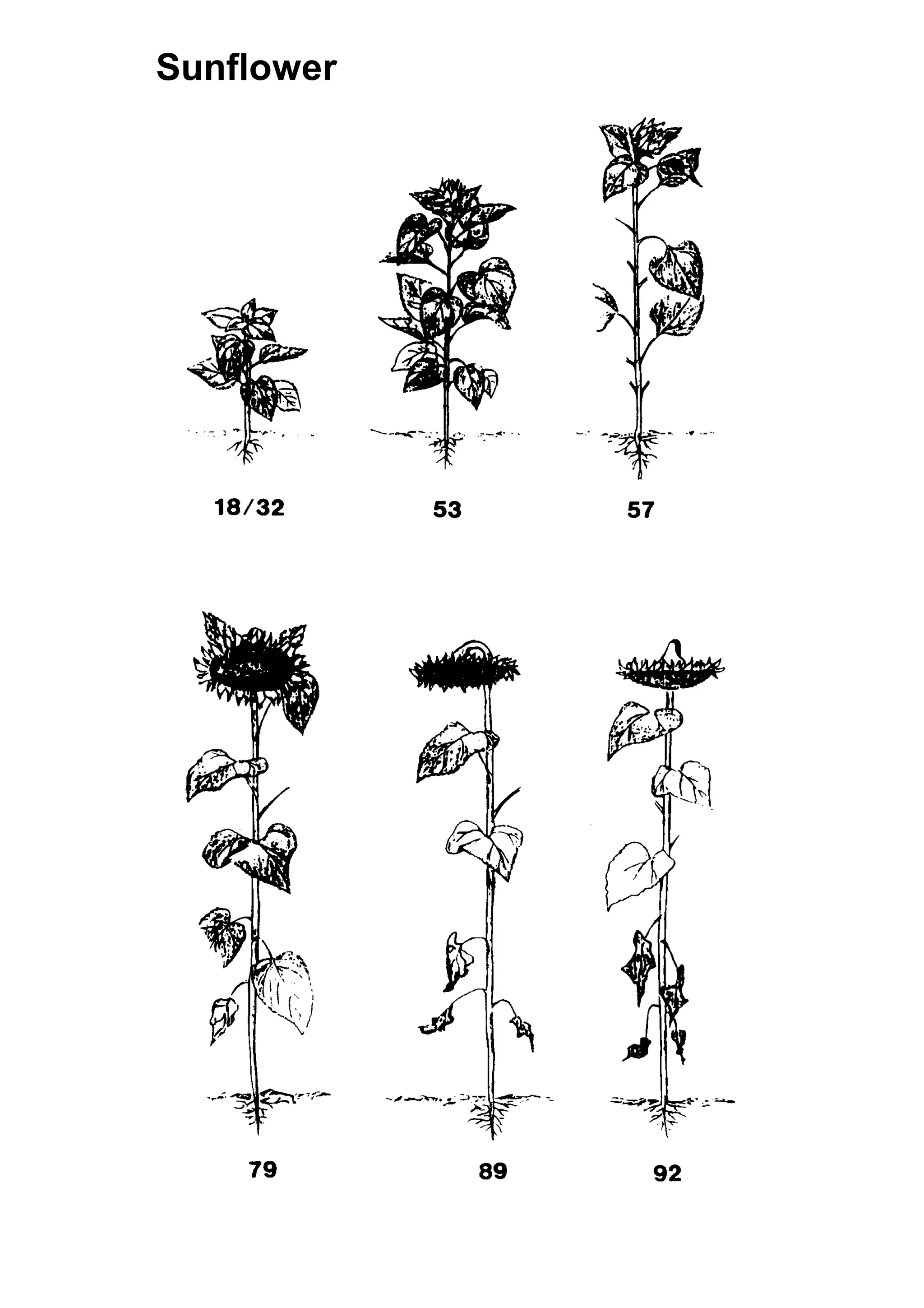
Sunflower Weber and Bleiholder, 1990; Lancashire et al., 1991
Phenological growth stages and BBCH-identification keys
of sunflower
(Helianthus annuus L.)
Code Description
Principal growth stage 0: Germination
00 Dry seed (achene)
01 Beginning of seed imbibition
03 Seed imbibition complete
05 Radicle emerged from seed
06 Radicle elongated, root hairs developing
07 Hypocotyl with cotyledons emerged from seed
08 Hypocotyl with cotyledons growing towards soil surface
09 Emergence: cotyledons emerge through soil surface
Principal growth stage 1: Leaf development1
10 Cotyledons completely unfolded
12 2 leaves (first pair) unfolded
14 4 leaves (second pair) unfolded
15 5 leaves unfolded
16 6 leaves unfolded
17 7 leaves unfolded
18 8 leaves unfolded
19 9 or more leaves unfolded
Principal growth stage 3: Stem elongation
30 Beginning of stem elongation
31 1 visibly extended internode
32 2 visibly extended internodes
33 3 visibly extended internodes
3 . Stages continuous till . . .
39 9 or more visibly extended internodes
Principal growth stage 5: Inflorescence emergence
51 Inflorescence just visible between youngest leaves
53 Inflorescence separating from youngest leaves, bracts
distinguishable from foliage leaves
55 Inflorescence separated from youngest foliage leaf
57 Inflorescence clearly separated from foliage leaves
59 Ray florets visible between the bracts; inflorescence still closed
1
Stem elongation may occur earlier than stage 19; in this case continue with the
principal stage 3
Sunflower Weber and Bleiholder, 1990; Lancashire et al., 1991
Phenological growth stages and BBCH-identification keys
of sunflower
Code Description
Principal growth stage 6: Flowering
61 Beginning of flowering: ray florets extended, disc florets visible
in outer third of inflorescence
63 Disc florets in outer third of inflorescence in bloom
(stamens and stigmata visible)
65 Full flowering: disc florets in middle third of inflorescence
in bloom (stames and stigmata visible)
67 Flowering declining: disc florets in inner third of inflorescence
in bloom (stames and stigmata visible)
69 End of flowering: most disc florets have finished flowering,
ray florets dry or fallen
Principal growth stage 7: Development of fruit
71 Seeds on outer edge of the inflorescence are grey and have
reached final size
73 Seeds on outer third of the inflorescence are grey and have
reached final size
75 Seeds on middle third of the inflorescence are grey and have
reached final size
79 Seeds on inner third of the inflorescence are grey and have
reached final size
Principal growth stage 8: Ripening
80 Beginning of ripening: seeds on outer third of anthocarp black
and hard. Back of anthocarp still green
81 Seeds on outer third of anthocarp dark and hard.
Back ofanthocarp still green
83 Dark of anthocarp yellowish-green, bracts still green.
Seeds about 50% dry matter
85 Seeds on middle third of anthocarp dark and hard.
Back of anthocarp yellow, bracts brown edged.
Seeds about 60% dry matter
87 Physiological ripeness: back of the anthocarp yellow.
Bracts marbled brown. Seeds about 75–80% dry matter
89 Fully ripe: seeds on inner third of anthocarp dark and hard.
Back of anthocarp brown. Bracts brown.
Seeds about 85% dry matter
Principal growth stage 9:
92 Over ripe, seeds over 90% dry matter
97 Plant dead and dry
99 Harvested product
Sunflower
© 1994: BASF AG
Sunflower
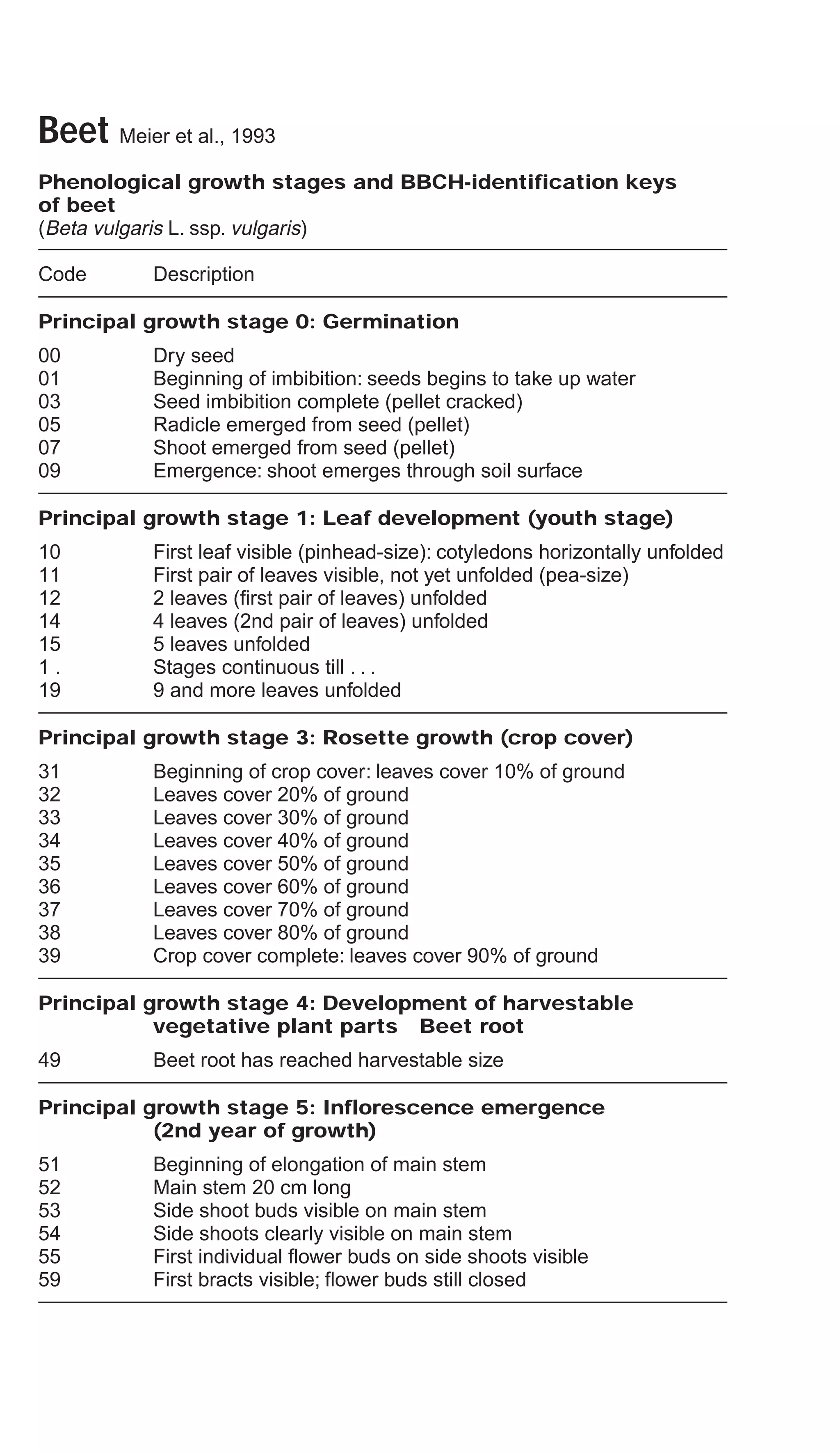
Beet Meier et al., 1993
Phenological growth stages and BBCH-identification keys
of beet
(Beta vulgaris L. ssp. vulgaris)
Code Description
Principal growth stage 0: Germination
00 Dry seed
01 Beginning of imbibition: seeds begins to take up water
03 Seed imbibition complete (pellet cracked)
05 Radicle emerged from seed (pellet)
07 Shoot emerged from seed (pellet)
09 Emergence: shoot emerges through soil surface
Principal growth stage 1: Leaf development (youth stage)
10 First leaf visible (pinhead-size): cotyledons horizontally unfolded
11 First pair of leaves visible, not yet unfolded (pea-size)
12 2 leaves (first pair of leaves) unfolded
14 4 leaves (2nd pair of leaves) unfolded
15 5 leaves unfolded
1 . Stages continuous till . . .
19 9 and more leaves unfolded
Principal growth stage 3: Rosette growth (crop cover)
31 Beginning of crop cover: leaves cover 10% of ground
32 Leaves cover 20% of ground
33 Leaves cover 30% of ground
34 Leaves cover 40% of ground
35 Leaves cover 50% of ground
36 Leaves cover 60% of ground
37 Leaves cover 70% of ground
38 Leaves cover 80% of ground
39 Crop cover complete: leaves cover 90% of ground
Principal growth stage 4: Development of harvestable
vegetative plant parts Beet root
49 Beet root has reached harvestable size
Principal growth stage 5: Inflorescence emergence
(2nd year of growth)
51 Beginning of elongation of main stem
52 Main stem 20 cm long
53 Side shoot buds visible on main stem
54 Side shoots clearly visible on main stem
55 First individual flower buds on side shoots visible
59 First bracts visible; flower buds still closed
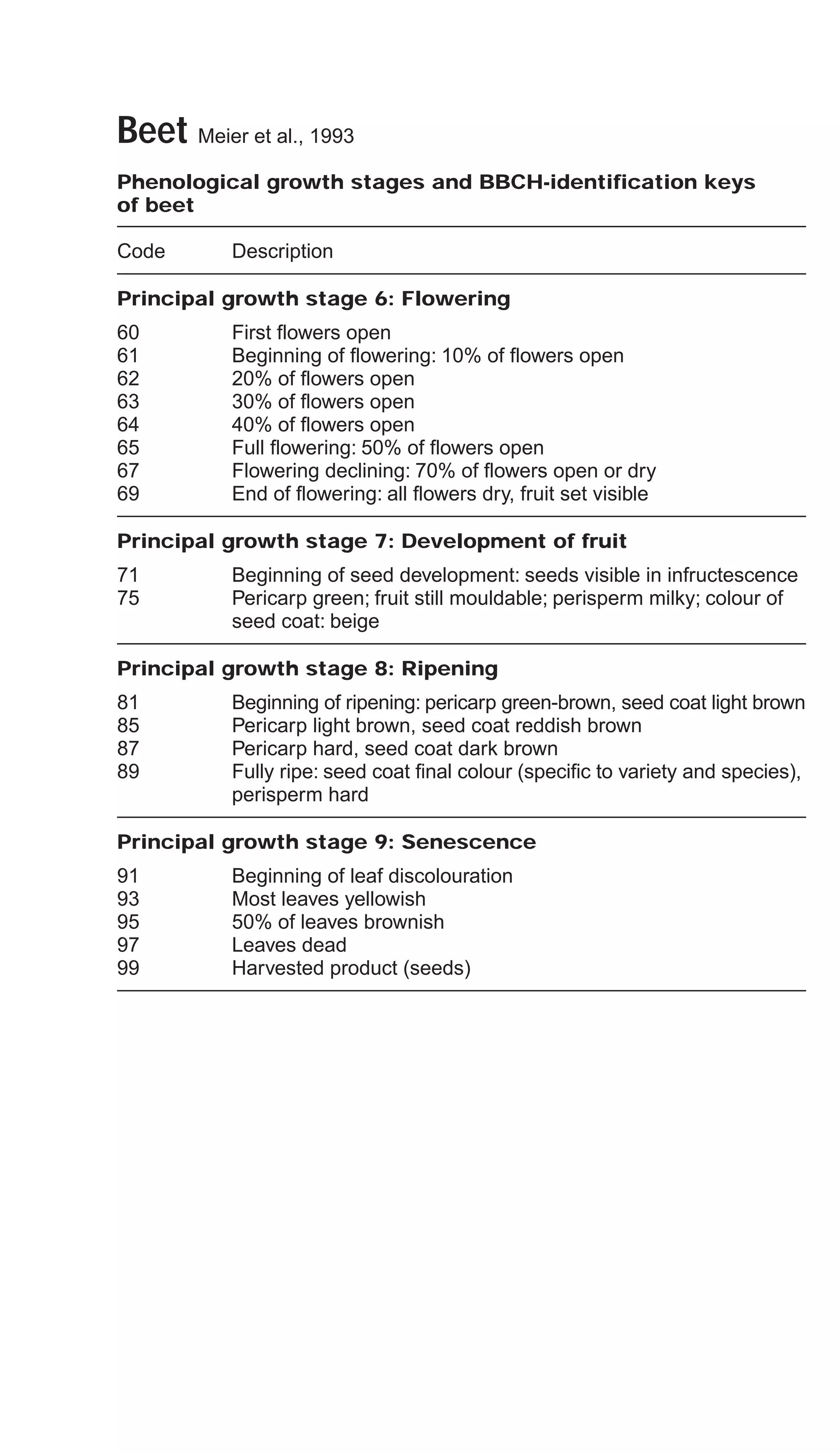
Beet Meier et al., 1993
Phenological growth stages and BBCH-identification keys
of beet
Code Description
Principal growth stage 6: Flowering
60 First flowers open
61 Beginning of flowering: 10% of flowers open
62 20% of flowers open
63 30% of flowers open
64 40% of flowers open
65 Full flowering: 50% of flowers open
67 Flowering declining: 70% of flowers open or dry
69 End of flowering: all flowers dry, fruit set visible
Principal growth stage 7: Development of fruit
71 Beginning of seed development: seeds visible in infructescence
75 Pericarp green; fruit still mouldable; perisperm milky; colour of
seed coat: beige
Principal growth stage 8: Ripening
81 Beginning of ripening: pericarp green-brown, seed coat light brown
85 Pericarp light brown, seed coat reddish brown
87 Pericarp hard, seed coat dark brown
89 Fully ripe: seed coat final colour (specific to variety and species),
perisperm hard
Principal growth stage 9: Senescence
91 Beginning of leaf discolouration
93 Most leaves yellowish
95 50% of leaves brownish
97 Leaves dead
99 Harvested product (seeds)
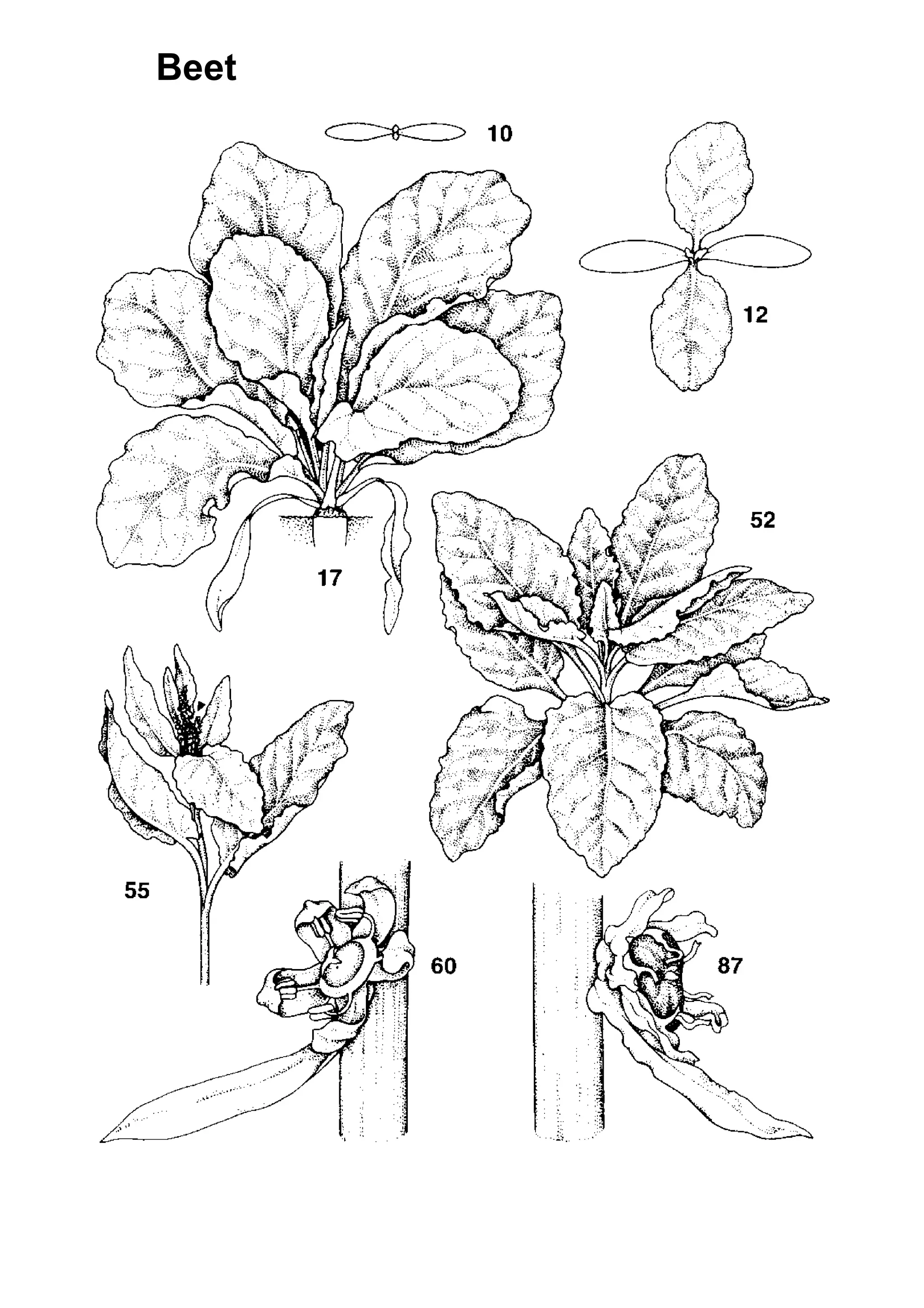
Beet
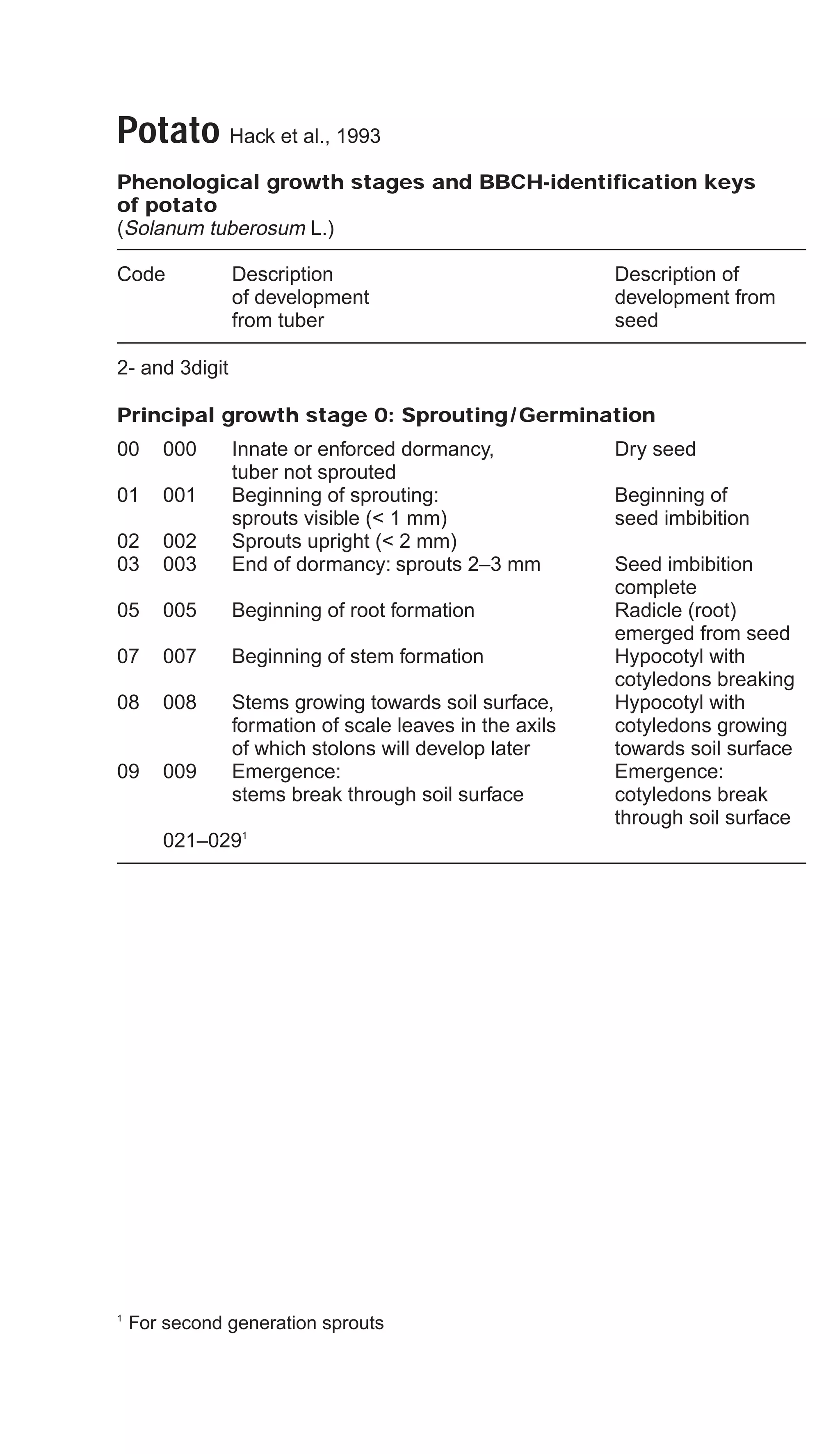
Potato Hack et al., 1993
Phenological growth stages and BBCH-identification keys
of potato
(Solanum tuberosum L.)
Code Description Description of
of development development from
from tuber seed
2- and 3digit
Principal growth stage 0: Sprouting/Germination
00 000 Innate or enforced dormancy, Dry seed
tuber not sprouted
01 001 Beginning of sprouting: Beginning of
sprouts visible (< 1 mm) seed imbibition
02 002 Sprouts upright (< 2 mm)
03 003 End of dormancy: sprouts 2–3 mm Seed imbibition
complete
05 005 Beginning of root formation Radicle (root)
emerged from seed
07 007 Beginning of stem formation Hypocotyl with
cotyledons breaking
08 008 Stems growing towards soil surface, Hypocotyl with
formation of scale leaves in the axils cotyledons growing
of which stolons will develop later towards soil surface
09 009 Emergence: Emergence:
stems break through soil surface cotyledons break
through soil surface
021–0291
1
For second generation sprouts
Potato Hack et al., 1993
Phenological growth stages and BBCH-identification keys
of potato
Code Description of development from tuber and seed
2- and 3digit
Principal growth stage 1: Leaf development
10 100 From tuber: first leaves begin to extend
From seed: cotyledons completely unfolded
11 101 1st leaf of main stem unfolded (> 4 cm)
12 102 2nd leaf of main stem unfolded (> 4 cm)
13 103 3rd leaf Auf main stem unfolded (> 4 cm)
1 . 10 . Stages continuous till . . .
19 109 9 or more leaves of main stem unfolded (> 4cm) (2digit);2
9 leaves of main stem unfolded (> 4 cm) (3digit)
110 10th leaf of main stem unfolded (> 4 cm)
11 . Stages continuous till . . .
119 19. leaf of main stem unfolded (> 4 cm)
121 First leaf of 2nd order branch above first inflorescence
unfolded (> 4 cm)
122 2nd leaf of 2nd order branch above first inflorescence
unfolded (> 4 cm)
12 . Stages continuous till . . .
131 First leaf of 3rd order branch above 2nd inflorescence
unfolded (> 4 cm)
132 2nd leaf of 3rd order branch above 2nd inflorescence
unfolded (> 4 cm)
13 . Stages continuous till . . .
1NX Xth leaf of nth order branch above n-1th inflorescence
unfolded (> 4 cm)
2
Stem development stops after termination of main stem by an inflorescence.
Branches arise from axils of upper leaves of the main stem, exhibiting a
sympodial branching pattern
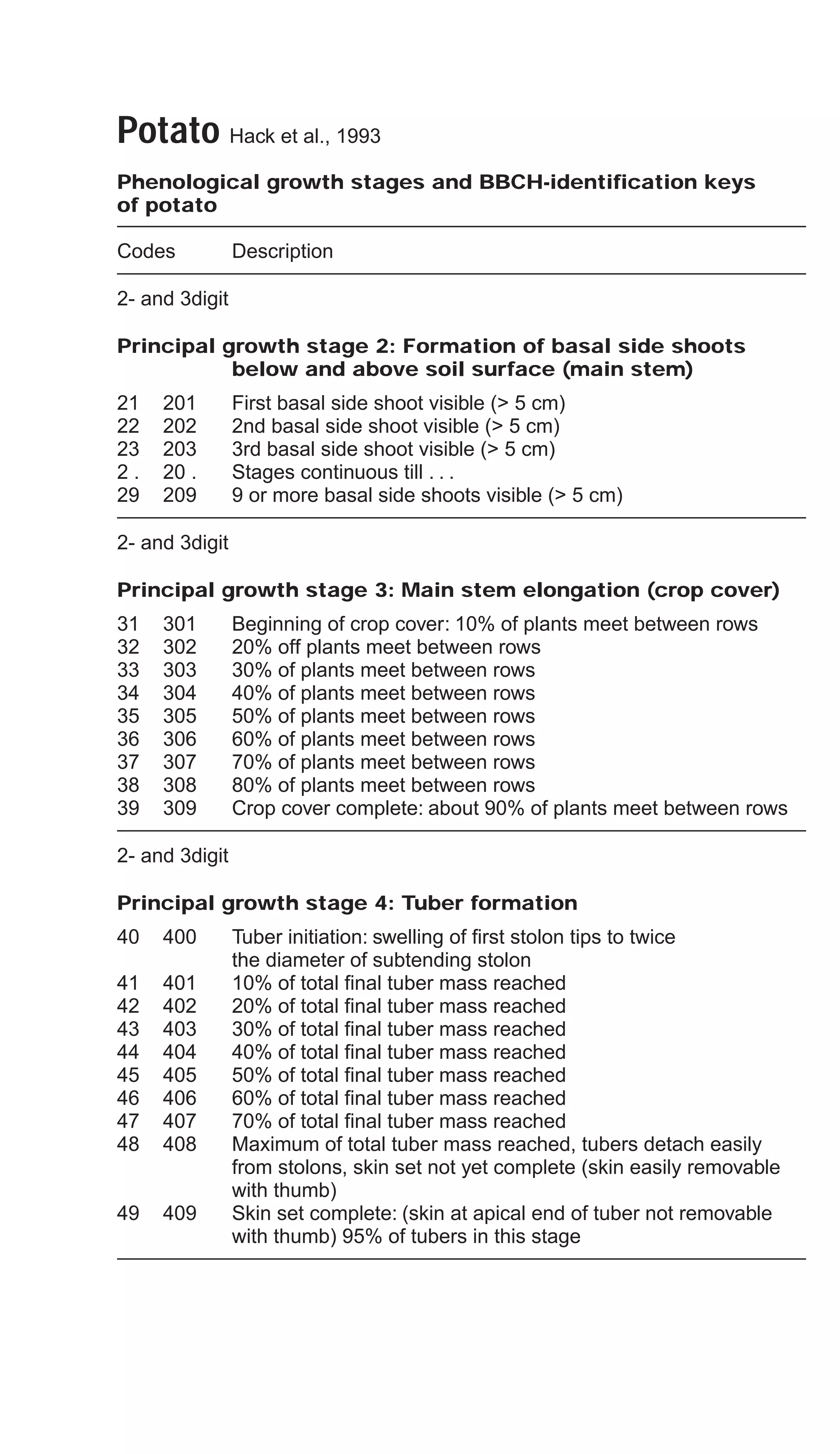
Potato Hack et al., 1993
Phenological growth stages and BBCH-identification keys
of potato
Codes Description
2- and 3digit
Principal growth stage 2: Formation of basal side shoots
below and above soil surface (main stem)
21 201 First basal side shoot visible (> 5 cm)
22 202 2nd basal side shoot visible (> 5 cm)
23 203 3rd basal side shoot visible (> 5 cm)
2 . 20 . Stages continuous till . . .
29 209 9 or more basal side shoots visible (> 5 cm)
2- and 3digit
Principal growth stage 3: Main stem elongation (crop cover)
31 301 Beginning of crop cover: 10% of plants meet between rows
32 302 20% off plants meet between rows
33 303 30% of plants meet between rows
34 304 40% of plants meet between rows
35 305 50% of plants meet between rows
36 306 60% of plants meet between rows
37 307 70% of plants meet between rows
38 308 80% of plants meet between rows
39 309 Crop cover complete: about 90% of plants meet between rows
2- and 3digit
Principal growth stage 4: Tuber formation
40 400 Tuber initiation: swelling of first stolon tips to twice
the diameter of subtending stolon
41 401 10% of total final tuber mass reached
42 402 20% of total final tuber mass reached
43 403 30% of total final tuber mass reached
44 404 40% of total final tuber mass reached
45 405 50% of total final tuber mass reached
46 406 60% of total final tuber mass reached
47 407 70% of total final tuber mass reached
48 408 Maximum of total tuber mass reached, tubers detach easily
from stolons, skin set not yet complete (skin easily removable
with thumb)
49 409 Skin set complete: (skin at apical end of tuber not removable
with thumb) 95% of tubers in this stage
Potato Hack et al., 1993
Phenological growth stages and BBCH-identification keys
of potato
Codes Description
2- and 3digit
Principal growth stage 5: Inflorescence (cyme) emergence
51 501 First individual buds (1–2 mm) of first inflorescence visible
(main stem)
55 505 Buds of first inflorescence extended to 5 mm
59 509 First flower petals of first inflorescence visible
2- and 3digit
Principal growth stage 5: Inflorescence emergence
(continuation)
521 Individual buds of 2nd inflorescence visible
(second order branch)
525 Buds of 2nd inflorescence extended to 5 mm open (main stem)
529 First flower petals of 2nd inflorescence visible above sepals
531 Individuell buds of 3rd inflorescence visible(3rd order branch)
535 Buds of 3rd inflorescence extended to 5 mm
539 First flower petals of 3rd inflorescence visible above sepals
5N . Nth inflorescence emerging
2- and 3digit
Principal growth stage 6: Flowering
60 600 First open flowers in population
61 601 Beginning of flowering: 10% of flowers in the first inflorescence
open (main stem)
62 602 20% of flowers in the first inflorescence open
63 603 30% of flowers in the first inflorescence open
64 604 40% of flowers in the first inflorescence open
65 605 Full flowering: 50% of flowers in the first inflorescence open
66 606 60% of flowers in the first inflorescence open
67 607 70% of flowers in the first inflorescence open
68 608 80% of flowers in the first inflorescence open
69 609 End of flowering in the first inflorescence
Potato Hack et al., 1993
Phenological growth stages and BBCH-identification keys
of potato
Codes Description
2- and 3digit
Principal growth stage 6: Flowering (continuation)
621 Beginning of flowering: 10% of flowers in the 2nd inflorescence
open (second order branch)
625 Full flowering: 50% of flowers in the 2nd inflorescence open
629 End of flowering in the 2nd inflorescence
631 Beginning of flowering: 10% of flowers in the 3rd inflorescence
open (third order branch)
635 Full flowering: 50% of flowers in the 3rd inflorescence open
639 End of flowering in the 3rd inflorescence
6N . Nth inflorescence flowering
6N9 End of flowering
2- and 3digit
Principal growth stage 7: Development of fruit
70 700 First berries visible
71 701 10% of berries in the first fructification have reached full size
(main stem)
72 702 20% of berries in the first fructification have reached full size
73 703 30% of berries in the first fructification have reached full size
7 . 70 . Stages continuous till . . .
721 10% of berries in the 2nd fructification have reached full size
(second order branch)
7N . Development of berries in nth fructification
7N9 Nearly all berries in the nth fructification have reached full size
(or have been shed)
2- and 3digit
Principal growth stage 8: Ripening of fruit and seed
81 801 Berries in the first fructification still green, seed light-coloured
(main stem)
85 805 Berries in the first fructification ochre-coloured or brownish
89 809 Berries in the first fructification shrivelled, seed dark
821 Berries in the 2nd fructification still green, seed light-coloured
(second order branch)
8N . Ripening of fruit and seed in nth fructification
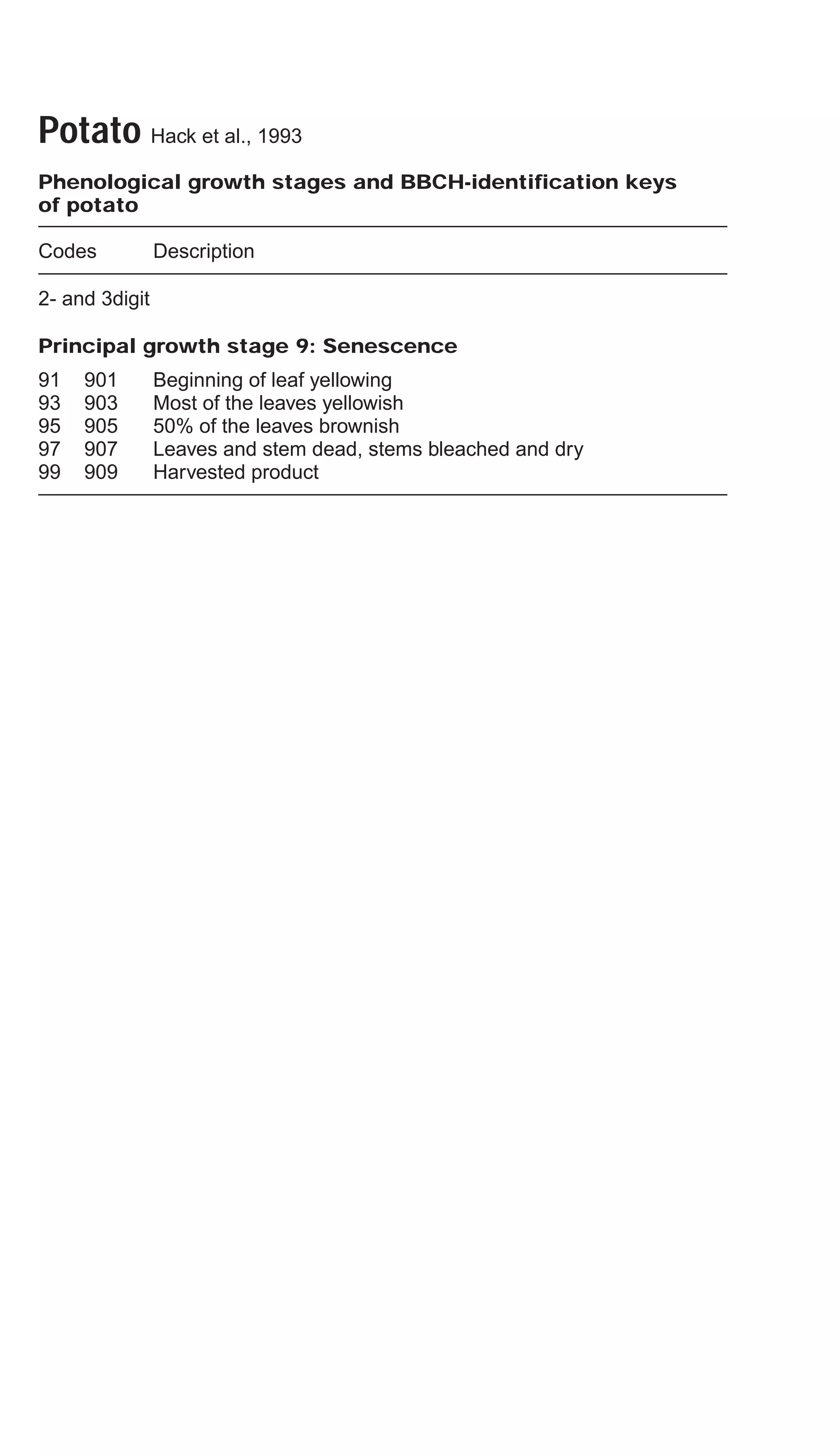
Potato Hack et al., 1993
Phenological growth stages and BBCH-identification keys
of potato
Codes Description
2- and 3digit
Principal growth stage 9: Senescence
91 901 Beginning of leaf yellowing
93 903 Most of the leaves yellowish
95 905 50% of the leaves brownish
97 907 Leaves and stem dead, stems bleached and dry
99 909 Harvested product
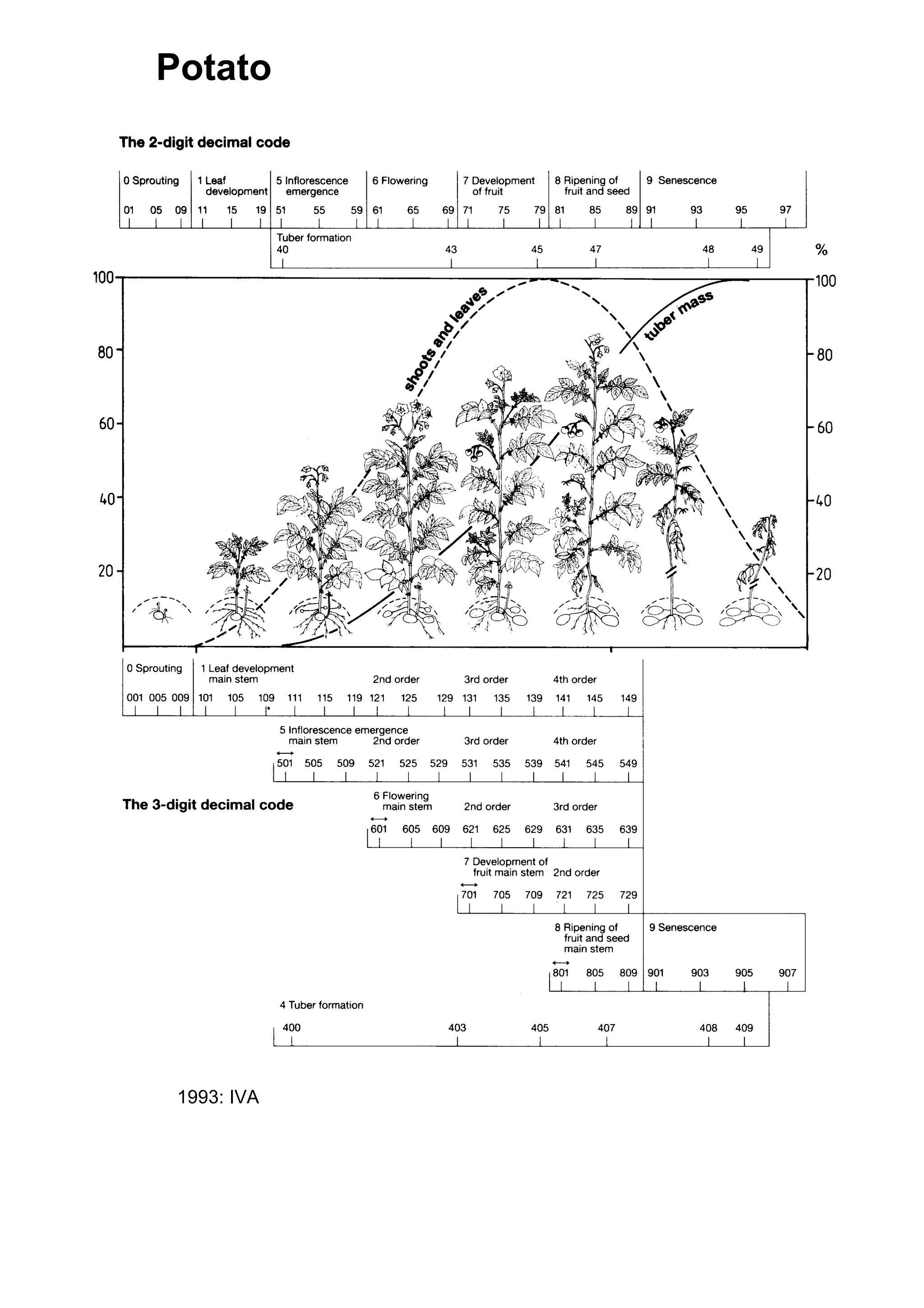
Potato
© 1993: IVA
Potato
© 1993: Bayer, BBA und IVA
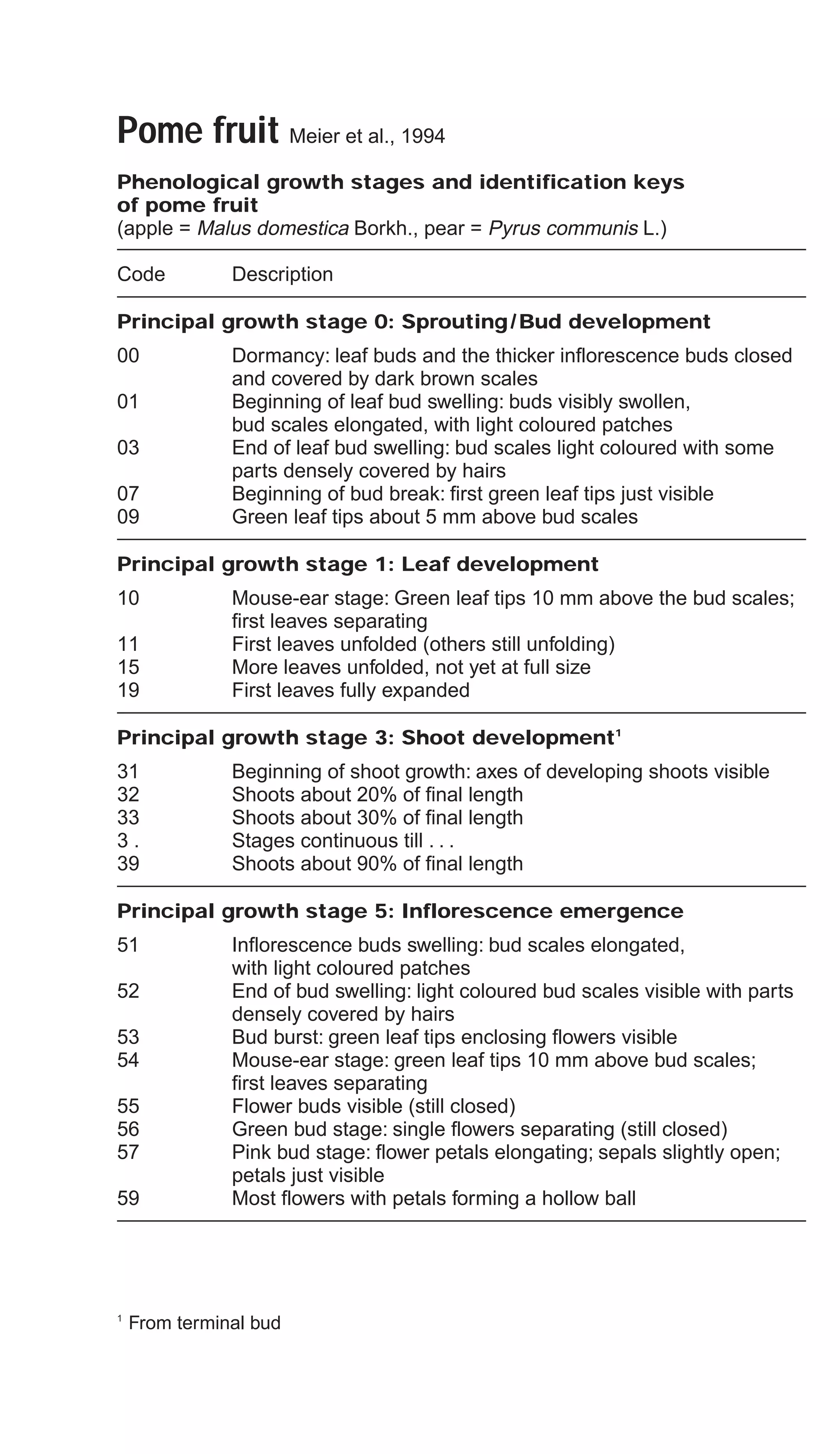
Pome fruit Meier et al., 1994
Phenological growth stages and identification keys
of pome fruit
(apple = Malus domestica Borkh., pear = Pyrus communis L.)
Code Description
Principal growth stage 0: Sprouting/Bud development
00 Dormancy: leaf buds and the thicker inflorescence buds closed
and covered by dark brown scales
01 Beginning of leaf bud swelling: buds visibly swollen,
bud scales elongated, with light coloured patches
03 End of leaf bud swelling: bud scales light coloured with some
parts densely covered by hairs
07 Beginning of bud break: first green leaf tips just visible
09 Green leaf tips about 5 mm above bud scales
Principal growth stage 1: Leaf development
10 Mouse-ear stage: Green leaf tips 10 mm above the bud scales;
first leaves separating
11 First leaves unfolded (others still unfolding)
15 More leaves unfolded, not yet at full size
19 First leaves fully expanded
Principal growth stage 3: Shoot development1
31 Beginning of shoot growth: axes of developing shoots visible
32 Shoots about 20% of final length
33 Shoots about 30% of final length
3 . Stages continuous till . . .
39 Shoots about 90% of final length
Principal growth stage 5: Inflorescence emergence
51 Inflorescence buds swelling: bud scales elongated,
with light coloured patches
52 End of bud swelling: light coloured bud scales visible with parts
densely covered by hairs
53 Bud burst: green leaf tips enclosing flowers visible
54 Mouse-ear stage: green leaf tips 10 mm above bud scales;
first leaves separating
55 Flower buds visible (still closed)
56 Green bud stage: single flowers separating (still closed)
57 Pink bud stage: flower petals elongating; sepals slightly open;
petals just visible
59 Most flowers with petals forming a hollow ball
1
From terminal bud
Pome fruit Meier et al., 1994
Phenological growth stages and identification keys
of pome fruit
Code Description
Principal growth stage 6: Flowering
60 First flowers open
61 Beginning of flowering: about 10% of flowers open
62 About 20% of flowers open
63 About 30% of flowers open
64 About 40% of flowers open
65 Full flowering: at least 50% of flowers open, first petals falling
67 Flowers fading: majority of petals fallen
69 End of flowering: all petals fallen
Principal growth stage 7: Development of fruit
71 Fruit size up to 10 mm; fruit fall after flowering
72 Fruit size up to 20 mm
73 Second fruit fall
74 Fruit diameter up to 40 mm; fruit erect
(T-stage: underside of fruit and stalk forming a T)
75 Fruit about half final size
76 Fruit about 60% final size
77 Fruit about 70% final size
78 Fruit about 80% final size
79 Fruit about 90% final size
Principal growth stage 8: Maturity of fruit and seed
81 Beginning of ripening: first appearance of cultivar-specific colour
85 Advanced ripening: increase in intensity of cultivar-specific
colour
87 Fruit ripe for picking
89 Fruit ripe for consumption: fruit have typical taste and firmness
Principal growth stage 9: Senescence, beginning of dormancy
91 Shoot growth completed; terminal bud developed; foliage still
fully green
92 Leaves begin to discolour
93 Beginning of leaf fall
95 50% of leaves discoloured
97 All leaves fallen
99 Harvested product
Pome fruit
1 Leave bud smaller and slimer, directly on the long sprout
© 1994: BBA und IVA
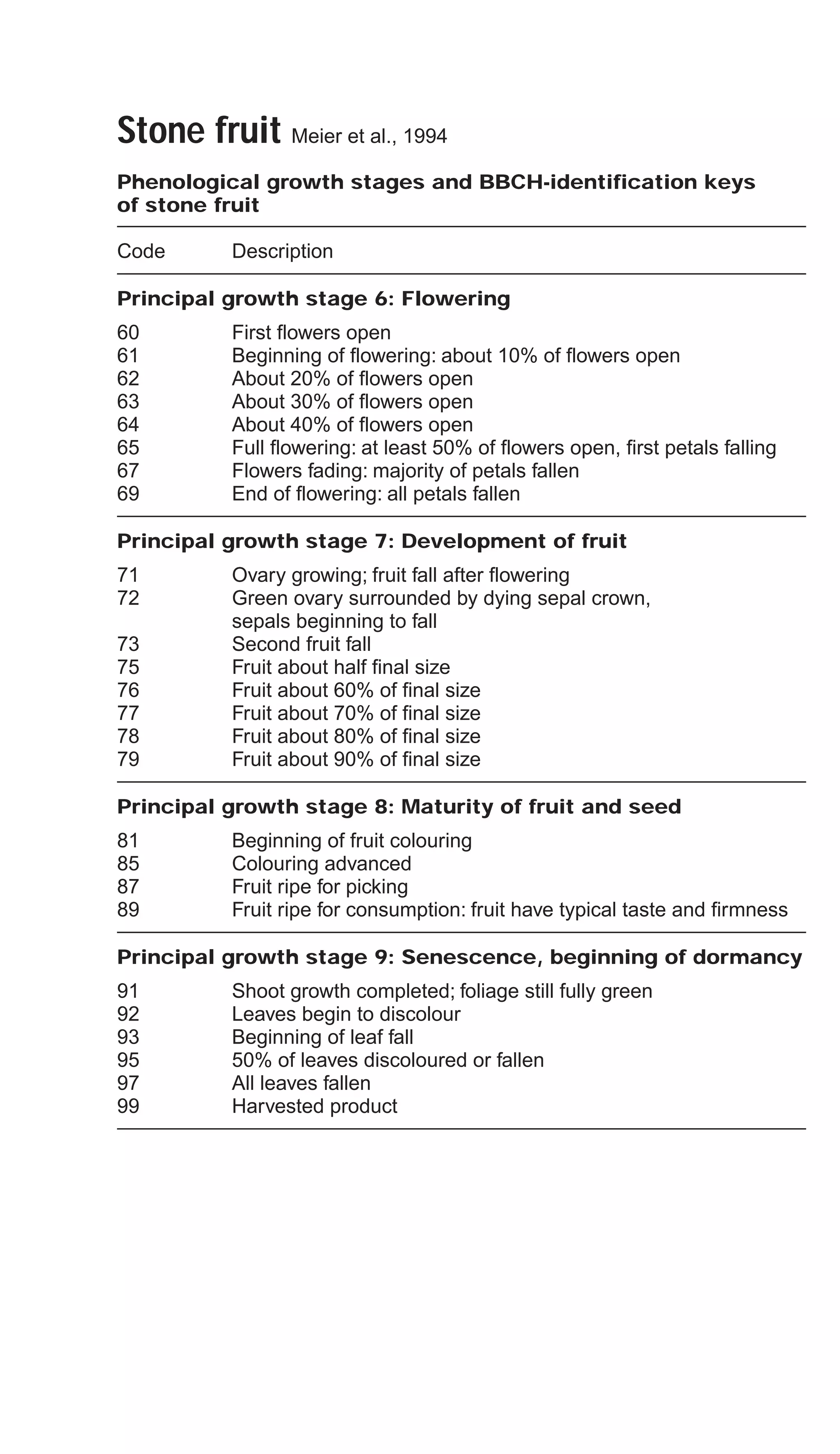
Stone fruit Meier et al., 1994
Phenological growth stages and BBCH-identification keys
of stone fruit
(cherry = Prunus cerasus L., plum = Prunus domestica L. ssp. domestica,
peach = Prunus persica Batsch., apricot = Prunus ameriaca L.)
Code Description
Principal growth stage 0: Sprouting/Bud development
00 Dormancy: leaf buds and the thicker inflorescence buds closed
and covered by dark brown scales
01 Beginning of bud swelling (leaf buds); light brown scales visible,
scales with light coloured edges
03 End of leaf bud swelling: scales separated, light green bud
sections visible
09 Green leaf tips visible: brown scales fallen, buds enclosed
by light green scales
Principal growth stage 1: Leaf development
10 First leaves separating: green scales slightly open,
leaves emerging
11 First leaves unfolded, axis of developing shoot visible
19 First leaves fully expanded
Principal growth stage 3: Shoot development 1
31 Beginning of shoot growth: axes of developing shoots visible
32 Shoots about 20% of final length
33 Shoots about 30% of final length
3 . Stages continuous till . . .
39 Shoots about 90% of final length
Principal growth stage 5: Inflorescence emergence
51 Inflorescence buds swelling: buds closed, light brown scales
visible
53 Bud burst: scales separated, light green bud sections visible
54 Inflorescence enclosed by light green scales, if such scales are
formed (not all cultivars)
55 Single flower buds visible (still closed) borne on short stalks,
green scales slightly open
56 Flower pedicel elongating; sepals closed; single flowers separating
57 Sepals open: petal tips visible; single flowers with white or
pink petals (still closed)
59 Most flowers with petals forming a hollow ball
1
From terminal bud
Stone fruit Meier et al., 1994
Phenological growth stages and BBCH-identification keys
of stone fruit
Code Description
Principal growth stage 6: Flowering
60 First flowers open
61 Beginning of flowering: about 10% of flowers open
62 About 20% of flowers open
63 About 30% of flowers open
64 About 40% of flowers open
65 Full flowering: at least 50% of flowers open, first petals falling
67 Flowers fading: majority of petals fallen
69 End of flowering: all petals fallen
Principal growth stage 7: Development of fruit
71 Ovary growing; fruit fall after flowering
72 Green ovary surrounded by dying sepal crown,
sepals beginning to fall
73 Second fruit fall
75 Fruit about half final size
76 Fruit about 60% of final size
77 Fruit about 70% of final size
78 Fruit about 80% of final size
79 Fruit about 90% of final size
Principal growth stage 8: Maturity of fruit and seed
81 Beginning of fruit colouring
85 Colouring advanced
87 Fruit ripe for picking
89 Fruit ripe for consumption: fruit have typical taste and firmness
Principal growth stage 9: Senescence, beginning of dormancy
91 Shoot growth completed; foliage still fully green
92 Leaves begin to discolour
93 Beginning of leaf fall
95 50% of leaves discoloured or fallen
97 All leaves fallen
99 Harvested product
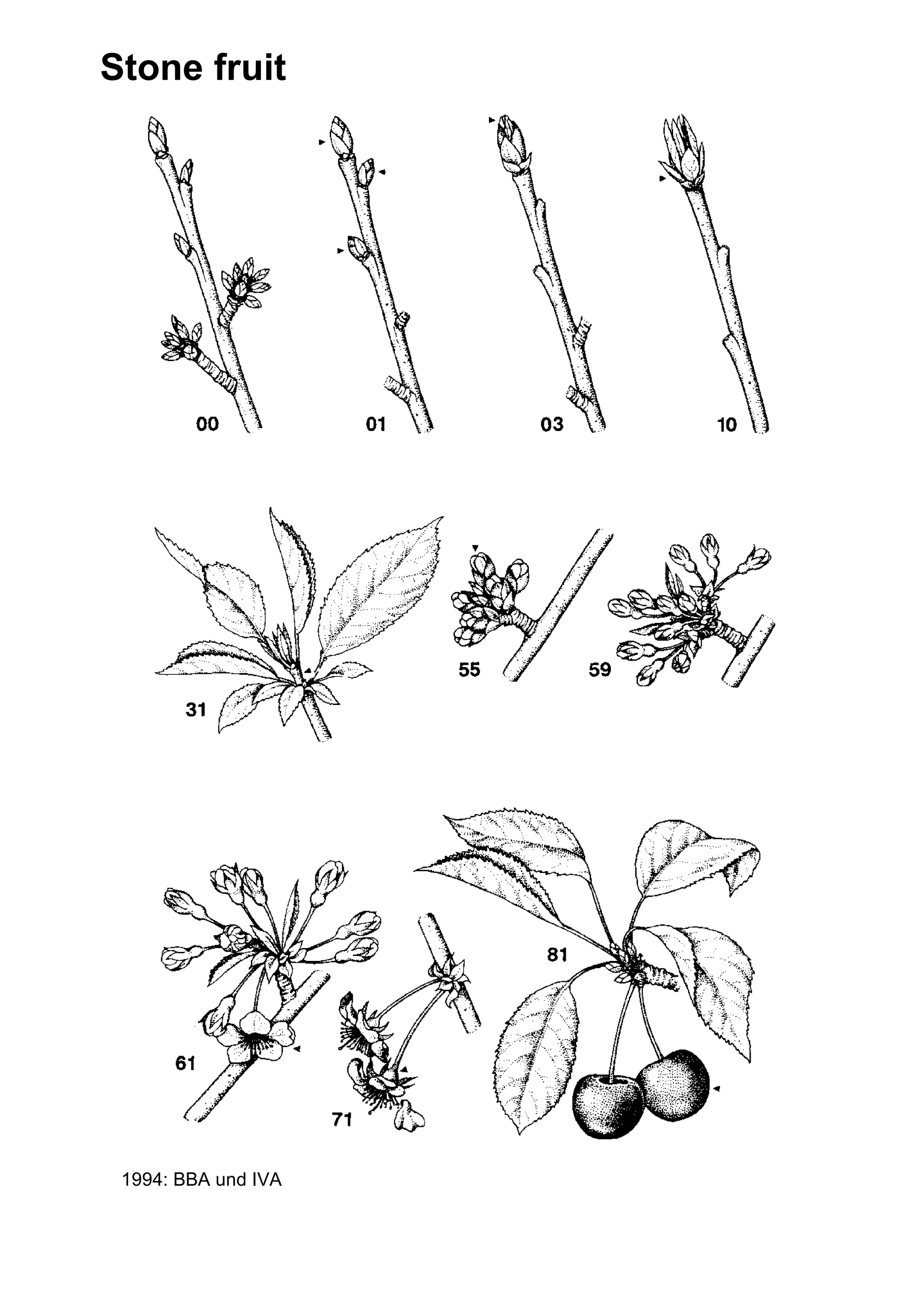
Stone fruit
© 1994: BBA und IVA
Currants Meier et al., 1994
Phenological growth stages and BBCH-identification keys of
currants
(black currant = Ribes nigrum L., red currant = Ribes rubrum L.)
Code Description
Principal growth stage 0: Sprouting/Bud development
00 Dormancy: leaf buds and the thicker inflorescence buds closed
and covered by dark brown scales
01 Beginning of bud swelling: bud scales elongated
03 End of bud swelling: edges of bud scales light coloured
07 Beginning of bud burst: first green or red leaf tips just visible
09 Leaf tips extended beyond scales
Principal growth stage 1: Leaf development
10 Leaf tips above the bud scales: first leaves separating
11 First leaves unfolded (others still unfolding)
15 More leaves unfolded, not yet full size
19 First leaves fully expanded
Currants Meier et al., 1994
Phenological growth stages and BBCH-identification keys of
currants
Code Description
Principal growth stage 3: Shoot development1
31 Beginning of shoot growth: axes of developing shoots visible
32 Shoots about 20% of final length
33 Shoots about 30% of final length
3 . Stages continuous till . . .
39 Shoots about 90% of final length
Principal growth stage 5: Inflorescence emergence
51 Inflorescence buds and leaf buds swelling: buds closed,
light brown scales visible
53 Bud burst: scales separated light green but sections visible
54 Green or red leaf tips above bud scales
55 First flower buds (compact raceme) visible beside unfolded
leaves
56 Beginning of raceme elongation
57 First flower bud separated on elongating raceme
59 Grape stage: all flower buds separated
Principal growth stage 6: Flowering
60 First flowers open
61 Beginning of flowering: about 10% of flowers open
65 Full flowering: at least 50% of flowers open, first petals falling
67 Flowers fading: majority of petals fallen
69 End of flowering: all petals fallen
Principal growth stage 7: Development of fruit
71 Beginning of fruit growth: first fruits visible at raceme base
72 20% of fruits formed
73 30% of fruits formed
74 40% of fruits formed
75 50% of fruits formed
76 60% of fruits formed
77 70% of fruits formed
78 80% of fruits formed
79 90% of fruits formed
1
From terminal bud
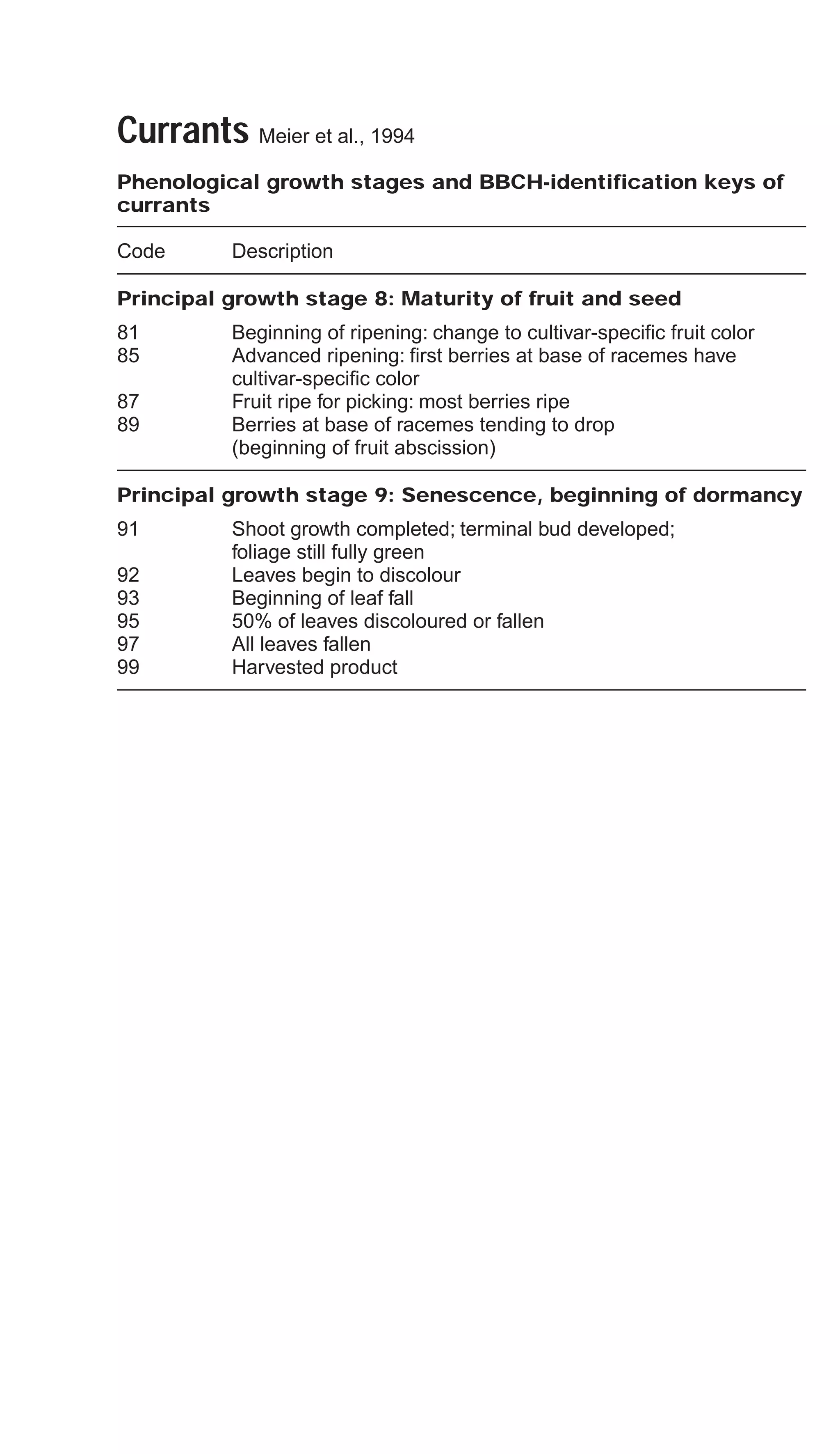
Currants Meier et al., 1994
Phenological growth stages and BBCH-identification keys of
currants
Code Description
Principal growth stage 8: Maturity of fruit and seed
81 Beginning of ripening: change to cultivar-specific fruit color
85 Advanced ripening: first berries at base of racemes have
cultivar-specific color
87 Fruit ripe for picking: most berries ripe
89 Berries at base of racemes tending to drop
(beginning of fruit abscission)
Principal growth stage 9: Senescence, beginning of dormancy
91 Shoot growth completed; terminal bud developed;
foliage still fully green
92 Leaves begin to discolour
93 Beginning of leaf fall
95 50% of leaves discoloured or fallen
97 All leaves fallen
99 Harvested product
Currants
© 1994: BBA und IVA
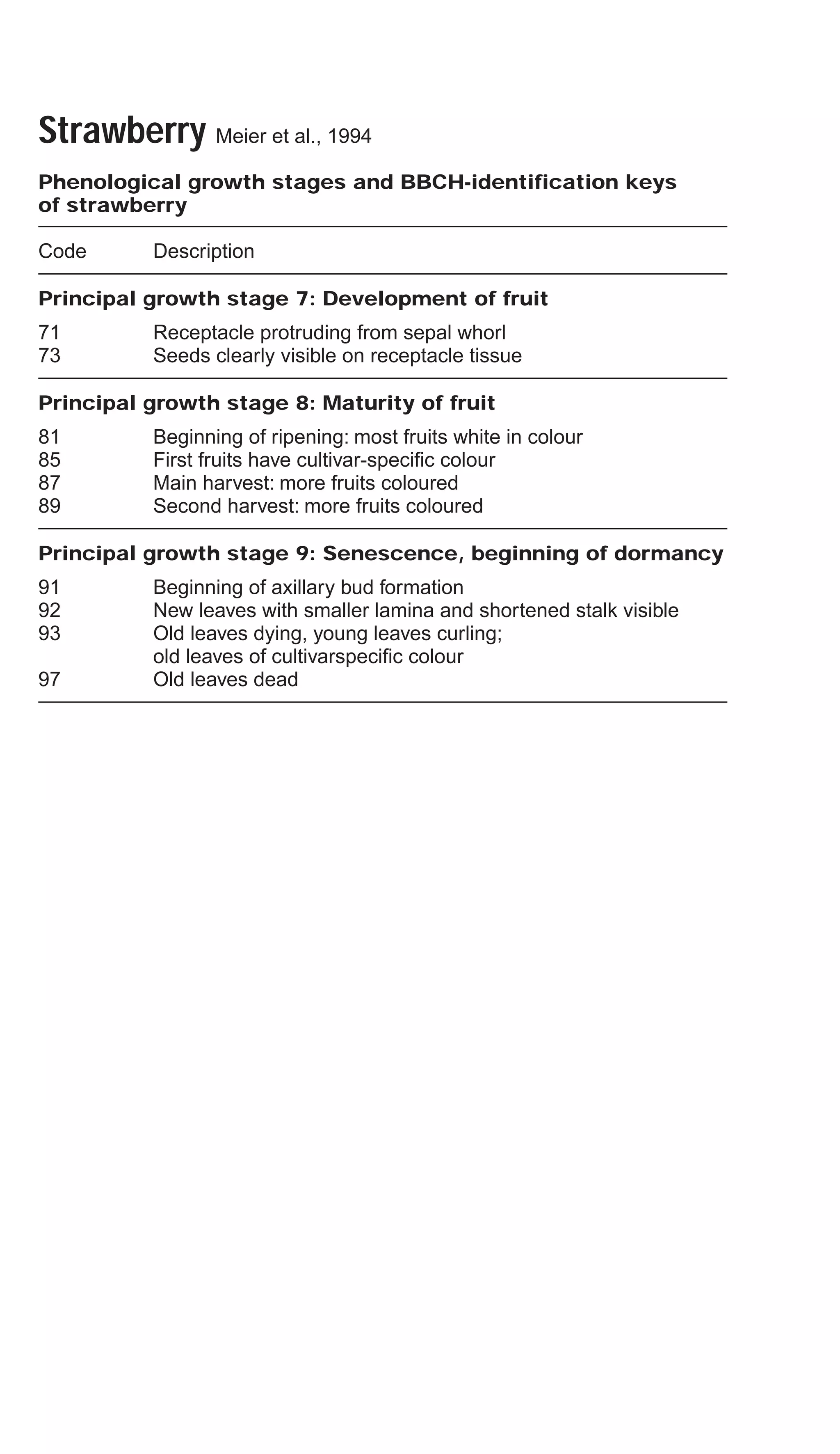
Strawberry Meier et al., 1994
Phenological growth stages and BBCH-identification keys
of strawberry
(Fragaria ananassa Duch.)
Code Description
Principal growth stage 0: Sprouting/Bud development
00 Dormancy: Leaves prostrate and partly dead
03 Main bud swelling
Principal growth stage 1: Leaf development
10 First leaf emerging
11 First leaf unfolded
12 2nd leaf unfolded
13 3rd leaf unfolded1
1 . Stages continuous till . . .
19 9 or more leaves unfolded
Principal growth stage 4: Development of stolons and young
plants
41 Beginning of stolon (runner) formation: stolons visible
(about 2 cm long)
42 First daughter plant visible
43 Beginning of root development in first daughter plant
45 First daughter plant with roots (ready for planting)
49 Several daughter plants with roots (ready for planting)
Principal growth stage 5: Inflorescence emergence
55 First set flowers at the bottom of the rosette
56 Inflorescence elongating
57 First flower buds emerged (still closed)
58 Early balloon stage: first flowers with petals forming
a hollow ball
59 Most flowers with petals forming a hollow ball
Principal growth stage 6: Flowering
60 First flowers open (primary or A-flower)
61 Beginning of flowering: about 10% of flowers open
65 Full flowering: secondary (B) and tertiary (C) flowers open,
first petals falling
67 Flowers fading: majority of petals fallen
1
Normally after the three leaf stage the bud development occurs in principal
growth stage 5
Strawberry Meier et al., 1994
Phenological growth stages and BBCH-identification keys
of strawberry
Code Description
Principal growth stage 7: Development of fruit
71 Receptacle protruding from sepal whorl
73 Seeds clearly visible on receptacle tissue
Principal growth stage 8: Maturity of fruit
81 Beginning of ripening: most fruits white in colour
85 First fruits have cultivar-specific colour
87 Main harvest: more fruits coloured
89 Second harvest: more fruits coloured
Principal growth stage 9: Senescence, beginning of dormancy
91 Beginning of axillary bud formation
92 New leaves with smaller lamina and shortened stalk visible
93 Old leaves dying, young leaves curling;
old leaves of cultivarspecific colour
97 Old leaves dead
Strawberries
© 1994: BBA und IVA
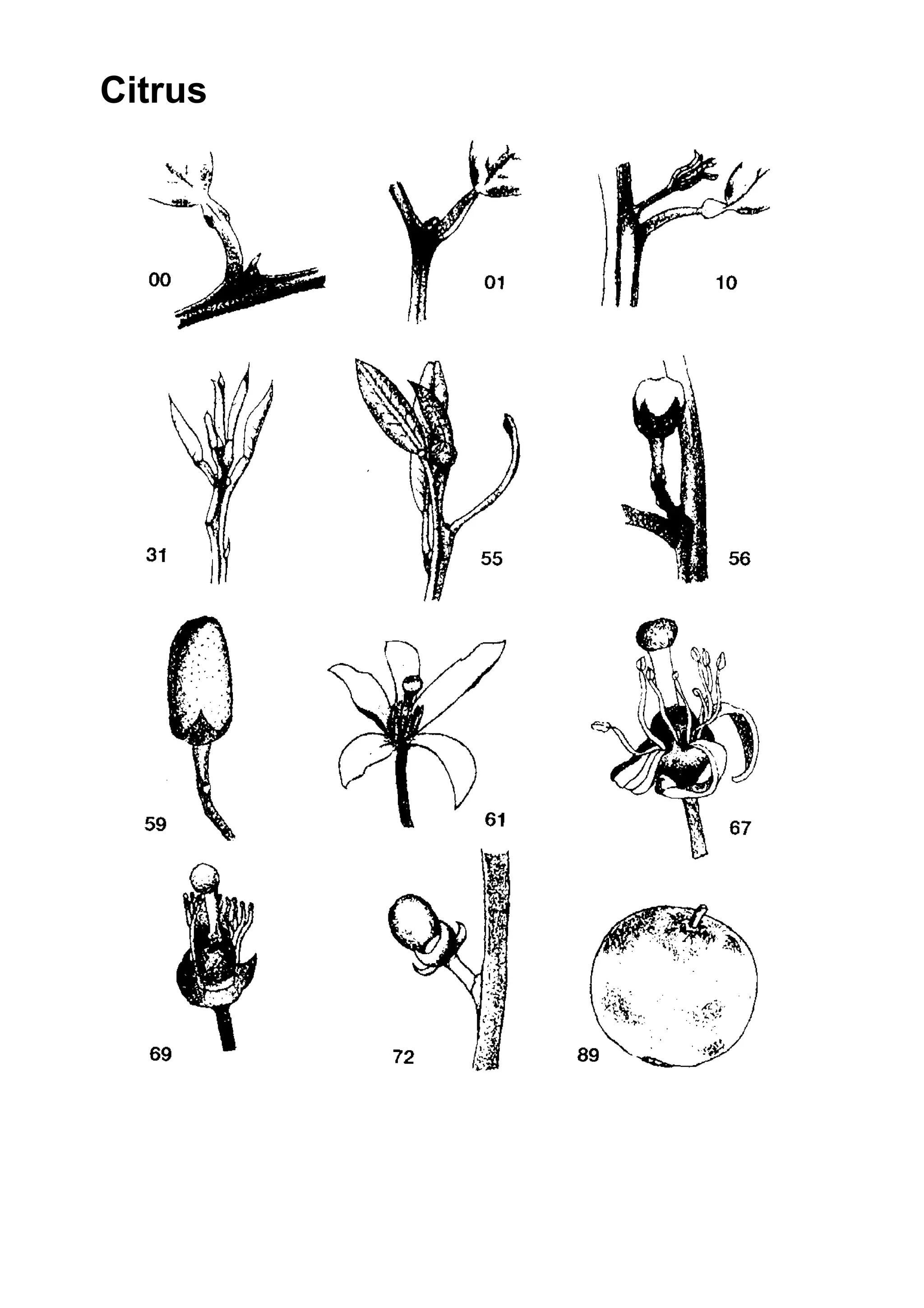
Citrus Agusti et al., 1995
Phenological growth stages and BBCH-identification keys of
citrus
(Citrus spp. L.),
Code Description
Principal growth stage 0: Sprouting/Bud development
00 Dormancy: leaf and inflorescence buds undifferentiated,
closed and covered by green scales
01 Beginning of bud swelling
03 End of bud swelling: green scales slightly separated
07 Beginning of bud burst
09 Green leaf tips visible
Principal growth stage 1: Leaf development
10 First leaves separating: green scales slightly open,
leaves emerging
11 First leaves visible1
15 More leaves visible, not yet at full size
19 First leaves fully expanded
Principal growth stage 3: Shoot development
31 Beginning of shoot growth: axes of developing shoots visible
32 Shoots about 20% of final length
39 Shoots about 90% of final length
Principal growth stage 5: Inflorescence emergence
51 Inflorescence buds swelling: buds closed,
light green scales visible
53 Bud burst: scales separated, floral tips visible
55 Flowers visible, still closed (green bud), borne on single
or multiflowered leafy or leafless inflorescences
56 Flower petals elongating; sepals covering half corolla
(white bud)
57 Sepals open: petal tips visible; flowers with white
or purplish petals, still closed
59 Most flowers with petals forming a hollow ball
1
In Citrus the term “visible” replaces “unfolded” used for other fruit species.
Leaf unfolding takes place precociously in citrus
Citrus Agusti et al., 1995
Phenological growth stages and BBCH-identification keys of
citrus
Code Description
Principal growth stage 6: Flowering
60 First flowers open
61 Beginning of flowering: about 10% of flowers open
65 Full flowering: 50% of flowers open; first petals falling
67 Flowers fading: majority of petals fallen
69 End of flowering: all petals fallen
Principal growth stage 7: Development of fruit
71 Fruit set; beginning of ovary growth;
beginning of fruitlets abscission
72 Green fruit surrounded by sepal crown
73 Some fruits slightly yellow: beginning of physiological fruit drop
74 Fruits about 40% of final size.
Dark green fruit: end of physiological fruit drop
79 Fruits about 90% of final size
Principal growth stage 8: Maturity of fruit
81 Beginning of fruit colouring (colour-break)
83 Fruit ripe for picking; fruit has not yet developed variety-specific
colour
85 Advanced ripening; increase in intensity of variety-specific
colour
89 Fruit ripe for consumption; fruit has typical taste and firmness;
beginning of senescence and fruit abscission
Principal growth stage 9: Senescence, beginning of dormancy
91 Shoot growth complete; foliage fully green
93 Beginning of senescense and abscission of old leaves
97 Winter dormancy period
Citrus
Olive Sanz-Cortés et al., in press
Phenological growth stages and BBCH-identification keys of olive tree
(Olea europaea L.)
Code Description
Principal growth stage 0: Bud development
00 Foliar buds at the apex of shoots grown the previous crop-year
are completely closed, sharp-pointed, stemless and ochre-
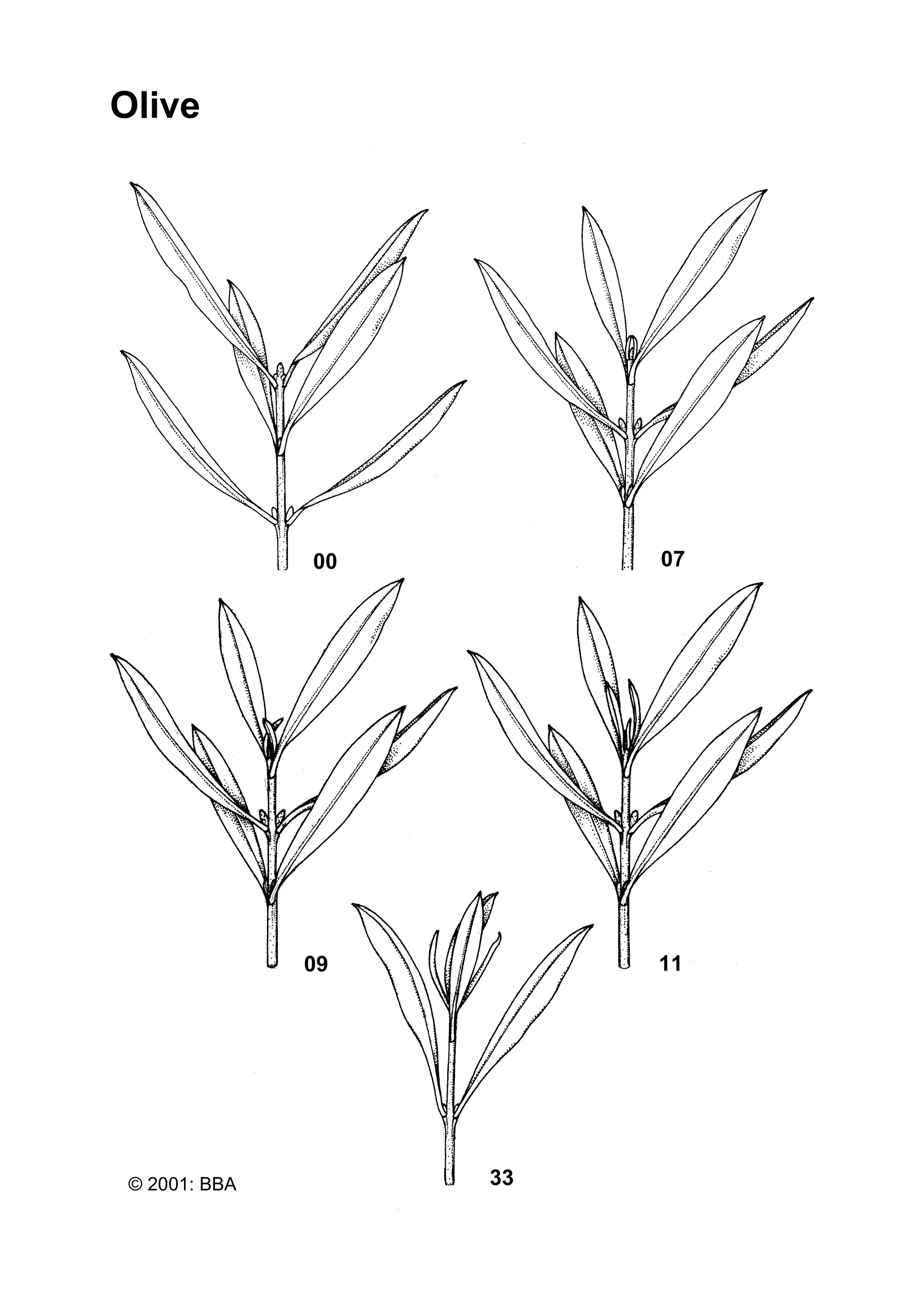
coloured (Fig. 1: 00).
01 Foliar buds start to swell and open, showing the new foliar
primordia.
03 Foliar buds lengthen and separate from the base.
07 External small leaves open, not completely separated,
remaining joined by apices (Fig. 1: 07).
09 External small leaves opening further with their tips inter
crossing (Fig. 1: 09)
Principal growth stage 1: Leaf development
11 First leaves completely separated. Grey-greenish coloured
(Fig. 1: 11)
15 The leaves are more separated without reaching their final size.
First leaves turn greenish on the upperside.
19 Leaves get the typical variety size and shape.
Principal growth stage 3: Shoot development
31 Shoots reach 10 % of final size.
33 Shoots reach 30 % of final size (Fig. 1: 33).
37 Shoots reach 70 % of final size.
Principal growth stage 5: Inflorescence emergence.
50 Inflorescence buds in leaf axiles are completely closed. They
are sharp-pointed, stemless and ochre-coloured.
51 Inflorescence buds start to swell on its stem.
52 Inflorescence buds open. Flower cluster development starts
(Fig 1: 53).
54 Flower cluster growing
55 Flower cluster totally expanded. Floral buds start to open
(Fig 1: 55).
57 The corolla, green-coloured, is longer than calyx (Fig 1: 57).
59 The corolla changes from green to white colour.
Olive Sanz-Cortés et al., in press
Phenological growth stages and BBCH-identification keys of olive tree
(Olea europaea L.)
Code Description
Principal growth stage 6: Flowering
60 First flowers open (Fig 1: 60).
61 Begining of flowering: 10 % of flowers open.
65 Full flowering: at least 50 % of flowers open (Fig 1: 65).
67 First petals falling.
68 Majority of petals fallen or faded (Fig 1: 68).
69 End of flowering, fruit set, non-fertilized ovaries fallen.
Principal growth stage 7: Fruit development
71 Fruit size about 10 % of final size (Fig 1: 71).
75 Fruit size about 50 % of final size. Stone starts to lignificate (it
shows cutting resistance).
79 Fruit size about 90 % of final size. Fruit suitable for picking
green olives (Fig 1: 79).
Principal growth stage 8: Maturity of fruit
80 Fruit deep green colour becomes light green, yellowish.
81 Begining of fruit colouring (Fig 1: 81).
85 Increasing of specific fruit colouring.
89 Harvest maturity: fruits get the typical variety colour, remaining
turgid, suitable for oil extraction (Fig. 1: 89).
Principal growth stage 9: Senescence
92 Overripe: fruits lose turgidity and start to fall (Fig 1: 92).
Olive
00 07
09 11
33© 2001: BBA
53
55
57
60
65
68
71
79
81 89
92
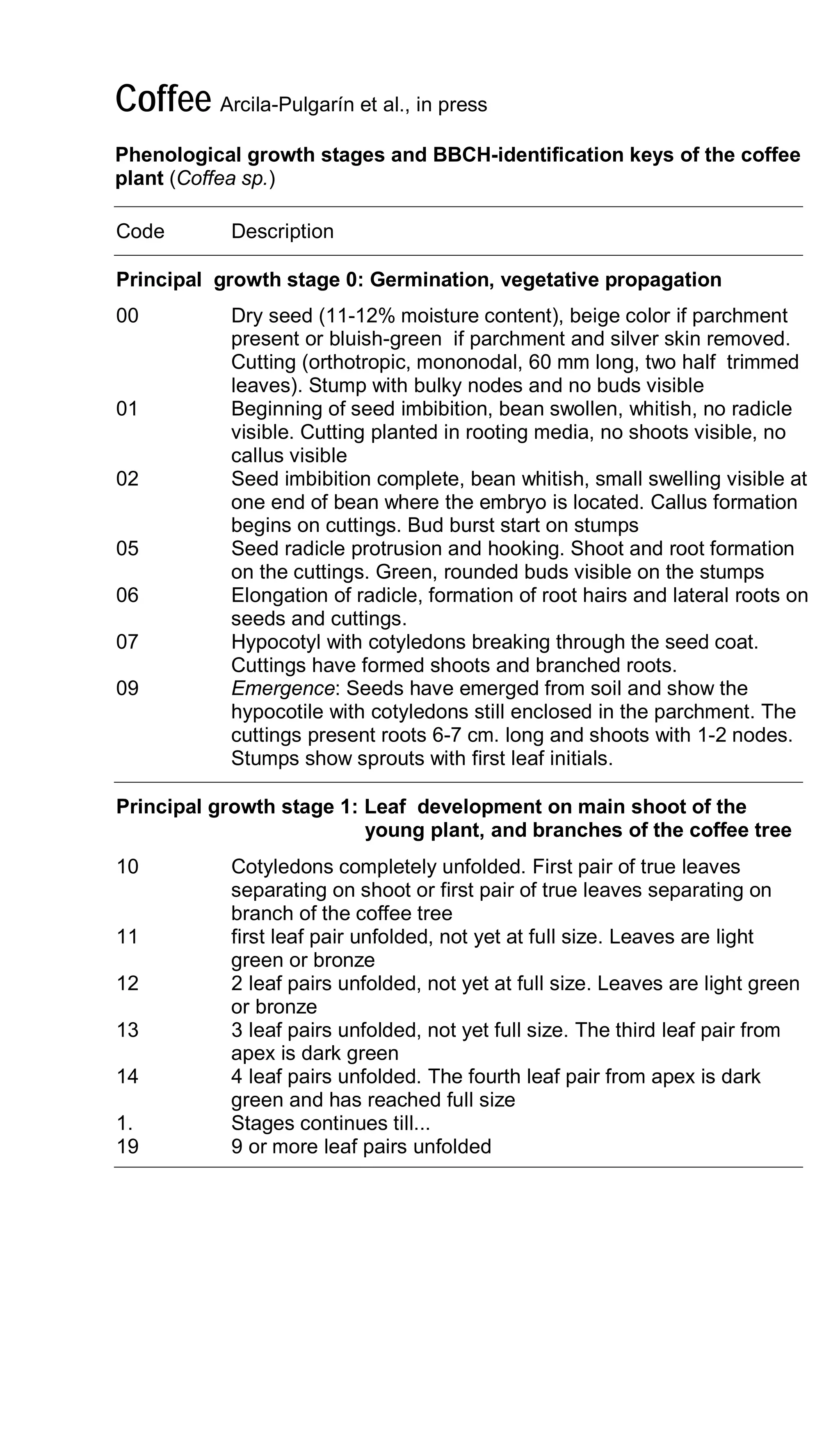
Coffee Arcila-Pulgarín et al., in press
Phenological growth stages and BBCH-identification keys of the coffee
plant (Coffea sp.)
Code Description
Principal growth stage 0: Germination, vegetative propagation
00 Dry seed (11-12% moisture content), beige color if parchment
present or bluish-green if parchment and silver skin removed.
Cutting (orthotropic, mononodal, 60 mm long, two half trimmed
leaves). Stump with bulky nodes and no buds visible
01 Beginning of seed imbibition, bean swollen, whitish, no radicle
visible. Cutting planted in rooting media, no shoots visible, no
callus visible
02 Seed imbibition complete, bean whitish, small swelling visible at
one end of bean where the embryo is located. Callus formation
begins on cuttings. Bud burst start on stumps
05 Seed radicle protrusion and hooking. Shoot and root formation
on the cuttings. Green, rounded buds visible on the stumps
06 Elongation of radicle, formation of root hairs and lateral roots on
seeds and cuttings.
07 Hypocotyl with cotyledons breaking through the seed coat.
Cuttings have formed shoots and branched roots.
09 Emergence: Seeds have emerged from soil and show the
hypocotile with cotyledons still enclosed in the parchment. The
cuttings present roots 6-7 cm. long and shoots with 1-2 nodes.
Stumps show sprouts with first leaf initials.
Principal growth stage 1: Leaf development on main shoot of the
young plant, and branches of the coffee tree
10 Cotyledons completely unfolded. First pair of true leaves
separating on shoot or first pair of true leaves separating on
branch of the coffee tree
11 first leaf pair unfolded, not yet at full size. Leaves are light
green or bronze
12 2 leaf pairs unfolded, not yet at full size. Leaves are light green
or bronze
13 3 leaf pairs unfolded, not yet full size. The third leaf pair from
apex is dark green
14 4 leaf pairs unfolded. The fourth leaf pair from apex is dark
green and has reached full size
1. Stages continues till...
19 9 or more leaf pairs unfolded
Coffee Arcila-Pulgarín et al., in press
Phenological growth stages and BBCH-identification keys of the coffee
plant (Coffea sp.)
Code Description
Principal growth stage 2: Formation of branches
(only for plants in the field)
20 First pair of primary branches are visible
21 10 pair of primary branches visible
22 20 pair of primary branches visible
23 30 pair of primary branches visible
2. Stages continues till...
29 90 or more pairs of primary branches visible
Principal growth stage 3: Branch elongation
31 10 nodes present in the branch(es)
32 20 nodes present in the branch(es)
3. Stages continues till...
39 90 or more nodes present in the branch(es)
Principal growth stage 5: Inflorescence emergence
51 Inflorescence buds swelling in leaf axils
53 Inflorescence buds burst and covered by brown mucilage; no
flowers visible
57 Flowers visible, still closed and tightly join, borne on
multiflowered inflorescence (3-4 flowers per inflorescence)
58 Flowers visible, untight, still closed, petals 4-6 mm long and
green (dormant stage)
59 Flowers with petals elongated ( 6-10 mm long), still closed and
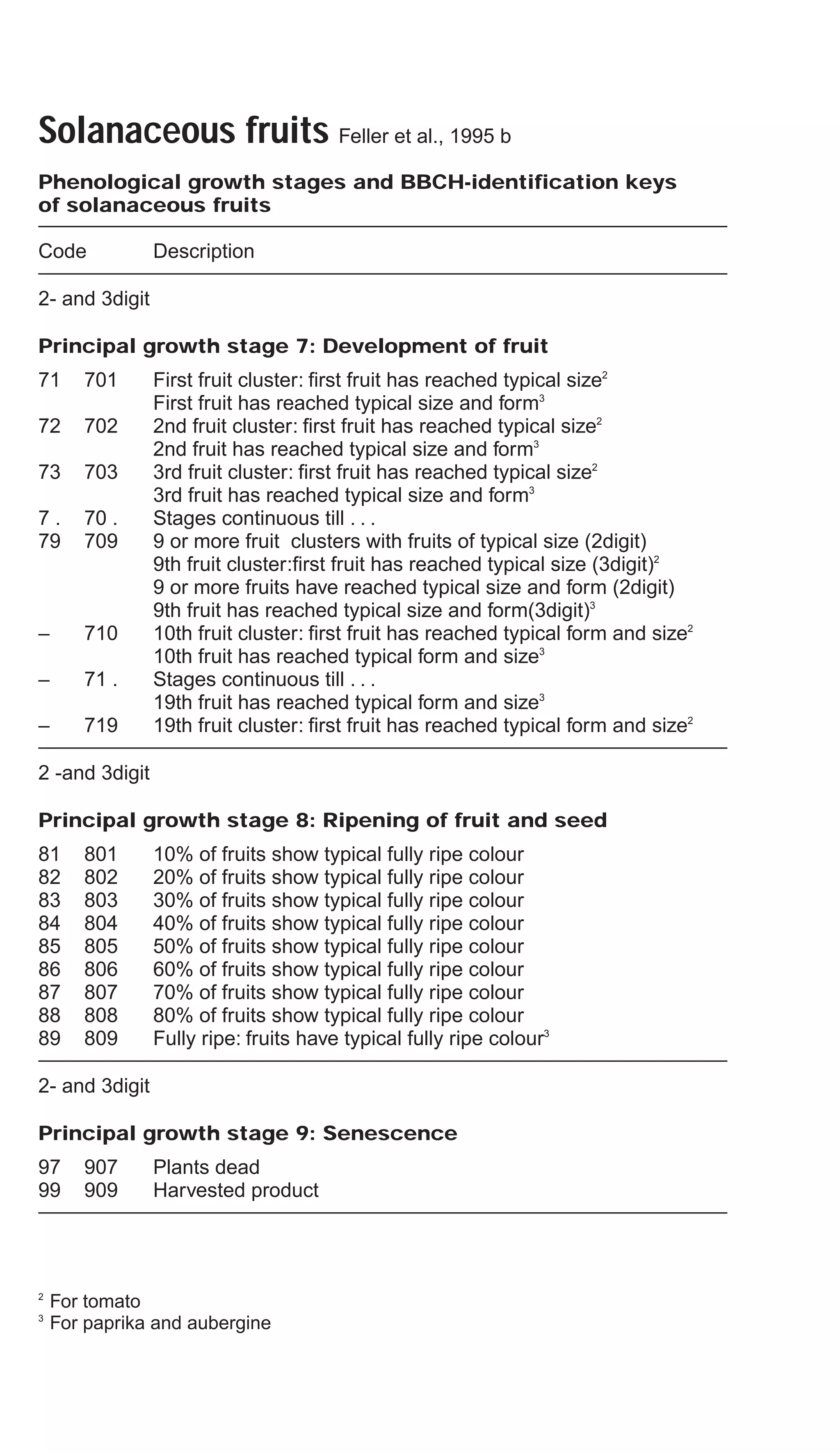
white color.
Principal growth stage 6: Flowering
60 First flowers open
61 10% of flowers open
63 30% of flowers open
65 50% of flowers open
67 70% of flowers open
69 90% of flowers open
Coffee Arcila-Pulgarín et al., in press
Phenological growth stages and BBCH-identification keys of the coffee
plant (Coffea sp.)
Code Description
Principal growth stage 7: Development of fruit
70 Fruits visible as small yellowish berries
71 Fruit set: Beginning of berry growth. Fruits have reached 10%
of final size (pinheads).
73 Fruits are light green and contents are liquid and crystalline.
Fruits have reached 30% of final size (fast growth).
75 Fruits are light green and its contents are liquid and crystalline.
Fruits have reached 50% of final size.
77 Fruits are dark green and its contents are solid and white. Fruits
have reached 70% of final size.
79 Fruits are pale green and its contents are solid and white.
Physiological maturity is complete. Fruits have reached 90% of
final size.
Principal growth stage 8: Ripening of fruit and seed
81 Beginning of change of fruit coloration from pale green to yellow
or red
85 Increase in intensity (variety-specific), yellow or red , fruit color;
fruit not yet ready for picking.
88 Fruit is fully-ripe color and ready for picking.
89 Overripe; beginning of darkening or drying; fruits stay on the
tree or abscission begins.
Principal growth stage 9: Senescence
90 Shoots have completed their development; the plant appears
of an intense dark green color, leaves are of normal size and
harvest locates at the bottom part of the plant.
93 Older leaves change its color from deep green to yellow with
red spots, and fall specially at harvesting time.
94 The foliage changes to a pale green color. Defoliation is
observed on the bottom part of the main stem and lower
branches.
97 The production zone has moved towards the upper parts in the
main shoot and outer parts of branches, leaves are of smaller
size than normal, strong defoliation is observed on the bottom
and inner part of the plant, some dead branches are observed
at the bottom.
98 The production zone is limited to a very few branches on the
top of the shoot and a very few nodes on the tip of these
branches, and the plant is heavily defoliated. A high-degree of
senescence has been reached. 90% or more of the harvest
completed.
99 Post harvest or storage treatments
00 05 09
19/33
10
20
10
21/90 23/93 25/94 29/97
Coffee
© 2001: BBA
51 57
59 60
71 77
79
Musaceae Gonzales et al., in preparation
Phenological growth stages and BBCH-identification keys of of edible
Musaceae
Code Description
2- 3- 4-digit
Principal stage 0: Sprouting or emergence
00 000 0000 Recently planted material (plants from tissue cultures
and corns) without visible growth
05 005 0005 Emergence of the 1st new leaf in plants from tissue
cultures or of the foliar shoot of the corn
Principal stage 1: Leaf development
10 100 1000 Formation of the 1st leaf of the planted corn or the
candela leaf in tissue culture plants (candela stage 0)
1002 Leaf 1 at candela stage 2
1004 Leaf 1 at candela stage 4
1006 Leaf l at candela stage 6
1008 Leaf l at candela stage 8
11 101 1010 One leaf completely open and the youngest leaf at
candela stage 0
1012 One leaf completely open and the youngest leaf at
candela stage 2
1014 One leaf completely open and the youngest leaf at
candela stage 4
1016 One leaf completely open and the youngest leaf at
candela stage 6
1018 One leaf completely open and the youngest leaf at
candela stage 8
12 102 1020 Two leaves completely open and the youngest leaf at
candela stage 0
1022 Two leaves completely open and the youngest leaf at
candela stage 2
1024 Two leaves completely open and the youngest leaf at
candela stage 4
1026 Two leaves completely open and the youngest leaf at
candela stage 6
1028 Two leaves completely open and the youngest leaf at
candela stage 8
Musaceae Gonzales et al., in preparation
Phenological growth stages and BBCH-identification keys of of edible
Musaceae
Codes Description
2- 3- 4-digit
Principal stage 1: Leaf development (cont.)
13 103 1030 Three leaves completely open and the youngest leaf at
candela stage 0
1032 Three leaves completely open and the youngest leaf at
candela stage 2
1034 Three leaves completely open and the youngest leaf at
candela stage 4
1036 Three leaves completely open and the youngest leaf at
candela stage 6
1038 Three leaves completely open and the youngest leaf at
candela stage 8 stages continue till...
19 109 1090 9 or more leaves (only 2 digit code ) or nine leaves
completely open and the youngest leaf at candela stage
0
1092 Nine leaves completely open and the youngest leaf at
candela stage 2
1094 Nine leaves completely open and the youngest leaf at
candela stage 4
1096 Nine leaves completely open and the youngest leaf at
candela stage 6
1098 Nine leaves completely open and the youngest leaf at
candela stage 8 stages continue till...
119 1190 Nineteen or more leaves completely open and the
youngest leaf at candela stage 0
1192 Nineteen or more leaves completely open and the
youngest leaf at candela stage 2
1194 Nineteen or more leaves completely open and the
youngest leaf at candela stage 4
1196 Nineteen or more leaves completely open and the
youngest leaf at candela stage 6
1198 Nineteen or more leaves completely open and the
youngest leaf at candela stage 8
Musaceae Gonzales et al., in preparation
Phenological growth stages and BBCH-identification keys of of edible
Musaceae
Code Description
2- 3- 4-digit
Principal stage 2: Sucker formation
21 201 2010 1st sucker with visible leaf
2011 1st sucker with visible sword leaf
2012 1st sucker with visible water leaf
22 202 2020 2nd sucker with visible leaf
2021 2nd sucker with visible sword leaf
2022 2nd sucker with visible water leaf
23 203 2030 3rd sucker with visible leaf
2031 3rd sucker with visible sword leaf
2032 3rd sucker with visible water leaf
stages continue till...
29 209 2090 nine or more suckers with visible leaf
2091 nine or more suckers with visible sword leaf
2092 nine or more suckers with visible water leaf
2- 3- 4-digit
Principal stage 3: Pseudostem elongation
35 305 3050 The pseudostem reaches 50 % of its typical thickness
and length according to the genome or clone
39 309 3090 The maximum length and thickness of the pseudostem
are reached according to the genome or clone and the
formation of new leaves of normal size has been
terminated
Musaceae Gonzales et al., in preparation
Phenological growth stages and BBCH-identification keys of of edible
Musaceae
Code Description
2- 3- 4-digit
Principal stage 4: Leaf development of the sucker (sword sucker)
40 400 4000 Sub-phase of dependent growth: the sucker becomes
visible and develops the leaf shoot
41 401 4011 Development of the 1st lanceolate leaf
4012 Development of the 2nd lanceolate leaf
4013 Development of the 3rd lanceolate leaf
4014 Development of the 4th lanceolate leaf
4015 Development of the 5th lanceolate leaf
4016 Development of the 6th lanceolate leaf
4017 Development of the 7th lanceolate leaf
4018 Development of the 8th lanceolate leaf
4019 Development of the 9th or more lanceolate leaves
45 405 4050 Sub-phase of independent growth: leaves of approx. 10
cm width are developed (original leaf/zero leaf/F10)
4051 Development of the 1st leaf of approx. 10 cm width
4052 Development of the 2nd leaf of approx. 10 cm width
4053 Development of the 3rd leaf of approx. 10 cm width
4054 Development of the 4th leaf of approx. 10 cm width
4055 Development of the 5th leaf of approx. 10 cm width
4056 Development of the 6th leaf of approx. 10 cm width
4057 Development of the 7th leaf of approx. 10 cm width
4058 Development of the 8th leaf of approx. 10 cm width
4059 Development of the 9th or more leaves of approx. 10
cm width
49 409 4090 End of this phase is reached with the development of
the first leaf with characteristics of the genome or clone
(length width ratio, leaf surface index). Beginning of
synchronised development of ”normal” leaves (FM)
2- 3- 4-digit
Principal stage 5: Emergence of inflorescence
50 500 5000 The development of new normal leaves has been
terminated and the flower bract emergence
51 501 5010 Flower bract at candela stage 2
52 502 5020 Flower bract at candela stage 4
53 503 5030 Flower bract at candela stage 6
54 504 5040 Flower bract at candela stage 8
55 505 5050 Flower bract completely open
59 509 5090 Emergence of the last bract leaf or first sterile bract
protecting the flower
Musaceae Gonzales et al., in preparation
Phenological growth stages and BBCH-identification keys of of edible
Musaceae
Code Description
2- 3- 4-digit
Principal stage 6: Flowering
60 600 6000 The stage begins with the emergence of the flower
protected by the last bract leaf (1st sterile bract)
61 601 6010 A bract which does not protect any hand of flowers rises
(2nd sterile bract) and the rachis or flower stalk takes a
pendulum position
62 602 6020 The bract rises which protects the first hand of female
or pistillate flowers
63 603 6030 The bract rises which protects the second hand of
female or pistillate flowers
64 604 6040 The bract rises which protects the third hand of female
or pistillate flowers
65 605 6050 Full bloom: at least 50 % of the hands of females
flowers are developed
69 609 6090 The bracts which protect the hands wither and fall off
and the fingers are bent into a direction perpendicular to
the rachis
2- 3- 4-digit
Principal stage 7: Development of the fruit
70 700 7000 At least 50 % of the fingers show an upwards curvature
and the fruits (fingers) begin to fill
71 701 7010 Total exposure of the fingers or female flowers
(protective bracts fallen off or bent and withered above
the hands)
72 702 7020 The fingers of the hands show the characteristic
curvature of the fruit (upwards and almost parallel to the
axis or rachis)
73 703 7030 From the first two hands up to 30 % of the hands have
reached the maximum thickness of the fruit
74 704 7040 Up to 40 % of the hands have reached the maximum
thickness of the fruit
75 705 7050 Up to 50 % of the hands have reached the maximum
thickness of the fruit
76 706 7060 Up to 60 % of the hands have reached the maximum
thickness of the fruit
77 707 7070 Up to 70 % of the hands have reached the maximum
thickness of the fruit
78 708 7080 Up to 80 % of the hands have reached the maximum
thickness of the fruit
79 709 7090 All hands have reached the maximum thickness of the
fruit and no hand shows a loss of weight
Musaceae Gonzales et al., in preparation
Phenological growth stages and BBCH-identification keys of of edible
Musaceae
Code Description
2- 3- 4-digit
Principal stage 8: Ripening of the fruit
80 800 8000 Ripening starts when the fruit has reached the
maximum thickness, begins to lose weight and shows
changes of the colour by which the degrees of maturity
are defined
81 801 8010 Degree of maturity 1: green. Normal colour of the fresh
fruit
82 802 8020 Degree of maturity 2: tinge of yellow. First modification
of colour during the ripening cycle
83 803 8030 Degree of maturity 3: more green than yellow
84 804 8040 Degree of maturity 4: more yellow than green
85 805 8050 Degree of maturity 5: tinge of green
86 806 8060 Degree of maturity 6: all yellow
87 807 8070 Degree of maturity 7: yellow with brown specks. Fruit is
completely ripe, has the best flavour and a high nutritive
value
88 808 8080 Degree of maturity 8: 20-50 % of surface discoloured
brown or spoiled
89 809 8090 Degree of maturity 9: More than 50 % of the surface of
the fruits is discoloured brown and spoiled
2- 3- 4-digit
Principal stage 9: Senescence and death
90 900 9000 More than 50 % of the surface of the fruits are
discoloured brown
91 901 9010 The leaves the plant shows have died off acropetally
and the male flowers have withered, are necrotic and/or
have fallen off
93 903 9030 Total rot and necrosis of the fruits
95 905 9050 Degeneration (necrosis) of the flower
97 907 9070 The sheaths enclosed in the pseudostem become brittle
which indicates the beginning of necrosis of the
pseudostem. The pseudostem turns to be brown
98 908 9080 Total decomposition of the tissues and fall down of the
pseudostem
* Harvested product
* post-harvest or storage treatments take place at stage 99, 909 or 9090
0 Sprouting 1 Leaf development
2 Sucker formation
3 Pseudostem elongation 4 Leaf development
of the sucker
Musacea
© 2001: BBA
Halwaß
5 Emergence of inflorescence 6 Flowering
7 Development of the fruit
9 Senescence and death
8 Ripening of the fruit
20
2x1 2x2
IXX6 IXX8
IXX0 IXX2 IXX4
XX = 00 to 19 indicate
the number of leaves
50 51 52
53 51 55 56
40 41 45 49
60
62
65
69
61
70 72 79
81 83
84
86
88
85
87
89
91
95
93
98
Grapevine Lorenz et al., 1994
Phenological growth stages and BBCH-identification keys
of grapevine
(Vitis vinifera L. ssp. vinifera)
Code Description
Principal growth stage 0: Sprouting/Bud development
00 Dormancy: winter buds pointed to rounded, light or dark brown
according to cultivar; bud scales more or less closed according
to cultivar
01 Beginning of bud swelling: buds begin to expand inside the bud
scales
03 End of bud swelling: buds swollen, but not green
05 “Wool stage”: brown wool clearly visible
07 Beginning of bud burst: green shoot tips just visible
08 Bud burst: green shoot tips clearly visible
Principal growth stage 1: Leaf development
11 First leaf unfolded and spread away from shoot
12 2nd leaves unfolded
13 3rd leaves unfolded
1 . Stages continuous till . . .
19 9 or more leaves unfolded
Principal growth stage 5: Inflorescence emerge
53 Inflorescences clearly visible
55 Inflorescences swelling, flowers closely pressed together
57 Inflorescences fully developed; flowers separating
Principal growth stage 6: Flowering
60 First flowerhoods detached from the receptacle
61 Beginning of flowering: 10% of flowerhoods fallen
62 20% of flowerhoods fallen
63 Early flowering: 30% of flowerhoods fallen
64 40% of flowerhoods fallen
65 Full flowering: 50% of flowerhoods fallen
66 60% of flowerhoods fallen
67 70% of flowerhoods fallen
68 80% of flowerhoods fallen
69 End of flowering
Grapevine Lorenz et al., 1994
Phenological growth stages and BBCH-identification keys
of grapevine
Code Description
Principal growth stage 7: Development of fruits
71 Fruit set: young fruits begin to swell, remains of flowers lost
73 Berries groat-sized, bunches begin to hang
75 Berries pea-sized, bunches hang
77 Berries beginning to touch
79 Majority of berries touching
Principal growth stage 8: Ripening of berries
81 Beginning of ripening: berries begin to develop
variety-specific colour
83 Berries developing colour
85 Softening of berries
89 Berries ripe for harvest
Principal growth stage 9: Senescence
91 After harvest; end of wood maturation
92 Beginning of leaf discolouration
93 Beginning of leaf-fall
95 50% of leaves fallen
97 End of leaf-fall
99 Harvested product
Grapevine
© 1994: BASF
Soybean Munger et al., 1997
Phenological growth stages and BBCH-identification keys
of the soybean
(Glycine max L. Merr.)
Code Description
2- and 3digit
Principal growth stage 0: Germination
00 000 Dry seed
01 001 Beginning of seed imbibition
03 003 Seed imbibition complete
05 005 Radicle emerged from seed
06 006 Elongation of radicle; formation of root hairs
07 007 Hypocotyl with cotyledons breaking through seed coat
08 008 Hypocotyl reaches the soil surface; hypocotyl arch visible
09 009 Emergence: hypocotyl with cotyledons emerged above soil
surface (“cracking stage”)
2- and 3digit
Principal growth stage 1: Leaf development (Main shoot)
10 100 Cotyledons completely unfolded
11 101 First pair of true leaves unfolded (unifoliolate leaves on the
first node)
12 102 Trifoliolate leaf on the 2nd node unfolded
13 103 Trifoliolate leaf on the 3rd node unfolded
1 . 10 . Stages continuous till . . .
19 109 Trifoliolate leaf on the 9th node unfolded. No side shoots visible1
110 Trifoliolate leaf on the 10th node unfolded1
111 Trifoliolate leaf on the 11th node unfolded1
112 Trifoliolate leaf on the 12th node unfolded1
113 Trifoliolate leaf on the 13th node unfolded1
11 . Stages continuous till . . .
119 Trifoliolate leaf on the 19th node unfolded1
1The side shoot development may occur earlier, in this case continue with the
principal growth stage 2
Soybean Munger et al., 1997
Phenological growth stages and BBCH-identification keys
of the soybean
Code Description
2- and 3digit
Principal growth stage 2: Formation of side shoots
21 201 First side shoot visible
22 202 2nd side shoot of first order visible
23 203 3rd side shoot of first order visible
2 . 20 . Stages continuous till . . .
29 209 9 or more side shoots of first order visible (2 digit)
9th side shoot of first order visible (3 digit)
210 10th side shoot of first order visible
221 First side shoot of 2nd order visible
22 . Stages continuous till . . .
229 9th side shoot of 2nd order visible
2N1 First side shoot of Nth order visible
2N9 9th side shoot of Nth order visible
2- and 3digit
Principal growth stage 4: Development of harvestable
vegetative plant parts Main shoot
49 409 Harvestable vegetative plant parts have reached final size
(Cutting of soybean plants for feeding purposes)
2- and 3digit
Principal growth stage 5: Inflorescence emergence
(Main shoot)
51 501 First flower buds visible
55 505 First flower buds enlarged
59 509 First flower petals visible; flower buds still closed
Soybean Munger et al., 1997
Phenological growth stages and BBCH-identification keys
of the soybean
Code Description
2- and 3digit
Principal growth stage 6: Flowering (Main shoot)
60 600 First flowers opened (sporadically in population)
61 601 Beginning of flowering: about 10% of flowers open2
Beginning of flowering3
62 602 About 20% of flowers open2
63 603 About 30% of flowers open2
64 604 About 40% of flowers open2
65 605 Full flowering: about 50% of flowers open2
Main period of flowering3
66 606 About 60% of flowers open2
67 607 Flowering declining2
69 609 End of flowering: first pods visible (approx. 5 mm length)2
2- and 3digit
Principal growth stage 7: Development of fruits and seeds
70 700 First pod reached final length (15–20 mm)
71 701 About 10% of pods have reached final length (15–20 mm)2
Beginning of pod development3
72 702 About 20% of pods have reached final length (15–20 mm)2
73 703 About 30% of pods have reached final length (15–20 mm)2
Beginning of pod filling3
74 704 About 40% of pods have reached final length (15–20 mm)2
75 705 About 50% of pods have reached final length (15–20 mm).
Continuation of pod filling.2
Main period of pod development.
Continuation of pod filling3
77 707 About 70% of pods have reached final length (15–20 mm);
Advanced pod filling.2
Advanced pod filling3
79 709 Approx. all pods have reached final length (15–20 mm).
Seeds filling the cavity of the majority of pods2, 3
2
This definition refers to determinate varieties
3
This definition refers to indeterminate varieties
Soybean Munger et al., 1997
Phenological growth stages and BBCH-identification keys
of the soybean
Code Description
2- and 3digit
Principal growth stage 8: Ripening of fruits and seeds
80 800 First pod ripe, beans final colour, dry and hard
81 801 Beginning of ripening; about 10% of pods are ripe, beans final
colour, dry and hard.2
Beginning of pod and seed ripening3
82 802 About 20% of pods are ripe; beans final colour, dry and hard2
83 803 About 30% of pods are ripe; beans final colour, dry and hard2
84 804 About 40% of pods are ripe; beans final colour, dry and hard2
85 805 Advanced ripening; about 50% of pods are ripe ; beans final
colour, dry and hard.2
Main period of pod and seed ripening3
86 806 About 60% of pods are ripe; beans final colour, dry and hard2
87 807 About 70% of pods are ripe; beans final colour, dry and hard2
88 808 About 80% of pods are ripe; beans final colour, dry and hard2
89 809 Full maturity: approx. all pods are ripe; beans final colour, dry
and hard (= Harvest maturity).2
Majority of pods are ripe; beans
final colour, dry and hard3
2- and 3digit
Principal growth stage 9: Senescence
91 901 About 10% of leaves discoloured or fallen
92 902 About 20% of leaves discoloured or fallen
93 903 About 30% of leaves discoloured or fallen
94 904 About 40% of leaves discoloured or fallen
95 905 About 50% of leaves discoloured or fallen
96 906 About 60% of leaves discoloured or fallen
97 907 Above ground parts of plants dead
99 909 Harvested product (seeds)
2
This definition refers to determinate varieties
3
This definition refers to indeterminate varieties
Soybean
Cotton Munger et al., 1998
Phenological growth stages and BBCH-identification keys
of the cotton
(Gossypium hirsutum L.)
Code Description
Principal growth stage 0: Germination
00 Dry seed
01 Beginning of seed imbibition
03 Seed imbibition complete
05 Radicle emerged from seed
06 Elongation of radicle
07 Hypocotyl with cotyledons breaking through seed coat
08 Hypocotyl with cotyledons growing towards soil surface
09 Emergence: hypocotyl with cotyledons breaking through soil
surface (“crook stage”)
Principal growth stage 1: Leaf development (Main shoot)
10 Cotyledons completely unfolded1
11 First true leaf unfolded1
12 2nd true leaf unfolded1
13 3rd true leaf unfolded1
1 . Stages continuous till . . .
19 9 or more true leaves unfolded;1
no side shoots visible2
Principal growth stage 2: Formation of side shoots3
21 First vegetative side shoot (2nd order) visible
22 2 vegetative side shoots (2nd order) visible
23 3 vegetative side shoots (2nd order) visible
2 . Stages continuous till . . .
29 9 or more vegetative side shoots (2nd order) visible
1
Leaves are counted from the cotyledon node (= node 0)
2
Side shoot development may occur earlier, if there is a vegetative side shoot
continue with principal growth stage 2. If there is a reproductive side shoot
(fruiting branch) continue with the principal growth stage 5
3
Vegetative side shoots are counted from the cotyledon node
Cotton Munger et al., 1998
Phenological growth stages and BBCH-identification keys
of the cotton
Code Description
Principal growth stage 3: Main stem elongation (Crop cover)
31 Beginning of crop cover: 10% of plants meet between rows
32 20% of plants meet between rows
33 30% of plants meet between rows
34 40% of plants meet between rows
35 50% of plants meet between rows
36 60% of plants meet between rows
37 70% of plants meet between rows
38 80% of plants meet between rows
39 Canopy closure: 90% of the plants meet between rows
Principal growth stage 5: Inflorescence emergence
(Main shoot)
51 First floral buds detectable (“pin-head square”)4
52 First floral buds visible (“match-head square”)4
55 Floral buds distinctly enlarged
59 Petals visible: floral buds still closed
Principal growth stage 6: Flowering
60 First flowers opened (sporadically within the population)
61 Beginning of flowering (“Early bloom”):
5–6 blooms / 25 ft of row (= 5–6 blooms / 7,5 meter of row)
65 Full flowering: (“Mid bloom”): 11 and more blooms / 25 ft
of row = 11 and more blooms / 7,5 meter of row
67 Flowering finishing: majority of flowers faded (“Late bloom”)
69 End of flowering
Principal growth stage 7: Development of fruits and seeds
71 About 10% of bolls have attained their final size
72 About 20% of bolls have attained their final size
73 About 30% of bolls have attained their final size
74 About 40% of bolls have attained their final size
75 About 50% of bolls have attained their final size
76 About 60% of bolls have attained their final size
77 About 70% of bolls have attained their final size
78 About 80% of bolls have attained their final size
79 About 90% of bolls have attained their final size
4
“pin-head square” or “match-head square” is the first square which forms at the
first fruiting position of the first fruiting branch
Cotton Munger et al., 1998
Phenological growth stages and BBCH-identification keys
of the cotton
Code Description
Principal growth stage 8: Ripening of fruits and seeds
80 Firstst open bolls on the first fruiting branches
81 Beginning of boll opening: about 10% of bolls open.
Nodes Above White Flower (NAWF)
82 About 20% of bolls open
83 About 30% of bolls open. Nodes Above Cracked Boll (NACB)
84 About 40% of bolls open
85 About 50% of bolls open
86 About 60% of bolls open
87 About 70% of bolls open
88 About 80% of bolls open
89 About 90% of bolls open
Principal growth stage 9: Senescence
91 About 10% of leaves discoloured or fallen
92 About 20% of leaves discoloured or fallen
93 About 30% of leaves discoloured or fallen
94 About 40% of leaves discoloured or fallen
95 About 50% of leaves discoloured or fallen
96 About 60% of leaves discoloured or fallen
97 Above ground parts of plant dead; plant dormant
99 Harvested product (bolls and seeds)
Cotton
© 1997: BASF AG
Peanut Munger et al., 1998a
Phenological growth stages and BBCH-identification keys
of the peanut
(Arachis hypogaea L.)
Code Description
Principal growth stage 0: Germination
00 Dry seed
01 Beginning of seed imbibition
03 Seed imbibition complete
05 Radicle emerged from seed
07 Hypocotyl with cotyledons breaking through seed coat
08 Hypocotyl reaches the soil surface; hypocotyl arch visible
09 Emergence: hypocotyl with cotyledons arising above soil
surface (“cracking stage”)
Principal growth stage 1: Leaf development (Main shoot)
10 Cotyledons completely unfolded1
11 First true leaf (pinnate) unfolded1
12 2nd true leaf (pinnate) unfolded1
13 3rd true leaf (pinnate) unfolded1
1 . Stages continuous till . . .
19 9 or more true leaves unfolded.1
No side shoots visible2
Principal growth stage 2: Formation of side shoots3
21 1st side shoot visible
22 2nd side shoot visible
23 3rd side shoot visible
2 . Stages continuous till . . .
29 9 or more side shoots visible
Principal growth stage 3: Main stem elongation (Crop cover)
31 Beginning of crop cover: 10% of plants meets between rows
32 20% of plants meets between rows
33 30% of plants meets between rows
34 40% of plants meets between rows
35 50% of plants meets between rows
36 60% of plants meets between rows
37 70% of plants meets between rows
38 80% of plants meets between rows
39 Crop cover complete: 90% of plants meets between rows
1
Leaves are counted from the cotyledon node (= node 0)
2
Side shoot development may occur earlier; in this case continue with principal
growth stage 2
Peanut Munger et al., 1998a
Phenological growth stages and BBCH-identification keys
of the peanut
Code Description
Principal growth stage 5: Inflorescence emergence
51 First inflorescence buds visible
55 First individual flower buds visible
59 First flower petals visible. Flower buds still closed
Principal growth stage 6: Flowering
61 Beginning of flowering
62 First carpophore pegs visible
63 Continuation of flowering
64 First carpophore pegs visibly elongated
65 Full flowering
66 First carpophore pegs penetrating the soil
67 Flowering declining4
68 Tip of first carpophore pegs growing horizontally in the soil
69 End of flowering4
Principal growth stage 7: Development of fruits and seeds
71 Beginning of pod development: tip of first carpophore pegs
swollen (at least twice the original diameter)
73 Continuation of pod development: beginning of pod filling:
first pods have attained final size and are ripening
75 Main phase of pod development: continuation of pod filling
77 Advanced pod filling
79 Fresh seeds fill the cavity of the pods which have attained
their final size
4
Only for varieties with a determinate flowering period
Peanut Munger et al., 1998a
Phenological growth stages and BBCH-identification keys
of the peanut
Code Description
Principal growth stage 8: Ripening of fruits and seeds5
81 Beginning of ripening: about 10% of pods developed
to final size are ripe
82 About 20% of pods developed to final size are ripe
83 Continuation of ripening: about 30% of pods developed
to final size are ripe
84 About 40% of pods developed to final size are ripe
85 Main phase of ripening: about 50% of pods developed
to final size are ripe
86 About 60% of pods developed to final size are ripe
87 Advanced ripening: about 70% of pods developed
to final size are ripe
88 About 80% of pods developed to final size are ripe
89 Full maturity: nearly all pods developed to final size are ripe
Principal growth stage 9: Senescence
91 About 10% of above ground parts of plant dry
92 About 40% of above ground parts of plant dry
93 About 30% of above ground parts of plant dry
94 About 40% of above ground parts of plant dry
95 About 50% of above ground parts of plant dry
96 About 60% of above ground parts of plant dry
97 Above ground parts of plant dead
99 Harvested product
5
Criteria of maturity: Pericarp hard, with distinct texture, can be split open easily;
Testa (seed coat) dry, with cultivar-specific dark colour
Peanut
© 1997: BASF
Hop Rossbauer et al., 1995
Phenological growth stages and BBCH-identification keys
of hop
(Humulus lupulus L.)
Code Description
Principal growth stage 0: Sprouting
00 Dormancy: rootstock without shoots (uncut)
01 Dormancy: rootstock without shoots (cut)
07 Rootstock with shoots (uncut)
08 Beginning of shoot-growth (rootstock cut)
09 Emergence: first shoots emerge at the soil surface
Principal growth stage 1: Leaf development
11 First pair of leaves unfolded
12 2nd pair of leaves unfolded (beginning of twining)
13 3rd pair of leaves unfolded
1 . Stages continuous till . . .
19 9 and more pairs of leaves unfolded
Principal growth stage 2: Formation of side shoots
21 First pair of side shoots visible
22 2nd pair of side shoots visible
23 3rd pair of side shoots visible
2 . Stages continuous till . . .
29 Nine and more pairs of side shoots visible
(secondary side shoots occur)
Principal growth stage 3: Elongation of bines
31 Bines have reached 10% of top wire height
32 Bines have reached 20% of top wire height
33 Bines have reached 30% of top wire height
3 . Stages continuous till . . .
38 Plants have reached the top wire
39 End of bine growth
Principal growth stage 5: Inflorescence emergence
51 Inflorescence buds visible
55 Inflorescence buds enlarged
Hop Rossbauer et al., 1995
Phenological growth stages and BBCH-identification keys
of hop
Code Description
Principal growth stage 6: Flowering
61 Beginning of flowering: about 10% of flowers open
62 About 20% of flowers open
63 About 30% of flowers open
64 About 40% of flowers open
65 Full flowering: about 50% of flowers open
66 About 60% of flowers open
67 About 70% of flowers open
68 About 80% of flowers open
69 End of flowering
Principal growth stage 7: Development of cones
71 Beginning of cone development: 10% of inflorescences
are cones
75 Cone development half way: all cones visible, cones soft,
stigmas still present
79 Cone development complete: nearly all cones have
reached full size
Principal growth stage 8: Maturity of cones
81 Beginning of maturity: 10% of cones are compact
82 20% of cones are compact
83 30% of cones are compact
84 40% of cones are compact
85 Advanced maturity: 50% of cones are compact
86 60% of cones are compact
87 70% of cones are compact
88 80% of cones are compact
89 Cones ripe for picking: cones closed; lupulin golden;
aroma potential fully developed
Principal growth stage 9: Senescence, entry into dormancy
92 Overripeness: cones yellow-brown discoloured,
aroma deterioration
97 Dormancy: leaves and stems dead
Hop
Hop
Bulb vegetables Feller et al., 1995 a
Phenological growth stages and BBCH-identification keys
of bulb vegetables
(Onion = Allium cepa L., leek = Allium porrum L., garlic = Allium sativum L.,
shallot = Allium ascalonicum auct. non L.)
Code Description
2- and 3digit
Principal growth stage 0: Germination
00 000 Dry seed,1
dormant bulb 2
01 000 Beginning of seed imbibition1
03 003 Seed imbibition complete1
05 005 Radicle emerged from seed.1
Roots appearing2
07 007 Cotyledon breaking through seed coat1
09 009 Emergence: cotyledon breaks through soil surface.1
Green shoot visible2
010 Cotyledon visible as hook1
011 Hook stage: hooked cotyledon green1
012 Whip stage: cotyledon has whip-like form1
2- and 3digit
Principal growth stage 1: Leaf development (Main shoot)
10 100 Advanced whip stage: whip begins to die off1
11 101 First leaf (> 3 cm) clearly visible
12 102 2nd leaf (> 3 cm) clearly visible
13 103 3rd leaf (> 3 cm)
1 . 10 . Stages continuous till . . .
19 109 9 or more leaves clearly visible
Principal growth stage 4: Development of harvestable
vegetative plant parts
41 401 Leaf bases begin to thicken or extend
43 403 30% of the expected bulb or shaft diameter reached
45 405 50% of the expected bulb or shaft diameter reached
47 407 Bolting begins; in 10% of the plants leaves bent over3
70% of the expected shaft length and diameter reached4
48 408 Leaves bent over in 50% of plants3
49 409 Leaves dead, bulb top dry; dormancy3
Growth complete;
length and stem diameter typical for variety reached4
1
Seed sown
2
Onion sets, shallot and garlic
3
For onions, garlic
4
For leek
Bulb vegetables Feller et al., 1995 a
Phenological growth stages and BBCH-identification keys
of bulb vegetables
Code Description
2- and 3digit
Principal growth stage 5: Inflorescence emergence
51 501 Onion bulb begins to elongate
53 503 30% of the expected length of flower stem reached
55 505 Flower stem at full length; sheath closed
57 507 Sheath burst open
59 509 First flower petals visible; flowers still closed
2- and 3digit
Principal growth stage 6: Flowering
60 600 First flowers open (sporadically)
61 601 Beginning of flowering: 10% of flowers open
62 602 20% of flowers open
63 603 30% of flowers open
64 604 40% of flowers open
65 605 Full flowering: 50% of flowers open
67 607 Flowering finishing: 70% of petals fallen or dry
69 609 End of flowering
2- and 3digit
Principal growth stage 7: Development of fruit
71 701 First capsules formed
72 702 20% of capsules formed
73 703 30% of capsules formed
74 704 40% of capsules formed
75 705 50% of capsules formed
76 706 60% of capsules formed
77 707 70% of capsules formed
78 708 80% of capsules formed
79 709 Capsule development complete; seeds pale
2- and 3digit
Principal growth stage 8: Ripening of fruit and seed
81 801 Beginning of ripening: 10% of capsules ripe
85 805 First capsules bursting
89 809 Fully ripe: seeds black and hard
Bulb vegetables Feller et al., 1995 a
Phenological growth stages and BBCH-identification keys
of bulb vegetables
Code Description
2- and 3digit
Principal growth stage 9: Senescence
92 902 Leaves and shoots beginning to discolour
95 905 50% of leaves yellow or dead
97 907 Plants or above ground parts dead
99 909 Harvested product (seeds)
Bulb vegetables
© 1994: BBA und IVA
Root and stem vegetables Feller et al., 1995 a
Phenological growth stages and BBCH-identification keys
of root and stem vegetables
(Carrot = Daucus carota L. ssp. sativus, celeriac = Apium graveolens L. var.
rapaceum Gaud., kohlrabi = Brassica oleracea L. var. gongylodes,
chicory = Cichorium intybus var. foliosum, radish = Raphanus sativus L. ssp.,
swede = Brassica napus L. ssp. rapifera Metzg., scorzonera = Scorzonera
hispanica L.)
Code Description
Principal growth stage 0: Germination
00 Dry seed
01 Beginning of seed imbibition
03 Seed imbibition complete
05 Radicle emerged from seed
07 Hypocotyl with cotyledons breaking through seed coat
09 Emergence: cotyledons break through soil surface
Principal growth stage 1: Leaf development (Main shoot)
10 Cotyledons completely unfolded; growing point or true leaf
initial visible
11 First true leaf unfolded
12 2nd true leaf unfolded
13 3rd true leaf unfolded
1 . Stages continuous till . . .
19 9 or more true leaves unfolded
Principal growth stage 4: Development of harvestable
vegetative plant parts
41 Roots beginning to expand (diameter > 0,5 cm)
42 20% of the expected root diameter reached
43 30% of the expected root diameter reached
44 40% of the expected root diameter reached
45 50% of the expected root diameter reached
46 60% of the expected root diameter reached
47 70% of the expected root diameter reached
48 80% of the expected root diameter reached
49 Expansion complete; typical form and size of roots reached
Principal growth stage 5: Inflorescence emergence
51 Main shoot begins to elongate
53 30% of the expected height of the main shoot reached
55 First individual flowers of main inflorescence visible (still closed)
57 First individual flowers of secondary inflorescences visible
(still closed)
59 First flower petals visible; flowers still closed
Root and stem vegetables Feller et al., 1995 a
Phenological growth stages and BBCH-identification keys
of root and stem vegetables
Code Description
Principal growth stage 6: Flowering
60 First flowers open (sporadically)
61 Beginning of flowering: 10% of flowers open
62 20% of flowers open
63 30% of flowers open
64 40% of flowers open
65 Full flowering: 50% of flowers open
67 Flowering finishing: majority of petals fallen or dry
69 End of flowering
Principal growth stage 7: Development of fruit
71 First fruits formed
72 20% of fruits have reached typical size
73 30% of fruits have reached typical size
74 40% of fruits have reached typical size
75 50% of fruits have reached typical size
76 60% of fruits have reached typical size
77 70% of fruits have reached typical size
78 80% of fruits have reached typical size
79 Fruits have reached typical size
Principal growth stage 8: Rispening of fruit and seed
81 Beginning of ripening: 10% of fruits ripe,
or 10% of seeds of typical colour, dry and hard
85 50% of the fruits ripe, or 50% of seeds of typical colour,
dry and hard
89 Fully ripe: seeds on the whole plant of typical colour and hard
Principal growth stage 9: Senescence
92 Leaves and shoots beginning to discolour
95 50% of leaves yellow or dead
97 Plants or above ground parts dead
99 Harvested product (seeds)
Root and stem vegetables
© 1994: BBA und IVA
Leaf vegetables (forming heads) Feller et al., 1995 a
Phenological growth stages and BBCH-identification keys
of leaf vegetables (forming heads)
(cabbage = Brassica oleracea L. var. capitata f. alba and rubra, chinese
cabbage = Brassica chinensis L., lettuce = Lactuca sativa L. var. capitata,
endive = Cichorium endivia L.)
Code Description
Principal growth stage 0: Germination
00 Dry seed
01 Beginning of seed imbibition
03 Seed imbibition complete
05 Radicle emerged from seed
07 Hypocotyl with cotyledons breaking through seed coat
09 Emergence: cotyledons break through soil surface
Principal growth stage 1: Leaf development (Main shoot)
10 Cotyledons completely unfolded;
growing point or true leaf initial visible
11 First true leaf unfolded
12 2nd true leaf unfolded
13 3rd true leaf unfolded
1 . Stages continuous till . . .
19 9 or more true leaves unfolded
Principal growth stage 4: Development of harvestable
vegetative plant parts
41 Heads begin to form: the two youngest leaves do not unfold
42 20% of the expected head size reached
43 30% of the expected head size reached
44 40% of the expected head size reached
45 50% of the expected head size reached
46 60% of the expected head size reached
47 70% of the expected head size reached
48 80% of the expected head size reached
49 Typical size, form and firmness of heads reached
Principal growth stage 5: Inflorescence emergence
51 Main shoot inside head begins to elongate
53 30% of the expected height of the main shoot reached
55 First individual flowers of main inflorescence visible (still closed)
57 First individual flowers of secondary inflorescences visible
(still closed)
59 First flower petals visible; flowers still closed
Leaf vegetables (forming heads) Feller et al., 1995 a
Phenological growth stages and BBCH-identification keys
of leaf vegetables (forming heads)
Code Description
Principal growth stage 6: Flowering
60 First flowers open (sporadically)
61 Beginning of flowering: 10% of flowers open
62 20% of flowers open
63 30% of flowers open
64 40% of flowers open
65 Full flowering: 50% of flowers open
67 Flowering finishing: majority of petals fallen or dry
69 End of flowering
Principal growth stage 7: Development of fruit
71 First fruits formed
72 20% of fruits have reached typical size
73 30% of fruits have reached typical size
74 40% of fruits have reached typical size
75 50% of fruits have reached typical size
76 60% of fruits have reached typical size
77 70% of fruits have reached typical size
78 80% of fruits have reached typical size
79 Fruits have reached typical size
Principal growth stage 8: Ripening of fruit and seed
81 Beginning of ripening: 10% of fruits ripe, or 10% of seeds
of typical colour, dry and hard
82 20% of fruits ripe, or 20% of seeds of typical colour,
dry and hard
83 30% of fruits ripe, or 30% of seeds of typical colour,
dry and hard
84 40% of fruits ripe, or 40% of seeds of typical colour,
dry and hard
85 50% of the fruits ripe, or 50% of seeds of typical colour,
dry and hard
86 60% of fruits ripe, or 60% of seeds of typical colour,
dry and hard
87 70% of fruits ripe, or 70% of seeds of typical colour,
dry and hard
88 80% of fruits ripe, or 80% of seeds of typical colour,
dry and hard
89 Fully ripe: seeds on the whole plant of typical colour and hard
Leaf vegetables (forming heads) Feller et al., 1995 a
Phenological growth stages and BBCH-identification keys
of leaf vegetables (forming heads)
Code Description
Principal growth stage 9: Senescence
92 Leaves and shoots beginning to discolour
95 50% of leaves yellow or dead
97 Plants dead
99 Harvested product (seeds)
Leaf vegetables (forming heads)
© 1994: BBA und IVA
Leaf vegetables (not forming heads)
Feller et al., 1995 a
Phenological growth stages and BBCH-identification keys
of leaf vegetables not forming heads
(spinach = Spinacia oleracea L., loosehead lettuce = Lactuca sativa L. var.
crispa, kale = Brassica oleracea L. var. sabellica)
Code Description
Principal growth stage 0: Germination
00 Dry seed
01 Beginning of seed imbibition
03 Seed imbibition complete
05 Radicle emerged from seed
07 Hypocotyl with cotyledons breaking through seed coat
09 Emergence: cotyledons break through soil surface
Principal growth stage 1: Leaf development (Main shoot)
10 Cotyledons completely unfolded;
growing point or true leaf initial visible
11 First true leaf unfolded
12 2nd true leaf unfolded
13 3rd true leaf unfolded
1 . Stages continuous till . . .
19 9 or more true leaves unfolded
Principal growth stage 3: Stem elongation of rosette growth
33 Leaf rosette has reached 30% of the expected diameter
typical for the variety.1
Main shoot has reached 30% of the
expected height typical for the variety2
35 Leaf rosette has reached 50% of the expected diameter
typical for the variety.1
Main shoot has reached 50% of the
expected height typical for the variety2
37 Leaf rosette has reached 70% of the expected diameter
typical for the variety.1
Main shoot has reached 70% of the
expected height for the variety2
39 Rosette development completed1
Main shoot has reached the height typical for the variety2
1
For letucce varieties without head, spinach and species with rosette-type growth
2
For kale and species without rosette growth
Leaf vegetables (not forming heads)
Feller et al., 1995 a
Phenological growth stages and BBCH-identification keys
of leaf vegetables (not forming heads)
Code Description
Principal growth stage 4: Development of harvestable
vegetative plant parts
41 10% of the leaf mass typical for the variety reached
42 20% of the leaf mass typical for the variety reached
43 30% of the leaf mass typical for the variety reached
44 40% of the leaf mass typical for the variety reached
45 50% of the leaf mass typical for the variety reached
46 60% of the leaf mass typical for the variety reached
47 70% of the leaf mass typical for the variety reached
48 80% of the leaf mass typical for the variety reached
49 Typical leaf mass reached
Principal growth stage 5: Inflorescence emergence
51 Main shoot begins to elongate1
Main inflorescence visible between uppermost leaves2
53 30% of the expected height of the main shoot reached
55 First individual flowers of main inflorescence visible (still closed)
59 First flower petals visible; flowers still closed
Principal growth stage 6: Flowering
60 First flowers open (sporadically)
61 Beginning of flowering: 10% of flowers open
62 20% of flowers open
63 30% of flowers open
64 40% of flowers open
65 Full flowering: 50% of flowers open
67 Flowering finishing: majority of petals fallen or dry
69 End of flowering
1
For letucce varieties without head, spinach and species with rosette-type growth
2
For kale and species without rosette growth
Leaf vegetables (not forming heads)
Feller et al., 1995 a
Phenological growth stages and BBCH-identification keys
of leaf vegetables (not forming heads)
Code Description
Principal growth stage 7: Development of fruit
71 First fruits formed
72 20% of fruits have reached typical size
73 30% of fruits have reached typical size
74 40% of fruits have reached typical size
75 50% of fruits have reached typical size
76 60% of fruits have reached typical size
77 70% of fruits have reached typical size
78 80% of fruits have reached typical size
79 Fruits have reached typical size
Principal growth stage 8: Ripening of fruit and seed
81 Beginning of ripening: 10% of fruits ripe,
or 10% of seeds of typical colour, dry and hard
82 20% of fruits ripe, or 20% of seeds of typical colour,
dry and hard
83 30% of fruits ripe, or 20% of seeds of typical colour,
dry and hard
84 40% of fruits ripe, or 20% of seeds of typical colour,
dry and hard
85 50% of fruits ripe, or 50% of seeds of typical colour,
dry and hard
86 60% of fruits ripe, or 20% of seeds of typical colour,
dry and hard
87 70% of fruits ripe, or 20% of seeds of typical colour,
dry and hard
88 80% of fruits ripe, or 20% of seeds of typical colour,
dry and hard
89 Fully ripe: seeds on the whole plant of typical colour and hard
Principal growth stage 9: Senescence
92 Leaves and shoots beginning to discolor
95 50% of leaves yellow or dead
97 Plants dead
99 Harvested product (seeds)
Leaf vegetables (not forming heads)
© 1994: BBA und IVA
Other brassica vegetables Feller et al., 1995 a
Phenological growth stages and BBCH-identification keys
of other brassica vegetables
(Brussels sprout = Brassica oleracea L. var. gemmifera
DC./Zenk., cauliflower = Brassica oleracea L. var. botrytis,
broccoli = Brassica oleracea L. var. italica Plenck)
Code Description
Principal growth stage 0: Germination
00 Dry seed
01 Beginning of seed imbibition
03 Seed imbibition complete
05 Radicle emerged from seed
07 Hypocotyl with cotyledons breaking through seed coat
09 Emergence: cotyledons break through soil surface
Principal growth stage 1: Leaf development (Main shoot)
10 Cotyledons completely unfolded;
growing point or true leaf initial visible
11 First true leaf unfolded
12 2nd true leaf unfolded
13 3rd true leaf unfolded
1 . Stages continuous till . . .
19 9 or more true leaves unfolded
Principal growth stage 2: Formation of side shoots
21 First side shoot visible1
22 2nd side shoot visible1
23 3rd side shoot visible1
2 . Stages continuous till . . .
29 9 or more side shoots visible1
1
For broccoli
Other brassica vegetables Feller et al., 1995 a
Phenological growth stages and BBCH-identification keys
of other brassica vegetables
Code Description
Principal growth stage 3: Stem elongation of rosette growth
31 Main shoot has reached 10% of the expected height typical
for the variety2
32 Main shoot has reached 20% of the expected height typical
for the variety2
33 Main shoot has reached 30% of the expected height typical
for the variety2
34 Main shoot has reached 40% of the expected height typical
for the variety2
35 Main shoot has reached 50% of the expected height typical
for the variety2
36 Main shoot has reached 60% of the expected height typical
for the variety2
37 Main shoot has reached 70% of the expected height typical
for the variety2
38 Main shoot has reached 80% of the expected height typical
for the variety2
39 Main shoot has reached the height typical for the variety2
Principal growth stage 4: Development of harvestable
vegetative plant parts
41 Lateral buds begin to develop2
Cauliflower heads begin to form;width of growing tip > 1 cm3
43 First sprouts tightly closed2
30% of the expected head diameter reached3
45 50% of the sprouts tightly closed2
50% of the expected head diameter reached3
46 60% of the sprouts tightly closed2
60% of the expected head diameter reached3
47 70% of the sprouts tightly closed2
70% of the expected head diameter reached3
48 80% of the sprouts tightly closed2
80% of the expected head diameter reached3
49 Sprouts below terminal bud tightly closed2
Typical size and form reached; head tightly closed3
2
For brussels sprout
3
For cauliflower and broccoli
Other brassica vegetables Feller et al., 1995 a
Phenological growth stages and BBCH-identification keys
of other brassica vegetables
Code Description
Principal growth stage 5: Inflorescence emergence
51 Main inflorescence visible between uppermost leaves2
Branches of inflorescence begin to elongate3
55 First individual flowers visible (still closed)
59 First flower petals visible; flowers still closed
Principal growth stage 6: Flowering
60 First flowers open (sporadically)
61 Beginning of flowering: 10% of flowers open
62 20% of flowers open
63 30% of flowers open
64 40% of flowers open
65 Full flowering: 50% of flowers open
67 Flowering finishing: majority of petals fallen or dry
69 End of flowering
Principal growth stage 7: Development of fruit
71 First fruits formed
72 20% of fruits have reached typical size
73 30% of fruits have reached typical size
74 40% of fruits have reached typical size
75 50% of fruits have reached typical size
76 60% of fruits have reached typical size
77 70% of fruits have reached typical size
78 80% of fruits have reached typical size
79 Fruits have reached typical size
Principal growth stage 8: Ripening of fruit and seed
81 Beginning of ripening: 10% of fruits ripe
82 20% of fruits ripe
83 30% of fruits ripe
84 40% of fruits ripe
85 50% of fruits ripe
86 60% of fruits ripe
87 70% of fruits ripe
88 80% of fruits ripe
89 Fully ripe: seeds on the whole plant of typical color and hard
2
For brussels sprout
3
For cauliflower and broccoli
Other brassica vegetables Feller et al., 1995 a
Phenological growth stages and BBCH-identification keys
of other brassica vegetables
Code Description
Principal growth stage 9: Senescence
92 Leaves and shoots beginning to discolour
95 50% of leaves yellow or dead
97 Plants dead
99 Harvested product (seeds)
Cucurbits Feller et al., 1995 b
Phenological growth stages and BBCH-identification keys
of cucurbits
(Cucumber = Cucumis sativus L., melon = Cucumis melo L., pumpkin,
marrow, squash = Cucurbita pepo L., calabash = Cucurbita pepo L. var.
giromontiina Alef./Greb, water-melon = Citrullus var. vulgaris Schad.)
Code Description
2 -and 3digit
Principal growth stage 0: Germination
00 000 Dry seed
01 001 Beginning of seed imbibition
03 003 Seed imbibition complete
05 005 Radicle emerged from seed
07 007 Hypocotyl with cotyledons breaking through seed coat
09 009 Emergence: cotyledons break through soil surface
2- and 3digit
Principal growth stage 1: Leaf development
10 100 Cotyledons completely unfolded
11 101 First true leaf on main stem fully unfolded
12 102 2nd true leaf on main stem unfolded
13 103 3rd true leaf on main stem unfolded
1 . 10 . Stages continuous till . . .
19 109 9 or more leaves on main stem unfolded (2digit)
9th leaf unfolded on main stem (3digit)
– 110 10th leaf on main stem unfolded
– 11 . Stages continuous till . . .
– 119 19th leaf on main stem unfolded
2 -and 3digit
Principal growth stage 2: Formation of side shoots
21 201 First primary side shoot visible
22 202 2nd primary side shoot visible
2 . 20 . Stages continuous till . . .
29 209 9 or more primary side shoots visible
– 221 First secondary side shoot visible
– 22 . Stages continuous till . . .
– 229 9th secondary side shoot visible
– 231 First tertiary side shoot visible
Cucurbits Feller et al., 1995 b
Phenological growth stages and BBCH-identification keys
of cucurbits
Code Description
2- and 3digit
Principal growth stage 5: Inflorescence emergence
51 501 First flower initial with elongated ovary visible on main stem
52 502 2nd flower initial with elongated ovary visible on main stem
53 503 3rd flower initial with elongated ovary visible on main stem
5 . 50 . Stages continuous till . . .
59 509 9 or more flower initials with elongated ovary already visible
on main stem
– 510 10 or more flower initials with elongated ovary already visible
on main stem
– 51 . Stages continuous till . . .
– 519 19 ore more flower initials with elongated ovary already visible
on main stem
– 521 First flower initial visible on a secondary side shoot
– 531 First flower initial visible on a tertiary side shoot
2 -and 3digit
Principal growth stage 6: Flowering
61 601 First flower open on main stem
62 602 2nd flower open on main stem
63 603 3rd flower open on main stem
6 . 60 . Stages continuous till . . .
69 609 9th flower open on main stem or 9 flowers on main stem already
open
– 610 10th flower open on main stem or 10 flowers on main stem
already open
– 61 . Stages continuous till . . .
– 619 19th flower open on man stem ore more than 19 flowers on
main stem already open
– 621 First flower on secondary side shoot open
– 631 First flower on tertiary side shoot open
Cucurbits Feller et al., 1995 b
Phenological growth stages and BBCH-identification keys
of cucurbits
Code Description
2- and 3digit
Principal growth stage 7: Development of fruit
71 701 First fruit on main stem has reached typical size and form
72 702 2nd fruit on main stem has reached typical size and form
73 703 3rd fruit on main stem has reached typical size and form
7 . 70 . Stages continuous till . . .
79 709 9 or more fruits on main stem has reached typical size and form
– 721 First fruit on a secondary side shoot has reached typical
size and form
– 731 First fruit on a tertiary side shoot has reached typical
size and form
2 -and 3digit
Principal growth stage 8: Ripening of fruit and seed
81 801 10% of fruits show typical fully ripe colour
82 802 20% of fruits show typical fully ripe colour
83 803 30% of fruits show typical fully ripe colour
84 804 40% of fruits show typical fully ripe colour
85 805 50% of fruits show typical fully ripe colour
86 806 60% of fruits show typical fully ripe colour
87 807 70% of fruits show typical fully ripe colour
88 808 80% of fruits show typical fully ripe colour
89 809 Fully ripe: fruits have typical fully ripe colour
2- and 3digit
Principal growth stage 9: Senescence
97 907 Plants dead
99 909 Harvested product (seeds)
Cucurbits
© 1994: BBA und IVA
Solanaceous fruits Feller et al., 1995 b
Phenological growth stages and BBCH-identification keys
of solanaceous fruits
(Tomato = Lycopersicon esculentum Mill., aubergine = Solanum melongena L.,
paprika = Capsicum annuum L)
Code Description
2 -and 3digit
Principal growth stage 0: Germination
00 000 Dry seeds
01 001 Beginning of seed imbibition
03 003 Seed imbibition complete
05 005 Radicle emerged from seed
07 007 Hypocotyl with cotyledons breaking through seed coat
09 009 Emergence: coryledons break through soil surface
2- and 3digit
Principal growth stage 1: Leaf development
10 100 Cotyledons completely unfolded
11 101 First true leaf on main shoot fully unfolded
12 102 2nd leaf on main shoot unfolded
13 103 3rd leaf on main shoot unfolded
1 . 10 . Stages continuous till . . .
19 109 9 or more leaves on main shoot unfolded
2 -and 3digit
Principal growth stage 2: Formation of side shoots1
21 201 First primary apical side shoot visible
22 202 2nd primary apical side shoot visible
2 . 20 . Stages continuous till . . .
29 209 9 or more apical primary side shoots visible
– 221 First secondary apical side shoot visible
– 22 . Stages continuous till . . .
– 229 9th secondary apical side shoot visible
– 231 First tertiary apical side shoot visible
– 23 . Stages continuous till . . .
– 2NX Xth apical side shoot of the Nth order visible
1
For tomatoes with determinate stem growth, paprika and aubergines.
In tomatoes with indeterminate stem growth and only one sympodial branch
at the corresponding axis, the apical side shoot formation occurs concurrently
with the emergence of the inflorescence (Principal growth stage 5),
so that the coding within principal growth stage 2 is not necessary
Solanaceous fruits Feller et al., 1995 b
Phenological growth stages and BBCH-identification keys
of solanaceous fruits
Code Description
2- and 3digit
Principal growth stage 5: Inflorescence emergence
51 501 First inflorescence visible (first bud erect)2
First flower bud visible3
52 502 2nd inflorescence visible (first bud erect)2
2nd flower bud visible3
53 503 3th inflorescence visible (first bud erect)2
3th flower bud visible3
5 . 50 . Stages continuous till . . .
59 509 9 or more inflorescences visible (2digit),
9th inflorescence visible(first bud erect) (3digit)2
9 or more flower buds already visible (2digit),
9th flower bud visible (3digit)3
– 510 10th inflorescence visible (first bud erect)2
10th flower bud visible3
– 51 . Stages continuous till . . .
– 519 19th inflorescence visible (first bud erect)2
19th flower bud visible3
2 -and 3digit
Principal growth stage 6: Flowering
61 601 First inflorescence: first flower open2
First flower open3
62 602 2nd inflorescence: first flower open2
2nd flower open3
63 603 3rd inflorescence: first flower open2
3rd flower open3
6 . 60 . Stages continuous till . . .
69 609 9 or more inflorescences with open flowers (2digit)
9th inflorescence: first flower open (3digit)2
9 or more flowers already open (2digit)
9th flower open (3digit)3
– 610 10th inflorescence: first flower open2
10th flower open3
– 61 . Stages continuous till . . .
– 619 19th inflorescence: first flower open2
19th flower open3
2
For tomato
3
For paprika and aubergine
Solanaceous fruits Feller et al., 1995 b
Phenological growth stages and BBCH-identification keys
of solanaceous fruits
Code Description
2- and 3digit
Principal growth stage 7: Development of fruit
71 701 First fruit cluster: first fruit has reached typical size2
First fruit has reached typical size and form3
72 702 2nd fruit cluster: first fruit has reached typical size2
2nd fruit has reached typical size and form3
73 703 3rd fruit cluster: first fruit has reached typical size2
3rd fruit has reached typical size and form3
7 . 70 . Stages continuous till . . .
79 709 9 or more fruit clusters with fruits of typical size (2digit)
9th fruit cluster:first fruit has reached typical size (3digit)2
9 or more fruits have reached typical size and form (2digit)
9th fruit has reached typical size and form(3digit)3
– 710 10th fruit cluster: first fruit has reached typical form and size2
10th fruit has reached typical form and size3
– 71 . Stages continuous till . . .
19th fruit has reached typical form and size3
– 719 19th fruit cluster: first fruit has reached typical form and size2
2 -and 3digit
Principal growth stage 8: Ripening of fruit and seed
81 801 10% of fruits show typical fully ripe colour
82 802 20% of fruits show typical fully ripe colour
83 803 30% of fruits show typical fully ripe colour
84 804 40% of fruits show typical fully ripe colour
85 805 50% of fruits show typical fully ripe colour
86 806 60% of fruits show typical fully ripe colour
87 807 70% of fruits show typical fully ripe colour
88 808 80% of fruits show typical fully ripe colour
89 809 Fully ripe: fruits have typical fully ripe colour3
2- and 3digit
Principal growth stage 9: Senescence
97 907 Plants dead
99 909 Harvested product
2
For tomato
3
For paprika and aubergine
Solanaceous fruits
© 1994: BBA und IVA
Pea Weber and Bleiholder, 1990; Feller et al., 1995 b
Phenological growth stages and BBCH-identification keys
of pea
(Pisum sativum L.)
Code Description
Principal growth stage 0: Germination
00 Dry seed
01 Beginning of seed imbibition
03 Seed imbibition complete
05 Radicle emerged from seed
07 Shoot breaking through seed coat
08 Shoot growing towards soil surface; hypocotyl arch visible
09 Emergence: shoot breaks through soil surface
(“cracking stage”)
Principal growth stage 1: Leaf development
10 Pair of scale leaves visible
11 First true leaf (with stipules) unfolded or first tendril developed
12 2 leaves (with stipules) unfolded or 2 tendrils developed
13 3 leaves (with stipules) unfolded or 3 tendrils developed
1 . Stages continuous till . . .
19 9 or more leaves (with stipules) unfolded or 9 or more
tendrils developed
Principal growth stage 3: Stem elongation (Main shoot)
30 Beginning of stem elongation
31 1 visibly extended internode1
32 2 visibly extended internodes1
33 3 visibly extended internodes1
3 . Stages continuous till . . .
39 9 or more visibly extended internodes1
Principal growth stage 5: Inflorescence emergence
51 First flower buds visible outside leaves
55 First separated flower buds visible outside leaves but still closed
59 First petals visible, flowers still closed
1
The first internode extends from the scale leaf node to the first true leaf node
Pea Weber and Bleiholder, 1990; Feller et al., 1995 b
Phenological growth stages and BBCH-identification keys
of pea
Code Description
Principal growth stage 6: Flowering
60 First flowers open (sporadically within the population)
61 Beginning of flowering: 10% of flowers open
62 20% of flowers open
63 30% of flowers open
64 40% of flowers open
65 Full flowering: 50% of flowers open
67 Flowering declining
69 End of flowering
Principal growth stage 7: Development of fruit
71 10% of pods have reached typical length;
juice exudes if pressed
72 20% of pods have reached typical length;
juice exudes if pressed
73 30% of pods have reached typical length;
juice exudes if pressed.Tenderometer value: 80 TE
74 40% of pods have reached typical length;
juice exudes if pressed.Tenderometer value: 95 TE
75 50% of pods have reached typical length;
juice exudes if pressed.Tenderometer value: 105 TE
76 60% of pods have reached typical length;
juice exudes if pressed.Tenderometer value: 115 TE
77 70% of pods have reached typical length.
Tenderometer value: 130 TE
79 Pods have reached typical size (green ripe); peas fully formed
Principal growth stage 8: Ripening of fruit and seed
81 10% of pods ripe, seeds final colour, dry and hard
82 20% of pods ripe, seeds final colour, dry and hard
83 30% of pods ripe, seeds final colour, dry and hard
84 40% of pods ripe, seeds final colour, dry and hard
85 50% of pods ripe, seeds final colour, dry and hard
86 60% of pods ripe, seeds final colour, dry and hard
87 70% of pods ripe, seeds final colour, dry and hard
88 80% of pods ripe, seeds final colour, dry and hard
89 Fully ripe: all pods dry and brown. Seeds dry and hard (dry ripe)
Principal growth stage 9: Senescence
97 Plants dead and dry
99 Harvested product
Pea
© 1994: BBA und IVA
Stipule
Inferior leaves
Bean Feller et al., 1995 b
Phenological growth stages and BBCH-identification keys
of Bean
(Phaseolus vulgaris var. nanus L.),
Code Description
Principal growth stage 0: Germination
00 Dry seed
01 Beginning of seed imbibition
03 Seed imbibition complete
05 Radicle emerged from seed
07 Hypocotyl with cotyledons breaking through seed coat
08 Hypocotyl reaches the soil surface; hypocotyl arch visible
09 Emergence: hypocotyl with cotyledons break through soil
surface (“cracking stage”)
Principal growth stage 1: Leaf development
10 Cotyledons completely unfolded
12 2 full leaves (first leaf pair unfolded)
13 3rd true leaf (first trifoliate leaf) unfolded
1 . Stages continuous till . . .
19 9 or more leaves (2 full leaves, 7 or more trifoliate) unfolded
Principal growth stage 2: Formation of side shoots
21 First side shoot visible
22 2nd side shoot visible
23 3rd side shoot visible
2 . Stages continuous till . . .
29 9 or more side shoots visible
Principal growth stage 5: Inflorescence emergence
51 First flower buds visible
55 First flower buds enlarged
59 First petals visible, flowers still closed
Bean Feller et al., 1995 b
Phenological growth stages and BBCH-identification keys
of Bean
Code Description
Principal growth stage 6: Flowering
60 First flowers open (sporadically within the population)
61 Beginning of flowering: 10% of flowers open1
Beginning of flowering2
62 20% of flowers open1
63 30% of flowers open1
64 40% of flowers open1
65 Full flowering: 50% of flowers open1
Main flowering period2
67 Flowering finishing: majority of petals fallen or dry1
69 End of flowering: first pods visible1
Principal growth stage 7: Development of fruit
71 10% of pods have reached typical length1
Beginning of pot development2
72 20% of pods have reached typical length1
73 30% of pods have reached typical length1
74 40% of pods have reached typical length1
75 50% of pods have reached typical length,
beans beginning to fill out1
Main pod development period2
76 60% of pods have reached typical length1
77 70% of pods have reached typical length, pods still break cleanly1
78 80% of pods have reached typical length1
79 Pods: individual beans easily visible1
Principal growth stage 8: Ripening of fruit and seed
81 10% of pods ripe (beans hard)1
Seeds beginning to mature2
82 20% of pods ripe (beans hard)1
83 30% of pods ripe (beans hard)1
84 40% of pods ripe (beans hard)1
85 50% of pods ripe (beans hard)1
Main period of ripening2
86 60% of pods ripe (beans hard)1
87 70% of pods ripe (beans hard)1
88 80% of pods ripe (beans hard)1
89 Fully ripe: pods ripe (beans hard)1
1 For varieties with limited flowering period
2 For varieties in which the flowering period is not limited
Bean Feller et al., 1995 b
Phenological growth stages and BBCH-identification keys
of Bean
Code Description
Principal growth stage 9: Senescence
97 Plants dead
99 Harvested product
Bean
© 1994: BBA und IVA
Weed species Hess et al., 1997
Phenological growth stages and BBCH-identification keys
of weed species
D = Dicotyledons,
G = Gramineae,
M = Monocotyledons,
P = Perennial plants,
V = Development from vegetative parts or propagated organs.
No code letter is used if the description applies to all groups of plants.
Code Description
Principal growth stage 0: Germination, sprouting,
bud development
00 Dry seed
V Perennating or reproductive organs during the resting period
(tuber, rhizome, bulb, stolon)
P Winter dormancy or resting period
01 Beginning of seed imbibition
P, V Beginning of bud swelling
03 Seed imbibition complete
P, V End of bud swelling
05 Radicle (root) emerged from seed
V Perennating or reproductive organs forming roots
06 Elongation of radicle, formation of root hairs and/or lateral roots
07 G Coleoptile emerged from caryopsis
D, M Hypocotyl with cotyledons or shoot breaking through seed coat
P, V Beginning of sprouting or bud breaking
08 D Hypocotyl with cotyledons or shoot growing towards soil surface
V Shoot growing towards soil surface
09 G Emergence: Coleoptile breaks through soil surface
D, M Emergence: Cotyledons break through soil surface
(except hypogeal germination);
V Emergence: Shoot/Leaf breaks through soil surface
P Buds show green tips
Principal growth stage 1: Leaf development (main shoot)
10 G, M First true leaf emerged from coleoptile
D Cotyledons completely unfolded
P First leaves separated
11 First true leaf, leaf pair or whorl unfolded
P First leaves unfolded
12 2 true leaves, leaf pairs or whorls unfolded
13 3 true leaves, leaf pairs or whorls unfolded
1 . Stages continuous till ...
19 9 or more true leaves, leaf pairs or whorls unfolded
Weed species Hess et al., 1997
Phenological growth stages and BBCH-identification keys
of weed species
Code Description
Principal growth stage 2: Formation of side shoots / tillering
21 First side shoot visible
G First tiller visible
22 2 side shoots visible
G 2 tillers visible
23 3 side shoots visible
G 3 tillers visible
2 . Stages continuous till ...
29 9 or more side shoots visible
G 9 or more tillers visible
Principal growth stage 3: Stem elongation /shoot
development (main shoot)
30 Beginning of stem elongation
G Beginning of shooting
31 1 visibly extended internode
G 1 node stage
32 2 visibly extended internode;
G 2 node stage
33 3 visibly extended internode
G 3 node stage
3 . Stages continuous till ...
39 9 or more visibly extended internodes
G 9 or more nodes
Principal growth stage 4: vegetative propagation / booting
(main shoot)
40 V Vegetative reproductive organs begin to develop
(rhizomes, stolons, tubers, runners, bulbs)
41 G Flag leaf sheath extending
42 V First young plant visible
43 G Flag leaf sheath just visibly swollen (mid-boot)
45 G Flag leaf sheath swollen (late-boot)
47 G Flag leaf sheath opening
49 V Constant new development of young plants;
vegetative reproductive organs reach final size
G First awns visible
Weed species Hess et al., 1997
Phenological growth stages and BBCH-identification keys
of weed species
Code Description
Principal growth stage 5: Inflorescence emergence
(main shoot) / heading
51 Inflorescence or flower buds visible
G Beginning of heading
55 First individual flowers visible (still closed)
G Half of inflorescence emerged (middle of heading)
59 First flower petals visible (in petalled forms)
G Inflorescence fully emerged (end of heading)
Principal growth stage 6: Flowering (main shoot)
60 First flowers open (sporadically)
61 Beginning of flowering: 10% of flowers open
63 30% of flowers open
65 Full flowering: 50% of flowers open, first petals may be fallen
67 Flowering finishing: majority of petals fallen or dry
69 End of flowering: fruit set visible
Principal growth stage 7: Development of fruit
71 Fruits begin to develop
G Caryopsis watery ripe
79 Nearly all fruits have reached final size normal
for the species and location
Principal growth stage 8: Ripening or maturity of fruit
and seed
81 Beginning of ripening or fruit coloration
89 Fully ripe
Principal growth stage 9: Senescence, beginning of dormancy
97 End of leaf fall, plants or above ground parts dead or dormant;
P, V Plant resting or dormant
Weed species
© 1997: BBA und IVA
Weed species
Weed species
Cited References !!!! Zitierte Literatur !!!!
Bibliografía citada !!!! Bibliographie cité
AGUSTI, M., S. ZARAGOZA, H. BLEIHOLDER, L. BUHR, H. HACK, R. KLOSE y R.
STAUSS, 1995: Escala BBCH para la descripción de los estadios fenológicos del
desarrollo de los agrios (Gén. Citrus). Levante Agricola3, 189-199.
ARCILA-PULGARÍN J., L. BUHR, H. BLEIHOLDER, H. HACK, U. MEIER and H.
WICKE: Application of the “Extended BBCH - Scale” for the description of the
growth stages of coffee (Coffea sp): Ann app.Biol. in press
FELLER, C., H. BLEIHOLDER, L. BUHR, H. HACK, M. HESS, R. KLOSE, U. MEIER,
R. STAUSS, T. VAN DEN BOOM und E. WEBER, 1995a: Phänologische
Entwicklungsstadien von Gemüsepflanzen: I. Zwiebel-, Wurzel-, Knollen- und
Blattgemüse. Nachrichtenbl. Deut. Pflanzenschutzd.47, 193-206.
FELLER, C., H. BLEIHOLDER, L. BUHR, H. HACK, M. HESS, R. KLOSE, U. MEIER,
R. STAUSS, T. VAN DEN BOOM und E. WEBER, 1995b: Phänologische Entwick-
lungsstadien von Gemüsepflanzen: II. Fruchtgemüse und Hülsenfrüchte. Nach-
richtenbl. Deut. Pflanzenschutzd. 47, 217-232.
GONZALES, R., C. RUIZ-SILVERA, L. BUHR, H. BLEIHOLDER, H. HACK, U. MEIER
and H. WICKE:. Proposal for codification of the phenological cycle of edible
Musaceae. Ann. appl. Biol. In preparation
HACK, H., H. BLEIHOLDER, L. BUHR, U. MEIER, U. SCHNOCK-FRICKE, E. WEBER
und A. WITZENBERGER, 1992: Einheitliche Codierung der phänologischen
Entwicklungsstadien mono- und dikotyler Pflanzen - Erweiterte BBCH-Skala,
Allgemein -. Nachrichtenbl. Deut. Pflanzenschutzd.44, 265-270.
HACK, H., H. GALL, TH. KLEMKE, R. KLOSE, U. MEIER, R. STAUSS und A.
WITZEN-BERGER, 1993: Phänologische Entwick-lungsstadien der Kartoffel
(Solanum tube-rosum L.). Codierung und Beschreibung nach der erweiterten
BBCH-Skala mit Abbildungen. Nachrichtenbl. Deut. Pflanzenschutzd.45, 11-19.
HESS, M., G. BARRALIS, H. BLEIHOLDER, L. BUHR, TH. EGGERS, H. HACK und R.
STAUSS, 1997: Use of the extended BBCH-scale - general for the description of
the growth stages of mono- and dicotyledonous weed species. Weed Research, in
press.
LANCASHIRE, P. D., H. BLEIHOLDER, P. LANGELÜDDECKE, R. STAUSS, T. VAN
DEN BOOM, E. WEBER und A. WITZEN-BERGER, 1991: An uniform decimal
code for growth stages of crops and weeds. Ann. appl. Biol.119, 561-601.
LORENZ, D. H., K. W. EICHHORN, H. BLEI-HOLDER, R. KLOSE, U. MEIER und E.
WEBER, 1994: Phänologische Entwicklungsstadien der Weinrebe (Vitis vinifera L.
ssp. vinifera). Vitic. Enol. Sci. 49, 66-70.
MEIER, U., L. BACHMANN, H. BUHTZ, H. HACK, R. KLOSE, B. MÄRLÄNDER und E.
WEBER, 1993: Phänologische Entwick-lungsstadien der Beta-Rüben (Beta
vulgaris L. ssp.). Codierung und Beschreibung nach der erweiterten BBCH-Skala
(mit Abbildungen). Nachrichtenbl. Deut. Pflanzenschutzd.45, 37-41.
MEIER, U., H. GRAF, H. HACK, M. HESS, W. KENNEL, R. KLOSE, D. MAPPES, D.
SEIPP, R. STAUSS, J. STREIF und T. VAN DEN BOOM, 1994: Phänologische
Entwick-lungsstadien des Kernobstes (Malus domestica Borkh. und Pyrus
communis L.), des Steinobstes (Prunus-Arten), der Johannisbeere (Ribes-Arten)
und der Erdbeere (Fragaria x ananassa Duch.). Nachrichtenbl. Deut.
Pflanzenschutzd. 46, 141-153.
MUNGER, P., H. BLEIHOLDER, H. HACK, M. HESS, R. STAUSS, T. VAN DEN
BOOM and E. WEBER, 1997: Phenological Growth Stages of the Soybean Plant
(Glycine max (L.) MERR.) – Codification and Description according to the General
BBCH Scale – with Figures. Journal of Agronomy and Crop Science 179,
209 - 217.
MUNGER, P., H.BLEIHOLDER, H. HACK, M. HESS, R. STAUSS, T. VAN DEN BOOM
and E. WEBER, 1998: Phenological Growth Stages of the Cotton plant
(Gossypium hirsutum L.) Codification and Description according to the BBCH Scale
– with figures. Journal of Agronomy and Crop Science 180, 143 - 149.
MUNGER, P., H. BLEIHOLDER, H. HACK, M. HESS, R. STAUSS, T. VAN DEN
BOOM and E. WEBER, 1998: Phenological Growth Stages of the Peanut plant
(Arachis hypogaea L.) Codification and Description according to the BBCH Scale –
with figures.Journal of Agronomy and Crop Science 180, 101 - 107.
ROSSBAUER, G., L. BUHR, H. HACK, S. HAUPTMANN, R. KLOSE, U. MEIER, R.
STAUSS und E. WEBER, 1995: Phänologische Entwicklungsstadien von Kultur-
Hopfen (Humulus lupulus L.). 249-253.
WEBER, E. und H. BLEIHOLDER, 1990: Erläuterungen zu den BBCH-Dezimal-Codes
für die Entwicklungsstadien von Mais, Raps, Faba-Bohne, Sonnenblume und Erbse
- mit Abbildungen. Gesunde Pflanzen 42, 308-321.
WITZENBERGER, A., H. HACK und T. VAN DEN BOOM, 1989: Erläuterungen zum
BBCH-Dezimal-Code für die Entwicklungsstadien des Getreides - mit Abbildungen.
Gesunde Pflanzen 41, 384-388.
ZADOKS, J. C., T. T. CHANG, and C. F. KONZAK, 1974: A decimal code for the
growth stages of cereals. Weed Research14, 415-421 and Eucarpia Bulletin No. 7,
49-52.
Additional References
Weiterführende Literatur
Bibliografía adicional
Bibliographie additionel
ADAS; J., 1976: Black Currant Early Growth Stage Key No. 71. Ministry of Agriculture,
Fisheries and Food (GB).
ANONYMOUS, 1976: Manual of plant growth stage and disease assessment keys.
Field bean growth stages key No. 4.1. Ministry of Agriculture, Fisheries and Food,
Harpen-den, UK.
ANONYMOUS, 1984: EPPO Crop Growth Stage Keys, Echelles OEPP des stades des
développement des plantes cultivées - Grapevine/Vigne. OEPP/EPPO Bulletin14,
295-298.
ANONYMOUS, 1990: EPPO Crop Growth Stage Keys - Soybean -. EPPO Bulletin 20,
645-650.
ARCILA, P. J, and B. CHAVES-CORDOBA, 1995: Desarrollo foliar del cafeto en tres
densidades de siembra. Cenicafé 46(1): 5-20.
ARCILA, P. J., A. JARAMILLO-ROBLEDO, J. V. BALDION, and A. BUSTILLO-
PARDEY, 1993: La floración del cafeto y su relación con el control de la broca.
Avances Técnicos Cenicafé. 193:1-6
ARCILA P. J., 1988: Aspectos fisiológicos de la producción de café. In: Comité
Departamental de Cafeteros de Caldas. Centro Nacional de Investigaciones de
Café, Cenicafé. Tecnología del cultivo del café. Chinchiná, Cenicafé. Pp: 59-111.
AUTORENKOLLEKTIV, 1978: Methodische Anleitung zur Durchführung von Versuchen
mit Pflanzenschutzmitteln und Mitteln zur Steuerung biologischer Prozesse. Institut
für Pflanzenschutzforschung, AdL DDR, Kleinmachnow.
BACHMANN, L., 1984: Markante Wachstumsstadien der Zuckerrübe zur
Datenerfassung. Feldwirtschaft 25, 407-409.
BACHMANN, L., 1986: Zur Einführung eines zweiziffrigen Codes zur Kennzeichnung
der Wachstumsstadien bei Zuckerrüben. Feldwirtschaft27, 392-394.
BÄTZ, W., U. MEIER, W. RADTKE, B. SCHÖBER, L. SEIDEWITZ und J.
STEINBERGER, 1980: Entwicklungsstadien der Kartoffel. Biologische
Bundesanstalt für Land- und Forstwirtschaft. Merkblatt27/5.
BAGGIOLINI, M., 1952: Les stades repères dans le développement annuel de la vigne
et leur utilisation pratique. Rev. romande Agric. Vitic. Arboric1, 4-6.
BAGGIOLINI, M., 1980: Stades repères du cerisier - Stades repères du prunier. Stades
repères de l’abricotier. Stades repères du pêcher. ACTA. Guide Pratique de
Défense des Cultures, Paris.
BAILLOD, M. und M. BAGGIOLINI, 1993: Les stades repères de la vigne. Revue
suisse Vitic. Arboric. Hortic.25, 7-9.
BARTELS, G., A. VON KRIES, B. ÄRLÄNDER, U. MEIER, W. STEUDEL und
I. M. WITT-STOCK, 1984: Entwicklungsstadien der Zucker- und Futterrübe.
Biologische Bundesanstalt für Land- und Forstwirtschaft, Merkblatt27/6.
BERNING, A., H. GRAF, J. MARTIN, U. MEIER, W. KENNEL und W. ZELLER, 1987:
Entwicklungsstadien von Kernobst. Biologische Bundesanstalt für Land- und
Forstwirtschaft. Merkblatt 27/15.
BERNING, A., K. HEIN, L. KUNZE und U. MEIER, 1988a: Entwicklungsstadien von
Steinobst. Biologische Bundesanstalt für Land- und Forstwirtschaft, Merkblatt
27/16.
BERNING, A., U. MEIER, D. NAUMANN, E. SEEMÜLLER und D. SEIPP, 1988b:
Entwicklungsstadien der Erdbeere. Biologische Bundesanstalt für Land- und
Forstwirtschaft, Merkblatt 27/17.
BLEIHOLDER, H., T. EGGERS, M. HANF U. MEIER, 1986: Entwicklungsstadien
zweikeimblättriger Unkräuter. Biologische Bundesanstalt für Land- und
Forstwirtschaft, Merkblatt 27/9.
BLEIHOLDER, H., T. VAN DEN BOOM, P. LANGELÜDDECKE und R. STAUSS,
1989: Einheitliche Codierung der phänologischen Stadien bei Kultur- und
Schadpflanzen. Gesunde Pflanzen 41, 381-384.
BLEIHOLDER, H., H. KIRFEL, P. LANGE-LÜDDECKE und R. STAUSS, 1991:
Codificação unificada dos estádios fenológicos de culturas e ervas daninhas. Pesq.
agropec. bras., Brasília 26, 1423-1429.
BLEIHOLDER, H., T. VAN DEN BOOM, P. LANGELÜDDECKE y R. STAUSS, 1991:
Codificación uniforme para los estadios fenológicos de las plantas cultivadas y de
las malas hierbas. Phytoma España 28, 54- 56.
BÖHM, J., W. FRIEDT, K. LINDEMANN und U. MEIER, 1988: Entwicklungsstadien der
Sonnenblume. Biologische Bundesanstalt für Land- und Forstwirtschaft. Merkblatt
27/11.
BOOTE, K. J., 1980: Stages of development for peanut. Proc. Amer. Peanut Res. and
Ed. Soc. 12, 63.
BOOTE, K. J., 1982: Growth Stages of Peanut (Arachis hypogaea L.). Peanut Sci. 9,
35-40.
BUHTZ, E., L BOESE, C. GRUNERT und W. HAMANN, 1990: Koordinierter
Dezimalcode (KDC) der phänologischen Entwicklung für landwirtschaftliche
Kulturpflanzen., Gemüse, Obst und Sonderkulturen. Feldversuchswesen, 7/1,
Berlin, 94 S.
CAMARGO, P. de A, 1985: Florescimento e frutificacao de café arabica nas diferentes
regiones cafeeiras do Brazil. Pesq. Agropec. Bras. 20(7): 831-839.
CAMAYO, V. G. C. 1995: Estudio anatómico y morfológico de la diferenciación y
desarrollo de las flores del cafeto Coffea arabica L. var. Colombia. Popayán,
Universidad del Cauca. 164 p. (Tesis: Licenciatura en Biología).
CAMAYO, V. G. C. 1995: Estudio anatómico y morfológico de la diferenciación y
desarrollo de las flores del cafeto Coffea arabica L. var. Colombia. Popayán,
Universidad del Cauca. 164 p. (Tesis: Licenciatura en Biología).
DANERT, S., 1957: Über den Sproßaufbau und die Blattentwicklung bei der Kartoffel.
Der Züchter 27, 22-33.
DECOURTYE, L., B. LANTIN und P. VILCOT, 1979: Stades de développement du
cassissier. In: Stades de Développement des Plantes Cultivées. ACTA, Paris: 45.
DENNIS, R. E. and R. E. BRIGGS, 1969: Growth and Development of the cotton plant
in Arizona. University of Arizona, Cooperative Extension Service and Agricultural
Experiment Station, Phoenix, Arizona. Bulletin A-64, 21 p.
EGGERS, T., G. HEIDLER, 1985: Entwicklungsstadien von Unkräutern. Nachrichtenbl.
Deut. Pflanzenschutzd. 37, 71-76.
EHLE, H., F. GMELCH, H. LIEBEL, W. LÜDERS und K. ZÜRN, 1980:
Entwicklungsstadien von Hopfen. Biologische Bundesanstalt für Land- und
Forstwirtschaft, Merkblatt 27/8.
EICHHORN, K. W. und D. H. LORENZ, 1977: Phänologische Entwicklungsstadien der
Rebe. Nachrichtenbl. Deut. Pflanzenschutzd.29, 119-120.
ELSNER, J. E., C. W. SMITH and D. F. OWEN, 1979: Uniform Stage Descriptions in
Upland Cotton. Crop Sci. 19, 361-363.
FAO, 1977: Growth Stage Key - Cotton -. In: Crop Loss Assessment Methods. FAO
Manual on the evaluation and prevention of losses by pests, diseases and weeds.
Supplement 2, 4.4.5/1, Rome, Italy.
FAO, 1977: Growth Stage Key - Soybean -. In: Crop Loss Assessment Methods. FAO
Manual on the evaluation and prevention of losses by pests, diseases and weeds.
Supplement 2, 4.4.12, Rome, Italy.
FEEKES, W., 1941: De tarwe en haar milieu. Versl. techn. Tarwe Comm: 12, 523-888
and 17, 560-561.
FEHR, W. R., C. E. CAVINESS, D. T. BUR-MOOD and J. S. PENNINGTON, 1971:
Stage of Development Descriptions for Soybeans, Glycine max (L.) Merr. Crop Sci.
11, 929-931.
FEHR, W. R. and C. E. CAVINESS, 1977: Stages of Soybean Development. Iowa State
University of Science and Technology. Agriculture and Home Economics
Experiment Station, Ames, Iowa. Special Report 80, 11 p.
FELICI, G., 1979: Stades de développement du fraisier. In: Stades de Développement
des Plantes Cultivées. ACTA, Paris: 45.
FELIPE, A. und A. RAMOS, 1984: Estados tipo del almendro. Estaciones de avisos
agricolas. Ministerio de Agricultura. Madrid. In: EPPO/OEPP 1984, No. 6, 567-568.
FLECKINGER, J., 1948: Les stades vegétatifs des arbres fruitiers, en rapport avec le
traitements. Pomologie Française, Supplément 81-93.
FREER, J. B. S., 1991: A development stage key for linseed (Linum usitatissimum).
Asp.appl. Biol. 28, 33-40.
GALL, H., 1988: Code zur Kennzeichnung von Entwicklungsphasen und -stadien der
Kartoffel - Grundlage der Bestandesführung. Feldwirtschaft, Berlin,29, 338.
GRIESS, H. und A. MOLL, 1985: Vorschlag eines neuen Systems von Entwicklungs-
stadien der Kartoffel. Arch. Acker- und Pflanzenbau und Bodenkunde, Berlin,29,
303-310.
GRIESS, H., 1987: Entwicklungsstadien der Kartoffel (Systeme von
Entwicklungsstadien und Beschreibung der Ontogenese). AdL DDR, Berlin, 58 S.
GRIESS, H., H. GALL, A. MOLL und D. KLEINHEMPEL, 1987: Zur Einführung eines
zweiziffrigen Codes zur Kennzeichnung von Entwicklungsphasen und -stadien der
Kartoffel. Feldwirtschaft 28, 42-44.
HANWAY, J. J., 1963: Growth stages of corn (Zea mays L.). Agr. Jour. 55, 487-492.
HANWAY, J. J. and H. E. THOMPSON, 1967: How a soybean plant develops. Iowa
State University of Science and Technology. Cooperative Extension Service,
Ames, Iowa. Special Report 53, 18 p.
HANWAY, J. J., 1970: Growth stages of maize/corn. In: Crop Loss Assessment
Methods 4.4.2/1. FAO, Rome.
HEATHCOTE, G. D., 1973: Growth stages of the sugar beet - root crop - seed crop.
Crop Loss Assessment Methods, FAO Manual of the evaluation and prevention of
losses by pests, diseases and weeds, 4.4.7/1-4.4.7/2.
JEFFRIES, R. A. und H. M. LAWSON, 1991: A key for the stages of development of
potato (Solanum tuberosum). Ann. appl. Biol. 119, 387-399.
KELLER, C. und M. BAGGIOLINI, 1954: Les stades repères dans la végétation du blé.
Revue Romande D’Agriculture, Lausanne10, 17-20.
KITTLITZ, E. VON, A. VON KRIES, U. MEIER, R. STÜLPNAGEL und L.-M.
WITTSTOCK, 1984: Entwicklungsstadien der Faba-Bohne. Biologische
Bundesanstalt für Land- und Forstwirtschaft. Merkblatt27/10.
KNOTT, C. M., 1987: A key for stage of development of the pea (Pisum sativum L.).
Ann. appl. Biol. 111, 233-244.
KNOTT, C. M., 1990: A key for stage of development of the faba bean (Vicia faba). Ann.
appl. Biol. 116, 391-401
KOHEL, R. J. and C. F. LEWIS, 1984: Cotton. Amer. Soc. Agron., Madison, Wisconsin,
USA.
KOLBE, W., 1979: Jahreszeitlicher Verlauf der Entwicklungsstadien bei Obstarten in
Beziehung zu Jahreswitterung und Pflanzenschutzmaßnahmen. Pflanzenschutz-
Nachrichten Bayer 32, 97-163.
KRUG, H., 1986: Gemüseproduktion. Ein Lehr- und Nachschlagewerk für Studium und
Praxis. Paul-Parey Verlag, Berlin und Hamburg, 544 S.
KURTZ, L., H. LYRE, J. STEINBERGER und W. WEDLER, 1979: Entwicklungsstadien
bei Getreide - außer Mais -. Biologische Bundesanstalt für Land- und
Forstwirtschaft. Merkblatt 27/1.
LAGIERE, V. R., 1966: Le Cotonier. Techniques Agricoles et Productions Tropicales,
Vol. 9, Maisonneuve & Larose, Paris.
LANDES, A. and J. R. PORTER, 1989: Comparison of scales used for categorising the
development of wheat, barley, rye and oats. Ann. appl. Biol.115, 343-360.
LARGE, E. C., 1954: Growth stages in cereals. Illustrations of the Feekes scale. Plant
Pathol. 3, 128-129.
LE BARON, J., 1974: Developmental Stages of the Common Bean Plant. University of
Idaho, College of Agriculture Current Information, Series Nr. 228.
LEON J. and L. FOURNIER 1962: Crecimiento y desarrollo del fruto de Coffea arabica
L. Turrialba12: 65-74.
MARTINEZ, E. and A. URSINA 1978: Ciclos vegetativos de las variedades de plátano y
banano comerciales en la zona bananera del Magdalena. Revista COMALFI (Col)
5 (3/4): 105-114.
MAUNEY, J. R., 1968: Morphology of the Cotton Plant. In: Elliot, F. C., Hoover, Porter,
W. K. Jr. (Editors): Advances in production and utilization of quality cotton;
principles and practices. Iowa State University Press, Ames, Iowa, 532 p.
MEIER, U., 1985: Die Merkblattserie 27 „Entwicklungsstadien von Pflanzen“.
Biologische Bundesanstalt für Land- und Forstwirtschaft. Nachrichtenbl. Deut.
Pflanzenschutzd. 37, 76-77.
MEIER, U. 1997: BBCH-Monograph. Growth stages of plants - Entwicklungsstadien von
Pflanzen - Estadios de las plantas - Développement des Plantes. Blackwell
Wissenschaftsverlag, Berlin und Wien. 622 p
MEIER, U., 1988: Merkblätter über Entwicklungsstadien von Kernobst, Steinobst und
Erdbeeren. Erwerbsobstbau 4, 117.
MÜLLER, G., 1968: Cotton - Cultivation and Fertilization. Ruhr-Stickstoff AG, Bochum.
NIJDAM, F. E., 1955: L’analyse morphologique des caractéristiques agricoles des
variétés. Acta bot. Neerl. 4, 452-459.
PATTEE, H. E., E. B. JOHNS, J. A. SINGLE-TON and T. H. SANDERS, 1974:
Composition Changes of Peanut Fruit Parts during Maturation. Peanut Science 1,
57-62.
PINKAU, H. und I. HOLLNAGEL, 1987: Dezimal-Code zur Kennzeichnung der
Wachstums- und Entwicklungsstadien bei Kopfkohl und Anwendungsbeispiele.
Gartenbau 34, 135-136.
PRENTICE, A. N., 1972: Cotton - with special reference to Africa. Longman, London.
REESTMAN, A. J. und A. SCHEPERS, 1971: Toepassing van morphologisches gewas-
analyse bij het toprol-onderzoek van aardappelen. In: Jaarsverlag 1971, P. A.
Lelystad. pp. 61-64. Cited in: H. P. Beukema & D. E. van der Zaag: Introduction to
Potato Production. Pudoc, Wageningen, 1980, 208 S.
SALAZAR G M R, B. CHAVES-CORDOBA, N. M. RIAÑO-HERRERA, J. ARCILA-
PULGARIN, J. A. JARAMILLO-ROBLEDO 1994: Crecimiento del fruto de café,
Coffea arabica L. var. Colombia. Cenicafé 45(2): 41-50.
SALAZAR A N, F. J. OROZCO, J. CLAVIJO-PORRAS 1989: Características
morfológicas, productivas y componentes del rendimiento de dos variedades de
café: Colombia y Caturra. Cenicafé. 39(2): 41-63.
SANTOS B R, M. MAESTRI, M. P. COONS 1978: The physiology of flowering in coffee.
A Review. J. Coffee. Res. 8: 29-73.
SCHENK, R. U., 1961: Development of peanut fruit. Georgia A. E. S. Techn. Bull. N. S.
22, 53 pp.
SCHNEITER, A. A. and J. F. MILLER, 1981: Description of sunflower growth stages.
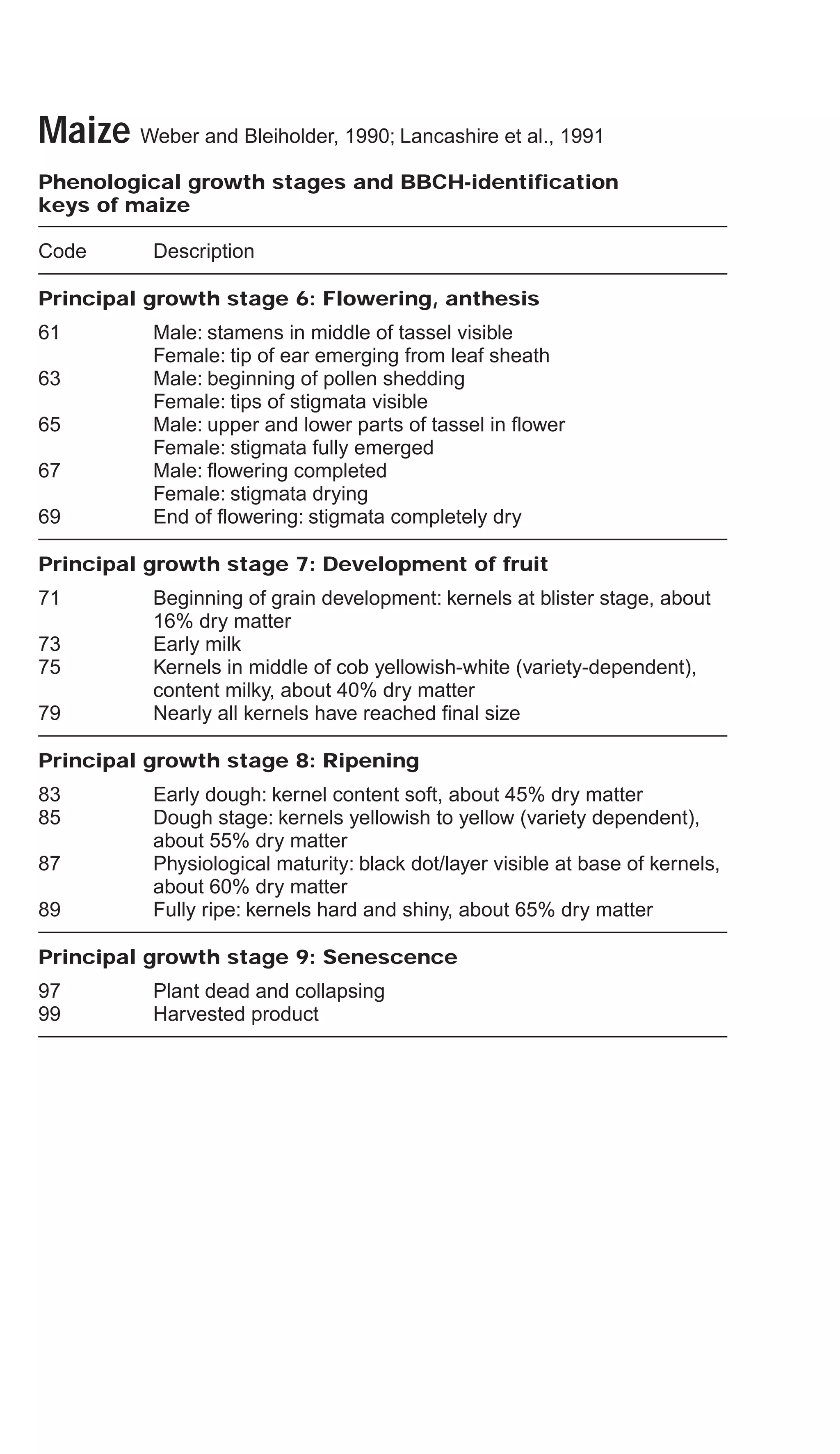
Crop Sci. 21, 901-903.
SCHOTT, P. E., M. HANF, D. O’NEAL, K. SCHELBERGER, M. SCHROEDER, T.
WARE and T. JOHN, 1987: A decimal code for the development stages of a
soybean plant - prerequisite for progressive bioregulator research and use.
Proceedings of the 14th annual meeting of plant Growth Regulator Society for the
Chemical Regulation of Plants, Honolulu, Hawaii, USA.
SCHÜTTE, F., J. STEINBERGER und U. MEIER, 1982: Entwicklungsstadien des Raps
- einschl. Rübsen, Senfarten und Ölrettich -. Biologische Bundesanstalt für Land-
und Forstwirtschaft. Merkblatt 27/7.
SIDDIQUI, M. Q., J. F. BROWN and S. J. ALLEN, 1975: Growth stages of sunflower
and intensity indices for white blister and rust. Plant Dis. Repter.59, 7-11.
SOENEN, A., 1951: Les bases de l’avertissement en culture fruitière. Le
développement du bourgeon floral. Comptes rendus de Recherches,IRSIA 5.
SPARKS, W. C., and G. W. WOODBURRY, 1967: Stages of potato plant growth. Idaho
Agric. Exper. Stat. 309, 1-22.
STAUSS, R., 1994: Compendium of growth stage identification keys for mono- and
dicotyledonous plants, extended BBCH scale. Ciba-Geigy AG, Basel, 99 p.
STAUSS, R., 1995: Compendium pour l’identification des stades phénologiques des
espèces mono et dicotylédones cultivées, échelle BBCH. Ciba-Geigy AG, Basel,
104 p.
STAUSS, R., H. BLEIHOLDER, T. VAN DEN BOOM, L. BUHR, H. HACK, M. HESS, R.
KLOSE, U. MEIER und E. WEBER, 1994: Einheitliche Codierung der
phänologischen Entwicklungsstadien mono- und dikotyler Pflanzen. Erweiterte
BBCH-Skala: Allgemein. Ciba-Geigy AG, Basel, 58 S.
SYLVESTER-BRADLEY, R., R. J. MAKEPEACE and H. BROAD, 1984: A code for
stages of development in oilseed rape (Brassica napus L.) Asp. appl. Biol. 6,
Agronomy, physiology, plant breeding and crop protection of oilseed rape, 399-419.
SYLVESTER-BRADLEY, R., 1985: Revision of a code for stages of development in
oilseed rape (Brassica napus L.). Asp. appl. Biol. 10, Field Trials Methods and Data
handling, 395-400.
THARP, W. H., 1960: The cotton plant - How it grows and why its growth varies. United
States Department of Agriculture, Agricultural Research Service. Agriculture
Handbook No. 178, U. S. Government Printing Office, Washington, D. C.
THEUNISSEN, J. und A. SINS, 1984: Growth stages of Brassica crops for crop
protection purposes. Sci. Horticult.24, 1-11.
TOTTMAN, D. R., 1977: The identification of growth stages in winter wheat with refe-
rence to the application of growth-regulator herbicides. Ann. appl. Biol.87, 213-
224.
TOTTMAN, D. R. and R. J. MAKEPEACE, 1979: An explanation of the decimal code
for the growth stages of cereals, with illustrations. Ann. appl. Biol.93, 221-234.
TOTTMAN, D. R. and H. BROAD, 1987: The decimal code for the growth stages of
cereals, with illustrations. Ann. appl. Biol.110, 441-454.
TROITZKY, N. N., 1925: Vorläufige Untersuchungsmittel der experimentell-biologischen
Station für angewandte Entomologie. Leningrad. In: Kolbe, W., 1979:
Jahreszeitlicher Verlauf der Entwicklungsstadien bei Obstarten in Beziehung zu
Jahreswitterung und Pflanzenschutzmaßnahmen. In: Pflanzenschutz-Nachrichten
Bayer 32, 97-163.
VOGEL, G., H. FRÖHLICH, G. BANHOLZER und H. PINKAU, 1987: Vorschläge zur
Charakteristik ausgewählter Gemüsearten auf der Grundlage eines Dezimal-Code-
Systems. Gartenbau 34, 132-134.
WINNER, C., 1974: Die Jugendentwicklung der Zuckerrübe in ihrer Bedeutung für das
spätere Wachstum und den Ertrag. Zucker27, 517-527.

BBCH

  • 1.
    Growth stages ofmono-and dicotyledonous plants BBCH Monograph 2. Edition, 2001 Edited by Uwe Meier Federal Biological Research Centre for Agriculture and Forestry
  • 2.
    The code hasbeen jointly by – German Federal Biological Research Centre for Agriculture and Forestry (BBA) – German Federal Office of Plant Varieties (BSA) – German Agrochemical Association (IVA) – Institute for Vegetables and Ornamentals in Grossbeeren/Erfurt, Germany Members of the BBCH working group H. Bleiholder und Frau E. Weber BASF AG Landwirtschaftliche Ver- suchsstation Carl-Bosch-Strasse 64 D-67117 Limburgerhof C. Feller Institut für Gemüse & Zier- pflanzenbau Theodor-Echtermeyer-Weg 1 D-14979 Grossbeeren M. Hess und H. Wicke Aventis D-65926 Frankfurt/Main U. Meier Biologische Bundesanstalt für Land- und Forstwirtschaft Messeweg 11/12 D-38104 Braunschweig T. van den Boom Bayer AG Landwirtschaftszentrum Monheim Alfred-Nobel-Strasse 50 D-51368 Leverkusen- Bayerwerk P. D. Lancashire Bayer plc. Eastern Way Bury St. Edmunds Suffolk IP 32 7 AH, UK Frau L. Buhr Biologische Bundesanstalt für Land- und Forstwirtschaft Stahnsdorfer Damm 81 D-14532 Kleinmachnow H. Hack Industrieverband Agrar (IVA) Theodor-Storm-Weg 2 D-51519 Odenthal Frau R. Klose Bundessortenamt Osterfelddamm 80 D-30604 Hannover R. Stauss Ministerium für ländliche Räume, Landwirtschaft, Ernährung und Tourismus des Landes Schleswig- Holstein Düsternbrooker Weg 104 D-24105 Kiel
  • 3.
    General Scale Cereals, Rice,Maize Oilseed rape, Faba bean, Sunflower Beta beets Potato Fruits Citrus, Olive, Coffee, Banana Grapevine Soybean, Cotton, Peanuts Hop Vegetable crops I Vegetable crops II Weeds BBCH-Publications
  • 4.
    Foreword As all branchesof science, the individual disciplines in agricultural plant research also work more closely together, and, in addition, have become more international. The exchange of new findings and joint work on projects presuppose, however, that all those involved have the same understanding of the terms they use. This calls the need for an extensively standardised description of plant development stages in order of their phenological characteristics and their coding. The phenological development stages of plants are also used in agricultural practice, agrometeorology and agricultural insurance, each with its own varying individual objectives. Moreover, the applied botanical sciences also make use of phenological development stages. This book about plant development stages – and their corresponding codes – aims at satisfying all these demands. Of particular significance is the fact that the work appears in four languages and thus contributes to a large extent to reducing linguistic communication problems. It thus fulfils in a special way the intertwinement in research, trade, production and service present today. The book thanks its existence to the close co-operation between scientists from variously oriented agricultural authorities and companies from the chemical industry with agricultural research departments. It is hoped that this fruitful co-operation, in the course of which knowledge has been gathered by all sides over many years, will contribute to furnishing decision makers with more surety, and will promote international co- operation. Prof. Dr. F. Klingauf President of the Federal Biological Research Centre for Agriculture and Forestry, Berlin and Braunschweig
  • 5.
    Note of Thanks Thisbook was made possible by a joint initiative of the Institute for Vegetables and Ornamentals in Großbeeren/Erfurt (IGZ), the German Federal Office of Plant Varieties (BSA), the concerns Aventis, Bayer, BASF and Syngenta, the German Agrochemical Association (IVA) and the German Federal Biological Research Centre for Agriculture and Forestry (BBA). Not only have these institutions and concerns provided substantial funds, but also scientific and technical employees, whose joint work over several years has made this book possible. Indispensable however has been the work of numerous cooperating scientists and co-authors who have enabled the description of the development stages of the crops with their crop specific knowledge. I would like to thank them at this point for their help. An essential aim of this book is to facilitate scientific communication on an international level. Fortunately I was able to find specialist translators .The Spanish translations were done by Mr. Enrique Gonzales Medina, Bogotá/Kolumbien, Mr. José Antonio Guerra, Ciba, Barcelona, as well as Dr. Herrman Bleiholder, BASF AG, who earns the credit for unifying versions in the Spanish language from South America and Spain. The French text was translated by Mrs. Sybil Rometsch, Université de Lausanne. The English text was corrected by Dr. P. D. Lancashire, Bayer, Bury St. Edmunds, UK. Mr. Ernst Halwaß from Nossen agreed as commercial artist to produce the main part of the graphical representations, enabling the clear visual portrayal of the important development stages of the particular crops. Thanks go to him for the creation of drawings of all vegetable and fruit plants, and those of the beet, potato, cotton, peanut, hop, faba bean, sunflower, maize, soybean, musacea, coffe, olive and grapevine. Thanks also to the Gesellschaft der Freunde und Förderer der Biologischen Bundesanstalt for financing the pictures and Mr. Tottman and Mrs. Broad for their drawings of cereals. The authors would also like to thank those colleagues who carried out the necessary technical work with so much patience and perseverance. The production of a book in this form requires substantial financial means. We would therefore like to thank the following companies and institutions at this point for the financial resources provided: Aventis, BASF, Bayer, Syngenta, Dow Elanco, Du Pont de Nemours, Rhône-Poulenc Agro, and the German Agrochemical Association (IVA). Uwe Meier
  • 6.
    The extended BBCH-scale Hacket al., 1992 The extended BBCH-scale is a system for a uniform coding of phenologically similar growth stages of all mono- and dicotyledonous plant species. It results from teamwork between the German Federal Biological Research Centre for Agriculture and Forestry (BBA), the German Federal Office of Plant Varieties (BSA), the German Agrochemical Association (IVA) and the Institute for Vegetables and Ornamentals in Grossbeeren/Erfurt, Germany (IGZ). The decimal code, which is divided into principal and secondary growth stages, is based on the well-known cereal code developed by ZADOKS et al. (1974) in order to avoid major changes from this widely used phenological key.The abbreviation BBCH derives from Biologische Bundesanstalt, Bundessortenamt and CHemical industry. The basic principles of the scale – The general scale forms the framework within which the individual scales are developed. It can also be used for those plant species for which no special scale is currently available. – Similar phenological stages of each plant species are given the same code. – For each code, a description is given, and for some important stages, drawings are included. – For the description of the phenological development stages, clear and easily recognised (external) morphological characte-ristics are used. – Except where stated otherwise, only the development of the main stem is taken into consideration. – The growth stages refer to representative individual plants within the crop stand. Crop stand characteristics may also be considered. – Relative values relating to species- and/or variety-specific ultimate sizes are used for the indication of sizes. – The secondary growth stages 0 to 8 correspond to the respective ordinal numbers or percentage values. For example stage 3 could represent: 3rd true leaf, 3rd tiller, 3rd node or 30% of the final length or size typical of the species or 30% of the flowers open. – Post harvest or storage treatment is coded 99. – Seed treatment before planting is coded 00. Organisation of the scale The entire developmental cycle of the plants is subdivided into ten clearly recognizable and distinguishable longer-lasting developmental phases. These principal growth stages are described using numbers from 0 to 9 in ascending order (see Figures 1a and b). The principal growth stages are described in Table 1. Owing to the very many different plant species there may be shifts in the course of the development or certain stages may even be omitted.
  • 7.
    The principal growthstages need not proceed in the strict sequence defined by the ascending order of the figures, but can occasionally also proceed in parallel. Table 1: Principal growth stages Stage Description 0 Germination / sprouting / bud development 1 Leaf development (main shoot) 2 Formation of side shoots / tillering 3 Stem elongation or rosette growth / shoot development (main shoot) 4 Development of harvestable vegetative plant parts or vegetatively propagated organs / booting (main shoot) 5 Inflorescence emergence (main shoot) / heading 6 Flowering (main shoot) 7 Development of fruit 8 Ripening or maturity of fruit and seed 9 Senescence, beginning of dormancy If two or more principal growth stages proceed in parallel, both can be indicated by using a diagonal stroke (example 16/22). If only one stage is to be indicated, either the more advanced growth stage must be chosen or the principal growth stage of particular interest, depending upon the plant species. The principal growth stages alone are not sufficient to define exactly application or evaluation dates, since they always describe time spans in the course of the development of a plant. Secondary stages are used if points of time or steps in the plant development must be indicated precisely. In contrast to the principal growth stages they are defined as short developmental steps characteristic of the respective plant species, which are passed successively during the respective principal growth stage.They are also coded by using the figures 0 to 9. The combination of figures for the principal and the secondary stages, results in the two-digit code. The two-digit code is a scale which offers the possibility of precisely defining all phenological growth stages for the majority of plant species. Only in the case of some plant species (e.g. cucumber, onion, potato, soybean, tomato) is further subdivision necessary within a principal growth stage beyond that possible using the secondary stages from 0 to 9. For these cases a three-digit scale is presented alongside the two-digit scale. This involves the inclusion of the so-called mesostage between the principal and the secondary stage, which provides a further subdivision with figures 0 and 1 describing the development on the main stem and figures 2 to 9
  • 8.
    that of theside shoots 2nd to 9th order (see Figures 1a and b). In this way up to 19 leaves can be counted on the main stem or the branching can be described. The BBCH-scales allow the comparison of individual codes only within one principal growth stage: an arithmetically greater code indicates a plant at a later growth stage. Sorting codes into numerical order therefore allows a listing in order of the stage of plant development. The time span of certain developmental phases of a plant can be exactly defined and coded by indicating two stages. For this purpose two codes are connected with a hyphen. Thus, for instance, the code 51–69 describes the developmental phase from the appearance of the first inflorescence or flower buds until the end of flowering. This allows the computer-supported monitoring of crop stands. For a uniform coding which covers the maximum number of plant species, it is necessary to use primarily phenological criteria rather than homologous or analogous stages. Thus, for instance, germination of plants from true seed and sprouting from buds are classified in one principal growth stage, the principal growth stage 0, even though they are completely different biological processes. In case of the BBCH-scales the descriptions are based on the actual characteristic features of the individual plant. If the scales are used for the definition of the development stage of a plant stand, the description should apply to at least 50% of the plants. Greater differences in the course of the development of different plant groupshave to be taken into consideration for the description of the general scale (see 1.2). This problem is dealt with by offering several definitions for one specific stage wherever the formulation of a uniform text is impossible. The following letters show to which plant group the respective definition refers. Figures 1a and b: Subdivision of the developmental cycle of plants into principal and secondary stages (a) and into principal, meso- and secondary stages (b). The mesostages are inserted between the principal and the secondary stages. Modified according to a draft by A. Witzenberger.
  • 10.
    The extended BBCH-scale,general Hack et al., 1992 D = Dicotyledons M = Monocotyledons V = Development from vegetative parts or propagated organs. G = Gramineae P = Perennial plants No code letter is used if the description applies to all groups of plants. Code Description Principal growth stage 0: Germination, sprouting, bud development 00 Dry seed (seed dressing takes place at stage 00) P, V Winter dormancy or resting period 01 Beginning of seed imbibition; P, V Beginning of bud swelling 03 Seed imbibition complete; P, V End of bud swelling 05 Radicle (root) emerged from seed; P, V Perennating organs forming roots 06 Elongation of radicle, formation of root hairs and/or lateral roots 07 G Coleoptile emerged from caryopsis; D, M Hypocotyl with cotyledons or shoot breaking through seed coat; P, V Beginning of sprouting or bud breaking 08 D Hypocotyl with cotyledons growing towards soil surface; P, V Shoot growing towards soil surface 09 G Emergence: Coleoptile breaks through soil surface; D, M Emergence: Cotyledons break through soil surface (except hypogeal germination); D, V Emergence: Shoot/leaf breaks through soil surface; P Bud shows green tips Principal growth stage 1: Leaf development (main shoot) 10 G First true leaf emerged from coleoptile; D, M Cotyledons completely unfolded; P First leaves separated 11 First true leaf, leaf pair or whorl unfolded; P First leaves unfolded 12 2 true leaves, leaf pairs or whorls unfolded 13 3 true leaves, leaf pairs or whorls unfolded 1 . Stages continuous till . . . 19 9 or more true leaves, leaf pairs or whorls unfolded
  • 11.
    The extended BBCH-scale,general Hack et al., 1992 Code Description Principal growth stage 2: Formation of side shoots/tillering 21 First side shoot visible; G First tiller visible 22 2 side shoots visible; G 2 tillers visible 23 3 side shoots visible; G 3 tillers visible 2 . Stages continuous till . . . 29 9 or more side shoots visible; G 9 or more tillers visible Principal growth stage 3: Stem elongation or rosette growth, shoot development (main shoot) 31 Stem (rosette) 10% of final length (diameter); G 1 node detectable 32 Stem (rosette) 20% of final length (diameter); G 2 nodes detectable 33 Stem (rosette) 30% of final length (diameter); G 3 nodes detectable 3 . Stages continuous till . . . 39 Maximum stem length or rosette diameter reached; G 9 or more nodes detectable Principal growth stage 4: Development of harvestable vegetative plant parts or vegetatively propagated organs/booting (main shoot) 40 Harvestable vegetative plant parts or vegetatively propagated organs begin to develop 41 G Flag leaf sheath extending 43 Harvestable vegetative plant parts or vegetatively propagated organs have reached 30% of final size; G Flag leaf sheath just visibly swollen (mid-boot) 45 Harvestable vegetative plant parts or vegetatively propagated organs have reached 50% of final size; G Flag leaf sheath swollen (late-boot) 47 Harvestable vegetative plant parts or vegetatively propagated organs have reached 70% of final size; G Flag leaf sheath opening 49 Harvestable vegetative plant parts or vegetatively propagated organs have reached final size; G First awns visible
  • 12.
    The extended BBCH-scale,general Hack et al., 1992 Code Description Principal growth stage 5: Inflorescence emergence (main shoot) / heading 51 Inflorescence or flower buds visible; G Beginning of heading 55 First individual flowers visible (still closed); G Half of inflorescence emerged (middle of heading) 59 First flower petals visible (in petalled forms); G Inflorescence fully emerged (end of heading) Principal growth stage 6: Flowering (main shoot) 60 First flowers open (sporadically) 61 Beginning of flowering: 10% of flowers open 62 20% of flowers open 63 30% of flowers open 64 40% of flowers open 65 Full flowering: 50% of flowers open, first petals may be fallen 67 Flowering finishing: majority of petals fallen or dry 69 End of flowering: fruit set visible Principal growth stage 7: Development of fruit 71 10% of fruits have reached final size or fruit has reached 10% of final size1 G Caryopsis watery ripe 72 20% of fruits have reached final size or fruit has reached 20% of final size1 73 30% of fruits have reached final size or fruit has reached 30% of final size1 G Early milk 74 40% of fruits have reached final size or fruit has reached 40% of final size1 75 50% of fruits have reached final size or fruit has reached 50% of final size1 G Milky ripe, medium milk 76 60% of fruits have reached final size or fruit has reached 60% of final size1 77 70% of fruits have reached final size or fruit has reached 70% of final size1 G Late milk 78 80% of fruits have reached final size or fruit has reached 80% of final size1 79 Nearly all fruits have reached final size1 1 This stage is not used, if the main fruit growth happens in principal growth stage 8
  • 13.
    The extended BBCH-scale,general Hack et al., 1992 Code Description Principal growth stage 8: Ripening or maturity of fruit and seed 81 Beginning of ripening or fruit colouration 85 Advanced ripening or fruit colouration; G Dough stage 87 Fruit begins to soften (species with fleshy fruit) 89 Fully ripe: fruit shows fully-ripe colour, beginning of fruit abscission Principal growth stage 9: Senescence, beginning of dormancy 91 P Shoot development completed, foliage still green 93 Beginning of leaf-fall 95 50% of leaves fallen 97 End of leaf fall, plants or above ground parts dead or dormant; P Plant resting or dormant 99 Harvested product (post-harvest or storage treatment is applied at stage 99)
  • 14.
    The extended BBCH-scale,for specific crops Cereals Witzenberger et al., 1989; Lancashire et al., 1991 Phenological growth stages and BBCH-identification keys of cereals (wheat = Triticum sp. L., barley = Hordeum vulgare L., oat = Avena sativa L., rye = Secale cereale L.) Code Description Principal growth stage 0: Germination 00 Dry seed (caryopsis) 01 Beginning of seed imbibition 03 Seed imbibition complete 05 Radicle emerged from caryopsis 06 Radicle elongated, root hairs and/or side roots visible 07 Coleoptile emerged from caryopsis 09 Emergence: coleoptile penetrates soil surface (cracking stage) Principal growth stage 1: Leaf development1, 2 10 First leaf through coleoptile 11 First leaf unfolded 12 2 leaves unfolded 13 3 leaves unfolded 1 . Stages continuous till . . . 19 9 or more leaves unfolded Principal growth stage 2: Tillering3 20 No tillers 21 Beginning of tillering: first tiller detectable 22 2 tillers detectable 23 3 tillers detectable 2 . Stages continuous till . . . 29 End of tillering. Maximum no. of tillers detectable 1 A leaf is unfolded when its ligule is visible or the tip of the next leaf is visible 2 Tillering or stem elongation may occur earlier than stage 13; in this case continue with stages 21 3 If stem elongation begins before the end of tillering continue with stage 30
  • 15.
    Cereals Witzenberger etal., 1989; Lancashire et al., 1991 Phenological growth stages and BBCH-identification keys of cereals Code Description Principal growth stage 3: Stem elongation 30 Beginning of stem elongation: pseudostem and tillers erect, first internode begins to elongate, top of inflorescence at least 1 cm above tillering node 31 First node at least 1 cm above tillering node 32 Node 2 at least 2 cm above node 1 33 Node 3 at least 2 cm above node 2 3 . Stages continuous till . . . 37 Flag leaf just visible, still rolled 39 Flag leaf stage: flag leaf fully unrolled, ligule just visible Principal growth stage 4: Booting 41 Early boot stage: flag leaf sheath extending 43 Mid boot stage: flag leaf sheath just visibly swollen 45 Late boot stage: flag leaf sheath swollen 47 Flag leaf sheath opening 49 First awns visible (in awned forms only) Principal growth stage 5: Inflorescence emergence, heading 51 Beginning of heading: tip of inflorescence emerged from sheath, first spikelet just visible 52 20% of inflorescence emerged 53 30% of inflorescence emerged 54 40% of inflorescence emerged 55 Middle of heading: half of inflorescence emerged 56 60% of inflorescence emerged 57 70% of inflorescence emerged 58 80% of inflorescence emerged 59 End of heading: inflorescence fully emerged Principal growth stage 6: Flowering, anthesis 61 Beginning of flowering: first anthers visible 65 Full flowering: 50% of anthers mature 69 End of flowering: all spikelets have completed flowering but some dehydrated anthers may remain Principal growth stage 7: Development of fruit 71 Watery ripe: first grains have reached half their final size 73 Early milk 75 Medium milk: grain content milky, grains reached final size, still green 77 Late milk
  • 16.
    Cereals Witzenberger etal., 1989; Lancashire et al., 1991 Phenological growth stages and BBCH-identification keys of cereals Code Description Principal growth stage 8: Ripening 83 Early dough 85 Soft dough: grain content soft but dry. Fingernail impression not held 87 Hard dough: grain content solid. Fingernail impression held 89 Fully ripe: grain hard, difficult to divide with thumbnail Principal growth stage 9: Senescence 92 Over-ripe: grain very hard, cannot be dented by thumbnail 93 Grains loosening in day-time 97 Plant dead and collapsing 99 Harvested product
  • 17.
  • 18.
  • 19.
    Rice Lancashire etal., 1991 Phenological growth stages and BBCH-identification keys of rice (Oryza sativa L.) Code Description Principal growth stage 0: Germination 00 Dry seed (caryopsis) 01 Beginning of seed imbibition 03 Seed imbibition complete (pigeon breast) 05 Radicle emerged from caryopsis 06 Radicle elongated, root hairs and/or side roots visible 07 Coleoptile emerged from caryopsis (in water-rice this stage occurs before stage 05) 09 Imperfect leaf emerges (still rolled) at the tip of the coleoptile Principal growth stage 1: Leaf development1, 2 10 Imperfect leaf unrolled, tip of first true leaf visible 11 First leaf unfolded 12 2 leaves unfolded 13 3 leaves unfolded 1 . Stages continuous till . . . 19 9 or more leaves unfolded Principal growth stage 2: Tillering3 21 Beginning of tillering: first tiller detectable 22 2 tillers detectable 23 3 tillers detectable 2 . Stages continuous till ... 29 Maximum number of tillers detectable Principal growth stage 3: Stem elongation 30 Panicle initiation or green ring stage: chlorophyll accumulates in the stem tissue, forming a green ring 32 Panicle formation: panicle 1–2 mm in length 34 Internode elongation or jointing stage: internodes begin to elongate, panicle more than 2 mm long (variety-dependent) 37 Flag leaf just visible, still rolled, panicle moving upwards 39 Flag leaf stage: flag leaf unfolded, collar regions (auricle and ligule) of flag leaf and penultimate leaf aligned (pre-boot stage) 1 A leaf is unfolded when its ligule is visible or the tip of the next leaf is visible 2 Tillering or stem elongation may occur earlier than stage 13; in this case continue with stages 21 or 30 3 If stem elongation begins before the end of tillering continue with stage 30
  • 20.
    Rice Lancashire etal., 1991 Phenological growth stages and BBCH-identification keys of rice Code Description Principal growth stage 4: Booting 41 Early boot stage: upper part of stem slightly thickened, sheath of flag leaf about 5 cm out of penultimate leaf sheath 43 Mid boot stage: sheath of flag leaf 5–10 cm out of the penultimate leaf sheath 45 Late boot stage: flag leaf sheath swollen, sheath of flag leaf more than 10 cm out of penultimate leaf sheath 47 Flag leaf sheath opening 49 Flag leaf sheath open Principal growth stage 5: Inflorescence emergence, heading4 51 Beginning of panicle emergence: tip of inflorescence emerged from sheath 52 20% of panicle emerged 53 30% of panicle emerged 54 40% of panicle emerged 55 Middle of panicle emergence: neck node still in sheath 56 60% of panicle emerged 57 70% of panicle emerged 58 80% of panicle emerged 59 End of panicle emergence: neck node level with the flag leaf auricle, anthers not yet visible Principal growth stage 6: Flowering, anthesis 61 Beginning of flowering: anthers visible at top of panicle 65 Full flowering: anthers visible on most spikelets 69 End of flowering: all spikelets have completed flowering but some dehydrated anthers may remain Principal growth stage 7: Development of fruit 71 Watery ripe: first grains have reached half their final size 73 Early milk 75 Medium milk: grain content milky 77 Late milk Principal growth stage 8: Ripening 83 Early dough 85 Soft dough: grain content soft but dry, fingernail impression not held, grains and glumes still green 87 Hard dough: grain content solid, fingernail impression held 89 Fully ripe: grain hard, difficult to divide with thumbnail 4 Flowering usually starts before stage 55; continue with principal stage 6
  • 21.
    Rice Lancashire etal., 1991 Phenological growth stages and BBCH-identification keys of rice Code Description Principal growth stage 9: Senescence 92 Over-ripe: grain very hard, cannot be dented by thumbnail 97 Plant dead and collapsing 99 Harvested product
  • 22.
  • 23.
    Rice Collar regions aligned Detail Neck nodeand auricle coincide (Ripening)
  • 24.
    Maize Weber andBleiholder, 1990; Lancashire et al., 1991 Phenological growth stages and BBCH-identification keys of maize (Zea mays L.) Code Description Principal growth stage 0: Germination 00 Dry seed (caryopsis) 01 Beginning of seed imbibition 03 Seed imbibition complete 05 Radicle emerged from caryopsis 06 Radicle elongated, root hairs and/or side roots visible 07 Coleptile emerged from caryopsis 09 Emergence: coleoptile penetrates soil surface (cracking stage) Principal growth stage 1: Leaf development1, 2 10 First leaf through coleoptile 11 First leaf unfolded 12 2 leaves unfolded 13 3 leaves unfolded 1 . Stages continuous till . . . 19 9 or more leaves unfolded Principal growth stage 3: Stem elongation 30 Beginning of stem elongation 31 First node detectable 32 2 nodes detectable 33 3 nodes detectable 3 . Stages continuous till . . . 39 9 or more nodes detectable3 Principal growth stage 5: Inflorescence emergence, heading 51 Beginning of tassel emergence: tassel detectable at top of stem 53 Tip of tassel visible 55 Middle of tassel emergence: middle of tassel begins to separate 59 End of tassel emergence: tassel fully emerged and separated 1 A leaf may be described as unfolded when its ligule is visible or the tip of next leaf is visible 2 Tillering or stem elongation may occur earlier than stage 19; in this case continue with principal growth stage 3 3 In maize, tassel emergence may occur earlier, in this case continue with principal growth stage 5
  • 25.
    Maize Weber andBleiholder, 1990; Lancashire et al., 1991 Phenological growth stages and BBCH-identification keys of maize Code Description Principal growth stage 6: Flowering, anthesis 61 Male: stamens in middle of tassel visible Female: tip of ear emerging from leaf sheath 63 Male: beginning of pollen shedding Female: tips of stigmata visible 65 Male: upper and lower parts of tassel in flower Female: stigmata fully emerged 67 Male: flowering completed Female: stigmata drying 69 End of flowering: stigmata completely dry Principal growth stage 7: Development of fruit 71 Beginning of grain development: kernels at blister stage, about 16% dry matter 73 Early milk 75 Kernels in middle of cob yellowish-white (variety-dependent), content milky, about 40% dry matter 79 Nearly all kernels have reached final size Principal growth stage 8: Ripening 83 Early dough: kernel content soft, about 45% dry matter 85 Dough stage: kernels yellowish to yellow (variety dependent), about 55% dry matter 87 Physiological maturity: black dot/layer visible at base of kernels, about 60% dry matter 89 Fully ripe: kernels hard and shiny, about 65% dry matter Principal growth stage 9: Senescence 97 Plant dead and collapsing 99 Harvested product
  • 26.
  • 27.
  • 28.
    Oilseed rape Weberand Bleiholder, 1990; Lancashire et al., 1991 Phenological growth stages and BBCH-identification keys of oilseed rape (Brassica napus L. ssp. napus) Code Description Principal growth stage 0: Germination 00 Dry seed 01 Beginning of seed imbibition 03 Seed imbibition complete 05 Radicle emerged from seed 07 Hypocotyl with cotyledons emerged from seed 08 Hypocotyl with cotyledons growing towards soil surface 09 Emergence: cotyledons emerge through soil surface Principal growth stage 1: Leaf development1 10 Cotyledons completely unfolded 11 First leaf unfolded 12 2 leaves unfolded 13 3 leaves unfolded 1 . Stages continuous till . . . 19 9 or more leaves unfolded Principal growth stage 2: Formation of side shoots 20 No side shoots 21 Beginning of side shoot development: first side shoot detectable 22 2 side shoots detectable 23 3 side shoots detectable 2 . Stages continuous till . . . 29 End of side shoot development: 9 or more side shoots detectable Principal growth stage 3: Stem elongation2 30 Beginning of stem elongation: no internodes (“rosette”) 31 1 visibly extended internode 32 2 visibly extended internodes 33 3 visibly extended internodes 3 . Stages continuous till . . . 39 9 or more visibly extended internodes 1 Stem elongation may occur earlier than stage stage 19; in this case continue with stage 20 2 Visibly extended internode n develops between leaf n and leaf n+1
  • 29.
    Oilseed rape Weberand Bleiholder, 1990; Lancashire et al., 1991 Phenological growth stages and BBCH-identification keys of oilseed rape Code Description Principal growth stage 5: Inflorescence emergence 50 Flower buds present, still enclosed by leaves 51 Flower buds visible from above (“green bud”) 52 Flower buds free, level with the youngest leaves 53 Flower buds raised above the youngest leaves 55 Individual flower buds (main inflorescence) visible but still closed 57 Individual flower buds (secondary inflorescences) visible but still closed 59 First petals visible, flower buds still closed (“yellow bud”) Principal growth stage 6: Flowering 60 First flowers open 61 10% of flowers on main raceme open, main raceme elongating 62 20% of flowers on main raceme open 63 30% of flowers on main raceme open 64 40% of flowers on main raceme open 65 Full flowering: 50% flowers on main raceme open, older petals falling 67 Flowering declining: majority of petals fallen 69 End of flowering Principal growth stage 7: Development of fruit 71 10% of pods have reached final size 72 20% of pods have reached final size 73 30% of pods have reached final size 74 40% of pods have reached final size 75 50% of pods have reached final size 76 60% of pods have reached final size 77 70% of pods have reached final size 78 80% of pods have reached final size 79 Nearly all pods have reached final size
  • 30.
    Oilseed rape Weberand Bleiholder, 1990; Lancashire et al., 1991 Phenological growth stages and BBCH-identification keys of oilseed rape Code Description Principal growth stage 8: Ripening 80 Beginning of ripening: seed green, filling pod cavity 81 10% of pods ripe, seeds dark and hard 82 20% of pods ripe, seeds dark and hard 83 30% of pods ripe, seeds dark and hard 84 40% of pods ripe, seeds dark and hard 85 50% of pods ripe, seeds dark and hard 86 60% of pods ripe, seeds dark and hard 87 70% of pods ripe, seeds dark and hard 88 80% of pods ripe, seeds dark and hard 89 Fully ripe: nearly all pods ripe, seeds dark and hard Principal growth stage 9: Senescence 97 Plant dead and dry 99 Harvested product
  • 31.
    Oilseed rape © 1990:BASF AG 51 (Detail)
  • 32.
  • 33.
    Faba bean Weberand Bleiholder, 1990; Lancashire et al., 1991 Phenological growth stages and BBCH-identification keys of faba bean (Vicia faba L.) Code Description Principal growth stage 0: Germination 00 Dry seed 01 Beginning of seed imbibition 03 Seed imbibition complete 05 Radicle emerged from seed 07 Shoot emerged from seed (plumule apparent) 08 Shoot growing towards soil surface 09 Emergence: shoot emerges through soil surface Principal growth stage 1: Leaf development1 10 Pair of scale leaves visible (may be eaten or lost) 11 First leaf unfolded 12 2 leaves unfolded 13 3 leaves unfolded 1 . Stages continuous till . . . 19 9 or more leaves unfolded Principal growth stage 2: Formation of side shoots 20 No side shoots 21 Beginning of side shoot development: first side shoot detectable 22 2 side shoots detectable 23 3 side shoots detectable 2 . Stages continuous till . . . 29 End of side shoot development: 9 or more side shoots detectable Principal growth stage 3: Stem elongation 30 Beginning of stem elongation 31 One visibly extended internode2 32 2 visibly extended internodes 33 3 visibly extended internodes 3 . Stages continuous till . . . 39 9 or more visibly extended internodes 1 Stem elongation may occur earlier than stage 19; in this case continue with the principal stage 3 2 First internode extends from the scale leaf node to the first true leaf node
  • 34.
    Faba bean Weberand Bleiholder, 1990; Lancashire et al., 1991 Phenological growth stages and BBCH-identification keys of faba bean Code Description Principal growth stage 5: Inflorescence emergence 50 Flower buds present, still enclosed by leaves 51 First flower buds visible outside leaves 55 First individual flower buds visible outside leaves but still closed 59 First petals visible, many individual flower buds, still closed Principal growth stage 6: Flowering 60 First flowers open 61 Flowers open on first raceme 63 Flowers open 3 racemes per plant 65 Full flowering: flowers open on 5 racemes per plant 67 Flowering declining 69 End of flowering Principal growth stage 7: Development of fruit 70 First pods have reached final length (“flat pod”) 71 10% of pods have reached final length 72 20% of pods have reached final length 73 30% of pods have reached final length 74 40% of pods have reached final length 75 50% of pods have reached final length 76 60% of pods have reached final length 77 70% of pods have reached final length 78 80% of pods have reached final length 79 Nearly all pods have reached final length Principal growth stage 8: Ripening 80 Beginning of ripening: seed green, filling pod cavity 81 10% of pods ripe, seeds dry and hard 82 20% of pods ripe, seeds dry and hard 83 30% of pods ripe and dark, seeds dry and hard 84 40% of pods ripe and dark, seeds dry and hard 85 50% of pods ripe and dark, seeds dry and hard 86 60% of pods ripe and dark, seeds dry and hard 87 70% of pods ripe and dark, seeds dry and hard 88 80% of pods ripe and dark, seeds dry and hard 89 Fully ripe: nearly all pods dark, seeds dry and hard
  • 35.
    Faba bean Weberand Bleiholder, 1990; Lancashire et al., 1991 Phenological growth stages and BBCH-identification keys of faba bean Code Description Principal growth stage 9: Senescence 93 Stems begin to darken 95 50% of stems brown or black 97 Plant dead and dry 99 Harvested product
  • 36.
  • 37.
    Sunflower Weber andBleiholder, 1990; Lancashire et al., 1991 Phenological growth stages and BBCH-identification keys of sunflower (Helianthus annuus L.) Code Description Principal growth stage 0: Germination 00 Dry seed (achene) 01 Beginning of seed imbibition 03 Seed imbibition complete 05 Radicle emerged from seed 06 Radicle elongated, root hairs developing 07 Hypocotyl with cotyledons emerged from seed 08 Hypocotyl with cotyledons growing towards soil surface 09 Emergence: cotyledons emerge through soil surface Principal growth stage 1: Leaf development1 10 Cotyledons completely unfolded 12 2 leaves (first pair) unfolded 14 4 leaves (second pair) unfolded 15 5 leaves unfolded 16 6 leaves unfolded 17 7 leaves unfolded 18 8 leaves unfolded 19 9 or more leaves unfolded Principal growth stage 3: Stem elongation 30 Beginning of stem elongation 31 1 visibly extended internode 32 2 visibly extended internodes 33 3 visibly extended internodes 3 . Stages continuous till . . . 39 9 or more visibly extended internodes Principal growth stage 5: Inflorescence emergence 51 Inflorescence just visible between youngest leaves 53 Inflorescence separating from youngest leaves, bracts distinguishable from foliage leaves 55 Inflorescence separated from youngest foliage leaf 57 Inflorescence clearly separated from foliage leaves 59 Ray florets visible between the bracts; inflorescence still closed 1 Stem elongation may occur earlier than stage 19; in this case continue with the principal stage 3
  • 38.
    Sunflower Weber andBleiholder, 1990; Lancashire et al., 1991 Phenological growth stages and BBCH-identification keys of sunflower Code Description Principal growth stage 6: Flowering 61 Beginning of flowering: ray florets extended, disc florets visible in outer third of inflorescence 63 Disc florets in outer third of inflorescence in bloom (stamens and stigmata visible) 65 Full flowering: disc florets in middle third of inflorescence in bloom (stames and stigmata visible) 67 Flowering declining: disc florets in inner third of inflorescence in bloom (stames and stigmata visible) 69 End of flowering: most disc florets have finished flowering, ray florets dry or fallen Principal growth stage 7: Development of fruit 71 Seeds on outer edge of the inflorescence are grey and have reached final size 73 Seeds on outer third of the inflorescence are grey and have reached final size 75 Seeds on middle third of the inflorescence are grey and have reached final size 79 Seeds on inner third of the inflorescence are grey and have reached final size Principal growth stage 8: Ripening 80 Beginning of ripening: seeds on outer third of anthocarp black and hard. Back of anthocarp still green 81 Seeds on outer third of anthocarp dark and hard. Back ofanthocarp still green 83 Dark of anthocarp yellowish-green, bracts still green. Seeds about 50% dry matter 85 Seeds on middle third of anthocarp dark and hard. Back of anthocarp yellow, bracts brown edged. Seeds about 60% dry matter 87 Physiological ripeness: back of the anthocarp yellow. Bracts marbled brown. Seeds about 75–80% dry matter 89 Fully ripe: seeds on inner third of anthocarp dark and hard. Back of anthocarp brown. Bracts brown. Seeds about 85% dry matter Principal growth stage 9: 92 Over ripe, seeds over 90% dry matter 97 Plant dead and dry 99 Harvested product
  • 39.
  • 40.
  • 41.
    Beet Meier etal., 1993 Phenological growth stages and BBCH-identification keys of beet (Beta vulgaris L. ssp. vulgaris) Code Description Principal growth stage 0: Germination 00 Dry seed 01 Beginning of imbibition: seeds begins to take up water 03 Seed imbibition complete (pellet cracked) 05 Radicle emerged from seed (pellet) 07 Shoot emerged from seed (pellet) 09 Emergence: shoot emerges through soil surface Principal growth stage 1: Leaf development (youth stage) 10 First leaf visible (pinhead-size): cotyledons horizontally unfolded 11 First pair of leaves visible, not yet unfolded (pea-size) 12 2 leaves (first pair of leaves) unfolded 14 4 leaves (2nd pair of leaves) unfolded 15 5 leaves unfolded 1 . Stages continuous till . . . 19 9 and more leaves unfolded Principal growth stage 3: Rosette growth (crop cover) 31 Beginning of crop cover: leaves cover 10% of ground 32 Leaves cover 20% of ground 33 Leaves cover 30% of ground 34 Leaves cover 40% of ground 35 Leaves cover 50% of ground 36 Leaves cover 60% of ground 37 Leaves cover 70% of ground 38 Leaves cover 80% of ground 39 Crop cover complete: leaves cover 90% of ground Principal growth stage 4: Development of harvestable vegetative plant parts Beet root 49 Beet root has reached harvestable size Principal growth stage 5: Inflorescence emergence (2nd year of growth) 51 Beginning of elongation of main stem 52 Main stem 20 cm long 53 Side shoot buds visible on main stem 54 Side shoots clearly visible on main stem 55 First individual flower buds on side shoots visible 59 First bracts visible; flower buds still closed
  • 42.
    Beet Meier etal., 1993 Phenological growth stages and BBCH-identification keys of beet Code Description Principal growth stage 6: Flowering 60 First flowers open 61 Beginning of flowering: 10% of flowers open 62 20% of flowers open 63 30% of flowers open 64 40% of flowers open 65 Full flowering: 50% of flowers open 67 Flowering declining: 70% of flowers open or dry 69 End of flowering: all flowers dry, fruit set visible Principal growth stage 7: Development of fruit 71 Beginning of seed development: seeds visible in infructescence 75 Pericarp green; fruit still mouldable; perisperm milky; colour of seed coat: beige Principal growth stage 8: Ripening 81 Beginning of ripening: pericarp green-brown, seed coat light brown 85 Pericarp light brown, seed coat reddish brown 87 Pericarp hard, seed coat dark brown 89 Fully ripe: seed coat final colour (specific to variety and species), perisperm hard Principal growth stage 9: Senescence 91 Beginning of leaf discolouration 93 Most leaves yellowish 95 50% of leaves brownish 97 Leaves dead 99 Harvested product (seeds)
  • 43.
  • 44.
    Potato Hack etal., 1993 Phenological growth stages and BBCH-identification keys of potato (Solanum tuberosum L.) Code Description Description of of development development from from tuber seed 2- and 3digit Principal growth stage 0: Sprouting/Germination 00 000 Innate or enforced dormancy, Dry seed tuber not sprouted 01 001 Beginning of sprouting: Beginning of sprouts visible (< 1 mm) seed imbibition 02 002 Sprouts upright (< 2 mm) 03 003 End of dormancy: sprouts 2–3 mm Seed imbibition complete 05 005 Beginning of root formation Radicle (root) emerged from seed 07 007 Beginning of stem formation Hypocotyl with cotyledons breaking 08 008 Stems growing towards soil surface, Hypocotyl with formation of scale leaves in the axils cotyledons growing of which stolons will develop later towards soil surface 09 009 Emergence: Emergence: stems break through soil surface cotyledons break through soil surface 021–0291 1 For second generation sprouts
  • 45.
    Potato Hack etal., 1993 Phenological growth stages and BBCH-identification keys of potato Code Description of development from tuber and seed 2- and 3digit Principal growth stage 1: Leaf development 10 100 From tuber: first leaves begin to extend From seed: cotyledons completely unfolded 11 101 1st leaf of main stem unfolded (> 4 cm) 12 102 2nd leaf of main stem unfolded (> 4 cm) 13 103 3rd leaf Auf main stem unfolded (> 4 cm) 1 . 10 . Stages continuous till . . . 19 109 9 or more leaves of main stem unfolded (> 4cm) (2digit);2 9 leaves of main stem unfolded (> 4 cm) (3digit) 110 10th leaf of main stem unfolded (> 4 cm) 11 . Stages continuous till . . . 119 19. leaf of main stem unfolded (> 4 cm) 121 First leaf of 2nd order branch above first inflorescence unfolded (> 4 cm) 122 2nd leaf of 2nd order branch above first inflorescence unfolded (> 4 cm) 12 . Stages continuous till . . . 131 First leaf of 3rd order branch above 2nd inflorescence unfolded (> 4 cm) 132 2nd leaf of 3rd order branch above 2nd inflorescence unfolded (> 4 cm) 13 . Stages continuous till . . . 1NX Xth leaf of nth order branch above n-1th inflorescence unfolded (> 4 cm) 2 Stem development stops after termination of main stem by an inflorescence. Branches arise from axils of upper leaves of the main stem, exhibiting a sympodial branching pattern
  • 46.
    Potato Hack etal., 1993 Phenological growth stages and BBCH-identification keys of potato Codes Description 2- and 3digit Principal growth stage 2: Formation of basal side shoots below and above soil surface (main stem) 21 201 First basal side shoot visible (> 5 cm) 22 202 2nd basal side shoot visible (> 5 cm) 23 203 3rd basal side shoot visible (> 5 cm) 2 . 20 . Stages continuous till . . . 29 209 9 or more basal side shoots visible (> 5 cm) 2- and 3digit Principal growth stage 3: Main stem elongation (crop cover) 31 301 Beginning of crop cover: 10% of plants meet between rows 32 302 20% off plants meet between rows 33 303 30% of plants meet between rows 34 304 40% of plants meet between rows 35 305 50% of plants meet between rows 36 306 60% of plants meet between rows 37 307 70% of plants meet between rows 38 308 80% of plants meet between rows 39 309 Crop cover complete: about 90% of plants meet between rows 2- and 3digit Principal growth stage 4: Tuber formation 40 400 Tuber initiation: swelling of first stolon tips to twice the diameter of subtending stolon 41 401 10% of total final tuber mass reached 42 402 20% of total final tuber mass reached 43 403 30% of total final tuber mass reached 44 404 40% of total final tuber mass reached 45 405 50% of total final tuber mass reached 46 406 60% of total final tuber mass reached 47 407 70% of total final tuber mass reached 48 408 Maximum of total tuber mass reached, tubers detach easily from stolons, skin set not yet complete (skin easily removable with thumb) 49 409 Skin set complete: (skin at apical end of tuber not removable with thumb) 95% of tubers in this stage
  • 47.
    Potato Hack etal., 1993 Phenological growth stages and BBCH-identification keys of potato Codes Description 2- and 3digit Principal growth stage 5: Inflorescence (cyme) emergence 51 501 First individual buds (1–2 mm) of first inflorescence visible (main stem) 55 505 Buds of first inflorescence extended to 5 mm 59 509 First flower petals of first inflorescence visible 2- and 3digit Principal growth stage 5: Inflorescence emergence (continuation) 521 Individual buds of 2nd inflorescence visible (second order branch) 525 Buds of 2nd inflorescence extended to 5 mm open (main stem) 529 First flower petals of 2nd inflorescence visible above sepals 531 Individuell buds of 3rd inflorescence visible(3rd order branch) 535 Buds of 3rd inflorescence extended to 5 mm 539 First flower petals of 3rd inflorescence visible above sepals 5N . Nth inflorescence emerging 2- and 3digit Principal growth stage 6: Flowering 60 600 First open flowers in population 61 601 Beginning of flowering: 10% of flowers in the first inflorescence open (main stem) 62 602 20% of flowers in the first inflorescence open 63 603 30% of flowers in the first inflorescence open 64 604 40% of flowers in the first inflorescence open 65 605 Full flowering: 50% of flowers in the first inflorescence open 66 606 60% of flowers in the first inflorescence open 67 607 70% of flowers in the first inflorescence open 68 608 80% of flowers in the first inflorescence open 69 609 End of flowering in the first inflorescence
  • 48.
    Potato Hack etal., 1993 Phenological growth stages and BBCH-identification keys of potato Codes Description 2- and 3digit Principal growth stage 6: Flowering (continuation) 621 Beginning of flowering: 10% of flowers in the 2nd inflorescence open (second order branch) 625 Full flowering: 50% of flowers in the 2nd inflorescence open 629 End of flowering in the 2nd inflorescence 631 Beginning of flowering: 10% of flowers in the 3rd inflorescence open (third order branch) 635 Full flowering: 50% of flowers in the 3rd inflorescence open 639 End of flowering in the 3rd inflorescence 6N . Nth inflorescence flowering 6N9 End of flowering 2- and 3digit Principal growth stage 7: Development of fruit 70 700 First berries visible 71 701 10% of berries in the first fructification have reached full size (main stem) 72 702 20% of berries in the first fructification have reached full size 73 703 30% of berries in the first fructification have reached full size 7 . 70 . Stages continuous till . . . 721 10% of berries in the 2nd fructification have reached full size (second order branch) 7N . Development of berries in nth fructification 7N9 Nearly all berries in the nth fructification have reached full size (or have been shed) 2- and 3digit Principal growth stage 8: Ripening of fruit and seed 81 801 Berries in the first fructification still green, seed light-coloured (main stem) 85 805 Berries in the first fructification ochre-coloured or brownish 89 809 Berries in the first fructification shrivelled, seed dark 821 Berries in the 2nd fructification still green, seed light-coloured (second order branch) 8N . Ripening of fruit and seed in nth fructification
  • 49.
    Potato Hack etal., 1993 Phenological growth stages and BBCH-identification keys of potato Codes Description 2- and 3digit Principal growth stage 9: Senescence 91 901 Beginning of leaf yellowing 93 903 Most of the leaves yellowish 95 905 50% of the leaves brownish 97 907 Leaves and stem dead, stems bleached and dry 99 909 Harvested product
  • 50.
  • 51.
  • 52.
    Pome fruit Meieret al., 1994 Phenological growth stages and identification keys of pome fruit (apple = Malus domestica Borkh., pear = Pyrus communis L.) Code Description Principal growth stage 0: Sprouting/Bud development 00 Dormancy: leaf buds and the thicker inflorescence buds closed and covered by dark brown scales 01 Beginning of leaf bud swelling: buds visibly swollen, bud scales elongated, with light coloured patches 03 End of leaf bud swelling: bud scales light coloured with some parts densely covered by hairs 07 Beginning of bud break: first green leaf tips just visible 09 Green leaf tips about 5 mm above bud scales Principal growth stage 1: Leaf development 10 Mouse-ear stage: Green leaf tips 10 mm above the bud scales; first leaves separating 11 First leaves unfolded (others still unfolding) 15 More leaves unfolded, not yet at full size 19 First leaves fully expanded Principal growth stage 3: Shoot development1 31 Beginning of shoot growth: axes of developing shoots visible 32 Shoots about 20% of final length 33 Shoots about 30% of final length 3 . Stages continuous till . . . 39 Shoots about 90% of final length Principal growth stage 5: Inflorescence emergence 51 Inflorescence buds swelling: bud scales elongated, with light coloured patches 52 End of bud swelling: light coloured bud scales visible with parts densely covered by hairs 53 Bud burst: green leaf tips enclosing flowers visible 54 Mouse-ear stage: green leaf tips 10 mm above bud scales; first leaves separating 55 Flower buds visible (still closed) 56 Green bud stage: single flowers separating (still closed) 57 Pink bud stage: flower petals elongating; sepals slightly open; petals just visible 59 Most flowers with petals forming a hollow ball 1 From terminal bud
  • 53.
    Pome fruit Meieret al., 1994 Phenological growth stages and identification keys of pome fruit Code Description Principal growth stage 6: Flowering 60 First flowers open 61 Beginning of flowering: about 10% of flowers open 62 About 20% of flowers open 63 About 30% of flowers open 64 About 40% of flowers open 65 Full flowering: at least 50% of flowers open, first petals falling 67 Flowers fading: majority of petals fallen 69 End of flowering: all petals fallen Principal growth stage 7: Development of fruit 71 Fruit size up to 10 mm; fruit fall after flowering 72 Fruit size up to 20 mm 73 Second fruit fall 74 Fruit diameter up to 40 mm; fruit erect (T-stage: underside of fruit and stalk forming a T) 75 Fruit about half final size 76 Fruit about 60% final size 77 Fruit about 70% final size 78 Fruit about 80% final size 79 Fruit about 90% final size Principal growth stage 8: Maturity of fruit and seed 81 Beginning of ripening: first appearance of cultivar-specific colour 85 Advanced ripening: increase in intensity of cultivar-specific colour 87 Fruit ripe for picking 89 Fruit ripe for consumption: fruit have typical taste and firmness Principal growth stage 9: Senescence, beginning of dormancy 91 Shoot growth completed; terminal bud developed; foliage still fully green 92 Leaves begin to discolour 93 Beginning of leaf fall 95 50% of leaves discoloured 97 All leaves fallen 99 Harvested product
  • 54.
    Pome fruit 1 Leavebud smaller and slimer, directly on the long sprout © 1994: BBA und IVA
  • 55.
    Stone fruit Meieret al., 1994 Phenological growth stages and BBCH-identification keys of stone fruit (cherry = Prunus cerasus L., plum = Prunus domestica L. ssp. domestica, peach = Prunus persica Batsch., apricot = Prunus ameriaca L.) Code Description Principal growth stage 0: Sprouting/Bud development 00 Dormancy: leaf buds and the thicker inflorescence buds closed and covered by dark brown scales 01 Beginning of bud swelling (leaf buds); light brown scales visible, scales with light coloured edges 03 End of leaf bud swelling: scales separated, light green bud sections visible 09 Green leaf tips visible: brown scales fallen, buds enclosed by light green scales Principal growth stage 1: Leaf development 10 First leaves separating: green scales slightly open, leaves emerging 11 First leaves unfolded, axis of developing shoot visible 19 First leaves fully expanded Principal growth stage 3: Shoot development 1 31 Beginning of shoot growth: axes of developing shoots visible 32 Shoots about 20% of final length 33 Shoots about 30% of final length 3 . Stages continuous till . . . 39 Shoots about 90% of final length Principal growth stage 5: Inflorescence emergence 51 Inflorescence buds swelling: buds closed, light brown scales visible 53 Bud burst: scales separated, light green bud sections visible 54 Inflorescence enclosed by light green scales, if such scales are formed (not all cultivars) 55 Single flower buds visible (still closed) borne on short stalks, green scales slightly open 56 Flower pedicel elongating; sepals closed; single flowers separating 57 Sepals open: petal tips visible; single flowers with white or pink petals (still closed) 59 Most flowers with petals forming a hollow ball 1 From terminal bud
  • 56.
    Stone fruit Meieret al., 1994 Phenological growth stages and BBCH-identification keys of stone fruit Code Description Principal growth stage 6: Flowering 60 First flowers open 61 Beginning of flowering: about 10% of flowers open 62 About 20% of flowers open 63 About 30% of flowers open 64 About 40% of flowers open 65 Full flowering: at least 50% of flowers open, first petals falling 67 Flowers fading: majority of petals fallen 69 End of flowering: all petals fallen Principal growth stage 7: Development of fruit 71 Ovary growing; fruit fall after flowering 72 Green ovary surrounded by dying sepal crown, sepals beginning to fall 73 Second fruit fall 75 Fruit about half final size 76 Fruit about 60% of final size 77 Fruit about 70% of final size 78 Fruit about 80% of final size 79 Fruit about 90% of final size Principal growth stage 8: Maturity of fruit and seed 81 Beginning of fruit colouring 85 Colouring advanced 87 Fruit ripe for picking 89 Fruit ripe for consumption: fruit have typical taste and firmness Principal growth stage 9: Senescence, beginning of dormancy 91 Shoot growth completed; foliage still fully green 92 Leaves begin to discolour 93 Beginning of leaf fall 95 50% of leaves discoloured or fallen 97 All leaves fallen 99 Harvested product
  • 57.
  • 58.
    Currants Meier etal., 1994 Phenological growth stages and BBCH-identification keys of currants (black currant = Ribes nigrum L., red currant = Ribes rubrum L.) Code Description Principal growth stage 0: Sprouting/Bud development 00 Dormancy: leaf buds and the thicker inflorescence buds closed and covered by dark brown scales 01 Beginning of bud swelling: bud scales elongated 03 End of bud swelling: edges of bud scales light coloured 07 Beginning of bud burst: first green or red leaf tips just visible 09 Leaf tips extended beyond scales Principal growth stage 1: Leaf development 10 Leaf tips above the bud scales: first leaves separating 11 First leaves unfolded (others still unfolding) 15 More leaves unfolded, not yet full size 19 First leaves fully expanded
  • 59.
    Currants Meier etal., 1994 Phenological growth stages and BBCH-identification keys of currants Code Description Principal growth stage 3: Shoot development1 31 Beginning of shoot growth: axes of developing shoots visible 32 Shoots about 20% of final length 33 Shoots about 30% of final length 3 . Stages continuous till . . . 39 Shoots about 90% of final length Principal growth stage 5: Inflorescence emergence 51 Inflorescence buds and leaf buds swelling: buds closed, light brown scales visible 53 Bud burst: scales separated light green but sections visible 54 Green or red leaf tips above bud scales 55 First flower buds (compact raceme) visible beside unfolded leaves 56 Beginning of raceme elongation 57 First flower bud separated on elongating raceme 59 Grape stage: all flower buds separated Principal growth stage 6: Flowering 60 First flowers open 61 Beginning of flowering: about 10% of flowers open 65 Full flowering: at least 50% of flowers open, first petals falling 67 Flowers fading: majority of petals fallen 69 End of flowering: all petals fallen Principal growth stage 7: Development of fruit 71 Beginning of fruit growth: first fruits visible at raceme base 72 20% of fruits formed 73 30% of fruits formed 74 40% of fruits formed 75 50% of fruits formed 76 60% of fruits formed 77 70% of fruits formed 78 80% of fruits formed 79 90% of fruits formed 1 From terminal bud
  • 60.
    Currants Meier etal., 1994 Phenological growth stages and BBCH-identification keys of currants Code Description Principal growth stage 8: Maturity of fruit and seed 81 Beginning of ripening: change to cultivar-specific fruit color 85 Advanced ripening: first berries at base of racemes have cultivar-specific color 87 Fruit ripe for picking: most berries ripe 89 Berries at base of racemes tending to drop (beginning of fruit abscission) Principal growth stage 9: Senescence, beginning of dormancy 91 Shoot growth completed; terminal bud developed; foliage still fully green 92 Leaves begin to discolour 93 Beginning of leaf fall 95 50% of leaves discoloured or fallen 97 All leaves fallen 99 Harvested product
  • 61.
  • 62.
    Strawberry Meier etal., 1994 Phenological growth stages and BBCH-identification keys of strawberry (Fragaria ananassa Duch.) Code Description Principal growth stage 0: Sprouting/Bud development 00 Dormancy: Leaves prostrate and partly dead 03 Main bud swelling Principal growth stage 1: Leaf development 10 First leaf emerging 11 First leaf unfolded 12 2nd leaf unfolded 13 3rd leaf unfolded1 1 . Stages continuous till . . . 19 9 or more leaves unfolded Principal growth stage 4: Development of stolons and young plants 41 Beginning of stolon (runner) formation: stolons visible (about 2 cm long) 42 First daughter plant visible 43 Beginning of root development in first daughter plant 45 First daughter plant with roots (ready for planting) 49 Several daughter plants with roots (ready for planting) Principal growth stage 5: Inflorescence emergence 55 First set flowers at the bottom of the rosette 56 Inflorescence elongating 57 First flower buds emerged (still closed) 58 Early balloon stage: first flowers with petals forming a hollow ball 59 Most flowers with petals forming a hollow ball Principal growth stage 6: Flowering 60 First flowers open (primary or A-flower) 61 Beginning of flowering: about 10% of flowers open 65 Full flowering: secondary (B) and tertiary (C) flowers open, first petals falling 67 Flowers fading: majority of petals fallen 1 Normally after the three leaf stage the bud development occurs in principal growth stage 5
  • 63.
    Strawberry Meier etal., 1994 Phenological growth stages and BBCH-identification keys of strawberry Code Description Principal growth stage 7: Development of fruit 71 Receptacle protruding from sepal whorl 73 Seeds clearly visible on receptacle tissue Principal growth stage 8: Maturity of fruit 81 Beginning of ripening: most fruits white in colour 85 First fruits have cultivar-specific colour 87 Main harvest: more fruits coloured 89 Second harvest: more fruits coloured Principal growth stage 9: Senescence, beginning of dormancy 91 Beginning of axillary bud formation 92 New leaves with smaller lamina and shortened stalk visible 93 Old leaves dying, young leaves curling; old leaves of cultivarspecific colour 97 Old leaves dead
  • 64.
  • 65.
    Citrus Agusti etal., 1995 Phenological growth stages and BBCH-identification keys of citrus (Citrus spp. L.), Code Description Principal growth stage 0: Sprouting/Bud development 00 Dormancy: leaf and inflorescence buds undifferentiated, closed and covered by green scales 01 Beginning of bud swelling 03 End of bud swelling: green scales slightly separated 07 Beginning of bud burst 09 Green leaf tips visible Principal growth stage 1: Leaf development 10 First leaves separating: green scales slightly open, leaves emerging 11 First leaves visible1 15 More leaves visible, not yet at full size 19 First leaves fully expanded Principal growth stage 3: Shoot development 31 Beginning of shoot growth: axes of developing shoots visible 32 Shoots about 20% of final length 39 Shoots about 90% of final length Principal growth stage 5: Inflorescence emergence 51 Inflorescence buds swelling: buds closed, light green scales visible 53 Bud burst: scales separated, floral tips visible 55 Flowers visible, still closed (green bud), borne on single or multiflowered leafy or leafless inflorescences 56 Flower petals elongating; sepals covering half corolla (white bud) 57 Sepals open: petal tips visible; flowers with white or purplish petals, still closed 59 Most flowers with petals forming a hollow ball 1 In Citrus the term “visible” replaces “unfolded” used for other fruit species. Leaf unfolding takes place precociously in citrus
  • 66.
    Citrus Agusti etal., 1995 Phenological growth stages and BBCH-identification keys of citrus Code Description Principal growth stage 6: Flowering 60 First flowers open 61 Beginning of flowering: about 10% of flowers open 65 Full flowering: 50% of flowers open; first petals falling 67 Flowers fading: majority of petals fallen 69 End of flowering: all petals fallen Principal growth stage 7: Development of fruit 71 Fruit set; beginning of ovary growth; beginning of fruitlets abscission 72 Green fruit surrounded by sepal crown 73 Some fruits slightly yellow: beginning of physiological fruit drop 74 Fruits about 40% of final size. Dark green fruit: end of physiological fruit drop 79 Fruits about 90% of final size Principal growth stage 8: Maturity of fruit 81 Beginning of fruit colouring (colour-break) 83 Fruit ripe for picking; fruit has not yet developed variety-specific colour 85 Advanced ripening; increase in intensity of variety-specific colour 89 Fruit ripe for consumption; fruit has typical taste and firmness; beginning of senescence and fruit abscission Principal growth stage 9: Senescence, beginning of dormancy 91 Shoot growth complete; foliage fully green 93 Beginning of senescense and abscission of old leaves 97 Winter dormancy period
  • 67.
  • 68.
    Olive Sanz-Cortés etal., in press Phenological growth stages and BBCH-identification keys of olive tree (Olea europaea L.) Code Description Principal growth stage 0: Bud development 00 Foliar buds at the apex of shoots grown the previous crop-year are completely closed, sharp-pointed, stemless and ochre- coloured (Fig. 1: 00). 01 Foliar buds start to swell and open, showing the new foliar primordia. 03 Foliar buds lengthen and separate from the base. 07 External small leaves open, not completely separated, remaining joined by apices (Fig. 1: 07). 09 External small leaves opening further with their tips inter crossing (Fig. 1: 09) Principal growth stage 1: Leaf development 11 First leaves completely separated. Grey-greenish coloured (Fig. 1: 11) 15 The leaves are more separated without reaching their final size. First leaves turn greenish on the upperside. 19 Leaves get the typical variety size and shape. Principal growth stage 3: Shoot development 31 Shoots reach 10 % of final size. 33 Shoots reach 30 % of final size (Fig. 1: 33). 37 Shoots reach 70 % of final size. Principal growth stage 5: Inflorescence emergence. 50 Inflorescence buds in leaf axiles are completely closed. They are sharp-pointed, stemless and ochre-coloured. 51 Inflorescence buds start to swell on its stem. 52 Inflorescence buds open. Flower cluster development starts (Fig 1: 53). 54 Flower cluster growing 55 Flower cluster totally expanded. Floral buds start to open (Fig 1: 55). 57 The corolla, green-coloured, is longer than calyx (Fig 1: 57). 59 The corolla changes from green to white colour.
  • 69.
    Olive Sanz-Cortés etal., in press Phenological growth stages and BBCH-identification keys of olive tree (Olea europaea L.) Code Description Principal growth stage 6: Flowering 60 First flowers open (Fig 1: 60). 61 Begining of flowering: 10 % of flowers open. 65 Full flowering: at least 50 % of flowers open (Fig 1: 65). 67 First petals falling. 68 Majority of petals fallen or faded (Fig 1: 68). 69 End of flowering, fruit set, non-fertilized ovaries fallen. Principal growth stage 7: Fruit development 71 Fruit size about 10 % of final size (Fig 1: 71). 75 Fruit size about 50 % of final size. Stone starts to lignificate (it shows cutting resistance). 79 Fruit size about 90 % of final size. Fruit suitable for picking green olives (Fig 1: 79). Principal growth stage 8: Maturity of fruit 80 Fruit deep green colour becomes light green, yellowish. 81 Begining of fruit colouring (Fig 1: 81). 85 Increasing of specific fruit colouring. 89 Harvest maturity: fruits get the typical variety colour, remaining turgid, suitable for oil extraction (Fig. 1: 89). Principal growth stage 9: Senescence 92 Overripe: fruits lose turgidity and start to fall (Fig 1: 92).
  • 70.
  • 71.
  • 72.
  • 73.
    Coffee Arcila-Pulgarín etal., in press Phenological growth stages and BBCH-identification keys of the coffee plant (Coffea sp.) Code Description Principal growth stage 0: Germination, vegetative propagation 00 Dry seed (11-12% moisture content), beige color if parchment present or bluish-green if parchment and silver skin removed. Cutting (orthotropic, mononodal, 60 mm long, two half trimmed leaves). Stump with bulky nodes and no buds visible 01 Beginning of seed imbibition, bean swollen, whitish, no radicle visible. Cutting planted in rooting media, no shoots visible, no callus visible 02 Seed imbibition complete, bean whitish, small swelling visible at one end of bean where the embryo is located. Callus formation begins on cuttings. Bud burst start on stumps 05 Seed radicle protrusion and hooking. Shoot and root formation on the cuttings. Green, rounded buds visible on the stumps 06 Elongation of radicle, formation of root hairs and lateral roots on seeds and cuttings. 07 Hypocotyl with cotyledons breaking through the seed coat. Cuttings have formed shoots and branched roots. 09 Emergence: Seeds have emerged from soil and show the hypocotile with cotyledons still enclosed in the parchment. The cuttings present roots 6-7 cm. long and shoots with 1-2 nodes. Stumps show sprouts with first leaf initials. Principal growth stage 1: Leaf development on main shoot of the young plant, and branches of the coffee tree 10 Cotyledons completely unfolded. First pair of true leaves separating on shoot or first pair of true leaves separating on branch of the coffee tree 11 first leaf pair unfolded, not yet at full size. Leaves are light green or bronze 12 2 leaf pairs unfolded, not yet at full size. Leaves are light green or bronze 13 3 leaf pairs unfolded, not yet full size. The third leaf pair from apex is dark green 14 4 leaf pairs unfolded. The fourth leaf pair from apex is dark green and has reached full size 1. Stages continues till... 19 9 or more leaf pairs unfolded
  • 74.
    Coffee Arcila-Pulgarín etal., in press Phenological growth stages and BBCH-identification keys of the coffee plant (Coffea sp.) Code Description Principal growth stage 2: Formation of branches (only for plants in the field) 20 First pair of primary branches are visible 21 10 pair of primary branches visible 22 20 pair of primary branches visible 23 30 pair of primary branches visible 2. Stages continues till... 29 90 or more pairs of primary branches visible Principal growth stage 3: Branch elongation 31 10 nodes present in the branch(es) 32 20 nodes present in the branch(es) 3. Stages continues till... 39 90 or more nodes present in the branch(es) Principal growth stage 5: Inflorescence emergence 51 Inflorescence buds swelling in leaf axils 53 Inflorescence buds burst and covered by brown mucilage; no flowers visible 57 Flowers visible, still closed and tightly join, borne on multiflowered inflorescence (3-4 flowers per inflorescence) 58 Flowers visible, untight, still closed, petals 4-6 mm long and green (dormant stage) 59 Flowers with petals elongated ( 6-10 mm long), still closed and white color. Principal growth stage 6: Flowering 60 First flowers open 61 10% of flowers open 63 30% of flowers open 65 50% of flowers open 67 70% of flowers open 69 90% of flowers open
  • 75.
    Coffee Arcila-Pulgarín etal., in press Phenological growth stages and BBCH-identification keys of the coffee plant (Coffea sp.) Code Description Principal growth stage 7: Development of fruit 70 Fruits visible as small yellowish berries 71 Fruit set: Beginning of berry growth. Fruits have reached 10% of final size (pinheads). 73 Fruits are light green and contents are liquid and crystalline. Fruits have reached 30% of final size (fast growth). 75 Fruits are light green and its contents are liquid and crystalline. Fruits have reached 50% of final size. 77 Fruits are dark green and its contents are solid and white. Fruits have reached 70% of final size. 79 Fruits are pale green and its contents are solid and white. Physiological maturity is complete. Fruits have reached 90% of final size. Principal growth stage 8: Ripening of fruit and seed 81 Beginning of change of fruit coloration from pale green to yellow or red 85 Increase in intensity (variety-specific), yellow or red , fruit color; fruit not yet ready for picking. 88 Fruit is fully-ripe color and ready for picking. 89 Overripe; beginning of darkening or drying; fruits stay on the tree or abscission begins. Principal growth stage 9: Senescence 90 Shoots have completed their development; the plant appears of an intense dark green color, leaves are of normal size and harvest locates at the bottom part of the plant. 93 Older leaves change its color from deep green to yellow with red spots, and fall specially at harvesting time. 94 The foliage changes to a pale green color. Defoliation is observed on the bottom part of the main stem and lower branches. 97 The production zone has moved towards the upper parts in the main shoot and outer parts of branches, leaves are of smaller size than normal, strong defoliation is observed on the bottom and inner part of the plant, some dead branches are observed at the bottom. 98 The production zone is limited to a very few branches on the top of the shoot and a very few nodes on the tip of these branches, and the plant is heavily defoliated. A high-degree of senescence has been reached. 90% or more of the harvest completed. 99 Post harvest or storage treatments
  • 76.
    00 05 09 19/33 10 20 10 21/9023/93 25/94 29/97 Coffee © 2001: BBA
  • 77.
  • 78.
    Musaceae Gonzales etal., in preparation Phenological growth stages and BBCH-identification keys of of edible Musaceae Code Description 2- 3- 4-digit Principal stage 0: Sprouting or emergence 00 000 0000 Recently planted material (plants from tissue cultures and corns) without visible growth 05 005 0005 Emergence of the 1st new leaf in plants from tissue cultures or of the foliar shoot of the corn Principal stage 1: Leaf development 10 100 1000 Formation of the 1st leaf of the planted corn or the candela leaf in tissue culture plants (candela stage 0) 1002 Leaf 1 at candela stage 2 1004 Leaf 1 at candela stage 4 1006 Leaf l at candela stage 6 1008 Leaf l at candela stage 8 11 101 1010 One leaf completely open and the youngest leaf at candela stage 0 1012 One leaf completely open and the youngest leaf at candela stage 2 1014 One leaf completely open and the youngest leaf at candela stage 4 1016 One leaf completely open and the youngest leaf at candela stage 6 1018 One leaf completely open and the youngest leaf at candela stage 8 12 102 1020 Two leaves completely open and the youngest leaf at candela stage 0 1022 Two leaves completely open and the youngest leaf at candela stage 2 1024 Two leaves completely open and the youngest leaf at candela stage 4 1026 Two leaves completely open and the youngest leaf at candela stage 6 1028 Two leaves completely open and the youngest leaf at candela stage 8
  • 79.
    Musaceae Gonzales etal., in preparation Phenological growth stages and BBCH-identification keys of of edible Musaceae Codes Description 2- 3- 4-digit Principal stage 1: Leaf development (cont.) 13 103 1030 Three leaves completely open and the youngest leaf at candela stage 0 1032 Three leaves completely open and the youngest leaf at candela stage 2 1034 Three leaves completely open and the youngest leaf at candela stage 4 1036 Three leaves completely open and the youngest leaf at candela stage 6 1038 Three leaves completely open and the youngest leaf at candela stage 8 stages continue till... 19 109 1090 9 or more leaves (only 2 digit code ) or nine leaves completely open and the youngest leaf at candela stage 0 1092 Nine leaves completely open and the youngest leaf at candela stage 2 1094 Nine leaves completely open and the youngest leaf at candela stage 4 1096 Nine leaves completely open and the youngest leaf at candela stage 6 1098 Nine leaves completely open and the youngest leaf at candela stage 8 stages continue till... 119 1190 Nineteen or more leaves completely open and the youngest leaf at candela stage 0 1192 Nineteen or more leaves completely open and the youngest leaf at candela stage 2 1194 Nineteen or more leaves completely open and the youngest leaf at candela stage 4 1196 Nineteen or more leaves completely open and the youngest leaf at candela stage 6 1198 Nineteen or more leaves completely open and the youngest leaf at candela stage 8
  • 80.
    Musaceae Gonzales etal., in preparation Phenological growth stages and BBCH-identification keys of of edible Musaceae Code Description 2- 3- 4-digit Principal stage 2: Sucker formation 21 201 2010 1st sucker with visible leaf 2011 1st sucker with visible sword leaf 2012 1st sucker with visible water leaf 22 202 2020 2nd sucker with visible leaf 2021 2nd sucker with visible sword leaf 2022 2nd sucker with visible water leaf 23 203 2030 3rd sucker with visible leaf 2031 3rd sucker with visible sword leaf 2032 3rd sucker with visible water leaf stages continue till... 29 209 2090 nine or more suckers with visible leaf 2091 nine or more suckers with visible sword leaf 2092 nine or more suckers with visible water leaf 2- 3- 4-digit Principal stage 3: Pseudostem elongation 35 305 3050 The pseudostem reaches 50 % of its typical thickness and length according to the genome or clone 39 309 3090 The maximum length and thickness of the pseudostem are reached according to the genome or clone and the formation of new leaves of normal size has been terminated
  • 81.
    Musaceae Gonzales etal., in preparation Phenological growth stages and BBCH-identification keys of of edible Musaceae Code Description 2- 3- 4-digit Principal stage 4: Leaf development of the sucker (sword sucker) 40 400 4000 Sub-phase of dependent growth: the sucker becomes visible and develops the leaf shoot 41 401 4011 Development of the 1st lanceolate leaf 4012 Development of the 2nd lanceolate leaf 4013 Development of the 3rd lanceolate leaf 4014 Development of the 4th lanceolate leaf 4015 Development of the 5th lanceolate leaf 4016 Development of the 6th lanceolate leaf 4017 Development of the 7th lanceolate leaf 4018 Development of the 8th lanceolate leaf 4019 Development of the 9th or more lanceolate leaves 45 405 4050 Sub-phase of independent growth: leaves of approx. 10 cm width are developed (original leaf/zero leaf/F10) 4051 Development of the 1st leaf of approx. 10 cm width 4052 Development of the 2nd leaf of approx. 10 cm width 4053 Development of the 3rd leaf of approx. 10 cm width 4054 Development of the 4th leaf of approx. 10 cm width 4055 Development of the 5th leaf of approx. 10 cm width 4056 Development of the 6th leaf of approx. 10 cm width 4057 Development of the 7th leaf of approx. 10 cm width 4058 Development of the 8th leaf of approx. 10 cm width 4059 Development of the 9th or more leaves of approx. 10 cm width 49 409 4090 End of this phase is reached with the development of the first leaf with characteristics of the genome or clone (length width ratio, leaf surface index). Beginning of synchronised development of ”normal” leaves (FM) 2- 3- 4-digit Principal stage 5: Emergence of inflorescence 50 500 5000 The development of new normal leaves has been terminated and the flower bract emergence 51 501 5010 Flower bract at candela stage 2 52 502 5020 Flower bract at candela stage 4 53 503 5030 Flower bract at candela stage 6 54 504 5040 Flower bract at candela stage 8 55 505 5050 Flower bract completely open 59 509 5090 Emergence of the last bract leaf or first sterile bract protecting the flower
  • 82.
    Musaceae Gonzales etal., in preparation Phenological growth stages and BBCH-identification keys of of edible Musaceae Code Description 2- 3- 4-digit Principal stage 6: Flowering 60 600 6000 The stage begins with the emergence of the flower protected by the last bract leaf (1st sterile bract) 61 601 6010 A bract which does not protect any hand of flowers rises (2nd sterile bract) and the rachis or flower stalk takes a pendulum position 62 602 6020 The bract rises which protects the first hand of female or pistillate flowers 63 603 6030 The bract rises which protects the second hand of female or pistillate flowers 64 604 6040 The bract rises which protects the third hand of female or pistillate flowers 65 605 6050 Full bloom: at least 50 % of the hands of females flowers are developed 69 609 6090 The bracts which protect the hands wither and fall off and the fingers are bent into a direction perpendicular to the rachis 2- 3- 4-digit Principal stage 7: Development of the fruit 70 700 7000 At least 50 % of the fingers show an upwards curvature and the fruits (fingers) begin to fill 71 701 7010 Total exposure of the fingers or female flowers (protective bracts fallen off or bent and withered above the hands) 72 702 7020 The fingers of the hands show the characteristic curvature of the fruit (upwards and almost parallel to the axis or rachis) 73 703 7030 From the first two hands up to 30 % of the hands have reached the maximum thickness of the fruit 74 704 7040 Up to 40 % of the hands have reached the maximum thickness of the fruit 75 705 7050 Up to 50 % of the hands have reached the maximum thickness of the fruit 76 706 7060 Up to 60 % of the hands have reached the maximum thickness of the fruit 77 707 7070 Up to 70 % of the hands have reached the maximum thickness of the fruit 78 708 7080 Up to 80 % of the hands have reached the maximum thickness of the fruit 79 709 7090 All hands have reached the maximum thickness of the fruit and no hand shows a loss of weight
  • 83.
    Musaceae Gonzales etal., in preparation Phenological growth stages and BBCH-identification keys of of edible Musaceae Code Description 2- 3- 4-digit Principal stage 8: Ripening of the fruit 80 800 8000 Ripening starts when the fruit has reached the maximum thickness, begins to lose weight and shows changes of the colour by which the degrees of maturity are defined 81 801 8010 Degree of maturity 1: green. Normal colour of the fresh fruit 82 802 8020 Degree of maturity 2: tinge of yellow. First modification of colour during the ripening cycle 83 803 8030 Degree of maturity 3: more green than yellow 84 804 8040 Degree of maturity 4: more yellow than green 85 805 8050 Degree of maturity 5: tinge of green 86 806 8060 Degree of maturity 6: all yellow 87 807 8070 Degree of maturity 7: yellow with brown specks. Fruit is completely ripe, has the best flavour and a high nutritive value 88 808 8080 Degree of maturity 8: 20-50 % of surface discoloured brown or spoiled 89 809 8090 Degree of maturity 9: More than 50 % of the surface of the fruits is discoloured brown and spoiled 2- 3- 4-digit Principal stage 9: Senescence and death 90 900 9000 More than 50 % of the surface of the fruits are discoloured brown 91 901 9010 The leaves the plant shows have died off acropetally and the male flowers have withered, are necrotic and/or have fallen off 93 903 9030 Total rot and necrosis of the fruits 95 905 9050 Degeneration (necrosis) of the flower 97 907 9070 The sheaths enclosed in the pseudostem become brittle which indicates the beginning of necrosis of the pseudostem. The pseudostem turns to be brown 98 908 9080 Total decomposition of the tissues and fall down of the pseudostem * Harvested product * post-harvest or storage treatments take place at stage 99, 909 or 9090
  • 84.
    0 Sprouting 1Leaf development 2 Sucker formation 3 Pseudostem elongation 4 Leaf development of the sucker Musacea © 2001: BBA
  • 85.
    Halwaß 5 Emergence ofinflorescence 6 Flowering 7 Development of the fruit 9 Senescence and death 8 Ripening of the fruit
  • 86.
    20 2x1 2x2 IXX6 IXX8 IXX0IXX2 IXX4 XX = 00 to 19 indicate the number of leaves
  • 87.
    50 51 52 5351 55 56 40 41 45 49
  • 88.
  • 89.
  • 90.
  • 91.
    Grapevine Lorenz etal., 1994 Phenological growth stages and BBCH-identification keys of grapevine (Vitis vinifera L. ssp. vinifera) Code Description Principal growth stage 0: Sprouting/Bud development 00 Dormancy: winter buds pointed to rounded, light or dark brown according to cultivar; bud scales more or less closed according to cultivar 01 Beginning of bud swelling: buds begin to expand inside the bud scales 03 End of bud swelling: buds swollen, but not green 05 “Wool stage”: brown wool clearly visible 07 Beginning of bud burst: green shoot tips just visible 08 Bud burst: green shoot tips clearly visible Principal growth stage 1: Leaf development 11 First leaf unfolded and spread away from shoot 12 2nd leaves unfolded 13 3rd leaves unfolded 1 . Stages continuous till . . . 19 9 or more leaves unfolded Principal growth stage 5: Inflorescence emerge 53 Inflorescences clearly visible 55 Inflorescences swelling, flowers closely pressed together 57 Inflorescences fully developed; flowers separating Principal growth stage 6: Flowering 60 First flowerhoods detached from the receptacle 61 Beginning of flowering: 10% of flowerhoods fallen 62 20% of flowerhoods fallen 63 Early flowering: 30% of flowerhoods fallen 64 40% of flowerhoods fallen 65 Full flowering: 50% of flowerhoods fallen 66 60% of flowerhoods fallen 67 70% of flowerhoods fallen 68 80% of flowerhoods fallen 69 End of flowering
  • 92.
    Grapevine Lorenz etal., 1994 Phenological growth stages and BBCH-identification keys of grapevine Code Description Principal growth stage 7: Development of fruits 71 Fruit set: young fruits begin to swell, remains of flowers lost 73 Berries groat-sized, bunches begin to hang 75 Berries pea-sized, bunches hang 77 Berries beginning to touch 79 Majority of berries touching Principal growth stage 8: Ripening of berries 81 Beginning of ripening: berries begin to develop variety-specific colour 83 Berries developing colour 85 Softening of berries 89 Berries ripe for harvest Principal growth stage 9: Senescence 91 After harvest; end of wood maturation 92 Beginning of leaf discolouration 93 Beginning of leaf-fall 95 50% of leaves fallen 97 End of leaf-fall 99 Harvested product
  • 93.
  • 94.
    Soybean Munger etal., 1997 Phenological growth stages and BBCH-identification keys of the soybean (Glycine max L. Merr.) Code Description 2- and 3digit Principal growth stage 0: Germination 00 000 Dry seed 01 001 Beginning of seed imbibition 03 003 Seed imbibition complete 05 005 Radicle emerged from seed 06 006 Elongation of radicle; formation of root hairs 07 007 Hypocotyl with cotyledons breaking through seed coat 08 008 Hypocotyl reaches the soil surface; hypocotyl arch visible 09 009 Emergence: hypocotyl with cotyledons emerged above soil surface (“cracking stage”) 2- and 3digit Principal growth stage 1: Leaf development (Main shoot) 10 100 Cotyledons completely unfolded 11 101 First pair of true leaves unfolded (unifoliolate leaves on the first node) 12 102 Trifoliolate leaf on the 2nd node unfolded 13 103 Trifoliolate leaf on the 3rd node unfolded 1 . 10 . Stages continuous till . . . 19 109 Trifoliolate leaf on the 9th node unfolded. No side shoots visible1 110 Trifoliolate leaf on the 10th node unfolded1 111 Trifoliolate leaf on the 11th node unfolded1 112 Trifoliolate leaf on the 12th node unfolded1 113 Trifoliolate leaf on the 13th node unfolded1 11 . Stages continuous till . . . 119 Trifoliolate leaf on the 19th node unfolded1 1The side shoot development may occur earlier, in this case continue with the principal growth stage 2
  • 95.
    Soybean Munger etal., 1997 Phenological growth stages and BBCH-identification keys of the soybean Code Description 2- and 3digit Principal growth stage 2: Formation of side shoots 21 201 First side shoot visible 22 202 2nd side shoot of first order visible 23 203 3rd side shoot of first order visible 2 . 20 . Stages continuous till . . . 29 209 9 or more side shoots of first order visible (2 digit) 9th side shoot of first order visible (3 digit) 210 10th side shoot of first order visible 221 First side shoot of 2nd order visible 22 . Stages continuous till . . . 229 9th side shoot of 2nd order visible 2N1 First side shoot of Nth order visible 2N9 9th side shoot of Nth order visible 2- and 3digit Principal growth stage 4: Development of harvestable vegetative plant parts Main shoot 49 409 Harvestable vegetative plant parts have reached final size (Cutting of soybean plants for feeding purposes) 2- and 3digit Principal growth stage 5: Inflorescence emergence (Main shoot) 51 501 First flower buds visible 55 505 First flower buds enlarged 59 509 First flower petals visible; flower buds still closed
  • 96.
    Soybean Munger etal., 1997 Phenological growth stages and BBCH-identification keys of the soybean Code Description 2- and 3digit Principal growth stage 6: Flowering (Main shoot) 60 600 First flowers opened (sporadically in population) 61 601 Beginning of flowering: about 10% of flowers open2 Beginning of flowering3 62 602 About 20% of flowers open2 63 603 About 30% of flowers open2 64 604 About 40% of flowers open2 65 605 Full flowering: about 50% of flowers open2 Main period of flowering3 66 606 About 60% of flowers open2 67 607 Flowering declining2 69 609 End of flowering: first pods visible (approx. 5 mm length)2 2- and 3digit Principal growth stage 7: Development of fruits and seeds 70 700 First pod reached final length (15–20 mm) 71 701 About 10% of pods have reached final length (15–20 mm)2 Beginning of pod development3 72 702 About 20% of pods have reached final length (15–20 mm)2 73 703 About 30% of pods have reached final length (15–20 mm)2 Beginning of pod filling3 74 704 About 40% of pods have reached final length (15–20 mm)2 75 705 About 50% of pods have reached final length (15–20 mm). Continuation of pod filling.2 Main period of pod development. Continuation of pod filling3 77 707 About 70% of pods have reached final length (15–20 mm); Advanced pod filling.2 Advanced pod filling3 79 709 Approx. all pods have reached final length (15–20 mm). Seeds filling the cavity of the majority of pods2, 3 2 This definition refers to determinate varieties 3 This definition refers to indeterminate varieties
  • 97.
    Soybean Munger etal., 1997 Phenological growth stages and BBCH-identification keys of the soybean Code Description 2- and 3digit Principal growth stage 8: Ripening of fruits and seeds 80 800 First pod ripe, beans final colour, dry and hard 81 801 Beginning of ripening; about 10% of pods are ripe, beans final colour, dry and hard.2 Beginning of pod and seed ripening3 82 802 About 20% of pods are ripe; beans final colour, dry and hard2 83 803 About 30% of pods are ripe; beans final colour, dry and hard2 84 804 About 40% of pods are ripe; beans final colour, dry and hard2 85 805 Advanced ripening; about 50% of pods are ripe ; beans final colour, dry and hard.2 Main period of pod and seed ripening3 86 806 About 60% of pods are ripe; beans final colour, dry and hard2 87 807 About 70% of pods are ripe; beans final colour, dry and hard2 88 808 About 80% of pods are ripe; beans final colour, dry and hard2 89 809 Full maturity: approx. all pods are ripe; beans final colour, dry and hard (= Harvest maturity).2 Majority of pods are ripe; beans final colour, dry and hard3 2- and 3digit Principal growth stage 9: Senescence 91 901 About 10% of leaves discoloured or fallen 92 902 About 20% of leaves discoloured or fallen 93 903 About 30% of leaves discoloured or fallen 94 904 About 40% of leaves discoloured or fallen 95 905 About 50% of leaves discoloured or fallen 96 906 About 60% of leaves discoloured or fallen 97 907 Above ground parts of plants dead 99 909 Harvested product (seeds) 2 This definition refers to determinate varieties 3 This definition refers to indeterminate varieties
  • 98.
  • 99.
    Cotton Munger etal., 1998 Phenological growth stages and BBCH-identification keys of the cotton (Gossypium hirsutum L.) Code Description Principal growth stage 0: Germination 00 Dry seed 01 Beginning of seed imbibition 03 Seed imbibition complete 05 Radicle emerged from seed 06 Elongation of radicle 07 Hypocotyl with cotyledons breaking through seed coat 08 Hypocotyl with cotyledons growing towards soil surface 09 Emergence: hypocotyl with cotyledons breaking through soil surface (“crook stage”) Principal growth stage 1: Leaf development (Main shoot) 10 Cotyledons completely unfolded1 11 First true leaf unfolded1 12 2nd true leaf unfolded1 13 3rd true leaf unfolded1 1 . Stages continuous till . . . 19 9 or more true leaves unfolded;1 no side shoots visible2 Principal growth stage 2: Formation of side shoots3 21 First vegetative side shoot (2nd order) visible 22 2 vegetative side shoots (2nd order) visible 23 3 vegetative side shoots (2nd order) visible 2 . Stages continuous till . . . 29 9 or more vegetative side shoots (2nd order) visible 1 Leaves are counted from the cotyledon node (= node 0) 2 Side shoot development may occur earlier, if there is a vegetative side shoot continue with principal growth stage 2. If there is a reproductive side shoot (fruiting branch) continue with the principal growth stage 5 3 Vegetative side shoots are counted from the cotyledon node
  • 100.
    Cotton Munger etal., 1998 Phenological growth stages and BBCH-identification keys of the cotton Code Description Principal growth stage 3: Main stem elongation (Crop cover) 31 Beginning of crop cover: 10% of plants meet between rows 32 20% of plants meet between rows 33 30% of plants meet between rows 34 40% of plants meet between rows 35 50% of plants meet between rows 36 60% of plants meet between rows 37 70% of plants meet between rows 38 80% of plants meet between rows 39 Canopy closure: 90% of the plants meet between rows Principal growth stage 5: Inflorescence emergence (Main shoot) 51 First floral buds detectable (“pin-head square”)4 52 First floral buds visible (“match-head square”)4 55 Floral buds distinctly enlarged 59 Petals visible: floral buds still closed Principal growth stage 6: Flowering 60 First flowers opened (sporadically within the population) 61 Beginning of flowering (“Early bloom”): 5–6 blooms / 25 ft of row (= 5–6 blooms / 7,5 meter of row) 65 Full flowering: (“Mid bloom”): 11 and more blooms / 25 ft of row = 11 and more blooms / 7,5 meter of row 67 Flowering finishing: majority of flowers faded (“Late bloom”) 69 End of flowering Principal growth stage 7: Development of fruits and seeds 71 About 10% of bolls have attained their final size 72 About 20% of bolls have attained their final size 73 About 30% of bolls have attained their final size 74 About 40% of bolls have attained their final size 75 About 50% of bolls have attained their final size 76 About 60% of bolls have attained their final size 77 About 70% of bolls have attained their final size 78 About 80% of bolls have attained their final size 79 About 90% of bolls have attained their final size 4 “pin-head square” or “match-head square” is the first square which forms at the first fruiting position of the first fruiting branch
  • 101.
    Cotton Munger etal., 1998 Phenological growth stages and BBCH-identification keys of the cotton Code Description Principal growth stage 8: Ripening of fruits and seeds 80 Firstst open bolls on the first fruiting branches 81 Beginning of boll opening: about 10% of bolls open. Nodes Above White Flower (NAWF) 82 About 20% of bolls open 83 About 30% of bolls open. Nodes Above Cracked Boll (NACB) 84 About 40% of bolls open 85 About 50% of bolls open 86 About 60% of bolls open 87 About 70% of bolls open 88 About 80% of bolls open 89 About 90% of bolls open Principal growth stage 9: Senescence 91 About 10% of leaves discoloured or fallen 92 About 20% of leaves discoloured or fallen 93 About 30% of leaves discoloured or fallen 94 About 40% of leaves discoloured or fallen 95 About 50% of leaves discoloured or fallen 96 About 60% of leaves discoloured or fallen 97 Above ground parts of plant dead; plant dormant 99 Harvested product (bolls and seeds)
  • 102.
  • 103.
    Peanut Munger etal., 1998a Phenological growth stages and BBCH-identification keys of the peanut (Arachis hypogaea L.) Code Description Principal growth stage 0: Germination 00 Dry seed 01 Beginning of seed imbibition 03 Seed imbibition complete 05 Radicle emerged from seed 07 Hypocotyl with cotyledons breaking through seed coat 08 Hypocotyl reaches the soil surface; hypocotyl arch visible 09 Emergence: hypocotyl with cotyledons arising above soil surface (“cracking stage”) Principal growth stage 1: Leaf development (Main shoot) 10 Cotyledons completely unfolded1 11 First true leaf (pinnate) unfolded1 12 2nd true leaf (pinnate) unfolded1 13 3rd true leaf (pinnate) unfolded1 1 . Stages continuous till . . . 19 9 or more true leaves unfolded.1 No side shoots visible2 Principal growth stage 2: Formation of side shoots3 21 1st side shoot visible 22 2nd side shoot visible 23 3rd side shoot visible 2 . Stages continuous till . . . 29 9 or more side shoots visible Principal growth stage 3: Main stem elongation (Crop cover) 31 Beginning of crop cover: 10% of plants meets between rows 32 20% of plants meets between rows 33 30% of plants meets between rows 34 40% of plants meets between rows 35 50% of plants meets between rows 36 60% of plants meets between rows 37 70% of plants meets between rows 38 80% of plants meets between rows 39 Crop cover complete: 90% of plants meets between rows 1 Leaves are counted from the cotyledon node (= node 0) 2 Side shoot development may occur earlier; in this case continue with principal growth stage 2
  • 104.
    Peanut Munger etal., 1998a Phenological growth stages and BBCH-identification keys of the peanut Code Description Principal growth stage 5: Inflorescence emergence 51 First inflorescence buds visible 55 First individual flower buds visible 59 First flower petals visible. Flower buds still closed Principal growth stage 6: Flowering 61 Beginning of flowering 62 First carpophore pegs visible 63 Continuation of flowering 64 First carpophore pegs visibly elongated 65 Full flowering 66 First carpophore pegs penetrating the soil 67 Flowering declining4 68 Tip of first carpophore pegs growing horizontally in the soil 69 End of flowering4 Principal growth stage 7: Development of fruits and seeds 71 Beginning of pod development: tip of first carpophore pegs swollen (at least twice the original diameter) 73 Continuation of pod development: beginning of pod filling: first pods have attained final size and are ripening 75 Main phase of pod development: continuation of pod filling 77 Advanced pod filling 79 Fresh seeds fill the cavity of the pods which have attained their final size 4 Only for varieties with a determinate flowering period
  • 105.
    Peanut Munger etal., 1998a Phenological growth stages and BBCH-identification keys of the peanut Code Description Principal growth stage 8: Ripening of fruits and seeds5 81 Beginning of ripening: about 10% of pods developed to final size are ripe 82 About 20% of pods developed to final size are ripe 83 Continuation of ripening: about 30% of pods developed to final size are ripe 84 About 40% of pods developed to final size are ripe 85 Main phase of ripening: about 50% of pods developed to final size are ripe 86 About 60% of pods developed to final size are ripe 87 Advanced ripening: about 70% of pods developed to final size are ripe 88 About 80% of pods developed to final size are ripe 89 Full maturity: nearly all pods developed to final size are ripe Principal growth stage 9: Senescence 91 About 10% of above ground parts of plant dry 92 About 40% of above ground parts of plant dry 93 About 30% of above ground parts of plant dry 94 About 40% of above ground parts of plant dry 95 About 50% of above ground parts of plant dry 96 About 60% of above ground parts of plant dry 97 Above ground parts of plant dead 99 Harvested product 5 Criteria of maturity: Pericarp hard, with distinct texture, can be split open easily; Testa (seed coat) dry, with cultivar-specific dark colour
  • 106.
  • 107.
    Hop Rossbauer etal., 1995 Phenological growth stages and BBCH-identification keys of hop (Humulus lupulus L.) Code Description Principal growth stage 0: Sprouting 00 Dormancy: rootstock without shoots (uncut) 01 Dormancy: rootstock without shoots (cut) 07 Rootstock with shoots (uncut) 08 Beginning of shoot-growth (rootstock cut) 09 Emergence: first shoots emerge at the soil surface Principal growth stage 1: Leaf development 11 First pair of leaves unfolded 12 2nd pair of leaves unfolded (beginning of twining) 13 3rd pair of leaves unfolded 1 . Stages continuous till . . . 19 9 and more pairs of leaves unfolded Principal growth stage 2: Formation of side shoots 21 First pair of side shoots visible 22 2nd pair of side shoots visible 23 3rd pair of side shoots visible 2 . Stages continuous till . . . 29 Nine and more pairs of side shoots visible (secondary side shoots occur) Principal growth stage 3: Elongation of bines 31 Bines have reached 10% of top wire height 32 Bines have reached 20% of top wire height 33 Bines have reached 30% of top wire height 3 . Stages continuous till . . . 38 Plants have reached the top wire 39 End of bine growth Principal growth stage 5: Inflorescence emergence 51 Inflorescence buds visible 55 Inflorescence buds enlarged
  • 108.
    Hop Rossbauer etal., 1995 Phenological growth stages and BBCH-identification keys of hop Code Description Principal growth stage 6: Flowering 61 Beginning of flowering: about 10% of flowers open 62 About 20% of flowers open 63 About 30% of flowers open 64 About 40% of flowers open 65 Full flowering: about 50% of flowers open 66 About 60% of flowers open 67 About 70% of flowers open 68 About 80% of flowers open 69 End of flowering Principal growth stage 7: Development of cones 71 Beginning of cone development: 10% of inflorescences are cones 75 Cone development half way: all cones visible, cones soft, stigmas still present 79 Cone development complete: nearly all cones have reached full size Principal growth stage 8: Maturity of cones 81 Beginning of maturity: 10% of cones are compact 82 20% of cones are compact 83 30% of cones are compact 84 40% of cones are compact 85 Advanced maturity: 50% of cones are compact 86 60% of cones are compact 87 70% of cones are compact 88 80% of cones are compact 89 Cones ripe for picking: cones closed; lupulin golden; aroma potential fully developed Principal growth stage 9: Senescence, entry into dormancy 92 Overripeness: cones yellow-brown discoloured, aroma deterioration 97 Dormancy: leaves and stems dead
  • 109.
  • 110.
  • 111.
    Bulb vegetables Felleret al., 1995 a Phenological growth stages and BBCH-identification keys of bulb vegetables (Onion = Allium cepa L., leek = Allium porrum L., garlic = Allium sativum L., shallot = Allium ascalonicum auct. non L.) Code Description 2- and 3digit Principal growth stage 0: Germination 00 000 Dry seed,1 dormant bulb 2 01 000 Beginning of seed imbibition1 03 003 Seed imbibition complete1 05 005 Radicle emerged from seed.1 Roots appearing2 07 007 Cotyledon breaking through seed coat1 09 009 Emergence: cotyledon breaks through soil surface.1 Green shoot visible2 010 Cotyledon visible as hook1 011 Hook stage: hooked cotyledon green1 012 Whip stage: cotyledon has whip-like form1 2- and 3digit Principal growth stage 1: Leaf development (Main shoot) 10 100 Advanced whip stage: whip begins to die off1 11 101 First leaf (> 3 cm) clearly visible 12 102 2nd leaf (> 3 cm) clearly visible 13 103 3rd leaf (> 3 cm) 1 . 10 . Stages continuous till . . . 19 109 9 or more leaves clearly visible Principal growth stage 4: Development of harvestable vegetative plant parts 41 401 Leaf bases begin to thicken or extend 43 403 30% of the expected bulb or shaft diameter reached 45 405 50% of the expected bulb or shaft diameter reached 47 407 Bolting begins; in 10% of the plants leaves bent over3 70% of the expected shaft length and diameter reached4 48 408 Leaves bent over in 50% of plants3 49 409 Leaves dead, bulb top dry; dormancy3 Growth complete; length and stem diameter typical for variety reached4 1 Seed sown 2 Onion sets, shallot and garlic 3 For onions, garlic 4 For leek
  • 112.
    Bulb vegetables Felleret al., 1995 a Phenological growth stages and BBCH-identification keys of bulb vegetables Code Description 2- and 3digit Principal growth stage 5: Inflorescence emergence 51 501 Onion bulb begins to elongate 53 503 30% of the expected length of flower stem reached 55 505 Flower stem at full length; sheath closed 57 507 Sheath burst open 59 509 First flower petals visible; flowers still closed 2- and 3digit Principal growth stage 6: Flowering 60 600 First flowers open (sporadically) 61 601 Beginning of flowering: 10% of flowers open 62 602 20% of flowers open 63 603 30% of flowers open 64 604 40% of flowers open 65 605 Full flowering: 50% of flowers open 67 607 Flowering finishing: 70% of petals fallen or dry 69 609 End of flowering 2- and 3digit Principal growth stage 7: Development of fruit 71 701 First capsules formed 72 702 20% of capsules formed 73 703 30% of capsules formed 74 704 40% of capsules formed 75 705 50% of capsules formed 76 706 60% of capsules formed 77 707 70% of capsules formed 78 708 80% of capsules formed 79 709 Capsule development complete; seeds pale 2- and 3digit Principal growth stage 8: Ripening of fruit and seed 81 801 Beginning of ripening: 10% of capsules ripe 85 805 First capsules bursting 89 809 Fully ripe: seeds black and hard
  • 113.
    Bulb vegetables Felleret al., 1995 a Phenological growth stages and BBCH-identification keys of bulb vegetables Code Description 2- and 3digit Principal growth stage 9: Senescence 92 902 Leaves and shoots beginning to discolour 95 905 50% of leaves yellow or dead 97 907 Plants or above ground parts dead 99 909 Harvested product (seeds)
  • 114.
  • 115.
    Root and stemvegetables Feller et al., 1995 a Phenological growth stages and BBCH-identification keys of root and stem vegetables (Carrot = Daucus carota L. ssp. sativus, celeriac = Apium graveolens L. var. rapaceum Gaud., kohlrabi = Brassica oleracea L. var. gongylodes, chicory = Cichorium intybus var. foliosum, radish = Raphanus sativus L. ssp., swede = Brassica napus L. ssp. rapifera Metzg., scorzonera = Scorzonera hispanica L.) Code Description Principal growth stage 0: Germination 00 Dry seed 01 Beginning of seed imbibition 03 Seed imbibition complete 05 Radicle emerged from seed 07 Hypocotyl with cotyledons breaking through seed coat 09 Emergence: cotyledons break through soil surface Principal growth stage 1: Leaf development (Main shoot) 10 Cotyledons completely unfolded; growing point or true leaf initial visible 11 First true leaf unfolded 12 2nd true leaf unfolded 13 3rd true leaf unfolded 1 . Stages continuous till . . . 19 9 or more true leaves unfolded Principal growth stage 4: Development of harvestable vegetative plant parts 41 Roots beginning to expand (diameter > 0,5 cm) 42 20% of the expected root diameter reached 43 30% of the expected root diameter reached 44 40% of the expected root diameter reached 45 50% of the expected root diameter reached 46 60% of the expected root diameter reached 47 70% of the expected root diameter reached 48 80% of the expected root diameter reached 49 Expansion complete; typical form and size of roots reached Principal growth stage 5: Inflorescence emergence 51 Main shoot begins to elongate 53 30% of the expected height of the main shoot reached 55 First individual flowers of main inflorescence visible (still closed) 57 First individual flowers of secondary inflorescences visible (still closed) 59 First flower petals visible; flowers still closed
  • 116.
    Root and stemvegetables Feller et al., 1995 a Phenological growth stages and BBCH-identification keys of root and stem vegetables Code Description Principal growth stage 6: Flowering 60 First flowers open (sporadically) 61 Beginning of flowering: 10% of flowers open 62 20% of flowers open 63 30% of flowers open 64 40% of flowers open 65 Full flowering: 50% of flowers open 67 Flowering finishing: majority of petals fallen or dry 69 End of flowering Principal growth stage 7: Development of fruit 71 First fruits formed 72 20% of fruits have reached typical size 73 30% of fruits have reached typical size 74 40% of fruits have reached typical size 75 50% of fruits have reached typical size 76 60% of fruits have reached typical size 77 70% of fruits have reached typical size 78 80% of fruits have reached typical size 79 Fruits have reached typical size Principal growth stage 8: Rispening of fruit and seed 81 Beginning of ripening: 10% of fruits ripe, or 10% of seeds of typical colour, dry and hard 85 50% of the fruits ripe, or 50% of seeds of typical colour, dry and hard 89 Fully ripe: seeds on the whole plant of typical colour and hard Principal growth stage 9: Senescence 92 Leaves and shoots beginning to discolour 95 50% of leaves yellow or dead 97 Plants or above ground parts dead 99 Harvested product (seeds)
  • 117.
    Root and stemvegetables © 1994: BBA und IVA
  • 118.
    Leaf vegetables (formingheads) Feller et al., 1995 a Phenological growth stages and BBCH-identification keys of leaf vegetables (forming heads) (cabbage = Brassica oleracea L. var. capitata f. alba and rubra, chinese cabbage = Brassica chinensis L., lettuce = Lactuca sativa L. var. capitata, endive = Cichorium endivia L.) Code Description Principal growth stage 0: Germination 00 Dry seed 01 Beginning of seed imbibition 03 Seed imbibition complete 05 Radicle emerged from seed 07 Hypocotyl with cotyledons breaking through seed coat 09 Emergence: cotyledons break through soil surface Principal growth stage 1: Leaf development (Main shoot) 10 Cotyledons completely unfolded; growing point or true leaf initial visible 11 First true leaf unfolded 12 2nd true leaf unfolded 13 3rd true leaf unfolded 1 . Stages continuous till . . . 19 9 or more true leaves unfolded Principal growth stage 4: Development of harvestable vegetative plant parts 41 Heads begin to form: the two youngest leaves do not unfold 42 20% of the expected head size reached 43 30% of the expected head size reached 44 40% of the expected head size reached 45 50% of the expected head size reached 46 60% of the expected head size reached 47 70% of the expected head size reached 48 80% of the expected head size reached 49 Typical size, form and firmness of heads reached Principal growth stage 5: Inflorescence emergence 51 Main shoot inside head begins to elongate 53 30% of the expected height of the main shoot reached 55 First individual flowers of main inflorescence visible (still closed) 57 First individual flowers of secondary inflorescences visible (still closed) 59 First flower petals visible; flowers still closed
  • 119.
    Leaf vegetables (formingheads) Feller et al., 1995 a Phenological growth stages and BBCH-identification keys of leaf vegetables (forming heads) Code Description Principal growth stage 6: Flowering 60 First flowers open (sporadically) 61 Beginning of flowering: 10% of flowers open 62 20% of flowers open 63 30% of flowers open 64 40% of flowers open 65 Full flowering: 50% of flowers open 67 Flowering finishing: majority of petals fallen or dry 69 End of flowering Principal growth stage 7: Development of fruit 71 First fruits formed 72 20% of fruits have reached typical size 73 30% of fruits have reached typical size 74 40% of fruits have reached typical size 75 50% of fruits have reached typical size 76 60% of fruits have reached typical size 77 70% of fruits have reached typical size 78 80% of fruits have reached typical size 79 Fruits have reached typical size Principal growth stage 8: Ripening of fruit and seed 81 Beginning of ripening: 10% of fruits ripe, or 10% of seeds of typical colour, dry and hard 82 20% of fruits ripe, or 20% of seeds of typical colour, dry and hard 83 30% of fruits ripe, or 30% of seeds of typical colour, dry and hard 84 40% of fruits ripe, or 40% of seeds of typical colour, dry and hard 85 50% of the fruits ripe, or 50% of seeds of typical colour, dry and hard 86 60% of fruits ripe, or 60% of seeds of typical colour, dry and hard 87 70% of fruits ripe, or 70% of seeds of typical colour, dry and hard 88 80% of fruits ripe, or 80% of seeds of typical colour, dry and hard 89 Fully ripe: seeds on the whole plant of typical colour and hard
  • 120.
    Leaf vegetables (formingheads) Feller et al., 1995 a Phenological growth stages and BBCH-identification keys of leaf vegetables (forming heads) Code Description Principal growth stage 9: Senescence 92 Leaves and shoots beginning to discolour 95 50% of leaves yellow or dead 97 Plants dead 99 Harvested product (seeds)
  • 121.
    Leaf vegetables (formingheads) © 1994: BBA und IVA
  • 122.
    Leaf vegetables (notforming heads) Feller et al., 1995 a Phenological growth stages and BBCH-identification keys of leaf vegetables not forming heads (spinach = Spinacia oleracea L., loosehead lettuce = Lactuca sativa L. var. crispa, kale = Brassica oleracea L. var. sabellica) Code Description Principal growth stage 0: Germination 00 Dry seed 01 Beginning of seed imbibition 03 Seed imbibition complete 05 Radicle emerged from seed 07 Hypocotyl with cotyledons breaking through seed coat 09 Emergence: cotyledons break through soil surface Principal growth stage 1: Leaf development (Main shoot) 10 Cotyledons completely unfolded; growing point or true leaf initial visible 11 First true leaf unfolded 12 2nd true leaf unfolded 13 3rd true leaf unfolded 1 . Stages continuous till . . . 19 9 or more true leaves unfolded Principal growth stage 3: Stem elongation of rosette growth 33 Leaf rosette has reached 30% of the expected diameter typical for the variety.1 Main shoot has reached 30% of the expected height typical for the variety2 35 Leaf rosette has reached 50% of the expected diameter typical for the variety.1 Main shoot has reached 50% of the expected height typical for the variety2 37 Leaf rosette has reached 70% of the expected diameter typical for the variety.1 Main shoot has reached 70% of the expected height for the variety2 39 Rosette development completed1 Main shoot has reached the height typical for the variety2 1 For letucce varieties without head, spinach and species with rosette-type growth 2 For kale and species without rosette growth
  • 123.
    Leaf vegetables (notforming heads) Feller et al., 1995 a Phenological growth stages and BBCH-identification keys of leaf vegetables (not forming heads) Code Description Principal growth stage 4: Development of harvestable vegetative plant parts 41 10% of the leaf mass typical for the variety reached 42 20% of the leaf mass typical for the variety reached 43 30% of the leaf mass typical for the variety reached 44 40% of the leaf mass typical for the variety reached 45 50% of the leaf mass typical for the variety reached 46 60% of the leaf mass typical for the variety reached 47 70% of the leaf mass typical for the variety reached 48 80% of the leaf mass typical for the variety reached 49 Typical leaf mass reached Principal growth stage 5: Inflorescence emergence 51 Main shoot begins to elongate1 Main inflorescence visible between uppermost leaves2 53 30% of the expected height of the main shoot reached 55 First individual flowers of main inflorescence visible (still closed) 59 First flower petals visible; flowers still closed Principal growth stage 6: Flowering 60 First flowers open (sporadically) 61 Beginning of flowering: 10% of flowers open 62 20% of flowers open 63 30% of flowers open 64 40% of flowers open 65 Full flowering: 50% of flowers open 67 Flowering finishing: majority of petals fallen or dry 69 End of flowering 1 For letucce varieties without head, spinach and species with rosette-type growth 2 For kale and species without rosette growth
  • 124.
    Leaf vegetables (notforming heads) Feller et al., 1995 a Phenological growth stages and BBCH-identification keys of leaf vegetables (not forming heads) Code Description Principal growth stage 7: Development of fruit 71 First fruits formed 72 20% of fruits have reached typical size 73 30% of fruits have reached typical size 74 40% of fruits have reached typical size 75 50% of fruits have reached typical size 76 60% of fruits have reached typical size 77 70% of fruits have reached typical size 78 80% of fruits have reached typical size 79 Fruits have reached typical size Principal growth stage 8: Ripening of fruit and seed 81 Beginning of ripening: 10% of fruits ripe, or 10% of seeds of typical colour, dry and hard 82 20% of fruits ripe, or 20% of seeds of typical colour, dry and hard 83 30% of fruits ripe, or 20% of seeds of typical colour, dry and hard 84 40% of fruits ripe, or 20% of seeds of typical colour, dry and hard 85 50% of fruits ripe, or 50% of seeds of typical colour, dry and hard 86 60% of fruits ripe, or 20% of seeds of typical colour, dry and hard 87 70% of fruits ripe, or 20% of seeds of typical colour, dry and hard 88 80% of fruits ripe, or 20% of seeds of typical colour, dry and hard 89 Fully ripe: seeds on the whole plant of typical colour and hard Principal growth stage 9: Senescence 92 Leaves and shoots beginning to discolor 95 50% of leaves yellow or dead 97 Plants dead 99 Harvested product (seeds)
  • 125.
    Leaf vegetables (notforming heads) © 1994: BBA und IVA
  • 126.
    Other brassica vegetablesFeller et al., 1995 a Phenological growth stages and BBCH-identification keys of other brassica vegetables (Brussels sprout = Brassica oleracea L. var. gemmifera DC./Zenk., cauliflower = Brassica oleracea L. var. botrytis, broccoli = Brassica oleracea L. var. italica Plenck) Code Description Principal growth stage 0: Germination 00 Dry seed 01 Beginning of seed imbibition 03 Seed imbibition complete 05 Radicle emerged from seed 07 Hypocotyl with cotyledons breaking through seed coat 09 Emergence: cotyledons break through soil surface Principal growth stage 1: Leaf development (Main shoot) 10 Cotyledons completely unfolded; growing point or true leaf initial visible 11 First true leaf unfolded 12 2nd true leaf unfolded 13 3rd true leaf unfolded 1 . Stages continuous till . . . 19 9 or more true leaves unfolded Principal growth stage 2: Formation of side shoots 21 First side shoot visible1 22 2nd side shoot visible1 23 3rd side shoot visible1 2 . Stages continuous till . . . 29 9 or more side shoots visible1 1 For broccoli
  • 127.
    Other brassica vegetablesFeller et al., 1995 a Phenological growth stages and BBCH-identification keys of other brassica vegetables Code Description Principal growth stage 3: Stem elongation of rosette growth 31 Main shoot has reached 10% of the expected height typical for the variety2 32 Main shoot has reached 20% of the expected height typical for the variety2 33 Main shoot has reached 30% of the expected height typical for the variety2 34 Main shoot has reached 40% of the expected height typical for the variety2 35 Main shoot has reached 50% of the expected height typical for the variety2 36 Main shoot has reached 60% of the expected height typical for the variety2 37 Main shoot has reached 70% of the expected height typical for the variety2 38 Main shoot has reached 80% of the expected height typical for the variety2 39 Main shoot has reached the height typical for the variety2 Principal growth stage 4: Development of harvestable vegetative plant parts 41 Lateral buds begin to develop2 Cauliflower heads begin to form;width of growing tip > 1 cm3 43 First sprouts tightly closed2 30% of the expected head diameter reached3 45 50% of the sprouts tightly closed2 50% of the expected head diameter reached3 46 60% of the sprouts tightly closed2 60% of the expected head diameter reached3 47 70% of the sprouts tightly closed2 70% of the expected head diameter reached3 48 80% of the sprouts tightly closed2 80% of the expected head diameter reached3 49 Sprouts below terminal bud tightly closed2 Typical size and form reached; head tightly closed3 2 For brussels sprout 3 For cauliflower and broccoli
  • 128.
    Other brassica vegetablesFeller et al., 1995 a Phenological growth stages and BBCH-identification keys of other brassica vegetables Code Description Principal growth stage 5: Inflorescence emergence 51 Main inflorescence visible between uppermost leaves2 Branches of inflorescence begin to elongate3 55 First individual flowers visible (still closed) 59 First flower petals visible; flowers still closed Principal growth stage 6: Flowering 60 First flowers open (sporadically) 61 Beginning of flowering: 10% of flowers open 62 20% of flowers open 63 30% of flowers open 64 40% of flowers open 65 Full flowering: 50% of flowers open 67 Flowering finishing: majority of petals fallen or dry 69 End of flowering Principal growth stage 7: Development of fruit 71 First fruits formed 72 20% of fruits have reached typical size 73 30% of fruits have reached typical size 74 40% of fruits have reached typical size 75 50% of fruits have reached typical size 76 60% of fruits have reached typical size 77 70% of fruits have reached typical size 78 80% of fruits have reached typical size 79 Fruits have reached typical size Principal growth stage 8: Ripening of fruit and seed 81 Beginning of ripening: 10% of fruits ripe 82 20% of fruits ripe 83 30% of fruits ripe 84 40% of fruits ripe 85 50% of fruits ripe 86 60% of fruits ripe 87 70% of fruits ripe 88 80% of fruits ripe 89 Fully ripe: seeds on the whole plant of typical color and hard 2 For brussels sprout 3 For cauliflower and broccoli
  • 129.
    Other brassica vegetablesFeller et al., 1995 a Phenological growth stages and BBCH-identification keys of other brassica vegetables Code Description Principal growth stage 9: Senescence 92 Leaves and shoots beginning to discolour 95 50% of leaves yellow or dead 97 Plants dead 99 Harvested product (seeds)
  • 130.
    Cucurbits Feller etal., 1995 b Phenological growth stages and BBCH-identification keys of cucurbits (Cucumber = Cucumis sativus L., melon = Cucumis melo L., pumpkin, marrow, squash = Cucurbita pepo L., calabash = Cucurbita pepo L. var. giromontiina Alef./Greb, water-melon = Citrullus var. vulgaris Schad.) Code Description 2 -and 3digit Principal growth stage 0: Germination 00 000 Dry seed 01 001 Beginning of seed imbibition 03 003 Seed imbibition complete 05 005 Radicle emerged from seed 07 007 Hypocotyl with cotyledons breaking through seed coat 09 009 Emergence: cotyledons break through soil surface 2- and 3digit Principal growth stage 1: Leaf development 10 100 Cotyledons completely unfolded 11 101 First true leaf on main stem fully unfolded 12 102 2nd true leaf on main stem unfolded 13 103 3rd true leaf on main stem unfolded 1 . 10 . Stages continuous till . . . 19 109 9 or more leaves on main stem unfolded (2digit) 9th leaf unfolded on main stem (3digit) – 110 10th leaf on main stem unfolded – 11 . Stages continuous till . . . – 119 19th leaf on main stem unfolded 2 -and 3digit Principal growth stage 2: Formation of side shoots 21 201 First primary side shoot visible 22 202 2nd primary side shoot visible 2 . 20 . Stages continuous till . . . 29 209 9 or more primary side shoots visible – 221 First secondary side shoot visible – 22 . Stages continuous till . . . – 229 9th secondary side shoot visible – 231 First tertiary side shoot visible
  • 131.
    Cucurbits Feller etal., 1995 b Phenological growth stages and BBCH-identification keys of cucurbits Code Description 2- and 3digit Principal growth stage 5: Inflorescence emergence 51 501 First flower initial with elongated ovary visible on main stem 52 502 2nd flower initial with elongated ovary visible on main stem 53 503 3rd flower initial with elongated ovary visible on main stem 5 . 50 . Stages continuous till . . . 59 509 9 or more flower initials with elongated ovary already visible on main stem – 510 10 or more flower initials with elongated ovary already visible on main stem – 51 . Stages continuous till . . . – 519 19 ore more flower initials with elongated ovary already visible on main stem – 521 First flower initial visible on a secondary side shoot – 531 First flower initial visible on a tertiary side shoot 2 -and 3digit Principal growth stage 6: Flowering 61 601 First flower open on main stem 62 602 2nd flower open on main stem 63 603 3rd flower open on main stem 6 . 60 . Stages continuous till . . . 69 609 9th flower open on main stem or 9 flowers on main stem already open – 610 10th flower open on main stem or 10 flowers on main stem already open – 61 . Stages continuous till . . . – 619 19th flower open on man stem ore more than 19 flowers on main stem already open – 621 First flower on secondary side shoot open – 631 First flower on tertiary side shoot open
  • 132.
    Cucurbits Feller etal., 1995 b Phenological growth stages and BBCH-identification keys of cucurbits Code Description 2- and 3digit Principal growth stage 7: Development of fruit 71 701 First fruit on main stem has reached typical size and form 72 702 2nd fruit on main stem has reached typical size and form 73 703 3rd fruit on main stem has reached typical size and form 7 . 70 . Stages continuous till . . . 79 709 9 or more fruits on main stem has reached typical size and form – 721 First fruit on a secondary side shoot has reached typical size and form – 731 First fruit on a tertiary side shoot has reached typical size and form 2 -and 3digit Principal growth stage 8: Ripening of fruit and seed 81 801 10% of fruits show typical fully ripe colour 82 802 20% of fruits show typical fully ripe colour 83 803 30% of fruits show typical fully ripe colour 84 804 40% of fruits show typical fully ripe colour 85 805 50% of fruits show typical fully ripe colour 86 806 60% of fruits show typical fully ripe colour 87 807 70% of fruits show typical fully ripe colour 88 808 80% of fruits show typical fully ripe colour 89 809 Fully ripe: fruits have typical fully ripe colour 2- and 3digit Principal growth stage 9: Senescence 97 907 Plants dead 99 909 Harvested product (seeds)
  • 133.
  • 134.
    Solanaceous fruits Felleret al., 1995 b Phenological growth stages and BBCH-identification keys of solanaceous fruits (Tomato = Lycopersicon esculentum Mill., aubergine = Solanum melongena L., paprika = Capsicum annuum L) Code Description 2 -and 3digit Principal growth stage 0: Germination 00 000 Dry seeds 01 001 Beginning of seed imbibition 03 003 Seed imbibition complete 05 005 Radicle emerged from seed 07 007 Hypocotyl with cotyledons breaking through seed coat 09 009 Emergence: coryledons break through soil surface 2- and 3digit Principal growth stage 1: Leaf development 10 100 Cotyledons completely unfolded 11 101 First true leaf on main shoot fully unfolded 12 102 2nd leaf on main shoot unfolded 13 103 3rd leaf on main shoot unfolded 1 . 10 . Stages continuous till . . . 19 109 9 or more leaves on main shoot unfolded 2 -and 3digit Principal growth stage 2: Formation of side shoots1 21 201 First primary apical side shoot visible 22 202 2nd primary apical side shoot visible 2 . 20 . Stages continuous till . . . 29 209 9 or more apical primary side shoots visible – 221 First secondary apical side shoot visible – 22 . Stages continuous till . . . – 229 9th secondary apical side shoot visible – 231 First tertiary apical side shoot visible – 23 . Stages continuous till . . . – 2NX Xth apical side shoot of the Nth order visible 1 For tomatoes with determinate stem growth, paprika and aubergines. In tomatoes with indeterminate stem growth and only one sympodial branch at the corresponding axis, the apical side shoot formation occurs concurrently with the emergence of the inflorescence (Principal growth stage 5), so that the coding within principal growth stage 2 is not necessary
  • 135.
    Solanaceous fruits Felleret al., 1995 b Phenological growth stages and BBCH-identification keys of solanaceous fruits Code Description 2- and 3digit Principal growth stage 5: Inflorescence emergence 51 501 First inflorescence visible (first bud erect)2 First flower bud visible3 52 502 2nd inflorescence visible (first bud erect)2 2nd flower bud visible3 53 503 3th inflorescence visible (first bud erect)2 3th flower bud visible3 5 . 50 . Stages continuous till . . . 59 509 9 or more inflorescences visible (2digit), 9th inflorescence visible(first bud erect) (3digit)2 9 or more flower buds already visible (2digit), 9th flower bud visible (3digit)3 – 510 10th inflorescence visible (first bud erect)2 10th flower bud visible3 – 51 . Stages continuous till . . . – 519 19th inflorescence visible (first bud erect)2 19th flower bud visible3 2 -and 3digit Principal growth stage 6: Flowering 61 601 First inflorescence: first flower open2 First flower open3 62 602 2nd inflorescence: first flower open2 2nd flower open3 63 603 3rd inflorescence: first flower open2 3rd flower open3 6 . 60 . Stages continuous till . . . 69 609 9 or more inflorescences with open flowers (2digit) 9th inflorescence: first flower open (3digit)2 9 or more flowers already open (2digit) 9th flower open (3digit)3 – 610 10th inflorescence: first flower open2 10th flower open3 – 61 . Stages continuous till . . . – 619 19th inflorescence: first flower open2 19th flower open3 2 For tomato 3 For paprika and aubergine
  • 136.
    Solanaceous fruits Felleret al., 1995 b Phenological growth stages and BBCH-identification keys of solanaceous fruits Code Description 2- and 3digit Principal growth stage 7: Development of fruit 71 701 First fruit cluster: first fruit has reached typical size2 First fruit has reached typical size and form3 72 702 2nd fruit cluster: first fruit has reached typical size2 2nd fruit has reached typical size and form3 73 703 3rd fruit cluster: first fruit has reached typical size2 3rd fruit has reached typical size and form3 7 . 70 . Stages continuous till . . . 79 709 9 or more fruit clusters with fruits of typical size (2digit) 9th fruit cluster:first fruit has reached typical size (3digit)2 9 or more fruits have reached typical size and form (2digit) 9th fruit has reached typical size and form(3digit)3 – 710 10th fruit cluster: first fruit has reached typical form and size2 10th fruit has reached typical form and size3 – 71 . Stages continuous till . . . 19th fruit has reached typical form and size3 – 719 19th fruit cluster: first fruit has reached typical form and size2 2 -and 3digit Principal growth stage 8: Ripening of fruit and seed 81 801 10% of fruits show typical fully ripe colour 82 802 20% of fruits show typical fully ripe colour 83 803 30% of fruits show typical fully ripe colour 84 804 40% of fruits show typical fully ripe colour 85 805 50% of fruits show typical fully ripe colour 86 806 60% of fruits show typical fully ripe colour 87 807 70% of fruits show typical fully ripe colour 88 808 80% of fruits show typical fully ripe colour 89 809 Fully ripe: fruits have typical fully ripe colour3 2- and 3digit Principal growth stage 9: Senescence 97 907 Plants dead 99 909 Harvested product 2 For tomato 3 For paprika and aubergine
  • 137.
  • 138.
    Pea Weber andBleiholder, 1990; Feller et al., 1995 b Phenological growth stages and BBCH-identification keys of pea (Pisum sativum L.) Code Description Principal growth stage 0: Germination 00 Dry seed 01 Beginning of seed imbibition 03 Seed imbibition complete 05 Radicle emerged from seed 07 Shoot breaking through seed coat 08 Shoot growing towards soil surface; hypocotyl arch visible 09 Emergence: shoot breaks through soil surface (“cracking stage”) Principal growth stage 1: Leaf development 10 Pair of scale leaves visible 11 First true leaf (with stipules) unfolded or first tendril developed 12 2 leaves (with stipules) unfolded or 2 tendrils developed 13 3 leaves (with stipules) unfolded or 3 tendrils developed 1 . Stages continuous till . . . 19 9 or more leaves (with stipules) unfolded or 9 or more tendrils developed Principal growth stage 3: Stem elongation (Main shoot) 30 Beginning of stem elongation 31 1 visibly extended internode1 32 2 visibly extended internodes1 33 3 visibly extended internodes1 3 . Stages continuous till . . . 39 9 or more visibly extended internodes1 Principal growth stage 5: Inflorescence emergence 51 First flower buds visible outside leaves 55 First separated flower buds visible outside leaves but still closed 59 First petals visible, flowers still closed 1 The first internode extends from the scale leaf node to the first true leaf node
  • 139.
    Pea Weber andBleiholder, 1990; Feller et al., 1995 b Phenological growth stages and BBCH-identification keys of pea Code Description Principal growth stage 6: Flowering 60 First flowers open (sporadically within the population) 61 Beginning of flowering: 10% of flowers open 62 20% of flowers open 63 30% of flowers open 64 40% of flowers open 65 Full flowering: 50% of flowers open 67 Flowering declining 69 End of flowering Principal growth stage 7: Development of fruit 71 10% of pods have reached typical length; juice exudes if pressed 72 20% of pods have reached typical length; juice exudes if pressed 73 30% of pods have reached typical length; juice exudes if pressed.Tenderometer value: 80 TE 74 40% of pods have reached typical length; juice exudes if pressed.Tenderometer value: 95 TE 75 50% of pods have reached typical length; juice exudes if pressed.Tenderometer value: 105 TE 76 60% of pods have reached typical length; juice exudes if pressed.Tenderometer value: 115 TE 77 70% of pods have reached typical length. Tenderometer value: 130 TE 79 Pods have reached typical size (green ripe); peas fully formed Principal growth stage 8: Ripening of fruit and seed 81 10% of pods ripe, seeds final colour, dry and hard 82 20% of pods ripe, seeds final colour, dry and hard 83 30% of pods ripe, seeds final colour, dry and hard 84 40% of pods ripe, seeds final colour, dry and hard 85 50% of pods ripe, seeds final colour, dry and hard 86 60% of pods ripe, seeds final colour, dry and hard 87 70% of pods ripe, seeds final colour, dry and hard 88 80% of pods ripe, seeds final colour, dry and hard 89 Fully ripe: all pods dry and brown. Seeds dry and hard (dry ripe) Principal growth stage 9: Senescence 97 Plants dead and dry 99 Harvested product
  • 140.
    Pea © 1994: BBAund IVA Stipule Inferior leaves
  • 141.
    Bean Feller etal., 1995 b Phenological growth stages and BBCH-identification keys of Bean (Phaseolus vulgaris var. nanus L.), Code Description Principal growth stage 0: Germination 00 Dry seed 01 Beginning of seed imbibition 03 Seed imbibition complete 05 Radicle emerged from seed 07 Hypocotyl with cotyledons breaking through seed coat 08 Hypocotyl reaches the soil surface; hypocotyl arch visible 09 Emergence: hypocotyl with cotyledons break through soil surface (“cracking stage”) Principal growth stage 1: Leaf development 10 Cotyledons completely unfolded 12 2 full leaves (first leaf pair unfolded) 13 3rd true leaf (first trifoliate leaf) unfolded 1 . Stages continuous till . . . 19 9 or more leaves (2 full leaves, 7 or more trifoliate) unfolded Principal growth stage 2: Formation of side shoots 21 First side shoot visible 22 2nd side shoot visible 23 3rd side shoot visible 2 . Stages continuous till . . . 29 9 or more side shoots visible Principal growth stage 5: Inflorescence emergence 51 First flower buds visible 55 First flower buds enlarged 59 First petals visible, flowers still closed
  • 142.
    Bean Feller etal., 1995 b Phenological growth stages and BBCH-identification keys of Bean Code Description Principal growth stage 6: Flowering 60 First flowers open (sporadically within the population) 61 Beginning of flowering: 10% of flowers open1 Beginning of flowering2 62 20% of flowers open1 63 30% of flowers open1 64 40% of flowers open1 65 Full flowering: 50% of flowers open1 Main flowering period2 67 Flowering finishing: majority of petals fallen or dry1 69 End of flowering: first pods visible1 Principal growth stage 7: Development of fruit 71 10% of pods have reached typical length1 Beginning of pot development2 72 20% of pods have reached typical length1 73 30% of pods have reached typical length1 74 40% of pods have reached typical length1 75 50% of pods have reached typical length, beans beginning to fill out1 Main pod development period2 76 60% of pods have reached typical length1 77 70% of pods have reached typical length, pods still break cleanly1 78 80% of pods have reached typical length1 79 Pods: individual beans easily visible1 Principal growth stage 8: Ripening of fruit and seed 81 10% of pods ripe (beans hard)1 Seeds beginning to mature2 82 20% of pods ripe (beans hard)1 83 30% of pods ripe (beans hard)1 84 40% of pods ripe (beans hard)1 85 50% of pods ripe (beans hard)1 Main period of ripening2 86 60% of pods ripe (beans hard)1 87 70% of pods ripe (beans hard)1 88 80% of pods ripe (beans hard)1 89 Fully ripe: pods ripe (beans hard)1 1 For varieties with limited flowering period 2 For varieties in which the flowering period is not limited
  • 143.
    Bean Feller etal., 1995 b Phenological growth stages and BBCH-identification keys of Bean Code Description Principal growth stage 9: Senescence 97 Plants dead 99 Harvested product
  • 144.
  • 145.
    Weed species Hesset al., 1997 Phenological growth stages and BBCH-identification keys of weed species D = Dicotyledons, G = Gramineae, M = Monocotyledons, P = Perennial plants, V = Development from vegetative parts or propagated organs. No code letter is used if the description applies to all groups of plants. Code Description Principal growth stage 0: Germination, sprouting, bud development 00 Dry seed V Perennating or reproductive organs during the resting period (tuber, rhizome, bulb, stolon) P Winter dormancy or resting period 01 Beginning of seed imbibition P, V Beginning of bud swelling 03 Seed imbibition complete P, V End of bud swelling 05 Radicle (root) emerged from seed V Perennating or reproductive organs forming roots 06 Elongation of radicle, formation of root hairs and/or lateral roots 07 G Coleoptile emerged from caryopsis D, M Hypocotyl with cotyledons or shoot breaking through seed coat P, V Beginning of sprouting or bud breaking 08 D Hypocotyl with cotyledons or shoot growing towards soil surface V Shoot growing towards soil surface 09 G Emergence: Coleoptile breaks through soil surface D, M Emergence: Cotyledons break through soil surface (except hypogeal germination); V Emergence: Shoot/Leaf breaks through soil surface P Buds show green tips Principal growth stage 1: Leaf development (main shoot) 10 G, M First true leaf emerged from coleoptile D Cotyledons completely unfolded P First leaves separated 11 First true leaf, leaf pair or whorl unfolded P First leaves unfolded 12 2 true leaves, leaf pairs or whorls unfolded 13 3 true leaves, leaf pairs or whorls unfolded 1 . Stages continuous till ... 19 9 or more true leaves, leaf pairs or whorls unfolded
  • 146.
    Weed species Hesset al., 1997 Phenological growth stages and BBCH-identification keys of weed species Code Description Principal growth stage 2: Formation of side shoots / tillering 21 First side shoot visible G First tiller visible 22 2 side shoots visible G 2 tillers visible 23 3 side shoots visible G 3 tillers visible 2 . Stages continuous till ... 29 9 or more side shoots visible G 9 or more tillers visible Principal growth stage 3: Stem elongation /shoot development (main shoot) 30 Beginning of stem elongation G Beginning of shooting 31 1 visibly extended internode G 1 node stage 32 2 visibly extended internode; G 2 node stage 33 3 visibly extended internode G 3 node stage 3 . Stages continuous till ... 39 9 or more visibly extended internodes G 9 or more nodes Principal growth stage 4: vegetative propagation / booting (main shoot) 40 V Vegetative reproductive organs begin to develop (rhizomes, stolons, tubers, runners, bulbs) 41 G Flag leaf sheath extending 42 V First young plant visible 43 G Flag leaf sheath just visibly swollen (mid-boot) 45 G Flag leaf sheath swollen (late-boot) 47 G Flag leaf sheath opening 49 V Constant new development of young plants; vegetative reproductive organs reach final size G First awns visible
  • 147.
    Weed species Hesset al., 1997 Phenological growth stages and BBCH-identification keys of weed species Code Description Principal growth stage 5: Inflorescence emergence (main shoot) / heading 51 Inflorescence or flower buds visible G Beginning of heading 55 First individual flowers visible (still closed) G Half of inflorescence emerged (middle of heading) 59 First flower petals visible (in petalled forms) G Inflorescence fully emerged (end of heading) Principal growth stage 6: Flowering (main shoot) 60 First flowers open (sporadically) 61 Beginning of flowering: 10% of flowers open 63 30% of flowers open 65 Full flowering: 50% of flowers open, first petals may be fallen 67 Flowering finishing: majority of petals fallen or dry 69 End of flowering: fruit set visible Principal growth stage 7: Development of fruit 71 Fruits begin to develop G Caryopsis watery ripe 79 Nearly all fruits have reached final size normal for the species and location Principal growth stage 8: Ripening or maturity of fruit and seed 81 Beginning of ripening or fruit coloration 89 Fully ripe Principal growth stage 9: Senescence, beginning of dormancy 97 End of leaf fall, plants or above ground parts dead or dormant; P, V Plant resting or dormant
  • 148.
  • 149.
  • 150.
  • 151.
    Cited References !!!!Zitierte Literatur !!!! Bibliografía citada !!!! Bibliographie cité AGUSTI, M., S. ZARAGOZA, H. BLEIHOLDER, L. BUHR, H. HACK, R. KLOSE y R. STAUSS, 1995: Escala BBCH para la descripción de los estadios fenológicos del desarrollo de los agrios (Gén. Citrus). Levante Agricola3, 189-199. ARCILA-PULGARÍN J., L. BUHR, H. BLEIHOLDER, H. HACK, U. MEIER and H. WICKE: Application of the “Extended BBCH - Scale” for the description of the growth stages of coffee (Coffea sp): Ann app.Biol. in press FELLER, C., H. BLEIHOLDER, L. BUHR, H. HACK, M. HESS, R. KLOSE, U. MEIER, R. STAUSS, T. VAN DEN BOOM und E. WEBER, 1995a: Phänologische Entwicklungsstadien von Gemüsepflanzen: I. Zwiebel-, Wurzel-, Knollen- und Blattgemüse. Nachrichtenbl. Deut. Pflanzenschutzd.47, 193-206. FELLER, C., H. BLEIHOLDER, L. BUHR, H. HACK, M. HESS, R. KLOSE, U. MEIER, R. STAUSS, T. VAN DEN BOOM und E. WEBER, 1995b: Phänologische Entwick- lungsstadien von Gemüsepflanzen: II. Fruchtgemüse und Hülsenfrüchte. Nach- richtenbl. Deut. Pflanzenschutzd. 47, 217-232. GONZALES, R., C. RUIZ-SILVERA, L. BUHR, H. BLEIHOLDER, H. HACK, U. MEIER and H. WICKE:. Proposal for codification of the phenological cycle of edible Musaceae. Ann. appl. Biol. In preparation HACK, H., H. BLEIHOLDER, L. BUHR, U. MEIER, U. SCHNOCK-FRICKE, E. WEBER und A. WITZENBERGER, 1992: Einheitliche Codierung der phänologischen Entwicklungsstadien mono- und dikotyler Pflanzen - Erweiterte BBCH-Skala, Allgemein -. Nachrichtenbl. Deut. Pflanzenschutzd.44, 265-270. HACK, H., H. GALL, TH. KLEMKE, R. KLOSE, U. MEIER, R. STAUSS und A. WITZEN-BERGER, 1993: Phänologische Entwick-lungsstadien der Kartoffel (Solanum tube-rosum L.). Codierung und Beschreibung nach der erweiterten BBCH-Skala mit Abbildungen. Nachrichtenbl. Deut. Pflanzenschutzd.45, 11-19. HESS, M., G. BARRALIS, H. BLEIHOLDER, L. BUHR, TH. EGGERS, H. HACK und R. STAUSS, 1997: Use of the extended BBCH-scale - general for the description of the growth stages of mono- and dicotyledonous weed species. Weed Research, in press. LANCASHIRE, P. D., H. BLEIHOLDER, P. LANGELÜDDECKE, R. STAUSS, T. VAN DEN BOOM, E. WEBER und A. WITZEN-BERGER, 1991: An uniform decimal code for growth stages of crops and weeds. Ann. appl. Biol.119, 561-601. LORENZ, D. H., K. W. EICHHORN, H. BLEI-HOLDER, R. KLOSE, U. MEIER und E. WEBER, 1994: Phänologische Entwicklungsstadien der Weinrebe (Vitis vinifera L. ssp. vinifera). Vitic. Enol. Sci. 49, 66-70. MEIER, U., L. BACHMANN, H. BUHTZ, H. HACK, R. KLOSE, B. MÄRLÄNDER und E. WEBER, 1993: Phänologische Entwick-lungsstadien der Beta-Rüben (Beta vulgaris L. ssp.). Codierung und Beschreibung nach der erweiterten BBCH-Skala (mit Abbildungen). Nachrichtenbl. Deut. Pflanzenschutzd.45, 37-41. MEIER, U., H. GRAF, H. HACK, M. HESS, W. KENNEL, R. KLOSE, D. MAPPES, D. SEIPP, R. STAUSS, J. STREIF und T. VAN DEN BOOM, 1994: Phänologische Entwick-lungsstadien des Kernobstes (Malus domestica Borkh. und Pyrus communis L.), des Steinobstes (Prunus-Arten), der Johannisbeere (Ribes-Arten) und der Erdbeere (Fragaria x ananassa Duch.). Nachrichtenbl. Deut. Pflanzenschutzd. 46, 141-153.
  • 152.
    MUNGER, P., H.BLEIHOLDER, H. HACK, M. HESS, R. STAUSS, T. VAN DEN BOOM and E. WEBER, 1997: Phenological Growth Stages of the Soybean Plant (Glycine max (L.) MERR.) – Codification and Description according to the General BBCH Scale – with Figures. Journal of Agronomy and Crop Science 179, 209 - 217. MUNGER, P., H.BLEIHOLDER, H. HACK, M. HESS, R. STAUSS, T. VAN DEN BOOM and E. WEBER, 1998: Phenological Growth Stages of the Cotton plant (Gossypium hirsutum L.) Codification and Description according to the BBCH Scale – with figures. Journal of Agronomy and Crop Science 180, 143 - 149. MUNGER, P., H. BLEIHOLDER, H. HACK, M. HESS, R. STAUSS, T. VAN DEN BOOM and E. WEBER, 1998: Phenological Growth Stages of the Peanut plant (Arachis hypogaea L.) Codification and Description according to the BBCH Scale – with figures.Journal of Agronomy and Crop Science 180, 101 - 107. ROSSBAUER, G., L. BUHR, H. HACK, S. HAUPTMANN, R. KLOSE, U. MEIER, R. STAUSS und E. WEBER, 1995: Phänologische Entwicklungsstadien von Kultur- Hopfen (Humulus lupulus L.). 249-253. WEBER, E. und H. BLEIHOLDER, 1990: Erläuterungen zu den BBCH-Dezimal-Codes für die Entwicklungsstadien von Mais, Raps, Faba-Bohne, Sonnenblume und Erbse - mit Abbildungen. Gesunde Pflanzen 42, 308-321. WITZENBERGER, A., H. HACK und T. VAN DEN BOOM, 1989: Erläuterungen zum BBCH-Dezimal-Code für die Entwicklungsstadien des Getreides - mit Abbildungen. Gesunde Pflanzen 41, 384-388. ZADOKS, J. C., T. T. CHANG, and C. F. KONZAK, 1974: A decimal code for the growth stages of cereals. Weed Research14, 415-421 and Eucarpia Bulletin No. 7, 49-52.
  • 153.
    Additional References Weiterführende Literatur Bibliografíaadicional Bibliographie additionel ADAS; J., 1976: Black Currant Early Growth Stage Key No. 71. Ministry of Agriculture, Fisheries and Food (GB). ANONYMOUS, 1976: Manual of plant growth stage and disease assessment keys. Field bean growth stages key No. 4.1. Ministry of Agriculture, Fisheries and Food, Harpen-den, UK. ANONYMOUS, 1984: EPPO Crop Growth Stage Keys, Echelles OEPP des stades des développement des plantes cultivées - Grapevine/Vigne. OEPP/EPPO Bulletin14, 295-298. ANONYMOUS, 1990: EPPO Crop Growth Stage Keys - Soybean -. EPPO Bulletin 20, 645-650. ARCILA, P. J, and B. CHAVES-CORDOBA, 1995: Desarrollo foliar del cafeto en tres densidades de siembra. Cenicafé 46(1): 5-20. ARCILA, P. J., A. JARAMILLO-ROBLEDO, J. V. BALDION, and A. BUSTILLO- PARDEY, 1993: La floración del cafeto y su relación con el control de la broca. Avances Técnicos Cenicafé. 193:1-6 ARCILA P. J., 1988: Aspectos fisiológicos de la producción de café. In: Comité Departamental de Cafeteros de Caldas. Centro Nacional de Investigaciones de Café, Cenicafé. Tecnología del cultivo del café. Chinchiná, Cenicafé. Pp: 59-111. AUTORENKOLLEKTIV, 1978: Methodische Anleitung zur Durchführung von Versuchen mit Pflanzenschutzmitteln und Mitteln zur Steuerung biologischer Prozesse. Institut für Pflanzenschutzforschung, AdL DDR, Kleinmachnow. BACHMANN, L., 1984: Markante Wachstumsstadien der Zuckerrübe zur Datenerfassung. Feldwirtschaft 25, 407-409. BACHMANN, L., 1986: Zur Einführung eines zweiziffrigen Codes zur Kennzeichnung der Wachstumsstadien bei Zuckerrüben. Feldwirtschaft27, 392-394. BÄTZ, W., U. MEIER, W. RADTKE, B. SCHÖBER, L. SEIDEWITZ und J. STEINBERGER, 1980: Entwicklungsstadien der Kartoffel. Biologische Bundesanstalt für Land- und Forstwirtschaft. Merkblatt27/5. BAGGIOLINI, M., 1952: Les stades repères dans le développement annuel de la vigne et leur utilisation pratique. Rev. romande Agric. Vitic. Arboric1, 4-6. BAGGIOLINI, M., 1980: Stades repères du cerisier - Stades repères du prunier. Stades repères de l’abricotier. Stades repères du pêcher. ACTA. Guide Pratique de Défense des Cultures, Paris. BAILLOD, M. und M. BAGGIOLINI, 1993: Les stades repères de la vigne. Revue suisse Vitic. Arboric. Hortic.25, 7-9. BARTELS, G., A. VON KRIES, B. ÄRLÄNDER, U. MEIER, W. STEUDEL und I. M. WITT-STOCK, 1984: Entwicklungsstadien der Zucker- und Futterrübe. Biologische Bundesanstalt für Land- und Forstwirtschaft, Merkblatt27/6. BERNING, A., H. GRAF, J. MARTIN, U. MEIER, W. KENNEL und W. ZELLER, 1987: Entwicklungsstadien von Kernobst. Biologische Bundesanstalt für Land- und Forstwirtschaft. Merkblatt 27/15.
  • 154.
    BERNING, A., K.HEIN, L. KUNZE und U. MEIER, 1988a: Entwicklungsstadien von Steinobst. Biologische Bundesanstalt für Land- und Forstwirtschaft, Merkblatt 27/16. BERNING, A., U. MEIER, D. NAUMANN, E. SEEMÜLLER und D. SEIPP, 1988b: Entwicklungsstadien der Erdbeere. Biologische Bundesanstalt für Land- und Forstwirtschaft, Merkblatt 27/17. BLEIHOLDER, H., T. EGGERS, M. HANF U. MEIER, 1986: Entwicklungsstadien zweikeimblättriger Unkräuter. Biologische Bundesanstalt für Land- und Forstwirtschaft, Merkblatt 27/9. BLEIHOLDER, H., T. VAN DEN BOOM, P. LANGELÜDDECKE und R. STAUSS, 1989: Einheitliche Codierung der phänologischen Stadien bei Kultur- und Schadpflanzen. Gesunde Pflanzen 41, 381-384. BLEIHOLDER, H., H. KIRFEL, P. LANGE-LÜDDECKE und R. STAUSS, 1991: Codificação unificada dos estádios fenológicos de culturas e ervas daninhas. Pesq. agropec. bras., Brasília 26, 1423-1429. BLEIHOLDER, H., T. VAN DEN BOOM, P. LANGELÜDDECKE y R. STAUSS, 1991: Codificación uniforme para los estadios fenológicos de las plantas cultivadas y de las malas hierbas. Phytoma España 28, 54- 56. BÖHM, J., W. FRIEDT, K. LINDEMANN und U. MEIER, 1988: Entwicklungsstadien der Sonnenblume. Biologische Bundesanstalt für Land- und Forstwirtschaft. Merkblatt 27/11. BOOTE, K. J., 1980: Stages of development for peanut. Proc. Amer. Peanut Res. and Ed. Soc. 12, 63. BOOTE, K. J., 1982: Growth Stages of Peanut (Arachis hypogaea L.). Peanut Sci. 9, 35-40. BUHTZ, E., L BOESE, C. GRUNERT und W. HAMANN, 1990: Koordinierter Dezimalcode (KDC) der phänologischen Entwicklung für landwirtschaftliche Kulturpflanzen., Gemüse, Obst und Sonderkulturen. Feldversuchswesen, 7/1, Berlin, 94 S. CAMARGO, P. de A, 1985: Florescimento e frutificacao de café arabica nas diferentes regiones cafeeiras do Brazil. Pesq. Agropec. Bras. 20(7): 831-839. CAMAYO, V. G. C. 1995: Estudio anatómico y morfológico de la diferenciación y desarrollo de las flores del cafeto Coffea arabica L. var. Colombia. Popayán, Universidad del Cauca. 164 p. (Tesis: Licenciatura en Biología). CAMAYO, V. G. C. 1995: Estudio anatómico y morfológico de la diferenciación y desarrollo de las flores del cafeto Coffea arabica L. var. Colombia. Popayán, Universidad del Cauca. 164 p. (Tesis: Licenciatura en Biología). DANERT, S., 1957: Über den Sproßaufbau und die Blattentwicklung bei der Kartoffel. Der Züchter 27, 22-33. DECOURTYE, L., B. LANTIN und P. VILCOT, 1979: Stades de développement du cassissier. In: Stades de Développement des Plantes Cultivées. ACTA, Paris: 45. DENNIS, R. E. and R. E. BRIGGS, 1969: Growth and Development of the cotton plant in Arizona. University of Arizona, Cooperative Extension Service and Agricultural Experiment Station, Phoenix, Arizona. Bulletin A-64, 21 p. EGGERS, T., G. HEIDLER, 1985: Entwicklungsstadien von Unkräutern. Nachrichtenbl. Deut. Pflanzenschutzd. 37, 71-76. EHLE, H., F. GMELCH, H. LIEBEL, W. LÜDERS und K. ZÜRN, 1980: Entwicklungsstadien von Hopfen. Biologische Bundesanstalt für Land- und Forstwirtschaft, Merkblatt 27/8.
  • 155.
    EICHHORN, K. W.und D. H. LORENZ, 1977: Phänologische Entwicklungsstadien der Rebe. Nachrichtenbl. Deut. Pflanzenschutzd.29, 119-120. ELSNER, J. E., C. W. SMITH and D. F. OWEN, 1979: Uniform Stage Descriptions in Upland Cotton. Crop Sci. 19, 361-363. FAO, 1977: Growth Stage Key - Cotton -. In: Crop Loss Assessment Methods. FAO Manual on the evaluation and prevention of losses by pests, diseases and weeds. Supplement 2, 4.4.5/1, Rome, Italy. FAO, 1977: Growth Stage Key - Soybean -. In: Crop Loss Assessment Methods. FAO Manual on the evaluation and prevention of losses by pests, diseases and weeds. Supplement 2, 4.4.12, Rome, Italy. FEEKES, W., 1941: De tarwe en haar milieu. Versl. techn. Tarwe Comm: 12, 523-888 and 17, 560-561. FEHR, W. R., C. E. CAVINESS, D. T. BUR-MOOD and J. S. PENNINGTON, 1971: Stage of Development Descriptions for Soybeans, Glycine max (L.) Merr. Crop Sci. 11, 929-931. FEHR, W. R. and C. E. CAVINESS, 1977: Stages of Soybean Development. Iowa State University of Science and Technology. Agriculture and Home Economics Experiment Station, Ames, Iowa. Special Report 80, 11 p. FELICI, G., 1979: Stades de développement du fraisier. In: Stades de Développement des Plantes Cultivées. ACTA, Paris: 45. FELIPE, A. und A. RAMOS, 1984: Estados tipo del almendro. Estaciones de avisos agricolas. Ministerio de Agricultura. Madrid. In: EPPO/OEPP 1984, No. 6, 567-568. FLECKINGER, J., 1948: Les stades vegétatifs des arbres fruitiers, en rapport avec le traitements. Pomologie Française, Supplément 81-93. FREER, J. B. S., 1991: A development stage key for linseed (Linum usitatissimum). Asp.appl. Biol. 28, 33-40. GALL, H., 1988: Code zur Kennzeichnung von Entwicklungsphasen und -stadien der Kartoffel - Grundlage der Bestandesführung. Feldwirtschaft, Berlin,29, 338. GRIESS, H. und A. MOLL, 1985: Vorschlag eines neuen Systems von Entwicklungs- stadien der Kartoffel. Arch. Acker- und Pflanzenbau und Bodenkunde, Berlin,29, 303-310. GRIESS, H., 1987: Entwicklungsstadien der Kartoffel (Systeme von Entwicklungsstadien und Beschreibung der Ontogenese). AdL DDR, Berlin, 58 S. GRIESS, H., H. GALL, A. MOLL und D. KLEINHEMPEL, 1987: Zur Einführung eines zweiziffrigen Codes zur Kennzeichnung von Entwicklungsphasen und -stadien der Kartoffel. Feldwirtschaft 28, 42-44. HANWAY, J. J., 1963: Growth stages of corn (Zea mays L.). Agr. Jour. 55, 487-492. HANWAY, J. J. and H. E. THOMPSON, 1967: How a soybean plant develops. Iowa State University of Science and Technology. Cooperative Extension Service, Ames, Iowa. Special Report 53, 18 p. HANWAY, J. J., 1970: Growth stages of maize/corn. In: Crop Loss Assessment Methods 4.4.2/1. FAO, Rome. HEATHCOTE, G. D., 1973: Growth stages of the sugar beet - root crop - seed crop. Crop Loss Assessment Methods, FAO Manual of the evaluation and prevention of losses by pests, diseases and weeds, 4.4.7/1-4.4.7/2. JEFFRIES, R. A. und H. M. LAWSON, 1991: A key for the stages of development of potato (Solanum tuberosum). Ann. appl. Biol. 119, 387-399.
  • 156.
    KELLER, C. undM. BAGGIOLINI, 1954: Les stades repères dans la végétation du blé. Revue Romande D’Agriculture, Lausanne10, 17-20. KITTLITZ, E. VON, A. VON KRIES, U. MEIER, R. STÜLPNAGEL und L.-M. WITTSTOCK, 1984: Entwicklungsstadien der Faba-Bohne. Biologische Bundesanstalt für Land- und Forstwirtschaft. Merkblatt27/10. KNOTT, C. M., 1987: A key for stage of development of the pea (Pisum sativum L.). Ann. appl. Biol. 111, 233-244. KNOTT, C. M., 1990: A key for stage of development of the faba bean (Vicia faba). Ann. appl. Biol. 116, 391-401 KOHEL, R. J. and C. F. LEWIS, 1984: Cotton. Amer. Soc. Agron., Madison, Wisconsin, USA. KOLBE, W., 1979: Jahreszeitlicher Verlauf der Entwicklungsstadien bei Obstarten in Beziehung zu Jahreswitterung und Pflanzenschutzmaßnahmen. Pflanzenschutz- Nachrichten Bayer 32, 97-163. KRUG, H., 1986: Gemüseproduktion. Ein Lehr- und Nachschlagewerk für Studium und Praxis. Paul-Parey Verlag, Berlin und Hamburg, 544 S. KURTZ, L., H. LYRE, J. STEINBERGER und W. WEDLER, 1979: Entwicklungsstadien bei Getreide - außer Mais -. Biologische Bundesanstalt für Land- und Forstwirtschaft. Merkblatt 27/1. LAGIERE, V. R., 1966: Le Cotonier. Techniques Agricoles et Productions Tropicales, Vol. 9, Maisonneuve & Larose, Paris. LANDES, A. and J. R. PORTER, 1989: Comparison of scales used for categorising the development of wheat, barley, rye and oats. Ann. appl. Biol.115, 343-360. LARGE, E. C., 1954: Growth stages in cereals. Illustrations of the Feekes scale. Plant Pathol. 3, 128-129. LE BARON, J., 1974: Developmental Stages of the Common Bean Plant. University of Idaho, College of Agriculture Current Information, Series Nr. 228. LEON J. and L. FOURNIER 1962: Crecimiento y desarrollo del fruto de Coffea arabica L. Turrialba12: 65-74. MARTINEZ, E. and A. URSINA 1978: Ciclos vegetativos de las variedades de plátano y banano comerciales en la zona bananera del Magdalena. Revista COMALFI (Col) 5 (3/4): 105-114. MAUNEY, J. R., 1968: Morphology of the Cotton Plant. In: Elliot, F. C., Hoover, Porter, W. K. Jr. (Editors): Advances in production and utilization of quality cotton; principles and practices. Iowa State University Press, Ames, Iowa, 532 p. MEIER, U., 1985: Die Merkblattserie 27 „Entwicklungsstadien von Pflanzen“. Biologische Bundesanstalt für Land- und Forstwirtschaft. Nachrichtenbl. Deut. Pflanzenschutzd. 37, 76-77. MEIER, U. 1997: BBCH-Monograph. Growth stages of plants - Entwicklungsstadien von Pflanzen - Estadios de las plantas - Développement des Plantes. Blackwell Wissenschaftsverlag, Berlin und Wien. 622 p MEIER, U., 1988: Merkblätter über Entwicklungsstadien von Kernobst, Steinobst und Erdbeeren. Erwerbsobstbau 4, 117. MÜLLER, G., 1968: Cotton - Cultivation and Fertilization. Ruhr-Stickstoff AG, Bochum. NIJDAM, F. E., 1955: L’analyse morphologique des caractéristiques agricoles des variétés. Acta bot. Neerl. 4, 452-459.
  • 157.
    PATTEE, H. E.,E. B. JOHNS, J. A. SINGLE-TON and T. H. SANDERS, 1974: Composition Changes of Peanut Fruit Parts during Maturation. Peanut Science 1, 57-62. PINKAU, H. und I. HOLLNAGEL, 1987: Dezimal-Code zur Kennzeichnung der Wachstums- und Entwicklungsstadien bei Kopfkohl und Anwendungsbeispiele. Gartenbau 34, 135-136. PRENTICE, A. N., 1972: Cotton - with special reference to Africa. Longman, London. REESTMAN, A. J. und A. SCHEPERS, 1971: Toepassing van morphologisches gewas- analyse bij het toprol-onderzoek van aardappelen. In: Jaarsverlag 1971, P. A. Lelystad. pp. 61-64. Cited in: H. P. Beukema & D. E. van der Zaag: Introduction to Potato Production. Pudoc, Wageningen, 1980, 208 S. SALAZAR G M R, B. CHAVES-CORDOBA, N. M. RIAÑO-HERRERA, J. ARCILA- PULGARIN, J. A. JARAMILLO-ROBLEDO 1994: Crecimiento del fruto de café, Coffea arabica L. var. Colombia. Cenicafé 45(2): 41-50. SALAZAR A N, F. J. OROZCO, J. CLAVIJO-PORRAS 1989: Características morfológicas, productivas y componentes del rendimiento de dos variedades de café: Colombia y Caturra. Cenicafé. 39(2): 41-63. SANTOS B R, M. MAESTRI, M. P. COONS 1978: The physiology of flowering in coffee. A Review. J. Coffee. Res. 8: 29-73. SCHENK, R. U., 1961: Development of peanut fruit. Georgia A. E. S. Techn. Bull. N. S. 22, 53 pp. SCHNEITER, A. A. and J. F. MILLER, 1981: Description of sunflower growth stages. Crop Sci. 21, 901-903. SCHOTT, P. E., M. HANF, D. O’NEAL, K. SCHELBERGER, M. SCHROEDER, T. WARE and T. JOHN, 1987: A decimal code for the development stages of a soybean plant - prerequisite for progressive bioregulator research and use. Proceedings of the 14th annual meeting of plant Growth Regulator Society for the Chemical Regulation of Plants, Honolulu, Hawaii, USA. SCHÜTTE, F., J. STEINBERGER und U. MEIER, 1982: Entwicklungsstadien des Raps - einschl. Rübsen, Senfarten und Ölrettich -. Biologische Bundesanstalt für Land- und Forstwirtschaft. Merkblatt 27/7. SIDDIQUI, M. Q., J. F. BROWN and S. J. ALLEN, 1975: Growth stages of sunflower and intensity indices for white blister and rust. Plant Dis. Repter.59, 7-11. SOENEN, A., 1951: Les bases de l’avertissement en culture fruitière. Le développement du bourgeon floral. Comptes rendus de Recherches,IRSIA 5. SPARKS, W. C., and G. W. WOODBURRY, 1967: Stages of potato plant growth. Idaho Agric. Exper. Stat. 309, 1-22. STAUSS, R., 1994: Compendium of growth stage identification keys for mono- and dicotyledonous plants, extended BBCH scale. Ciba-Geigy AG, Basel, 99 p. STAUSS, R., 1995: Compendium pour l’identification des stades phénologiques des espèces mono et dicotylédones cultivées, échelle BBCH. Ciba-Geigy AG, Basel, 104 p. STAUSS, R., H. BLEIHOLDER, T. VAN DEN BOOM, L. BUHR, H. HACK, M. HESS, R. KLOSE, U. MEIER und E. WEBER, 1994: Einheitliche Codierung der phänologischen Entwicklungsstadien mono- und dikotyler Pflanzen. Erweiterte BBCH-Skala: Allgemein. Ciba-Geigy AG, Basel, 58 S. SYLVESTER-BRADLEY, R., R. J. MAKEPEACE and H. BROAD, 1984: A code for stages of development in oilseed rape (Brassica napus L.) Asp. appl. Biol. 6, Agronomy, physiology, plant breeding and crop protection of oilseed rape, 399-419.
  • 158.
    SYLVESTER-BRADLEY, R., 1985:Revision of a code for stages of development in oilseed rape (Brassica napus L.). Asp. appl. Biol. 10, Field Trials Methods and Data handling, 395-400. THARP, W. H., 1960: The cotton plant - How it grows and why its growth varies. United States Department of Agriculture, Agricultural Research Service. Agriculture Handbook No. 178, U. S. Government Printing Office, Washington, D. C. THEUNISSEN, J. und A. SINS, 1984: Growth stages of Brassica crops for crop protection purposes. Sci. Horticult.24, 1-11. TOTTMAN, D. R., 1977: The identification of growth stages in winter wheat with refe- rence to the application of growth-regulator herbicides. Ann. appl. Biol.87, 213- 224. TOTTMAN, D. R. and R. J. MAKEPEACE, 1979: An explanation of the decimal code for the growth stages of cereals, with illustrations. Ann. appl. Biol.93, 221-234. TOTTMAN, D. R. and H. BROAD, 1987: The decimal code for the growth stages of cereals, with illustrations. Ann. appl. Biol.110, 441-454. TROITZKY, N. N., 1925: Vorläufige Untersuchungsmittel der experimentell-biologischen Station für angewandte Entomologie. Leningrad. In: Kolbe, W., 1979: Jahreszeitlicher Verlauf der Entwicklungsstadien bei Obstarten in Beziehung zu Jahreswitterung und Pflanzenschutzmaßnahmen. In: Pflanzenschutz-Nachrichten Bayer 32, 97-163. VOGEL, G., H. FRÖHLICH, G. BANHOLZER und H. PINKAU, 1987: Vorschläge zur Charakteristik ausgewählter Gemüsearten auf der Grundlage eines Dezimal-Code- Systems. Gartenbau 34, 132-134. WINNER, C., 1974: Die Jugendentwicklung der Zuckerrübe in ihrer Bedeutung für das spätere Wachstum und den Ertrag. Zucker27, 517-527.