International Journal of Modern Engineering Research (IJMER)
              www.ijmer.com             Vol.3, Issue.2, March-April. 2013 pp-765-768      ISSN: 2249-6645


        Multiple Response Optimizations in Drilling Using Taguchi and
                          Grey Relational Analysis

              B.Shivapragash, 1 K.Chandrasekaran, 2 C.Parthasarathy, 3 M.Samuel4
         1 Assistant Professor, Department of mechanical engineering, PRIST University ,Trichy, Tamilnadu, India
         2,3,4 Assistant Professor, Department of mechanical engineering, PRIST University ,Trichy, Tamilnadu, India

Abstract: Composite materials are important engineering materials due to their outstanding mechanical properties. Metal
matrix composite (MMCs) are one of the widely known composites because of their superior properties such as high
strength, hardness, stiffness, and corrosion resistances. Al-TiBr2 produces higher tool wear, poor surface roughness and
minimizes the metal removal rate. The quality of the material is influenced by the cutting conditions, tool material and
geometry. The present work is focusing on multiple response optimization of drilling process for composite Al-TiBr2. The
study provided to minimise the damage events occurring during drilling process for composite material. A statistical
approach used to analyse experiment data. Taguchi method with grey relational analysis was used to optimize the machining
parameters with multiple performance characteristics in drilling of MMC Al-TiBr2. The results shows that the maximum
feed rate, low spindle speed are the most significant factors which affect the drilling process and the performance in the
drilling process can be effectively improved by using this approach.

Keywords: Drilling, Grey relational analysis, Metal removal rate, Surface roughness, Taguchi method

                                                      I. Introduction
          To provide cost effectiveness in manufacturing and especially machining operations, there is a continuous need to
reduce tooling costs. The most well-known methods used to reduce tooling costs are various applications of more resistant
tool materials, heat treatments, cutting fluids, speed and feed rates and the development of coated cutting tool [1, 2]. A
composite material is a heterogeneous solid consists of two or more different materials that are mechanically or metallurgical
bonded together. Each of its components retains its identity in the composite and maintains its characteristic structure and
property. The composite material, however generally possesses characteristics properties, such as stiffness, strength, high
temperature performance, corrosion resistance, hardness or conductivity that are not possible with the individual components
by them. Analysis of these properties shows that they depend on the property of individual components; the relative amount
of components; the size, shape and distribution of the discontinuous components; the degree of bonding between them and
the orientation of the various components [3]. MMC have become a large leading material in composite materials, and
particle reinforced aluminum MMCs have received considerable attention due to their excellent engineering properties.
These materials are known as the difficult-to-machine materials, because of the hardness and abrasive nature of
reinforcement element like silicon carbide (SiC) particles [4]. The application fields of MMCs include aerospace, defence
and automotives [4]. Hybrid MMCs were obtained by reinforcing the matrix alloy with more than one type of reinforcements
having different properties [6]. The Al-based hybrid composites, with 20% SiC Whiskers and 0, 2%, 5%, 7% SiC nano
particles, were fabricated by squeeze casting route [7]. In the view of the growing engineering applications of these
composites, a need for detailed and systematic study of their machining characteristics is envisaged. The efficient and
economic machining of these materials is required for the desired dimensions and surface finish [8].
          Nihat Tosun[9] Use The grey relational analysis for optimizing the drilling process parameters for the work piece
surface roughness and the burr height is introduced. Various drilling parameters, such as feed rate, cutting speed, drill and
point angles of drill were considered. An orthogonal array was used for the experimental design. Optimal machining
parameters were determined by the grey relational grade obtained from the grey relational analysis for multi-performance
characteristics (the surface roughness and the burr height). Experimental results have shown that the surface roughness and
the burr height in the drilling process can be improved effectively through the new approach. Stein and Dornfeld [10]
presented a study on the burr height, thickness, and geometry observed in the drilling of 0.91-mm diameter through holes in
stainless steel 304L. They presented a proposal for using the drilling burr data as part of a process planning methodology for
burr control. To minimize the burr formed during drilling, Ko and Lee [11] investigated the effect of drill geometry on burr
formation. They showed that a larger point angle of drill reduced the burr size. Sakurai et al. [12] have also tried to change
the cutting conditions and determined high feed rate drilling of aluminium alloy. The researchers examined cutting forces,
drill wear, heat generated, chip shape, hole finish, etc. Gillespie and Blotter [13] studied experimentally the effects of drill
geometry, process conditions, and material properties. They have classified the machining burrs into four types: Poisson
burr, rollover burr, tear burr, and cut-off burr. Valuable review about burr in machining operation provided important
information [14].Erol Kilickap [15] Modelling and optimization of burr height in drilling of Al-7075 using Taguchi method
and response surface methodology. This investigation presents the use of Taguchi and response surface methodologies for
minimizing the burr height and the surface roughness in drilling Al-7075. The optimization results showed that the
combination of low cutting speed, low feed rate, and high point angle is necessary to minimize the burr height The study
shows that the Taguchi method is suitable to solve the stated within minimum number of trials as compared with a full

                                                          www.ijmer.com                                              765 | Page
International Journal of Modern Engineering Research (IJMER)
                www.ijmer.com              Vol.3, Issue.2, March-April. 2013 pp-765-768      ISSN: 2249-6645

factorial design. Limited research papers are available for machining of composite materials in drilling processes. So in this
investigation grey relational analysis is used to multiple response optimizations on Al-TiBr2 in drilling.

                                                   II. Materials And Methods
       In this study, Al-TiBr2 is used as the work piece material. The dimensions of this work piece material are
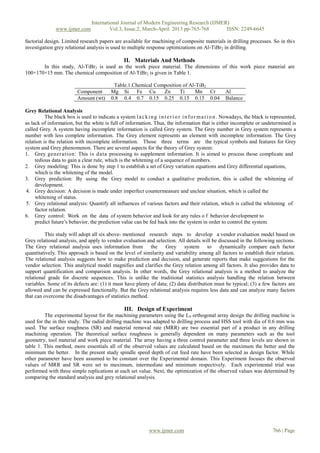
100×170×15 mm. The chemical composition of Al-TiBr2 is given in Table 1.

                                              Table.1.Chemical Composition of Al-TiB2
                           Component         Mg Si      Fe Cu     Zn     Ti      Mn Cr                  Al
                           Amount (wt)       0.8 0.4 0.7 0.15 0.25 0.15 0.15 0.04                       Balance

Grey Relational Analysis
          The black box is used to indicate a system l a c k i n g i n t e r i o r i n f o r m a t i o n . Nowadays, the black is represented,
as lack of information, but the white is full of information. Thus, the information that is either incomplete or undetermined is
called Grey. A system having incomplete information is called Grey system. The Grey number in Grey system represents a
number with less complete information. The Grey element represents an element with incomplete information. The Grey
relation is the relation with incomplete information. Those three terms are the typical symbols and features for Grey
system and Grey phenomenon. There are several aspects for the theory of Grey system:
1. Grey generation : This is d ata processing to supplement information. It is aimed to process those complicate and
     tedious data to gain a clear rule, which is the whitening of a sequence of numbers.
2. Grey modeling: This is done by step 1 to establish a set of Grey variation equations and Grey differential equations,
     which is the whitening of the model.
3. Grey prediction: By using the Grey model to conduct a qualitative prediction, this is called the whitening of
     development.
 4. Grey decision: A decision is made under imperfect countermeasure and unclear situation, which is called the
     whitening of status.
 5. Grey relational analysis: Quantify all influences of various factors and their relation, which is called the whitening of
     factor relation.
6. Grey control: Work on the data of system behavior and look for any rules o f behavior development to
     predict future’s behavior, the prediction value can be fed back into the system in order to control the system.

         This study will adopt all six above- mentioned research steps to develop a vendor evaluation model based on
Grey relational analysis, and apply to vendor evaluation and selection. All details will be discussed in the following sections.
The Grey relational analysis uses information from the             Grey     system to        dynamically compare each factor
quantitatively. This approach is based on the level of similarity and variability among all factors to establish their relation.
The relational analysis suggests how to make prediction and decision, and generate reports that make suggestions for the
vendor selection. This analytical model magnifies and clarifies the Grey relation among all factors. It also provides data to
support quantification and comparison analysis. In other words, the Grey relational analysis is a method to analyze the
relational grade for discrete sequences. This is unlike the traditional statistics analysis handling the relation between
variables. Some of its defects are: (1) it must have plenty of data; (2) data distribution must be typical; (3) a few factors are
allowed and can be expressed functionally. But the Grey relational analysis requires less data and can analyze many factors
that can overcome the disadvantages of statistics method.

                                                   III. Design of Experiment
         The experimental layout for the machining parameters using the L9 orthogonal array design the drilling machine is
used for the in this study. The radial drilling machine was adapted to drilling process and HSS tool with dia of 0.6 mm was
used. The surface roughness (SR) and material removal rate (MRR) are two essential part of a product in any drilling
machining operation. The theoretical surface roughness is generally dependent on many parameters such as the tool
geometry, tool material and work piece material. The array having a three control parameter and three levels are shown in
table 1. This method, more essentials all of the observed values are calculated based on the maximum the better and the
minimum the better. In the present study spindle speed depth of cut feed rate have been selected as design factor. While
other parameter have been assumed to be constant over the Experimental domain. This Experiment focuses the observed
values of MRR and SR were set to maximum, intermediate and minimum respectively. Each experimental trial was
performed with three simple replications at each set value. Next, the optimization of the observed values was determined by
comparing the standard analysis and grey relational analysis.


                                                                www.ijmer.com                                                    766 | Page
International Journal of Modern Engineering Research (IJMER)
               www.ijmer.com               Vol.3, Issue.2, March-April. 2013 pp-765-768      ISSN: 2249-6645

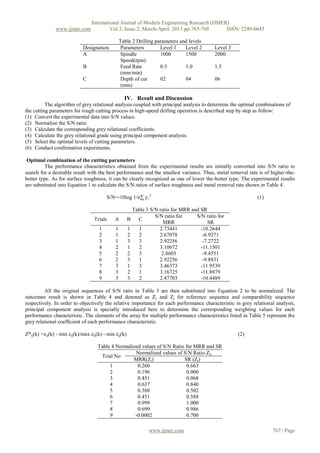
                                                  Table 2 Drilling parameters and levels
                             Designation           Parameters        Level 1    Level 2      Level 3
                             A                     Spindle           1000       1500         2000
                                                   Speed(rpm)
                             B                     Feed Rate         0.5        1.0          1.5
                                                   (mm/min)
                             C                     Depth of cut      02         04           06
                                                   (mm)

                                                    IV. Result and Discussion
          The algorithm of grey relational analysis coupled with principal analysis to determine the optimal combinations of
the cutting parameters for rough cutting process in high-speed drilling operation is described step by step as follow:
(1) Convert the experimental data into S/N values.
(2) Normalize the S/N ratio.
(3) Calculate the corresponding grey relational coefficients.
(4) Calculate the grey relational grade using principal component analysis.
(5) Select the optimal levels of cutting parameters.
(6) Conduct confirmation experiments.

 Optimal combination of the cutting parameters
          The performance characteristics obtained from the experimental results are initially converted into S/N ratio to
search for a desirable result with the best performance and the smallest variance. Thus, metal removal rate is of higher-the-
better type. As for surface roughness, it can be clearly recognized as one of lower the-better type. The experimental results
are substituted into Equation 1 to calculate the S/N ratios of surface roughness and metal removal rate shown in Table 4.

                                         S/N=-10log 1/n∑ yi 2                                                (1)

                                                         Table 3 S/N ratio for MRR and SR
                                                                   S/N ratio for     S/N ratio for
                                   Trials     A        B   C
                                                                       MRR                SR
                                     1        1        1   1         2.73441           -10.2644
                                     2        1        2   2         2.67078            -6.9271
                                     3        1        3   3         2.92256            -7.2722
                                     4        2        1   2         3.10672           -11.1501
                                     5        2        2   3          2.8603            -9.4551
                                     6        2        3   1         2.92256            -9.8831
                                     7        3        1   3         3.46373           -11.9539
                                     8        3        2   1         3.16725           -11.8879
                                     9        3        3   2         2.47703           -10.4489

         All the original sequences of S/N ratio in Table 3 are then substituted into Equation 2 to be normalized. The
outcomes result is shown in Table 4 and denoted as Zi and Zj for reference sequence and comparability sequence
respectively. In order to objectively the relative importance for each performance characteristic in grey relational analysis,
principal component analysis is specially introduced here to determine the corresponding weighting values for each
performance characteristic. The elements of the array for multiple performance characteristics listed in Table 5 represent the
grey relational coefficient of each performance characteristic.

Z*ij(k) =zij(k) - min zij(k)/max zij(k) - min zij(k)                                                   (2)

                                     Table 4 Normalized values of S/N Ratio for MRR and SR
                                                     Normalized values of S/N Ratio Zij
                                      Trial No
                                                    MRR(Zi)                SR (Zj)
                                          1           0.260                 0.663
                                          2           0.196                 0.000
                                          3           0.451                 0.068
                                          4           0.637                 0.840
                                          5           0.388                 0.502
                                          6           0.451                 0.588
                                          7           0.999                 1.000
                                          8           0.699                 0.986
                                          9          -0.0002                0.700

                                                                www.ijmer.com                                      767 | Page
International Journal of Modern Engineering Research (IJMER)
               www.ijmer.com              Vol.3, Issue.2, March-April. 2013 pp-765-768      ISSN: 2249-6645

                                     Table 5 Grey Relational Coefficients for MRR and SR
                                                Grey Relational Coefficient
                                   Trial No                                     Grey Grade
                                                 MRR                SR
                                      1       0.657397           0.42959         0.543493
                                      2         0.7183            1.0000          0.85915
                                      3       0.525618          0.879272         0.702445
                                      4       0.439404          0.373107         0.406256
                                      5        0.56296          0.498552         0.530756
                                      6       0.525618          0.459539         0.492578
                                      7       0.333394          0.333333         0.333364
                                      8       0.416927          0.336277         0.376602
                                      9       1.000548          0.416457         0.708502

         The response table of Taguchi method is employed here to calculate the average grey relational grade for each
cutting parameter level. It is done by sorting the grey relational grades corresponding to levels of the cutting parameter in
each column of the orthogonal array, and taking an average on those with the same level. Using the same method,
calculations are performed for each cutting parameter level and the response table is constructed as shown in Table 6.
Basically, the larger the grey relational grade is the better the corresponding multiple performance characteristic. From the
response table for the grey relational grades shown in Table 05, the best combination of the cutting parameters is the set with
spindle low speed, high feed rate and middle depth of cut.

                                          Table 6 Optimum Level for Drilling Parameter
                                        Factors            1          2                3
                                           Spindle
                                  A                    0.701696    0.47653        0.472823
                                            Speed
                                   B      Feed Rate    0.427704 0.588836          0.634508
                                          Depth of
                                   C                   0.470891 0.657969          0.522188
                                             Cut

                                                         V. Conclusions
          In this study mainly focus on material removal rate and surface roughness on Al-TiBr2 in radial drilling machining
with dry conditions. From the study of result in drilling is using Grey relational analysis. These following can be concluded
by this present studies.
1. Optimum cutting parameters for minimization surface roughness is spindle speed set as low level (1000 rpm), feed rate
     set as maximum level (1.5 mm/min) and depth of cut set as middle level (6 mm).
2. Optimum cutting parameters for maximization material removal rate is spindle speed set as low level (1000 rpm), feed
     rate set as maximum level (1.5 mm/min) and depth of cut set as middle level (6 mm).

                                                              Reference
[1]   Da Silva, F.J., Franco, S.D., Machado, A.R., Ezugwu, E.O., Souza Jr. A.M. (2006). Performance cryogenically treated HSS tools.
      Wear, vol. 261, no.5-6, p. 674-685,
[2] Boris Stirn, Kiha Lee, David A. Dornfeld (2001) “BURR FORMATION IN MICRO-DRILLING”.
[3] KILIÇKAP E, ÇAKIR O, AKSOY M, INAN A. Study of tool wear and surface roughness in machining of homogenized SiC-p
      reinforced aluminium metal matrix composite. Journal of Materials Processing Technology, 2005, 165: 862-867.
[4] MOHAN B, RAJADURAI A, SATYANARAYANA K G. Electric discharge machining of Al/SiC metal matrix composites using
      rotary tube electrode [J]. Journal of Mater Process Technology, 2004, 153: 978-985.
[5] ZHAN Y Z, ZHANG G D. The role of graphite particles in the high temperature wear of copper hybrid composites against steel [J].
      Materials and Design, 2006, 27: 79-84.
[6] ZHANG X N, GENG L, WANG G S. Fabrication of Al-based hybrid composites reinforced with SiC whiskers and SiC nano
      particles by squeeze casting [J]. Journal of Materials Processing Technology, 2066, 176: 146-151.
[7] GALLAB M, SKLAD M. Machining of Al/SiC metal matrix composites. Part II: Workpiece integrity [J]. Journal Mater Process,
      1998, 83: 277-283.
[8]. Lin TR, Shyu RF (2000) Improvement of tool life and exit burr using variable feeds when drilling stainless steel with coated drills.
      Int J Adv Manuf Technol 16:308–313
[9]. Stein JM, Dornfeld DA (1997) Burr formation in drilling miniature holes. Ann CIRP 46/17:63–66
[10]. Ko SL, Lee JK (2001) Analysis of burr formation in drilling with a new-concept drill. J Mater Process Technol 113:392–398
[11]. Sakurai K, Adachi K, Kawai G, Sawai T (2000) High feed rate drilling of aluminum alloy. Mat Sci Forum 331–337:625–630
[12]. Gillespie LK, Blotter PT (1976) the formation and properties of machining burs. Transactions ASME Journal of Engineering for
      Industry 98:66–74
[13]. Aurich JC, Dornfeld D, Arrazola PJ, Franke V, Leitz L, Min S (2009) Burrs: analysis, control and removal. CIRP Annals Manuf
      Technol 58:519–542
[14]. Erol Kilickap Modelling and optimization of burr height in drilling of Al-7075 using Taguchi method and response surface
      methodology Springer-Verlag London Limited 2010.


                                                              www.ijmer.com                                                  768 | Page

Bb32765768

  • 1.
    International Journal ofModern Engineering Research (IJMER) www.ijmer.com Vol.3, Issue.2, March-April. 2013 pp-765-768 ISSN: 2249-6645 Multiple Response Optimizations in Drilling Using Taguchi and Grey Relational Analysis B.Shivapragash, 1 K.Chandrasekaran, 2 C.Parthasarathy, 3 M.Samuel4 1 Assistant Professor, Department of mechanical engineering, PRIST University ,Trichy, Tamilnadu, India 2,3,4 Assistant Professor, Department of mechanical engineering, PRIST University ,Trichy, Tamilnadu, India Abstract: Composite materials are important engineering materials due to their outstanding mechanical properties. Metal matrix composite (MMCs) are one of the widely known composites because of their superior properties such as high strength, hardness, stiffness, and corrosion resistances. Al-TiBr2 produces higher tool wear, poor surface roughness and minimizes the metal removal rate. The quality of the material is influenced by the cutting conditions, tool material and geometry. The present work is focusing on multiple response optimization of drilling process for composite Al-TiBr2. The study provided to minimise the damage events occurring during drilling process for composite material. A statistical approach used to analyse experiment data. Taguchi method with grey relational analysis was used to optimize the machining parameters with multiple performance characteristics in drilling of MMC Al-TiBr2. The results shows that the maximum feed rate, low spindle speed are the most significant factors which affect the drilling process and the performance in the drilling process can be effectively improved by using this approach. Keywords: Drilling, Grey relational analysis, Metal removal rate, Surface roughness, Taguchi method I. Introduction To provide cost effectiveness in manufacturing and especially machining operations, there is a continuous need to reduce tooling costs. The most well-known methods used to reduce tooling costs are various applications of more resistant tool materials, heat treatments, cutting fluids, speed and feed rates and the development of coated cutting tool [1, 2]. A composite material is a heterogeneous solid consists of two or more different materials that are mechanically or metallurgical bonded together. Each of its components retains its identity in the composite and maintains its characteristic structure and property. The composite material, however generally possesses characteristics properties, such as stiffness, strength, high temperature performance, corrosion resistance, hardness or conductivity that are not possible with the individual components by them. Analysis of these properties shows that they depend on the property of individual components; the relative amount of components; the size, shape and distribution of the discontinuous components; the degree of bonding between them and the orientation of the various components [3]. MMC have become a large leading material in composite materials, and particle reinforced aluminum MMCs have received considerable attention due to their excellent engineering properties. These materials are known as the difficult-to-machine materials, because of the hardness and abrasive nature of reinforcement element like silicon carbide (SiC) particles [4]. The application fields of MMCs include aerospace, defence and automotives [4]. Hybrid MMCs were obtained by reinforcing the matrix alloy with more than one type of reinforcements having different properties [6]. The Al-based hybrid composites, with 20% SiC Whiskers and 0, 2%, 5%, 7% SiC nano particles, were fabricated by squeeze casting route [7]. In the view of the growing engineering applications of these composites, a need for detailed and systematic study of their machining characteristics is envisaged. The efficient and economic machining of these materials is required for the desired dimensions and surface finish [8]. Nihat Tosun[9] Use The grey relational analysis for optimizing the drilling process parameters for the work piece surface roughness and the burr height is introduced. Various drilling parameters, such as feed rate, cutting speed, drill and point angles of drill were considered. An orthogonal array was used for the experimental design. Optimal machining parameters were determined by the grey relational grade obtained from the grey relational analysis for multi-performance characteristics (the surface roughness and the burr height). Experimental results have shown that the surface roughness and the burr height in the drilling process can be improved effectively through the new approach. Stein and Dornfeld [10] presented a study on the burr height, thickness, and geometry observed in the drilling of 0.91-mm diameter through holes in stainless steel 304L. They presented a proposal for using the drilling burr data as part of a process planning methodology for burr control. To minimize the burr formed during drilling, Ko and Lee [11] investigated the effect of drill geometry on burr formation. They showed that a larger point angle of drill reduced the burr size. Sakurai et al. [12] have also tried to change the cutting conditions and determined high feed rate drilling of aluminium alloy. The researchers examined cutting forces, drill wear, heat generated, chip shape, hole finish, etc. Gillespie and Blotter [13] studied experimentally the effects of drill geometry, process conditions, and material properties. They have classified the machining burrs into four types: Poisson burr, rollover burr, tear burr, and cut-off burr. Valuable review about burr in machining operation provided important information [14].Erol Kilickap [15] Modelling and optimization of burr height in drilling of Al-7075 using Taguchi method and response surface methodology. This investigation presents the use of Taguchi and response surface methodologies for minimizing the burr height and the surface roughness in drilling Al-7075. The optimization results showed that the combination of low cutting speed, low feed rate, and high point angle is necessary to minimize the burr height The study shows that the Taguchi method is suitable to solve the stated within minimum number of trials as compared with a full www.ijmer.com 765 | Page
  • 2.
    International Journal ofModern Engineering Research (IJMER) www.ijmer.com Vol.3, Issue.2, March-April. 2013 pp-765-768 ISSN: 2249-6645 factorial design. Limited research papers are available for machining of composite materials in drilling processes. So in this investigation grey relational analysis is used to multiple response optimizations on Al-TiBr2 in drilling. II. Materials And Methods In this study, Al-TiBr2 is used as the work piece material. The dimensions of this work piece material are 100×170×15 mm. The chemical composition of Al-TiBr2 is given in Table 1. Table.1.Chemical Composition of Al-TiB2 Component Mg Si Fe Cu Zn Ti Mn Cr Al Amount (wt) 0.8 0.4 0.7 0.15 0.25 0.15 0.15 0.04 Balance Grey Relational Analysis The black box is used to indicate a system l a c k i n g i n t e r i o r i n f o r m a t i o n . Nowadays, the black is represented, as lack of information, but the white is full of information. Thus, the information that is either incomplete or undetermined is called Grey. A system having incomplete information is called Grey system. The Grey number in Grey system represents a number with less complete information. The Grey element represents an element with incomplete information. The Grey relation is the relation with incomplete information. Those three terms are the typical symbols and features for Grey system and Grey phenomenon. There are several aspects for the theory of Grey system: 1. Grey generation : This is d ata processing to supplement information. It is aimed to process those complicate and tedious data to gain a clear rule, which is the whitening of a sequence of numbers. 2. Grey modeling: This is done by step 1 to establish a set of Grey variation equations and Grey differential equations, which is the whitening of the model. 3. Grey prediction: By using the Grey model to conduct a qualitative prediction, this is called the whitening of development. 4. Grey decision: A decision is made under imperfect countermeasure and unclear situation, which is called the whitening of status. 5. Grey relational analysis: Quantify all influences of various factors and their relation, which is called the whitening of factor relation. 6. Grey control: Work on the data of system behavior and look for any rules o f behavior development to predict future’s behavior, the prediction value can be fed back into the system in order to control the system. This study will adopt all six above- mentioned research steps to develop a vendor evaluation model based on Grey relational analysis, and apply to vendor evaluation and selection. All details will be discussed in the following sections. The Grey relational analysis uses information from the Grey system to dynamically compare each factor quantitatively. This approach is based on the level of similarity and variability among all factors to establish their relation. The relational analysis suggests how to make prediction and decision, and generate reports that make suggestions for the vendor selection. This analytical model magnifies and clarifies the Grey relation among all factors. It also provides data to support quantification and comparison analysis. In other words, the Grey relational analysis is a method to analyze the relational grade for discrete sequences. This is unlike the traditional statistics analysis handling the relation between variables. Some of its defects are: (1) it must have plenty of data; (2) data distribution must be typical; (3) a few factors are allowed and can be expressed functionally. But the Grey relational analysis requires less data and can analyze many factors that can overcome the disadvantages of statistics method. III. Design of Experiment The experimental layout for the machining parameters using the L9 orthogonal array design the drilling machine is used for the in this study. The radial drilling machine was adapted to drilling process and HSS tool with dia of 0.6 mm was used. The surface roughness (SR) and material removal rate (MRR) are two essential part of a product in any drilling machining operation. The theoretical surface roughness is generally dependent on many parameters such as the tool geometry, tool material and work piece material. The array having a three control parameter and three levels are shown in table 1. This method, more essentials all of the observed values are calculated based on the maximum the better and the minimum the better. In the present study spindle speed depth of cut feed rate have been selected as design factor. While other parameter have been assumed to be constant over the Experimental domain. This Experiment focuses the observed values of MRR and SR were set to maximum, intermediate and minimum respectively. Each experimental trial was performed with three simple replications at each set value. Next, the optimization of the observed values was determined by comparing the standard analysis and grey relational analysis. www.ijmer.com 766 | Page
  • 3.
    International Journal ofModern Engineering Research (IJMER) www.ijmer.com Vol.3, Issue.2, March-April. 2013 pp-765-768 ISSN: 2249-6645 Table 2 Drilling parameters and levels Designation Parameters Level 1 Level 2 Level 3 A Spindle 1000 1500 2000 Speed(rpm) B Feed Rate 0.5 1.0 1.5 (mm/min) C Depth of cut 02 04 06 (mm) IV. Result and Discussion The algorithm of grey relational analysis coupled with principal analysis to determine the optimal combinations of the cutting parameters for rough cutting process in high-speed drilling operation is described step by step as follow: (1) Convert the experimental data into S/N values. (2) Normalize the S/N ratio. (3) Calculate the corresponding grey relational coefficients. (4) Calculate the grey relational grade using principal component analysis. (5) Select the optimal levels of cutting parameters. (6) Conduct confirmation experiments. Optimal combination of the cutting parameters The performance characteristics obtained from the experimental results are initially converted into S/N ratio to search for a desirable result with the best performance and the smallest variance. Thus, metal removal rate is of higher-the- better type. As for surface roughness, it can be clearly recognized as one of lower the-better type. The experimental results are substituted into Equation 1 to calculate the S/N ratios of surface roughness and metal removal rate shown in Table 4. S/N=-10log 1/n∑ yi 2 (1) Table 3 S/N ratio for MRR and SR S/N ratio for S/N ratio for Trials A B C MRR SR 1 1 1 1 2.73441 -10.2644 2 1 2 2 2.67078 -6.9271 3 1 3 3 2.92256 -7.2722 4 2 1 2 3.10672 -11.1501 5 2 2 3 2.8603 -9.4551 6 2 3 1 2.92256 -9.8831 7 3 1 3 3.46373 -11.9539 8 3 2 1 3.16725 -11.8879 9 3 3 2 2.47703 -10.4489 All the original sequences of S/N ratio in Table 3 are then substituted into Equation 2 to be normalized. The outcomes result is shown in Table 4 and denoted as Zi and Zj for reference sequence and comparability sequence respectively. In order to objectively the relative importance for each performance characteristic in grey relational analysis, principal component analysis is specially introduced here to determine the corresponding weighting values for each performance characteristic. The elements of the array for multiple performance characteristics listed in Table 5 represent the grey relational coefficient of each performance characteristic. Z*ij(k) =zij(k) - min zij(k)/max zij(k) - min zij(k) (2) Table 4 Normalized values of S/N Ratio for MRR and SR Normalized values of S/N Ratio Zij Trial No MRR(Zi) SR (Zj) 1 0.260 0.663 2 0.196 0.000 3 0.451 0.068 4 0.637 0.840 5 0.388 0.502 6 0.451 0.588 7 0.999 1.000 8 0.699 0.986 9 -0.0002 0.700 www.ijmer.com 767 | Page
  • 4.
    International Journal ofModern Engineering Research (IJMER) www.ijmer.com Vol.3, Issue.2, March-April. 2013 pp-765-768 ISSN: 2249-6645 Table 5 Grey Relational Coefficients for MRR and SR Grey Relational Coefficient Trial No Grey Grade MRR SR 1 0.657397 0.42959 0.543493 2 0.7183 1.0000 0.85915 3 0.525618 0.879272 0.702445 4 0.439404 0.373107 0.406256 5 0.56296 0.498552 0.530756 6 0.525618 0.459539 0.492578 7 0.333394 0.333333 0.333364 8 0.416927 0.336277 0.376602 9 1.000548 0.416457 0.708502 The response table of Taguchi method is employed here to calculate the average grey relational grade for each cutting parameter level. It is done by sorting the grey relational grades corresponding to levels of the cutting parameter in each column of the orthogonal array, and taking an average on those with the same level. Using the same method, calculations are performed for each cutting parameter level and the response table is constructed as shown in Table 6. Basically, the larger the grey relational grade is the better the corresponding multiple performance characteristic. From the response table for the grey relational grades shown in Table 05, the best combination of the cutting parameters is the set with spindle low speed, high feed rate and middle depth of cut. Table 6 Optimum Level for Drilling Parameter Factors 1 2 3 Spindle A 0.701696 0.47653 0.472823 Speed B Feed Rate 0.427704 0.588836 0.634508 Depth of C 0.470891 0.657969 0.522188 Cut V. Conclusions In this study mainly focus on material removal rate and surface roughness on Al-TiBr2 in radial drilling machining with dry conditions. From the study of result in drilling is using Grey relational analysis. These following can be concluded by this present studies. 1. Optimum cutting parameters for minimization surface roughness is spindle speed set as low level (1000 rpm), feed rate set as maximum level (1.5 mm/min) and depth of cut set as middle level (6 mm). 2. Optimum cutting parameters for maximization material removal rate is spindle speed set as low level (1000 rpm), feed rate set as maximum level (1.5 mm/min) and depth of cut set as middle level (6 mm). Reference [1] Da Silva, F.J., Franco, S.D., Machado, A.R., Ezugwu, E.O., Souza Jr. A.M. (2006). Performance cryogenically treated HSS tools. Wear, vol. 261, no.5-6, p. 674-685, [2] Boris Stirn, Kiha Lee, David A. Dornfeld (2001) “BURR FORMATION IN MICRO-DRILLING”. [3] KILIÇKAP E, ÇAKIR O, AKSOY M, INAN A. Study of tool wear and surface roughness in machining of homogenized SiC-p reinforced aluminium metal matrix composite. Journal of Materials Processing Technology, 2005, 165: 862-867. [4] MOHAN B, RAJADURAI A, SATYANARAYANA K G. Electric discharge machining of Al/SiC metal matrix composites using rotary tube electrode [J]. Journal of Mater Process Technology, 2004, 153: 978-985. [5] ZHAN Y Z, ZHANG G D. The role of graphite particles in the high temperature wear of copper hybrid composites against steel [J]. Materials and Design, 2006, 27: 79-84. [6] ZHANG X N, GENG L, WANG G S. Fabrication of Al-based hybrid composites reinforced with SiC whiskers and SiC nano particles by squeeze casting [J]. Journal of Materials Processing Technology, 2066, 176: 146-151. [7] GALLAB M, SKLAD M. Machining of Al/SiC metal matrix composites. Part II: Workpiece integrity [J]. Journal Mater Process, 1998, 83: 277-283. [8]. Lin TR, Shyu RF (2000) Improvement of tool life and exit burr using variable feeds when drilling stainless steel with coated drills. Int J Adv Manuf Technol 16:308–313 [9]. Stein JM, Dornfeld DA (1997) Burr formation in drilling miniature holes. Ann CIRP 46/17:63–66 [10]. Ko SL, Lee JK (2001) Analysis of burr formation in drilling with a new-concept drill. J Mater Process Technol 113:392–398 [11]. Sakurai K, Adachi K, Kawai G, Sawai T (2000) High feed rate drilling of aluminum alloy. Mat Sci Forum 331–337:625–630 [12]. Gillespie LK, Blotter PT (1976) the formation and properties of machining burs. Transactions ASME Journal of Engineering for Industry 98:66–74 [13]. Aurich JC, Dornfeld D, Arrazola PJ, Franke V, Leitz L, Min S (2009) Burrs: analysis, control and removal. CIRP Annals Manuf Technol 58:519–542 [14]. Erol Kilickap Modelling and optimization of burr height in drilling of Al-7075 using Taguchi method and response surface methodology Springer-Verlag London Limited 2010. www.ijmer.com 768 | Page