Naive Bayes
Techno Main Salt Lake
By
Name : Mahim Majee
Stream : CSE
Semester : 7th
Section : A
Roll No. : 13000119055
Registration No. : 016704 of 2019-20
1
Introduction
 Classification technique based on Bayes’ Theorem
 With “naive” assumption of independence among
predictors.
 Easy to build
 Particularly useful for very large data sets
 Known to outperform even highly sophisticated
classification methods a. e.g. Earlier method for
spam detection
Introduction - Bayes theorem
● P(c|x) - the posterior probability of class (c, target) given predictor (x,
attributes).
● P(c) - the prior probability of class.
● P(x|c) - is the likelihood which is the probability of predictor given class.
● P(x) - is the prior probability of predictor.
How Naive Bayes algorithm works
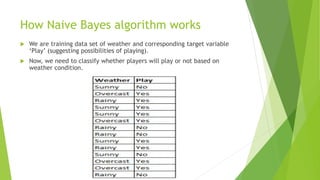
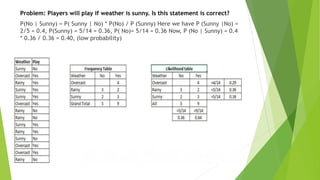
 We are training data set of weather and corresponding target variable
‘Play’ (suggesting possibilities of playing).
 Now, we need to classify whether players will play or not based on
weather condition.
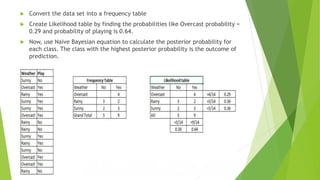
 Convert the data set into a frequency table
 Create Likelihood table by finding the probabilities like Overcast probability =
0.29 and probability of playing is 0.64.
 Now, use Naive Bayesian equation to calculate the posterior probability for
each class. The class with the highest posterior probability is the outcome of
prediction.
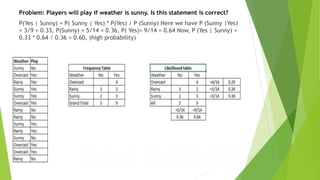
Problem: Players will play if weather is sunny. Is this statement is correct?
P(Yes | Sunny) = P( Sunny | Yes) * P(Yes) / P (Sunny) Here we have P (Sunny |Yes)
= 3/9 = 0.33, P(Sunny) = 5/14 = 0.36, P( Yes)= 9/14 = 0.64 Now, P (Yes | Sunny) =
0.33 * 0.64 / 0.36 = 0.60, (high probability)
Problem: Players will play if weather is sunny. Is this statement is correct?
P(No | Sunny) = P( Sunny | No) * P(No) / P (Sunny) Here we have P (Sunny |No) =
2/5 = 0.4, P(Sunny) = 5/14 = 0.36, P( No)= 5/14 = 0.36 Now, P (No | Sunny) = 0.4
* 0.36 / 0.36 = 0.40, (low probability)
Zero Frequency Problem
 What if any of the count is 0?
 Add 1 to all counts
 It is a form of Laplace smoothing
Using Python
#Import Library of Gaussian Naive Bayes model
from sklearn.naive_bayes import GaussianNB
import numpy as np
#assigning predictor and target variables
X= np.array([[-3,7],[1,5], [1,2], [-2,0], [2,3], [-4,0], [-1,1], [1,1], [-2,2],
[2,7], [-4,1], [-2,7]])
y = np.array([3, 3, 3, 3, 4, 3, 3, 4, 3, 4, 4, 4])
#Create a Gaussian Classifier
model = GaussianNB()
# Train the model using the training sets
model.fit(X, y)
#Predict Output
predicted= model.predict([[1,2],[3,4]])
print(predicted)
Tips to improve the Naive Bayes Model
 If continuous features do not have normal distribution, we
should use transformation or different methods to convert
 If test data set has zero frequency issue, apply smoothing
techniques “Laplace smoothing”
 Remove correlated features, as the highly correlated features
are voted twice in the model and it can lead to over inflating
importance.
 Naive Bayes classifier has limited options for parameter tuning
 Can’t be ensembled - because there is no variance to reduce
Variants
 Gaussian: It is used in classification and it assumes that
features follow a normal distribution.
 Multinomial: It is used for discrete counts. Implements the
naive Bayes algorithm for multinomially distributed data. It is
one of the two classic naive Bayes variants used in text
classification
 Bernoulli: The binomial model is useful if your feature vectors
are binary (i.e. zeros and ones). One application would be text
classification with ‘bag of words’ model where the 1s & 0s are
“word occurs in the document” and “word does not occur in the
document” respectively.
Applications
 Real time Prediction: Naive Bayes is an eager learning classifier and it
is sure fast. Thus, it could be used for making predictions in real time.
 Multi class Prediction: Well known for multi class prediction feature.
 Text classification/ Spam Filtering/ Sentiment Analysis: Mostly used in
text classification. Have higher success rate as compared to other
algorithms. Widely used in Spam filtering (identify spam e-mail) and
Sentiment Analysis.
 Recommendation System: Naive Bayes Classifier and Collaborative
Filtering together builds a Recommendation System that uses machine
learning and data mining techniques to filter unseen information and
predict whether a user would like a given resource or not
Conclusions
 The naive Bayes model is tremendously appealing because of its
simplicity, elegance, and robustness.
 It is one of the oldest formal classification algorithms, and yet
even in its simplest form it is often surprisingly effective.
 It is widely used in areas such as text classification and spam
filtering. A large number of modifications have been
introduced, by the statistical, data mining, machine learning,
and pattern recognition communities, in an attempt to make it
more flexible.
 But someone has to recognize that such modifications are
necessarily complications, which detract from its basic
simplicity.
References
 1.9. Naive Bayes — scikit-learn 1.1.1 documentation
 https://en.wikipedia.org/wiki/Bayes%27_theorem
 Naive Bayes classifier – Wikipedia
 http://en.wikipedia.org/wiki/Naive_Bayes_classifier
 http://www.cs.cmu.edu/afs/cs.cmu.edu/project/theo20/www/mlbo
ok/ch6.pdf
 Data Mining: Concepts and Techniques, 3rd Edition, Han & Kamber &
Pei ISBN: 9780123 814791
Naive.pdf

Naive.pdf

  • 1.
    Naive Bayes Techno MainSalt Lake By Name : Mahim Majee Stream : CSE Semester : 7th Section : A Roll No. : 13000119055 Registration No. : 016704 of 2019-20 1
  • 2.
    Introduction  Classification techniquebased on Bayes’ Theorem  With “naive” assumption of independence among predictors.  Easy to build  Particularly useful for very large data sets  Known to outperform even highly sophisticated classification methods a. e.g. Earlier method for spam detection
  • 3.
    Introduction - Bayestheorem ● P(c|x) - the posterior probability of class (c, target) given predictor (x, attributes). ● P(c) - the prior probability of class. ● P(x|c) - is the likelihood which is the probability of predictor given class. ● P(x) - is the prior probability of predictor.
  • 4.
    How Naive Bayesalgorithm works  We are training data set of weather and corresponding target variable ‘Play’ (suggesting possibilities of playing).  Now, we need to classify whether players will play or not based on weather condition.
  • 5.
     Convert thedata set into a frequency table  Create Likelihood table by finding the probabilities like Overcast probability = 0.29 and probability of playing is 0.64.  Now, use Naive Bayesian equation to calculate the posterior probability for each class. The class with the highest posterior probability is the outcome of prediction.
  • 6.
    Problem: Players willplay if weather is sunny. Is this statement is correct? P(Yes | Sunny) = P( Sunny | Yes) * P(Yes) / P (Sunny) Here we have P (Sunny |Yes) = 3/9 = 0.33, P(Sunny) = 5/14 = 0.36, P( Yes)= 9/14 = 0.64 Now, P (Yes | Sunny) = 0.33 * 0.64 / 0.36 = 0.60, (high probability)
  • 7.
    Problem: Players willplay if weather is sunny. Is this statement is correct? P(No | Sunny) = P( Sunny | No) * P(No) / P (Sunny) Here we have P (Sunny |No) = 2/5 = 0.4, P(Sunny) = 5/14 = 0.36, P( No)= 5/14 = 0.36 Now, P (No | Sunny) = 0.4 * 0.36 / 0.36 = 0.40, (low probability)
  • 8.
    Zero Frequency Problem What if any of the count is 0?  Add 1 to all counts  It is a form of Laplace smoothing
  • 9.
    Using Python #Import Libraryof Gaussian Naive Bayes model from sklearn.naive_bayes import GaussianNB import numpy as np #assigning predictor and target variables X= np.array([[-3,7],[1,5], [1,2], [-2,0], [2,3], [-4,0], [-1,1], [1,1], [-2,2], [2,7], [-4,1], [-2,7]]) y = np.array([3, 3, 3, 3, 4, 3, 3, 4, 3, 4, 4, 4]) #Create a Gaussian Classifier model = GaussianNB() # Train the model using the training sets model.fit(X, y) #Predict Output predicted= model.predict([[1,2],[3,4]]) print(predicted)
  • 10.
    Tips to improvethe Naive Bayes Model  If continuous features do not have normal distribution, we should use transformation or different methods to convert  If test data set has zero frequency issue, apply smoothing techniques “Laplace smoothing”  Remove correlated features, as the highly correlated features are voted twice in the model and it can lead to over inflating importance.  Naive Bayes classifier has limited options for parameter tuning  Can’t be ensembled - because there is no variance to reduce
  • 11.
    Variants  Gaussian: Itis used in classification and it assumes that features follow a normal distribution.  Multinomial: It is used for discrete counts. Implements the naive Bayes algorithm for multinomially distributed data. It is one of the two classic naive Bayes variants used in text classification  Bernoulli: The binomial model is useful if your feature vectors are binary (i.e. zeros and ones). One application would be text classification with ‘bag of words’ model where the 1s & 0s are “word occurs in the document” and “word does not occur in the document” respectively.
  • 12.
    Applications  Real timePrediction: Naive Bayes is an eager learning classifier and it is sure fast. Thus, it could be used for making predictions in real time.  Multi class Prediction: Well known for multi class prediction feature.  Text classification/ Spam Filtering/ Sentiment Analysis: Mostly used in text classification. Have higher success rate as compared to other algorithms. Widely used in Spam filtering (identify spam e-mail) and Sentiment Analysis.  Recommendation System: Naive Bayes Classifier and Collaborative Filtering together builds a Recommendation System that uses machine learning and data mining techniques to filter unseen information and predict whether a user would like a given resource or not
  • 13.
    Conclusions  The naiveBayes model is tremendously appealing because of its simplicity, elegance, and robustness.  It is one of the oldest formal classification algorithms, and yet even in its simplest form it is often surprisingly effective.  It is widely used in areas such as text classification and spam filtering. A large number of modifications have been introduced, by the statistical, data mining, machine learning, and pattern recognition communities, in an attempt to make it more flexible.  But someone has to recognize that such modifications are necessarily complications, which detract from its basic simplicity.
  • 14.
    References  1.9. NaiveBayes — scikit-learn 1.1.1 documentation  https://en.wikipedia.org/wiki/Bayes%27_theorem  Naive Bayes classifier – Wikipedia  http://en.wikipedia.org/wiki/Naive_Bayes_classifier  http://www.cs.cmu.edu/afs/cs.cmu.edu/project/theo20/www/mlbo ok/ch6.pdf  Data Mining: Concepts and Techniques, 3rd Edition, Han & Kamber & Pei ISBN: 9780123 814791