Basics of Modeling and Simulation
Serdar Kaya, serdar@grenergyllc.com cell: +90 5394772377
X
Y
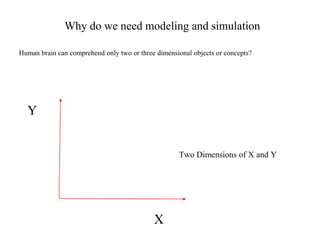
Why do we need modeling and simulation
Human brain can comprehend only two or three dimensional objects or concepts?
Two Dimensions of X and Y
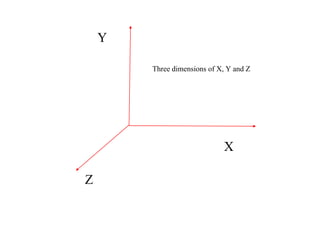
X
Y
Z
Three dimensions of X, Y and Z
X
Y
Z
X
Y
Z
X
Y
Z
T1
T2
T3
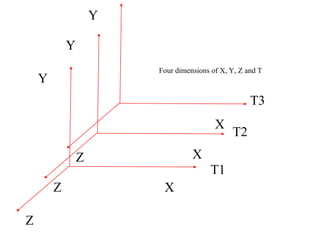
Four dimensions of X, Y, Z and T
X
Y
Z
R
S
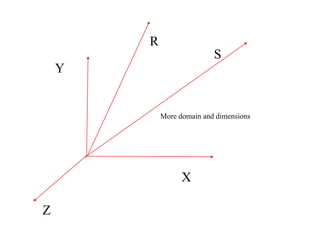
More domain and dimensions
X
Y
Z
3
2
1
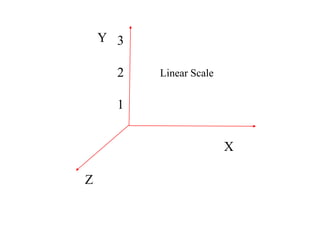
Linear Scale
X
Y
Z
100
10
1
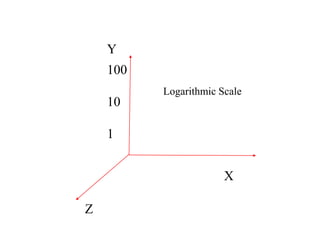
Logarithmic Scale
What Is A Model ?
A Representation of an object, a
system, or an idea in some form
other than that of the entity itself.
(Shannon)
Types of Models:
Physical
(Scale models, prototype plants,…)
Mathematical
(Analytical queueing models, linear
programs, simulation)
What is Simulation?
â—Ź dynamic behavior of a model
â—Ź representation of dynamic behavior
â—Ź changing behavior of parameters in dynamic
system
Modeling Team
We Need:
-Knowledge of the system under investigation
-System analyst skills (model formulation)
-Model building skills (model Programming)
-Data collection skills
-Statistical skills (input data representation)
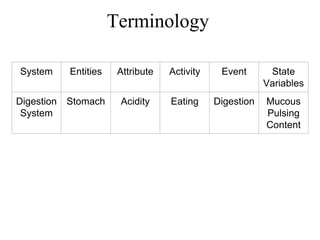
Terminology
System Entities Attribute Activity Event State
Variables
Digestion
System
Stomach Acidity Eating Digestion Mucous
Pulsing
Content
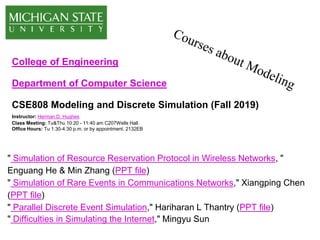
" Simulation of Resource Reservation Protocol in Wireless Networks, "
Enguang He & Min Zhang (PPT file)
" Simulation of Rare Events in Communications Networks," Xiangping Chen
(PPT file)
" Parallel Discrete Event Simulation," Hariharan L Thantry (PPT file)
" Difficulties in Simulating the Internet," Mingyu Sun
College of Engineering
Department of Computer Science
CSE808 Modeling and Discrete Simulation (Fall 2019)
Instructor: Herman D. Hughes
Class Meeting: Tu&Thu 10:20 - 11:40 am C207Wells Hall.
Office Hours: Tu 1:30-4:30 p.m. or by appointment. 2132EB
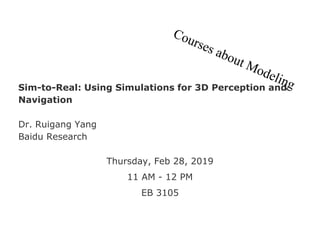
Sim-to-Real: Using Simulations for 3D Perception and
Navigation
Dr. Ruigang Yang
Baidu Research
Thursday, Feb 28, 2019
11 AM - 12 PM
EB 3105
â—Ź To simulate is to try to duplicate the characteristics
of a real system
â—Ź mathematical simulation models
â—Ź Real systems to help make business decisions
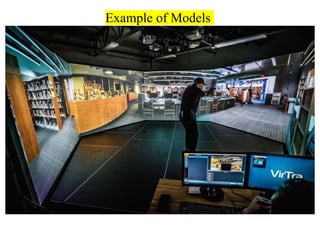
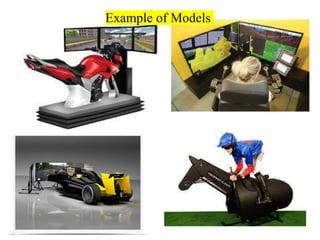
â—Ź Use in education to reduce cost
Benefit of Modeling/Simulation
1. Flexibility
2. Can handle large and complex systems
3. Can answer “what-if” questions
4. Does not interfere with the real system
5. Allows study of interaction among variables
6. “Time compression” is possible
7. Handles complications that other methods can’t
Risks of Modeling/Simulation
1. inaccuracy
2. Initial time consuming
3. Sceneroi time needed
4. Each case is unique might have unconsidered
parameters
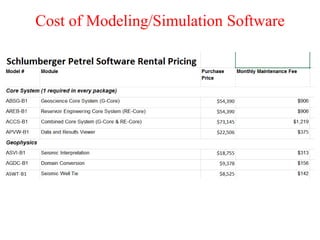
Cost of Modeling/Simulation Software
Available Models/Simulations
Monte Carlo Simulation
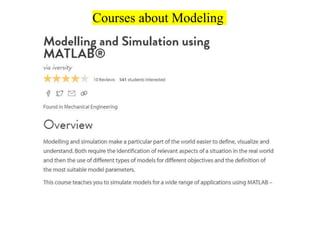
Metlab
Ansys (fluid flow)
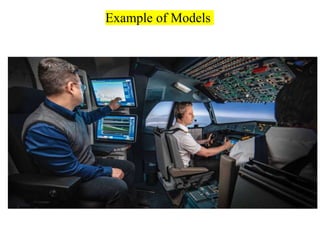
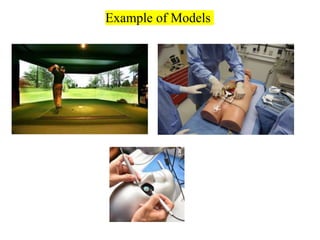
Flight Simulators
Surgery Simulators
War/Fighting Simulators
Civilization Simulators
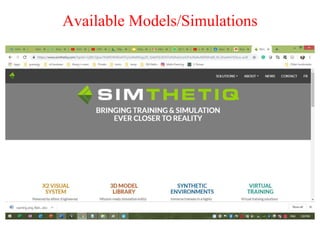
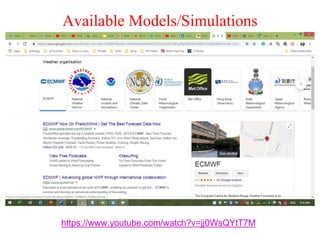
Available Models/Simulations
https://www.youtube.com/watch?v=jj0WsQYtT7M
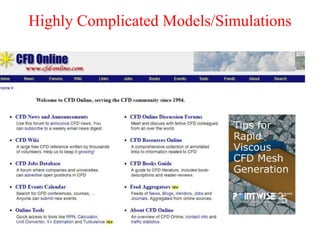
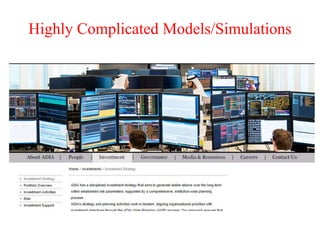
Highly Complicated Models/Simulations
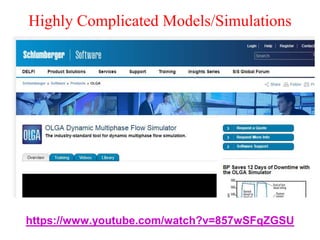
https://www.youtube.com/watch?v=857wSFqZGSU
Highly Complicated Models/Simulations
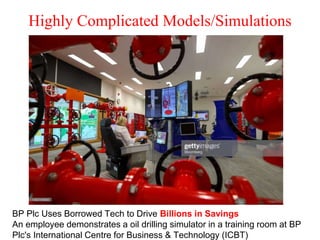
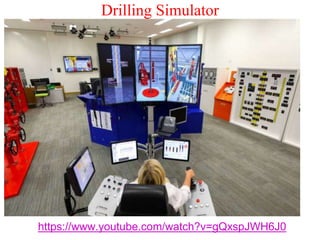
BP Plc Uses Borrowed Tech to Drive Billions in Savings
An employee demonstrates a oil drilling simulator in a training room at BP
Plc's International Centre for Business & Technology (ICBT)
https://www.youtube.com/watch?v=gQxspJWH6J0
Drilling Simulator
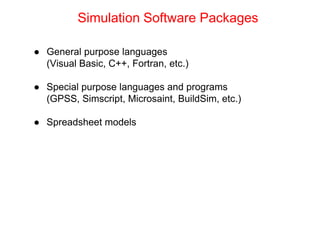
â—Ź General purpose languages
(Visual Basic, C++, Fortran, etc.)
â—Ź Special purpose languages and programs
(GPSS, Simscript, Microsaint, BuildSim, etc.)
â—Ź Spreadsheet models
Simulation Software Packages
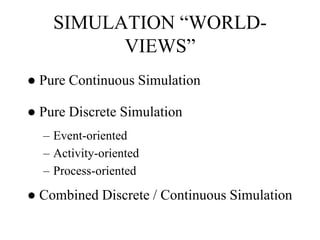
SIMULATION “WORLD-
VIEWS”
â—Ź Pure Continuous Simulation
â—Ź Pure Discrete Simulation
– Event-oriented
– Activity-oriented
– Process-oriented
â—Ź Combined Discrete / Continuous Simulation
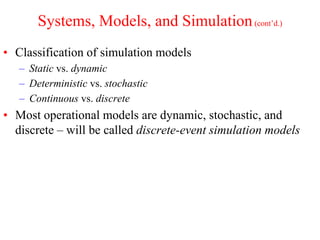
Systems, Models, and Simulation(cont’d.)
• Classification of simulation models
– Static vs. dynamic
– Deterministic vs. stochastic
– Continuous vs. discrete
• Most operational models are dynamic, stochastic, and
discrete – will be called discrete-event simulation models
Systems, Models, and Simulation(cont’d.)
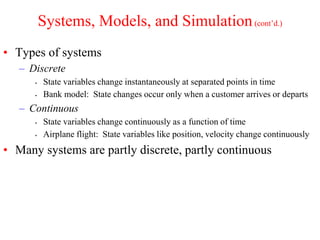
• Types of systems
– Discrete
â–Ş State variables change instantaneously at separated points in time
â–Ş Bank model: State changes occur only when a customer arrives or departs
– Continuous
â–Ş State variables change continuously as a function of time
â–Ş Airplane flight: State variables like position, velocity change continuously
• Many systems are partly discrete, partly continuous
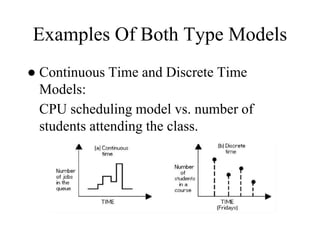
Examples Of Both Type Models
â—Ź Continuous Time and Discrete Time
Models:
CPU scheduling model vs. number of
students attending the class.
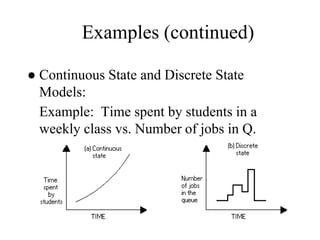
Examples (continued)
â—Ź Continuous State and Discrete State
Models:
Example: Time spent by students in a
weekly class vs. Number of jobs in Q.
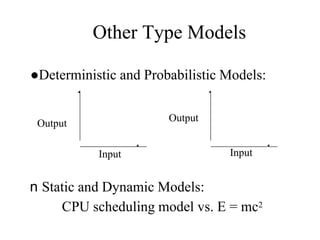
n Static and Dynamic Models:
CPU scheduling model vs. E = mc2
Other Type Models
Input
Output
Input
Output
â—ŹDeterministic and Probabilistic Models:

Basics of modeling and simulation